Was #Stonehenge a ‘Mecca on stilts’?

18 03 2015

Structure supported a wooden platform to get ‘closer to the heavens’, claims expert 

  • Historian Julian Spalding has provided a new theory on Stonehenge
  • He says the stones were pillars used to support a raised platform
  • This would have had people of importance upon it, with others below
  • A ramp or stairs would have led to the top of the platform
  • But the wood has long since rotted away, leaving only the stones behind 
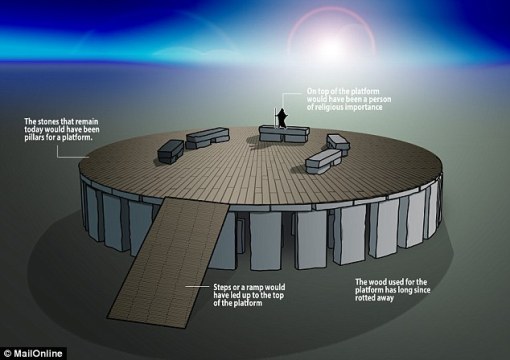
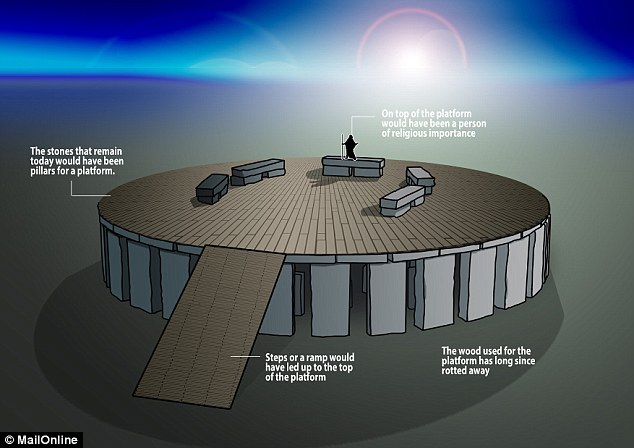
Historian Julian Spalding has provided a new theory on Stonehenge. He says the stones were pillars used to support a raised platform during ceremonies. As shown in this illustration, steps or a ramp would have led to the top of the platform, where figures of importance would have stood, perhaps addressing a crowd below.  Copyright @Daily Mail

Historian Julian Spalding has provided a new theory on Stonehenge. He says the stones were pillars used to support a raised platform during ceremonies. As shown in this illustration, steps or a ramp would have led to the top of the platform, where figures of importance would have stood, perhaps addressing a crowd below. Copyright @Daily Mail

Whether it was a Druid temple, an astronomical calendar or a centre for healing, the mystery of Stonehenge has sparked endless debate over the centuries.

Now a dramatic new theory suggests that the prehistoric stone circle monument was in fact ‘an ancient Mecca on stilts’.

The megaliths would not have been used for ceremonies at ground level, but would instead have supported a circular wooden platform on which ceremonies were performed to the rotating heavens, according to new research.

Julian Spalding, former director of some of the UK’s leading museums, argues that the stones were foundations for a vast platform, long since lost – ‘a great altar’ raised up high towards the heavens and able to take the weight of hundreds of worshippers.

‘It’s a totally different theory which has never been put forward before,’ he said.

‘All the interpretations to date could be mistaken. We’ve been looking at Stonehenge the wrong way, from the earth, which is very much a 20th-century viewpoint. We haven’t been thinking about what they were thinking about.’

Part of his evidence lies in ancient civilisations worldwide. As far afield as China, Peru and Turkey, such sacred monuments were built high up, whether on manmade or natural sites, and with circular patterns possibly linked to celestial movements.

‘In early times, no spiritual ceremonies would have been performed on the ground,’ said Mr Spalding.

The Pharaoh of Egypt and the Emperor of China were always carried – as the Pope used to be… The feet of holy people were not allowed to touch the ground. We’ve been looking at Stonehenge from a modern, earth-bound perspective.

‘All the great raised altars of the past suggest that the people who built Stonehenge would never have performed celestial ceremonies on the lowly earth… That would have been unimaginably insulting to the immortal beings, for it would have brought them down from heaven to bite the dust and tread in the dung.’

However, he says the wood that would have been used for the platform has long since rotted away, leaving only the stone pillars that support it behind.

Mr Spalding’s museum directorships include Glasgow, which boasts world-class archaeological collections within a complex of institutions that exceed the British Museum in size.

Today, he published his theories in a new book, titled Realisation: From Seeing to Understanding – The Origins of Art, published by Wilmington Square Books.

It explores our ancestors’ understanding of the world, offering new explanations of iconic works of art and monuments.

Stonehenge, built in stages between 3000 and 2000 BC, is England’s most famous prehistoric monument, a Unesco World Heritage site on Salisbury Plain in Wiltshire that draws more than one million annual visitors.

It began as a timber circle, later made permanent with massive blocks of stone, many somehow dragged from dolerite rock in the Welsh mountains.

Dolerite has a bluish tinge and is dappled with white spots that look like stars, according to Mr Spalding.

‘These megaliths, weighing between two and four tons each, were transported 250 miles [400km], an extraordinary achievement in those times, which indicates that building Stonehenge was a massive communal enterprise,’ he said.

He believes that ancient worshippers would have reached the giant altar by climbing curved wooden ramps or staircases, moving in the direction of the slowly circulating stars for ceremonies dedicated to, for example, a dead king’s soul or midsummer and solstice celebrations.

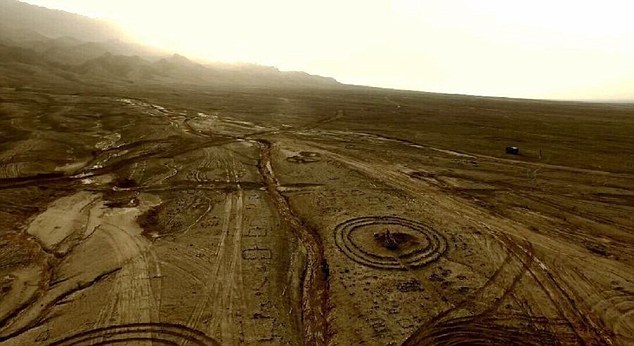
His theories have been shaped by visits to ancient sites like the stone circles of Göbekli Tepe in southern Turkey, reminiscent of Stonehenge but predating it by around 6,000 years.

Only a fraction of the site has been excavated, and the purpose of its T-shaped pillars is a mystery, Spalding said: ‘These must have supported some sort of raised platform.’

He also points to the Nazca Lines in Peru, vast drawings apparently etched into Earth’s surface more than 2,000 years ago on to a high natural plateau above the villages where they lived: ‘They went up to the sacred place. These lines were a processional way, which followed the movement and shape of the stars.

‘The great mystery of early man was that we all thought the world was flat. Everyone did until very recent times. All the major religious ceremonies, as the Haj still does in Mecca, always ends in a circular motion, going round and round, which imitates the stars.’

Professor Vincent Gaffney, principal investigator on the Stonehenge Hidden Landscapes Project at Bradford University, responded with ‘a fair degree of scepticism.’

He said: ‘At Stonehenge, there are other structures which are clearly designed to be viewed from the ground, along astronomic alignments, and you can see the sky from pretty much anywhere.’

Sir Barry Cunliffe, a prehistorian and Emeritus Professor of European Archaeology, Oxford University, said: ‘He could be right, but I know of no evidence to support it… There are a large number of stone circles around the country which clearly didn’t have a platform on top. So why should Stonehenge?’

But Aubrey Burl, an authority on prehistoric stone circles, said: ‘There could be something in it. There is a possibility, of course. Anything new and worthwhile about Stonehenge is well worth looking into, but with care and consideration.’

Mr Spalding is fully expecting resistance from fellow academics. He draws parallels with the 1868 discovery of magnificent prehistoric ceiling paintings in the Altamira Cave in Spain, by a geologist and archaeologist.

‘He went in there and looked on the ground – because he assumed all the evidence for early man would be on the ground,’ he said.

‘It never occurred to him to look up. It was his young daughter who said, papa look on the ceiling.’

Experts at the time denounced those paintings as forgeries. It was not until the end of the 19th century that they were accepted as genuine.

Read the full article (source) in the Daily Mail

Merlin at Stonehenge
The Stonehenge News Blog


Solstice celebrations at #Stonehenge: the sensible way forward.

10 03 2015

heritageaction's avatarThe Heritage Journal

Following the recent wide publicity we would like to make our position clear regarding solstice celebrations at Stonehenge:


We have no objections whatsoever to solstice celebrations at Stonehenge subject to the simple proviso that they don’t involve damage or disrespect to the monument by which we mean significant litter, urine, vomit, faeces or deliberate marks on the stones – or any climbing up or standing on them (both of which are not open for debate as they are illegal under the government regulations by which English Heritage is bound).
.
We feel those obvious parameters should have been imposed many years ago on a zero tolerance basis and we look forward to the speedy publication of measures to achieve them. We trust the reforms will be announced not debated and that they will be judged by results this summer and will be revised thereafter as necessary. To this end…

View original post 104 more words


The Stonehenge Landscape Tour, introduced by Phil Harding: CBA Members’ Event

22 02 2015

Join Time Team favourite Phil Harding and expert guide Pat Shelley for a unique exploration of the Stonehenge landscape at the exclusive Council for British Archaeology (CBA) and English Heritage (EH) members’ event on Sunday 19th April 2015.

EH-Tour

The pair will be leading a walk through some of the often-overlooked enigmatic elements of the landscape, combining rich archaeological background with personal anecdotes and replica artefacts. The walk will take around an hour and a half, and highlights will include round barrows at nearby Fargo Woods and the Cursus barrow group, before visiting the Cursus itself. The culmination of the walk will see our group descending into Stonehenge Bottom before walking up the Avenue to Stonehenge.

CBA and EH members will meet at the Stonehenge Visitor Centre where they can enjoy complimentary refreshments Phil supporting the New YAC Dolls raising money for the Young Archaeologists' Clubbefore beginning the walk at 11.30am. Participants should wear suitable clothing and footwear for the walk, and be of a reasonable level of fitness. Please note that this is a walk around the wider Stonehenge landscape putting the monument into its context, and does not include access into the stones themselves.

Tickets for this CBA and EH members’ event are just £30 per head, and can be booked now via the English Heritage events booking line on: 0370 333 1183. Proceeds from the walk will go towards supporting the work of the Young Archaeologists’ Club (YAC).

Phil Harding is best known and loved as the hat-wearing archaeologist from Channel 4’s Time Team. His expertise lies in© www.tripadvisor.com.au prehistory, and his personal experience and anecdotes – coupled with the opportunity to handle some of his beautiful handmade replica artefacts – will add a unique extra dimension to your walking tour.

Pat Shelley is an experienced independent guide, with years of experience of bringing Stonehenge and its landscape to life. Described on ‘TripAdvisor’ as “the ONLY way to see Stonehenge”, Pat is an engaging speaker who will be only to pleased to share his love of Stonehenge with you, and answer any questions that you might have.

Visit the Council for British Archaeology Website for full details.

Visit the English Heritage website if you are planning to visit Stonehenge

Stonehenge Guided Tours offer frequent tours and many also include ‘Stonehenge Inner Circle Access Tours

The Visit Wiltshire website lists local operators based in Salisbury offering Stonehenge tours

Merlin @ Stonehenge
The Stonehenge News Blog


Stonehenge Spring (Vernal) Equinox Open Access Arrangements 2015

13 02 2015

English Heritage will welcome people to Stonehenge to celebrate the Spring (Vernal) Equinox on Saturday 21st March.
Expect a short period of access, from  first light (approximately 05:45am) until 08:30am.

• Access to Stonehenge will cease at 0830h and the cooperation of all of visitors in ensuring the monument is vacated at this Stonehenge Equinoxtime would be most appreciated. Please note that, in previous years, access for the Equinox ceased earlier at 0800h, however English Heritage has permitted an additional half an hour within the monument for our visitors.

• Temporary toilets (Porta-Loos) will be available at the monument once the site is open for public access. This includes a provision for those with disabilities.

•The Cafe and Shop at the new Visitor Centre at Airmans Cross should be opening for visitors from approximately 0800h on the morning of Saturday 21st March. Please note that the toilets at this location will also become available for use at this time. Although the Cafe will be opening only hot and cold drinks will be available for the first hour. Pasties etc will become available after 0900h.
There will be no access to Stonehenge via the A344.

Accessible parking is extremely limited and is booked on a first-come-first-served basis. Please apply to lucy.barker@english-heritage.org.uk. Accessible parking opens at 5am.

English Heritage Website

Solstice Events UK are offering their usual small group tour visiing Stonehenge at sunrise on the Spring Equinox: Book here

Merlin at Stonehenge
The Stonehenge News Blog
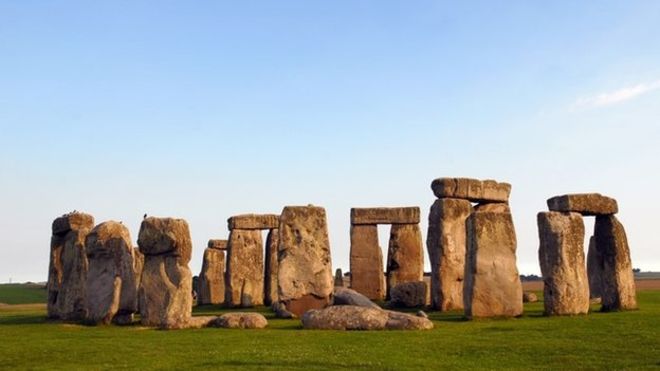


The Stones of Stonehenge. A new web site with a page devoted to each stone at Stonehenge.

11 02 2015

Strange as it may seem, there isn’t a useful reference work that shows photographs of every stone at Stonehenge from all (easily) available angles, until now.  The website is a work in progress toward that end. Not all stones currently have pages, but eventually they will have.

Stone Numbering System

The numbering system for the stones is that devised by W.M. Flinders Petrie in the late 19th century and which is still in use

Heel Stone

The HeelStone (or HeleStone or HealStone) is a natural stone that has not been worked or tooled.

by researchers and archaeologists to this day.

Petrie carried out one of the first highly (and dependably) accurate surveys of Stonehenge and decided that all previous systems of numbering the stones were inadequate in one way or another.
He resolved to number the stones in ascending order clockwise from the main axis of the monument and beginning with the sarsen immediately to the east of the axis in the outer circle as seen from the centre. This is Stone 1. All the actual and supposed positions of sarsen stones are numbered, whether or not there is a stone (or fragment of stone) at or near the position.
The horizontal lintels of the outer sarsen circle are numbered by adding 100 to the number for the higher of the two uprights that support each one. So the lintel supported by Stones 4 and 5 is numbered 105, and that supported by Stones 21 and 22 is numbered 122.
There is a single exception to this rule for the lintel spanning Stones 30 and 1 across the main entrance into the monument which is numbered 101 rather than 130. This is because the number 130 is already in use for the neighbouring lintel that is supported by Stones 29 and 30.
The bluestones of the circle within the sarsen circle are similarly numbered clockwise from the main axis beginning with Stone 31. In the case of the bluestones, Petrie did not assign numbers to the supposed positions of any that are missing.
The sarsens in the horseshoe of massive trilithons are numbered clockwise starting from Stone 51 round to Stone 60. Their respective five lintels (or “imposts” as Petrie called these huge lintels) are numbered 152, 154, 156, 158 and 160.
The bluestones of the innermost horseshoe arrangement are numbered clockwise from Stone 61.
The Altar Stone is Stone 80. The two remaining Station Stones outside the circle are numbered 91 (eastern stone) and 93 (western stone). Station Stones 92 and 94 are missing. The Slaughter Stone is Stone 95 and the Heel Stone is Stone 96.
Fragments of stones which are clearly associated with each other are given alphabetical indices, for example Stones 55a and 55b are the two parts of the broken fallen sarsen upright of the Great Trilithon.

Image credit:

Merlin @ Stonehenge
The Stonehenge News Blog


RSPB creates wildflower meadow for butterflies at Stonehenge World Heritage Site.

9 02 2015

Hundreds of wildflowers have been planted at Normanton Down on the Stonehenge World Heritage Site to help gives butterflies a home during the summer months.

Flowers such as classic chalk grassland herbs, common rockrose and wild thyme are among many more that make up the wildflower meadow that was created on four iron-age barrows across the ancient site.

The wildflowers, which were all grown from seed and collected from Salisbury Plain, will serve as a food source for the caterpillars of the iconic chalk downland butterfly and many pollinators during the summer season.

The work for the project was completed by the RSPB, who manage the Normanton Down nature reserve, which is known for its ground nesting birds and downland wildlife.

Stonehenge Flowers

Chalkhill Blue – female © Tony Davison, from the surfbirds galleries.

RSPB Site Manager, Patrick Cashman, said: “These barrows already support fragments of a once more widespread flower-rich downland landscape. We are taking this opportunity to top them up with key butterfly food plants, so their warm southern flanks can become new homes for butterflies from nearby Salisbury Plain and help provide stepping stones in the wider landscape.”

The wildflower planting was funded by the Heritage Lottery Fund as a part of ‘Save Our Magnificent Meadows’ project, which is a national partnership of 11 organisations led by Plantlife to help transform the fortunes of vanishing meadows, grasslands and wildlife.

English Heritage’s Stonehenge World Heritage Site co-ordinator, Beth Thomas, said: “We are delighted to see the historic monument being treasured for their relict ancient grassland, and having their profile raised as resource to help reconnect the natural and historic landscape.”

Through the RSPB’s Giving Nature a Home campaign, you can help tackle the housing crisis facing the UK’s threatened wildlife. The charity is asking people to provide a place for wildlife in their own gardens and outside space – whether it’s a dead wood pile for mini beats and other insects, putting up a nestbox for a house sparrow, or creating a pond that will support a number of different species.

To find out more about Giving Nature a Home and to receive a free guide packed full of simple, fun activities to help wildlife where you live, visit: rspb.org.uk/homes

Notes

1. The RSPB is the UK’s largest nature conservation charity, inspiring everyone to give nature a home. Together with our partners, we protect threatened birds and wildlife so our towns, coast and countryside will teem with life once again. We play a leading role in BirdLife International, a worldwide partnership of nature conservation organisations.

2. Giving Nature a Home is the RSPB’s latest campaign, aimed at tackling the housing crisis facing the UK’s threatened wildlife. The charity is asking people to provide a place for wildlife in their own gardens and outside spaces – whether it by planting pollen-rich plants to attract bees and butterflies, putting up a nestbox for a house sparrow, or creating a pond that will support a number of different species. The charity hopes to inspire people across the UK to create a million new homes for nature.

3. Normanton Down lies within the Stonehenge World Heritage Site, and comprises 47 ha of former arable land in the process of being reverted to species-rich chalk grassland, through a management agreement with the private owner. Reseeding of the arable land has taken place over the last three years, and the diversity of wild flowers, along with butterflies and other invertebrates, is gradually increasing. The site is also being managed to encourage breeding stone-curlews and other birds such as lapwings and corn buntings.

4. The wildflowers that are being planted on the site are; the classic chalk grassland herbs; kidney and horseshoe vetch, common rockrose, wild thyme, dropwort, harebell, small scabious and devil’s-bit scabious.

5. Iconic downland butterflies expected on the site include; chalkhill blue, adonis blue, brown argus and marsh fritillary.

Article source: http://www.surfbirds.com/community-blogs/blog/2015/02/08/rspb-creates-wildflower-meadow-for-butterflies-at-stonehenge/

The National Trust offer guided tours though the Stonehenge Landscape: http://www.nationaltrust.org.uk/stonehenge-landscape/

The Stonehenge News Blog


LECTURE: The Stonehenge Landscape – 31st January

24 01 2015

There will be a lecture by Sharon Soutar of English Heritage at Devizes Town Hall, Wiltshire, England from 2:30 pm on Saturday, 31 January 2015.  

20141227_083502With the construction of the new Visitor Centre at Airman’s Corner it was vital that Stonehenge and its surrounding landscape were re-presented with the fullest and most up-to-date information available. Fantastic as it may seem very few of the monuments, not even Stonehenge itself, had been surveyed to modern standards. To rectify this English Heritage set up a project to significantly enhance the record and understanding of all upstanding archaeological monuments within the World Heritage Site. The fieldwork was conducted between 2009 and 2012 and the book is nearing publication, while a number of research reports on the different areas are available through the website (see below).

The fieldwork covered just over 15% of the World Heritage Site in detail. It included Stonehenge, the Greater Cursus and all of the principal barrow cemeteries and incorporated sites later in date, such as the medieval settlement earthworks at Lake. English Heritage surveyed almost half of the known or suspected round barrows within the WHS; nearly all of those surviving as earthworks. At the same time colleagues looked at the historic buildings, added high resolution Ground Penetrating Radar [GPR] to complement earlier geophysical surveys and took new photography of the landscape and artefacts found within it. ~English Heritage also commissioned a laser scan of the stones and surrounding henge.

Sharon will describe some of the important discoveries resulting from the project and take a look at the more surprising aspects of the field archaeology in the Stonehenge landscape.

Sharon is a landscape archaeologist specialising in the survey and visualisation of heritage landscapes and data; from maps and site plans right through to infographics. After a number of years interpreting and mapping archaeology visible in aerial photographs and lidar data for different parts of England she was lucky enough to join the team investigating the Stonehenge WHS landscape.

The project webpage is: www.english-heritage.org.uk/professional/research/landscapes-and-areas/archaeological-field-survey-and-investigation/stonehenge-landscape/

The project monograph is due for publication in the spring of 2015:
Bowden, M.C.B., Soutar, S., Field, D.J. and Barber, M.J. forthcoming. The Stonehenge Landscape. Swindon: EH.

The 1:10,000 scale map – Stonehenge and Avebury: Exploring the World Heritage Site is available in our shop www.english-heritage.org.uk/publications/stonehenge-avebury-map

The various Research Department Reports are available through: research.english-heritage.org.uk

Booking:

Essential. To contact us, either:
* Tel: 01380 727369 to book and pay using credit/debit card (Monday to Friday 10am to 5pm preferred)
* Send an e-mail
Visit the Wiltshire Museum website: http://www.wiltshiremuseum.org.uk/events/index.php?Action=2&thID=972&prev=1

The Stonehenge News Blog


The Stonehenge Landscape

23 01 2015

The Heritage Trust's avatarThe Heritage Trust

 
Stonehenge by Henry Mark Anthony (1817-1886)
 
There will be a lecture by Sharon Soutar of English Heritage at Devizes Town Hall, Wiltshire, England from 2:30 pm on Saturday, 31 January 2015.
 
With the construction of the new Visitor Centre at Airman’s Corner it was vital that Stonehenge and its surrounding landscape were re-presented with the fullest and most up-to-date information available. Fantastic as it may seem very few of the monuments, not even Stonehenge itself, had been surveyed to modern standards. To rectify this English Heritage set up a project to significantly enhance the record and understanding of all upstanding archaeological monuments within the World Heritage Site. The fieldwork was conducted between 2009 and 2012 and the book is nearing publication, while a number of research reports on the different areas are available through the website here.
 
More here.
    

View original post


Robin Heath: Stonehenge – The Marriage of the Sun and Moon

14 01 2015

tallbloke's avatarTallbloke's Talkshop

Reblogged from Ishtar’s Gate, a blog covering diverse subjects relating to antiquity, myth, culture, legend and ancient arts. Although the idea that the Aubrey holes around the outside of the stone complex have an astronomical observation and eclipse prediction purpose has been dismissed because later cremations were found in them, their number, spacing and mathematical relationship to the station stones indicates otherwise. Ishtar’s introduction follows:

This is from the book of the same title by the highly regarded Robin Heath, and it is a deeply researched and expert interpretation of the sacred geometrical azimuths and alignments of Stonehenge.

It is well established that the axis of Stonehenge aligns approximately to the midsummer rising sun azimuth. In addition, the station stone rectangle is constructed perpendicular to the axis and has a ratio of 5:12. In Megalithic yards, this is 40:96, i.e. the units of the rectangle’s ratio are expressed in…

View original post 1,270 more words


Events at Stonehenge: Up Close

4 01 2015

Stonehenge: Up Close

Gain a rare and fascinating insight into the famous World Heritage Site with an exclusive tour around the site led by one of English Heritage’s experts. The event starts with exclusive early morning access to the stone circle at Stonehenge accompanied by our expert.

Stonehenge Landscape

Following a light breakfast, we will then go on to explore key archaeological sites including Durrington Walls, Woodhenge and The Cursus to learn more about the archaeological landscape and investigate work that has taken place in recent years.

There is plenty of walking, sometimes over uneven ground on this tour, so we have graded it as moderate access.

15th January 2015 SOLD OUT
9th February 2015 SOLD OUT
9th March 2015

Heaven and Earth Tours
Special evening bookable tour learning about the stars and planetary movements and how early man may have utilised them.

24th January 2015
21st February 2015

How to Book
Tickets are available to purchase by calling the English Heritage dedicated ticket sales team on 0370 333 1183. (Mon-Fri 8.30am – 5.30pm, Sat 9am – 5pm) Visit their website here

There are tour operators who offer special access trips and include transport from London.  Visit Wiltshire have links to local tour operators offering inner circle tours from Salisbury

Merlin at Stonehenge
The Stonehenge News Blog