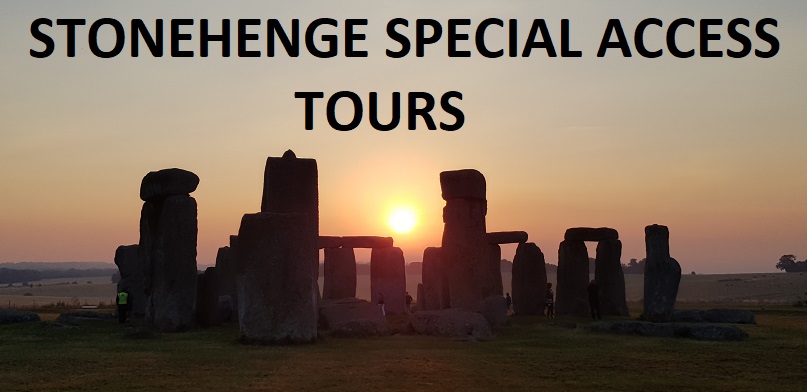
A NEW exhibition focusing on Stonehenge through the years will be opening today. #Stonehengewishyouwerehere.

1 05 2015

New ‘Stonehengiana’ exhibition created by archeologist Julian Richards displays souvenirs and other ephemera charting history of site as tourist attraction since the 19th century. It has been a place of pilgrimage for many centuries and a tourist attraction probably since Roman times.  Wish You Were Here! takes a look back at how the ‘henge was viewed by previous generations and it provides a glimpse at the iconic role it has played in popular culture.

A new Stonehenge exhibition, Wish You Were Here, reveals the site’s history as a tourist attraction since Victorian times. Photograph: English Heritage/PA

A new Stonehenge exhibition, Wish You Were Here, reveals the site’s history as a tourist attraction since Victorian times. Photograph: English Heritage/PA

From 1st May 2015 explore the ‘Wish You Were Here’ special exhibition in the Stonehenge visitor centre.  Celebrating both the changing ways in which Stonehenge has been experienced by its many visitors, and its status as a world-wide icon, through historical souvenirs, guidebooks, postcards and photographs.

The exhibition features items from the personal collection of Julian Richards and objects on loan from the Wiltshire Museum and The Salisbury Museum.

This is the latest in a regularly changing programme of special exhibitions at the Stonehenge visitor centre. Entry to the exhibition is included in the price of your ticket. Explore previous exhibitions held at Stonehenge.

Wish You Were Here opens on 1st May and runs until March 2016. Admission is included in the Stonehenge entry price.  Visitors are invited to share their experiences on social media with the hashtag #stonehengewishyouwerehere.

Links:
English Heritage. Stonehenge: Things to see and do 
From ‘druidical erection’ to Spinal Tap: a history of Stonehenge as tourist site
New exhibition focuses on Stonehenge through the years
Quirky look at Stonehenge through new Wish You Were Here exhibition

The Stonehenge News Blog


NEW THEORY: Stonehenge’s tallest stone ‘points at winter sunrise’

22 04 2015

The tallest stone at Stonehenge points towards the sunrise on the midwinter solstice, according to a new theory from an English Heritage steward.

Aerial photograph of Stonehenge
The newly observed alignment (red line) is at 80 degrees to the line of the axis of the monument (blue line)

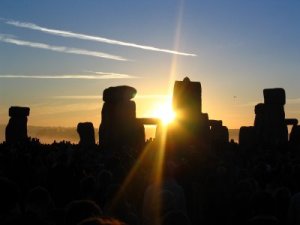
Historians have long known the circle of stones is aligned with the midsummer sunrise but Tim Daw says the tallest one is lined up with the midwinter sun.

It was previously thought the stone had been put back at the wrong angle when it was re-erected in 1901.

But Mr Daw, who works there, says his research shows its angle is deliberate.

‘Botched job’

Mr Daw said: “The largest stone at Stonehenge is not where it ‘should’ be, it is twisted.

“This stone, Stone 56, is the tallest one at the end of the inner horseshoe of sarsen stones.

“Because it was put back to the vertical in 1901 it has been assumed that the twist is the result of the modern excavators botching the job.

Drawing of Stonehenge prior to 1901
The tallest stone in the monument was straightened in 1901

“My research shows that not only was the standing stone out of symmetry with the central solstice alignment originally, but that its now fallen partner had also been, and so were surrounding stones, including the Altar Stone.”

Mr Daw, who last year came up with evidence that the outer stone circle at Stonehenge was once complete, said his newly discovered alignment was at 80 degrees to the line of the axis of the monument, which points to midsummer solstice sunrise and midwinter sunset.

‘100 tonnes of stone’

“The stones point to the midwinter solstice sunrise and midsummer sunset,” he said.

“This alignment had been missed by previous investigators… as they used an idealised plan rather than an actual plan for their calculations.”

“This isn’t some nebulous sighting line on a distant star; this is 100 tonnes of stone deliberately pointing to the major event at the other end of the day the rest of the monument celebrates.

“One stone out of line might be a coincidence but that it is five of the major stones, at least, shows it was a designed feature.

“It shows what can be discovered by simple observation even in such a well-researched site as Stonehenge.”

Stonehenge
Tim Daw said the tallest stone (centre) was positioned to align with the midwinter sunrise

Director of the Wiltshire Archaeological and Natural History Society (WANHS), David Dawson, said: “This is an interesting new idea which highlights the “skew” of the Stonehenge trilithons, which has been known for some time.

“It highlights the significance of the summer and winter solstices at Stonehenge, and the 80 degree angle between them.

“We know that the Bush Barrow lozenge, on display at the Wiltshire Museum, hints at this same significant astronomical feature.

“There will now be a debate between archaeologists and a re-examination of the evidence to test this new hypothesis.”

Jessica Trethowan from English Heritage said it was “an interesting idea”.

Mr Daw’s theory has been published in the latest WANHS magazine.

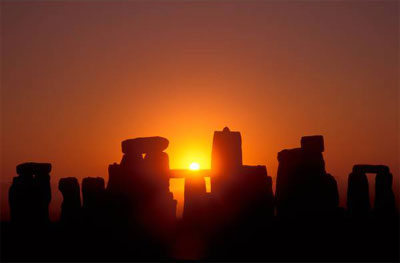
Midwinter sunrise at Stonehenge
People traditionally gather at Stonehenge for the winter and summer solstices

Read the full story on the BBC News website

The Stonehenge News Blog


Did you know today (April 18th) is World Heritage Day? Celebrate it with a visit to Stonehenge or Avebury.

18 04 2015

World Heritage is the shared wealth of humankind. Protecting and preserving this valuable asset demands the collective efforts of the international community. This special day offers an opportunity to raise the public’s awareness about the diversity of cultural heritage and the efforts that are required to protect and conserve it, as well as draw attention to its vulnerability.

On 18th April 1982 on the occasion of a symposium organised by ICOMOS in Tunisia, the holding of the “International Day WHSfor Monuments and Sites” to be celebrated simultaneously throughout the world was suggested. This project was approved by the Executive Committee who provided practical suggestions to the National Committees on how to organise this day.

The idea was also approved by the UNESCO General Conference who passed a resolution at its 22nd session in November 1983 recommending that Member States examine the possibility of declaring 18th April each year “International Monuments and Sites Day”. This has been traditionally called the World Heritage Day.

Stonehenge, Avebury and Associated Sites

Stonehenge and Avebury, in Wiltshire, are among the most famous groups of megaliths in the world. The two sanctuaries consist of circles of menhirs arranged in a pattern whose astronomical significance is still being explored. These holy places and the nearby Neolithic sites are an incomparable testimony to prehistoric times.

Stonehenge and Avebury form part of one of the UK’s UNESCO World Heritage Sites. The explanations behind why the sites are located where they are and what their exact purposes are still remain a mystery to this day.

Stonehenge

Managed by English Heritage dates back approximately 5,000 years. Evolving between 3,000 and 1,600 BC, Stonehenge is aligned with the rising and setting of the sun at the solstices. The summer solstice in June often attracts up to 20,000 visitors to view the sunrise. When visiting Stonehenge pick up one of their audio guides (available in different languages) giving details of the history and legends behind the site. For a more intimate experience there’s an inner circle tour which takes place before and after the site is open to the general public (pre-booking is essential) or view tour companies who offer general and inner circle visits to the stones.

Around the Stonehenge landscape there are other sites of notable importance including Durrington Walls, the largest henge monument in Britain and Woodhenge, a Neolithic monument dating from around 2,300 BC.

Avebury

The largest stone circle in the World, Avebury was erected around 4,500 years ago and consists of around 100 stones. Many of the stones were re-erected by Alexander Keiller in the 1930s.

The Alexander Keiller Museum in the village holds many of the archaeological finds that Keiller discovered during the excavations of Avebury during this time and the history of the excavations. Today Avebury is managed by the National Trust.

The site is open daily (due to its village location) and visitors can not only explore the stone circle but also the Avenue, the West Kennett Long Barrow and can look over at Silbury Hill – the largest man-made hill in Europe. Similarly to Stonehenge, Avebury is also plays host to both Winter and Summer Solstices.

In 2012, Avebury Manor opened its doors following the BBC TV programme ‘The Manor Reborn’ which also saw the kitchen garden transformed into a working Victorian kitchen garden.

See objects excavated from the World Heritage Site at Salisbury Museum and the new prehistory displays at Wiltshire Museum in Devizes. Salisbury Museum has recently reopened its Wessex Gallery. The Wiltshire Museum in Devizes has new displays featuring gold from the Time of Stonehenge, including Britain’s richest Bronze Age burial.
Visit Wiltshire Website

“Celebrate it with a visit to Stonehenge or Avebury and observe a minute of silence for the ones we have lost to insensitive developments”

The Stonehenge News Blog


Discover the Hidden History and Ancient Mysteries that lie within the World Heritage Site. 2015 National Trust Events

12 04 2015

Discover the hidden history and ancient mysteries that lie within the World Heritage Site on a National Trust event National Trust Eventsthis year.

Walk with an archaeologist: the Stonehenge landscape

Join Neolithic expert and National Trust archaeologist Dr. Nick Snashall on this half day exploration of the Stonehenge landscape and find out about the latest exciting discoveries. We’ll be walking around four miles.

18th April 2015 – Visit the National Trust website

Discover Durrington Walls

Ever wondered where the builders of Stonehenge lived? Join our landscape guides to explore the secrets of Durrington Walls – once home to the builders of Stonehenge – and discover 6,000 years of hidden history (2.5 – 3 mile walk).

25th April 2015 – Visit the National Trust website

Archaeology Walk 

Explore the wider Stonehenge World Heritage landscape with a guide discovering hidden histories and ancient mysteries.

6 May 2015 2:00pm –  – Visit the National Trust website

Wings over Stonehenge 

Walk in the slipstream of the early pioneer military aviators at Larkhill. See where the Bristol Boxkite made its first flight in 1910 and where the first British military aeroplane unit was formed..

20 May and 6th June 2015 2:00pm –  – Visit the National Trust website

Discover Durrington Walls 
Ever wondered where the builders of Stonehenge lived? Join our landscape guides to explore the secrets of Durrington Walls – once home to the builders of Stonehenge – and discover 6,000 years of..

10 June 2015 1:30pm – Visit the National Trust website

Booking Essential 0844 249 1895
A 5% booking fee applies. Phone lines are open Mon to Fri 9am-5.30pm, plus Sat and Sun 9am-4pm.Booking Fee Applies

The Stonehenge News Blog


Great News for Tour Operators as New Stonehenge Coach Park Plans are Approved.

12 04 2015

StonehengeNews's avatarStonehenge and Salisbury Guided Tours

 26-space coach park is set to be built at Stonehenge and will operate for two years, councillors in Wiltshire have agreed.

A temporary coach park will be built near to Stonehenge, Wiltshire Council has agreed A temporary coach park will be built near to Stonehenge, Wiltshire Council has agreed

English Heritage will convert farmland next to the existing coach park and will include walkways for pedestrians.

Concerns had been raised over increased traffic, landscape impact and what would happen after the two-year period.

Wiltshire Council’s conditions include ensuring the land can easily be returned to its original state.

Last month, the council rejected plans to resurface an overflow car park on the grounds of visual impact on the landscape.

More than 1.3 million people have visited the prehistoric monument since the opening of a new visitor centre in December 2013.

Seven councillors approved the vote, with three against and one abstaining

Full story on the BBC news website

The Stonehenge Travel Company
Guided Tours…

View original post 4 more words


End of the line for the Stonehenge land trains?

8 04 2015

The Heritage Trust's avatarThe Heritage Trust


One of the five Stonehenge land trains
©
The Heritage Trust
 
All five of the so called land trains that convey sightseers from the Stonehenge Visitor Centre to the monument itself were withdrawn last week just days before thousands of people were expected to visit the monument over the Easter break. Each train carries about 45 people and is pulled along by a single Land Rover. There have been concerns expressed in the past that there was not enough turning room at the Visitor Centre for the land trains to easily manoeuvre in and also that they would be unable to cope with thousands of sightseers during peak periods. Sightseers are now being transported to the monument by a fleet of buses.
 
According to Historic England (formerly English Heritage), “They [the land trains] have all gone for the moment. They went about a week ago. We do not know when…

View original post 120 more words


Stone circles dating from the Bronze Age discovered in China’s Gobi Desert

30 03 2015

The Heritage Trust's avatarThe Heritage Trust


Stone circles in the Gobi Desert. The largest circle in this image is known as the Sun Circle
 
Sarah Griffiths, for the MailOnline, reports on the stone structures discovered in China’s Gobi Desert in 2003 –
 
Known as the ‘strange stone circles’ by locals in Turpan, the formations vary in size and shape with one intricate example resembling the sun. The circles are located in the Flaming Mountain in Turpan, north west China and cover more than two-and-a-half square miles (6.6 square km).
 
Dr Volker Heyd, an archaeologist at the University of Bristol, believes …the first of these Gobi stone structures might date back as early as the Bronze Age. This could make them up to 4,500 years old. Although the more complex formations are likely ‘younger and could have been constructed until the Medieval period.’
 
Full article here.
 

View original post


First Day of spring: Stonehenge crowd gathers for Equinox sunrise

22 03 2015

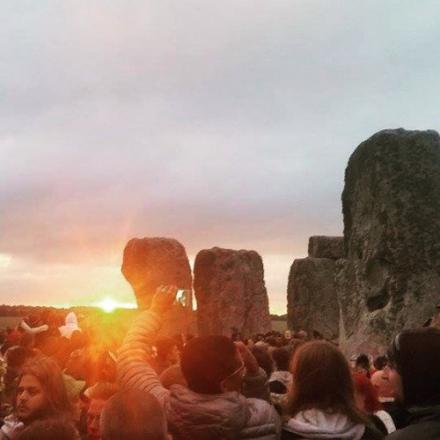
The first day of spring has been marked by more than 800 revellers who gathered at Stonehenge to watch the sunrise.

Stonehenge-Spring-Equinox-2015 (54)

Despite a cloudy forecast, @St0nehenge tweeted the gathering had been “blessed with a perfect sunrise”

Druids and pagans were joined by a mass of revellers at the ancient monument to celebrate the spring or vernal equinox.

Open access to the stones was given from first light, 05:45 GMT, by English Heritage which manages the site.

Senior druid King Arthur Pendragon, who performed the sunrise ceremony, said: “We’re lucky, we used to get 200 people but now it’s up to nearly 1,000.”

Despite a cloudy forecast, @St0nehenge tweeted that the gathering had been “blessed with a perfect sunrise”.

“A lot of people are coming out to sacred places to celebrate the turning of the wheel, which is what paganism is about,” said Mr Pendragon.

“We don’t worship nature, we worship the divine through nature and so we worship at the times of the year when it’s auspicious – spring, summer, autumn and winter.”

English Heritage opens the ancient stone circle for the spring equinox as well as the winter and summer solstice

Full article (source) and more images at the BBC website: (Nice to see the BBC’s reference to our twitter account)

Follow us here for all the latest / ongoing Stonehenge news: https://twitter.com/ST0NEHENGE

There are many some fantastic images on the Stonehenge Stone Circle Flickr page

Merlin at Stonehenge
The Stonehenge News Blog


Happy Spring Equinox to all our readers

20 03 2015


Friday will see a rare cosmic coincidence. Was Stonehenge used to predict eclipses?

19 03 2015

As the eclipse plunges Wiltshire and other places into darkness this Friday (March 20th), two other rare if less spectacular celestial events will be taking place, too: the Spring equinox and a Supermoon. Friday will see three rare celestial events and this will be the first time in living memory that the Spring equinox, a solar eclipse, and a supermoon are all taking place on the same day in the UK.

One of the most intriguing mysteries in the world is the Stonehenge. Nobody knows who built the mysterious Stone Circle in Wiltshire, or what its purpose was exactly. There are many theories associated with Stonehenge and archaeologists have been debating for ages to determine why it was built. Most experts believe that Stonehenge is actually an ancient astronomical calculator.

Eclipses have long been feared as bad omens, but the equinox is celebrated as a time of renewal

Eclipses have long been feared as bad omens, but the equinox is celebrated as a time of renewal

Eclipse Cycles

Now, it’s widely accepted that Stonehenge was used to predict eclipses. The inner “horseshoe” of 19 stones at the very heart of Stonehenge actually acted as a long-term calculator that could predict lunar eclipses. By moving one of Stonehenge’s markers along the 30 markers of the outer circle, it’s discovered that the cycle of the moon can be predicted. Moving this marker one lunar month at a time – as opposed to one lunar day the others were moved – made it possible for them to mark when a lunar eclipse was going to occur in the typical 47-month lunar eclipse cycle. The marker would go around the circle 38 times and halfway through its next circle, on the 47th full moon, a lunar eclipse would occur.

Aubrey Holes
Stonehenge has a ring of 56 pits that are now known as Aubrey holes, after antiquarian John Aubrey. They date back to the late fourth and early fifth millennium. These holes were not really noticed until the 1920s. It’s believed that the only standing feature at Stonehenge at the time these holes were dug was the Heel Stone – the marker of the midsummer sunrise – but this is now proven false. Some experts believe they were meant to hold timbers or more stones, but the astronomical interpretations of these holes are very interesting. It’s also believed that the holes helped to predict astronomical events. Complicated math theories back this up to some degree, as some lunar eclipses can be predicted by using numbers associated with Stonehenge. It’s even believed that Stonehenge was used to keep track of lunar cycles by moving marker stones two holes per day, ending with 56 holes.

Hawkins
Meanwhile, Gerald Hawkins studied Stonehenge much later, in 1965, using computer programs. He found multiple solar and lunar alignments that correlated with the location

of Stonehenge. He set his data so that the positions of the stars and planets would match where they were in 1500 B.C., when he believed it was built, and found that 13 solar correlations and 11 lunar correlations matched up with the megalithic stages. In other words, he believed Stonehenge was used to predict astronomical events. He also believed that it was built to align with the position of the summer and winter solstices.

What is a solar eclipse?
A solar eclipse happens when the moon passes between the sun and the earth, hiding the sun from view and blocking out the sunlight that usually reaches us.

The eclipse, which will be partial, not total, will begin here at around 8.45am on Friday and peak at around 9.30am before ending at 10.30am. It will be the biggest eclipse since August 1999.

Spring equinox

The equinox will also happen on March 20th. While it won’t have any discernable, direct impact on how the solar eclipse looks, it will contribute to a rare collision of three unusual celestial events.

On March 20th, the Earth’s axis will be perpindecular to the sun’s rays — which only happens twice a year, at the two equinoxes. After that, it will start tipping over, making the days longer in the northern hemisphere.

As such, the equinox has long been celebrated as a time of beginning and renewal, by a number of historic cultures, and is linked to Easter and Passover.

The equinox will happen at the same time as a solar eclipse in 2053 and 2072, though it doesn’t always appear as close together as that.

English Heritage will welcome people to Stonehenge to celebrate the Spring (Vernal) Equinox on Saturday 21st March. Expect a short period of access, from first light (approximately 05:45am) until 08:30am. Click here for more info

Supermoon

A very rare supermoon eclipse of the sun is happening this week that won’t take place again until 2034.  A supermoon is when a full, or new moon coincides with the night when the earth and moon’s orbits move them slightly closer together, making the moon look about 14% bigger, and 30% brighter than normal. This generally happens roughly once every 14 months, but can happen more often; in January 2014, there were actually two supermoons in a single month.

In the past, groups have argued that the supermoon could cause natural disasters, madness, or even throw the earth off its axis. Experts agree that the worst thing that might happen is the tide comes in another inch that night.  As well as a supermoon, there is also an event when a full moon is as far away from earth as possible; this is called a micromoon, for obvious reasons.

Some useful Links:

Solar eclipse, Supermoon, Spring equinox:

Solar Eclipse, Supermoon, Spring Equinox: 3 Rare Celestial Events Align March 20th

Solar Eclipse 2015: How to watch a solar eclipse safely

Stonehenge: An Astronomical Calculator

Astro-Archaeology at Stonehenge

Remember that no one should look directly at the sun during a partial eclipse without proper equipment, as it can damage the eyes.

Merlin at Stonehenge
The Stonehenge News Blog
Follow us on Twitter for Stonehenge updates