Thousands gathered at Stonehenge to celebrate the winter solstice

22 12 2016

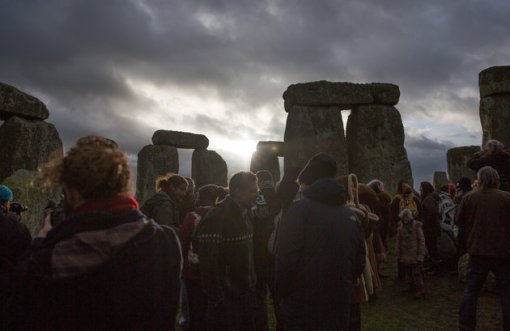
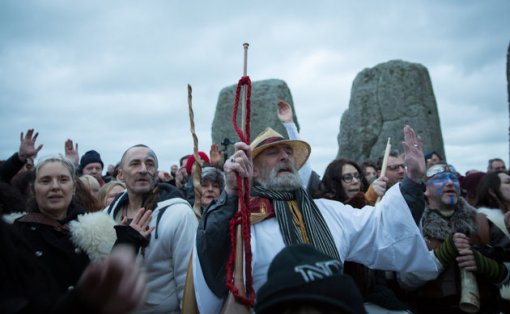
Thousands of people gathered at Stonehenge to celebrate the winter solstice.

solstice2016

Stonehenge was built over 5,000 thousands years ago and remains a place of spiritual significance for many. Credit: PA

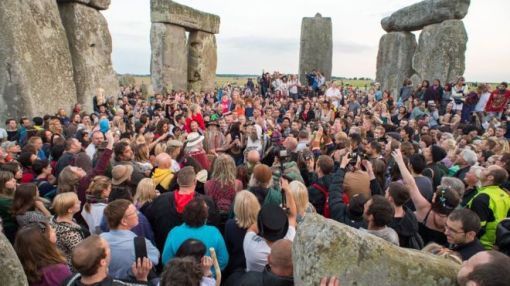
Druids and pagans were among the crowd that watched the sun come up at 8.13am on the shortest day of the year.

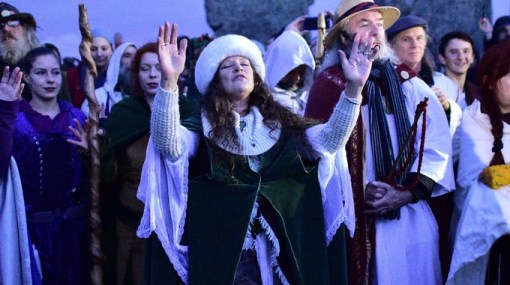
People, some dressed in traditional pagan clothing, danced, played musical instruments and kissed the ancient stones.

One South African woman said she had made the trip to the UK “especially for the solstice”.

She said: “I am a Pagan, a witch and this is about the best place to be.”

Kate Davies from English Heritage, who manage the prehistoric monument in Wiltshire, said: “We were delighted to welcome approximately 5,000 people to Stonehenge to celebrate winter solstice this morning.

It was a very enjoyable and peaceful celebration and the ancient stone circle was filled with the sound of drumming and chanting.”

There will be just seven hours, 49 minutes and 41 seconds of daylight on 21 December, almost nine hours less than the year’s longest day in June.

Stonehenge was built over 5,000 thousands years ago and remains a place of spiritual significance for many people.

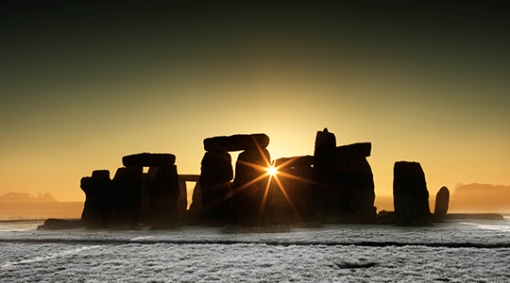
Crowds gather at the UNESCO World Heritage Site on the shortest and longest days of the year as the stones are aligned to the sunset of the winter solstice and the opposing sunrise of the summer solstice.

Some experts believe the winter solstice was more important to our ancient ancestors than the summer solstice as the longest night marked a turning of the year as the days begin to grow longer.

Article source: ITV NEWS

The Stonehenge News Blog
Follow us on Twitter and Facebook for all the latest Stonehenge News and Stories


A Happy Winter Solstice to you all. Time to celebrate! It’s the shortest day of the year!

20 12 2016

happy-winter-solstice

The Pagan celebration of Winter Solstice (also known as Yule) is one of the oldest winter celebrations in the world.

The Winter Solstice falls on the shortest day of the year (21st December) and was celebrated in Britain long before the arrival of Christianity. The Druids (Celtic priests) would cut the mistletoe that grew on the oak tree and give it as a blessing. Oaks were seen as sacred and the winter fruit of the mistletoe was a symbol of life in the dark winter months.

It was also the Druids who began the tradition of the yule log. The Celts thought that the sun stood still for twelve days in the middle of winter and during this time a log was lit to conquer the darkness, banish evil spirits and bring luck for the coming year.

Many of these customs are still followed today. They have been incorporated into the Christian and secular celebrations of Christmas.

Stonehenge is an ancient pre-historic site. It has been a place of worship and celebration at the time of the Winter Solstice since time immemorial. Respect the Stones and each other!

Time to celebrate! It’s the shortest day of the year!

happy-solstoce-3

Image courtesy of Astrocal Calendars 

SOLSTICE LINKS:
Stonehenge Winter Solstice Cards: Astrocal and Solstice Calendars
Stonehenge Winter Solstice Open Access Arrangements
Please visit the official English Heritage website for full details and respect the terms of entry.

Please respect the Stones and each other! 

The Stonehenge News Blog
Follow us on Twitter and Facebook for all the latest Stonehenge news and Winter Solstice updates.  Watch the live Winter Solstice broadcast on Periscope


Why Thousands Of Pagans Gather At Stonehenge For The Winter Solstice

17 12 2016

The prehistoric site holds spiritual significance for many Pagans and Druids.

While some are buying presents and trimming their tree for Christmas, a very different kind of spiritual celebration gets underway every year at Stonehenge. It’s the winter solstice, also known as Yule in some Pagan circles, and the occasion draws thousands of Pagans, Druids, spiritual seekers and tourists to the prehistoric site for a reverent and ecstatic ceremony.

solstice-inner

The sun peeks through clouds during a winter solstice ceremony at the ancient neolithic monument of Stonehenge near on December, 2015. MATT CARDY VIA GETTY IMAGES

The December solstice marks the longest night and shortest day of the year in the Northern Hemisphere, and this year it falls on Wednesday, December 21 at 5:44 EST.

In ancient Pagan traditions, the winter solstice was a time to honor the cycles of life and death and celebrate the sun’s rebirth as the days would slowly begin to lengthen in the months leading into spring. Many modern practitioners of Pagan and earth-centered spiritual traditions observe the holiday, and at Stonehenge, the celebration is particularly special.

Stonehenge, which celebrates its 30th year as a World Heritage site this year, is believed to be roughly 4,500 years old. Its significance as a link to British prehistory has drawn countless visitors over the years who come to gaze upon what’s considered to be the most architecturally advanced, prehistoric stone circle on the globe.

Apart from its architectural significance, Stonehenge holds a place of sacred importance to many. Much of its history is still shrouded in mystery, though one thing that’s sure is that it was built upon a landscape that had long been used for religious purposes. The stones that make up the massive circle are thought to have been collected from distant places, some as far as 150 miles away, and brought to this particular location. They were then erected using sophisticated, interlocking joints ― but how exactly the builders accomplished these feats is unclear.

It’s also unclear what exact purpose the site served to those who built it. English Heritage, a UK-based charity, notes that speculations on Stonehenge’s original function include “a coronation place for Danish kings, a Druid temple, an astronomical computer for predicting eclipses and solar events, a place where ancestors were worshipped or a cult centre for healing.”

rolo-solstice

Rollo Maughfling, Archdruid of Stonehenge & Britain, conducts a winter solstice ceremony at Stonehenge on December 22, 2015 in Wiltshire, England. MATT CARDY VIA GETTY IMAGES

Whatever its intended purpose, Stonehenge remains a place of wonder for thousands who visit the awe-inspiring structure every year. And its significance is especially potent at the winter solstice.

“One of the most important and well-known features of Stonehenge is its alignment on the midwinter sunset-midsummer sunrise solstitial axis,” a spokesman for England Heritage told BBC. “The midwinter sun sets between the two upright stones of the great trilithon.”

In other words, on the two annual solstices ― summer and winter ― the sun respectively rises and sets in perfect alignment with the site’s massive stones.

To witness the astronomical event, visitors typically arrive early in the morning on the day of the solstice to watch the sunrise and stay through to the sunset. Local Druids host a ceremony during the day, as revelers and tourists alike bask in Stonehenge’s ancient atmosphere.

“What we’re really here for is to celebrate the fact that the cycle of the world turns, and from now on the days get longer and it’s the return of the sun,” Druid leader and activist King Arthur Pendragon told BBC at the Stonehenge winter solstice celebration in 2014. “It’s a time of change and hope is renewed ― the same message really from a pagan perspective as from a Christian perspective. That’s what this season is all about ― a message of hope.”

Article source: Antonia Blumberg  Associate Religion Editor, The Huffington Post

Stonehenge Winter Solstice Open Access Arrangements

Please visit the official English Heritage website for full details.

Solstice Events are offering their usual  Stonehenge Winter Solstice guided tour from London and Bath.


The Stonehenge News Blog
Follow us on Twitter and Facebook for all the latest Stonehenge news and Winter Solstice updates.  Watch the live Winter Solstice broadcast on Periscope


Winter Solstice Celebrations at Stonehenge: 21st December 2016

1 12 2016

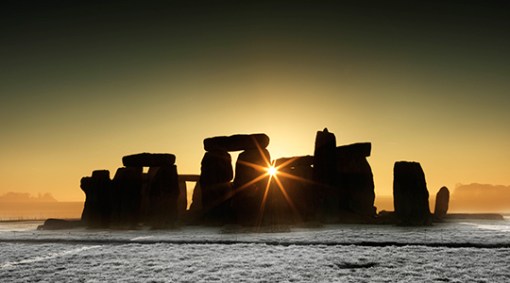
English Heritage will once again welcome people to Stonehenge to celebrate the Winter Solstice. Sunrise is just after 8am on Wednesday 21st December and visitors will be able to access the monument as soon as it is light enough to do so safely. Please read the information below before planning your visit.

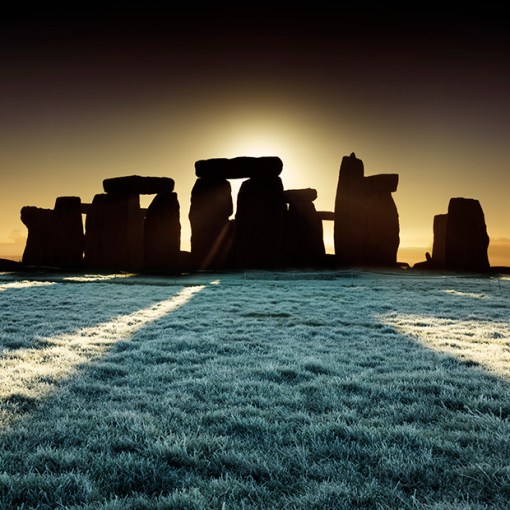
frosty-sunrise-henge

PRACTICAL INFORMATION:

DATE AND TIMINGS
WEDNESDAY 21st DECEMBER 2016
MONUMENT FIELD OPENS: 07.45am (approximately, depending on light levels)
MONUMENT FIELD CLOSES: 10am

Please note, access to Stonehenge for Winter Solstice is free. Parking charges apply.

GETTING HERE:

Parking for Winter Solstice is very limited and we cannot guarantee that you will be able to park near to Stonehenge. If you are planning to travel by car, wherever you park there may be a 30 minute walk to the Monument. We strongly recommend car sharing or using public transport.

Car Sharing – Request or offer a lift to Solstice at Stonehenge

Travel by busSalisbury Reds buses will be running from 06:30 from Salisbury (New Canal, Stop U and Salisbury Rail Station). Check timetable.

Blue Badge Parking – Blue badge parking is in the visitor centre car park and permits must be booked in advance. There is accessible transport to the monument field from the visitor centre beginning at approximately 6.30am. Permits available from Solstice.Stonehenge@english-heritage.org.uk

Parking and parking charges Limited parking is available in the winter solstice car parks, which will open at 5.30am on the 21st December.

As you approach Stonehenge, there will be signs to direct you to the car park – please ensure that you follow these. Please do not arrive early as there is no waiting on the roads in the area and you will be moved on.

Parking may involve a shuttle journey to the visitor centre and wherever you park there may be a 30 minute walk.

  • Cars, private hire minibuses and live-in vehicles £5
  • Motorbikes £2
  • Commercial coaches £50

The car parking charge is designed to encourage people to car share and will help the charity offset  the costs of providing additional staffing and lighting in the car parks.

Please note, car parking charges apply to all users of the Winter Solstice car parks, including Blue Badge holders, and members of English Heritage and National Trust.

Motorists have access to a park and ride shuttle from the off-site solstice car parking to the visitor centre. A shuttle will also be provided between the visitor centre and Stonehenge, however visitors are asked to note that disabled people have priority on this bus and should therefore be prepared for a 30 minute walk, in low light, from parking areas to the monument.

We cannot guarantee entry to the car parks and recommend coming by public transport as cars will be turned away when the car parks are full.

CONDITIONS OF ENTRY

Access to Stonehenge for solstice is subject to the Conditions of Entry – please read these before deciding whether to attend.

COME PREPARED

Stonehenge is in a field on Salisbury Plain and the weather in December will be cold and may be wet and windy. Even if it isn’t raining, the ground will be wet from the dew. There may also be frost.

Please be prepared for a 30 minute walk (in low light or darkness), from the bus drop off and from parking areas to the monument. You are strongly advised to wear warm and waterproof clothing and footwear and bring a torch with you.

Toilets at the Monument Field will only be available once the access period begins. There are no catering facilities in the monument field, however the café at the visitor centre is open for hot drinks and breakfast rolls from 6am.

Please note that there are no other amenities or facilities available to visitors until the Monument Field opens.

Please visit the official English Heritage website for full details.

Solstice Events are offering their usual small group Winter Solstice guided tour from London and Bath, ideal if you do not have your own transport and want to learn more about the history and  mystery of Stonehenge and the surrounding landscape. Visit their website to book.

The Stonehenge News Blog
Follow us on Twitter and Facebook for all the latest Stonehenge news and Winter Solstice updates.  Watch the live Winter Solstice broadcast on Periscope 


Amesbury to Stonehenge Solstice Lantern Parade 2016

30 11 2016

The annual lantern parade is back again this year on the 20th December 2016 starting at the Amesbury History Centre 4:45pm.

As usual the route will take the procession through the beautiful grounds of the Amesbury Abbey where we will stop for mince pies and mulled wine before making our way to the ancient spring where the solstice lantern will be waiting for us and our resident druid Frank Somners will perform a service.

amesburylantern-1

Amesbury Lantern Procession along the original “Avenue”

The fading solstice light at Stonehenge is taken and put into the solstice lantern which is kept alight all night to light the darkest night and then taken back to the stones the next morning to extinguish. This is a tradition that started a few years ago and has grown in popularity year on year.

Come and join us and our ancestors in celebrating the solstice. Lanterns are available from the History Centre for £3.50 each and there will be an afternoon of lantern decorating in the centre on the 20th until 3:30pm

Visit their website for more details

The Stonehenge News Blog
Follow us on Twitter and Facebook  and for all the latest Stonehenge news and Winter Solstice updates.


Stonehenge Winter Solstice 2016: Travel Trade News

26 11 2016

Arrangements for Groups on Tuesday 20th and Wednesday 21st December

Stonehenge closes to visitors at the usual time of 5pm on Tuesday 20th December ahead of the annual Winter Solstice celebrations on the morning of Wednesday 21st December.

stonehengewinter

The last timed-ticket admission for pre-booked groups is the usual time of 3pm, providing a 2-hour window for groups arriving at this time to view the monument and enjoy the exhibition and other facilities in the visitor centre.

All coaches and minibuses and their passengers must be off-site by 5pm as usual.

Stonehenge re-opens to visitors from 11.30am on Wednesday 21 December.

Coach Parking for Winter Solstice 2016

Parking for coaches and minibuses bringing visitors for the Winter Solstice will cost £50 per vehicle and is provided from 6am until 10am in the Stonehenge Coach Park.

Coach and minibus parking for Winter Solstice is limited and tour operators and group travel organisers should contact the Stonehenge Bookings Team from today to book coach or minibus parking. Booking is essential.

There will be a number of temporary road closures in the local area. There will be no access to Byway 12 throughout the Winter Solstice access period.

Further Information for Winter Solstice

Access to Stonehenge for solstice is subject to the Conditions of Entry which we would ask tour operators, group leaders and drivers to ensure their group members are aware of and adhere to.

Stonehenge is in a field in the middle of Salisbury Plain and the weather in December will be cold and wet. Even if it isn’t raining, the ground will be wet from the dew. There may also be frost. Sensible footwear and warm, waterproof clothing are essential.

There is at least a 30 minute walk (in low light or darkness), from the coach park to the monument. Visitors are therefore strongly advised to wear strong, waterproof footwear and bring a torch with you.

Toilets at the monument field will only be available once the access period begins. There are no catering facilities in the monument field, however the café at the visitor centre is open for hot drinks and breakfast rolls from 6am.

On Wednesday 21 December, sunrise is at 8.09am.

The monument field will open at approximately 7.45am, depending on light levels and will close at 10am.

Stonehenge re-opens to day visitors from 11.30am on Wednesday 21st December.

Please visit the official English Heritage website for more details

Solstice Events are offering their usual small group Winter Solstice guided tour from London and Bath, ideal if you do not have your own transport. Visit their website

The Stonehenge News Blog
Follow us on Twitter , Facebook  and Periscope broadcast for all the latest Stonehenge news and Winter Solstice updates.


Solar Astronomy at Stonehenge

4 11 2016

Most people are aware that Stonehenge is somehow aligned to the annual movements of the Sun.

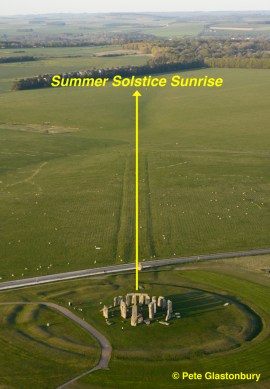
Each year thousands of pilgrims, druids and party-goers gather in celebration, hoping to Stonehenge Avenue.jpgwitness the most famous of these – the Summer Solstice Sunrise on June 21st.

At this time of year, as seen from the centre of the monument, the Sun rises in the same direction as the centre-line of the Avenue – the ancient processional approach to Stonehenge – towards the northeast.

The Stonehenge Avenue alignment was first pointed out by William Stukeley in 1740.

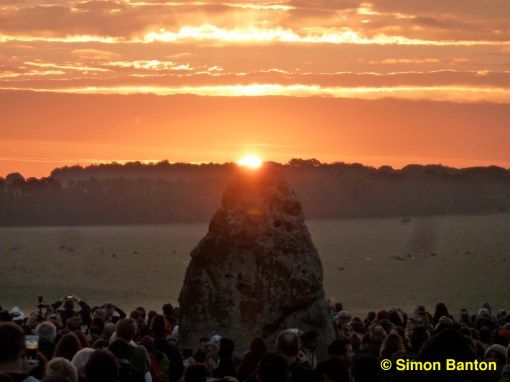
Even though almost everyone believes the Heel Stone was put up by the builders to exactly mark the summer solstice sunrise position, this can’t be true because it stands off to the right hand side of the alignment.

Today the Sun seems to rise out of the top of the Heel Stone due to the modern trees that are on the horizon.

heel-stone-sunrise

Walking up the Avenue they would have seen the Sun setting exactly into the middle of the stones between the uprights of the tallest trilithon in the southwest. We can still experience this today, even though only one upright of that trilithon – Stone 56, the tallest stone on the site – remains in place.

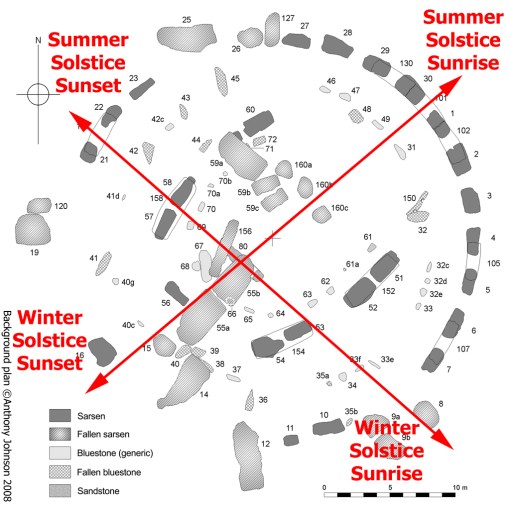
There’s a secondary alignment too – from Winter Solstice Sunrise to Summer Solstice Sunset.

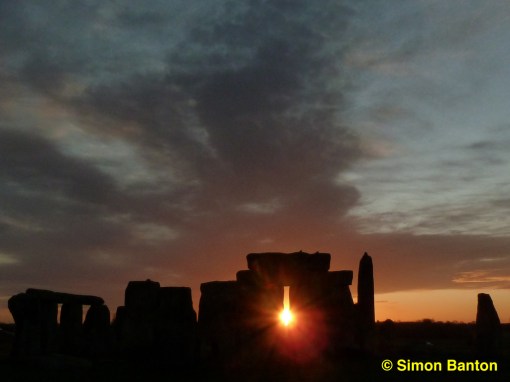
This was first described by Prof. Gordon Freeman in 1997 and it makes use of a “notch” in the edge of Stone 58 of the western trilithon to give a clear sightline across the stone circle.

Viewed through this notch, Winter Solstice Sunrise is seen over Coneybury Hill to the southeast…

winter-solstice-sunrise

If they weren’t there, sunrise would be almost a Sun’s width to the left – and 4,500 years ago the Sun would have risen a whole degree further over to the left.

Even though the Heel Stone wasn’t intended as the solstice sunrise marker, the sight is still magnificent – when the weather cooperates.

Along the same alignment, but exactly in the opposite direction, lies the Winter Solstice Sunset point.

… and Summer Solstice Sunset is seen over Fargo Wood to the northwest.

What’s remarkable about these alignments through the circle is that they intersect over the centre of the Altar Stone (shown as Stone 80 in the plan below). The Altar Stone is not perpendicular to the main alignment but is offset so that it lies exactly along the secondary one.

image description

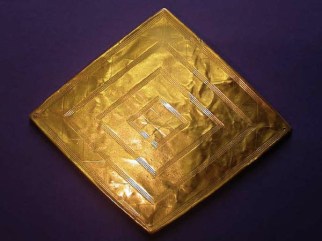
The intersection angle of 80° between summer and winter solstice sunrises at this latitude is echoed in the large gold lozenge discovered in 1808 when the Bronze Age “shamanic” burial from Bush Barrow, just south of Stonehenge, was excavated.

The intersection angle of 80° between summer and winter solstice sunrises at this latitude is echoed in the large gold lozenge discovered in 1808 when the Bronze Age “shamanic” burial from Bush Barrow, just south of Stonehenge, was excavated.bush-barrow-lozenge
Some see this as coincidence. Others believe the lozenge shows that the knowledge of this important astronomical angle was passed down the generations for at least 600 years.

The lozenge and the other astonishing Bush Barrow finds are on display at Wiltshire Museum in Devizes.

There are Stonehenge lunar alignments too, but that will be the subject of a different article.

Article by guest blogger and local Stonehenge historian Simon Banton

The Stonehenge News Blog
Follow us on Twitter and Facebook for all the latest Stonehenge news and discoveries


Why did the builders of Stonehenge choose Salisbury Plain?

23 10 2016

One of the most frequently asked questions about Stonehenge is “Why is it where it is?” and there are several possible explanations for this. They’re described below but it’s important to understand that combinations of these are also possible – there may not be just one single reason.

The location isn’t at all the obvious choice because it’s not at the top of the slope, which rises further towards the west. However, if you analyse the terrain you realise that it’s ideally positioned to give medium to long distance views to the northeast, southeast, southwest and northwest over a horizon that is relatively flat in profile.

In fact, the horizon is less than 1° in elevation in all directions.
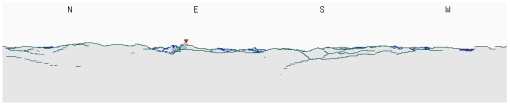
Salisbury Plain

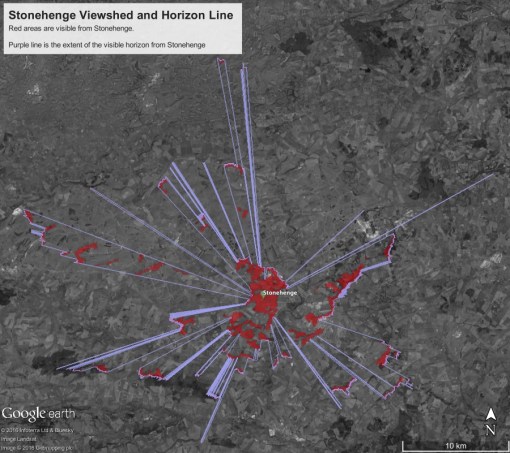
Archaeologists believe that there were only isolated stands of trees in the Salisbury Plain landscape at the time Stonehenge was built, far fewer than are evident today, so the far-reaching views that are hidden today by modern plantations wouldn’t have been obscured.
viewshed-and-horizon

In the Google Earth image the areas coloured red are directly visible from Stonehenge while the purple line shows the extent of the visible horizon (without trees in the way).

So why not build it further up the westerly slope and achieve even further-reaching views? To do so would be to lose some of the flatness of the horizon in key directions. As it is, Stonehenge appears to be in the centre of a bowl of visibility where the directions to the important astronomical events of summer and winter solstice sunrise and sunset are clear and level.

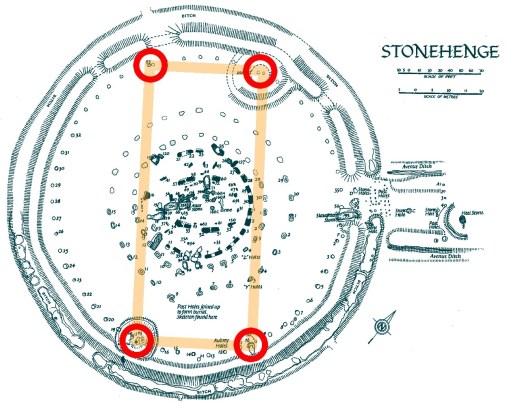
The second theory relates to the Station Stone Rectangle. Originally there were four Station Stones situated just inside the henge bank. Only two remain in place, the positions of the others (whose stoneholes have been detected) are known.

The short sides of this rectangle are parallel to the main alignment at Stonehenge – winter solstice sunset to summer solstice sunrise. In 1966, C.A. “Peter” Newham pointed out in an article in
station-stone-rectangle

Nature that the long sides of the rectangle are aligned on the extreme moonrise and moonset positions, in a cycle that takes 18.6 years to complete.

It’s a feature of the astronomical geometry that only at the latitude of Stonehenge (give or take 30 miles) that these solar and lunar alignments occur at right angles to each other. Further north or south than that limit and the Station Stone Rectangle would become a parallelogram.

The third possibility concerns the Heel Stone and the Avenue. The Heel Stone is an unshaped sarsen boulder weighing in at over 35 tons that is positioned to the northeast of Stonehenge at the top of the ceremonial approach way called the Avenue. It is traditionally associated with marking the position of sunrise on the summer solstice as seen from the centre of the circle.

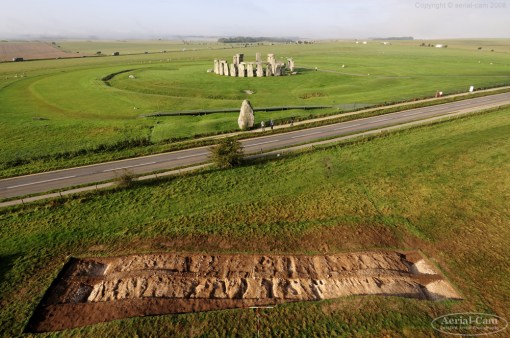
During excavations by the Stonehenge Riverside Project in the mid-2000s, a series of features were discovered at the top of the Avenue which have been identified as “periglacial stripes”. These cracks and runnels in the underlying chalk where water has repeatedly frozen and thawed happen to run exactly along the main solstice alignment down the slope to the northeast beyond the Heel Stone.
periglacial

The SRP team suggest that these features would have been visible as parallel lines in the grass leading towards the Heel Stone. They go on to suggest that since the Heel Stone is unshaped, it may always have been lying in the landscape very close to where it has been set upright.

They conclude that a series of noticeable stripes in the grass leading up a slope towards a massive rock exactly in the direction of the winter solstice sunset may be the reason why this spot was regarded as a special place, worthy of memorialising.

Fourthly, there’s the theory that the combination of Bluestones from Wales with Sarsens from the more local area represents the symbolic political unification of two different groups of people at this spot on the borderland between their separate spheres of influence.

We do know that the area has been a focus of activity for more than 10,000 years going right back to the end of the last Ice Age in Britain, as shown by the recent discoveries at Blick Mead in Amesbury, and there are the massive Mesolithic post holes in the landscape only a couple of hundred metres northwest of Stonehenge.

Perhaps we’re looking at the continuation of a specialness that was handed down across the generations, with each successive group embellishing the stories and the monumentalisation a little for itself until finally we end up with a Visitor Centre that receives over a million people a year.

Ultimately though, the reasons for the choice of this location will remain one of the more puzzling Stonehenge mysteries.
Article by guest blogger and local Stonehenge historian Simon Banton

Salisbury Plain links:
Salisbury Plain Safaris offers a unique look at the dramatic landscapes, rich history and picturesque villages surrounding Salisbury, Stonehenge and the surrounding villages.
Stonehenge Guided Tours offer unique guided tours of the Stonehenge landscape and Salisbury Plain
Stonehenge ATV. This is what you have been looking for – the ultimate two seater buggy Salisbury Plain experience.
Visit Wiltshire.  Looking for more information on the famous Salisbury plain?…If so, click here to get the latest information direct from the official Wiltshire tourism site!

The Stonehenge News Blog
Follow us on Twitter and Facebook for all the latest Stonehenge news and discoveries

Alcohol ban and car parking charges proposed at Stonehenge solstice

6 02 2016

Revellers at Stonehenge could face a ban on alcohol and parking charges at this year’s solstice celebrations.

bbc-solstice

English Heritage wants to “reduce risk to the monument” by banning alcohol during the summer solstice celebrations (GETTY IMAGE)

English Heritage, which manages the ancient site, wants to introduce “significant changes” in response to “repeated and consistent” feedback.

Stonehenge manager Kate Davies, said an alcohol ban would “help everyone to have a better experience of solstice”.

But senior druid, King Arthur Pendragon, said English Heritage was “looking for confrontation”.

In December, large crowds gathered at the ancient monument in Wiltshire to watch the sunrise and mark the winter solstice.

And an estimated 23,000 people descended on the site to celebrate the summer solstice last June.

Despite it being illegal to damage the monument, last year the Heritage Journal wanted revellers banned from getting close to the stones in a bid to prevent the “annual vandalism”.

At the time, English Heritage claimed “deliberate damage” was “not characteristic of solstice celebrations” but now it wants to introduce changes “to reduce risk to the monument”.

“Over the past few years, we have had lots of feedback from those attending the solstice celebrations, from families with young children to those for whom the stones holds a special spiritual significance,” said Ms Davies.

“Having reflected on what they are telling us, we are now proposing two changes which will help us to better look after those attending and the monument itself.”

‘Sanitising the event’

Along with banning alcohol at Summer solstice, the organisation said it will also be “consulting with partners” on parking charges at both the winter and summer celebrations.

But Mr Pendragon said the charge was a “Pay to Pray policy” and he will fight the “total ban on alcohol”.

“It’s a celebration – not to be sanitized. It does not matter how they dress it up, we will not Pay to Pray,” he said.

“This isn’t just about money it’s about sanitizing the event. How long before it’s ticket only and book on-line like their [English Heritage] regular daily access?.”

Full Story on the BBC news website

Read the reaction from local Druid, Arthure Pendragon:

‘Pay for pray’ accusation after plans to charge for solstice parking at Stonehenge and ban alcohol

Follow us on Twitter and Facebook for results and daily Stonehenge updates
The Stonehenge News Blog


WINTER SOLSTICE AT STONEHENGE 2015

29 11 2015

English Heritage will once again welcome people to Stonehenge to celebrate the Winter Solstice. Sunrise is just after 8am on Tuesday 22nd December and visitors will be able to access the monument as soon as it is light enough to do so safely.

frosty-sunrise

Why 22nd December? 

Many people – not least diary manufacturers – believe that the Winter Solstice always falls on 21st December. But the celebration of Winter Solstice at Stonehenge is not fixed to a specifiic date – this is because of a mismatch between the calendar year and the solar year.

MANAGED OPEN ACCESS PRACTICAL INFORMATION

Please read and respect the Conditions of Entry for Winter Solstice 2015 and the English Heritage website.

Public Transport is being provided by Salisbury Reds buses and will be running from 06:00 from Salisbury.  Stonehenge Guided Tours are offering their usual transport with expert guide service from London and Bath. Booking essential (click here to book direct)

Please be aware that parking is very limited. There is a thirty minute walk, depending on where you are parked, in low light or darkness, from the parking areas to the monument. You are therefore strongly advised to bring a torch with you for personal use.

Accessibility – parking provision for people with disabilities

A limited number of permits will be avaialable for blue badge disabled parking and there will be dedicated accessible transport to the stone circle – which will begin just prior to the opening of the monument field. Please apply to Sandra.Ross@english-heritage.org.uk

Please note that there are no other amenities or facilities available to visitors until such time as  commences.

Conditions of Entry

Please read and respect the Conditions of Entry.

Stonehenge Audio Tour: Free Download from English Heritage

Follow Stonehenge and English Heritage on Twitter for Stonehenge Solstice news and updates

The Stonehenge News Blog