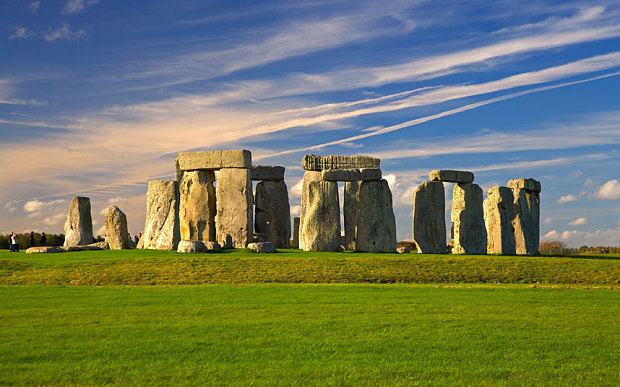
Stonehenge may have been first erected in Wales, ‘amazing’ finds suggest

7 12 2015

‘Evidence that bluestones were quarried in Wales 500 years before they were put up in Wiltshire prompts theory that Stonehenge is ‘second-hand monument’

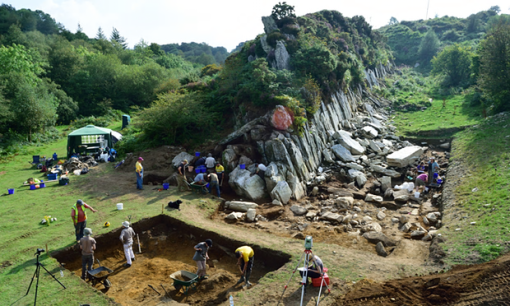
Archaeologists at one of the Stonehenge quarry sites in Wales. Photograph: UCL

Archaeologists at one of the Stonehenge quarry sites in Wales. Photograph: UCL

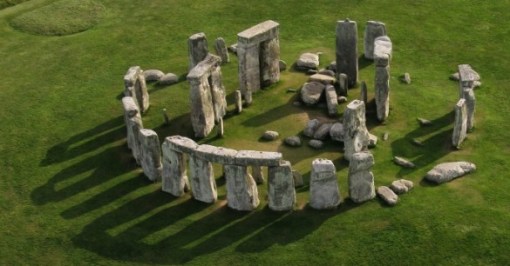
Evidence of quarrying for Stonehenge’s bluestones is among the dramatic discoveries leading archaeologists to theorise that England’s greatest prehistoric monument may have first been erected in Wales.

It has long been known that the bluestones that form Stonehenge’s inner horseshoe came from the Preseli hills in Pembrokeshire, around 140 miles from Salisbury Plain.

Now archaeologists have discovered a series of recesses in the rocky outcrops of Carn Goedog and Craig Rhos-y-felin, to the north of those hills, that match Stonehenge’s bluestones in size and shape. They have also found similar stones that the prehistoric builders extracted but left behind, and “a loading bay” from where the huge stones could be dragged away.

Carbonised hazelnut shells and charcoal from the quarry workers’ campfires have been radiocarbon-dated to reveal when the stones would have been extracted.

Prof Mike Parker Pearson, director of the project and professor of British later prehistory at University College London (UCL), said the finds were “amazing”.

“We have dates of around 3400 BC for Craig Rhos-y-felin and 3200 BC for Carn Goedog, which is intriguing because the bluestones didn’t get put up at Stonehenge until around 2900 BC,” he said. “It could have taken those Neolithic stone-draggers nearly 500 years to get them to Stonehenge, but that’s pretty improbable in my view. It’s more likely that the stones were first used in a local monument, somewhere near the quarries, that was then dismantled and dragged off to Wiltshire.”

The dating evidence suggests that Stonehenge could be older than previously thought, Parker Pearson said. “But we think it’s more likely that they were building their own monument [in Wales], that somewhere near the quarries there is the first Stonehenge and that what we’re seeing at Stonehenge is a second-hand monument.”

There is also the possibility that the stones were taken to Salisbury Plain around 3200 BC and that the giant sarsens – silicified sandstone found within 20 miles of the site – were added much later. “Normally we don’t get to make that many fantastic discoveries in our lives,” Parker Pearson said. “But this is one.”

Parker Pearson heads a project involving specialists from UCL and the universities of Manchester, Bournemouth and Southampton, among others. Their findings are published on Monday in the journal Antiquity alongside a new book by the Council for British Archaeology titled Stonehenge: Making Sense of a Prehistoric Mystery.

Prof Kate Welham, of Bournemouth University, said the ruins of a dismantled monument were likely to lie between the two megalith quarries. “We’ve been conducting geophysical surveys, trial excavations and aerial photographic analysis throughout the area and we think we have the most likely spot. The results are very promising. We may find something big in 2016,” she said.

The long-distance transport of the bluestones from Wales to Stonehenge is one of the most remarkable achievements of Neolithic societies. The archaeologists estimate that each of the 80 monoliths weighed less than two tons and that people or oxen could have dragged them on wooden sledges sliding on rail-like timbers.

Parker Pearson said people in Madagascar and other societies were known to have moved such standing stones long distances and that doing so created a spectacle that brought together communities from afar.

“One of the latest theories is that Stonehenge is a monument of unification, bringing together people from across the many parts of Britain,” he said.

He recalled the moment he looked up the near-vertical rock-face and realised that this was one of the quarries. “Three metres above us were the bases of these monoliths that were actually sitting there ready simply to be lowered out of their recesses,” he said.
“It’s the Ikea of Neolithic monument building. The nice thing about these particular outcrops is that the rock has formed 480 million years ago as pillars. So prehistoric people don’t have to go in there and bash away … All they have to do is get wedges into the cracks. You wet the wedge, it swells and the stone pops off the rock.”

 Article source:  (Guardian News)
The Stonehenge News Blog


WINTER SOLSTICE AT STONEHENGE 2015

29 11 2015

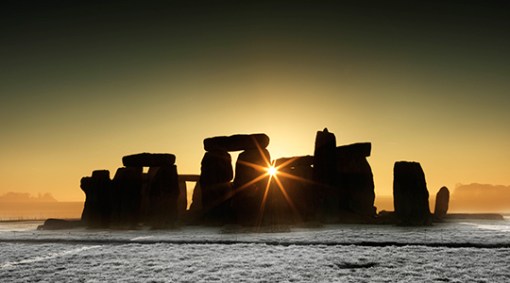
English Heritage will once again welcome people to Stonehenge to celebrate the Winter Solstice. Sunrise is just after 8am on Tuesday 22nd December and visitors will be able to access the monument as soon as it is light enough to do so safely.

frosty-sunrise

Why 22nd December? 

Many people – not least diary manufacturers – believe that the Winter Solstice always falls on 21st December. But the celebration of Winter Solstice at Stonehenge is not fixed to a specifiic date – this is because of a mismatch between the calendar year and the solar year.

MANAGED OPEN ACCESS PRACTICAL INFORMATION

Please read and respect the Conditions of Entry for Winter Solstice 2015 and the English Heritage website.

Public Transport is being provided by Salisbury Reds buses and will be running from 06:00 from Salisbury.  Stonehenge Guided Tours are offering their usual transport with expert guide service from London and Bath. Booking essential (click here to book direct)

Please be aware that parking is very limited. There is a thirty minute walk, depending on where you are parked, in low light or darkness, from the parking areas to the monument. You are therefore strongly advised to bring a torch with you for personal use.

Accessibility – parking provision for people with disabilities

A limited number of permits will be avaialable for blue badge disabled parking and there will be dedicated accessible transport to the stone circle – which will begin just prior to the opening of the monument field. Please apply to Sandra.Ross@english-heritage.org.uk

Please note that there are no other amenities or facilities available to visitors until such time as  commences.

Conditions of Entry

Please read and respect the Conditions of Entry.

Stonehenge Audio Tour: Free Download from English Heritage

Follow Stonehenge and English Heritage on Twitter for Stonehenge Solstice news and updates

The Stonehenge News Blog


The Stones of Stonehenge. A new web site with a page devoted to each stone at Stonehenge.

11 02 2015

Strange as it may seem, there isn’t a useful reference work that shows photographs of every stone at Stonehenge from all (easily) available angles, until now.  The website is a work in progress toward that end. Not all stones currently have pages, but eventually they will have.

Stone Numbering System

The numbering system for the stones is that devised by W.M. Flinders Petrie in the late 19th century and which is still in use

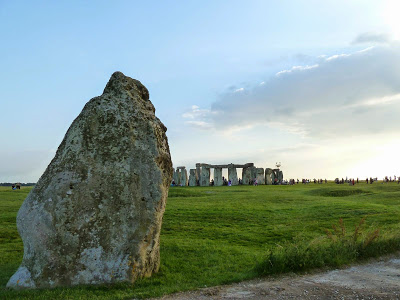
Heel Stone

The HeelStone (or HeleStone or HealStone) is a natural stone that has not been worked or tooled.

by researchers and archaeologists to this day.

Petrie carried out one of the first highly (and dependably) accurate surveys of Stonehenge and decided that all previous systems of numbering the stones were inadequate in one way or another.
He resolved to number the stones in ascending order clockwise from the main axis of the monument and beginning with the sarsen immediately to the east of the axis in the outer circle as seen from the centre. This is Stone 1. All the actual and supposed positions of sarsen stones are numbered, whether or not there is a stone (or fragment of stone) at or near the position.
The horizontal lintels of the outer sarsen circle are numbered by adding 100 to the number for the higher of the two uprights that support each one. So the lintel supported by Stones 4 and 5 is numbered 105, and that supported by Stones 21 and 22 is numbered 122.
There is a single exception to this rule for the lintel spanning Stones 30 and 1 across the main entrance into the monument which is numbered 101 rather than 130. This is because the number 130 is already in use for the neighbouring lintel that is supported by Stones 29 and 30.
The bluestones of the circle within the sarsen circle are similarly numbered clockwise from the main axis beginning with Stone 31. In the case of the bluestones, Petrie did not assign numbers to the supposed positions of any that are missing.
The sarsens in the horseshoe of massive trilithons are numbered clockwise starting from Stone 51 round to Stone 60. Their respective five lintels (or “imposts” as Petrie called these huge lintels) are numbered 152, 154, 156, 158 and 160.
The bluestones of the innermost horseshoe arrangement are numbered clockwise from Stone 61.
The Altar Stone is Stone 80. The two remaining Station Stones outside the circle are numbered 91 (eastern stone) and 93 (western stone). Station Stones 92 and 94 are missing. The Slaughter Stone is Stone 95 and the Heel Stone is Stone 96.
Fragments of stones which are clearly associated with each other are given alphabetical indices, for example Stones 55a and 55b are the two parts of the broken fallen sarsen upright of the Great Trilithon.

Image credit:

Merlin @ Stonehenge
The Stonehenge News Blog


Stonehenge new theory: music to their ears.

30 10 2014

A new theory has been put forward for why Stonehenge was created. Steven Waller, an American researcher, believes that its primary purposes was not visual, but aural: along with Neolithic cave paintings, it was designed for its acoustic properties, in this case the interference the stones would cause to the volume of the music.

Steven Waller, an American researcher, believes that Stonehenge's primary purpose was not visual, but aural: that it was designed for its acoustic properties Photo: Alamy

Steven Waller, an American researcher, believes that Stonehenge’s primary purpose was not visual, but aural: that it was designed for its acoustic properties Photo: Alamy

We have another theory, however. It is that Stonehenge was in fact built by ancient practical jokers, for no better reason than to drive future experts to distraction. One can picture them giggling to themselves as they laid false trails, safe in the knowledge that they would provide fodder for endless wild hypotheses about their true motives. Granted, it seems like a lot of bother to go to. But the fact that we are still trying to solve their riddles, thousands of years later, suggests it was worth the effort.

By : Link Source

The Stonehenge News Blog
All the lastest Stonehenge news on Twitter: https://twitter.com/ST0NEHENGE


Halloween History, Pagan Beginnings and Stonehenge Sacrifices

28 10 2014

Halloween is a day of tricks, treat, sweets, pumpkin carving, cider drinking and costume wearing; but the holiday has evolved immensely from its pagan beginnings.

Human Sacrifice at Stonehenge by ancient and modern pagans?

It has never been proven that there were human sacrifices by Celtic peoples to celebrate Samhain (sow-en). However, we do know that the Celtic peoples had a great spiritual reverence of Samhain and it was akin to how one views Easter and many of the other “holy days” today.Stonehenge sacrifice

Stonehenge is a well guarded public monument. Hundreds of Thousands of people visit this incredible site yearly. I have no doubt that it would be impossible to sacrifice anyone or anything at this monument without being caught. Besides, in the last 30 years, I have never heard of any sacrifice being committed at Stonehenge during Halloween, or anytime..

Samhain marks the beginning of the Celtic New Year and the beginning of the agricultural year.  The Celtic peoples

Stonehenge Pumpkin

Tweet us your Stonehenge / Druid / Pagan pumpkin carvings
https://twitter.com/ST0NEHENGE
#StonehengePumpkin

believed that the veil between the world of the living and that of the dead is at its thinnest on this night. In the ancient past, it was commonly believed that certain kinds of knowledge were available at the time of Samhain, a night when the sidhe or faery people would come forth to walk amongst mankind.

Over 2000 years ago, the Celts, a people who lived in what is now the United Kingdom, Ireland, and northern France, celebrated their New Year on November 1st. The New Year was associated with the end of summer and harvest season, and the beginning of cold, destructive winters. The Celts would often kill and eat weak livestock that they believed would not survive through the winter.

The Celts, who worshiped Pagan gods, commemorated this time with a festival called Samhain (sow-en). This time of year was associated with death for the Celts; they believed that the wall between the living and dead was thinnest the night before the New Year, which allowed spirits of all kinds to walk among the living.

Many of today’s Halloween traditions derive from the Pagan practices of the Celts. During their last night of the year, all manner of order was forgotten. Men would dress up as women, and women as men; people would play pranks such as moving livestock to different fields, or moving gates and fences from their proper places.

Since they believed that spirits of the recently deceased were most likely to emerge and cause trouble among the living, such as possessing people and ruining crops, many Celts would leave offerings of food and drink to the spirits, to either aid them to the afterlife, or ward them way. They would also feast and celebrate the lives of the deceased. People extinguished all of the fires in their homes in order to prevent evil spirits from haunting them.

A central aspect of Samhain was the worship by the Druids, or Celtic priests. The Celts brought crops and livestock to the priests who would sacrifice to the Pagan gods in large bonfires, praying for protection during the winter. During these celebrations, Celtics would dress in animal heads and skins and read each other’s fortunes.

One of the main influences of modern day trick-or-treating was the Celtic believe that faeries would roam about dressed as beggars and would go door to door asking for food. The belief was that those who helped the faeries were rewarded while those who didn’t were punished.

Ancient Celtic celebrations

Not only did the Celts believe the boundary between the worlds of the living and the dead dissolved on this night, they thought that the presence of the spirits helped their priests to make predictions about the future.

To celebrate Samhain the Druids built huge sacred bonfires. People brought harvest food and sacrificed animals to share a communal dinner in celebration of the festival.

During the celebration the Celts wore costumes – usually animal heads and skins. They would also try and tell each other’s fortunes.

After the festival they re-lit the fires in their homes from the sacred bonfire to help protect them, as well as keep them warm during the winter months.

Visit Stonehenge at Half Term
Stonehenge makes a great family day out during half term. Stonehenge now has a transformed visitor experience, with a new world-class visitor centre, housing museum-quality permanent and special exhibitions, plus a spacious shop and café.
Visit their website here

Other Spooky events at English Heritage properties

Visit Wiltshire Website for local spooky events
With many a historic building to be seen, it’s no surprise that Wiltshire has its own share of ghosts and spooky goings on. Halloween in Wiltshire can be a lot of fun with some exciting events including Ghost Walks run by the Salisbury City Guides as part of their Spooky Salisbury event, Halloween activities at Longleat with ghost tours, a pumpkin trail and fireworks set to spine-chilling tunes and a Halloween ghost train on the Swindon & Cricklade Railway

Link resources:
http://www.huffingtonpost.com/2014/10/24/halloween-witch-costumes_n_5965920.html
Links: http://www.ibtimes.com/halloween-history-pagan-beginnings-856991
Link: http://www.bbc.co.uk/religion/religions/paganism/holydays/samhain.shtml
Link: http://clonehenge.com/tag/stonehenge-pumpkin/

Merlin says “Tweet us your Stonehenge / Druid / Pagan pumpkin carvings”
https://twitter.com/ST0NEHENGE
#StonehengePumpkin

Stonehenge News Blog


Tunneling the A303 at Stonehenge is the sensible option – John Glen

29 04 2014

Salisbury’s MP says he’ll keep pushing for traffic problems on the A303 next to Stonehenge to be sorted out once and for all.

John Glen’s told Spire FM that there’s only one logical solution:

“There will be enormous battles between environmentalists, locals who want a Article imagesolution to the issue and the National trust who are the land owner around Stonehenge, and a Tunnel will be the safest option to please everyone.”
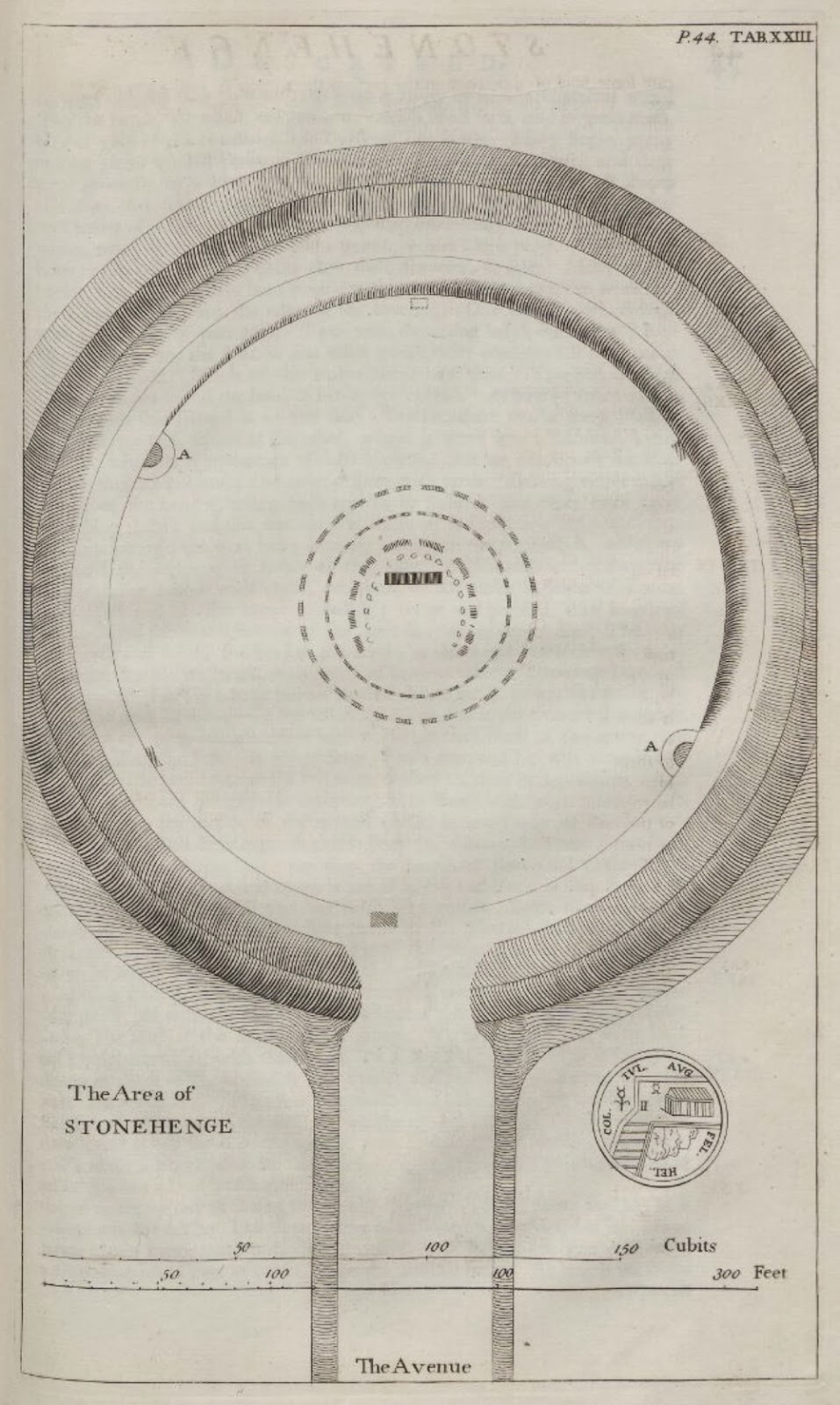
The Government’s now started a new feasibility study to look into the possible options and are due to make an announcement in the Autumn.

Mr Glen has a message for the Government as they look into what happens next:

“If I was a transport minister, and I wanted to improve transportation links to the South West; which have been particularly important given what we’ve seen happen over this last winter, then I would need to be pretty sure that any measures I put in place, would avoid there being a bottleneck at Stonehenge.”

Meanwhile, ideas to tunnel part of the A303 past Stonehenge have been described as ‘jumping the gun’ by the Campaign to Protect Rural England (CPRE).

Kate Fielden from the Wiltshire branch of the CPRE is also secretary of the Stonehenge Alliance – she says there are mixed views on the issue at the moment:

“At the present time, the Stonehenge Alliance feels that there is insufficient evidence to show that it would be justified. I do know though, and the CPRE recognises, that there are problems at Stonehenge, especially at weekends and at holiday times. That’s becoming intolerable really for local people.”

Kate also says the local habitat is key and therefore a tunnel could work:

“It’s difficult when you live close by something to stand back and realise that this whole site is something that is considered internationally to be of the highest significance. I think we have to take the bull by the horns and do a proper job if that is the job that has to be done. It would be completely unthinkable to dual that road on the surface.”

Link sourc: http://www.spirefm.co.uk/news/local-news/1268711/tunneling-the-a303-at-stonehenge-is-the-sensible-option—john-glen/

Stonehenge News Blog


Stonehenge Vernal (Spring) Equinox 2014

19 03 2014

An equinox occurs twice a year (around 20th March and 22nd September), when the tilt of the Earth’s axis is inclined neither away from nor towards the Sun, the center of the Sun being in the same plane as the Earth’s equator. The exact time of the Equinox this year is March 20th at 16:57 GMT

The name “equinox” is derived from the Latin aequus (equal) and nox (night), because around the equinox, the night and day have approximately equal length.

The ‘Managed Open Access’ at Stonehenge for the Vernal (Spring) Equinox, will be from approximately 05.45 am until 08.30 on 20th March 2014.Stonehenge Equinox Druids

Parking will be limited and cars will have to be moved by 9:00 am.

• Access to Stonehenge for the Spring Equinox will take place on the morning of 20 March 2014.

• Entrance to the monument will commence as soon as ‘light-levels’ are deemed safe enough to permit. For the past couple of years this has occurred around 0545h however EH would ask that people are patient should the morning prove ‘overcast’ and a slight delay occurs.

• Access to Stonehenge will cease at 0830h and the cooperation of all of visitors in ensuring the monument is vacated at this time would be most appreciated. Please note that, in previous years, access for the Equinox ceased earlier at 0800h, however English Heritage has permitted an additional half an hour within the monument for our visitors.

• Temporary toilets (Porta-Loos) will be available at the monument once the site is open for public access. This includes a provision for those with disabilities.

•The Cafe and Shop at the new Visitor Centre at Airmans Cross should be opening for visitors from approximately 0800h on the morning of 20 March. Please note that the toilets at this location will also become available for use at this time. Although the Cafe will be opening only hot and cold drinks will be available for the first hour. Pasties etc will become available after 0900h.

Link source: http://www.sarsen.org/2014/03/spring-or-vernal-equinox-stonehenge-2014.html
Link: http://www.thewhitegoddess.co.uk/the_wheel_of_the_year/solstice_and_equinox_dates_2010_to_2020.asp

Follow Stonehenge Stone Circle on Twitter for live pictures from the Stones: https://twitter.com/ST0NEHENGE
Follow English Heritage on Twitter: https://twitter.com/eh_stonehenge

Have fun and respect the Stones!

Merlin at Stonehenge
Stonehenge Stone Circle Blog


18th Century William Stukeley book on Stonehenge is now online.

3 02 2014

In 1740, British vicar William Stukeley published Stonehenge, A Temple Restor’d to the British Druids.

In more than 30 illustrations, Stukeley’s book documents the way Stonehenge appeared when he visited it in the early 18th century. The historian was only the 1-stukely-stonehengesecond scholarly investigator (after the 17th-century antiquarian John Aubrey) to take an interest in the site, and the first to publish a comprehensive account of what he found on his visits,  including images of the way that the monument looked in context of the  surrounding farmland.

In maps and vistas, Stukeley tried to capture the layout of the  monument’s stones. Much of his sense of urgency in the task came from  his belief that the stones’ arrangement needed preservation, as the  monument was under constant threat of vandalism and interference. For  example, Aubrey found and documented 20 stones in one area of the monument; a century later, Stukeley found only five remaining.

Stonehenge Visitor Centre: English Heritage current ‘Set in Stone’ exhibition includes an oil portrait of William Stukeley: http://www.english-heritage.org.uk/daysout/properties/stonehenge/discover/set-in-stone-exhibition

Link: http://tywkiwdbi.blogspot.co.uk/2014/01/1740-book-on-stonehenge-now-online.html
Stonehenge area news on twitter: https://twitter.com/ST0NEHENGE

The Stonehenge News Blog
Sponsored by ‘Stonehenge Guided Tours’ www.StonehengeTours.com


The Path to Stonehenge from Avebury: Walking Guide

24 11 2013

Wiltshire is home to arguably the greatest concentration of prehistoric monuments in Europe, if not the world!

The 45 mile route begins at Windmill Hill before heading south to spend the first day walking amongst the stone circles of Avebury.

                Stonehenge walking map                   

DOWNLOAD: The Path to Stonehenge walking guide (PDF 883kb)

The download includes full day by day walking instructions with accompanying history guide.

Discover how the famous monuments of the area are connected and what they can tell us about life, and death, in Neolithic Britain. The walk takes us across some of the most beautiful landscape in the south west, as we uncover the actions of our ancestors here between 4000 and 2000BC.

Day 1


Avebury Stone Circle
                Avebury Stone Circle                   

A gentle first day with plenty of time for admiring the monuments encountered along the route.

  • Windmill Hill to Avebury via Avebury Stone Circle and the Sanctuary

Distance: 6.5 miles

Day 2


                West Kennet Long Barrow                   

We up the pace as we hunt for hard evidence of our elusive ancestors at Silbury Hill and the West Kennet Long Barrow. We skirt the Marlborough Downs and head up and over Milk Hill for some more modern mysteries, like crop circles.

  • Avebury to Honeystreet, via Silbury Hill, Swallowhead Springs, West Kennet Long Barrow, Field of Sarsen Stones, Milk Hill and the Alton Barnes White Horse, and Adam’s Grave.

Distance: 15.5 miles

Day 3


The Avenue
                The Avenue                   

We follow our ancestors down the River Avon to the greatest prehistoric monument of them all – Stonehenge.

  • Honeystreet to Stonehenge via: Durrington Walls, West Amesbury Henge and the Avenue

Distance: 23.5 miles


The Map

OS Explorer Maps 157, 130 (1:25k) or OS Landranger 173, 184 (1:50k)

All distances are approximate so allow plenty of time

Link: http://www.channel4.com/programmes/walking-through-history/articles/all/walking-guide-the-path-to-stonehenge

Please share your Stonehenge / Avebury pics on Twitter: https://twitter.com/ST0NEHENGE

Merlin @ Stonehenge
The Stonehenge News Blog


Golden age: Ancient possessions of Stonehenge worshippers go on display

14 10 2013

Golden treasures from prehistoric Britain’s Stonehenge era, most of which have never previously been on public display, are today being unveiled at a small provincial museum.

Copyright: David Keys

Copyright: David Keys

The exhibition is the largest collection of early Bronze-Age gold ever put on public display in England.

It was impossible to exhibit most of the gold treasures before because of security concerns. Up until now the closest the public got to them was by seeing photographs.

Housed in a new, high-security and humidity-controlled series of galleries inside the Wiltshire Museum in Devizes, 15 miles north of Stonehenge, the gold treasures and other objects are being used to reveal the remarkable cultural story behind the world famous prehistoric stone monument.

The new Stonehenge-era galleries will feature at least 500 Neolithic and Bronze-Age objects from Wiltshire, many of them from the once sacred landscape around the monument itself, including a beautifully decorated golden cloak fastener, a magnificent bronze dagger with a gold-covered hilt, a gold decoration from a dagger sheath, the golden tip of a ceremonial sceptre and gold necklaces, earrings and pendants – as well as other high- status precious objects made of jet, amber and stone.

“These and other spectacular treasures from the age of Stonehenge were unearthed by antiquarians and archaeologists in the late 18th and early 19th centuries, but until now it’s never been possible to give the public permanent access to them,” said the museum’s director, David Dawson.

“Stonehenge is an iconic monument – but this is the first time that such a wide range of high-status objects from the spectacular burials of the people who used it, has ever been put on permanent display”.

They will tell the story of the people who lived in and around the Stonehenge landscape when the monument was one of the great religious centres of Western Europe.

“Many of the items may well have been worn by Bronze-Age priests and chieftains as they worshipped inside Stonehenge,” said Mr Dawson. Axes and daggers on display in the new purpose-built galleries are identical to images of weapons carved into the giant stones of Stonehenge itself.

“We believe the new displays are a major step forward in helping to explain the extraordinary sophistication of the remarkable people who used the world’s most famous prehistoric monument,” said Mr Dawson.

Over the past few years, an unprecedented amount of new research has been carried out on Stonehenge and its ancient culture – and the new galleries reflect that new knowledge, especially an increased understanding of how the different prehistoric artefacts were made and what they were originally used for.

Around 30 gold objects, made by craftsman between the 2200 and 1800BC, will be on permanent display along with hundreds of other Stonehenge-era treasures.

The creation of the new high-security Stonehenge-period galleries puts Devizes’ Wiltshire Museum into a totally different league in terms of exhibits and their interpretation.

The new galleries have cost £750,000 to build – with funding coming from, among others,  the Heritage Lottery Fund, English Heritage and Wiltshire Council.

Devizes has its magnificent collection because it is the home of one of Britain’s oldest local archaeology organisations – the Wiltshire Archaeological and Natural History Society which has been collecting Wiltshire archaeological material since its foundation 160 years ago.

Over that period it has conducted more than 50 excavations which have provided the museum with more than 50,000 archaeological finds. The town itself is located between prehistoric Britain’s two top monuments – Stonehenge and the Avebury stone circles.

The launch of the new permanent display at the town is part of a wider display of Stonehenge-era archaeology. On 18 December, just one and half miles from Stonehenge itself, English Heritage will open its new Stonehenge visitor centre, complete with around 300 Stonehenge-period exhibits – while, next spring, Salisbury Museum will unveil newly redesigned archaeological galleries including material of a similar age.
including material of a similar age.

David Keys: Independent: http://www.independent.co.uk/news/science/archaeology/news/golden-age-ancient-possessions-of-stonehenge-worshippers-go-on-display-8877704.html

Stonehenge News Blog