The Avebury Dig 2013

29 07 2013

heritageaction's avatarThe Heritage Journal

avedig

Do visit the dig if in Avebury this week or next!

The first excavation on West Kennet Avenue for more than three quarters of a century! The ‘Between the Monuments’ project is a collaboration between the University of Southampton under Dr Joshua Pollard, the University of Leicester under Dr Mark Gillings, and the archaeology and curatorial National Trust staff at Avebury Dr Nick Snashall and Dr Ros Cleal. The excavation on the line of the West Kennet Avenue involves two, possibly three trenches at two Neolithic sites at the foot of Avebury Down where Alexander Keiller’s excavations in 1934 unearthed remains of some form of settlement.

See here for more details
http://ntarchaeostonehengeaveburywhs.wordpress.com/
and Phone 01672 539250 after 10a.m. for tour times.

View original post


Stonehenge and the Stars: Perseid Meteor Shower 12th August 2013

27 07 2013

Facilitated by English Heritage and led by an expert local volunteer, the group will enjoy sole access to Stonehenge for two hours. The first hour will be dedicated to a guided tour and Q&A focussing on the astronomical theories surrounding Stonehenge. During the second hour visitors are invited to set up their own telescopes and cameras to star gaze and moon gaze, to share stories and experiences and, weather permitting, to enjoy the Perseid Meteor Shower at its fullest.

Meteor showers have always captured peoples interests. In astronomy, there’s nothing quite like a bright meteor streaking across the glittering canopy of a moonless night sky. The unexpected flash of light adds a dash of magic to an ordinary walk under the stars.Visitors are invited to bring their own telescopes, cameras and binoculars. (Please note: Tripods may not be pressed into the earth and must have rubber/protective feet. We are unable to provide any equipment ourselves). We recommend that visitors also bring red-filter torches. Visitors should wear appropriate clothing and footwear

Meteor showers have always captured peoples interests. In astronomy, there’s nothing quite like a bright meteor streaking across the glittering canopy of a moonless night sky. The unexpected flash of light adds a dash of magic to an ordinary walk under the stars.

How to Book

Purchase your tickets today by calling our dedicated Ticket Sales Team on 0870 333 1183 (Mon – Fri 8.30am – 5.30 Sat 9am – 5pm).

Prices

Ticket price includes entrance to Stonehenge stone circle, star gaze and guide

Link: http://www.english-heritage.org.uk/daysout/events/stonehenge-and-the-stars-sh-12-aug/
Link: http://www.clarksvilleonline.com/2013/07/27/nasa-research-shows-perseid-meteor-shower-to-peak-august-12th-and-13th/
Link: http://www.meteorwatch.org/

Merlin says “In total, the Perseid meteor rate from dark-sky sites could top 100 per hour. That’s a lot of magic. Enjoy the show.”

Merlin @ Stonehenge
The Stonehenge News Blog


‘World’s oldest calendar’ discovered in Scottish field

18 07 2013

Archaeologists believe they have discovered the world’s oldest lunar “calendar” in an Aberdeenshire field.

Excavations of a field at Crathes Castle found a series of 12 pits which appear to mimic the phases of the moon and track lunar months.

A team led by the University of Birmingham suggests the ancient monument was created by hunter-gatherers about 10,000 years ago.

The pit alignment, at Warren Field, was first excavated in 2004.
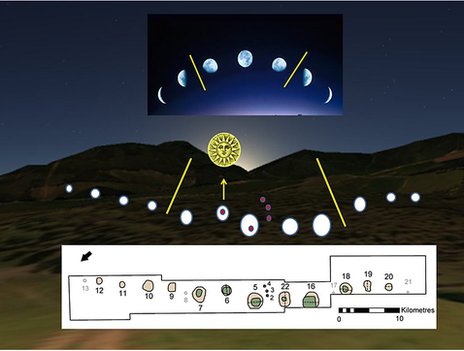
An illustration of how the pits would have worked An illustration of how the pits would have worked

An illustration of how the pits would have worked

The experts who analysed the pits said they may have contained a wooden post.

The Mesolithic “calendar” is thousands of years older than previous known formal time-measuring monuments created in Mesopotamia.

“It is remarkable to think that our aerial survey may have helped to find the place where time itself was invented” Dave CowleyRCAHMS

The analysis has been published in the journal, Internet Archaeology.

The pit alignment also aligns on the Midwinter sunrise to provided the hunter-gatherers with an annual “astronomic correction” in order to better follow the passage of time and changing seasons.

Vince Gaffney, Professor of Landscape Archaeology at Birmingham, led the analysis project.

He said: “The evidence suggests that hunter-gatherer societies in Scotland had both the need and sophistication to track time across the years, to correct for seasonal drift of the lunar year and that this occurred nearly 5,000 years before the first formal calendars known in the Near East.

“In doing so, this illustrates one important step towards the formal construction of time and therefore history itself.”

The universities of St Andrews, Leicester and Bradford were also involved.

Dr Richard Bates, of the University of St Andrews, said the discovery provided “exciting new evidence” of the early Mesolithic Scotland.

He added: “This is the earliest example of such a structure and there is no known comparable site in Britain or Europe for several thousands of years after the monument at Warren Field was constructed.”

The Warren Field site was first discovered as unusual crop marks spotted from the air by the Royal Commission on the Ancient and Historical Monuments of Scotland (RCAHMS).

Dave Cowley, aerial survey projects manager at RCAHMS, said: “We have been taking photographs of the Scottish landscape for nearly 40 years, recording thousands of archaeological sites that would never have been detected from the ground.

“Warren Field stands out as something special, however. It is remarkable to think that our aerial survey may have helped to find the place where time itself was invented.”

Prof Vince Gaffney
Prof Vince Gaffney led the project to analyse the pits at Warren FieldCrathes Castle and its estate is in the care of the National Trust for Scotland (NTS).

From 2004 to 2006, trust staff and Murray Archaeological Services excavated the site.

NTS archaeologist Dr Shannon Fraser said: “This is a remarkable monument, which is so far unique in Britain.

“Our excavations revealed a fascinating glimpse into the cultural lives of people some 10,000 years ago – and now this latest discovery further enriches our understanding of their relationship with time and the heavens.”

Full article: http://www.bbc.co.uk/news/uk-scotland-north-east-orkney-shetland-23286928

Merlin @ Stonehenge
The Stonehenge News Blog


Old Sarum/Stonehenge: Did you see the Neolithic houses?

16 07 2013

Alan S's avatarThe Heritage Journal

A couple of months ago, we drove down to Salisbury to take a look at the experimental Neolithic houses being built by English Heritage in preparation for the new Stonehenge visitor’s centre.

Neolithic Houses

Sadly, the buildings at Old Sarum were only ever designed as a temporary exhibit, to try out various ideas and techniques, and have now been demolished.  The volunteers who worked so hard on the houses had kept a blog of the process,  including covering the demolition and future possibilities, which is well worth reading.

Visitors to the experimental houses exhibit were encouraged to leave an email address where they could be contacted for a ‘later survey and feedback’, and it appears that time has now arrived. If you visited the houses at Old Sarum, but didn’t leave an email address, no matter. You can still take part in the survey, and as a thank you for your…

View original post 54 more words


Should we take back the Solstice?

6 07 2013

heritageaction's avatarThe Heritage Journal

The Heritage Journal is about raising awareness of ancient sites and this article by sociologist Tom Shakespeare suggested a way. He says when he looks at other cultures he has “a strong sense of festival envy” – for instance Solstice is often widely celebrated abroad but far less so here and he thinks we’re the poorer for it.

Maybe it’s because solstice is portrayed in the British media (and the EH website!) as about Druids, pagans and other enthusiasts gathered at Stonehenge. They’re entitled to do their own thing but it may cause others to see it as someone else’s festival, not theirs. That’s quite wrong though, it’s everyone’s – it didn’t start with Stonehenge but far earlier, with Mankind!

So is there a case for promoting it as something for people…

View original post 104 more words


Wessex Archeology are running a free open day at Barrow Clump with Phil Harding

4 07 2013

Explore Archaeology on Salisbury Plain – 20th July 2013

explore-archaeology-20th-july-2013

Merlin @ Stonehenge
The Stonehenge News Blog


The New Stonehenge Project in Wiltshire, Your Legacy Sailing into the Future!

3 07 2013

nancy wisser's avatarCLONEHENGE

It has been announced with great fanfare. Even a BBC article has announced the unveiling of the plans for this grand Stonehenge for the new millenium, its site only four miles from the original. The plans are unexpectedly elaborate, including a flooring of white quartz granite, a moat, gardens, and yurts for visitors who wish to spend the night.

Consider all of that, along with uprights that are to be of various colored stone types from around the world, eight gates, a white wall, and a visitor center and exhibition domes that will be built to look like Newgrange: and of all this the project leader, Colin Shearing said, “It’s going to look like Stonehenge as we believe it looked as it was new.” and “You can’t really experience how [Stonehenge] was when it was new because it’s old, so a new one would give you an opportunity…

View original post 522 more words


New Stonehenge tourist attraction planned in Wiltshire

29 06 2013

Plans have been unveiled for another Stonehenge stone circle to be built in Wiltshire using different-coloured stones from around the world.

Organisers of the £50m project want it to become another major tourist destination in the county, and one which will last for thousands of years.

Archaeologists believe the original Stonehenge was built anywhere from 3000 BC to 2000 BC

Archaeologists believe the original Stonehenge was built anywhere from 3000 BC to 2000 BC

New Stonehenge would include yurt huts for visitors to stay in, a planetarium and an observatory.

It would be located about four miles (6 km) from the existing stone circle.

The land is close to Fugglestone Red where Wiltshire Council has proposed a major new housing development as part of its 2009 Core Strategy.

“For tourism in Wiltshire, it will be a huge boost. The new Stonehenge will compliment the old one”
Graham Gould Salisbury City Centre Management

The project is currently in the planning stages while the team behind it seeks funding for consultation on the environmental impact of the proposed structure.

Private investment for the build is currently being sought, with organisers expecting the attraction to make back the outlay within 6-10 years of it opening.

‘Homage’ to original circle

Project leader Colin Shearing said it will be an “homage” to the original Stonehenge.

He said: “You can’t really experience how it was when it was new because it’s old, so a new one would give you an opportunity to experience what our ancestors experienced when they went to the original one.”

Archaeologists believe the original Stonehenge was built anywhere from 3000 BC to 2000 BC.

Mr Shearing said the new Stonehenge circle would be built with stones imported from different countries around the world, with each one matching a colour of the spectrum.

He said the entire structure will be polished and set into a floor of white quartz granite and surrounded by a white stone wall.

It is planned for the attraction to host events such as summer concerts and festivals as well as conferences and weddings.

Graham Gould, of Salisbury City Centre Management, described it as a “fantastic idea”.

He said: “For tourism in Wiltshire, it will be a huge boost. The new Stonehenge will compliment the old one.

“The two can work together, without a doubt.”

An English Heritage spokesperson said it is an “ambitious and interesting” project, and the organisation will be watching its development “with interest.”

Following a full environmental impact study, organisers hope to apply for planning permission to Wiltshire Council in 2014.

Article source: http://www.bbc.co.uk/news/uk-england-wiltshire-23094202

More info: http://www.newstonehenge.co.uk/

Merlin says “Great idea”
The Stonehenge News Blog


Mission to save Stonehenge gets underway to reclaim its ancient natural landscape

25 06 2013

STONEHENGE yesterday began reclaiming its ancient natural landscape with the closure of a busy road running through the World Heritage site.

Stonehenge is undergoing a massive renovation

Stonehenge is undergoing a massive renovation

The A344, which carried 6,000 cars a day past the monument’s Heel Stone, will now be turfed over and the high fences removed  to recreate the traditional downland pasture.

The closed section of the A344 is between the junction with the A303, the main road to the southwest,  and Byway 12 which  severs Stonehenge from  its ancient processional approach, the Avenue.

The move is part of a £27million English Heritage programme to protect the site and improve the experience for visitors.

This includes a new visitor’s centre, due to open in December,  which will be 1.5 miles form the monument instead of on its doorstep.

The remaining section of the A344 will become  the route of a new visitor shuttle service to and from the Stones.

The closure fulfils a pledge   given by the  Government to UNESCO 27 years ago to remove the A344 where it crosses the Avenue.

And this time next year, once the landscaping is complete, visitors will be able to walk in the footsteps of ancient Britons and approach  the monument from the Avenue.

Loraine Knowles, Stonehenge Director, English Heritage, said: “The Stones have never failed to impress visitors, but for too long their setting has marred people’s appreciation and enjoyment of this special place. At last, this is going to change. For the first time in centuries, when all the works are complete, people will be able to experience this complex and extraordinary monument in a more tranquil, natural setting.”

Jan Tomlin, the National Trust General Manager for Wiltshire Landscape, said: “We welcome the closure of the A344 past Stonehenge – it is an important step towards the vision for the future of the monument. We have worked over the past decade to restore much of the land we own around Stonehenge to grassland and this is an important step in linking Stonehenge to the ancient landscape.”

John Ingham (http://www.express.co.uk/news/uk/409933/Mission-to-save-Stonehenge-gets-underway-to-reclaim-its-ancient-natural-landscape)

Merlin at Stonehenge
The Stonehenge News Blog


Stonehenge road closed permanently today

24 06 2013
A stretch of road running next to Stonehenge will close permanently from today. Part of the A344 in Wiltshire almost touches the heel stone. English Heritage which manages the monument says the road spoils the visitor experience.

A major landscaping project should be finished by next summer, and traffic will be diverted onto nearby roads instead.

Existing A344 and junction with A303 at Stonehenge Bottom

Existing A344 and junction with A303 at Stonehenge Bottom

Link: http://www.itv.com/news/west/update/2013-06-24/stonehenge-road-closed-permanently/

TRAFFIC NEWS:
A344 Stonehenge, both ways between B3086 and A303

A344 Wiltshire – A344 in Stonehenge closed in both directions between Airmans Cross and Stonehenge Fork, because of development of the Stonehenge site – permanent closure. Diversion in operation – via A360 Longbarrow roundabout.

Main Changes at Stonehenge

  • The A344/A303 junction will be closed
  • The A344 from Stonehenge Bottom to Byway 12 near the stones will be closed
  • Vehicular traffic on the A344 between Byway 12 and the new visitor centre at Airman’s Corner will be restricted

Modifications to Existing Routes   

Alongside these changes there will be measures to mitigate the impact of the closure of the A344. Traffic removed from the 344 will be directed along the A360 via Longbarrow Roundabout and Airman’s Corner junctions, both of which will be modified to accommodate the re-directed traffic.

The A303/A344 junction is a renowned accident black-spot; its closure will reduce the risk of accidents in this location and was strongly supported by local residents in the public consultation of 2008.

Link: http://www.english-heritage.org.uk/daysout/properties/stonehenge/our-plans/our-proposals/transportation-and-safety/

Merlin @ Stonehenge
The Stonehenge News Blog