Heaven and Earth Stonehenge Access Tour

18 11 2014

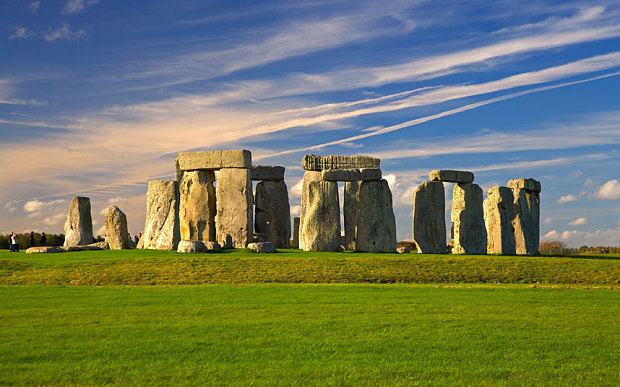
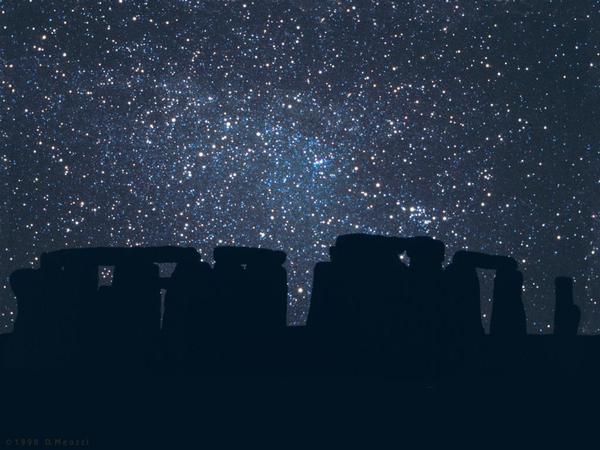
A special early evening bookable tour, learning about the stars and planetary movements and how early man may have utilised them. Over 12’s only, under 16’s to be accompanied by an adult.

stonehenge-stars1This event is next Saturday (to include a special access visit to the stones), all about the stars and planetary movements and how early man may have utilised them.

Each person is required to bring a torch.

How to Book: Call the English Heritage customer services team to book : 0870 3331183

November 22nd is also the ‘New Moon: In astronomy, new moon is the first phase of the Moon, when it orbits closest to the Sun in the sky as seen from the Earth. More precisely, it is the instant when the Moon and the Sun have the same ecliptical longitude. The Moon is not always visible at this time except when it is seen in silhouette during a solar eclipse or illuminated by earthshine. See the article on phases of the Moon for further details

Merlin @ Stonehenge
The Stonehenge News Blog


Pre-history may have to be re-written due to groundbreaking finds by Stonehenge team

2 11 2014

Pre-history may have to be re-written following a recent dig by university students near Stonehenge.

Senior research fellow David Jacques

Senior research fellow David Jacques

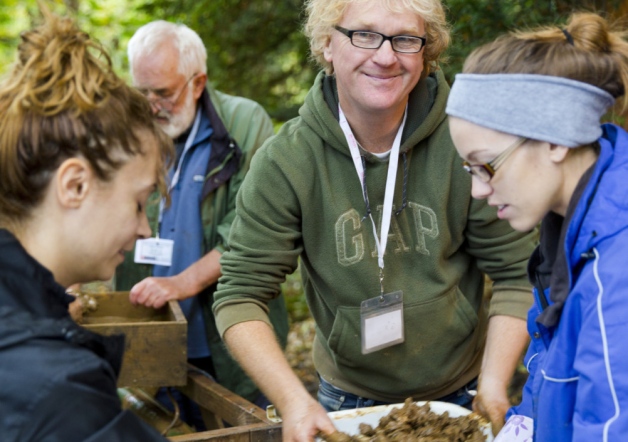
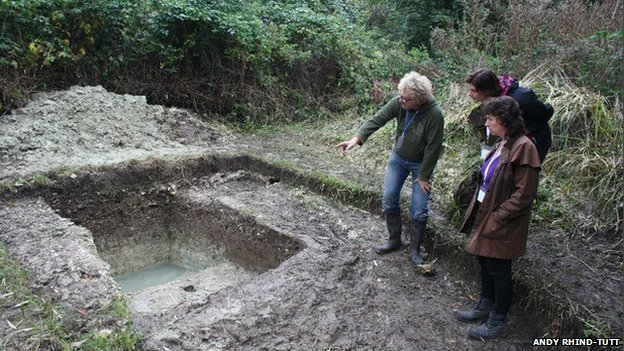
Signs of human habitation 8,000 years ago have been discovered by Archaeology MA students from the University of Buckingham, led by senior research fellow David Jacques.

Mr Jacques said: “This year we’ve found burnt flint – a sign that people had made fires, so were in the area, around 8,000 years ago.

“The finds will have to be carbon-dated to get a precise date.

“It’s been wonderful that the first ever University of Buckingham archaeology students have unearthed mesolithic tools as part of the team of volunteers at the dig.”

The archaeologist, who is leading the new Archaeology MA course at the university, has just completed a two-week dig at Vespasian’s Camp, a mile from Stonehenge, at which MA students and University of Buckingham staff worked as volunteers, sifting through remains.

A number of ancient flint tools were among the finds.

More than 12,000 items from the mesolithic era (8000 – 3500BC) have been uncovered, including hunting tools, the cooked bones of aurochs – a gigantic cow-like animal – deer, wild boar, and even toads’ legs.

The finds have revealed that the site was in use continually for over 3,000 years, and could even be the reason why Stonehenge is where it is.

Mr Jacques suspects the site will contain evidence of settlements, which would be some of the earliest ever found in the UK and would completely change our understanding of this era.

Mr Jacques appeared on TV this year in BBC 1’s Operation Stonehenge and BBC 4’s The Flying Archaeologist.

And the MA students working alongside him at the dig a fortnight ago found themselves being filmed for a forthcoming episode of Horizon.

Digs at the site over the last few years have already yielded a staggering 32,000 artefacts dating from as far back as 7500BC.

Last year, the dig resulted in 8,000-year-old burnt frogs’ legs being found, revealing the delicacy was originally English and not French.

Earlier this year, carbon dating of finds from the dig led to the revelation that Amesbury is the oldest town in the country.

A previous public lecture by Mr Jacques at the university drew a packed audience.

Following the latest dig, Mr Jacques is returning to deliver another public lecture on Thursday, November 13.

The free event will take place at 6.30pm, in the Chandos Road Building, as part of the university’s autumn concert and lecture series.

In the lecture, Mr Jacques will unveil startling new evidence showing how the mesolithic period influenced the building of Stonehenge.

The lecture will focus on the area around the dig, Blick Mead, which features a natural spring, which would have attracted settlers to the area.

The warm spring water has caused stones to turn a bright puce, a colour of stone not found elsewhere in the UK.

David Jacques was elected a Fellow of the Society of the Antiquaries (FSA) in recognition of the importance of his discoveries there.
Link Source:

Stonehenge News Blog


Stonehenge new theory: music to their ears.

30 10 2014

A new theory has been put forward for why Stonehenge was created. Steven Waller, an American researcher, believes that its primary purposes was not visual, but aural: along with Neolithic cave paintings, it was designed for its acoustic properties, in this case the interference the stones would cause to the volume of the music.

Steven Waller, an American researcher, believes that Stonehenge's primary purpose was not visual, but aural: that it was designed for its acoustic properties Photo: Alamy

Steven Waller, an American researcher, believes that Stonehenge’s primary purpose was not visual, but aural: that it was designed for its acoustic properties Photo: Alamy

We have another theory, however. It is that Stonehenge was in fact built by ancient practical jokers, for no better reason than to drive future experts to distraction. One can picture them giggling to themselves as they laid false trails, safe in the knowledge that they would provide fodder for endless wild hypotheses about their true motives. Granted, it seems like a lot of bother to go to. But the fact that we are still trying to solve their riddles, thousands of years later, suggests it was worth the effort.

By : Link Source

The Stonehenge News Blog
All the lastest Stonehenge news on Twitter: https://twitter.com/ST0NEHENGE


‘Old ones’ reference links 8th century poem to Stonehenge?

23 10 2014

AN ancient poem believed to have been written about Bath could in fact be the earliest writing ever discovered about Stonehenge, according to an academic expert following a presentation last night at the Amesbury History Centre. 

Dr Graeme Davis.jpg-pwrt2Mediaeval language scholar Dr Graeme Davis believes an 8th Century Anglo Saxon poem called “The Ruin” could be the oldest known surviving text in the world to describe the monument.

Although the original manuscript is damaged, Mr Davis has translated the poem and said he was surprised to find references to the standing stones as the “old ones”.

Mr Davis is part of a team studying a constant spring at Blick Mead in Amesbury.

He believes that the Stones and Blick Mead spring could be those referred to in the poem.

The spring caught Mr Davis’ attention during recent visits to Amesbury and led to discussions with the Amesbury Museum and Heritage Trust over the interesting history of the area.

A spokesman for the trust said: “Graeme’s interpretation of this poem intriguingly focuses the mind on Stonehenge especially with the reference to a hundred generations passed and the naming of the Stones as “the elders” or “old ones”.

“If the spring is indeed Blick Mead, it reinforces links and unlocks another clue to Amesbury’s significance in British History.

“It is interesting to note the book is recognised as one of the greatest works of the Benedictine revival, for which Amesbury played a major role.”

The full translation can be found on the Amesbury Museum, Heritage Trust Facebook page and the hard copy can be seen at the Amesbury History Centre.

Article source: http://www.salisburyjournal.co.uk/news/11546570.Is_eighth_century_poem_about_Stonehenge_/

The Stonehenge News Blog


Soldiers at Stonehenge: A new special exhibition is being launched at the Stonehenge visitor centre in November

4 10 2014

Salisbury Plain and the journey to the First World War.

A new special exhibition is being launched at the Stonehenge visitor centre in November to tell the story of the Stonehenge War memorial at Stonehengelandscape, its neighbouring communities and how they were dramatically altered by the Great War.  During the First World War, the World Heritage Site was at the heart of Salisbury Plain’s military training ground and the Wiltshire landscape was dramatically transformed.  A 25 mile area around Stonehenge became home to the largest complex of military training camps in the world, as soldiers dug intricate networks of trenches in an attempt to replicate conditions on the Western Front.

This exhibition will open in November 2014. It tells the story of the Stonehenge landscape, its neighbouring communities, and how they were changed by the First World War.

Visit the English Heritage Website and see ten of the exhibition objects and images in more detail.

NOVEMBER 11th 2014 EVENT:  Join English Heritage for an insight into the First World War exhibition at Stonehenge with Guest Curator and Historian Simon Jones .  Enjoy a guided tour of the exhibition and discover the story of the soldiers who trained on Salisbury Plain. £22 (visit the English Heritage website)

The Stonehenge News Blog

.


The Stonehenge Hidden Landscapes Project

3 10 2014

The Stonehenge Hidden Landscapes Project is an unprecedented initiative to survey a vast tract of land around the iconic stones. Now that the bulk of the practical work is complete, Carly Hilts spoke to Vince Gaffney and Chris Gaffney to find out more.

An ambitious programme of geophysical survey, covering 12 square kilometres around Stonehenge, has revealed a landscape scattered with previously-unknown features. Credit: All images courtesy of the University of Birmingham and LBI ArchPro

An ambitious programme of geophysical survey, covering 12 square kilometres around Stonehenge, has revealed a landscape scattered with previously-unknown features. Credit: All images courtesy of the University of Birmingham and LBI ArchPro

Stonehenge could confidently claim to be one of the most-studied, and certainly most hotly debated, prehistoric sites in Britain. However, much of the local landscape, so important to any interpretation or understanding of the site, was largely terra incognita – until the launch of The Stonehenge Hidden Landscapes Project, the largest geophysical mapping survey of its kind yet undertaken.

Begun in July 2010, and headed by the University of Birmingham and the Ludwig Boltzmann Institute for Archaeological Prospection and Virtual Archaeology  in Vienna, the four-year Project has explored a massive 12 square kilometres around the celebrated stones, and revealed the footprints of hundreds of previously unknown features, invisible to the naked eye, including henge-like monuments, burial mounds, ditches, and pits spanning thousands of years.

Clocking up 120 days in the field, the team used the latest non-invasive survey techniques – including magnetometry, ground penetrating radar (GPR), earth resistance surveys, and 3D laser scanning – to explore the Stonehenge landscape in unprecedented detail, allowing researchers to see features buried as much as 3m below the modern ground level.

‘We created a palimpsest,’ said geophysics expert Dr Chris Gaffney of the University of Bradford. ‘Unpicking it is one of the joys of geophysics, but also one of its conundrums – we don’t have a ditch detector or a wall detector, so after gathering this incredible explosion of data, you still have to delve in and interpret it manually.’

So far, eagle-eyed project members have picked out 17 shapes from the vast amounts of resulting data that are thought to represent Neolithic monuments roughly contemporary with Stonehenge, as well as field enclosures, barrows, settlements, and other signs of human activity ranging in date from the Bronze Age to the 20th century.

We approach the features as we would if we were using aerial photography, by looking at their shape and comparing them to known sites,’ said project co-director Professor Vince Gaffney of the University of Birmingham (and brother of Chris Gaffney). ‘The tricky thing is that prehistoric monuments come in a variety of forms, they do not conform to standards – even Stonehenge is not a typical henge, as its ditch lies outside its bank – so once you spot something, it is not always easy to categorise it.’

Professor Wolfgang Neubauer, Director of the Ludwig Boltzmann Institute, added: ‘No landscape deserves to benefit from a study at this level of detail more than Stonehenge. The terabytes of digital survey data collected, processed and visualised by LBI ArchPro provide the base for the precise mapping of the monuments and archaeological features buried in the subsurface or still visible in the landscape surrounding Stonehenge. After centuries of research, the analysis of all mapped features makes it possible, for the first time, to reconstruct the development of Stonehenge and its landscape through time.’

High-speed survey

With an ambitiously large area designated for investigation, the team called on other modern technologies to help cover the uneven terrain. Although hand-pushed carts were used to explore more difficult or sensitive sites, much of the project survey equipment was mounted on the back of quad bikes.

‘This means we were collecting data at up to 40kmph,’ said Vince. ‘It was georeferenced and its location logged as it came in, and the information would already be partly processed before you reached the end of the field – that’s how we managed to so much data in a relatively short time.’

Beyond the stones of Stonehenge

This multi-technology approach has proven a particular boon in revisiting well-known sites, where a host of unexpected new details have been revealed. Around 3km from Stonehenge lies , the largest-known henge in the world at over 0.5km in diameter, and home to a Neolithic settlement that some interpret as a possible base camp for the builders of Stonehenge (CA 270). Although the site has been studied in detail during previous investigations, the recent survey identified traces of a previously unknown row of holes along the site’s southern border, which could have held around 70 posts or stones.

While investigating a known long barrow at Woodhenge, the team found the remains of a large timber building hidden inside it. This reconstruction shows how it may have looked

Another enigmatic find comes from the adjacent site of ‘Woodhenge’, once home to a Neolithic timber circle. The chalk long barrow standing in the same field had long been known to archaeologists, and so it came as a complete surprise to discover that the monument seems to have a kind of forecourt in front of it – and that within the mound itself there once stood a massive timber building some 33m long. With the outline of its walls marked out by lines of holes that once contained huge wooden posts, the team has provisionally interpreted the building as a mortuary, possibly used in excarnation rituals.

Interpreting the Cursus

Stonehenge_new_monuments_distribution

Over at the Cursus ­– the c.3km long Neolithic earthwork just north of Stonehenge, thought to predate the earliest phase of the monument’s construction by several centuries –exploratory work has revealed new links between the two sites, as well as potentially significant astrological associations. At each end of the Cursus, the team has identified a massive pit measuring around 5m in diameter. More excitingly, Vince said, if you stand at Stonehenge and look towards the Cursus on the Summer Solstice, the easternmost pit aligns with the rising sun, and the westernmost with the sunset.

‘As the Cursus runs East-West it has long been suspected that it had some kind of association with the sun, so these pits forming a triangle with the site of Stonehenge are very interesting,’ he said. ‘It seems like a massive coincidence if their alignment was not intentional. We don’t know their date, but something else that is interesting to note is that while you can get a clear view of the sunrise pit from Stonehenge, looking down the first section of the Avenue, the sunset pit is hidden behind a bank. You might be able to see it if it was filled with fire and smoke, though – perhaps a future excavation will reveal traces of burning.’


This is an extract, but you can read the full article in Current Archaeology 296

Stonehenge’s hidden landscape


The Stonehenge News Blog


US President Barack Obama visits Stonehenge.

7 09 2014

US President Barack Obama paid a visit to Stonehenge on his return home from the Nato summit in Newport.

The White House said the presidential helicopter Marine One stopped at Boscombe Down Airbase, Wiltshire, before his motorcade drove to the ancient monument.

The president was then given a guided tour by curator Heather Sebire.

English Heritage, which manages the site, said it was “an honour” to host the president.

General manager of Stonehenge, Kate Davies, said: “His office told us the president was very interested to see the iconic monument for himself.

“Every day people from all over the world make the trip to the ancient stones but this visit was a particularly special one.”

Ms Sebire said Mr Obama “was fascinated by the story of the stones, what we know about them and the mysteries that have yet to be solved”.

we know about them and the mysteries that have yet to be solved”.

President Obama at Stonehenge
The president ented that he had “knocked this off my bucket list”
 

She went on: “He described the atmosphere around the stones as ‘really special’ and his visit to Stonehenge as ‘a highlight of my tour’.

“It was a beautiful still evening and it was a privilege to show the US president around this unique monument which continues to inspire and intrigue people.”

Mr Obama described seeing the monument as “cool” and said it was something he could tick off his “bucket list”.

He also chatted briefly to a local family and posed for photos.

Janice Raffle, who lives near Stonehenge, had come down to the monument with her husband and three sons after hearing Mr Obama was there.

She said: “We had a brief tete a tete across the barbed wire.

“He was really a sweetie. He asked all our names and he was commenting on the fresh air and the beautiful countryside.

“He also said that I was quite outnumbered because I have three little boys as well as my husband and there was a bit of banter between the boys saying boys are best and he said well I don’t know if I agree with that.”

Article source: http://www.bbc.co.uk/news/uk-england-wiltshire-29083959

mote International coverage on this story:

http://www.huffingtonpost.co.uk/2014/09/06/barack-obama-stonehenge-family-pictures_n_5776386.html
http://www.utsandiego.com/news/2014/sep/05/after-nato-obama-visits-stonehenge/
http://www.itv.com/news/meridian/story/2014-09-05/barack-obama-stops-off-for-visit-to-stonehenge/
http://www.spirefm.co.uk/news/local-news/1388552/president-barack-obama-visits-stonehenge/
http://www.chron.com/news/article/After-NATO-Obama-visits-Stonehenge-5736351.php
http://www.dailymail.co.uk/news/article-2745437/Knocked-bucket-list-Obama-makes-surprise-visit-Stonehenge-following-NATO-meeting-poses-grinning-family-walk.html
http://www.lbc.co.uk/familys-incredible-obama-stonehenge-surprise-96608

The Stonehenge News Blog


Stonehenge Exhibition and Visitor Centre by Denton Corker Marshall Architects has won an RIBA South West Award 2014

10 05 2014

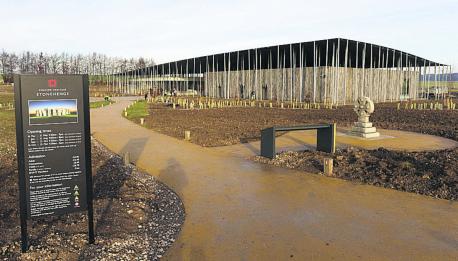
Honour for Stonehenge Exhibition and Visitor Centre.  Stonehenge Exhibition and Visitor Centre by Denton Corker Marshall Architects has won an RIBA South West Award 2014 from the Royal Institute of British Architects.

Stonehenge Exhibition and Visitor Centre by Denton Corker Marshall Architects has won an RIBA South West Award

Stonehenge Exhibition and Visitor Centre by Denton Corker Marshall Architects has won an RIBA South West Award

The £6.9m building, named in a prestigious ceremony at City Hall, Bristol, yesterday, takes an Australian aboriginal dictum of ‘touching the earth lightly’ to perch on an archaeological landscape creating a vastly improved visitor experience.

A major part of the £27million Stonehenge Environmental Improvements Programme – the largest capital project ever undertaken by English Heritage – the new visitor building, is 2.1km (1.5 miles) to the west of Stonehenge.

RIBA South West Awards recognise examples of innovative and outstanding new architecture within the region.

Chair of the jury, John Pardey of multiple award-winning John Pardey Architects said of the English Heritage project: “The building follows the concept sketch by the architect Barry Marshall.

“A forest of thin square columns dancing at different angles likes tree trunks, supporting a curvy canopy roof, which has fretted edges like leaves meeting the sky. Spaces are laid out with precise clarity and work fabulously well’.

‘The visitor centre provides an essentially outdoor experience and that is as it should be on this wide Wiltshire landscape’.

RIBA South West regional director Jon Watkins said ‘The RIBA South West Awards always bring out the best in local and national architects across our vast region. It is delightful that Salisbury Plain is a focus for local success and quality this year, and I commend the client and architects for their work in raising the profile of architecture nationally and in Wiltshire’.

RIBA South West Award winners will also be considered for a highly-coveted RIBA National Award in recognition of their architectural excellence, which will be announced in June.

The shortlist for the RIBA Stirling Prize for the best building of the year will be drawn from the RIBA National Award-winning buildings later in the year.

The full list of the 11 no. RIBA South West Award winners are:

1. Architecture Archive, Somerset (Hugh Strange Architects, London)

2. Lakeshore, Bristol (Ferguson Mann, Bristol)

3. Officers Field, Portland (HTA Design LLP, London)

4. Poole Harbour Second Crossing/Twin Sails Bridge, Poole (Wilkinson Eyre, London)

5. Porthmeor Artist’s Studios & Fishermen’s Cellars, St Ives (Long & Kentish Architects, London)

6. Royal William Yard Staircase, Plymouth (Gillespie Yunnie, Dartington, Devon)

7. Stonehenge Exhibition & Visitor Centre, Wiltshire (Denton Corker Marshall, London)

8. The Exchange, Falmouth University (Burwell Deakins, London)

9. The Lee Building, Bath (Feilden Fowles, London in association with FCB Studios, Bath)

10. The Wilson, Cheltenham Gallery & Museum (Berman Guedes Stretton, London)

11. Westering, Chagford, Devon (Annie Martin Architect, Teignmouth)

Article source: http://www.thisiswiltshire.co.uk/news/11202373.Honour_for_Stonehenge_Exhibition_and_Visitor_Centre/

Merlin at Stonehenge
The Stonehenge News Blog


Amesbury – including Stonehenge – is the UK’s longest continually-occupied settlement

6 05 2014

Amesbury in Wiltshire confirmed as oldest UK settlement.

A Wiltshire town has been confirmed as the longest continuous settlement in the United Kingdom.

Amesbury - including Stonehenge - is the UK's longest continually-occupied settlement

Amesbury – including Stonehenge – is the UK’s longest continually-occupied settlement

Amesbury, including Stonehenge, has been continually occupied since BC8820, experts have found.

The news was confirmed following an archaeological dig which also unearthed evidence of frogs’ legs being eaten in Britain 8,000 years before France.

Amesbury’s place in history has also now been recognised by the Guinness Book of Records.

David Jacques, from the University of Buckingham, said: “The site blows the lid off the Neolithic Revolution in a number of ways.

“It provides evidence for people staying put, clearing land, building, and presumably worshipping, monuments.

“The area was clearly a hub point for people to come to from many miles away, and in many ways was a forerunner for what later went on at Stonehenge itself.

“The first monuments at Stonehenge were built by these people. For years people have been asking why is Stonehenge where it is, now at last, we have found the answers.”

Mr Jacques said the River Avon, which runs through the area, would have been like an A road with people travelling along it.

“They may have had the equivalent of local guides and there would have been feasting,” he added.

“We have found remains of big game animals, such as aurochs and red deer, and an enormous amount of burnt flint from their feasting fires.”

_74573559_74573557

The dig unearthed the largest haul of worked flints from the Mesolithic period

Previously, Thatcham in Berkshire, 40 miles from Amesbury, held the record for the longest continuous settlement in the country.

The dig in Amesbury also uncovered 31,000 worked flints in 40 days as well as animal bones such as frogs’ legs.

Mr Jacques said our ancestors were eating a “Heston Blumenthal-style menu”.

The find was based on a report by fossil mammal specialist Simon Parfitt, of the Natural History Museum.

Andy Rhind-Tutt, the founder of Amesbury Museum and Heritage Trust, said there was “something unique and rather special about the area” to keep people there from the end of the Ice Age, to when Stonehenge was created and until today.

“The fact that the feasting of large animals and the discovery of a relatively constant temperature spring sitting alongside the River Avon, may well be it,” he said.

The dig was filmed and made into a documentary by the BBC, Smithsonian, CBC and others to be screened later in the summer.

The project was led by the University of Buckingham

Article source: BBC http://www.bbc.co.uk/news/uk-england-wiltshire-27238503

Historic Amesbury – the Home of Stonehenge

Nestling within a loop of the River Avon alongside the A303 just 1.5 miles from Stonehenge, Amesbury is a destination not to be missed. With recent evidence of continuous settlement since before 7500BC and a breath-taking Mesolithic collection that is greater in quantity (from one single location) than any other found in this country, the town’s new Museum at the Melor Hall, Church Street will amaze visitors with its story of life before the Stones and its mind blowing artefacts from the Town where History began.

Visit Wiltshire Website: http://www.visitwiltshire.co.uk/ideas-and-inspiration/amesbury-museum-and-heritage-centre-p1536253

Amesbury Museum and Heritage Trust: https://www.facebook.com/AmesburyMuseum

Salisbury Reds (transport to and from Amesbury): http://www.salisburyreds.co.uk/ptv-amesbury.shtml

Local Tour Operators including Amesbury and Stonehenge:
Salisbury, Stonehenge and Sarum Audio Tours: http://www.salisburystonehengetours.co.uk/
The Stonehenge Travel Company: http://www.StonehengeTravel.co.uk

The Stonehenge News Blog


Stonehenge tunnel plans could be revived

25 04 2014

Tunnel beneath Stonehenge could be reconsidered as part of plans to ease traffic congestion

Plans for a 1.3 mile road tunnel beneath the site and bypass have been proposed before but were dropped in 2007 due to the estimated £470 million cost

Plans for a 1.3 mile road tunnel beneath the site and bypass have been proposed before but were dropped in 2007 due to the estimated £470 million cost Photo: ALAMY

Plans to build a road tunnel under Stonehenge could be revived as the Government looks to ease bottlenecks on some of Britain’s most congested stretches of road.

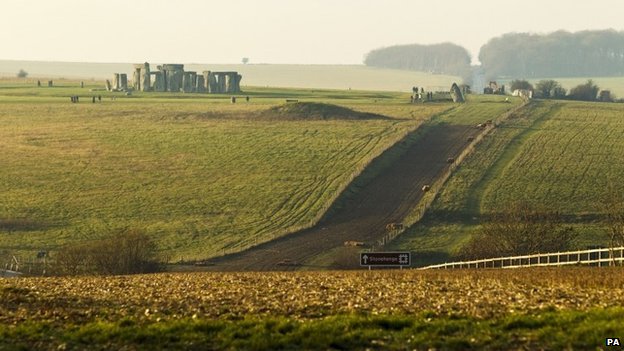
A study to be completed this summer will consider whether a dual carriageway or underground tunnel could solve the traffic problem caused by drivers slowing down to admire one of Britain’s most famous world heritage sites.

Plans for a 1.3 mile road tunnel beneath the site and bypass have been proposed before but were dropped in 2007 due to the estimated £470 million cost.

Yesterday, the Government outlined detailed plans for a “feasibility study” which will examine all possibilities for easing congestion along the route.

It pledged to deliver its final proposals in this year’s Autumn Statement along with the findings of five similar road-widening proposals on the A27 corridor, the A47 between Peterborough and Great Yarmouth, Trans-Pennine routes and two areas of the A1 around Newcastle.

Countryside campaigners attacked the plans which they claimed would scar beauty spots by laying extra tarmac along stretches of land which have remained untouched since Roman times.

Plans to widen the A27 include parts of the South Downs, Britain’s newest national park, while parts of the Norfolk Broads national park and the Northumberland coast could be affected under plans for the A47 and A1, they said.

The A303/A30/A358 corridor, which forms the main route from London to the south west, was highlighted by ministers last summer as one of six areas where solutions were urgently needed for the country’s most “notorious and long standing” congestion hot spots.

The A303 in particular is frequently gridlocked during summer weekends at a number of points where the dual carriageway narrows to a single lane, bringing holiday traffic to a standstill.

The feasibility study will “look to initially build on work done to date on potential proposals” rather than drawing up new solutions, beginning several plans for new stretches of dual carriageway including a 12km passage from Amesbury to Berwick Down (Stonehenge).

But the study will also “draw upon” work from a range of other projects including historic plans to tunnel beneath the prehistoric monument, with sources insisting all options are on the table.

The Campaign to Protect Rural England said several of the spots under examination, including Stonehenge, are only congested at certain times of year and do not merit major development.

Ralph Smyth, senior transport campaigner for the CPRE, said: “The traffic [at Stonehenge] hasn’t increased in the last 10 years and it does not justify the huge cost of a tunnel.”

A long tunnel would at least be preferable to a dual carriageway at the surface, which could cause the historic site to lose its world heritage status, he added.

Last month John Glen, Conservative MP for Salisbury, said a tunnel was the “only realistic” solution to protect Stonehenge while solving traffic problems which he said had turned the stretch into the “devil’s highway”.

A spokesman for the Department for Transport said the six studies would “develop solutions to some of the most notorious and  long-standing hot spots on the national road network.”

An English Heritage spokesman said: “We want to make certain the necessary improvements to the A303 are delivered in a way that will ensure the protection of the Outstanding Universal Value of the Stonehenge World Heritage Site.”

By , Transport Correspondent: Full article: http://www.telegraph.co.uk/news/uknews/road-and-rail-transport/10783496/Stonehenge-tunnel-plans-could-be-revived.html

The Stonehenge News Blog