Crown jewels of Stonehenge go on dazzling display: new prehistory galleries opening 14th October!

12 10 2013

In September 1808, William Cunnington, who was Britain’s first professional archaeologist, wrote to his patron to tell him that he had discovered what were to become known as the crown jewels of the “King of Stonehenge”.

On Monday, some of the treasures he found will go on permanent public display for the first time.

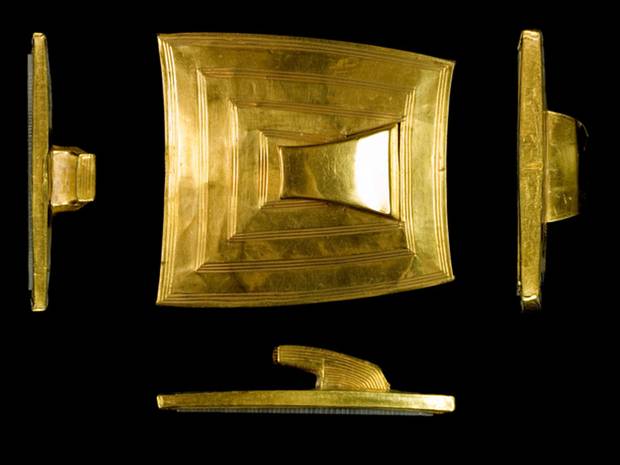
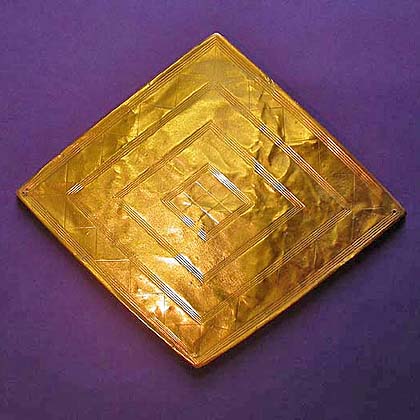
Gold from the time of Stonehenge:  new prehistory galleries at the Wiltshire Bush Barrow LozangeMuseum in Devizes Opening on 14 October, a completely new display over 4 galleries will tell the story of the Stonehenge and Avebury World Heritage Site.

On display for the first time are dozens of gold items dating to the time of Stonehenge. Many were found Bronze Age burial mounds within sight of Stonehenge, and were worn by people who worshipped inside the stone circle. These nationally important objects have never been on permanent display, and are now on show as part of this £750,000 gallery development at the Wiltshire Museum – home of Britain’s richest Bronze Age collection.

The centrepiece of the stunning new displays is Britain’s most important Bronze Age burial. The Bush Barrow chieftain lived almost 4,000 years ago and was buried in a barrow overlooking Stonehenge wearing the objects that showed his power and authority – including a gold lozenge, a ceremonial mace and a gold-decorated dagger. Axes and daggers like those found in the grave are carved onto the Sarsen stones at Stonehenge. The precision and design of the Bush Barrow lozenge proves that the people who built and used Stonehenge had a detailed knowledge of mathematics and geometry. The gold finds from Bush Barrow have never before been on permanent display in Wiltshire.

The image alongside show Sebastian Foxley of the Wiltshire Council Conservation Service and David Dawson, Director, moving the Stonehenge Urn to its new home.

Wiltshire Heritage Museum: http://www.wiltshireheritage.org.uk/news/index.php?Action=8&id=162&page=0

Follow Stonehenge News on Twitter: https://twitter.com/ST0NEHENGE

Merlin @ Stonehenge
The Stonehenge News Blog


Chairman needed for Stonehenge panel

6 10 2013

A NEW partnership panel set up to coordinate cooperation between the Stonehenge and Avebury is looking for a chairman.

Following a recent review it is hoped managers of the two parts of the World Heritage Site (WHS) will be working more closely together and it has been decided there will be a partnership panel led by an independent chairman.

This panel will also act as a representative for the whole WHS. It will be made up of the three key partners – English Heritage the National Trust and Wiltshire Council – together with the chairmen of the local Stonehenge and Avebury steering committees and a representative from the research community

“The new panel and chair will play a key role in ensuring this continues and that new opportunities to protect and present the World Heritage Site are identified.”

For more information go to jobs.wiltshire.gov.uk.

By Morwenna Blake: Salisbury Journal
http://www.salisburyjournal.co.uk/news/10720098.Chairman_needed_for_Stonehenge_panel/


Merlin @ Stonehenge
The Stonehenge News Blog


Stonehenge was built on solstice axis, dig confirms

9 09 2013

English Heritage excavations show site has nothing to do with sun worshipping, and find evidence circle was once complete

Archeologists found ridges, formed by Ice Age meltwater, that align Stonehenge with the solstice axis. Photograph: Francis Dean/Rex

Archeologists found ridges, formed by Ice Age meltwater, that align Stonehenge with the solstice axis. Photograph: Francis Dean/Rex

English Heritage says it has discovered a “missing piece in the jigsaw” in our understanding of Stonehenge, England’s greatest prehistoric site. Excavations  along the ancient processional route to the monument have confirmed the theory that it was built along an ice age landform that happened to be on the solstice axis.

The Avenue was an earthwork route that extended 1.5 miles from the north-eastern entrance to Wiltshire’s standing stones to the River Avon at West Amesbury. Following the closure of the A344 road, which cut across the route, archaeologists have been able to excavate there for the first time.

Just below the tarmac, they have found naturally occurring fissures that once lay between ridges against which prehistoric builders dug ditches to create the Avenue. The ridges were created by Ice Age meltwater that happen to point directly at the mid-winter sunset in one direction and the mid-summer sunrise in the other.

Professor Mike Parker Pearson, a leading expert on Stonehenge, said: “It’s hugely significant because it tells us a lot about why Stonehenge was located where it is and why they [prehistoric people] were so interested in the solstices. It’s not to do with worshipping the sun, some kind of calendar or astronomical observatory; it’s about how this place was special to prehistoric people.

“This natural landform happens to be on the solstice axis, which brings heaven and earth into one. So the reason that Stonehenge is all about the solstices, we think, is because they actually saw this in the land.”

The findings back theories that emerged in 2008 following exploration of a narrow trench across the Avenue. Parker Pearson said: “This is the confirmation. It’s being able to see the big picture.”

Dr Heather Sebire, English Heritage’s Stonehenge curator, said: “The part of the Avenue that was cut through by the road has obviously been destroyed forever, but we were hopeful that archaeology below the road would survive. And here we have it: the missing piece in the jigsaw. It is very exciting to find a piece of physical evidence that officially makes the connection which we were hoping for.”

The excavation was conducted by Wessex Archaeology for English Heritage.

The A344 will be grassed over next year as part of English Heritage’s £27m transformation of the World Heritage Site, which receives more than 1m visitors annually. There will be a new visitor centre, 1.5 miles away out of sight, to allow Stonehenge to reconnect with the surrounding landscape.

Sebire, who likens the Avenue to The Mall leading to Buckingham Palace, said that the latest findings should prompt vigorous academic debate.

The excavations have also uncovered three holes where missing stones would have stood on the outer sarsen circle, evidence, it is believed, that the circle was indeed once complete. Surprisingly, even the most sophisticated surveys failed to spot them. Two members of staff noticed dry areas of grass, or parchmarks.

Susan Greaney, an English Heritage historian, said: “The discovery … has certainly strengthened the case for it being a full circle.”

Asked why no one noticed them until now, Parker Pearson said: “The problem is we’ve not had a decent dry summer in many years. Stonehenge is always regularly watered, and the only reason these have shown up is because – for some reason this year – their hose was too short … So we’re very lucky.”

Article source: : The Guardian: http://www.theguardian.com/culture/2013/sep/08/stonehenge-ice-age-solstice-axis

Merlin @ Stonehenge
The Stonehenge News Blog  


Stonehenge and the Stars: Perseid Meteor Shower 12th August 2013

27 07 2013

Facilitated by English Heritage and led by an expert local volunteer, the group will enjoy sole access to Stonehenge for two hours. The first hour will be dedicated to a guided tour and Q&A focussing on the astronomical theories surrounding Stonehenge. During the second hour visitors are invited to set up their own telescopes and cameras to star gaze and moon gaze, to share stories and experiences and, weather permitting, to enjoy the Perseid Meteor Shower at its fullest.

Meteor showers have always captured peoples interests. In astronomy, there’s nothing quite like a bright meteor streaking across the glittering canopy of a moonless night sky. The unexpected flash of light adds a dash of magic to an ordinary walk under the stars.Visitors are invited to bring their own telescopes, cameras and binoculars. (Please note: Tripods may not be pressed into the earth and must have rubber/protective feet. We are unable to provide any equipment ourselves). We recommend that visitors also bring red-filter torches. Visitors should wear appropriate clothing and footwear

Meteor showers have always captured peoples interests. In astronomy, there’s nothing quite like a bright meteor streaking across the glittering canopy of a moonless night sky. The unexpected flash of light adds a dash of magic to an ordinary walk under the stars.

How to Book

Purchase your tickets today by calling our dedicated Ticket Sales Team on 0870 333 1183 (Mon – Fri 8.30am – 5.30 Sat 9am – 5pm).

Prices

Ticket price includes entrance to Stonehenge stone circle, star gaze and guide

Link: http://www.english-heritage.org.uk/daysout/events/stonehenge-and-the-stars-sh-12-aug/
Link: http://www.clarksvilleonline.com/2013/07/27/nasa-research-shows-perseid-meteor-shower-to-peak-august-12th-and-13th/
Link: http://www.meteorwatch.org/

Merlin says “In total, the Perseid meteor rate from dark-sky sites could top 100 per hour. That’s a lot of magic. Enjoy the show.”

Merlin @ Stonehenge
The Stonehenge News Blog


A visit to Stonehenge is bound to make you ask: who built it?

16 05 2013

Who built Stonehenge?
A visit to Stonehenge is bound to make you ask: who built it?  It is a question nearly as old as the stones themselves.  And what do we know about the people who achieved this prehistoric marvel? Words Susan Greaney

Wizard Ideas 

In the early medieval period, writers thought they knew who had built Stonehenge—Merlin. But by the early 17th century, scholars were looking for a more plausible answer. In 1620, architect Inigo Jones thought it was based on classical geometry and constructed by the Romans. Antiquary John Aubrey thought that the native Britons, in particular the Druids, were the builders of Stonehenge. Antiquary William Stukeley’s 1740 book firmly established the idea that it was a Druid temple.

Towards the end of the 19th century, archaeologists began to realise that Stonehenge could be much older, linking finds to the Bronze Age. William Gowland’s excavations in 1901 showed that Stonehenge was built in Neolithic or early Bronze Age. Today, we think the stones were raised about 2,500 BC by the native inhabitants of late Neolithic Britain.

The Early Theories…

stonehenge_1

stonehenge-port-JOHN_AUBREYJohn Aubrey Proposed that Stonehenge was a temple built by the Druids, the priests of the pagan Celts, who came to England in the centuries immediately prior to the Christian era.


stonehenge-port-WILLIAM_STUKELEYWilliam Stukeley The first person to recognise the alignment of Stonehenge on the solstices. Like John Aubrey, however, he mistakenly attributed their construction to the Druids.


stonehenge-port-INIGO_JONESInigo Jones Believed the stones were a Roman temple of the Tuscan order built to the sky god Coelus. Later disproved by evidence establishing the period in which the stones were first laid.

Past Lives

Stonehenge was built before metal began to be used in Britain. The most common finds from this period are flint tools required for everyday activities such as hunting, making leather and preparing food. We know from animal bones that the people who constructed Stonehenge had livestock and probably also grew small quantities of crops, but still gathered wild plants and hunted wild animals.

stonehenge_3

Whether visiting in 1958 or today, children have always been fascinated by Stonehenge.
At the time that Stonehenge was built, people across Britain were using a type of flat-based decorated pottery called Grooved Ware, often found at late Neolithic monuments across Britain. Many of these prehistoric finds can be seen at Wiltshire Museum, Devizes, at Salisbury and South Wiltshire Museum and at the new Stonehenge visitor centre later this year.

Neolithic Puzzles

Until a few years ago, experts thought late Neolithic people were largely mobile, moving between seasonal temporary camps. But in 2006, a team led by Professor Mike Parker Pearson, part of the Stonehenge Riverside Project, discovered several small buildings at Durrington, just over two miles north-east of Stonehenge. These houses appear to have been inhabited on a temporary, seasonal basis about 2,500 BC, the time that Stonehenge was built. Was this where its builders lived?

Among the excavated houses were mounds of rubbish, including cow and pig bones and broken Grooved Ware pottery, showing that large midwinter feasts were held here. Nearby were complex timber monuments, buildings set within special enclosures and other strange wooden structures. This was a place of ritual, probably connected to the ceremonies at Stonehenge.

stonehenge_4

Stone arrowheads and grooved pottery have helped our understanding of the Neolithic period
After the settlement was abandoned, an enormous henge called Durrington Walls was built, which is still visible today. Part of Durrington Walls and nearby Woodhenge are English Heritage properties you can explore. You can walk from Stonehenge across the fields to Durrington Walls, perhaps the route that its builders took. You’ll see other fragments from the past—the enormous Cursus monument, which pre-dates Stonehenge, and many of the early Bronze Age round barrows that scatter this area.

People Power

There are further clues in the monument itself. Transporting the stones, shaping them and fitting them together took great organisation and hundreds of people in what was a sophisticated and organised society. You can find out more at Stonehenge’s new visitor centre later this year.

Neolithic Life: Round the Houses

stonehenge_2Outside the new Stonehenge visitor centre will be an external gallery, where we’ll be recreating three of the late Neolithic houses excavated at Durrington Walls. Here you’ll be able to see what life was like at the time Stonehenge was built. And at Old Sarum, Wiltshire, volunteers are building some prototype houses to test different ideas about the methods and materials used.

You can follow the progress of our project on our blog at www.neolithichouses.wordpress.com and our Twitter account @NeolithicHouses. If you’d like to get involved with building the houses at the visitor centre next year, or working in the external gallery, keep an eye on our website for volunteering opportunities.

We’ll be holding tours and open days at the Old Sarum houses so you can come and learn more about prehistoric life and experimental archaeology:

All details and booking information can be found on our What’s On page

English Heritage website: http://www.english-heritage.org.uk/

Merlin @ Stonehenge
The Stonehenge News Blog


Dorset history experts turn Stone Age home-makers.

14 05 2013

A team of Dorset archaeologists have been brought in to help with the £27 million project to transform the visitor experience at Stonehenge.

Stone age homes construction smallStaff from Dorset County Council’s Ancient Technology Centre (ATC), at Cranborne, have been commissioned by English Heritage to test build three Neolithic houses and help discover how Stone Age man fashioned his homes.

Working at the historic site of Old Sarum, near Salisbury, the ATC team (with the help of English Heritage volunteers) is constructing the houses using the same tools and locally sourced materials as their Stone Age counterparts.

The final constructions will go on permanent display at the new Stonehenge visitor centre early next year.

Susan Greaney, senior properties historian at English Heritage, said:

“The reconstructed houses will be an immediate and sensory link to the distant past and will bring visitors as close as they can to appreciate what life was like for the extraordinary individuals who built Stonehenge.”

An excavation at Durrington Walls near Stonehenge revealed evidence of the houses believed to be seasonal homes of the people who built the ancient monument 4500 years ago, uncovering floors and stakeholes where the walls once stood. But above ground, the appearance of the structures is unknown. One of the aims of the project is to test different materials and structures to see which ones work best.

The Ancient Technology Centre (part of Dorset County Council’s Outdoor Education Service)  is an educational facility which provides a unique blend of hands-on ancient skills and crafts activities, long-term construction projects and an opportunity for children of all ages to experience the realities of past life.

The staff’s extensive expertise and experience made them ideal candidates for the Stonehenge project. The team have gathered materials for the huts from Garston Woods in Sixpenny Handley and the Cranborne Estate, and are using traditional Stone Age flint axes and tools to carry out the work.

ATC manager Luke Winter, who is leading the project and guiding the volunteers said:

“The evidence from Durrington Walls brought to light the remains of several types of building. We’re trying to reconstruct what they looked like above ground. We’re testing lots of different thatching and walling methods, and new questions about how the Neolithic people lived are appearing every day.”

The experimental Neolithic houses at Old Sarum are open to the public, with a chance to ask questions and view demonstrations, from Saturday, 25 May to Monday 27 May, between 11am and 5pm. For more information please call English Heritage Customer Service on 0800 333 1183.

You can keep up to date with this project via the Ancient Technology Centre  webpage.

For more information, please contact: Dorset County Council

Merlin @ Stonehenge
The Stonehenge News Blog


The Celtic Festival of Imbolc – 1st / 2nd February

1 02 2012

Imbolc is traditionally regarded as the first day of Spring.
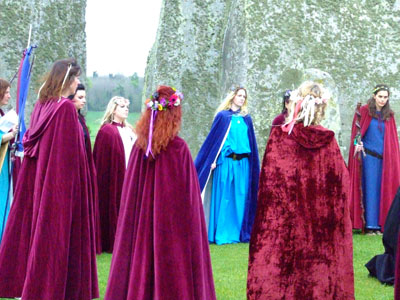
Life is beginning to stir again. The Celtic festival of Imbolc or Imbolg – pronounced without the ‘b’ sound – is sometimes known as Oimelc, means ‘ewe’s milk’ – named due to the birth of the first lambs at this time, and celebrates the return of fresh milk. Sheep are earlier with their offspring than cattle, because they could crop lower for grass and so thrive on the sparse vegetation in late winter. Cattle would calf around March. Bulbs are beginning to shoot and new lambs are born – the cycle of new life returns to the earth. Imbolc marks the rebirth of nature and fertility. It is the celebration of the gradual dawning of increasing light, bringing nature to life again. Nature is awakening from her winter rest – the long winter darkness begins to break as the daylight hours begin to get longer. Christians celebrate this festival as Candlemas.Stonehenge maidens - Imbolc

“As the light lengthens, so the cold strengthens”

Maidens
Imbolc focuses on the Goddess, both as Mother – as she gave birth to the Sun God at the Winter solstice, and as the Maiden. Brigit was originally considered a form of the Triple Goddess.
Imbolc is a feast dedicated to the Goddess in her maiden aspect, in her guise as Brigid, Bridget, Bride, Brighid, Brigit or Brig – goddess of learning, poetry, prophesying, craftmanship, agriculture and healing. Imbolc is considered a traditional healing time and it is a good time to consider ways to improve your health.

Brigid is the virgin goddess who brings new life to the earth. She is known as Bride in Scotland – pronounced Breed – which is the origin of the word ‘bride’. Imbolc is also known as Bride’s Day. She was christianised as St. Bridget of Kildare, the patroness of sheep and fertility, and she was also known as the ‘Mother of Ireland’.
Briget’s Cross is woven from corn and consists of four arms that meet to form a square centre – a fire wheel.
Traditionally, on this day candlelit processions were led to St. Bridget’s holy shrines – wells

Imbolc Traditions

Imbolc is a ‘fire festival’. particular attention was paid to the hearth fire and keeping it alight.
A celebratory dish used to be made from the new lambs’ docked tails.

Bridie dolls are made out of a sheaf of oats and dressed in women’s clothing, and then ritually buried in the earth as a fertility rite. Another custom was to place the doll in a ‘Bride’s bed’ of woven wheat, like a basket, which was placed near the front door, or sometimes near the hearth. A white candle was burnt nearby all night.

Spring cleaning comes from the habit at Imbolc of getting rid of unwanted clutter and preparing for the new season, physically and mentally.
Now is the time to finish old habits and make a fresh start, and realise the world is full of new opportunities.

Imbolc is a time of optimism and for making new plans for the sunny days ahead. Plant the seeds of your plans now and tend them so they mature into your hopes and dreams. Now is the time to renew your New Year resolutions.

Like many Celtic festivals, the Imbolc celebrations centred around the lighting of fires. Fire was perhaps more important for this festival than others as it was also the holy day of Brigid (also known as Bride, Brigit, Brid), the Goddess of fire, healing and fertility. The lighting of fires celebrated the increasing power of the Sun over the coming months. For the Christian calendar, this holiday was reformed and renamed ‘Candlemas’ when candles are lit to remember the purification of the Virgin Mary.

Imbolc is still a special time for Pagans. As people who are deeply aware of what is going on in the natural world they recognise that there is strength in cold as well as heat, death as well as life. The Horned God reigns over the Autumn and Winter and although the light and warmth of the world may be weak, he is still in his power.

Many feel that human actions are best when they reflect the actions of nature, so as the world slowly springs back into action it is time for the small tasks that are neglected through the busy year. Rituals and activities might include the making of candles, planting spring flowers, reading poetry and telling stories.

Links: http://www.druidry.org/obod/intro/festivals.html
Link: http://www.new-age.co.uk

Merlin says “It is called Imbolc in the Druid tradition, or sometimes Oimelc. Although we would think of Imbolc as being in the midst of Winter, it represents in fact the first of a trio of Spring celebrations, since it is the time of the first appearance of the snowdrop, and of the melting of the snows and the clearing of the debris of Winter. It is a time when we sense the first glimmer of Spring, and when the lambs are born. In the Druid tradition it is a gentle, beautiful festival in which the Mother Goddess is honoured with eight candles rising out of the water at the centre of the ceremonial circle.”

Blog Sponsored by ‘Stonehenge Guided Tours’ www.StonehengeTours.com

Merlin@ Stonehenge
The Stonehenge Website


Stonehenge opens to Druids for Vernal Equinox

26 03 2010
 

English Heritage site welcomes worshippers to mark the start of spring

Druids celebrate the sping equinox at Stonehenge(Panasonic)

A handful of lucky Druids took advantage of a rare opportunity to walk amongst Stonehenge this Saturday, 20 March in celebration of the Spring Equinox. Less than a hundred visitors, including Druids and pagan worshippers met at around 5.30am to watch the sunrise and welcome in the spring.

Despite the wet, windy weather, traditional customs such as blessings, chants and drum choruses went ahead in the middle of the ordinarily protected English Heritage site.

With characters dressed in outfits of white robes, floral headdresses, witches brooms and even stag’s antlers, attendees worshipped as the sun rose directly above the equator.

Despite heavy cloud cover, the gathered crowd enjoyed a brief glimpse of the sun before taking advantage of their rare chance to touch and interact with the stones.

Formal proceedings were overseen by renowned Arch Druid of Stonehenge Rollo MaughFling, leading both traditional chants and calling for more contemporary solutions, too. When talking about the upcoming General Election, the Arch Druid strayed away from a political bias and instead asked that, “Whoever is best fitted to lead us out of recession and back into prosperity be the party that wins as many people are suffering.”

One fellow Druid not afraid of showing his political stance was notorious eco-campaigner, Arthur Uther Pendragon, announcing his decision to run as an independent candidate in the forthcoming election.

“I have stood three times previously,” he told MSN UK, “The first time, I embarrassed the British National Party into last place, the second time, the new leader of the Monster Raving Looney Party into last place, and the third time I embarrassed myself into last place, but still polling 1% of the Vote.”

The day was also saw a posthumous appearance by Wally Hope, the founder of the Stonehenge festival. Since his death in 1975, the ashes of Wally Hope have been carried to the stones by their official keepers.


Concrete Post Henge is Oldest Structure In England

22 02 2010


English Heritage, working in conjunction with The National Trust, are fighting ‘tooth and nail’ to preserve the newly discovered ancient Henge found in Wiltshire, England.

Also located in Wiltshire is Stonehenge thought to have been erected in around 3000BC. Coincidently, Concrete Post Henge is only, a remarkable, fifty feet away from the former, just over a small hill. Chartered Surveyors were called to the scene immediately and were able to verify that the structure had been around since at least two days after The Big Bang. Primitive drill bit markings and circular saw striations were, apparently, the most obvious clues in the age determining process.

“I can’t believe we didn’t spot it before; it was right under our noses. The significance of this find cannot be underestimated. I’ve seen a few henges in my time, nobody knows what the heck a henge is yet, but I know this is a good one.”

National Trust stalwart Walter Ernest made only one comment to The Spoof:

“It’s a sad day here for us in Wiltshire. I’ve put my life, heart and soul into promoting ‘old stoney’ as the nation’s oldest treasure, since my divorce it’s been like a friend to me. No doubt some young bucks will get the job of looking after the new find and I’ll probably have to go back to a career
in druid stone circles now…”

Now that was funny! The story above is a satire or parody. It is entirely fictitious.

This was from the Spoof website.


Doctor Who filming at Stonehenge

5 02 2010


On Tuesday night, February 2, Wiltshire’s ancient stone monument was taken over by a film crew…..filming season five of BBC 1’s Doctor Who.

Exclusive leak….
Turns out that when the moon lies above the stone circle and the sun is on the opposite side of the earth, the stone circle acts as a gateway to a parallel time and place. Standing in the centre of the circle can allow one to be at one with the entire universe but unfortunately induces runaway ageing and exposure to other more evil personalities bent upon conquest. Dr Who finds himself imprisoned within the stone circle of an advanced extra-galactic civilisation and is held as a hostage until dastardly demands are met. The clock is running and the Doctor is rapidly ageing towards infancy. A twist in the tale is the entity that is allowed into the modern Human world when the stone circle is activated. Sadly, the choices are harsh…..either allow the proposed McDonalds drive-through planned for the Avenue, the bowling alley, the souvenir shop and the vast visitor facilities or, the Doctor will be wearing nappies for the remainder of this series and the evil personality (a hybrid mutation of David Icke and Schliemann) will win executive control of English Heritage.

Doctor Who at Stonehenge
Despite it being a closed set…
Local fans, braved the rain hoping to catch a glimpse of the action: “I’ve been a fan of Doctor Who since I was five, that’s 35 years now, and this has been the first chance I’ve had to see it being filmed.”

…plus returning professor River Song (Alex Kingston) have all been spotted on set – along with a brazier or two – the rumour is that the latest episodes including The Eleventh Hour, The Beast Below and Victory of the Daleks will all be set ‘some time in the past’.

With early filming reports claiming that the Doctor aka Matt Smith along with his sexy assistant Amy Pond played by Karen Gillan…