Tunnel could have an “adverse impact” on Stonehenge, an advisory body on World Heritage Sites has warned.

30 11 2014

Stonehenge fears over A303 road tunnel plan

A planned dual carriageway and road tunnel could have an “adverse impact” on Stonehenge, an advisory body on World Heritage Sites has warned.

The International Council on Monuments and Sites (Icomos), which advises Unesco, has expressed concern over plans for the project in Wiltshire.

The group wrote to Transport Secretary Patrick McLoughlin earlier in November.

An announcement about upgrading the whole A303 is expected in the chancellor’s Autumn Statement.

The options include a 1.6-mile (2.5km) tunnel or two longer 1.8-mile (2.9km) tunnels that would run south of the current A303 route.

Proposals to build a tunnel beside Stonehenge were dropped seven years ago because of cost, but lobbying has continued from local councils.

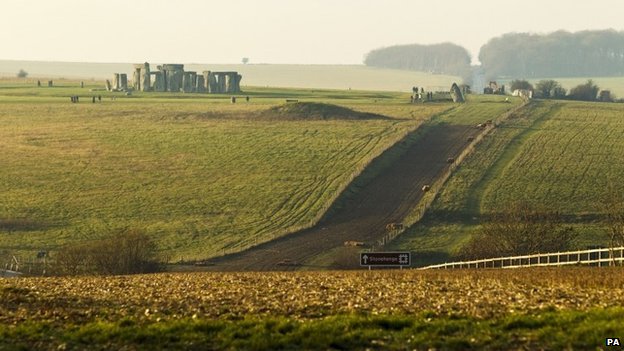
A303 past Stonehenge
The A303 currently passes right past the Stonehenge site in Wiltshire
Stonehenge
The site is near Amesbury, thought to be the longest continuous settlement in the UK

Despite the road layout at Stonehenge being changed, the stretch of single carriageway still has many traffic jams.

In a letter seen by the BBC, the UK branch of Icomos said it wanted the government to “fully engage” with the World Heritage Committee to find a solution that “respects and maintains” the value of the “iconic and unique site”.

“We appreciate the very real need to address the issue of the A303 and recognise that a tunnel could have beneficial impacts on parts of the World Heritage property,” Icomos said.

“However, we are concerned that associated portals and dual carriageways could have a highly adverse impact on other parts of the World Heritage landscape that cannot be set aside, however great the benefits of a tunnel.”

The Department for Transport said it had “worked closely with key organisations” and “no decisions” had yet been made.

English Heritage, which runs the Stonehenge site, said the bottleneck road was “highly detrimental” to the ancient monument.

“We have met with a representative of Icomos UK to explain the work we’ve done and sought feedback on it,” a spokeswoman said.

Article Source: http://www.bbc.co.uk/news/uk-england-wiltshire-30248826

The Stonehenge News Blog
https://twitter.com/ST0NEHENGE


Road tunnel under Stonehenge: Nick Clegg gives his backing to plans to improve the A303

10 10 2014

Deputy Prime Minister gives his backing to plans to improve the A303

Nick Clegg has said he wants the Government to sanction “diggers on the ground” to re-build the A303 highway before the next election.a303

A road tunnel under Stonehenge is one of nine proposals with an estimated cost of £1.2 billion being scrutinised by Whitehall officials to ease the traffic nightmare on the road connecting the South West to London.

The Government has signalled it will make an announcement during George Osborne’s autumn statement in December.

The Deputy Prime Minister said he and Lib Dem Chief Secretary to the Treasury, Danny Alexander, will be pushing for improvements on the 110-mile “A303-A30-A358 corridor”, which starts near Exeter in Devon and finishes close to Andover in Hampshire, in negotiations with David Cameron and Mr Osborne.

He said he was “very keen” to “push forward” with the A303. Mr Clegg said: “I can’t predict to you now exactly whether we will succeed in our discussions and all the sums involved, but that is something I would like to do even in this government.

“If we can’t do that in this coalition Government I’m very clear that the fiscal rules (we advocate) about borrowing prudently for infrastructure investment once the books are balanced after 2017-18 is exactly the kind of thing that would permit us to borrow money on the Government’s books to invest in the A303.

“But I very much hope we can see diggers in the ground and this arterial route properly unblocked well before then.”

The Western Daily Press understands officials are working up a plan to upgrade the entire road in phases, with stages signed off in advance. Some fear Labour would scupper the upgrade given their lack of MPs in the South West.

Full story: Western Daily Press:

Stonehenge News Blog


Bradford researchers help uncover hidden secrets of Stonehenge

12 09 2014

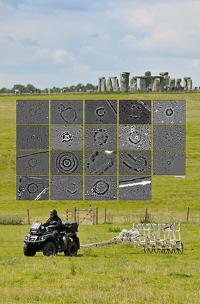
Bradford archaeologists are part of an international research team that has uncovered a host of previously unknown archaeological monuments around Stonehenge in a project that will transform our knowledge of this iconic site.

Operation Stonehenge: What Lies Beneath, can be seen on BBC iPlaver here: http://www.bbc.co.uk/iplayer/episode/b04hc5v7/operation-stonehenge-what-lies-beneath-episode-1

Results from the Stonehenge Hidden Landscapes Project are unveiled today at the Stonehenge_new_monumentsBritish Science Festival in Birmingham. They show how, using new remote sensing techniques and geophysical surveys, the team has uncovered 17 previously unknown ritual monuments around the site, along with dozens of burial mounds – all of which have been mapped in minute detail.

Researchers at the University of Bradford are partners in the project, which is led by the University of Birmingham and the Ludwig Boltzmann Institute for Archaeological Prospection and Virtual Archaeology, in Austria.

Alongside previously unknown features, the team has also uncovered new information on other monuments, including the Durrington Walls ‘super henge’, a vast ritual monument of more than 1.5 kilometers in circumference which is situated a short distance from Stonehenge.

Hundreds of burial mounds, and settlements from the Bronze Age, Iron Age and Roman period have also been surveyed at a level of detail never previously seen. Taken together, the results show how new technology is reshaping how archaeologists understand the landscape of Stonehenge and its development over a period of more than 11,000 years.

Dr Chris Gaffney, Head of Archaeological Sciences at Bradford, says: “The Stonehenge Hidden Landscapes project is the pinnacle of a recent trend to apply new and rapid technologies to collect accurate non-invasive data for mapping our buried heritage.

“In many respects, the Stonehenge project goes far beyond any other project – both in the complexity of the data sets generated but also in the immense impact it will have on our understanding of Britain’s greatest and best-known archaeological site.

He adds: “Archaeology studies the past, but, in the application of remote sensing at this scale, the Stonehenge Hidden Landscapes Project demonstrates how future researchers will investigate our archaeological heritage. Increasingly, the investigation and understanding of iconic sites across the globe will be enhanced by rapidly mapping the larger-scale environment that they have come to dominate.”

British project leader Professor Vincent Gaffney, Chair in Landscape Archaeology and Geomatics at the University of Birmingham, and Chris Gaffney’s brother, said:

“This project has revealed that the area around Stonehenge is teeming with previously unseen archaeology and that the application of new technology can transform how archaeologists and the wider public understand one of the best-studied landscapes on Earth.

“New monuments have been revealed, as well as new types of monument that have previously never been seen by archaeologists. All of this information has been placed within a single digital map, which will guide how Stonehenge and its landscape are studied in the future.

“Stonehenge may never be the same again.”

The results of the project will be featured in a major new BBC Two series, Operation Stonehenge: What Lies Beneath, is due to be broadcast at 8pm on Thursday 11 September.

Full article: http://www.bradford.ac.uk/life-sciences/news-and-events/news/bradford-researchers-help-uncover-hidden-secrets-of-stonehenge.php

The Stonehenge News Blog



Moving on from Stonehenge: Researchers make the case for archaeoastronomy

16 08 2014

The field of archaeoastronomy is evolving say researchers seeking a closer relationship between astronomy and merging of astronomical techniques and archaeology.

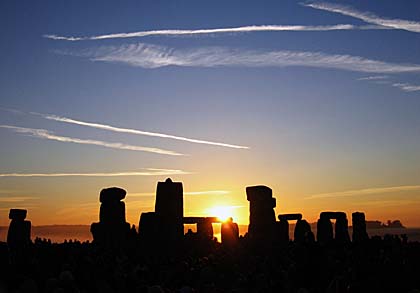
Summer Solstice Sunrise over Stonehenge 2005. Licensed under Creative Commons Attribution-Share Alike 2.0 via Wikimedia Commons

Summer Solstice Sunrise over Stonehenge 2005. Licensed under Creative Commons Attribution-Share Alike 2.0 via Wikimedia Commons

The merging of astronomical techniques with the archaeological study of ancient man-made features in the landscape could prove Neolithic and Bronze Age people were acute astronomical observers, according to researchers. 

Dubbed archaeoastronomy, the developing and sometimes maligned field takes a multi-disciplinary approach to exploring a range of theories about the astronomical alignment of standing stones and megalithic structures.

Some of these theories were highlighted recently at the 2014 National Astronomy Meeting in Portsmouth.

Archaeoastronomy expert Dr Fabio Silva of University College London has been studying 6000-year-old winter occupation sites and megalithic structures in the Mondego valley in central Portugal.

He said recent research shows that all the entrance corridors of passage graves in a necropolis in the valley aligned “with the seasonal rising over nearby mountains of the star Aldebaran, the brightest star of Taurus”.

Dr Silva believes this link between the appearance of the star in springtime and the mountains where the dolmen builders would have spent their summers “has echoes in local folklore” which recounts how the Serra da Estrela or ‘Mountain Range of the Star’ received its name from a shepherd and his dog following a star.

Some of the most debated claims about archeological alignment continue to be those relating to Stonehenge, which remains subject to a range of theories about solar and lunar alignments. Some archaeoastronomers are however keen to move the debate beyond the famous standing stones of Salisbury Plain.

Dr Daniel Brown of Nottingham Trent University, who presented updates on his work on the 4000-year-old Gardom’s Edge in the UK’s Peak District, which he believes to be astronomically aligned, said: “there’s more to archaeoastronomy than Stonehenge.

“Modern archaeoastronomy encompasses many other research areas such as anthropology, ethnoastronomy and even educational research.”

“It has stepped away from its speculative beginnings and placed itself solidly onto the foundation of statistical methods,” he added.

“However, this pure scientific approach has its own challenges that need to be overcome by embracing humanistic influences and putting the research into context with local cultures and landscape.”

Dr Silva, who is co-editor of the Journal for Skyscape Archaeology, which promotes the role and importance of the sky in archaeological interpretation, added: “We have much to gain if the fields of astronomy and archaeology come together to a fuller and more balanced understanding of European megaliths and the societies that built them.”

Article source: http://www.culture24.org.uk/history-and-heritage/archaeology/art495449 (By Richard Moss)

Merlin @ Stonehenge
The Stonehenge News Blog


Amesbury – including Stonehenge – is the UK’s longest continually-occupied settlement

6 05 2014

Amesbury in Wiltshire confirmed as oldest UK settlement.

A Wiltshire town has been confirmed as the longest continuous settlement in the United Kingdom.

Amesbury - including Stonehenge - is the UK's longest continually-occupied settlement

Amesbury – including Stonehenge – is the UK’s longest continually-occupied settlement

Amesbury, including Stonehenge, has been continually occupied since BC8820, experts have found.

The news was confirmed following an archaeological dig which also unearthed evidence of frogs’ legs being eaten in Britain 8,000 years before France.

Amesbury’s place in history has also now been recognised by the Guinness Book of Records.

David Jacques, from the University of Buckingham, said: “The site blows the lid off the Neolithic Revolution in a number of ways.

“It provides evidence for people staying put, clearing land, building, and presumably worshipping, monuments.

“The area was clearly a hub point for people to come to from many miles away, and in many ways was a forerunner for what later went on at Stonehenge itself.

“The first monuments at Stonehenge were built by these people. For years people have been asking why is Stonehenge where it is, now at last, we have found the answers.”

Mr Jacques said the River Avon, which runs through the area, would have been like an A road with people travelling along it.

“They may have had the equivalent of local guides and there would have been feasting,” he added.

“We have found remains of big game animals, such as aurochs and red deer, and an enormous amount of burnt flint from their feasting fires.”

_74573559_74573557

The dig unearthed the largest haul of worked flints from the Mesolithic period

Previously, Thatcham in Berkshire, 40 miles from Amesbury, held the record for the longest continuous settlement in the country.

The dig in Amesbury also uncovered 31,000 worked flints in 40 days as well as animal bones such as frogs’ legs.

Mr Jacques said our ancestors were eating a “Heston Blumenthal-style menu”.

The find was based on a report by fossil mammal specialist Simon Parfitt, of the Natural History Museum.

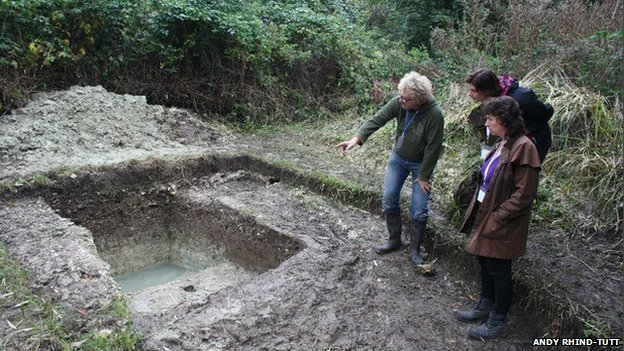
Andy Rhind-Tutt, the founder of Amesbury Museum and Heritage Trust, said there was “something unique and rather special about the area” to keep people there from the end of the Ice Age, to when Stonehenge was created and until today.

“The fact that the feasting of large animals and the discovery of a relatively constant temperature spring sitting alongside the River Avon, may well be it,” he said.

The dig was filmed and made into a documentary by the BBC, Smithsonian, CBC and others to be screened later in the summer.

The project was led by the University of Buckingham

Article source: BBC http://www.bbc.co.uk/news/uk-england-wiltshire-27238503

Historic Amesbury – the Home of Stonehenge

Nestling within a loop of the River Avon alongside the A303 just 1.5 miles from Stonehenge, Amesbury is a destination not to be missed. With recent evidence of continuous settlement since before 7500BC and a breath-taking Mesolithic collection that is greater in quantity (from one single location) than any other found in this country, the town’s new Museum at the Melor Hall, Church Street will amaze visitors with its story of life before the Stones and its mind blowing artefacts from the Town where History began.

Visit Wiltshire Website: http://www.visitwiltshire.co.uk/ideas-and-inspiration/amesbury-museum-and-heritage-centre-p1536253

Amesbury Museum and Heritage Trust: https://www.facebook.com/AmesburyMuseum

Salisbury Reds (transport to and from Amesbury): http://www.salisburyreds.co.uk/ptv-amesbury.shtml

Local Tour Operators including Amesbury and Stonehenge:
Salisbury, Stonehenge and Sarum Audio Tours: http://www.salisburystonehengetours.co.uk/
The Stonehenge Travel Company: http://www.StonehengeTravel.co.uk

The Stonehenge News Blog


Stonehenge tunnel plans could be revived

25 04 2014

Tunnel beneath Stonehenge could be reconsidered as part of plans to ease traffic congestion

Plans for a 1.3 mile road tunnel beneath the site and bypass have been proposed before but were dropped in 2007 due to the estimated £470 million cost

Plans for a 1.3 mile road tunnel beneath the site and bypass have been proposed before but were dropped in 2007 due to the estimated £470 million cost Photo: ALAMY

Plans to build a road tunnel under Stonehenge could be revived as the Government looks to ease bottlenecks on some of Britain’s most congested stretches of road.

A study to be completed this summer will consider whether a dual carriageway or underground tunnel could solve the traffic problem caused by drivers slowing down to admire one of Britain’s most famous world heritage sites.

Plans for a 1.3 mile road tunnel beneath the site and bypass have been proposed before but were dropped in 2007 due to the estimated £470 million cost.

Yesterday, the Government outlined detailed plans for a “feasibility study” which will examine all possibilities for easing congestion along the route.

It pledged to deliver its final proposals in this year’s Autumn Statement along with the findings of five similar road-widening proposals on the A27 corridor, the A47 between Peterborough and Great Yarmouth, Trans-Pennine routes and two areas of the A1 around Newcastle.

Countryside campaigners attacked the plans which they claimed would scar beauty spots by laying extra tarmac along stretches of land which have remained untouched since Roman times.

Plans to widen the A27 include parts of the South Downs, Britain’s newest national park, while parts of the Norfolk Broads national park and the Northumberland coast could be affected under plans for the A47 and A1, they said.

The A303/A30/A358 corridor, which forms the main route from London to the south west, was highlighted by ministers last summer as one of six areas where solutions were urgently needed for the country’s most “notorious and long standing” congestion hot spots.

The A303 in particular is frequently gridlocked during summer weekends at a number of points where the dual carriageway narrows to a single lane, bringing holiday traffic to a standstill.

The feasibility study will “look to initially build on work done to date on potential proposals” rather than drawing up new solutions, beginning several plans for new stretches of dual carriageway including a 12km passage from Amesbury to Berwick Down (Stonehenge).

But the study will also “draw upon” work from a range of other projects including historic plans to tunnel beneath the prehistoric monument, with sources insisting all options are on the table.

The Campaign to Protect Rural England said several of the spots under examination, including Stonehenge, are only congested at certain times of year and do not merit major development.

Ralph Smyth, senior transport campaigner for the CPRE, said: “The traffic [at Stonehenge] hasn’t increased in the last 10 years and it does not justify the huge cost of a tunnel.”

A long tunnel would at least be preferable to a dual carriageway at the surface, which could cause the historic site to lose its world heritage status, he added.

Last month John Glen, Conservative MP for Salisbury, said a tunnel was the “only realistic” solution to protect Stonehenge while solving traffic problems which he said had turned the stretch into the “devil’s highway”.

A spokesman for the Department for Transport said the six studies would “develop solutions to some of the most notorious and  long-standing hot spots on the national road network.”

An English Heritage spokesman said: “We want to make certain the necessary improvements to the A303 are delivered in a way that will ensure the protection of the Outstanding Universal Value of the Stonehenge World Heritage Site.”

By , Transport Correspondent: Full article: http://www.telegraph.co.uk/news/uknews/road-and-rail-transport/10783496/Stonehenge-tunnel-plans-could-be-revived.html

The Stonehenge News Blog


Stonehenge News: Stones may be moved to new visitor centre

1 04 2014

A leaked report has revealed that English Heritage intend to move the Stones from the current location closer to the new visitor centre. Visitors currently have to travel some 2km by land train to the Stone Circle and it makes perfect commercial sense to make the monument more accessible to visitors. All plans are subject to approved planning permission

The Heritage Lottery could help fund moving the Stones

The Heritage Lottery could help fund moving the Stones

A recent customer survey also revealed that 95% of 2014 visitors ‘agree’ or strongly agree’ that it would be a better experience if the Stones were closer to the souvenir shop, toilets, cafe and museum. This would also reduce carbon footprint and save valuable sightseeing time.

Local archaeologists support the idea and would give archaeological evidence as to how the Stones were moved in the first place. They would use ancient skills and technologies and could utilise the volunteers from the Neolithic house project. Concerns have now been raised about the ancient monuments act of 1913, but experts are confident a solution could be found.

Davinvi Construction, the current contractor who are completing the landscape restoration work said it would make sense to move the Stones this summer whilst they have heavy plant machinery and skilled labour on site, although it may be tricky moving some of the larger rocks, they added.

Circular stadium seats could surround the monument during the busy Solstice events and even a 3D simulation of the sunset and sunrise could amaze audiences from around the world. Suggestions of a glass roof covering the entire monument could overcome the poor weather conditions often experienced on the Solstice and guarantee a perfect sunrise every time.

Larkhill Commanding Officer Will Ruinit was delighted to hear the latest proposal and can now fast track the MOD plans to erect watch towers and a new missile base on the Solstice ‘sun gap’ alignment without further protests.

At time of going to press local Druid, King Arthur was unavailable for comment but a spokesman quoted “He will definitely not be happy.”

Have your say
There will be an opportunity to voice your concerns at the ‘Who’d a Thought It Inn’ Lockeridge, near Marlborough on April 8th. See you next Tuesday.
Please send you comments and feedback to Aprilfool@gottcha.com


Neolthic Houses at Stonehenge Visitor Centre

25 03 2014

NEOLITHIC buildings are being painstakingly recreated in the new outdoor exhibition area of the Stonehenge visitor centre.

Salisbury Journal: Neolithic houses at Stonehenge

Neolithic houses at Stonehenge

When complete, the houses will showcase what life would have been like at the time that Stonehenge was built. The re-created huts are based on archaeological evidence unearthed at the nearbyDurrington Walls.


Volunteers are weaving hundreds of hazel rods through the main supporting stakes, thatching the roofs with hand-knotted wheat straw, and starting to cover the walls with a daub of chalk, straw and water.

Once the buildings are completed, volunteers will be on hand to talk to visitors about the project and to demonstrate the daily activities of our Neolithic ancestors.


Link source:
Salisbury Journal http://www.salisburyjournal.co.uk/news/11097745.Neolithic_houses_at_Stonehenge/

Link resource:
Follow their progress here: http://neolithichouses.wordpress.com/
English Heritage Link: http://www.english-heritage.org.uk/daysout/properties/stonehenge/discover/neolithic-houses

Follow the project and progress on Twitter:

https://twitter.com/ST0NEHENGE

Merlin at Stonehenge
The Stonehenge and local area news blog


Stonehenge bluestones had acoustic properties, study shows

4 03 2014

The giant bluestones of Stonehenge may have been chosen because of their acoustic properties, claim researchers.

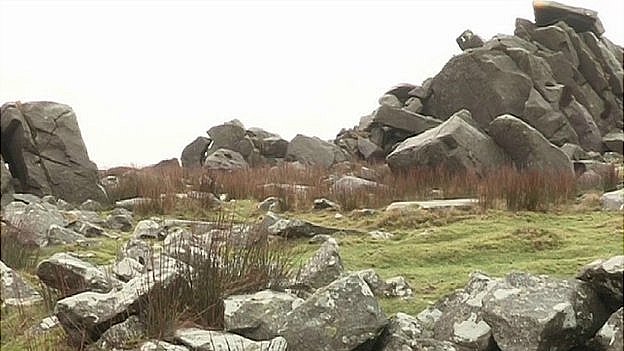
A study has discovered that rocks in the Preseli Hills, the source of some the stones at Stonehenge, have a sonic property

A study has discovered that rocks in the Preseli Hills, the source of some the stones at Stonehenge, have a sonic property

A study shows rocks in the Preseli Hills, the Pembrokeshire source of part of the monument, have a sonic property.

Researcher Paul Devereux said: “It hasn’t been considered until now that sound might have been a factor.”

The study, by London’s Royal College of Art, was to try and record what “Stone Age eyes and ears” would have heard and seen in a prehistoric landscape.

Since the 1920s, it has been known stones quarried in Mynydd Preseli were hauled 199 miles (320 km) to Wiltshire by its makers. But, trying to establish why has been more difficult.

‘Like a bell’

With this study, thousands of stones along the Carn Menyn ridge were tested and a high proportion of them were found to “ring” when they were struck.

“The percentage of the rocks on the Carn Menyn ridge are ringing rocks, they ring just like a bell,” said Mr Devereux, the principal investigator on the Landscape and Perception Project.

“And there’s lots of different tones, you could play a tune.

“In fact, we have had percussionists who have played proper percussion pieces off the rocks.”

Thousands of stones along the Carn Menyn ridge were tested and a high proportion were found to "ring" when struck

Thousands of stones along the Carn Menyn ridge were tested and a high proportion were found to “ring” when struck

According to Mr Devereux, the discovery of the “resonant rocks” could explain why they were selected for Stonehenge.

“There had to be something special about these rocks,” he said.

“Why else would they take them from here all the way to Stonehenge?”

‘Pre-historic glockenspiel’

Built between 3,000 BC and 1,600 BC, it has remained a mystery why the monument’s bluestones were lugged all the way from north Pembrokeshire.

But Prof Tim Darvill, who has undertaken hundreds of excavations at Stonehenge, insists “pre-historic attitudes to stone” must have been very different to those of today.

“We don’t know of course that they moved them because they rang but ringing rocks are a prominent part of many cultures,” he said.

“You can almost see them as a pre-historic glockenspiel, if you like and you could knock them and hear these tunes.

“And soundscapes of pre-history are something we’re really just beginning to explore.”

Inside Out was on  BBC1 at 19:30 GMT on Monday.
Full article here: http://www.bbc.co.uk/news/uk-england-wiltshire-26417976

Merlin @ Stonehenge
The Stonehenge News Blog


Another piece in Stonehenge rock source puzzle.

20 11 2013

Research to be published this month may bring us a step closer to understanding how bluestones from Pembrokeshire ended up at Stonehenge. A team of geologists have identified a hill in the Preseli Hills as the site from which 11 stones known as spotted dolerites were transported to Stonehenge

Scientists from Aberystwyth University, University College London and National Museum of Wales have located the specific outcrop, Carn Goedog, in the Preseli Mountains.

The chances of Stonehenge's spotted dolerites not coming from Carn Goedog are 'infinitesimally small'

The chances of Stonehenge’s spotted dolerites not coming from Carn Goedog are ‘infinitesimally small’

This is where the distinctive spotted dolerites originated.

The findings are to be published in the Journal of Archaeological Science.

Geologist Herbert Henry Thomas first proposed in 1923 that the rocks which form the giant inner ring were specifically quarried for Stonehenge by Neolithic man around 5,000 years ago, and were hauled to Wiltshire via land and sea.

However, other geologists theorise that they were carried east on an ice-age glacier 20,000 years ago.

“Trying to match the rocks at Stonehenge to a specific outcrop is considerably more complicated than looking for a needle in a haystack”

End Quote Dr Richard Bevins National Museum Wales

While the new discovery will not answer the debate, according to Dr Richard Bevins, of the National Museum Wales, it may eliminate some of the unknown variables.

“I’m not here to come down on one side of the argument or the other,” he explained.

“But our research is aimed at better informing the debate.”

Dr Bevins, keeper of natural sciences, added: “Trying to match the rocks at Stonehenge to a specific outcrop is considerably more complicated than looking for a needle in a haystack but the more we can trace them back to their original source, the closer archaeologists and geologists can hunt for clues to back-up their theories.

Rock sample The research has brought together archaeologists and geologists

“Archaeologists can now search an area of hundreds of metres rather than hundreds of kilometres for evidence of Neolithic quarrying.

“While geologists supporting the glacier theory know exactly where to hunt for the scarring they’d expect to find on the landscape if enormous chunks of the stone had indeed been swept east on a glacier.”

As the name suggests, the spotted dolerites have highly distinctive markings created by the elements contained within, cooling at different rates in the minutes after they were spewed out of an underwater volcano 450 million years ago.

In 2011, Dr Bevins’s team located the source of another of Stonehenge’s Pembrokeshire Bluestones – the rhyolites – 3km away from the spotted dolerites at Craig Rhos y Felin.

Although the relative proximity of the two discoveries offers evidence to both camps.

“Three kilometres is both closer and farther away than expected, depending on which theory you support.

“From a geologist’s point of view, 3km is nothing, and the rocks which ended up close to each other in Wiltshire could easily have been carried on the same glacier.

“However, for the archaeologists a distance of 3km between the potential quarries could be seen as evidence of planning and forethought, and a suggestion that the different types of stone were chosen for some specific purpose.”

‘Each piece of the puzzle’

Dr Bevins’s team are able to say so categorically that they have discovered the source of the spotted dolerites thanks to a range of laser mass spectrometry techniques which analyse both the chemical composition of the rock and the microbiology present when it was formed.

He says that the chance of them having originated anywhere other than Carn Goedog is “statistically-speaking, infinitesimally small”.

And while he is the first to admit that this discovery on its own gets us no closer to solving the riddle, he believes a definitive answer will come eventually.

“I’ve been studying the bluestones for over 30 years now, and I’m no closer to finding an answer which convinces me either way. But the one thing which I am increasingly sure of is that each piece of the puzzle we find brings us another step closer to the truth.

“We’ve located two of the sources, and there’s another five or possibly six to go.”

He added: “By the time we have identified those then I’m certain we’ll have an answer either way. Whether that happens in my career, or even my lifetime, who knows?”

By Neil Prior BBC News: http://www.bbc.co.uk/news/uk-wales-25004282

Link:http://www.walesonline.co.uk/news/wales-news/origin-stonehenges-blue-stones-pinpointed-6317230

Follow Stonehenge News on Twitter: https://twitter.com/ST0NEHENGE

Merlin @ Stonehenge
The Stonhenge News Blog