Memory Code: The Memory Technique That Unlocks the Secrets of Stonehenge and Ancient Monuments the World Over.

21 02 2017

The memory technique that unlocks the secrets of Stonehenge, Easter Island and ancient monuments the world over. Lynne Kelly has discovered that a powerful technique used by the ancients can unlock the secrets of the Neolithic stone circles of Britain and Europe

Without writing, indigenous elders memorised a vast amount of factual information onmemorycode which survival depended both physically and culturally: knowledge of thousands of animals and plants, astronomical charts, vast navigation networks, genealogies, geography and geology … the list goes on and on. How did they remember so much? And why does this explain the purpose of ancient monuments including Stonehenge, Easter Island and the Nasca Lines? Can we use these memory methods in contemporary life?

This lecture will focus on the transmission of scientific and practical knowledge among small-scale oral cultures across the world, drawing on Australian Aboriginal, Native American, African and Pacific cultures. Dr Kelly will explain the exact mechanisms used and why this explains the purpose of many enigmatic monuments around the world. We have a great deal to learn from the extraordinary mnemonic skills of indigenous cultures.

Dr Lynne Kelly is a science writer and Honorary Research Associate at Latrobe University, Australia. Her most recent books are Knowledge and Power in Prehistoric Societies: orality, memory and the transmission of culture (Cambridge University Press) and The Memory Code (Atlantic Books).

Wednesday 22nd February, University of Nottingham: Indigenous memory and Stonehenge – yes, there is a link, Workshop and public lecture. Click here to book

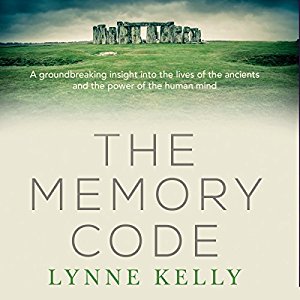
The Memory Code
The Allen & Unwin description:

Lynne Kelly has discovered that a powerful memory technique used by the ancients can unlock the secrets of the Neolithic stone circles of Britain and Europe, the ancient Pueblo buildings in New Mexico and other prehistoric stone monuments across the world. We can still use the memory code today to train our own memories.

In the past, the elders had encyclopaedic memories. They could name all the animals and plants across the landscape, and the stars in the sky too. Yet most of us struggle to memorise more than a short poem.

Using traditional Aboriginal Australian songlines as the key, Lynne Kelly has identified the powerful memory technique used by indigenous people around the world. She has discovered that this ancient memory technique is the secret behind the great stone monuments like Stonehenge, which have for so long puzzled archaeologists.

The stone circles across Britain and northern Europe, the elaborate stone houses of New Mexico, the huge animal shapes at Nasca in Peru, and the statues of Easter Island all serve as the most effective memory system ever invented by humans. They allowed people in non-literate cultures to memorise the vast amounts of practical information they needed to survive.

In her fascinating book The Memory Code, Lynne Kelly shows us how we can use this ancient technique to train our memories today.

Praise for The Memory Code:

As we rediscover the extraordinary endurance of the oral memories of people who do not depend on writing, and as we begin to rediscover that many of those memories include knowledge of distant times, Lynne Kelly has explored how vast, non-written memory systems can work. She explores the notion that memories were or are encoded in spaces that can be marked by natural or build elements and applies that exploration to some of the remarkable physical monuments of the last ten thousand years. She takes the reader on a fascinating journey into the past and around the world and into the minds of people who would not need to publish a book like this. They already knew it. An engaging and exciting read.
Iain Davidson, Emeritus Professor, University of New England

Dr Kelly has developed an intriguing and highly original account of the purpose of Stonehenge, Avebury and other stone monuments. The depth and breath of her research, and experimental experience she has brought to study, command respect and invite serious attention.
Dr Rosamund Cleal, Museum Curator, Alexander Keillor 

Visit her website and blog here

The Stonehenge News Blog
Follow us on Twitter and Facebook for all the latest Stonehenge News
http://www.Stonehenge.News


Stonehenge tunnel plans finalised by government.

12 01 2017

Long-awaited plans for a road tunnel past Stonehenge have been finalised by the government.

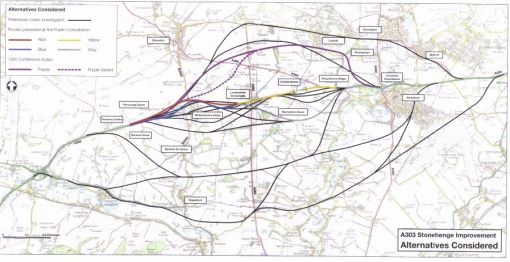
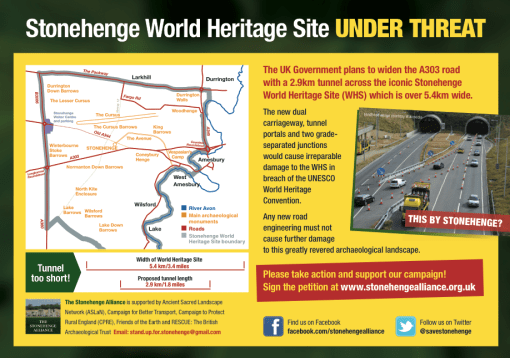
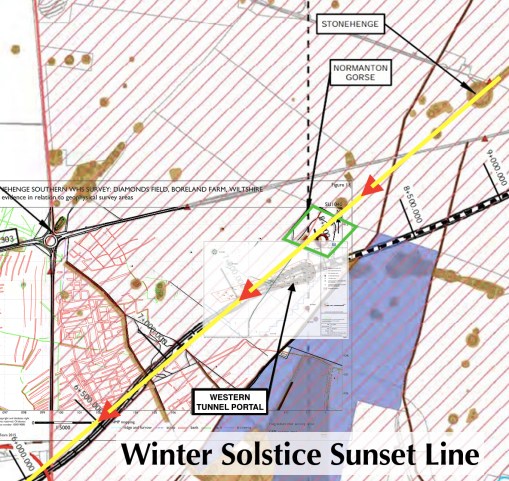
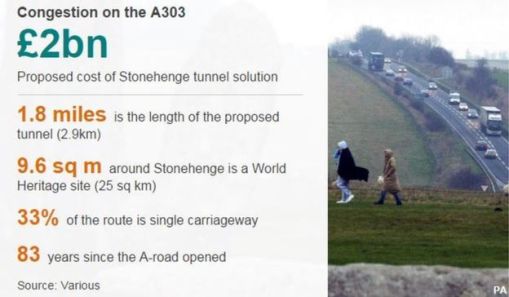
The proposal for a 1.8-mile (2.9 km) dual carriageway tunnel is aimed at easing congestion on the nearby A303.

a303

The proposals involve building a tunnel for the A303 which runs past the ancient monument

Transport Secretary Chris Grayling said the proposal will “transform’ the road and benefit people by “cutting congestion and improving journey times”.

A public consultation aimed at drivers and residents will run until 5 March.

The tunnel plans form part of a £2bn government scheme to upgrade all remaining sections of the A303 between the M3 and M5.

Highways England’s Jim O’Sullivan said: “Our plans for the A303 recognise the national importance of the route and these improvements will bring real benefit to the region and local communities.

“The public exhibitions will provide an excellent opportunity to explain further our plans and to hear feedback from stakeholders on our proposals to deliver the scheme.”

A report by UNESCO and the International Council on Monuments and Sites has recognised the benefits of the project.

At the moment the busy A303 passes within a few hundred metres of the ancient monument.

However, campaign group Stonehenge Alliance believes any tunnel shorter than 2.7-miles (4.3 km) would do “irreparable damage to the landscape”.

In 2015 it launched a petition calling for a longer tunnel which gained 17,500 signatures.

A spokesperson said: “The Alliance does not advocate new road building at Stonehenge but accepts the need to improve the tranquillity and appearance of the World Heritage Site and its setting.

“If the government insists on widening the A303 by means of a tunnel it must be sufficiently long to avoid any further damage to [Stonehenge] and its setting.”

English Heritage and the National Trust have also given their support to the option of “the longest tunnel possible”.

Chairman of Amesbury Museum and Heritage Trust Andy Rhind-Tutt described the tunnel plan as a “self-destructing time bomb” which would “do nothing” for traffic problems in the area.
BBC NEWS

The Stonehenge News Blog
Follow us on Twitter and Facebook for all the latest Stonehenge News


English Heritage are hiring a new ‘solstice coordinator’ at Stonehenge.

12 01 2017

How would you like to help organise this year’s solstice celebrations at Stonehenge?

English Heritage is advertising for a solstice coordinator to help put on seasonal gatherings at the ancient site near Salisbury.

The successful candidate will be tasked with arranging access to the stones during pagan celestial celebrations.

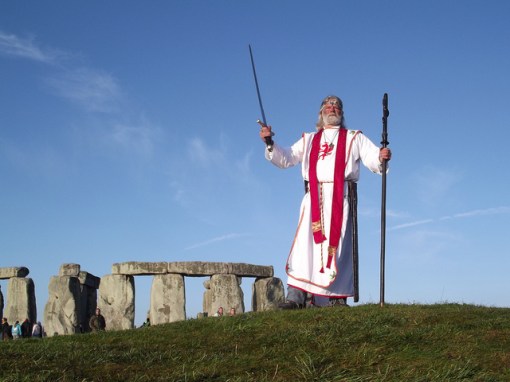
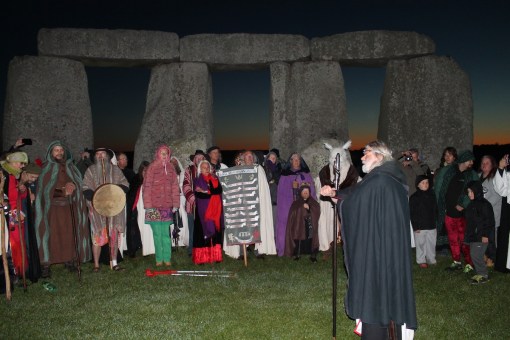
Druid greets the dawn at Stonehenge

Druids were traditionally allowed to attend Stonehenge for free on the solstice but there has been controversy recently over parking charges.

English Heritage is looking for somebody to: “Coordinate the planning and delivery of safe managed open access to Stonehenge for celebration of the summer solstice, winter solstice, spring and autumn equinoxes (and any other agreed seasonal gatherings).”

The salary is £20,000 pro rata on a part time basis working 14 hours a week and you must be available overnight on the night of each seasonal gathering.

There is a history of tension between the druid and pagan communities and English Heritage. Last year tempers flared when King Arthur Pendragon, Britain’s head druid said high parking charges meant solstice visitors had to ‘pay to pray’ at the sacred stones. English Heritage has also accused protestors of ‘vandalising’ the site.

According to the job advertisement, “The right person for this role will have excellent organisational skills and experience of organising events and controlling budgets. Resilience, empathy, diplomacy and a good sense of humour are a must.”

English Heritage cares for over 400 historic buildings, monuments and sites – from world famous prehistoric sites to grand medieval castles; from Roman forts on the edges of empire to a Cold War bunker.
Article by By JoeTSmith SomersetLive

Visit the English Heritage Jobs page

The Stonehenge News Blog
Follow us on Twitter and Facebook for all the latest Stonehenge News


Stonehenge, King Arthur and Merlin

8 01 2017

Merlin makes his first appearance in the Stonehenge story in Book 8, Chapter 10, of Geoffrey of Monmouth‘s epic work “Historia Regum Britanniae” (The History of the Kings of Britain, c. 1136AD) when Aurelius Ambrosius – recently annointed King of Britain and the brother of Uther Pendragon – seeks his advice for a lasting memorial to the British princes treacherously slain by the Saxons during a truce.

Merlin says:
“If you are desirous to honour the burying-place of these man with an everlasting monument, KIng Arthurs Merlin at Stonehengesend for the Giant’s Dance, which is in Killaraus, a mountain in Ireland. For there is a structure of stones there, which none of this age could raise without a profound knowledge of the mechanical arts. They are stones of a vast magnitude and wonderful quality; and if they can be placed here, as they are there, round this spot of ground, they will stand for ever.”
When Aurelius laughs at the idea of going such a long way when there are ample stones in Britain, Merlin continues:

“I entreat your majesty to forbear vain laughter; for what I say is without vanity. They are mystical stones, and of a medicinal virtue. The giants of old brought them from the farthest coasts of Africa, and placed them in Ireland, while they inhabited that country. Their design in this was to make baths in them, when they should be taken with any illness. For their method was to wash the stones, and put their sick into the water, which infallibly cured them. With the like success they cured wounds also, adding only the application of some herbs. There is no a stone there which has not some healing virtue.”

And so off to Ireland goes Uther along with Merlin and 15,000 men to fetch the Giant’s Dance.

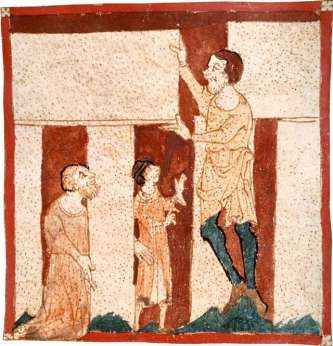
Robert Wace’s Roman de Brut from about 1155AD retells this story for a Norman French audience. A 14th Century manuscript version of the Brut accompanies the tale with an illustration of Merlin carrying out the work of re-erecting the monument, employing a giant to help him (a detail that Wace added that wasn’t in Geoffrey’s original text).

Aurelius subsequently dies – poisoned by a Saxon at Winchester – and is buried near the Giant’s Dance, reputedly in the largest barrow on Coneybury Hill (Amesbury G23 “King Barrow”) according to local tradition written down by Stukeley in the 18th Century.

Uther succeeds Aurelius and then Uther’s son Arthur receives the crown after Uther also succumbs to Saxon poison whereupon “the bishops and clergy of the kingdom assembled, and carried his body to the convent of Ambrius, where they buried it with regal solemnity, close by Aurelius Ambrosius, within the Giant’s Dance.”

Arthur’s famous exploits are well documented in the romances, but ultimately Geoffrey reports him mortally wounded and departed to the Isle of Avalon, to be replaced by Constantine, son of Cador of Cornwall.

Constantine was eventually killed by Conan and “buried close by Uther Pendragon within the structure of stones, which was set up with wonderful art not far from Salisbury, and called in the English tongue Stanheng”.

There is only one documented burial of a body actually within the centre of the stone circle of Stonehenge itself, known as WA2724, which was discovered by Col. William Hawley in 1926. Whether this is either Uther or Constantine (or neither) is unknowable and the dating is difficult since the burial was badly disturbed and found with pottery from medieval to Bronze Age in date plus a Roman coin and some Victorian and Georgian artifacts as well.

The next nearest inhumation is from fractionally outside the circle on the east side, known as WA1676 and discovered by Hawley in 1923. This person was decapitated from behind, probably with a sword, and then unceremoniously stuffed into a grave not big enough for the body. It does date from Anglo-Saxon times, around 650AD. Interestingly, the very first radiocarbon date for this burial was commissioned by a Welsh dentist called Wystan Peach in 1975 – he was convinced the bones were those of King Arthur himself and published a booklet describing his theory in 1961.

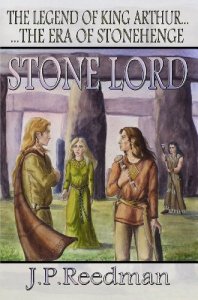
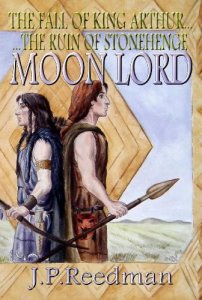
More recently two novels have sought to place Arthur and Merlin back in the Bronze Age at the time of the construction of Stonehenge rather than in the post-Roman Dark Ages – “Stone Lord” and “Moon Lord”, by J.P. Reedman. Drawing on the latest archaeological discoveries from the Stonehenge landscape these novels are a fascinating addition to the mythology of these legendary characters that are so iconic to the British sense of self.

stonelord moonlord

Article by guest blogger and local Stonehenge historian Simon Banton

MoonLord: The Fall of King Arthur – The Ruin of Stonehenge.  Buy on Amazon
StoneLord: The Legend Of King Arthur, The Era Of Stonehenge. Buy on Amazon
Visit Janet Reedmans Blog for more information

Recent Blog: Druid Leader King Arthur Uther Pendragon, Head of the Loyal Arthurian Warband.

English Heritage: The King Arthur Story and links to Arthurian locations
BBC HistoryKing Arthur, ‘Once and Future King’

Stonehenge Guided Tours offer King Arthur Tours including Stonehenge and associated sites in the South West of England.

The Stonehenge News Blog
Follow us on Twitter and Facebook for all the latest Stonehenge news and stories.


Thousands gathered at Stonehenge to celebrate the winter solstice

22 12 2016

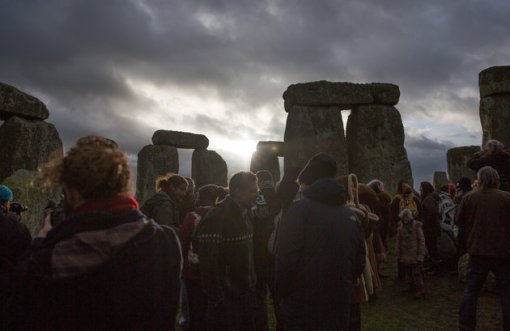
Thousands of people gathered at Stonehenge to celebrate the winter solstice.

solstice2016

Stonehenge was built over 5,000 thousands years ago and remains a place of spiritual significance for many. Credit: PA

Druids and pagans were among the crowd that watched the sun come up at 8.13am on the shortest day of the year.

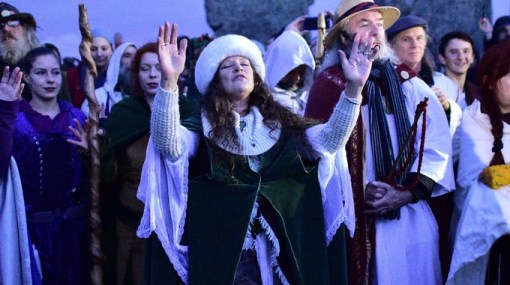
People, some dressed in traditional pagan clothing, danced, played musical instruments and kissed the ancient stones.

One South African woman said she had made the trip to the UK “especially for the solstice”.

She said: “I am a Pagan, a witch and this is about the best place to be.”

Kate Davies from English Heritage, who manage the prehistoric monument in Wiltshire, said: “We were delighted to welcome approximately 5,000 people to Stonehenge to celebrate winter solstice this morning.

It was a very enjoyable and peaceful celebration and the ancient stone circle was filled with the sound of drumming and chanting.”

There will be just seven hours, 49 minutes and 41 seconds of daylight on 21 December, almost nine hours less than the year’s longest day in June.

Stonehenge was built over 5,000 thousands years ago and remains a place of spiritual significance for many people.

Crowds gather at the UNESCO World Heritage Site on the shortest and longest days of the year as the stones are aligned to the sunset of the winter solstice and the opposing sunrise of the summer solstice.

Some experts believe the winter solstice was more important to our ancient ancestors than the summer solstice as the longest night marked a turning of the year as the days begin to grow longer.

Article source: ITV NEWS

The Stonehenge News Blog
Follow us on Twitter and Facebook for all the latest Stonehenge News and Stories


Why Thousands Of Pagans Gather At Stonehenge For The Winter Solstice

17 12 2016

The prehistoric site holds spiritual significance for many Pagans and Druids.

While some are buying presents and trimming their tree for Christmas, a very different kind of spiritual celebration gets underway every year at Stonehenge. It’s the winter solstice, also known as Yule in some Pagan circles, and the occasion draws thousands of Pagans, Druids, spiritual seekers and tourists to the prehistoric site for a reverent and ecstatic ceremony.

solstice-inner

The sun peeks through clouds during a winter solstice ceremony at the ancient neolithic monument of Stonehenge near on December, 2015. MATT CARDY VIA GETTY IMAGES

The December solstice marks the longest night and shortest day of the year in the Northern Hemisphere, and this year it falls on Wednesday, December 21 at 5:44 EST.

In ancient Pagan traditions, the winter solstice was a time to honor the cycles of life and death and celebrate the sun’s rebirth as the days would slowly begin to lengthen in the months leading into spring. Many modern practitioners of Pagan and earth-centered spiritual traditions observe the holiday, and at Stonehenge, the celebration is particularly special.

Stonehenge, which celebrates its 30th year as a World Heritage site this year, is believed to be roughly 4,500 years old. Its significance as a link to British prehistory has drawn countless visitors over the years who come to gaze upon what’s considered to be the most architecturally advanced, prehistoric stone circle on the globe.

Apart from its architectural significance, Stonehenge holds a place of sacred importance to many. Much of its history is still shrouded in mystery, though one thing that’s sure is that it was built upon a landscape that had long been used for religious purposes. The stones that make up the massive circle are thought to have been collected from distant places, some as far as 150 miles away, and brought to this particular location. They were then erected using sophisticated, interlocking joints ― but how exactly the builders accomplished these feats is unclear.

It’s also unclear what exact purpose the site served to those who built it. English Heritage, a UK-based charity, notes that speculations on Stonehenge’s original function include “a coronation place for Danish kings, a Druid temple, an astronomical computer for predicting eclipses and solar events, a place where ancestors were worshipped or a cult centre for healing.”

rolo-solstice

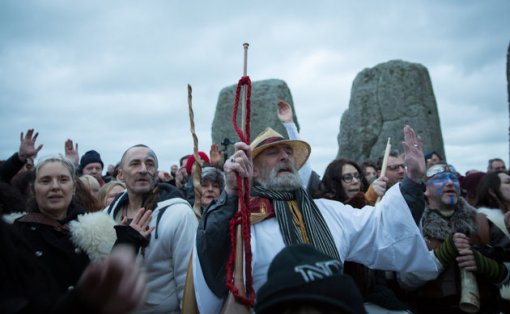
Rollo Maughfling, Archdruid of Stonehenge & Britain, conducts a winter solstice ceremony at Stonehenge on December 22, 2015 in Wiltshire, England. MATT CARDY VIA GETTY IMAGES

Whatever its intended purpose, Stonehenge remains a place of wonder for thousands who visit the awe-inspiring structure every year. And its significance is especially potent at the winter solstice.

“One of the most important and well-known features of Stonehenge is its alignment on the midwinter sunset-midsummer sunrise solstitial axis,” a spokesman for England Heritage told BBC. “The midwinter sun sets between the two upright stones of the great trilithon.”

In other words, on the two annual solstices ― summer and winter ― the sun respectively rises and sets in perfect alignment with the site’s massive stones.

To witness the astronomical event, visitors typically arrive early in the morning on the day of the solstice to watch the sunrise and stay through to the sunset. Local Druids host a ceremony during the day, as revelers and tourists alike bask in Stonehenge’s ancient atmosphere.

“What we’re really here for is to celebrate the fact that the cycle of the world turns, and from now on the days get longer and it’s the return of the sun,” Druid leader and activist King Arthur Pendragon told BBC at the Stonehenge winter solstice celebration in 2014. “It’s a time of change and hope is renewed ― the same message really from a pagan perspective as from a Christian perspective. That’s what this season is all about ― a message of hope.”

Article source: Antonia Blumberg  Associate Religion Editor, The Huffington Post

Stonehenge Winter Solstice Open Access Arrangements

Please visit the official English Heritage website for full details.

Solstice Events are offering their usual  Stonehenge Winter Solstice guided tour from London and Bath.


The Stonehenge News Blog
Follow us on Twitter and Facebook for all the latest Stonehenge news and Winter Solstice updates.  Watch the live Winter Solstice broadcast on Periscope


Druid Leader King Arthur Uther Pendragon, Head of the Loyal Arthurian Warband.

10 12 2016

King Arthur Uther Pendragon is the Chosen Chief and titular Head of the Loyal Arthurian Warband, a highly political modern Druid order that campaigns on a variety of issues primarily to do with Stonehenge.

8012908913_1b46a670da_z

These issues include protesting against the inclusion of human remains in English Heritage’s visitor centre exhibition, championing the right of celebrants to freely attend Solstices and Equinoxes at Stonehenge without having to “pay to pray” and calling for the return of the cremated remains that have been excavated from the Aubrey Holes and removed from the site by archaeologists.

He’s also got a long history as an eco-warrior and civil rights activist, protesting against road developments (notably the Newbury Bypass and Twyford Down) and of standing as an independent Parliamentary candidate for the Salisbury constituency.

When the media are looking for a soundbite from the rapidly growing pagan community in the UK, they invariably call Arthur and as a result the perception of many of the public is that he is the King of all the Druids. This tends to annoy some other people in the pagan and Druid community who resent the implication that Arthur speaks for all of them. Arthur, however, doesn’t claim this for himself.

What Arthur does believe is that he’s the modern reincarnation of the archetypal King Arthur of legend – returned to do battle for Truth, Honour and Justice in Britain’s hour of need.

arthur-closeupIn 1986 he changed his name from John Rothwell (ex biker and ex Army serviceman) by deed poll and he is unique in that his passport – in the name of Arthur Uther Pendragon – shows him wearing his crown.
The sword that he carries – Excalibur, naturally – is one of the originals made for the film of the same name. Its previous owner initially refused to part with it, on the basis that he’d only sell if the real King Arthur showed up to claim it. Arthur promptly presented his passport, much to the surprise of the owner!

His life story is too involved and full of startling magical coincidence to go into here but his biography “The Trials of Arthur” (C. J. Stone and A. U. Pendragon, Element Books, 2003) is worth reading if you want to better understand the man and his motivation.

After the government shut down the Stonehenge Free Festival with the infamous and appalling police violence of the Battle of the Beanfield in 1985, an exclusion zone was established around Stonehenge for the Summer Solstice complete with roadblocks, razor wire, helicopters, horses and dogs. Years of conflict between the festival community and the authorities followed.

Arthur was a key figure in the campaign to re-open Stonehenge to celebrants and eventually took the government to the European Court in 1998, claiming that the exclusion zone breached his freedom of thought, conscience, religion and freedom of expression, in contravention of Articles 9, 10 and 11 of the European Convention on Human Rights.

The exclusion zone was lifted in 1999 and in 2000 the first of the Summer Solstice Managed Open Access events took place, with around 5000 people attending a celebration through the night in pouring rain.

arthur-ceremony

These open accesses have continued ever since at Solstices and Equinoxes and it is doubtful that they would have ever begun if not for the campaigning of Arthur and others.

In the great British tradition of eccentrics, Arthur stands out proudly – he is the grit in the oyster, a thorn in the side of bureaucracy and passionate about the causes he champions.

You may or may not agree with him, you may like or dislike him, but you can’t deny that he gets out there and tries to change things in the face of almost overwhelming odds.

Without him the world would be a much less colourful place – as a nation, we could do with more of his kind.

Article by guest blogger and local Stonehenge historian Simon Banton

Loyal Arthurian Warband website: http://www.warband.org.uk
“The Trials of Arthur” Book review
Follow King Arthur on Twitter
King Arthur live periscope broadcast at the Autumn Equinox
King Arthur and Stonehenge images on Flickr

The Stonehenge News Blog
Follow us on Twitter and Facebook for all the latest Stonehenge news and stories


Winter Solstice Celebrations at Stonehenge: 21st December 2016

1 12 2016

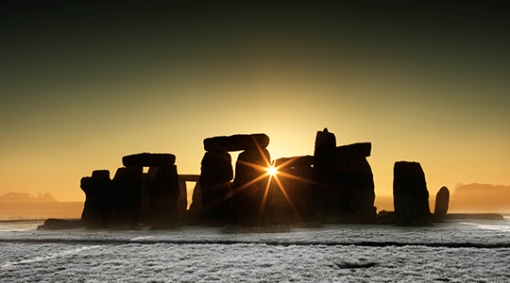
English Heritage will once again welcome people to Stonehenge to celebrate the Winter Solstice. Sunrise is just after 8am on Wednesday 21st December and visitors will be able to access the monument as soon as it is light enough to do so safely. Please read the information below before planning your visit.

frosty-sunrise-henge

PRACTICAL INFORMATION:

DATE AND TIMINGS
WEDNESDAY 21st DECEMBER 2016
MONUMENT FIELD OPENS: 07.45am (approximately, depending on light levels)
MONUMENT FIELD CLOSES: 10am

Please note, access to Stonehenge for Winter Solstice is free. Parking charges apply.

GETTING HERE:

Parking for Winter Solstice is very limited and we cannot guarantee that you will be able to park near to Stonehenge. If you are planning to travel by car, wherever you park there may be a 30 minute walk to the Monument. We strongly recommend car sharing or using public transport.

Car Sharing – Request or offer a lift to Solstice at Stonehenge

Travel by busSalisbury Reds buses will be running from 06:30 from Salisbury (New Canal, Stop U and Salisbury Rail Station). Check timetable.

Blue Badge Parking – Blue badge parking is in the visitor centre car park and permits must be booked in advance. There is accessible transport to the monument field from the visitor centre beginning at approximately 6.30am. Permits available from Solstice.Stonehenge@english-heritage.org.uk

Parking and parking charges Limited parking is available in the winter solstice car parks, which will open at 5.30am on the 21st December.

As you approach Stonehenge, there will be signs to direct you to the car park – please ensure that you follow these. Please do not arrive early as there is no waiting on the roads in the area and you will be moved on.

Parking may involve a shuttle journey to the visitor centre and wherever you park there may be a 30 minute walk.

  • Cars, private hire minibuses and live-in vehicles £5
  • Motorbikes £2
  • Commercial coaches £50

The car parking charge is designed to encourage people to car share and will help the charity offset  the costs of providing additional staffing and lighting in the car parks.

Please note, car parking charges apply to all users of the Winter Solstice car parks, including Blue Badge holders, and members of English Heritage and National Trust.

Motorists have access to a park and ride shuttle from the off-site solstice car parking to the visitor centre. A shuttle will also be provided between the visitor centre and Stonehenge, however visitors are asked to note that disabled people have priority on this bus and should therefore be prepared for a 30 minute walk, in low light, from parking areas to the monument.

We cannot guarantee entry to the car parks and recommend coming by public transport as cars will be turned away when the car parks are full.

CONDITIONS OF ENTRY

Access to Stonehenge for solstice is subject to the Conditions of Entry – please read these before deciding whether to attend.

COME PREPARED

Stonehenge is in a field on Salisbury Plain and the weather in December will be cold and may be wet and windy. Even if it isn’t raining, the ground will be wet from the dew. There may also be frost.

Please be prepared for a 30 minute walk (in low light or darkness), from the bus drop off and from parking areas to the monument. You are strongly advised to wear warm and waterproof clothing and footwear and bring a torch with you.

Toilets at the Monument Field will only be available once the access period begins. There are no catering facilities in the monument field, however the café at the visitor centre is open for hot drinks and breakfast rolls from 6am.

Please note that there are no other amenities or facilities available to visitors until the Monument Field opens.

Please visit the official English Heritage website for full details.

Solstice Events are offering their usual small group Winter Solstice guided tour from London and Bath, ideal if you do not have your own transport and want to learn more about the history and  mystery of Stonehenge and the surrounding landscape. Visit their website to book.

The Stonehenge News Blog
Follow us on Twitter and Facebook for all the latest Stonehenge news and Winter Solstice updates.  Watch the live Winter Solstice broadcast on Periscope 


Amesbury to Stonehenge Solstice Lantern Parade 2016

30 11 2016

The annual lantern parade is back again this year on the 20th December 2016 starting at the Amesbury History Centre 4:45pm.

As usual the route will take the procession through the beautiful grounds of the Amesbury Abbey where we will stop for mince pies and mulled wine before making our way to the ancient spring where the solstice lantern will be waiting for us and our resident druid Frank Somners will perform a service.

amesburylantern-1

Amesbury Lantern Procession along the original “Avenue”

The fading solstice light at Stonehenge is taken and put into the solstice lantern which is kept alight all night to light the darkest night and then taken back to the stones the next morning to extinguish. This is a tradition that started a few years ago and has grown in popularity year on year.

Come and join us and our ancestors in celebrating the solstice. Lanterns are available from the History Centre for £3.50 each and there will be an afternoon of lantern decorating in the centre on the 20th until 3:30pm

Visit their website for more details

The Stonehenge News Blog
Follow us on Twitter and Facebook  and for all the latest Stonehenge news and Winter Solstice updates.


Stonehenge celebrates 30 years of ‘World Heritage’

19 11 2016

English Heritage is celebrating 30 years of World Heritage Site status for Stonehenge this weekend.

To launch the 30th Anniversary celebrations, students from local Stonehenge School and Avon Valley College are today unveiling a special plaque highlighting the World Heritage Site status of the iconic Wiltshire monument.

whsstream

Thousands flock to the site for summer solstice every year. Photo: ITV West Country

n 1986 Stonehenge and Avebury were among the first seven sites in the UK to be inscribed on the UNESCO World Heritage List.

World Heritage Site status gives Stonehenge and Avebury international recognition alongside sites such the Egyptian Pyramids, the Great Wall of China and the Galapagos Islands as a place of exceptional importance to all humanity.

I am really pleased to be asked to help unveil the plaque at Stonehenge. World Heritage status is important because it means that a place is valuable to everyone, from all over the world and we must all look after it well so that everyone in the future can enjoy and understand it too.

– ERIN GALLAGHER,YEAR 9 STUDENT FROM AVON VALLEY COLLEGE

On 19th and 20th November, 30 Goody Bags will be given out at random; 30 Golden Tickets will be hidden around the site and every visitor will receive a special souvenir postcard.

Kate Davies, English Heritage General Manager of Stonehenge, said:

“This year we are celebrating thirty years of World Heritage status and we are excited to be joined by local schools as part of the Kids Takeover day, as we unveil a World Heritage Site plaque and launch our special 30th Anniversary weekend.

” Young people are the future guardians of our heritage, and it is fantastic to see that our local young community are so interested in learning about Stonehenge and what it means to have a World Heritage Site, one of 30 in the UK, on their doorstep.”

Visit the English Heritage Website for more information

Article source (ITV NEWS)

The Stonehenge News Blog
Follow us on Twitter and Facebook for all the latest Stonehenge news and discoveries