Massive 25 ton stones of Stonehenge may have come from further afield

29 10 2016

The builders of Stonehenge are known to have sourced the smaller bluestones used in the 5000-year-old monument from Wales.

But a new theory suggests that the entire monument might have come from elsewhere, even the huge 25 ton Sarsen stones which make up the large circle of the Wiltshire megalith.
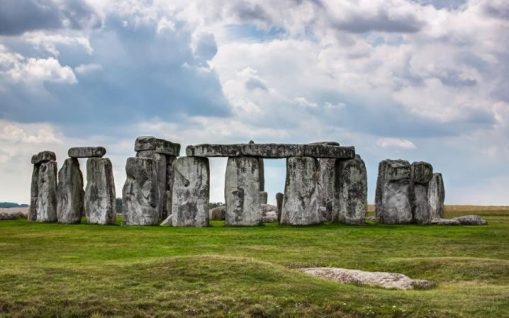
unesco-stonehenge_3293166a-large-large_trans2oueflmhzzhjcyuvn_gr-bvmxc2g6irfbtwdjolshwg

The huge sarsens at Stonehenge could have come from elsewhere

Katy Whitaker, of the University of Reading, will present a new paper at symposium at University College London next month suggesting that the sarsens could have come from sites as far away as Ken.

“Most people are aware that some of Stonehenge’s stones came all the way from south-west Wales,” she said.

“The really huge sarsen stones at Stonehenge are assumed to have come from sources on the Marlborough Downs in Wiltshire, about 30km to the north of Stonehenge. Sarsen stone, however, is found in other locations across southern England.

“There are sarsens in Dorset, spread about dry chalk valleys similar to the locations on the Marlborough Downs in Wiltshire, and as well as locations in Berkshire, Oxfordshire, Hampshire and Sussex, there are even sarsens in Kent.

“The distribution is quite broad, there are sarsens in Buckinghamshire and even across to Norfolk.”

People in the Neolithic are known for trading stone across large areas, including from the Lake District to the East of England.

Huge Sarsen boulders from outside of Wiltshire are known to have been used in other prehistoric monuments including Kits Coty House in Kent, and Wayland’s Smithy, a burial mound, in Oxfordshire.

“People were clearly aware of, and using, these stones in prehistory.” said Miss Whitaker. “Why not think about the possibility that sarsens came from further-afield too?”

The idea could also challenge that Stonehenge represents a peak of monument construction which could only have been achieved through organisation by a hierarchical leadership.

Instead, it may show that smaller groups had banded together to bring meaningful stones to a central area.

“Maybe it wasn’t a large group of people under the control of a tribal leader ‘cracking the whip’ to move all the rocks from one location down to Stonehenge as has been suggested before,” added Miss Whitaker.

“What about groups of people related in different ways, working collaboratively to move a special stone from one area to another? “

The source of the Stonehenge stones was first determined in the early 1920s by H.H. Thomas, an officer with the Geological Survey of England and Wales.

He determined that the so-called ‘spotted dolerites’ matched a small number of outcrops in the Mynydd Preseli district in south-west Wales

Latest theories about Stonehenge also suggest it was once an impressive Welsh tomb which was dismantled and shipped to Wiltshire.

An experiment this summer by University College London found that mounting huge stones on a sycamore sleigh and dragging it along timbers required far less effort than was expected.

They discovered that a  one tonne stone could be pulled on a raft by just 10 people at around one mile per hour, far faster than experts believed.

MS Whitaker is presenting her work at the Neolithic and Early Bronze Age Research Student Symposium at University College London from 18th to 19th of November.

Full article (source) The Telegraph:

The Stonehenge News Blog
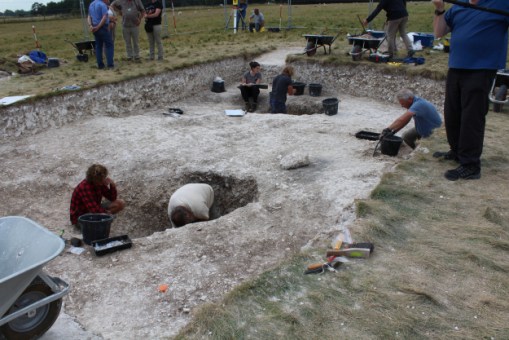


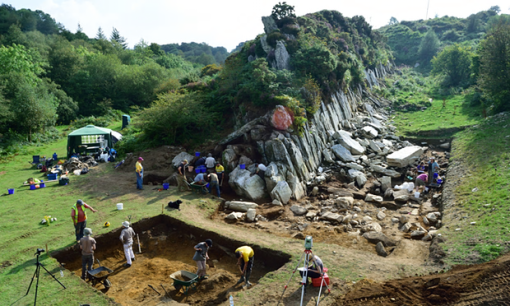
Dynamic Diversity – the nature of working on a prehistoric archaeological site. #DurringtonDig

10 08 2016

The team has been digging for 8 days and ideas are continually evolving and being re-evaluated. What is exciting about this excavation is that no matter what day you visit or read the blog, you will hear something different from the previous day – and tomorrow will likely be different from today.

Theories, which can develop in tandem, are either abandoned, held on to, proved or disproved, or sit in the background quietly in wait. There are many specialists and highly experienced archaeologists on site who are all sharing and debating their ideas with each other – and if you’re lucky you may have caught them on site in deep discussion.

img_0648

Three different areas under excavation – different ideas for each one

Read the full story on the National Trust blog

The Stonehenge News Blog


Stonehenge may have been first erected in Wales, ‘amazing’ finds suggest

7 12 2015

‘Evidence that bluestones were quarried in Wales 500 years before they were put up in Wiltshire prompts theory that Stonehenge is ‘second-hand monument’

Archaeologists at one of the Stonehenge quarry sites in Wales. Photograph: UCL

Archaeologists at one of the Stonehenge quarry sites in Wales. Photograph: UCL

Evidence of quarrying for Stonehenge’s bluestones is among the dramatic discoveries leading archaeologists to theorise that England’s greatest prehistoric monument may have first been erected in Wales.

It has long been known that the bluestones that form Stonehenge’s inner horseshoe came from the Preseli hills in Pembrokeshire, around 140 miles from Salisbury Plain.

Now archaeologists have discovered a series of recesses in the rocky outcrops of Carn Goedog and Craig Rhos-y-felin, to the north of those hills, that match Stonehenge’s bluestones in size and shape. They have also found similar stones that the prehistoric builders extracted but left behind, and “a loading bay” from where the huge stones could be dragged away.

Carbonised hazelnut shells and charcoal from the quarry workers’ campfires have been radiocarbon-dated to reveal when the stones would have been extracted.

Prof Mike Parker Pearson, director of the project and professor of British later prehistory at University College London (UCL), said the finds were “amazing”.

“We have dates of around 3400 BC for Craig Rhos-y-felin and 3200 BC for Carn Goedog, which is intriguing because the bluestones didn’t get put up at Stonehenge until around 2900 BC,” he said. “It could have taken those Neolithic stone-draggers nearly 500 years to get them to Stonehenge, but that’s pretty improbable in my view. It’s more likely that the stones were first used in a local monument, somewhere near the quarries, that was then dismantled and dragged off to Wiltshire.”

The dating evidence suggests that Stonehenge could be older than previously thought, Parker Pearson said. “But we think it’s more likely that they were building their own monument [in Wales], that somewhere near the quarries there is the first Stonehenge and that what we’re seeing at Stonehenge is a second-hand monument.”

There is also the possibility that the stones were taken to Salisbury Plain around 3200 BC and that the giant sarsens – silicified sandstone found within 20 miles of the site – were added much later. “Normally we don’t get to make that many fantastic discoveries in our lives,” Parker Pearson said. “But this is one.”

Parker Pearson heads a project involving specialists from UCL and the universities of Manchester, Bournemouth and Southampton, among others. Their findings are published on Monday in the journal Antiquity alongside a new book by the Council for British Archaeology titled Stonehenge: Making Sense of a Prehistoric Mystery.

Prof Kate Welham, of Bournemouth University, said the ruins of a dismantled monument were likely to lie between the two megalith quarries. “We’ve been conducting geophysical surveys, trial excavations and aerial photographic analysis throughout the area and we think we have the most likely spot. The results are very promising. We may find something big in 2016,” she said.

The long-distance transport of the bluestones from Wales to Stonehenge is one of the most remarkable achievements of Neolithic societies. The archaeologists estimate that each of the 80 monoliths weighed less than two tons and that people or oxen could have dragged them on wooden sledges sliding on rail-like timbers.

Parker Pearson said people in Madagascar and other societies were known to have moved such standing stones long distances and that doing so created a spectacle that brought together communities from afar.

“One of the latest theories is that Stonehenge is a monument of unification, bringing together people from across the many parts of Britain,” he said.

He recalled the moment he looked up the near-vertical rock-face and realised that this was one of the quarries. “Three metres above us were the bases of these monoliths that were actually sitting there ready simply to be lowered out of their recesses,” he said.
“It’s the Ikea of Neolithic monument building. The nice thing about these particular outcrops is that the rock has formed 480 million years ago as pillars. So prehistoric people don’t have to go in there and bash away … All they have to do is get wedges into the cracks. You wet the wedge, it swells and the stone pops off the rock.”

 Article source:  (Guardian News)
The Stonehenge News Blog


English Heritage Events at Stonehenge: December 2015

29 11 2015

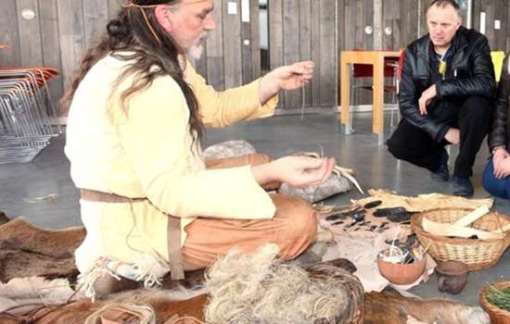
Neolithic craft and textile demonstration (Sun 6 Dec 2015)

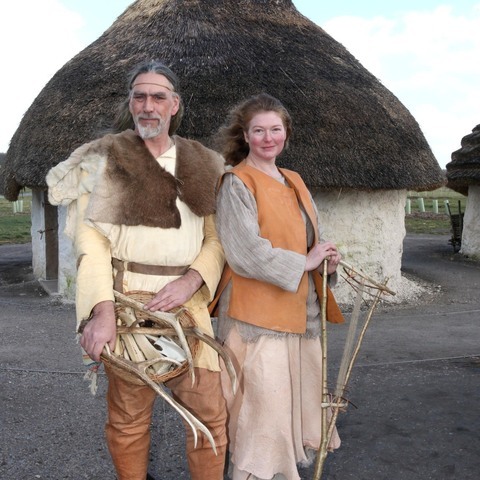
Sally Pointer and Gareth Riseborough will bring the past to life in their demonstrations of a variety of natural fabrics and crafts including cord making, twining, looped weaving, netting and leatherwork. See bone and antler worked and discover how all these materials were used in the Neolithic. Book here

neolithic-crafts-and-textile-workshop

Neolithic Textile and Craft Workshop (Mon 7 Dec 2015)

Work with textile experts Sally Pointer and Gareth Riseborough to discover more about the research and processes used to create replica Neolithic and Bronze Age clothing for Stonehenge and get hands-on experience with materials and techniques. Learn to make cordage from natural fibres and deer sinew and experiment with braiding, twining and looping techniques. All materials are supplied, and using flint tools, you will craft a needle from red deer antler to take home along with the resources to continue your project. Lunch and refreshments included. Book here

textiles-event-stonehenge

Stonehenge Christmas Shopping Evening (Wed 9 Dec 2015)

Join English Heritage on Wednesday 9th December for a festive evening of Christmas shopping and enjoy a 10% discount on purchases.

They will be serving delicious mince pies and hot mulled wine in the cafe.

Live music and Christmas carols will be sung throughout the evening and the exhibition will be open for free visits.  More info

xmas-stones.jpg

The Stonehenge News Blog


Discover the Hidden History and Ancient Mysteries that lie within the World Heritage Site. 2015 National Trust Events

12 04 2015

Discover the hidden history and ancient mysteries that lie within the World Heritage Site on a National Trust event National Trust Eventsthis year.

Walk with an archaeologist: the Stonehenge landscape

Join Neolithic expert and National Trust archaeologist Dr. Nick Snashall on this half day exploration of the Stonehenge landscape and find out about the latest exciting discoveries. We’ll be walking around four miles.

18th April 2015 – Visit the National Trust website

Discover Durrington Walls

Ever wondered where the builders of Stonehenge lived? Join our landscape guides to explore the secrets of Durrington Walls – once home to the builders of Stonehenge – and discover 6,000 years of hidden history (2.5 – 3 mile walk).

25th April 2015 – Visit the National Trust website

Archaeology Walk 

Explore the wider Stonehenge World Heritage landscape with a guide discovering hidden histories and ancient mysteries.

6 May 2015 2:00pm –  – Visit the National Trust website

Wings over Stonehenge 

Walk in the slipstream of the early pioneer military aviators at Larkhill. See where the Bristol Boxkite made its first flight in 1910 and where the first British military aeroplane unit was formed..

20 May and 6th June 2015 2:00pm –  – Visit the National Trust website

Discover Durrington Walls 
Ever wondered where the builders of Stonehenge lived? Join our landscape guides to explore the secrets of Durrington Walls – once home to the builders of Stonehenge – and discover 6,000 years of..

10 June 2015 1:30pm – Visit the National Trust website

Booking Essential 0844 249 1895
A 5% booking fee applies. Phone lines are open Mon to Fri 9am-5.30pm, plus Sat and Sun 9am-4pm.Booking Fee Applies

The Stonehenge News Blog


Moving on from Stonehenge: Researchers make the case for archaeoastronomy

16 08 2014

The field of archaeoastronomy is evolving say researchers seeking a closer relationship between astronomy and merging of astronomical techniques and archaeology.

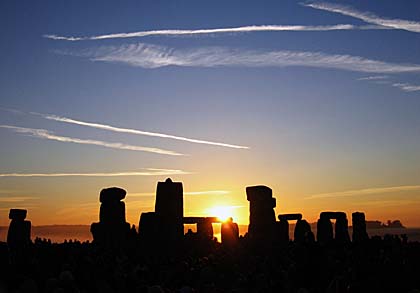
Summer Solstice Sunrise over Stonehenge 2005. Licensed under Creative Commons Attribution-Share Alike 2.0 via Wikimedia Commons

Summer Solstice Sunrise over Stonehenge 2005. Licensed under Creative Commons Attribution-Share Alike 2.0 via Wikimedia Commons

The merging of astronomical techniques with the archaeological study of ancient man-made features in the landscape could prove Neolithic and Bronze Age people were acute astronomical observers, according to researchers. 

Dubbed archaeoastronomy, the developing and sometimes maligned field takes a multi-disciplinary approach to exploring a range of theories about the astronomical alignment of standing stones and megalithic structures.

Some of these theories were highlighted recently at the 2014 National Astronomy Meeting in Portsmouth.

Archaeoastronomy expert Dr Fabio Silva of University College London has been studying 6000-year-old winter occupation sites and megalithic structures in the Mondego valley in central Portugal.

He said recent research shows that all the entrance corridors of passage graves in a necropolis in the valley aligned “with the seasonal rising over nearby mountains of the star Aldebaran, the brightest star of Taurus”.

Dr Silva believes this link between the appearance of the star in springtime and the mountains where the dolmen builders would have spent their summers “has echoes in local folklore” which recounts how the Serra da Estrela or ‘Mountain Range of the Star’ received its name from a shepherd and his dog following a star.

Some of the most debated claims about archeological alignment continue to be those relating to Stonehenge, which remains subject to a range of theories about solar and lunar alignments. Some archaeoastronomers are however keen to move the debate beyond the famous standing stones of Salisbury Plain.

Dr Daniel Brown of Nottingham Trent University, who presented updates on his work on the 4000-year-old Gardom’s Edge in the UK’s Peak District, which he believes to be astronomically aligned, said: “there’s more to archaeoastronomy than Stonehenge.

“Modern archaeoastronomy encompasses many other research areas such as anthropology, ethnoastronomy and even educational research.”

“It has stepped away from its speculative beginnings and placed itself solidly onto the foundation of statistical methods,” he added.

“However, this pure scientific approach has its own challenges that need to be overcome by embracing humanistic influences and putting the research into context with local cultures and landscape.”

Dr Silva, who is co-editor of the Journal for Skyscape Archaeology, which promotes the role and importance of the sky in archaeological interpretation, added: “We have much to gain if the fields of astronomy and archaeology come together to a fuller and more balanced understanding of European megaliths and the societies that built them.”

Article source: http://www.culture24.org.uk/history-and-heritage/archaeology/art495449 (By Richard Moss)

Merlin @ Stonehenge
The Stonehenge News Blog


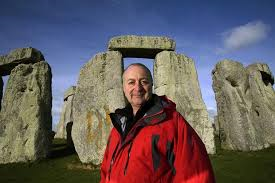
Avebury to Stonehenge. Walking Through History with Tony Robinson.

17 11 2013

Tony Robinson embarks on spectacular walks through some of Britain’s most historic landscapes in search of the richest stories from our past

Tony heads off for a 45-mile walk across Wiltshire to tell the story of life and death in the last centuries of the Stone Age. His route over chalk downlands and Salisbury plain takes him through the greatest concentration of prehistoric sites in Europe.

Tony Robinson at StonehengeFrom Avebury to Stonehenge and from spirituality to engineering, this is a journey through our ancestors’ remarkable development in the latter days of the Neolithic Age.

Windmill Hill near Avebury is the start of his route; with earthworks dating to 4500BC, it’s one of the most ancient sites in Wiltshire. From here, Tony moves on through 2000 years of the ‘New Stone Age’, encountering increasingly complex burial sites and processional routes that have helped make this area both captivating and intriguing.

As he heads south Tony can’t escape the eccentric characters and weird phenomena that have accompanied Wiltshire’s ancient history. Mysterious crop circles and unexplained underground energy sources enliven his visit, but his mind is firmly fixed on the extraordinary array of monuments in his path.

That means listening to the fanciful notions of 18th-century antiquarians, which have a grain of truth at their heart, and grasping the cutting edge of scientific archaeology around Stonehenge, which is finally offering up some astounding answers.

CHANNEL 4: 8PM: Saturday 23rd November 2013

http://www.channel4.com/programmes/walking-through-history/episode-guide

Merlin @ Stonehenge
The Stonehenge News Blog


Discovery of 5,000-year-old skull ‘in fabulous condition’ on side of river sparks mystery as archaeologists claim it would not have survived in water

1 09 2013
  • Skull is  believed to be of a middle aged woman living in 3,300 BC
  • Unbroken  skull found on the banks of the River Avon in Worcestershire
  • Carbon  dating technology places the piece between 3,338BC and 3,035  BC
  • The  ‘exceptional’ find suggests there is an undiscovered burial site  nearby

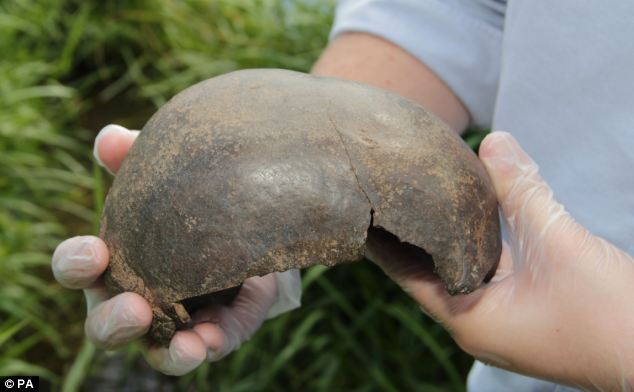
A 5,000-year-old human skull in ‘fabulous’  condition has been discovered on the banks of a river in Worcershire by a walker  who thought it was a coconut.

Remarkable discovery: Nick Daffern, senior archaeologist with Worcestershire Archaeology holds the 5,000-year-old skull which has baffled experts

Remarkable discovery: Nick Daffern, senior archaeologist with Worcestershire Archaeology holds the 5,000-year-old skull which has baffled experts

Experts said the piece of ancient skull is an  ‘exceptional find’ as the intricate marks  from blood vessels are still visible on the inner surface.

The smooth dark outer side gives only a  tantalising glimpse as to what the person may have looked like, although there  are ‘tentative’ suggestions it may have belonged to a woman in middle age living  in the Neolithic period – around the time Stonehenge was built.

The skull is not only prompting questions  about the person it belonged to, but where it may have come.

A dog walker first stumbled across the skull  piece, which is about 15cms (6ins) in length and 10cm (4ins) in width, earlier  this year but initially thought it was a ball or a coconut shell.

Detectives from West Mercia Police  investigated the scene and contacted experts at Worcestershire Archaeology, who  sent the skull to be radiocarbon dated.

‘When I first saw the skull, I thought it may  have been Anglo-Saxon or Roman but I knew that it was not recent due to the  colour,’ said Nick Daffern, senior archaeologist.

‘But we were all surprised when the  radiocarbon dating put it at between 3,338 BC and 3,035 BC, or about the middle  Neolithic period.’

‘It is so well preserved, it is unthinkable  that this had been in the river for any length of time which begs the question  as to where it has come from.

‘We know of Roman, Saxon and medieval burials  along the river, but this is very rare – it is an exceptional  find.

‘What it suggests is that we have a Neolithic  burial site very near here – we just don’t know where.’

He said: ‘I don’t think it was found where  the remains were buried, I think we’ve got a riverside burial and then flooding  has brought this down the river.

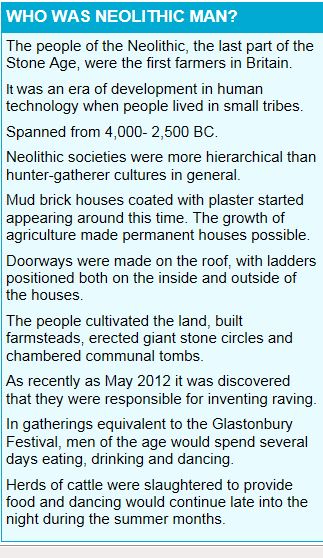
‘Finding that burial site though would be  like finding a needle in a haystack.’Who was neolithic man

Mr Daffern said that without the rest of the  skeleton it was difficult to draw conclusions about the person found, and  certainly there is no clue as to how they met their death.

‘Both myself and a forensic anthropologist  believe it is a woman due to the slightness of the skull and the lack of any  brow ridges although our conclusions are very tentative because we’re dealing  only with the top of a skull,’ he added.

‘There’s no trauma to the bone, and where it  has broken those are natural breaks, nor is there any sign of disease so we’ve  no idea as to cause of death.

‘The natural fusion of the bone in the skull  leads me to believe it may be an older woman, possibly in her 50s, but that is  very tentative again.

‘Unfortunately, it remains a bit of a  mystery.’

The find is a few miles from Bredon Hill,  which has been a scene of human activity down the ages and still boasts the  earthen ramparts of what was an Iron Age hill fort, however finds of Neolithic  remains are rare.

‘Whenever we come across Neolithic remains,  there seems to be a solid dividing line between where they buried their dead,  and where they lived and that is no accident,’ he said.

‘But it is frustrating as an archaeologist  because although we have the physical evidence, we still don’t have the answers  as to why.’

The skull is only the second set of Neolithic  remains to be found in the county, although two large 6,000-year-old ‘halls of  the dead’ were found in nearby Herefordshire this year but without any human  remains present.

Article source: By  Daily Mail Reporter – http://www.dailymail.co.uk/sciencetech/article-2407337/Discovery-5-000-year-old-skull-fabulous-condition-sparks-mystery.html

Merlin @ Stonehenge
The Stonehenge News Blog


A visit to Stonehenge is bound to make you ask: who built it?

16 05 2013

Who built Stonehenge?
A visit to Stonehenge is bound to make you ask: who built it?  It is a question nearly as old as the stones themselves.  And what do we know about the people who achieved this prehistoric marvel? Words Susan Greaney

Wizard Ideas 

In the early medieval period, writers thought they knew who had built Stonehenge—Merlin. But by the early 17th century, scholars were looking for a more plausible answer. In 1620, architect Inigo Jones thought it was based on classical geometry and constructed by the Romans. Antiquary John Aubrey thought that the native Britons, in particular the Druids, were the builders of Stonehenge. Antiquary William Stukeley’s 1740 book firmly established the idea that it was a Druid temple.

Towards the end of the 19th century, archaeologists began to realise that Stonehenge could be much older, linking finds to the Bronze Age. William Gowland’s excavations in 1901 showed that Stonehenge was built in Neolithic or early Bronze Age. Today, we think the stones were raised about 2,500 BC by the native inhabitants of late Neolithic Britain.

The Early Theories…

stonehenge_1

stonehenge-port-JOHN_AUBREYJohn Aubrey Proposed that Stonehenge was a temple built by the Druids, the priests of the pagan Celts, who came to England in the centuries immediately prior to the Christian era.


stonehenge-port-WILLIAM_STUKELEYWilliam Stukeley The first person to recognise the alignment of Stonehenge on the solstices. Like John Aubrey, however, he mistakenly attributed their construction to the Druids.


stonehenge-port-INIGO_JONESInigo Jones Believed the stones were a Roman temple of the Tuscan order built to the sky god Coelus. Later disproved by evidence establishing the period in which the stones were first laid.

Past Lives

Stonehenge was built before metal began to be used in Britain. The most common finds from this period are flint tools required for everyday activities such as hunting, making leather and preparing food. We know from animal bones that the people who constructed Stonehenge had livestock and probably also grew small quantities of crops, but still gathered wild plants and hunted wild animals.

stonehenge_3

Whether visiting in 1958 or today, children have always been fascinated by Stonehenge.
At the time that Stonehenge was built, people across Britain were using a type of flat-based decorated pottery called Grooved Ware, often found at late Neolithic monuments across Britain. Many of these prehistoric finds can be seen at Wiltshire Museum, Devizes, at Salisbury and South Wiltshire Museum and at the new Stonehenge visitor centre later this year.

Neolithic Puzzles

Until a few years ago, experts thought late Neolithic people were largely mobile, moving between seasonal temporary camps. But in 2006, a team led by Professor Mike Parker Pearson, part of the Stonehenge Riverside Project, discovered several small buildings at Durrington, just over two miles north-east of Stonehenge. These houses appear to have been inhabited on a temporary, seasonal basis about 2,500 BC, the time that Stonehenge was built. Was this where its builders lived?

Among the excavated houses were mounds of rubbish, including cow and pig bones and broken Grooved Ware pottery, showing that large midwinter feasts were held here. Nearby were complex timber monuments, buildings set within special enclosures and other strange wooden structures. This was a place of ritual, probably connected to the ceremonies at Stonehenge.

stonehenge_4

Stone arrowheads and grooved pottery have helped our understanding of the Neolithic period
After the settlement was abandoned, an enormous henge called Durrington Walls was built, which is still visible today. Part of Durrington Walls and nearby Woodhenge are English Heritage properties you can explore. You can walk from Stonehenge across the fields to Durrington Walls, perhaps the route that its builders took. You’ll see other fragments from the past—the enormous Cursus monument, which pre-dates Stonehenge, and many of the early Bronze Age round barrows that scatter this area.

People Power

There are further clues in the monument itself. Transporting the stones, shaping them and fitting them together took great organisation and hundreds of people in what was a sophisticated and organised society. You can find out more at Stonehenge’s new visitor centre later this year.

Neolithic Life: Round the Houses

stonehenge_2Outside the new Stonehenge visitor centre will be an external gallery, where we’ll be recreating three of the late Neolithic houses excavated at Durrington Walls. Here you’ll be able to see what life was like at the time Stonehenge was built. And at Old Sarum, Wiltshire, volunteers are building some prototype houses to test different ideas about the methods and materials used.

You can follow the progress of our project on our blog at www.neolithichouses.wordpress.com and our Twitter account @NeolithicHouses. If you’d like to get involved with building the houses at the visitor centre next year, or working in the external gallery, keep an eye on our website for volunteering opportunities.

We’ll be holding tours and open days at the Old Sarum houses so you can come and learn more about prehistoric life and experimental archaeology:

All details and booking information can be found on our What’s On page

English Heritage website: http://www.english-heritage.org.uk/

Merlin @ Stonehenge
The Stonehenge News Blog