Stonehenge Opening Hours Summer 2015

21 07 2015

You now park over a 2 kilometres from Stonehenge itself, out of sight of the Stonehenge monument. Here there is a modern visitor centre and excellent exhibition and education facilities plus a spacious cafe and souvenir gift shop. A Stonehenge shuttle bus transports you between the visitor centre and the Stone Circle.  English Heritage advise to budget for a visit of around 2 hours. The Visit Wiltshire App is a must for those visiting Stonehenge and the surrounding area.

Last admission time is 2 hours before the advertised closing time.

Entrance to Stonehenge is now managed through timed tickets and advance booking is required. Booking is the only way to guarantee entry on the day and at the time of your choice. Advance bookings are advised!

A temporary coach park will be built near to Stonehenge, Wiltshire Council has agreed

This includes FREE visits by English Heritage and National Trust members (applicable to members of the National Trust in England only – does not include National Trust Scotland or other National Trust affiliated organisations).

1 JUNE – 31 AUGUST 2015

Monday 9:00 – 20:00
Tuesday 9:00 – 20:00
Wednesday 9:00 – 20:00
Thursday 9:00 – 20:00
Friday 9:00 – 20:00
Saturday 9:00 – 20:00
Sunday 9:00 – 20:00

1 SEPTEMBER – 15 OCTOBER 2015

Monday 9:30 – 19:00
Tuesday 9:30 – 19:00
Wednesday 9:30 – 19:00
Thursday 9:30 – 19:00
Friday 9:30 – 19:00
Saturday 9:30 – 19:00
Sunday 9:30 – 19:00

16 OCTOBER 2015 – 15 MARCH 2016

Monday 9:30 – 17:00
Tuesday 9:30 – 17:00
Wednesday 9:30 – 17:00
Thursday 9:30 – 17:00
Friday 9:30 – 17:00
Saturday 9:30 – 17:00
Sunday 9:30 – 17:00

HOLIDAY OPENING TIMES FOR THIS PERIOD

Christmas Eve
24 Dec 2015
Closed
Christmas Day
25 Dec 2015
Closed
Boxing Day
26 Dec 2015
10:00 – 16:00
Boxing Day Bank Holiday
28 Dec 2015
9:30 – 17:00
New Year’s Eve
31 Dec 2015
9:30 – 17:00
New Year’s Day
1 Jan 2016
10:00 – 16:00

Please visit the English Heritage Website for details and current prices

Visit Wiltshire Official Website
Salisbury Museum
Devizes Museum
Amesbury Museum
Stonehenge Transport from Salisbury
Stonehenge Guided Tours from London

Enjoy your visit to Stonehenge!

The Stonehenge News Blog
Follow us on Twitter for  all the latest Stonehenge News


Did you know today (April 18th) is World Heritage Day? Celebrate it with a visit to Stonehenge or Avebury.

18 04 2015

World Heritage is the shared wealth of humankind. Protecting and preserving this valuable asset demands the collective efforts of the international community. This special day offers an opportunity to raise the public’s awareness about the diversity of cultural heritage and the efforts that are required to protect and conserve it, as well as draw attention to its vulnerability.

On 18th April 1982 on the occasion of a symposium organised by ICOMOS in Tunisia, the holding of the “International Day WHSfor Monuments and Sites” to be celebrated simultaneously throughout the world was suggested. This project was approved by the Executive Committee who provided practical suggestions to the National Committees on how to organise this day.

The idea was also approved by the UNESCO General Conference who passed a resolution at its 22nd session in November 1983 recommending that Member States examine the possibility of declaring 18th April each year “International Monuments and Sites Day”. This has been traditionally called the World Heritage Day.

Stonehenge, Avebury and Associated Sites

Stonehenge and Avebury, in Wiltshire, are among the most famous groups of megaliths in the world. The two sanctuaries consist of circles of menhirs arranged in a pattern whose astronomical significance is still being explored. These holy places and the nearby Neolithic sites are an incomparable testimony to prehistoric times.

Stonehenge and Avebury form part of one of the UK’s UNESCO World Heritage Sites. The explanations behind why the sites are located where they are and what their exact purposes are still remain a mystery to this day.

Stonehenge

Managed by English Heritage dates back approximately 5,000 years. Evolving between 3,000 and 1,600 BC, Stonehenge is aligned with the rising and setting of the sun at the solstices. The summer solstice in June often attracts up to 20,000 visitors to view the sunrise. When visiting Stonehenge pick up one of their audio guides (available in different languages) giving details of the history and legends behind the site. For a more intimate experience there’s an inner circle tour which takes place before and after the site is open to the general public (pre-booking is essential) or view tour companies who offer general and inner circle visits to the stones.

Around the Stonehenge landscape there are other sites of notable importance including Durrington Walls, the largest henge monument in Britain and Woodhenge, a Neolithic monument dating from around 2,300 BC.

Avebury

The largest stone circle in the World, Avebury was erected around 4,500 years ago and consists of around 100 stones. Many of the stones were re-erected by Alexander Keiller in the 1930s.

The Alexander Keiller Museum in the village holds many of the archaeological finds that Keiller discovered during the excavations of Avebury during this time and the history of the excavations. Today Avebury is managed by the National Trust.

The site is open daily (due to its village location) and visitors can not only explore the stone circle but also the Avenue, the West Kennett Long Barrow and can look over at Silbury Hill – the largest man-made hill in Europe. Similarly to Stonehenge, Avebury is also plays host to both Winter and Summer Solstices.

In 2012, Avebury Manor opened its doors following the BBC TV programme ‘The Manor Reborn’ which also saw the kitchen garden transformed into a working Victorian kitchen garden.

See objects excavated from the World Heritage Site at Salisbury Museum and the new prehistory displays at Wiltshire Museum in Devizes. Salisbury Museum has recently reopened its Wessex Gallery. The Wiltshire Museum in Devizes has new displays featuring gold from the Time of Stonehenge, including Britain’s richest Bronze Age burial.
Visit Wiltshire Website

“Celebrate it with a visit to Stonehenge or Avebury and observe a minute of silence for the ones we have lost to insensitive developments”

The Stonehenge News Blog


Discover the Hidden History and Ancient Mysteries that lie within the World Heritage Site. 2015 National Trust Events

12 04 2015

Discover the hidden history and ancient mysteries that lie within the World Heritage Site on a National Trust event National Trust Eventsthis year.

Walk with an archaeologist: the Stonehenge landscape

Join Neolithic expert and National Trust archaeologist Dr. Nick Snashall on this half day exploration of the Stonehenge landscape and find out about the latest exciting discoveries. We’ll be walking around four miles.

18th April 2015 – Visit the National Trust website

Discover Durrington Walls

Ever wondered where the builders of Stonehenge lived? Join our landscape guides to explore the secrets of Durrington Walls – once home to the builders of Stonehenge – and discover 6,000 years of hidden history (2.5 – 3 mile walk).

25th April 2015 – Visit the National Trust website

Archaeology Walk 

Explore the wider Stonehenge World Heritage landscape with a guide discovering hidden histories and ancient mysteries.

6 May 2015 2:00pm –  – Visit the National Trust website

Wings over Stonehenge 

Walk in the slipstream of the early pioneer military aviators at Larkhill. See where the Bristol Boxkite made its first flight in 1910 and where the first British military aeroplane unit was formed..

20 May and 6th June 2015 2:00pm –  – Visit the National Trust website

Discover Durrington Walls 
Ever wondered where the builders of Stonehenge lived? Join our landscape guides to explore the secrets of Durrington Walls – once home to the builders of Stonehenge – and discover 6,000 years of..

10 June 2015 1:30pm – Visit the National Trust website

Booking Essential 0844 249 1895
A 5% booking fee applies. Phone lines are open Mon to Fri 9am-5.30pm, plus Sat and Sun 9am-4pm.Booking Fee Applies

The Stonehenge News Blog


RSPB creates wildflower meadow for butterflies at Stonehenge World Heritage Site.

9 02 2015

Hundreds of wildflowers have been planted at Normanton Down on the Stonehenge World Heritage Site to help gives butterflies a home during the summer months.

Flowers such as classic chalk grassland herbs, common rockrose and wild thyme are among many more that make up the wildflower meadow that was created on four iron-age barrows across the ancient site.

The wildflowers, which were all grown from seed and collected from Salisbury Plain, will serve as a food source for the caterpillars of the iconic chalk downland butterfly and many pollinators during the summer season.

The work for the project was completed by the RSPB, who manage the Normanton Down nature reserve, which is known for its ground nesting birds and downland wildlife.

Stonehenge Flowers

Chalkhill Blue – female © Tony Davison, from the surfbirds galleries.

RSPB Site Manager, Patrick Cashman, said: “These barrows already support fragments of a once more widespread flower-rich downland landscape. We are taking this opportunity to top them up with key butterfly food plants, so their warm southern flanks can become new homes for butterflies from nearby Salisbury Plain and help provide stepping stones in the wider landscape.”

The wildflower planting was funded by the Heritage Lottery Fund as a part of ‘Save Our Magnificent Meadows’ project, which is a national partnership of 11 organisations led by Plantlife to help transform the fortunes of vanishing meadows, grasslands and wildlife.

English Heritage’s Stonehenge World Heritage Site co-ordinator, Beth Thomas, said: “We are delighted to see the historic monument being treasured for their relict ancient grassland, and having their profile raised as resource to help reconnect the natural and historic landscape.”

Through the RSPB’s Giving Nature a Home campaign, you can help tackle the housing crisis facing the UK’s threatened wildlife. The charity is asking people to provide a place for wildlife in their own gardens and outside space – whether it’s a dead wood pile for mini beats and other insects, putting up a nestbox for a house sparrow, or creating a pond that will support a number of different species.

To find out more about Giving Nature a Home and to receive a free guide packed full of simple, fun activities to help wildlife where you live, visit: rspb.org.uk/homes

Notes

1. The RSPB is the UK’s largest nature conservation charity, inspiring everyone to give nature a home. Together with our partners, we protect threatened birds and wildlife so our towns, coast and countryside will teem with life once again. We play a leading role in BirdLife International, a worldwide partnership of nature conservation organisations.

2. Giving Nature a Home is the RSPB’s latest campaign, aimed at tackling the housing crisis facing the UK’s threatened wildlife. The charity is asking people to provide a place for wildlife in their own gardens and outside spaces – whether it by planting pollen-rich plants to attract bees and butterflies, putting up a nestbox for a house sparrow, or creating a pond that will support a number of different species. The charity hopes to inspire people across the UK to create a million new homes for nature.

3. Normanton Down lies within the Stonehenge World Heritage Site, and comprises 47 ha of former arable land in the process of being reverted to species-rich chalk grassland, through a management agreement with the private owner. Reseeding of the arable land has taken place over the last three years, and the diversity of wild flowers, along with butterflies and other invertebrates, is gradually increasing. The site is also being managed to encourage breeding stone-curlews and other birds such as lapwings and corn buntings.

4. The wildflowers that are being planted on the site are; the classic chalk grassland herbs; kidney and horseshoe vetch, common rockrose, wild thyme, dropwort, harebell, small scabious and devil’s-bit scabious.

5. Iconic downland butterflies expected on the site include; chalkhill blue, adonis blue, brown argus and marsh fritillary.

Article source: http://www.surfbirds.com/community-blogs/blog/2015/02/08/rspb-creates-wildflower-meadow-for-butterflies-at-stonehenge/

The National Trust offer guided tours though the Stonehenge Landscape: http://www.nationaltrust.org.uk/stonehenge-landscape/

The Stonehenge News Blog
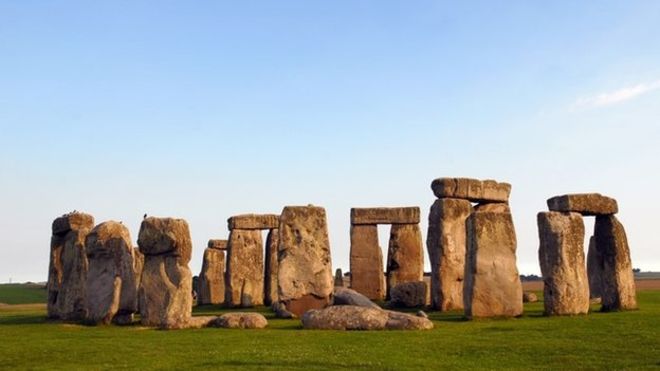


Midwinter walk: Explore the ancient Stonehenge Landscape on the Winter Solstice with National Trust

5 12 2014

On the midwinter solstice, explore the ancient monuments of the Stonehenge landscape. This walk is around four and a half miles.

21st December 2014: Ancient ceremonial landscape of great archaeological and wildlife interest:Stonehenge Landscape

Within the Stonehenge World Heritage Site, the National Trust manages 827 hectares (2,100 acres) of downland surrounding the famous stone circle.

Walking across the grassland, visitors can discover other prehistoric monuments, including the Avenue and King Barrow Ridge with its Bronze Age burial mounds.

Nearby, Winterbourne Stoke Barrows is another fascinating example of a prehistoric cemetery. While Durrington Walls hides the remains of a Neolithic village.

Today thanks to their extensive programme turning ploughed fields into pasture, you can explore the landscape and follow in the footsteps of the people who built and used Stonehenge.

Booking essential: http://www.nationaltrust.org.uk/stonehenge-landscape/things-to-see-and-do/events/

National Trust Stonehenge Landscape Tours:  http://www.nationaltrust.org.uk/stonehenge-landscape/

Merlin at Stonehenge
The Stonehenge News Blog


Tunnel could have an “adverse impact” on Stonehenge, an advisory body on World Heritage Sites has warned.

30 11 2014

Stonehenge fears over A303 road tunnel plan

A planned dual carriageway and road tunnel could have an “adverse impact” on Stonehenge, an advisory body on World Heritage Sites has warned.

The International Council on Monuments and Sites (Icomos), which advises Unesco, has expressed concern over plans for the project in Wiltshire.

The group wrote to Transport Secretary Patrick McLoughlin earlier in November.

An announcement about upgrading the whole A303 is expected in the chancellor’s Autumn Statement.

The options include a 1.6-mile (2.5km) tunnel or two longer 1.8-mile (2.9km) tunnels that would run south of the current A303 route.

Proposals to build a tunnel beside Stonehenge were dropped seven years ago because of cost, but lobbying has continued from local councils.

A303 past Stonehenge
The A303 currently passes right past the Stonehenge site in Wiltshire
Stonehenge
The site is near Amesbury, thought to be the longest continuous settlement in the UK

Despite the road layout at Stonehenge being changed, the stretch of single carriageway still has many traffic jams.

In a letter seen by the BBC, the UK branch of Icomos said it wanted the government to “fully engage” with the World Heritage Committee to find a solution that “respects and maintains” the value of the “iconic and unique site”.

“We appreciate the very real need to address the issue of the A303 and recognise that a tunnel could have beneficial impacts on parts of the World Heritage property,” Icomos said.

“However, we are concerned that associated portals and dual carriageways could have a highly adverse impact on other parts of the World Heritage landscape that cannot be set aside, however great the benefits of a tunnel.”

The Department for Transport said it had “worked closely with key organisations” and “no decisions” had yet been made.

English Heritage, which runs the Stonehenge site, said the bottleneck road was “highly detrimental” to the ancient monument.

“We have met with a representative of Icomos UK to explain the work we’ve done and sought feedback on it,” a spokeswoman said.

Article Source: http://www.bbc.co.uk/news/uk-england-wiltshire-30248826

The Stonehenge News Blog
https://twitter.com/ST0NEHENGE


Chairman needed for Stonehenge panel

6 10 2013

A NEW partnership panel set up to coordinate cooperation between the Stonehenge and Avebury is looking for a chairman.

Following a recent review it is hoped managers of the two parts of the World Heritage Site (WHS) will be working more closely together and it has been decided there will be a partnership panel led by an independent chairman.

This panel will also act as a representative for the whole WHS. It will be made up of the three key partners – English Heritage the National Trust and Wiltshire Council – together with the chairmen of the local Stonehenge and Avebury steering committees and a representative from the research community

“The new panel and chair will play a key role in ensuring this continues and that new opportunities to protect and present the World Heritage Site are identified.”

For more information go to jobs.wiltshire.gov.uk.

By Morwenna Blake: Salisbury Journal
http://www.salisburyjournal.co.uk/news/10720098.Chairman_needed_for_Stonehenge_panel/


Merlin @ Stonehenge
The Stonehenge News Blog