How and Why Was Stonehenge Built?

22 03 2010

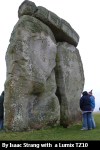
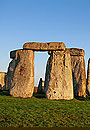
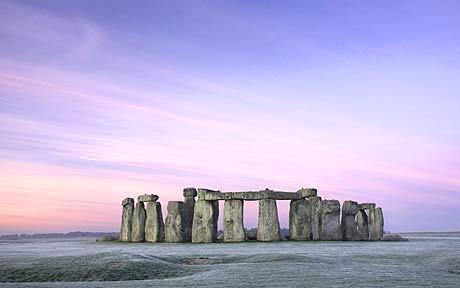
StonehengeFrom the grassy deserted plains of southern England rises a circle of standing stones, some of them up to 24 feet tall. For centuries they have towered over visitors, offering tantalizing hints about their prehistoric past. For centuries, everyone who has stood before them has wondered the same thing: Who built this mysterious rock monument? And why? “Since Stonehenge was built and rebuilt over a period of centuries, no one group has sole credit for its construction, but the main building seems to have been done by a people known as the ‘Beaker Folk,’” says Benjamin Hudson, professor of History and Medieval Studies at Penn State. The Beaker Folk (who earned their name from the distinctive inverted bell-shaped pottery drinking vessels they made) scattered throughout prehistoric western Europe. The earliest construction at Stonehenge began about 3000 B.C., says Hudson, with a stone circle inside a ditch and bank. Within that circle lay a timber building; researchers have excavated from the site about 56 pits containing the remains of human cremations. Construction continued for 600 years, in several phases of landscaping: Burial mounds (most pointing east-to-west) and ceremonial pathways were added to the site. In 2400 B.C., the builders erected the large sandstone blocks which give the site its name. (Coined by Henry of Huntingdon, a twelfth-century English historian, “Stonehenge” means “hinged or supported stones.”) The means of moving those enormous standing stones has provoked centuries of speculation, with theories ranging from demonic powers to Merlin’s magic to alien technology. The reality is much more ordinary, says Hudson. “Much of the construction was little more than putting enough men under a stone to move it into place,” he notes, “although some basic engineering was required for the larger stones and the lintels.” One theory holds that the builders used simple inclines and levers to move the stones into place. Like the Egyptian pyramid-builders, the Stonehenge constructors relied more on brute labor than sophisticated technology. Though one of the most complete and monumental examples of Neolithic and Bronze Age construction, Stonehenge was not alone in its time. Hudson notes one estimate that places it among 300 surviving stone monuments throughout the British Isles—including the famous stone circle in Avebury. The connections between and among these sites often remain murky, and undoubtedly many creations of the Beaker Folk have returned to nature, leaving few traces of their existence. “Stonehenge forces us to reconsider the period of history that is not accompanied by written records,” Hudson says. Since the builders left no explanation, the precise purpose of their work remains obscure. One theory sees Stonehenge as a temple, pointing to the elaborate landscaping surrounding the site. More recently, historians and archaeologists have suggested it provided an observatory for either moon or sun cults. The Beaker Folk are believed to have been sun worshipers who aligned Stonehenge with certain important sun events, such as mid summer and winter solstices. While the absence of records makes it nearly impossible to be certain about Stonehenge’s purpose, the site itself does leave us with a portrait of Beaker Folk society. “The building of the monument required knowledge of civil engineering, transportation, and quarrying,” he says. “The society that constructed it was wealthy enough to afford such an expensive venture and it also had a developed theology that provided the guidance for the designs whose meanings still elude us.” Perhaps it is that elusive meaning that has, for centuries, drawn people to Stonehenge, to sit and wonder among the silent stones.

Stonehenge Guide
Stonehenge Stone Circle


Spring Equinox at Stonehenge

19 03 2010
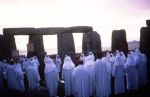
This is the second of the four ‘sky points’ in our Wheel of the Year and it is when the sun does a perfect balancing act in the heavens.


At the Spring (or Vernal) Equinox the sun rises exactly in the east, travels through the sky for 12 hours and then sets exactly in the west. So all over the world, at this special moment, day and night are of equal length hence the word equinox which means ‘equal night’.

Of course, for those of us here in the northern hemisphere it is this equinox that brings us out of our winter.

For those in the southern hemisphere, this time is the autumnal equinox that is taking you in to your winter. And this is very much how I think of the equinoxes – as the ‘edges’ of winter. This is why they can be quite hard on our bodies as it is a major climatic shift, so it is a good time to give a boost to your immune system with natural remedies and cleansing foods.

Here in Wiltshire (as with the rest of rural Britain), it was traditional to drink dandelion and burdock cordials at this time as these herbs help to cleanse the blood and are a good tonic for the body after its winter hardships.

As the Vernal Equinox heralds the arrival of spring, it is a time of renewal in both nature and the home, so time for some spring-cleaning!

This is more than just a physical activity, it also helps to remove any old or negative energies accumulated over the dark, heavy winter months preparing the way for the positive growing energy of spring and summer.

As with all the other key festivals of the year, there are both Pagan and Christian associations with the Spring Equinox.

To Pagans, this is the time of the ancient Saxon goddess, Eostre, who stands for new beginnings and fertility.

This is why she is symbolized by eggs (new life) and rabbits/hares (fertility).

Her name is also the root of the term we give to the female hormone, oestrogen.By now, you may be beginning to see the Christian celebration derived from this festival – Easter.

And this is the reason why the ‘Easter Bunny’ brings us coloured eggs (and if you’re lucky chocolate ones!) at this time of year.

So, as nature starts to sprout the seeds that have been gestating in her belly throughout the winter, maybe you can start to think about what you want to ‘sprout’ in your life now and start to take action. 

Celti Wheel

Celtic Wheel

In between these ‘sky points’ are the Cross-quarter days which mark ‘gear shifts’ in the energy of the earth. These times are also important agriculturally.

Imbolc (Beginning of February) is when the first lambs are born and ewe’s milk is available again after the long winter. The year is beginning to stir and wake-up.

Beltane (Beginning of May) is the transition from spring to summer when Nature is pumping with life-force and fertility.

Lammas (Beginning of August) is the time of ripeness and when the earth starts to give up her harvest.

Samhain (Beginning of November) is the end/beginning of the Celtic year. It is a time when the veil between the worlds is thinnest and it is possible to commune with the ancestors.

There is great joy in being aware of the seasons in this way and celebrating them in simple ways.

As the year unfolds, we will look in detail at the eight energy-points of the year and the ways in which they affect us.

We will also look at how these festivals have been celebrated in Wiltshire, both past and present.

Merlin – Stonehenge Tour Guide
Stonehenge Stone Circle



Grantham’s “Stonehenge” has got everyone talking

16 03 2010


editorial image 

Scene Setter : Somerby Hill Roundabout.

IS it a Satanic site of human sacrifice? Or maybe an area of deep spiritual awakening? 

 Neither of course, it is merely the latest in Grantham roundabout makeovers. 

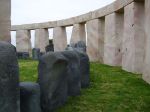
The Old Somerby roundabout featuring an arrangement of Ancaster Stone is the fourth Grantham “gateway” to be given a new look in recent months.  

Workers have been finishing it off this week and before it had even been completed it had already been dubbed “Grantham’s Stonehenge”.  

It remains to be seen whether the new attraction will draw mystics and spiritualists from across the country or what the arrangement of rocks means.  

The work has been largely funded thanks to a generous personal donation by a Miss Bean of Old Somerby, with sponsors chipping in the rest alongside Grantham Growth and Grantham Future.  

The cost of installation and five-year maintenance is £25,315.  

David Holmes chairman of Old Somerby Parish Council, said: “We are delighted to finally see come to fruition our plans for the renovation of this major entrance to Grantham.  

“It will greatly enhance the area.”  

Journal reader and motorcyclist Steve Foster was first to get in touch and point out the uncanny resemblance to the Salisbury tourist attraction.  

He said: “It looks like Stonehenge. It is just rediculous – the rocks are about five-feet high. “It must have cost a fortune.” 

 Journal reader Adrian Hewis said: “Is the re-creation of ‘Stonehenge’ at Somerby roundabout an essential expenditure considering the number of poorly maintained roads in the locale?” 

 However a Mrs Palmer got in touch to say she was so pleased with the work she pulled over to thank the workmen earlier this week. 

 She said: “They are making an excellent job of it. 

 “It is really nice and whoever is responsible really deserves a bit of credit.” 


Durrington Walls, Wiltshire: Walk of the week

13 03 2010

The first of our new series of weekly walks, provided by the National Trust, is a ramble around mysterious Durrington Walls in Wiltshire, with views towards Stonehenge.

View Durrington Walls: Walk of the week in a larger map
THE EXPERT’S VIEW

Mike Dando, Head Warden: “The walk starts at the largest henge monument in the country and takes you past ancient monuments such as Round Barrows and the ‘Cuckoo Stone’ where it is easy to imagine the landscape as it was some 4,000 years ago. The walk takes in beautiful grazed grassland, strips of mature Beech trees and offers fantastic views across the Stonehenge Landscape.

Download an OS map of this walk

“My favourite part of this walk would have to be walking past the New King Barrows, the large Bronze Age burial mounds. A stop here on a warm summers’ day, listening to the skylarks and the beech leaves rustling, is hard to beat, especially on top of the view over to Stonehenge itself.

“Unique to this walk is the sense of being in an ancient and sacred place; the combination of the natural and historic sights is simply spectacular. My top tip for first time walkers would be to bring binoculars to take in the wildlife and views.”

ESSENTIALS
Start: Woodhenge car park
Grid ref: SU151434
Map: OS Landranger 184

Getting there
Bike: National Cycle Network route 45 runs south-east of the property. See http://www.sustrans.org.uk

Bus: Wilts & Dorset 5 or 6, between Salisbury, Pewsey, Marlborough and Swindon. Service 16 from Amesbury, request stop at Woodhenge

Rail: Salisbury station, 9 miles from Woodhenge car park

Road: Woodhenge car park is 1¾ miles north of Amesbury, follow signs from A345

Distance, terrain and accessibility

4 mile (6.4km) across open access land, including Rights of Way, with gates, at several points. The ground is uneven in places, with a few short, steep slopes. Sheep graze the fields and there are ground-nesting birds, so please keep dogs under control.

Local facilities
Picnic area (not NT) and information panel at Woodhenge car park
WCs
Outdoor café
Picnic area (not NT) at Stonehenge car park, 0.75 miles from this walking route.
THINGS TO LOOK OUT FOR

Durrington Walls: The largest complete henge in Britain is 500m in diameter and encloses a natural valley. It once contained timber circles and what appear to have been shrines. The area outside the ditch and bank was once a settlement, perhaps containing hundreds of houses, making Durrington Walls potentially the largest village in north-west Europe at the time. People travelled for miles to feast and take part in ceremonies, probably at the midwinter solstice. Woodhenge stood nearby as an impressive timber circle surrounded by a bank and ditch.

The Cuckoo Stone: This standing stone now lies on its side, but over millennia it has been a focus for Bronze Age urn burials, an Iron Age boundary line and Roman remains. It is made of sarsen, a kind of sandstone, the same as the largest stones in the Stonehenge stone circle. The reason for its name remains a mystery.

The Stonehenge Avenue: A two mile long ceremonial way linking Stonehenge with the River Avon and crossing King Barrow Ridge. Interestingly, Durrington Walls is also connected to the river, leading experts to believe the Avon symbolically linked the two monuments, forming part of a ritual journey; maybe leading to the afterlife.

DIRECTIONS

Download an OS map of this walk

1. At Woodhenge car park, go through the gate nearest to you and into a field. Walk downhill into Durrington Walls (taking care of rabbit holes).

2. At the centre of Durrington Walls, looking around you, you can appreciate the nature of the henge as an enclosed valley. Standing here 4,500 years ago, you would have been viewing several “shrines” around the slopes. Next, turn left and walk to the corner of this field. Pass through gates either side of the road, heading towards a low rock.

3. The Cuckoo Stone is one of very few stones in the area that is made from sarsen – most local rock is chalk or flint. From here, continue forwards to the next gate.

4. You are now on the route of the old military railway between Amesbury and Larkhill; turn right and follow the path.

5. When you reach a crossroads and National Trust sign to King Barrow Ridge, turn left and follow the shaded bridleway.

6. At the junction, turn right through a gate to continue along the ridge, crossing the Stonehenge Avenue on your way to a line of 200-year-old beech trees and a fine view of Stonehenge. At winter solstice, Neolithic people may have marked the occasion of the midwinter sunset at Stonehenge, before travelling to Durrington Walls to celebrate the new sunrise.

7. Continue forward to New King Barrows, a fine row of Early Bronze Age burial mounds, originally capped in white chalk so they would have been visible from a far distance. Return to point 6, turn right and follow the stony track to point 8.

8. Take a left turn through a gap in the hedge, to join the old military railway once more. This leads back to the gate in the corner of the Cuckoo Stone field.

9. Head across the grassland to Woodhenge and back to Woodhenge car park.

STONEHENGE STONE CIRCLE


£20m Stonehenge visitor centre criticised by Government design watchdog

10 03 2010

The Commission for Architecture and the Built Environment (CABE) believes the centre’s “twee paths” are “more appropriate for an urban garden” and its “delicate roof” is unsuitable for the wind and rain that sweeps across the majestic Wiltshire plains where the stones stand.

Although the plans, by Australian architecture firm Denton Corker Marshall, have been approved by Wiltshire county council planners and are backed by local architects on the Wiltshire Design Forum, CABE said the “architectural approach” was wrong.

“We question whether, in this landscape of scale and huge horizons and with a very robust end point that has stood for centuries and centuries, this is the right design approach?” Diane Haigh, the watchdog’s director of design review, told The Guardian.

“You need to feel you are approaching Stonehenge. You want the sense you are walking over Salisbury Plain towards the stones.”

She said the intended location of the centre, at Airman’s Corner, is appropriate and that CABE was pleased that “something was happening at last” to enhance the appeal of the 5,000-year-old World Heritage site.

She said that she recognised the columns were meant to be “lots of trunks” holding up a “very delicate roof”, but added: “Is this the best approach on what is actually a very exposed site. In particular, if it’s a windy, rainy day, as it is quite often out there, it’s not going to give you shelter.

“We are concerned it’s very stylish nature will make it feel a bit dated in time, unlike the stones which have stood the test of time”.

The comments are the latest setback for long-running plans backed by English Heritage to make the site more suitable for visitors, 800,000 of whom make the journey to Stonehenge each year.

Traffic continues to rumble past the site today after the Government decided, two years ago, to scrap a highly-ambitious £65m scheme to build a tunnel to re-route traffic to protect the site on the grounds of cost.

English Heritage said it recognised that the visitor centre would prove controversial and divisive.

“Innovative architectural designs will always polarise opinion, and often nowhere more so that within the architectural world itself,” it said in a statement.

“The Stonehenge project has to overcome a unique set of challenges,” it said. “This has required a pragmatic approach and, following widespread consultation, we maintain the current plans offer the best solution”.

Stephen Quinlan, partner at Denton Corker Marshall, said the roof was meant to be a “sun canopy” and not meant to entirely keep out the elements since the visitor centre is part of the “an outdoor experience”.

“It’s not an iconic masterpiece. It’s a facility to help you appreciate the Stonehenge landscape. It’s intellectually ­deferential in a big, big way to Stonehenge as a monument,” he said.

“I wouldn’t even mind if you couldn’t remember what the building looked like when you left. The visitor centre is not the destination.”

But he said that his firm did not take criticism from CABE lightly. “We are crawling through their comments to see if there are any improvements we can make,” he said.

Denton Corker Marshall has previously designed the Manchester Civil Justice Centre, the Australian Embassies in Beijing and Tokyo and The Melbourne Museum.


Stonehenge Funny Image of the week

10 03 2010


The Story of Carbon Dating

10 03 2010

Ive had a number of questions recently about ‘Radio carbon dating at Stonehenge’ Here is a comprehensive anwser:
Radio carbon dating determines the age of ancient objects by means of measuring the amount of carbon-14 there is left in an object. A man called Willard F Libby pioneered it at the University of Chicago in the 50’s. In 1960, he won the Nobel Prize for Chemistry. This is now the most widely used method of age estimation in the field of archaeology.

How it works

Certain chemical elements have more than one type of atom. Different atoms of the same element are called isotopes. Carbon has three main isotopes. They are carbon-12, carbon-13 and carbon-14. Carbon-12 makes up 99% of an atom, carbon-13 makes up 1% and carbon-14 – makes up 1 part per million. Carbon-14 is radioactive and it is this radioactivity which is used to measure age.

Radioactive atoms decay into stable atoms by a simple mathematical process. Half of the available atoms will change in a given period of time, known as the half-life. For instance, if 1000 atoms in the year 2000 had a half-life of ten years, then in 2010 there would be 500 left. In 2020, there would be 250 left, and in 2030 there would be 125 left.

By counting how many carbon-14 atoms in any object with carbon in it, we can work out how old the object is – or how long ago it died. So we only have to know two things, the half-life of carbon-14 and how many carbon-14 atoms the object had before it died. The half-life of carbon-14 is 5,730 years. However knowing how many carbon-14 atoms something had before it died can only be guessed at. The assumption is that the proportion of carbon-14 in any living organism is constant. It can be deduced then that today’s readings would be the same as those many years ago. When a particular fossil was alive, it had the same amount of carbon-14 as the same living organism today.

The fact that carbon-14 has a half-life of 5,730 years helps archaeologists date artefacts. Dates derived from carbon samples can be carried back to about 50,000 years. Potassium or uranium isotopes which have much longer half-lives, are used to date very ancient geological events that have to be measured in millions or billions of years.


Stonehenge team wins project of the year

9 03 2010

The team which discovered the site of a second stone circle, 500 years older than the nearby Stonehenge has won a prestigious archaeology award.
The sensational discovery of a 5000 year-old “Blue Stonehenge” was made by a team led by archaeologists from Manchester, Sheffield and Bristol Universities on the West bank of the River Avon last year.
The Stonehenge Riverside Project – as they are known – won the Research Project of the Year award at the Current Archaeology awards held at the British Museum.

The Stonehenge Riverside Project is funded by the Arts and Humanities Research Council and the Royal Archaeological Institute.

The award was given following an online vote by readers of Britain’s biggest archaeology magazine.
The new circle was 10m in diameter and was surrounded by a henge – a ditch with an external bank.

However, the stones were at some point removed, leaving behind nine uncovered holes. The team believe they were probably part of a circle of 25 standing stones.

The outer henge around the stones was built around 2,400 BC, but distinctive chisel-shaped arrowheads found in the stone circle indicate that the stones were put up as much as 500 years earlier.
When the newly discovered circle’s stones were removed by Neolithic tribes, they may, according to the team, have been dragged to Stonehenge, to be incorporated within its major rebuilding around 2500 BC.

Archaeologists know that after this date, Stonehenge consisted of about 80 Welsh stones and 83 local, sarsen stones. Some of the bluestones that once stood at the riverside probably now stand within the centre of Stonehenge.
Professor Julian Thomas, from The University of Manchester and a co-director of the Stonehenge Riverside Project, said: “We are delighted to win this award – and it’s a tribute to the team who have done such a great job.
“We are still coming to terms with this truly sensational discovery: it’s amazing the circle of bluestones were dragged from the Welsh Preseli mountains, 150 miles away around 5,000 years ago.

“It adds weight to the theory that the River Avon linked a ‘domain of the living’ – marked by timber circles and houses upstream at the Neolithic village of ‘Durrington Walls’ – with a ‘domain of the dead’ marked by Stonehenge and this new stone circle.

“The Stonehenge Riverside Project also discovered a Late Neolithic settlement outside the enormous henge at Durrington Walls, upriver from Stonehenge, and a series of contemporary timber buildings and other structures in and around Durrington which may have been ceremonial in character.”
Notes for editors

The Stonehenge Riverside Project is run by a consortium of university teams. It is directed by Prof. Mike Parker Pearson of Sheffield University, with co-directors Dr Josh Pollard (Bristol University), Prof. Julian Thomas (The University of Manchester), Dr Kate Welham (Bournemouth University) and Dr Colin Richards (The University of Manchester). The 2009 excavation was funded by the National Geographic Society, Google, the Society of Antiquaries of London, and the Society of Northern Antiquaries.

Most of the circle remains preserved for future research and the 2009 excavation has been filled back in.

Stoneheneg Stone Circle


Stonehenge Funny Picture – Its not all serious…….

5 03 2010


New Stonehenge Tour

4 03 2010

Evan Evan Tours have just launched a new tour that includes Stonehenge Private access. In my opinion its a little ambitious (see below) but thats my opinion. There is a link below if you want to book
Their itinerary is as follows:

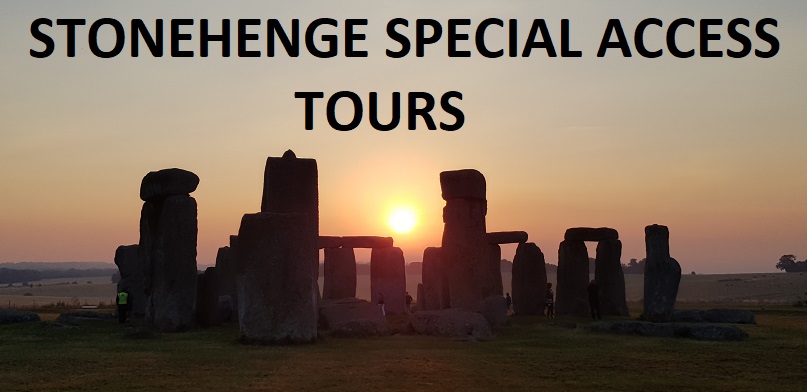
A PRIVATE VIEWING OF THE INNER CIRCLE AT STONEHENGE – an early start gives the opportunity to visit the inner circle of Stonehenge at sunrise, a walking tour of Oxford and visit to the state apartments at Windsor Castle.
Included Highlights
•Private Viewing at Sunrise of the Inner Circle at Stonehenge
•Walking tour of Oxford
•Visit Christ Church college (where Harry Potter was filmed)
•Entrance to Windsor Castle and a tour of the State Apartments and St George’s Chapel
•First-class luxury Motor-coach and the services of a Professional Guide

Private Viewing of Stonehenge
Most visitors to Stonehenge are not allowed direct access to the stones. On this special day trip from London, you’ll be invited to enter the stone circle itself, and stand beside the mysterious rocks towering above you. Your guide will unlock the secrets of this ancient World Heritage site. Enjoy the peace, away from the crowds, as you experience Stonehenge at its atmospheric best at sunrise.

Oxford
The colleges in Oxford date back to the 13th century and among its famous students were Bill Clinton, C.S. Lewis, J.R.R. Tolkien and Lewis Carroll. We take you on a fascinating walking tour, which includes visiting the Great Hall in Christ Church, where many scenes from Harry Potter were filmed. We’ll also see the Bodleian Library and the picture perfect college courtyards for which Oxford is famous.

Windsor Castle
Our day continues with a visit to Windsor Castle, the largest and oldest occupied Castle in the world, and home of the Royal Family for 900 years. Its proud, strong walls dominate the delightful town that has grown around the castle over the years. You’ll see the lavishly decorated State Apartments containing priceless furniture in glorious colours and St George’s Chapel, home to the 14th Century Order of the Royal Garter, our senior chivalric order.

Evan Evans Coach Tours – Click Here

The Stonehenge Tour Company

Histouries UK