Aboriginal Stonehenge: Stargazing in ancient Australia

12 10 2011

An egg-shaped ring of standing stones in Australia could prove to be older than Britain’s Stonehenge – and it may show that ancient Aboriginal cultures had a deep understanding of the movements of the stars.
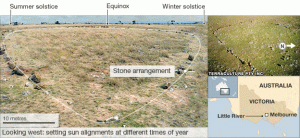
Australian Stonehenge

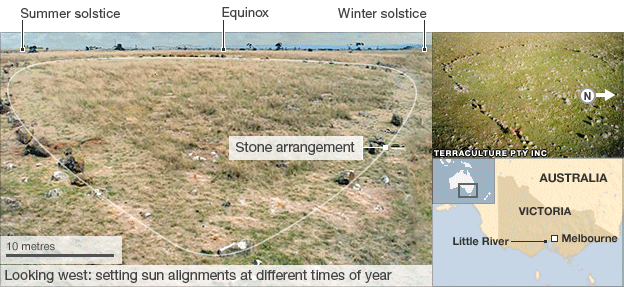
Fifty metres wide and containing more than 100 basalt boulders, the site of Wurdi Youang in Victoria was noted by European settlers two centuries ago, and charted by archaeologists in 1977, but only now is its purpose being rediscovered.

It is thought the site was built by the Wadda Wurrung people – the traditional inhabitants of the area. All understanding of the rocks’ significance was lost, however, when traditional language and practices were banned at the beginning of the 20th Century.

Now a team of archaeologists, astronomers and Aboriginal advisers is reclaiming that knowledge.

They have discovered that waist-high boulders at the tip of the egg-shaped point along the ring to the position on the horizon where the sun sets at the summer and winter solstice – the longest and shortest day of the year.

The axis from top to bottom points towards the equinox – when the length of day equals night.

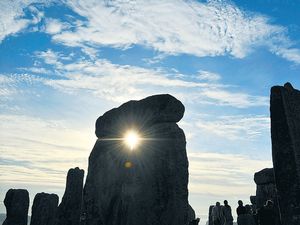
At Stonehenge, the sun aligns instead with gaps in the stones on these key dates in the solar calendar.

The probability that the layout of Wurdi Youang is a coincidence is minuscule, argues Ray Norris, a British astrophysicist at Australia’s national science agency, who is leading the investigation.

Prof Norris and his Aboriginal partners used Nasa technology to measure the position of each rock in relation to the sun, and to demonstrate the connection with the solstices and equinox.

”
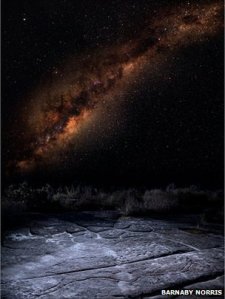
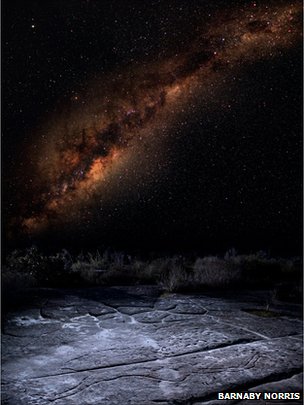
This photo of the emu in the sky, above an aboriginal rock carving, was sent to every school in Australia

This photo of the emu in the sky, above an aboriginal rock carving, was sent to every school in Australia

It’s truly special because a lot of people don’t take account of Aboriginal science,” says Reg Abrahams, an Aboriginal adviser working with Prof Norris.

As happened with Stonehenge, the discovery could change the way people view early societies. It is only recently that it has been demonstrated that Aboriginal societies could count beyond five or six.

Songs and stories

“This is the first time we have been able to show that, as well as being interested in the position of the sun, they were making astronomical measurements,” says Prof Norris, who is also a faculty member at the School of Indigenous Studies at Macquarie University in Sydney.

“It is interesting to know how far back people were doing astronomy – if it is 5,000 years old it would predate Stonehenge”

Quote Prof Ray Norris Astrophysicist

Other studies by Prof Norris, of Aboriginal songs and stories, have also indicated a clear understanding of the movements of the sun, moon and stars.

Indigenous customs vary among groups across Australia, but one story that appears in many local traditions is the tale of a great emu that sits in the sky.

The emu, which can be seen in the southern hemisphere during April and May, is a shape made by the dark patches of the Milky Way.

Its appearance coincides with the laying season of the wild emu and for the storytellers it is a sign to start collecting eggs.

Prompted by historian Hugh Cairns, Prof Norris examined and photographed an emu-shaped rock carving in Kuring-Gai Chase National Park, near Sydney, which cleverly mirrors the celestial animal-like shape.

During the southern autumn, the constellation is positioned above the rock with the bird shape almost perfectly reflected by the engraving.

Intellectual leap

Other stories show more complex, intellectual understanding of the universe.

In the case of the solar eclipse, the Walpiri people in the Northern Territory tell the story of a sun-woman who pursues a moon-man. When she catches him the two become husband and wife together causing a solar eclipse.

The idea that the solar eclipse is caused by the moon moving in front of the sun is something only widely accepted by western scientists in the 16th Century.

“This is not about balls of flames going out, it’s about one body moving in front of the other,” says Prof Norris. “That is a giant intellectual leap.”

Since solar eclipses are rare, the survival of this story, passed down through generations, also shows a remarkable continuity of learning.

These discoveries play a crucial role in helping Aboriginal and non-Aboriginal Australians understand just how intellectually advanced their ancient society was.

“This discovery has huge significance for understanding the amazing ability of this culture that is maligned,” says Janet Mooney, head of Indigenous Australian Studies at Sydney University.

“It makes not only me, as an Aboriginal person, but a lot of Aboriginal people around Australia very proud.”

She hopes to be able to tell her students of an aboriginal site more ancient than Stonehenge.

Until it is dated however, Wurdi Youang could be anywhere from 200 to 20,000 years old.

Aboriginal stone structures in the region have a vast age range and are very difficult to date. Many of the smaller rock sites that have been found, such as shelters and cooking areas, have been moved over time by natural and human forces.

But given the size of the stones at Wurdi Youang and how deeply they are entrenched in the ground it is more likely they have been there for thousands of years, archaeologists say.

Dating requires archaeologists to test the soil under the rocks to see when it was last exposed to sunlight and the team hope to be able to do this in the next few months.

But Prof Norris believes he has already proven the real value of the stone circle.

“It is interesting to know how far back people were doing astronomy, if it is 5,000 years old it would predate Stonehenge,” he says.

“But it is not quite as interesting to my mind as whether the Aboriginal people were doing real astronomy before British contact. That really tells us a lot about what kind of culture it is.”

Reach for the Stars – Aboriginal Astronomy was produced by Robert Cockburn and broadcast by Discovery for BBC World Service. Listen to the radio documentary via iplayer or download the podcast.

By Stephanie Hegarty BBC World Service
http://www.bbc.co.uk/news/magazine-15098959

Sponsored by ‘The Stonehenge Tour Company’ www.StonehengeTours.com

Merlin @ Stonehenge
The Stonehenge Stone Circle Website
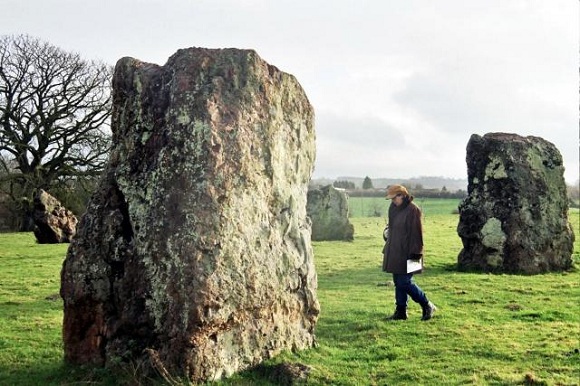


How students found evidence to change the way we think about Stonehenge

4 10 2011

Stonehengeholds many mysteries, but although there are plenty of competing

The Stonehenge area was important to people before the stones were erected

The Stonehenge area was important to people before the stones were erected

theories about its purpose, experts agree that the site chosen for such a monumental construction project must have held a very special significance for our ancestors. Now evidence is emerging that the Stonehenge area could have been an important centre for prehistoric people several thousand years before the giant stone circle was actually built.

The revelation emerged from a small-scale excavation undertaken by Open University archaeology students, which has uncovered a huge cache of artefacts belonging to hunter-gatherers from the middle of the Stone Age, including the remains of a gargantuan Mesolithic-era feast, which took place close to Stonehenge.

The site has also yielded what are believed to be the oldest carved figurines yet found in the UK, indicating a continuity of human presence in what seems to have been a sacred spot for thousands of years.

The shoestring project has been led by David Jacques, a tutor at the Open University, since 2005. After getting permission from the landowners, Sir Edward and Lady Antrobus, to survey a site just north-east of a previously unexcavated Iron Age hill fort known as Vespasian’s Camp, he was awarded a research fellowship by the university’s classical studies department with a small three-year grant. Jacques chose to dig in a number of areas along the bed of a spring and recruited students from his Open University course on culture, identity and power in the Roman Empire, to do the excavation work.

“Last year, we dug a trench in the south-east area of the spring, and as we went down the trench we found a late Roman layer, then Iron Age, then early Bronze Age – then we found all these flint tools packed together in a 12cm layer,” says Jacques. “We thought it was probably a mixed cache of early prehistoric tools, and assumed some were contemporary with Stonehenge. When we took them back to Cambridge and a number of experts suggested they were all Mesolithic, we started to get very excited.”

With the tools were animal remains, including what Jacques and his team thought was a cow’s tooth, which they sent away for radiocarbon dating. The result was an astonishingly early date of around 6250BC, firmly in the Mesolithic period and more than 3,000 years before construction on Stonehenge began. Further excavations ensued and, by the end of September 2011, the team had uncovered a rare Mesolithic hoard of more than 5,500 worked flints and tools from just two small trenches 35m away from each other. As well as the tools and tool production debris, large quantities of burnt flint were found, indicating a fire, and more than 200 cooked animal bones, which came not from a cow, but from at least one aurochs – a gigantic creature resembling a buffalo that is now extinct. “An aurochs was something like a large minivan in size, to catch an animal this big would have been a major feat. It would have fed a lot of people. It’s likely there was a large gathering, possibly as many as 100 people, who cooked and feasted on the aurochs,” says Jacques.

“Mesolithic people were nomadic hunter-gatherers who would have had temporary settlements. Salisbury Plain would have been something like the Serengeti with herds of animals roaming across it, and people could have used the hills that sort of create a basin around it as vantage points from which to see the movement of animals.”

The discovery was especially significant since only a few small scatterings of Mesolithic material have ever been found in the Stonehenge area. Tom Lyons, one of two field archaeologists from Oxford Archaeology East supervising the project, says: “It’s really exciting to get such a cache of material. This certainly makes this find nationally important, if not internationally important.”

He and the team are linking the finds to the mysterious Stonehenge “totem poles”, three colossal Mesolithic post holes found during the excavation of the Stonehenge car park some years ago, which indicate the area was important to people in the Mesolithic era. He said what has been lacking until now is evidence of the people who used them.

The flint hoard is being analysed by Barry Bishop, an independent lithic specialist, who will publish his findings in a 2012 report co-authored with Jacques. He believes the size and nature of the assemblage of tools suggest that Mesolithic people kept returning to this one site over a long period of time, probably attracted by the spring water.

“Springs are very rare in this chalk landscape, and the spring would have probably seemed unique and quite mysterious,” explains Bishop. “People in Mesolithic communities saw the world as a very spiritual place, and even saw the landscape as being alive in itself, and they would have been very attuned to any differences and sensed great significance in this. “These might have been the very conditions which gave rise to Stonehenge – people seeing certain places in the landscape as being more spiritual in some way could have led to the creation of monuments thousands of years later.”

Evidence that the spring was considered sacred in the Bronze Age comes from other objects found by Jacques’ team that the archaeologists believe were deposited there as offerings to a particular god or goddess. They include a ceremonial dagger, dated to 1400BC, and two stone carvings in the shape of ducks, dated to around 700BC. This makes them the oldest figurines yet found in the UK, says Dr David Barrowclough, director of studies in archaeology at Wolfson College Cambridge, who is writing a research paper with Jacques about these objects. “In Europe in the Bronze Age and the start of the Iron Age, there was a cult, associated with the Celtic people, of making models of waterfowl and throwing them into ponds and springs. These are the first ones ever found in Britain, and the oldest figurines ever to come out of the UK,” he explains.

Jacques’ team’s findings could be a major boost for the local town, Amesbury, which is currently developing a historic tourist trail as part of a regeneration programme. In the best Open University tradition, Jacques has made a point of engaging the public on the dig and by giving talks to local people, who have traditionally had little involvement with the archaeology taking place on their doorstep.

The town mayor, Andy Rhind-Tutt, who is spearheading the regeneration campaign, says: “I hope we can secure funding to create our own museum/exhibition centre to showcase Amesbury’s heritage and this remarkable find.”

The local unitary and town council, English Heritage and the cash prize Jacques received as part of his 2010 Open University teaching award, have provided financial support for the work, but Jacques says more funding is now a priority. “We have done all of this on a shoestring budget of a few thousand pounds. We urgently need to get funds that reflect the stature of the finds.”

For Open University courses information, call 0845 300 6090; or see www.open.ac.uk/courses

 By Yvonne Cook http://www.independent.co.uk/student/news/open-eye-you-never-know-what-you-might-unearth-2365369.html

Sponsored by ‘The Stonehenge Tour Company – www.StonehengeTours.com

Merlin @ Stonehenge
The Stonehenge Stone Circle Website


‘Standing Stones’ at Famous Wiltshire Site to be moved to London!

2 10 2011

Following discussions with the government the famous ancient standing stones of Wiltshire’s ‘Stonehenge‘ are not going to have to be destroyed after all. Instead they are to be carefully taken down from there present site at Amesbury then relocated to a new permanent site on East London’s Hackney Marshes. The idea is to have the job completed in time for the start of next summer’s Olympic Games.

Stonehenge

Stonehenge megaliths to be moved to London

“Hackney Marshes is a stones throw from the Olympic park” said Prime Minister David Cameron after announcing the decision from number 10 yesterday, “so the many thousands of overseas visitors coming to watch the games next summer will also be able to visit the ancient stone circle and take some photos of them without having to take a long journey to Wiltshire. The M4 can also be hard going for drivers at that time of the year what with resurfacing work of the M4 usually taking place to coincide with Britain’s summer holiday period, and the many caravans being towed along the motorway as drivers head for the Devon and Cornish resorts with their families.”

Wiltshire’s councillors took the decision to order the removal of the large circle of standing stones from the hill at Amesbury after a sharp eyed official at their offices in Salisbury discovered they had no records to show planning permission had ever been granted for there erection.

The original purpose of erecting the stones is uncertain, though it is now thought most likely that they were intended just as the first few stones of what would then go on to become a giant pyramid, though Wiltshire council admit there is no evidence to show the construction was then abandoned when planning permission was turned down.

“The fact remains that there are no records to show planning permission was ever granted even for the stones that are there,” say Wiltshire council. “We feel that under the circumstances it would be wrong for us to make an exception in this case simply because of the long time they’ve already been there. Council rules clearly state that planning permission has to be obtained before erecting any intended permanent building or structure over six feet high. They are a lot higher than that, and the rules mean that these monstrous eyesores have to go.”

The first of the smaller standing stones was in the process of being removed from the hill near Salisbury this morning. It is expected to be standing on it’s new site on Hackney Marshes as early as tomorrow evening (Sunday). It should be clearly visible to people heading into work on Monday morning from the Essex side of London, and clearly visible to them from the flyover just after and on the opposite side from where the old Hackney greyhound stadium, now part of the Olympic Park, used to be.

Once all the old Stonehenge standing stones have been removed from the Wiltshire site the plan is to build a much needed new supermarket on the old Stonehenge hill.

“This will create much needed jobs in the area,” said a Wiltshire council spokesperson, “and the new supermarket will be erecting replica plastic standing stones for any tourists to admire and take some snaps of.”

Its not all serious…………..
Fictious story from ‘The Spoof’ website – http://www.thespoof.com/

Sponsored by ‘The Stonehenge Tour Company’ www.StonehengeTours.com

Merlin @ Stonehenge
The Stonehenge Stone Circle Website


Digging up a new look of a famous old site

24 09 2011

Startling new evidence of one of the most famous ancient sites in the world has been uncovered by a mid-Somerset archaeologist – without setting foot on site.

Wells-based digital archaeologist Henry Rothwell has been working on a reconstruction of the entire site of Stonehenge, to show visitors what it would have looked like at various intervals in its long history.

It was when he turned his attention to recently discovered Bluehenge, sited between Stonehenge and the river Avon, that he made the startling discovery – it would not have been a circle at all but an oval.

If correct, Bluehenge would echo the oval circle already known to be at the centre of the famous Stonehenge.

And it raises an intriguing possibility: did the neolithic builders uproot Bluehenge, drag it a mile up the avenue and reconstruct it within Stonehenge itself?

It is certainly a possibility, according to Henry, who is a very modern-day archaeologist.

Any fan of TV archaeology programmes such as Time Team know that archaeologists are usually found in ditches, using trowels to peel back the layers of time to uncover the secrets of the past.

But not Henry Rothwell.

He might have a degree in archaeology but it is a computer mouse that is his chosen tool of trade as he sets about bringing back to life some of the most famous sites in the world from the comfort of his office chair at his base in Wells.

Thanks to his popular website Digital Digging, his reconstructions of wood and stone henges have helped archaeologists and the general public to visualise how such monuments would have once looked.

Using his extensive knowledge of prehistory, pouring over excavation reports and using CAD technology, he tracks where each stone or wooden post would have been and constructs diagrams showing how each monument would have looked set into the ancient landscape.

The latest breakthrough at Bluehenge came as he worked on a new initiative, to make a digital application for people to view Stonehenge via their mobile telephones.

Henry has joined forces with world-renowned photographer Adam Stanford, who uses a camera attached to a 70ft telescopic mast on the top of a 4×4 to take unique perspectives of famous sites, and well-known archaeologist, writer and broadcaster Julian Richards, from TV’s Meet The Ancestors to produce the app.

It was as they were working on The Journey To Stonehenge app – which it is hoped to be ready for iPhones and other smartphones by the mid-winter solstice – that Henry and Adam made the discovery.

“We were using a low-level aerial image taken by Adam that showed the full extent of the Stonehenge Riverside Project excavation of 2009, including the socket holes of Bluehenge, into which the Stonehenge Riverside Project team had placed upturned black buckets,” explained Henry.

“We started constructing the model, but then realised we had missed another bucket on the far right. Initially we tried expanding the circumference to make it fit but it would have been put Bluehenge into the river.

“By going back and tracing each of the socket sites again, it made the overall design of Bluehenge an oval – exactly as the one inside Stonehenge would have looked.”

The new monument was 10m (33ft) in diameter and surrounded by a henge – a ditch with an external bank.

When the Bluehenge’s stones were removed by Neolithic people, it is possible that they were dragged along the route of the Avenue to Stonehenge, to be incorporated within its major rebuilding around 2500 BC.

After posting his findings on archaeological websites last week, Henry’s views soon received the backing of influential archaeologists.

One of the first was renowned Stonehenge expert Mike Pitts, who explained that it matters if it is oval because it strengthens links between Bluehenge, Stonehenge and Woodhenge which also has an oval henge.

“The point is, if Bluehenge was an oval, it matters to how we think about it,” he wrote.

“Which makes finding out what really does happen to the rest of it under the ground important.”

To see the Bluehenge reconstruction and read more see Henry’s http://digitaldigging.co.uk/blog/2011/09/13/bluestone-henge-twin website.
Article: http://www.thisissomerset.co.uk

Sponsored by the Stonehenge Tour Company – www.StonehenegTours.com

Merlin at Stonehenge
The Stonehenge Stone Circle Website


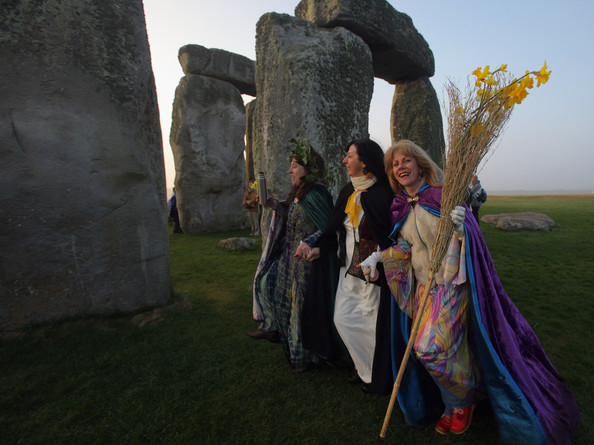
Stonehenge Autumn Equinox 2011

22 09 2011
 The Autumn Equinox (also known as Mabon) is celebrated when day and night are of equal duration before the descent into increasing darkness and is the final festival of the season of harvest.  For many pagans, this is the time to reflect on the past season, and to recognize the balance of the year has changed.

 2011 Autumnal Equinox takes place on September 23rd, at 10.04am UK time (3.03 UTC), but when ‘open access’ to Stonehenge starts is decided by English Heritage and depends on visibility. The sunrise is at 6.48am.
autumn-equinox-stonehenge

Public access to Stonehenge is denied after dark, so if you want to see the sunset on September 22nd (18.59pm), you’ll have to stand on either the Avenue or on the side of the A344

The Autumnal Equinox

In September is the Fall Equinox, which has come to be called Mabon by many contemporary Neo-Pagans. Occuring approximately on September 21st, this is the day when the hours of daylight and nighttime are once again balanced. Calender days from now until the Winter Solstice will slowly get shorter and shorter in their daylight hours.

Agriculturally, this time of year the harvest is now in full swing, with late summer and fall fruits, vegetables and grains being gathered up before winter. This is the time of year a lot of canning or preserving of garden foods takes place. Hunting season also starts around this time, and this was when farmers would slaughter animals and preserve meat for the coming months as well.

This holiday is the last of the harvest holidays which began with the summer solstice and continued with Lammas.

23rd September Harvest time!
The Autumn Equinox or Harvest Home is also called Mabon, pronounced ‘MAY-bon’, after the Welsh god Mabon ap Modron, which means literally ‘son of mother’. Mabon appears in ‘The Mabinogion’ tale. The Druids call this celebration, Mea’n Fo’mhair, and honour The Green Man, the God of the Forest, by offering libations to the trees. The Welsh know this time as ‘Alban Elfed’, meaning ‘light of autumn’. This is the point of the year when once again day and night are equal – 12 hours, as at Ostara, the Spring Equinox. The Latin word for Equinox means ‘time of equal days and nights’. After this celebration the descent into winter brings hours of increasing darkness and chiller temperatures. It is the time of the year when night conquers day. After the Autumn Equinox the days shorten and nights lengthen. To astrologers this is the date on which the sun enters the sign of Libra, the scales, reflecting appropriately the balanced day and night of the equinox. This was also the time when the farmers brought in their harvested goods to be weighed and sold.
Harvest festival This is the second festival of the season of harvest – at the beginning of the harvest, at Lammas, winter retreated to his underworld, now at the Autumn equinox he comes back to earth. For our Celtic ancestors this was time to reflect on the past season and celebrate nature’s bounty and accept that summer is now over. Harvest Home marks a time of rest after hard work, and a ritual of thanksgiving for the fruits of nature. This is the time to look back on the past year and what you have achieved and learnt, and to plan for the future. The full moon nearest to the Autumn Equinox is called the Harvest Moon and farmers would harvest their crops by then, as part of the second harvest celebration. Mabon was when livestock would be slaughtered and preserved (salted and smoked) to provide enough food for the winter. At the South Pole they will be celebrating the first appearance of the sun in six months. However, at the North Pole they will be preparing for six months of darkness. During Medieval times, the Christian Church replaced Pagan solstices and equinox celebrations with Christianized occasions. The Autumn equinox celebration was Michaelmas, the feast of the Archangel Michael.

The triple Goddess – worshipped by the Ancient Britons, is now in her aspect of the ageing Goddess and now passes from Mother to Crone, until she is reborn as a youthful virgin as the wheel of nature turns. At the Autumn equinox the goddess offers wisdom, healing and rest. Mabon Traditions The Wicker man There was a Celtic ritual of dressing the last sheaf of corn to be harvested in fine clothes, or weaving it into a wicker-like man or woman. It was believed the sun or the corn spirit was trapped in the corn and needed to be set free. This effigy was usually burned in celebration of the harvest and the ashes would be spread on the fields. This annual sacrifice of a large wicker man (representing the corn spirit) is thought by many to have been the origin of the misconception that Druids made human sacrifices. ‘The reaping is over and the harvest is in, Summer is finished, another cycle begins’ In some areas of the country the last sheaf was kept inside until the following spring, when it would be ploughed back into the land. In Scotland, the last sheaf of harvest is called ‘the Maiden’, and must be cut by the youngest female in attendance.
To Autumn O Autumn, laden with fruit, and stained With the blood of the grape, pass not, but sit Beneath my shady roof, there thou may’st rest, And tune thy jolly voice to my fresh pipe; And all the daughters of the year shall dance, Sing now the lusty song of fruits and flowers. William Blake Mabon is a time to reflect, as we reap the harvest of experience from the past year – the completion of another turn of the Great Wheel. Corn Dollies Corn dollies were also made from the last sheaf and kept in the house to protect the inhabitants from bad spirits during the long winter. Apples To honour the dead, it was also traditional at Mabon to place apples on burial cairns, as symbolism of rebirth and thanks. This also symbolizes the wish for the living to one day be reunited with their loved ones. Mabon is also known as the Feast of Avalon, deriving from the meaning of Avalon being, ‘the land of the apples’.

Sponsored by ‘The Stonehenge Tour Company’ www.StonehengeTours.com

Merlin @ Stonehenge – The Stonehenge Stone Circle Website


3D Stonehenge Model Unveiled

16 09 2011

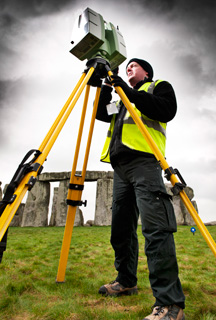
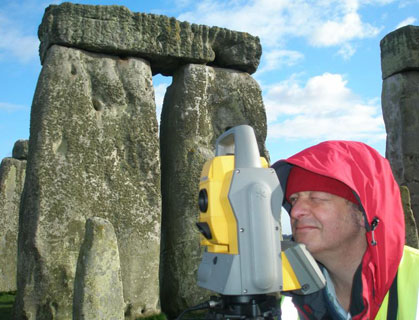
3d-stonehenge-scanEnglish Heritage have announced that the survey and initial data processing of the recent laser scan of Stonehenge is now complete, and present an update with a short video fly-though of the data.
A detailed survey of every stone that makes up Stonehenge using the latest technology, including a new scanner on loan from Z+F UK that has never before been used on a heritage project in this country, has resulted in the most accurate digital model ever produced of the world famous monument.

 With resolution level as high as 0.5mm in many areas, every nook and cranny of the stones’ surfaces is revealed with utmost clarity, including the lichens, Bronze Age carvings, erosion patterns and Victorian graffiti.

Most surprisingly, initial assessment of the survey has suggested that the ‘grooves’ resulting from stone dressing on some sarsen stones (the standing stones) appear to be divided into sections, perhaps with different teams of Neolithic builders working on separate areas.

A first glimpse of the model can now be viewed here
http://www.english-heritage.org.uk/about/news/3d-stonehenge-model-unveiled/

The model will be a powerful tool for tracking changes in the physical condition of Stonehenge, and for deepening our understanding of its construction and the thinking and working habits of its creators, plus changes to the monument in later history.

In March 2011 English Heritage commissioned 3D laser scanning specialists the Greenhatch Group, together with Atkins Mapping and Archaeo-Environment Ltd, to capture the stones and the landscape surrounding them at a level of precision and definition never before attempted. The survey includes all the visible faces of the standing and fallen stones of Stonehenge, including Station, Heel and Slaughter stones, as well as the top of the horizontal lintels.

 The resultant high resolution archival data and 3D meshed models is currently being synthesised and will be officially published and shared with the wider archaeological community in due course. Experts will also further analyse and study the archaeological significance of the data.

A variety of 3D models and datasets which can be manipulated and customised to simulate fly-over views of the monument from different perspectives will be used by  English Heritage’s interpretation team who is working on the new galleries of the proposed visitor centre.

http://www.stonehengelaserscan.org/

Sponsored by ‘The Stonehenge Tour Company’ – www.StonehengeTours.com

Merlin @ Stonehenge
The Stonehenge Stone Circle Website


Stonehenge Architect Linked With Welsh Burial Cairn?

8 09 2011

An impressive tomb discovered in Wales is believed to belong to an important figure involved with the construction of Stonehenge.

The burial chamber is located in the Preseli Hills in Pembrokeshire, Wales, and sits on top of a ceremonial monument.

Nearby, a pair of standing stones embedded in a bank bear a strong resemblance to the pair-arrangement of the stones at Stonehenge, the famous prehistoric monument in Wiltshire, southern England.

Stonehenge features earthworks encompassing a circular arrangement of large standing stones. These are mainly two types of rock—the large sarsen stones (a type of sandstone), and a variety of smaller igneous rocks called bluestones (natural columns of while-spotted dolerite).

The excavation of the tomb in the Carn Menyn region of west Wales was led by Tim Darvill from Bournemouth University, and Geoffrey Wainwright from the Society of Antiquaries.

The archeologists believe the 80 bluestones at Stonehenge originated from the same area as the tomb and were transported around 160 miles (nearly 260 kilometers) to the Wiltshire plains about 4,500 years ago (around 2,300BC).

Uncovering the reason for this epic journey will unlock the mystery behind Stonehenge’s existence

Darvill and Wainwright first suggested in 2008 that Stonehenge may have been built as a major healing center, rather like a prehistoric version of Lourdes or Santiago de Compostela. They think the bluestones, not the sarsen, were believed to convey healing powers.

The Preseli area has many springs linked with ritual healing in prehistory, and this could explain why the bluestones were quarried for Stonehenge, despite being so far away.

“We went back to the Preselis and started doing excavations up there,” says Wainright, according to The Guardian. “The first site we explored was a big burial cairn in the shadow of Carn Menyn, where the Stonehenge bluestones come from.”

The excavation team discovered a stone circle underneath the cairn, built of bluestone, and organic material is being carbon dated.

“Then this stone circle was covered with the huge burial cairn with a chamber in the middle,” Wainright added. “The space turned from a public ceremonial space defined by the stone circle into the burial spot of a very important person.”

“We have obviously got a very important person who may have been responsible for the impetus for these stones to be transported,” Wainwright BBC News.

“It can be compared directly with the first Stonehenge, so for the first time we have a direct link between Carn Menyn—where the bluestones came from—and Stonehenge, in the form of this ceremonial monument.”

Sponsored by the Stonehenge Tour Company – www.StonehengeTours.com

Merlin @ Stonehenge
The Stonehenge Stone Circle Website



The Stonehenge Landscape

8 09 2011

Stonehenge is the best known of all the prehistoric monuments in the British Isles and probably also in Europe. Along with the Neolithic monuments around Avebury situated 28km to the north, it forms a UNESCO recognised World Heritage Site (WHS), the parts of which are separated by the southern edge of the Marlborough Downs, Pewsey Vale and the Salisbury Plain military training area.

Much of the Avebury portion of the WHS, along with the military ranges, has been investigated from an archaeological landscape perspective during recent decades, as has the area to the south and west of the WHS, but ironically the Stonehenge area has not been treated in this way and it lacks the solid base of landscape surveys on which to build interpretations and understanding. The fresh Government-led imperative to ensure that new visitor facilities are in place by 2012 demands the provision of modern archaeological site plans, interpretations and other data which can feed into educational and presentational programmes as well as serving academic, management and conservation needs. 
Stonehenge Landscape

English Heritage are therefore undertaking an analytical landscape investigation of the Stonehenge World Heritage Site. This draws upon the considerable existing work provided by excavation, aerial, metric and geophysical survey but it fills a gap in this suite because there has been no modern detailed survey of the earthworks and other upstanding historicphysical remains within the Site – the barrow cemeteries, field systems and linear ditches, but also the tracks, ponds and military remains of more recent date.

Consequently there are no adequate plans of most of the upstanding archaeological remains within the WHS and no synthesis of the landscape history, especially in regard to its medieval and post-medieval phases. Analytical earthwork survey and analysis,supported by aerial survey and lidar data, is the key to understanding landscape change and will provide the framework in which individual small-scale site specific interventions can rest. Recommendations for other work, eg geophysical survey or coring to explore the extent of buried land surfaces, may arise from this.

The knowledge gained from this project is needed to inform displays in the new Visitor Centre, but also to inform various ongoing management issues, such as visitor pressure, and animal burrowing. The requirements of the new Visitor Centre include the best possible visualisation of the stones and their environs; digital terrain modelling of the surrounding land surface will provide the latter while it is hoped that laser scanning of the former will complete the package
For further detaisl visit: http://www.english-heritage.org.uk/

Sponsored by the Stonehenge Tour Company – www.StonehengeTours.com

Merlin @ Stonehenge
The Stonehenge News Website


Exploding star to be visible in skies above Stonehenge tonight

7 09 2011

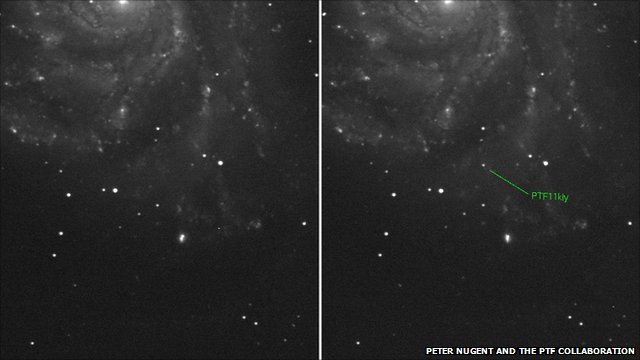
The most visible exploding star in a generation will be visible in skies above Stonehenge tonight.  Dubbed PTF11kly the supernova is still getting brighter and should be visible with a good pair of binoculars today.

Blink and you might miss it, but the canopy of the night sky looks ever so slightly different today. A single bright spark has been added to the millions of brilliant white dots illuminating the inky blackness.

Supernovae occur when giant stars reach the end of their life collapsing in on themselves and triggering an explosion that can briefly outshine an entire galaxy before fading away over a period of weeks or months.

The team, lead by Dr Mark Sullivan, made the discovery using a robotic telescope at the Palomar Observatory.

Sunspot 1283 produced a major M5.3-class solar flare during the early morning hours of September 6th. The coronal mass ejection (CME) associated with this flare was airmed directly at Earth so impact with our magnetosphere is likely within 2-3 days time. The expected time frame of impact will be between September 7th or 8th when geomagnetic storms are likely at high latitudes including the potential for even modest aurora activity at mid northern latitudes also so be on full alert!. Aurora forecast and alert charts below…

The geomagnetic field is expected to be quiet on September 6 and most of September 7. Late on September 7 or early on September 8/9th the CME from the major flare early on September could reach Earth and cause active to major storm conditions.

“The most exciting thing,” Dr Sullivan says, “is that this is what’s known as a type 1a supernova – the kind we use to measure the expansion of the Universe. Seeing one explode so close by allows us to study these events in unprecedented detail.”

The last time a supernova of this type occurred so close was 1972. Before that you have to go back to 1937, 1898 and 1572.

“Observing PTF11kly unfold should be a wild ride,” says Professor Peter Nugent from the Lawrence Berkeley National laboratory. “It is an instant cosmic classic.”

Sponsored by the Stonehenge Tour Company – www.StonehengeTours.com

Merlin @ Stonehenge
The Stonehenge Stone Circl Website


Tomb found at Stonehenge quarry site

1 09 2011

The tomb for the original builders of Stonehenge could have been unearthed by an excavation at a site in Wales.

The Carn Menyn site in the Preseli Hills is where the bluestones used to

The central site had already been disturbed so archaeologists chose to excavate around the edges

The central site had already been disturbed so archaeologists chose to excavate around the edges

construct the first stone phase of the henge were quarried in 2300BC.

Organic material from the site will be radiocarbon dated, but it is thought any remains have already been taken.

Archaeologists believe this could prove a conclusive link between the site and Stonehenge.

The remains of a ceremonial monument were found with a bank that appears to have a pair of standing stones embedded in it.

The bluestones at the earliest phase of Stonehenge – also set in pairs – give a direct architectural link from the iconic site to this newly discovered henge-like monument in Wales.

The tomb, which is a passage cairn – a style typical of Neolithic burial monument – was placed over this henge.

The link between the Welsh site and Stonehenge was first suggested by the geologist Herbert Thomas in 1923.

This was confirmed in 2008 when permission was granted to excavate inside the stone circle for the first time in about 50 years.

The bluestones had been transported from the hills over 150 miles to the plain in Wiltshire to create Stonehenge, the best known of all Britain’s prehistoric monuments.

Two of the leading experts on Stonehenge, Prof Geoff Wainwright and Prof Timothy Darvill, have been leading the project.

They are now excavating at the site of a robbed out Neolithic tomb, built right next to the original quarry.

They knew that the tomb had been disturbed previously, so rather than excavate inside, they placed their small trench along its outer edge.

Prof Darvill said: “It’s a little piece of keyhole surgery into an important monument, but it has actually lived up to our expectations perfectly.”

There are many springs in the area, which may be have been associated with ritual healing in prehistoric times, and also the reason why these particular stones were quarried for another monument so far away.

Prof Wainwright said: “The important thing is that we have a ceremonial monument here that is earlier than the passage grave.

“We have obviously got a very important person who may have been responsible for the impetus for these stones to be transported.

“It can be compared directly with the first Stonehenge, so for the first time we have a direct link between Carn Menyn – where the bluestones came from – and Stonehenge, in the form of this ceremonial monument.”

Sponsored by ‘The Stonehenge Tour Company’ www.StonehengeTours.com

Merlin @ Stonehenge
The Stonehenge Stone Circle Website