MEGALITHOMANIA TOURS 2012

28 03 2012

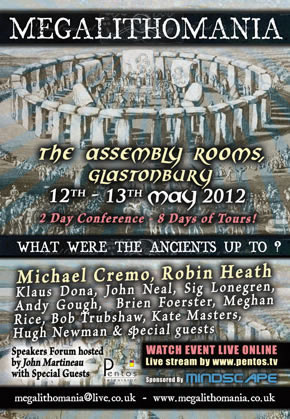
The Ultimate Conference for Megalithomaniacs 2012

Join us for an incredible selection of outdoor Antiquarian delights this May. Megalithomania invites you to explore, ponder, dowse, and be captivated by the incredible stones from antiquity. Over the years we have increased our tour schedule around the conference and now in 2012 we have eight days of tours and other activities for you to enjoy. From the heights of Glastonbury Tor, to the remote stone avenues of Dartmoor, the Olde English landscape still has lots to offer. With special guest experts joining us for each tour, who know their landscape well. For this year we introduce our new ‘Megalithic Cornwall‘ Tour with Glenn & Cameron Broughton. Save £42 if you book the ‘Full Ticket’ that includes the Cornwall Tour….

NEW: Megalithic Cornwall Tour Here


Coach travel included in price of all tours. Meet at Abbey Car Park. Bring packed lunch
. Info & Booking:             07779 113452

Friday 11th May: £55 (SOLD OUT)
Stonehenge with Robin Heath – 4pm – 9pm

Private Access to Stonehenge, with excursion to the Cursus, several Tumuli, Durrington Walls and Woodhenge. (inc private access to Stonehenge)

Monday 14th May:£50
Avebury & the Valley of the White Horse – 9am – 5pm

An exclusive tour around megalithic Avebury, the largest stone circle in the world, West Kennett Long Barrow, Silbury Hill and more with Peter Knight.

Tuesday 15th May: £50
Sacred Avalon Walking Tour – 9am – 1pm
with Anthony Thorley
Visiting the Tor, Glastonbury Abbey, Michael & Mary energy lines
Tuesday Afternoon: (inc in above price)
Cadbury Castle & Burrow Mump – 2.30pm – 6pm
A guided visit to two of the most impressive earthworks in Somerset

Wednesday 16th May: £50
Dartmoor Stone Circles and Avenues – 8am – 6pm

A five-hour walk around the incredible landscape of megalithic Dartmoor, Devon, visiting stone circles, megalithic avenues, menhirs and tracking earth energies. 90 min drive both ways. Bring packed lunch.
(NOTE: if you are going on the Cornwall Tour, you must be on this tour)

Link: http://www.megalithomania.co.uk/

Sponsored by ‘The Stonehenge Tour Company’ http://www.StonehengeTours.com

Merlin says “This conference is wirth every penny and a good excuse to spend a couple of days in Glastonbury”

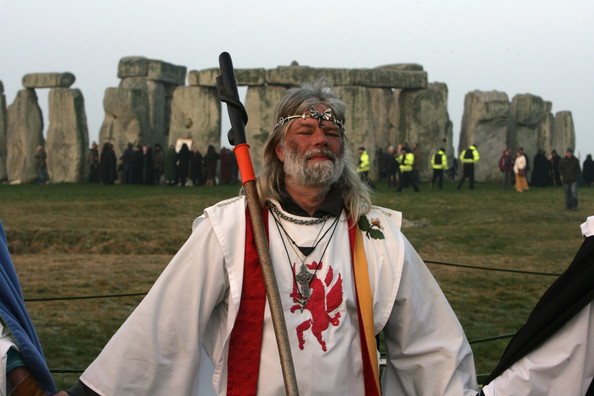
Merlin at Stonehenge


Salisbury, Stonehenge and Sarum Tour Company

27 03 2012

Local Tour Operator launches daily audio tours of Stonehenge and ancient Wiltshire sightseeing tour.

Join them on a journey as they travel back 5000 years in time.
Daily at 09:30 from the centre of Salisbury their “Magical History Tour” sets out to discover the mysteries of Stonehenge.  This is a great alternative to joining a coach tour from London.

Driven by their friendly fully qualified Driver. Enjoy 3 hours visiting some of the most mysterious places on earth. Be entertained and informed listening to a detailed commentary transmitted simultaneously in English, German, French and Italian.

On your return you will have seen some of the most beautiful English countryside, been fascinated by Stonehenge, seen Old Sarum the iron age fort which was the earliest settlement here and finally viewed the Cathedral from a special place, missed by most tourists.

They look forward to welcoming you on board. Why not catch a train from London and join this local tour.

Shrouded in mystery the World Heritage site at Stonehenge attracts people
from all over the world.

Salisbury Stonehenge Sarum Tours

Salisbury Stonehenge Sarum Tours

Our experience at Salisbury, Stonehenge & Sarum Tours ensures that you return home with lasting memories of the day when you stepped back in time. We have a selection of tours to meet all tastes from Cruise Guests with limited time to the visitor wanting to enjoy all the wonderful sites more leisurely. We also have our “Magical History Tour” to Stonehenge, which runs daily at 09:30. Commentary in English, German, French and Italian.

No tour to England would be complete without a tour of Stonehenge. Where is Stonehenge? Stonehenge is situated near Salisbury in the county of Wiltshire. Stonehenge is a Neolithic stone circle which even today is still shrouded in mystery.

Salisbury Stonehenge and Sarum Tours specialise in arranging multilingual tours of Stonehenge and surrounding places of interest including Salisbury and Old Sarum.
Salisbury, Stonehenge and Sarum Tour Guides are all local people who have been especially trained to achieve our “Yellow Badge” standard.

They meet their guests in the mediaeval city of Salisbury and you travel to Stonehenge in one of their modern vehicles.

The Stonehenge Tour from Salisbury Stonehenge and Sarum Tours will no doubt be one of your most memorable trips. So when you travel in England make sure that you take one of our tours to Stonehenge. We are also specialists catering for Southampton cruise passengers and their airport transits.

The Magical History Tour – English – German – French – Italian – simultaneously

The tour lasts 3 hours during which time you will have available multi lingual commentary in English, German, French and Italian. Disposable earphones are provided but feel free to bring your own personal ones with you. You will be given a tour program with maps describing you tour.

Firstly we drive along the picturesque Woodford Valley along a route too narrow for large buses where you will pass through traditional English villages with thatched cottages. You will see the homes of some very interesting and diverse residents. We shall tell you more about this as we drive along. Before we arrive at Stonehenge the bus will make a short stop so you can see the location of the newest discovery: Blue Stonehenge. Upon arriving at Stonehenge your guide will take you to the entrance where you will receive a multi lingual audio tour. You may now spend time pondering the mysteries of this World Heritage Site, buy souvenirs and purchase refreshments. We shall stop here for 60 minutes, but if the weather is bad guests find that 45 minutes is sufficient. We now drive across “Salisbury Plain” on our way to “Old Sarum”. This area has become a “Hotspot” for “crop circles” and UFO’s”. In spring and early summer it is quite possible that you could spot a crop circle but UFO’s might be more difficult to find. At Old Sarum, the original Iron Age settlement of Salisbury you will learn how the Celts, Saxons, Danes, Vikings and Normans all lived here. Look and enjoy the magnificent 360° vista and look down on the medieval city of Salisbury. Our last stop is at the “Harnham Mill” because it offers wonderful views of the magnificent St Mary’s Cathedral. Regrettably many tourists never see the Cathedral from this aspect, often being bussed into the city from London before being “whizzed” off to their next destination. It is from here that the respected English artist John Constable chose to depict Salisbury Cathedral in his famous paintings. At this point we offer you the option of leaving the tour and walking along the town path, through the water meadows, into the City. It is a gentle and flat 1,200 metre stroll which takes no more than 15 minutes. Your Tour Program highlights the interesting wildlife, which can be seen in the water meadows, which is a  nature “Preservation Area”. For those returning to Salisbury with the bus, our drive takes 5 minutes and we shall drop you off where we started, in the Guildhall Square.

The tour starts and returns from the Guildhall Square at 09:30 – see map. You will see our Guide on the steps of the Guildhall carrying a large psychedelic umbrella.
Stonehenge for 60 minutes, WC, refreshments and shop
Old Sarum for 30 minutes WC and shop
Harnham Mill for 15 minutes

The Stonehenge Stone Circle Website 


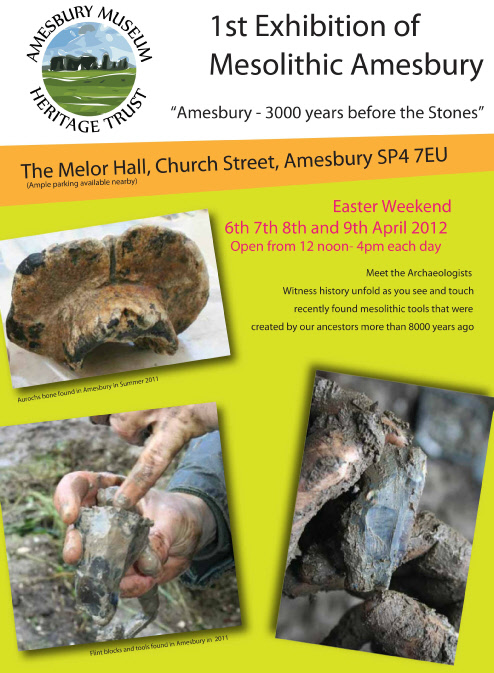
1st Exhibition of Mesolthic Amesbury – 3000 years before the Stones

24 03 2012

Resulting from the Amesbury 2012 initiative lead by Mayor Andy Rhind-Tutt and supported by Amesbury Town Council, local people and our Druids we are pleased to announce that Amesbury Town Council, have completed the purchase of the Melor Hall in Amesbury (Opposite the Antrobus Arms) and will now move to the process of planning and building the Town its first ever Museum and interpretation centre.

This will tell the Story of Amesbury and interest a percentage of those millions of tourists that visit our Stonehenge, bolstering the local economy and mutually supporting the two existing museums of Salisbury and Devizes and Stonehenge.
Amesbury Museum

On the Easter weekend, the existing hall will be used for an exhibition highlighting the Mesolithic rich heritage that is being found. This will feature live archaeology taking place locally at one of the most exciting dig sites in Britain today.

Meet the archaeologists, ask questions, handle finds and discover for yourselves the wonders of the Mesolithic Salisbury Plain.

Sponsored by ‘The Stonehenge Tour Company’ http://www.StonehengeTours.com

Merlin says “This is great news for Stonehenge, Amesbury and Wiltshire Tourism 2012.  See you at the Easter Weekend event”

The Stonehenge Stone Circle Website


Court rules on Achill ‘Stonehenge’

16 03 2012

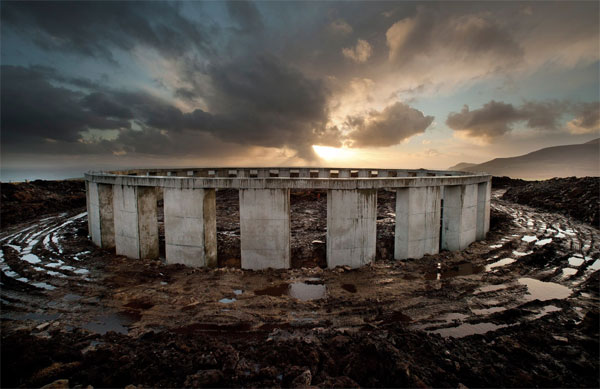
A Stonehenge-like structure built on Achill Island by developer Joe McNamara must be demolished if An Bord Pleanala finds it was built without planning permission, the High Court ruled today.

The massive Stonehenge-esque structure erected on an Achill hilltop by Joe McNamara. Photograph: Michael Mc Laughlin

The massive Stonehenge-esque structure erected on an Achill hilltop by Joe McNamara. Photograph: Michael Mc Laughlin


Mayo County Council had argued before the court that Mr McNamara’s application to An Bord Pleanala aimed at having the structure declared exempt from planning permission requirements cannot succeed and is “a delaying tactic”.

Mr Justice Brian McGovern agreed Mr McNamara’s application was “utterly hopeless” and was made simply “to delay the inevitable.”

In an affidavit by an architect acting on Mr McNamara’s behalf, the court was told the intended use of the structure was “primarily as an ornamental garden sited on agricultural lands”.

Mayo County Council, which contends the structure is unauthorised development, yesterday secured orders from Mr Justice McGovern compelling the developer, if An Bord Pleanala rules the structure is not exempted development, to demolish it and restore the site to its original state under the supervision of an ecologist and an archaeologist.

The Council previously told the court it has particular concerns about the structure because of its proximity to an area of special conservation on Achill.

Mr McNamara (41), with addresses at Achill Island, Co Mayo and Salthill, Co Galway, has claimed the structure – consisting of a ring with 30 large columns with tapping stones placed on top – does not require planning permission because it is exempted development within the meaning of the Planning and Development Regulations 2001.

He has applied under Section 5 of the Planning Development Act to An Bord Pleanála to have the structure deemed an exempted development. The board is due to make a decision on that application in the coming months.

Mr McNamara, who is working in the UK, was not in court.

Pat Butler SC, for the Council, told the judge an affidavit sworn by an architect acting on Mr McNamara’s behalf had stated the intended use of the structure is “primarily as an ornamental garden sited on agricultural lands.”

While a garden may be exempted development, Mr McNamara’s development contained structures which required planning permission, counsel argued. Under the planning laws, only structures in a garden erected by the State are exempt from the requirement for planning permission, he said.

Counsel said Mr McNamara’s application to An Bord Pleanala has no prospect of success and was “a delaying tactic.”

Patrick Keane, a solicitor acting for Mr McNamara, said the Council’s proceedings aimed at demolishing the structure should be put on hold until after the Board has made its decision.

Mr Justice McGovern said he would make the orders sought by the Council against Mr McNamara but would stay those pending the decision of An Bord Pleanala.

There was “overwhelming evidence” this “extraordinary structure” was not an exempted development, he said. Insufficient reasons for the structure to be regarded exempt had been offered to the court on Mr McNamara’s behalf, he added.

The judge noted the council’s concerns about the structures impact on an area of special conservation. There was enough evidence of poor planning in Ireland’s rural and urban landscapes in respect of developments were planning decisions were actually made, he also remarked.

Last year, Mr McNamara was jailed for three days after being found in contempt of a court order requiring him to immediately cease work on the project.

Mr McNamara previously came to public attention when he drove a cement lorry emblazoned with the words “Anglo” and “toxic bank” at the gates of Leinster House. He was later acquitted of charges of criminal damage and dangerous driving in connection with that incident.

Source: http://www.irishtimes.com/newspaper/breaking/2012/0315/breaking186.html

Sponsored by ‘The Stonehenge Tour Company’ http://www.StonehengeTours.com

Merlin says “Need some joined up thinking here – sad news”

Merlin @ Stonehenge
The Stonehenge Stone Circle Website


Stonehenge Spring Equinox 20th March 2012

1 03 2012

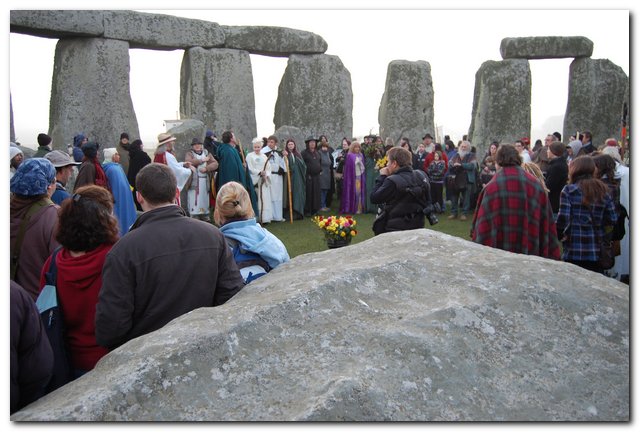
The exact time for the 2012 Spring (or Vernal) equinox at Stonehenge is 5.14am ;
Sunrise on the March 20th at 6.09am.

Stonehenge EquinoxEnglish Heritage have confirmed Open Access for Stonehenge on the Spring Equinox 2012 will be dawn on the 20th of March.

Expect a short period of access, from approximately 5.45am to 8.00am.

This is the second of the four ‘sky points’ in our Wheel of the Year and it is when the sun does a perfect balancing act in the heavens.

At the Spring (or Vernal) Equinox the sun rises exactly in the east, travels through the sky for 12 hours and then sets exactly in the west. So all over the world, at this special moment, day and night are of equal length hence the word equinox which means ‘equal night’.

Of course, for those of us here in the northern hemisphere it is this equinox that brings us out of our winter.

For those in the southern hemisphere, this time is the autumnal equinox that isArthur Pendragon taking you in to your winter. And this is very much how I think of the equinoxes – as the ‘edges’ of winter. This is why they can be quite hard on our bodies as it is a major climatic shift, so it is a good time to give a boost to your immune system with natural remedies and cleansing foods.

Here in Wiltshire (as with the rest of rural Britain), it was traditional to drink dandelion and burdock cordials at this time as these herbs help to cleanse the blood and are a good tonic for the body after its winter hardships.

As the Vernal Equinox heralds the arrival of spring, it is a time of renewal in both nature and the home, so time for some spring-cleaning!

This is more than just a physical activity, it also helps to remove any old or negative energies accumulated over the dark, heavy winter months preparing the way for the positive growing energy of spring and summer.

As with all the other key festivals of the year, there are both Pagan and Christian associations with the Spring Equinox.To Pagans, this is the time of the ancient Saxon goddess, Eostre, who stands for new beginnings and fertility.

This is why she is symbolized by eggs (new life) and rabbits/hares (fertility).

Her name is also the root of the term we give to the female hormone, oestrogen.By now, you may be beginning to see the Christian celebration derived from this festival – Easter.

And this is the reason why the ‘Easter Bunny’ brings us coloured eggs (and if you’re lucky chocolate ones!) at this time of year.

So, as nature starts to sprout the seeds that have been gestating in her belly throughout the winter, maybe you can start to think about what you want to ‘sprout’ in your life now and start to take action.

Our sponsors ‘The Stonehenge Tour Company’ are offering transport from London. They have been offering ‘non obtrusive’ small group guided tours of the solstice and equinox events for many years and we welcome their approach and ‘thought provoking’ trips.  It works out much cheaper and certainly easier  at that time of the morning.

Link: http://pagancalendar.co.uk/
Link: http://wwp.greenwichmeantime.com/longest-day/
Link:  http://www.stonehengetours.com/html/stonehenge-spring-equinox-tour-2011.htm
Link: http://www.timeanddate.com/calendar/determining-easter-date.html

Merlin says “See you there and remember – RESPECT THE STONES!”

Stonehenge on Twitter:  http://www.twitter.com/st0nehenge 

Merlin @ Stonehenge
The Stonehenge Stone Circle website


Leap Year Lark – Stonehenge Landscape Tour 29th February

29 02 2012

Make the most of your extra day with a lovely long walk in the outdoors!

Celebrate the leap year with a walk in the Neolithic and Bronze Age Stonehenge landscape. Your guide will take you on a circuit of around 5 miles over the downs, exploring some of the less visited monuments that together form the Stonehenge World Heritage Site. Bring your binoculars and keep an eye out for hares and winter birds too.
We’re meeting in the Stonehenge Car Park SP4 7DE (not NT), at the two ‘touching stones’ at the top of the slope that leads down towards the Stonehenge Cafe. Please dress for the weather and wear stout footwear. Wrap up warm – it gets chilly up on the downs! Access is by pedestrian and farm gates; the terrain is mostly grassland and trackways, uneven underfoot.
Accessible W.C. in car park. Accompanied children welcome, free. Dogs on leads welcome.
Booking Essential 0844 249 1895. A 5% booking fee applies. Phone lines are open Mon to Fri 9am-5.30pm, plus Sat and Sun 9am-4pm.
Stonehenge Landscape
Amesbury, Salisbury
Wiltshire
SP4 7DETel: +44 (0) 844 249 1895

Day Opening Times
Wednesday 11:00 – 15:00

SPONSORED BY ‘THE STONEHENGE TOUR COMPANY’ – WWW.STONEHENGETOURS.COM

Merlin says “Get some fresh air and enjoy the Wilstshire Landscape – next one in 4 years”

Merlin @ Stonehenge


STONEHENGE: UNCOVERED – February 24th 2012

22 02 2012

Unlock the secrets of Stonehenge and the surrounding sites in this exclusive walking tour led by English Heritages’ Properties Historian Susan Greaney.Visit the World Heritage Site and key archaeological areas in this fascinating landscape. Along the way, gain an exclusive insight into the new and exciting discoveries made by recent research projects carried out in the area and discover for yourself more about this special landscape.
Stonehenge HOW TO BOOK

Purchase your tickets today by calling our dedicated Ticket Sales Team on            0870 333 1183       (Mon – Fri 8.30am – 5.30 Sat 9am – 5pm). Please note: Booking tickets for this event is essential as places are limited

Link: http://www.english-heritage.org.uk/daysout/events/stonehenge-uncovered-s-24-feb/

Sponsored by ‘The Stoneheng Tour Company’ http://www.StonehengeTours.com

Merlin say “You have to be an English Heritage member for this tour but its well worth joining”

Merlin @ Stonehenge 


Was Stonehenege built for sound effects?

17 02 2012

The origins of Stonehenge have long baffled historians – was it intended as a monument for the dead, a celestial observatory, a place or healing?

The widely accepted theory is that the arrangement of pillars at Stonehenge is related to the positioning of the Sun at the equinoxes Photo: ALAMY

The widely accepted theory is that the arrangement of pillars at Stonehenge is related to the positioning of the Sun at the equinoxes Photo: ALAMY

But now a US researcher has come up with an intriguing new theory, claiming that the ancient stones were actually arranged to create a special sound effect.

Steven Waller said the ordering of stones at the rock monument in Wiltshire could be an attempt to recreate a sound illusion known as an “interference pattern” during prehistoric pipe-playing rituals.

The effect happens when two sounds clash, and results in some people hearing a louder noise and some a softer noise, depending on where they stand in relation to the source.

People taking part in a ritual dance around a pair of pipers would have heard the music unexpectedly grow quieter as they moved past certain spots due to this natural phenomenon, Mr Waller said.

This would have created the illusion that the sound was intermittently being muffled by invisible obstacles as the dancers circled the pipers, he said.

Speaking at the American Association for the Advancement of Science (AAAS) annual meeting in Vancouver on Thursday, Mr Waller, an independent California-based researcher, said it could be a desire to recreate this natural phenomenon that provided the “blueprint” for the stone circle.

Although it remains a puzzle why our ancestors built Stonehenge, the theory contradicts the most widely accepted assertion that the arrangement of the pillars is related to the positioning of the Sun at the equinoxes.

When sound waves clash they either reinforce each other, making the noise louder, or cancel each other out, depending on the exact point at which the waves meet.

If two sound sources are positioned near one another, they will sound noticeably louder from some angles but quieter from others.

Mr Waller said: “Ancient people had myths about echos being spirits in rock. If they heard interference patterns, that would have been a mysterious thing they would have been unable to explain.

“I think they were experiencing this illusion, thinking it was magic pillars, and then constructed the actual structure.”

Mr Waller tested his theory by blindfolding three school pupils and moving them in a circle around a pair of pipes each playing the same note.

When asked to draw the field they had been in, most students sketched a series of pillars which they imagined had been responsible for blocking the sound at certain points, and which resembled the layout of Stonehenge.

Three blindfolded University of California students who took part in a similar test also believed that obstacles had been responsible for blocking the sound.

Mr Waller said: “It is unlikely this relationship is merely coincidental, because a number of megaliths are named ‘Pipers Stones’.

“There is a legend that two magic pipers led maidens into a field and enticed them to dance to music in a circle. And the pipers all turned to stone.”

Mike Pitts, editor of British Archaeology and a leading expert on Stonehenge, said researchers had established that the stone circle was built over several centuries and “Wasn’t thought up overnight”.

He said: “There is no question it’s main axis is aligned along the mid-summer sunrise and mid-winter sunset and there is widespread agreement that it was used for cremation burials.

“However, I don’t think you’ll find many archaeologists who know about Stonehenge giving this particular acoustic theory a lot of time.”

Source: http://www.telegraph.co.uk/culture/art/architecture/9086555/Was-Stonehenege-built-for-sound-effects.html

Sponsored by ‘The Stonehenge Tour Company”  www.StonehengeTours.com
Merlin @ Stonehenge


Stonehenge was based on a ‘magical’ auditory illusion, says scientist

17 02 2012

The layout of Stonehenge matches the spacing of loud and quiet sounds created by acoustic interference, new theory claims
Two flutes playing the same continuous note set up a pattern of interference that apparently echoes the layout of Stonehenge. Photograph: Jason Hawkes/Getty

Two flutes playing the same continuous note set up a pattern of interference that apparently echoes the layout of Stonehenge. Photograph: Jason Hawkes/Getty

The Neolithic builders of Stonehenge were inspired by “auditory illusions” when they drew up blueprints for the ancient monument, a researcher claims.

The radical proposal follows a series of experiments by US scientistSteven Waller, who claims the positions of the standing stones match patterns in sound waves created by a pair of musical instruments.

Waller, an independent researcher in California, said the layout of the stones corresponded to the regular spacing of loud and quiet sounds created by acoustic interference when two instruments played the same note continuously.

In Neolithic times, the nature of sound waves – and their ability to reinforce and cancel each other out – would have been mysterious enough to verge on the magical, Waller said. Quiet patches created by acoustic interference could have led to the “auditory illusion” that invisible objects stood between a listener and the instruments being played, he added.

To investigate whether instruments could create such auditory illusions, Waller rigged two flutes to an air pump so they played the same note continuously. When he walked around them in a circle, the volume rose, fell and rose again as the sound waves interfered with each other. “What I found unexpected was how I experienced those regions of quiet. It felt like I was being sheltered from the sound. As if something was protecting me. It gave me a feeling of peace and quiet,” he said.

To follow up, Waller recruited volunteers, blindfolded them, and led them in a circle around the instruments. He then asked participants to sketch out the shape of any obstructions they thought lay between them and the flutes. Some drew circles of pillars, and one volunteer added lintels, a striking feature of the Stonehenge monument.

“If these people in the past were dancing in a circle around two pipers and were experiencing the loud and soft and loud and soft regions that happen when an interference pattern is set up, they would have felt there were these massive objects arranged in a ring. It would have been this completely baffling experience, and anything that was mysterious like that in the past was considered to be magic and supernatural.

“I think that was what motivated them to build the actual structure that matched this virtual impression. It was like a vision that they received from the other world. The design of Stonehenge matches this interference pattern auditory illusion,” said Waller, who described his research at a meeting of the American Association for the Advancement of Science in Vancouver.

“It’s not a complete structure now but there is a portion of the ring that still has the big megaliths arranged in the circle. If you have a sound source in the middle of Stonehenge, and you walk around the outside of the big stones, what you experience is alternating loud and soft, loud and soft, loud and soft as you alternately pass by the gaps and the stone, the gaps and the stone,” he added.

“So the stones of Stonehenge cast acoustic shadows that mimic an interference pattern.”

Waller argues that his findings are not mere coincidence and says local legend offers some support for his thesis. Some megaliths are known as pipers’ stones, while stories tell of walls of air forming an invisible tower, and two magical pipers that enticed maidens to dance in a circle before they turned to stone.

Stonehenge was built in several stages, with the lintelled stone circle constructed around 2,500 BC. The site was originally a burial ground, but may also have been a place for healing.

In 2009, Rupert Till, a music expert at Huddersfield University, used a full-scale replica of Stonehenge and computer analyses to show that repetitive drum beats and chanting would have resonated loudly between the standing stones.

Timothy Darvill, professor of archaeology at Bournemouth University, said that while sound played an important role in events at Stonehenge, the monument was probably not designed with acoustics in mind.

“The main structure is a replica in stone of what was normally built in wood,” he said. “They used the same techniques. The positioning of the main components is all about the construction of a framework, a building if you like, as the setting for ritual adventures that included the use of the bluestones brought over from Wales.”

Source: http://www.guardian.co.uk/science/2012/feb/16/stonehenge-based-magical-auditory-illusion?newsfeed=true

Sponsored by ‘The Stonehenge Tour Company’ http://www.StonehengeTours.com

Merlin says “Trippy stuff man………”

Merlin at Stonehenge 
The Stonehenge Stone Circle Website 


Stonehenge Tour – Ancient ceremonial landscape of great archaeological and wildlife interest

16 02 2012

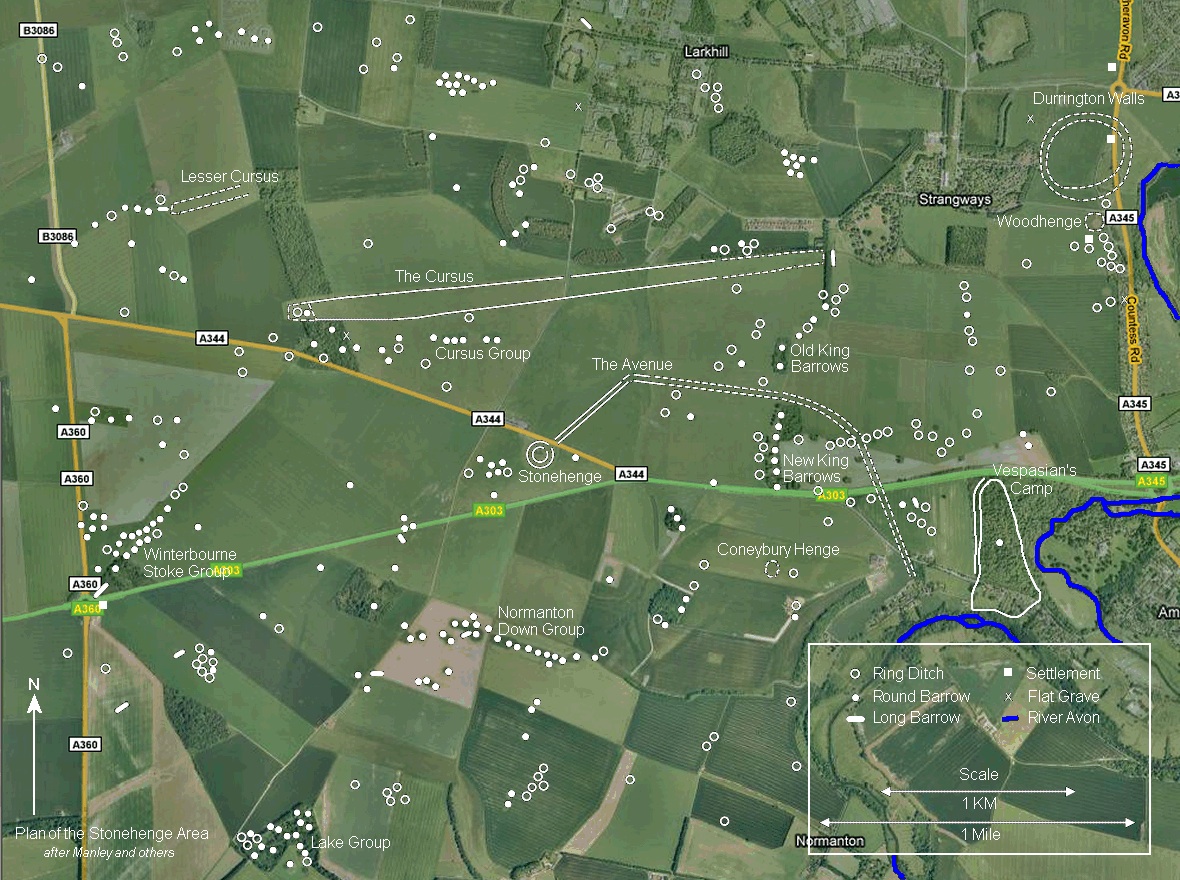
Explore the wider Stonehenge World Heritage Site with a guide and discover hidden histories, ancient mysteries and winter wildlife. February 18th 2012

Stonehenge landscapeWithin the Stonehenge World Heritage Site, the National Trust manages 827 hectares (2,100 acres) of downland surrounding the famous stone circle.

Walking across the grassland, visitors can discover other prehistoric monuments, including the Avenue and King Barrow Ridge with its Bronze Age burial mounds.

Nearby, Winterbourne Stoke Barrows is another fascinating example of a prehistoric cemetery. While Durrington Walls hides the remains of a Neolithic village.

The best approach to the famous stone circle is across Normanton Down, a round barrow cemetery dates from around 2600 to 1600BC.