Stonehenge: English Heritage unveils its new visitor centre

27 09 2013

Despite being one of the world’s most valued heritage sites Stonehenge has never been treated with the respect that it deserves. A new visitor centre will change the way we view this national treasure.

Pondering the enigma of the imposing stone circle that stands on Salisbury Plain early in the 17th century King James I commissioned his architect general, Inigo Jones, to prepare a report on the stones’ condition and their origins. Jones concluded that only the Romans could have built such a sophisticated structure, backing up his case with crisp drawings of the stones in a pre-ruinous state, while dismissing the ancient Britons as savages incapable of building such ‘stately structures’.

Four hundred years later much the same questions are still being asked about Stonehenge. Who built it? What was it for? But in more recent years the focus has been how best to preserve the stones and protect them from the modern-day savagery of the motor-car and mass tourism.

Stonehenge is perhaps the most famous Neolithic site in the world, drawing thousands of visitors each day. A Unesco World Heritage Site, it is a ‘must-see’ monument, part of the identity of Britain itself. But as the site’s fame has grown over the centuries, the question of how to deal with all these visitors while protecting the stones themselves, and their surroundings, has become ever more taxing.

The current visitor centre – little more than a collection of portable buildings and lavatories arranged around a car-park – was built in 1968 and was barely adequate even then. ‘Stonehenge has been a national humiliation,’ Simon Thurley, the chief executive of English Heritage, guardians of the stones since 1984, says. ‘I think it’s really extraordinary that the only man-made structure in Britain that is instantly recognisable, from Patagonia to Serbia and beyond, has been treated as though it was a motorway service station.’ But now, after decades of controversy and failure to find an answer to the ‘Stonehenge problem’, it looks as if a solution, or at least a partial solution, has been found.

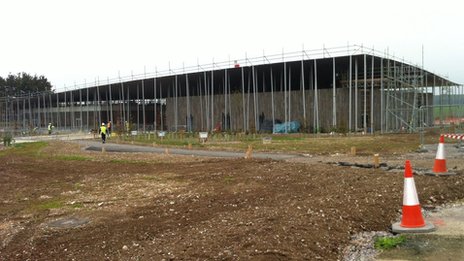
In December a new visitor centre and museum opens within a fresh and thoughtful building designed by the Anglo-Australian architectural practice Denton Corker Marshall (DCM). It is part of a whole package of measures that will also see the A344 roadway to one side of the stones removed, although the busy A303 trunk road to the West Country on the other side, which many campaigners have wanted to see put in a tunnel, remains, for now. Thurley sums up what has been achieved. ‘It has been an incredibly controversial saga and has involved three or four different schemes along the way. The most important thing has been the removal of the 1960s car-park and the closing of the road, and clearly getting rid of the terribly outdated stuff requires us to replace it with something new. So the corollary to the ambition to get rid of the road and the existing facilities has been the very long quest to decide where to put the new stuff.’

The ambition has long been to leave the stones themselves in splendid isolation, clearing the old visitor centre away and building something new well out of sight of the monument itself. After looking at a range of locations, English Heritage finally opted for a site at Airman’s Corner – one and a half miles from the stones themselves, within a natural dip in the landscape. ‘One of the key issues over the years has been where we should locate the new facilities,’ Lorraine Knowles, English Heritage’s Stonehenge director, says. ‘There was no disagreement that we needed to do something and close the road and that we needed to improve the setting around the stones. But the big question has been about where we should put the new centre.’

Having settled on the new site, the question became how to deliver a sensitively conceived building that responded to the open farmland setting, with scarcely another building in sight apart from an occasional barn. That includes the stones themselves, which will be accessed either by foot or by transit vehicles from the visitor centre. It is clear that the experience of visiting and understanding Stonehenge will be completely transformed.

The finished centre is a considered and respectful design, but also distinctly modern in approach, which may not please everyone. While the stones are all about mass and weight, the new building is purposefully light, low slung and partially transparent, allowing the eye to pass through and connect with the landscape beyond. It is a subtle presence in the landscape, with a sweeping roof supported by a small forest of slim supporting columns. The canopy shelters a cafe and shop to one side, within a more transparent section, while a museum sits at the other side protected by a facade of weathered chestnut. Between the two there is a sheltered courtyard and a ticket pod.

Stephen Quinlan, the director of DCM’s British office, has been involved in a substantial part of the story himself. Quite soon after establishing the British branch of a practice that was founded in Melbourne in the 1970s, Quinlan entered a 1992 competition for a new Stonehenge visitor centre that was eventually won by the architect Edward Cullinan, but later dropped. In 2001 DCM won a competition for a visitor centre at Countess East – about two miles from the stones – with its design for a building partly burrowed into the side of a sloping valley. In 2004 English Heritage gained Government backing for the idea of rerouting the A303 trunk road into a new tunnel out of view of the stones. It even got as far as getting planning permission in 2007, only for the whole scheme to be shelved when the Government decided that the new tunnel would be too expensive after all. Nevertheless, when English Heritage announced a new competition, for a £27 million building at Airman’s Corner, Quinlan decided it was worth having another go.

‘I know Stonehenge really, really well,’ Quinlan says. ‘It’s been a long time and a big part of my professional life. We had always hoped that we would get bounced on to the new project but it wasn’t like that at all and the new scheme had to go back out again into the market. So it was by no means a certainty that we would reapply to do it. We thought long and hard and in the end, because we are eternal optimists, we thought we might as well throw our hat in the ring, even though we didn’t rate our chances particularly highly. But the shortlist started getting smaller and smaller and we were incredibly excited when it happened again. We couldn’t believe our luck. It is a once in a lifetime opportunity.’

‘Quite early on we came up with this idea of an undulating roof with eccentric, irregular columns, which would fit well in this rolling countryside,’ continues Quinlan, who collaborated on the design with his colleagues in Melbourne, including the founding partners Barrie Marshall and John Denton. ‘It is quite a big building, with a million visitors going through it every year, so if you had a pitched roof it would become massive, like a cathedral, which didn’t fit in with our approach. We wanted the building to sit lightly in the landscape.’ Quinlan compares the supporting columns to reeds, or slim tree trunks, with a feeling of lightness. It looks as if they are supporting the roof, although they are actually holding it down, as the wind could catch the canopy and turn it into a giant sail without all of these vertical anchors.

‘With the buildings and sites that English Heritage owns itself we generally build in a way that’s very traditional,’ Thurley says. ‘Most of the buildings we have done over the past 10 years have been essentially timber framed and timber clad – out of oak normally – and silver down to get the same sort of colour register as the stone buildings that are often close by. So with our own estate we haven’t been champions of ultra-modern stuctures, although in our wider work we have supported many such buildings. But Stonehenge is completely different and in this case we think a traditional response would have been wrong and would have ended up looking far too solid. This building has a degree of permeability that makes it a lighter proposition. The aim was always to have something that felt like a leaf lying on the land, and hopefully it will feel something like that.’

For Quinlan the building will be a success only if it is seen as quiet and discreet. It forms the polar opposite to so much modern urban architecture, where drama and eye-catching, sculptural forms are so often seen as vital, within the aim of creating statement buildings. Purposefully the Stonehenge visitor centre makes no attempt to reference the stones themselves in its design language and never tries to compete with them in any way. The palette of materials – glass, limestone, chestnut, zinc for the roof – is also tempered and calm. ‘It is quite a big building, because of the job it has to do,’ Quinlan says. ‘But when you approach it, the building doesn’t seem that big at all, largely because there is a lot of landscape going on with the building placed within it. It almost disappears from some perspectives, which is fantastic. Although as an architect I probably shouldn’t be saying that.’

The museum is a key part of the development project, creating dedicated exhibition space for the first time and drawing on pieces lent by the Wiltshire Heritage Museum and the Salisbury and South Wiltshire Museum. ‘Between us we have agreed that we can tell the whole story of Stonehenge with thousands of objects on display,’ Thurley says. ‘It means that the million-plus people who come and see the stones every year will, for the first time, be able to come face to face with some of the actual artefacts that have been excavated on the site. We are building a major museum in the middle of Salisbury Plain, which is a quite extraordinary thing to do.’

An outdoor gallery alongside the new building will play host to three reconstructed Neolithic houses, made with walls of chalk cob over a willow framework and topped by thatched roofs. ‘They are based on some houses excavated at the nearby henge of Durrington Walls,’ Susan Greaney, an archaeologist and the museum’s curator, says. ‘They date from 2500bc, the same time as the large sarsen stones were being raised at Stonehenge and probably where the builders of Stonehenge lived. It will be a real hands-on, immersive experience. We hope the exhibition will show that the prehistoric people who built and used Stonehenge were sophisticated and clever. They were able to pool together vast resources to construct this extraordinary monument using only simple tools.’

The museum helps put Stonehenge into context for visitors, including a 360-degree film showing the henge in its various stages as it evolved over the centuries. But just as importantly the new building sits within a strategy of slowing down the experience of visiting the stones, with the aim of building a sense of anticipation by the time you reach Stonehenge itself. Visitors have the option of walking all the way or the final half of the way, adding to the idea of a journey along a path of discovery.

English Heritage is continuing to push for the A303 to go into a tunnel eventually. But for the time being the road has been resurfaced with a noise-reduction coating in the hope that the sound of constant traffic might be less intrusive when the visitor is contemplating the stones and asking the big questions of how and why they were put here in the first place.

english-heritage.org.uk

Merlin @ Stonehenge
The Stonehenge News Blog


A bit of a champion for Stonehenge and Avebury, but only a bit!

25 09 2013

heritageaction's avatarThe Heritage Journal

Wltshire Council has just published an advert for an Independent Chair of Stonehenge and Avebury World Heritage Site Partnership. It’s because it has been agreed that both parts of the WHS should work more closely together with input from English Heritage, the National Trust and Wiltshire Council so co-ordination is needed. So “The post holder will champion Stonehenge and Avebury’s World Heritage status.”

.

Hurrah! What could be more justified or better timed? The combined WHS is a huge earner of foreign currency (which will soon rocket as the Stonehenge admission fee goes up to £13.90) and Avebury has recently been judged by “Which Magazine” as the second best World Heritage site in the whole world.

.

But the advert also says:

It may on occasion be appropriate for them to attend the Stonehenge and Avebury local Steering Committees.”  

It is hard to set prescriptive time requirements but…

View original post 114 more words


Fascinating “Facts”: Holding StoneHenge up to a Mirror

20 09 2013

Alan S's avatarThe Heritage Journal

Fact

Show anyone a picture of the British Archaeology Trust’s logo for RESCUE (seen below), and ask them to describe it, and 9 times out of ten the answer will be along the lines of “Stonehenge on a bulldozer”. And of course, that’s what the logo depicts, but being totally pedantic, it actually depicts just the stones of Stonehenge. The ‘henge‘ part tends to get forgotten. Why is that?

Probably because henges are among the least understood of the monuments left behind by our ancient ancestors, and are often not very visually stimulating, consisting of a circular bank, and inner ditch with one or more entrance causeways.

In fact, stone settings associated with henges are often very much in the minority. Stonehenge we’ve already mentioned of course, and Avebury (where the henge component of the monument is on a much larger scale) is similarly well known. A henge such…

View original post 357 more words


Summer Discoveries at Stonehenge Stone Circle

13 09 2013

Two ditches belonging to the Stonehenge Avenue buried beneath the modern roadbed of the A344 have been uncovered during works to decommission the road as part of English Heritage’s project to transform the setting and visitor experience of Stonehenge.

The two ditches represent either side of The Avenue, a long linear feature to the north-east of Stonehenge

The Avenue, severed by the A344, will be reconnected to Stonehenge soon

The Avenue, severed by the A344, will be reconnected to Stonehenge soon

linking it with the River Avon. It has long been considered as the formal processional approach to the monument and is aligned with the solstice axis of Stonehenge. But its connection with Stonehenge had been severed by the A344 for centuries as the road cut through the delicate earthwork at an almost perpendicular angle.

The two ditches were found in excavations undertaken by Wessex Archaeology in their expected positions near to the Heel Stone, about 24 metres from the entrance to monument.


Missing Piece in the Jigsaw

Heather Sebire, properties curator and archaeologist at English Heritage, said: “The part of the Avenue that was cut through by the road has obviously been destroyed forever, but we were hopeful that archaeology below the road would survive.  And here we have it – the missing piece in the jigsaw.  It is very exciting to find a piece of physical evidence that officially makes the connection which we were hoping for.”

Dr Nick Snashall, National Trust Archaeologist for the World Heritage Site, said “This is a once in several life time’s opportunity to investigate the Avenue beneath the old road surface.  It has enabled us to confirm with total certainty for the first time that Stonehenge and its Avenue were once linked and will be so again shortly.”

The Avenue is difficult to identify on the ground but is clearly visible on aerial photographs. Once the A344 has been restored to grass in the summer of 2014, interpretation features will be put in place to clearly mark out the solstice alignment to enable visitors to appreciate the position of the Avenue and its intimate connection with and significance to Stonehenge.


Parchmarks discovered at Stonehenge by staff Simon Banton and Timothy Daw © Simon Banton/English Heritage

Parchmarks discovered at Stonehenge by staff Simon Banton and Timothy Daw
© Simon Banton/English Heritage

Parchmarks at the Stone Circle

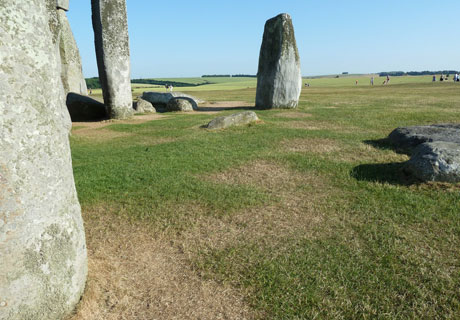
The recent prolonged spell of dry weather has also led to some exciting discoveries within the stone circle. Two eagle-eyed members of staff spotted some dry areas of grass, or parchmarks, amongst the stone circle in July. After investigation by English Heritage experts they seem to be positions of three holes where stones 17, 18 and 19 might have stood on the south-west side of the outer sarsen circle.

Susan Greaney, senior properties historian at English Heritage, said: “There is still debate among archaeologists whether Stonehenge was a full or incomplete circle, and the discovery of these holes for missing stones has strengthened the case for it being a full circle, albeit uneven and less perfectly formed in the south-west quadrant.”

NOTE: This story as reported in the Guardian on 9 September contains a number of inaccuracies. The article, including the headline, failed to distinguish between fact and interpretation, and presented one expert’s view as established fact. It also gives the impression that the expert’s view has been adopted by English Heritage. This is very confusing. English Heritage is firmly of the view that Stonehenge was built as a prehistoric temple aligned with the movements of the sun, contrary to what was implied in the article.

Professor Mike Parker Pearson’s theory about the naturally formed ridges is interesting, but is by no means established. English Heritage’s role was to record any archaeology that survived under the A344 and present the results of the recent discoveries clearly to the public. English Heritage’s interpretation of Stonehenge in general will be presented at the new visitor centre due to open in December 2013.

Article Source from English Heritage: http://www.english-heritage.org.uk/about/news/summer-discoveries-stonehenge/

The Stonehenge News Blog


A NEW DAWN: STONEHENGE TRANSFORMED

12 09 2013

A PRACTICAL PLANNER for Groups & Travel Trade Professionals

The new guide from English Heritage provides tour operators, group travel organisers, guides and other professionals with step-by-step information to help plan visits to Stonehenge, following its transformation when superb new facilities open from the end of 2013. Split into three easy-to-read colour coded sections, it provides practical information, tips and ideas to smooth your way through advance planning and procedures to the day of the visit and beyond.

Stonehenge-visitor-centre

PLANNING AHEAD:
Turn to the yellow section to discover other attractions to build into a Stonehenge itinerary, plus details in brief on English Heritage services and products for travel trade professionals and group travel organisers and how to obtain them.

THE NEW VISIT
With so much more to see at the transformed Stonehenge, the bronze section is a step-by-step guide on the new facilities and how to make the best of a visit, with an at a glance map, images and suggested timings for a two hour stay.

INFORMATION AND SUPPORT
Giving essential planning information, the green section explains pre-booking and ticketing procedures, contains prices and admission times and handy hints on reaching and arriving at Stonehenge.

Download the full guide here: http://gallery.mailchimp.com/4f19fb7ce76ee0800348d53d5/files/EH_Stonehenge_A6_PocketBook_LRPDF.PDF

Follow Stonehenge News on Twitter: https://twitter.com/ST0NEHENGE

The Stonehenge News Blog


Stonehenge was built on solstice axis, dig confirms

9 09 2013

English Heritage excavations show site has nothing to do with sun worshipping, and find evidence circle was once complete

Archeologists found ridges, formed by Ice Age meltwater, that align Stonehenge with the solstice axis. Photograph: Francis Dean/Rex

Archeologists found ridges, formed by Ice Age meltwater, that align Stonehenge with the solstice axis. Photograph: Francis Dean/Rex

English Heritage says it has discovered a “missing piece in the jigsaw” in our understanding of Stonehenge, England’s greatest prehistoric site. Excavations  along the ancient processional route to the monument have confirmed the theory that it was built along an ice age landform that happened to be on the solstice axis.

The Avenue was an earthwork route that extended 1.5 miles from the north-eastern entrance to Wiltshire’s standing stones to the River Avon at West Amesbury. Following the closure of the A344 road, which cut across the route, archaeologists have been able to excavate there for the first time.

Just below the tarmac, they have found naturally occurring fissures that once lay between ridges against which prehistoric builders dug ditches to create the Avenue. The ridges were created by Ice Age meltwater that happen to point directly at the mid-winter sunset in one direction and the mid-summer sunrise in the other.

Professor Mike Parker Pearson, a leading expert on Stonehenge, said: “It’s hugely significant because it tells us a lot about why Stonehenge was located where it is and why they [prehistoric people] were so interested in the solstices. It’s not to do with worshipping the sun, some kind of calendar or astronomical observatory; it’s about how this place was special to prehistoric people.

“This natural landform happens to be on the solstice axis, which brings heaven and earth into one. So the reason that Stonehenge is all about the solstices, we think, is because they actually saw this in the land.”

The findings back theories that emerged in 2008 following exploration of a narrow trench across the Avenue. Parker Pearson said: “This is the confirmation. It’s being able to see the big picture.”

Dr Heather Sebire, English Heritage’s Stonehenge curator, said: “The part of the Avenue that was cut through by the road has obviously been destroyed forever, but we were hopeful that archaeology below the road would survive. And here we have it: the missing piece in the jigsaw. It is very exciting to find a piece of physical evidence that officially makes the connection which we were hoping for.”

The excavation was conducted by Wessex Archaeology for English Heritage.

The A344 will be grassed over next year as part of English Heritage’s £27m transformation of the World Heritage Site, which receives more than 1m visitors annually. There will be a new visitor centre, 1.5 miles away out of sight, to allow Stonehenge to reconnect with the surrounding landscape.

Sebire, who likens the Avenue to The Mall leading to Buckingham Palace, said that the latest findings should prompt vigorous academic debate.

The excavations have also uncovered three holes where missing stones would have stood on the outer sarsen circle, evidence, it is believed, that the circle was indeed once complete. Surprisingly, even the most sophisticated surveys failed to spot them. Two members of staff noticed dry areas of grass, or parchmarks.

Susan Greaney, an English Heritage historian, said: “The discovery … has certainly strengthened the case for it being a full circle.”

Asked why no one noticed them until now, Parker Pearson said: “The problem is we’ve not had a decent dry summer in many years. Stonehenge is always regularly watered, and the only reason these have shown up is because – for some reason this year – their hose was too short … So we’re very lucky.”

Article source: : The Guardian: http://www.theguardian.com/culture/2013/sep/08/stonehenge-ice-age-solstice-axis

Merlin @ Stonehenge
The Stonehenge News Blog  


Fascinating “Facts”: When is a stone circle not a stone circle?

6 09 2013

Alan S's avatarThe Heritage Journal

FactIt is well known that the vast majority of stone circles in the British Isles are not actually circles. In fact, there are very few that are truly ‘circular’ in the sense of having a regular, circular ground plan. The shapes can vary from circular, through regular ovals to ovoid, to flattened version of any of these. But there is one form of stone circle that doesn’t fit into any of these categories, that of the ‘Four Poster’.

Four Poster ‘circles’, as their name suggests usually consist of just four uprights, laid on the plan of a circle, sometimes with a fifth recumbent stone. The majority of this type can be found in Scotland, though there are several examples throughout England and some in Ireland. The stones in a true Four Poster are generally placed at the cardinal compass points. Those that have been dated were constructed in the Bronze…

View original post 311 more words


Discovery of 5,000-year-old skull ‘in fabulous condition’ on side of river sparks mystery as archaeologists claim it would not have survived in water

1 09 2013
  • Skull is  believed to be of a middle aged woman living in 3,300 BC
  • Unbroken  skull found on the banks of the River Avon in Worcestershire
  • Carbon  dating technology places the piece between 3,338BC and 3,035  BC
  • The  ‘exceptional’ find suggests there is an undiscovered burial site  nearby

A 5,000-year-old human skull in ‘fabulous’  condition has been discovered on the banks of a river in Worcershire by a walker  who thought it was a coconut.

Remarkable discovery: Nick Daffern, senior archaeologist with Worcestershire Archaeology holds the 5,000-year-old skull which has baffled experts

Remarkable discovery: Nick Daffern, senior archaeologist with Worcestershire Archaeology holds the 5,000-year-old skull which has baffled experts

Experts said the piece of ancient skull is an  ‘exceptional find’ as the intricate marks  from blood vessels are still visible on the inner surface.

The smooth dark outer side gives only a  tantalising glimpse as to what the person may have looked like, although there  are ‘tentative’ suggestions it may have belonged to a woman in middle age living  in the Neolithic period – around the time Stonehenge was built.

The skull is not only prompting questions  about the person it belonged to, but where it may have come.

A dog walker first stumbled across the skull  piece, which is about 15cms (6ins) in length and 10cm (4ins) in width, earlier  this year but initially thought it was a ball or a coconut shell.

Detectives from West Mercia Police  investigated the scene and contacted experts at Worcestershire Archaeology, who  sent the skull to be radiocarbon dated.

‘When I first saw the skull, I thought it may  have been Anglo-Saxon or Roman but I knew that it was not recent due to the  colour,’ said Nick Daffern, senior archaeologist.

‘But we were all surprised when the  radiocarbon dating put it at between 3,338 BC and 3,035 BC, or about the middle  Neolithic period.’

‘It is so well preserved, it is unthinkable  that this had been in the river for any length of time which begs the question  as to where it has come from.

‘We know of Roman, Saxon and medieval burials  along the river, but this is very rare – it is an exceptional  find.

‘What it suggests is that we have a Neolithic  burial site very near here – we just don’t know where.’

He said: ‘I don’t think it was found where  the remains were buried, I think we’ve got a riverside burial and then flooding  has brought this down the river.

‘Finding that burial site though would be  like finding a needle in a haystack.’Who was neolithic man

Mr Daffern said that without the rest of the  skeleton it was difficult to draw conclusions about the person found, and  certainly there is no clue as to how they met their death.

‘Both myself and a forensic anthropologist  believe it is a woman due to the slightness of the skull and the lack of any  brow ridges although our conclusions are very tentative because we’re dealing  only with the top of a skull,’ he added.

‘There’s no trauma to the bone, and where it  has broken those are natural breaks, nor is there any sign of disease so we’ve  no idea as to cause of death.

‘The natural fusion of the bone in the skull  leads me to believe it may be an older woman, possibly in her 50s, but that is  very tentative again.

‘Unfortunately, it remains a bit of a  mystery.’

The find is a few miles from Bredon Hill,  which has been a scene of human activity down the ages and still boasts the  earthen ramparts of what was an Iron Age hill fort, however finds of Neolithic  remains are rare.

‘Whenever we come across Neolithic remains,  there seems to be a solid dividing line between where they buried their dead,  and where they lived and that is no accident,’ he said.

‘But it is frustrating as an archaeologist  because although we have the physical evidence, we still don’t have the answers  as to why.’

The skull is only the second set of Neolithic  remains to be found in the county, although two large 6,000-year-old ‘halls of  the dead’ were found in nearby Herefordshire this year but without any human  remains present.

Article source: By  Daily Mail Reporter – http://www.dailymail.co.uk/sciencetech/article-2407337/Discovery-5-000-year-old-skull-fabulous-condition-sparks-mystery.html

Merlin @ Stonehenge
The Stonehenge News Blog


“Free Stonehenge”, Sir Cecil Chubb and two dead horses

30 08 2013

heritageaction's avatarThe Heritage Journal

Calls for “Free Stonehenge” are legion, usually citing that the donor, Sir Cecil Chubb, stipulated that “the public shall have free access to the premises”. It’s a bit academic as his covenants are no longer enforceable but let’s pretend they are and consider if the campaigners have a moral case at least. Their wish for “free access” can mean one or both of the following:

1. Access for free
In other words, free of charge. But look what the Deed actually says: “the public shall have free access to the premises on the payment of such reasonable sum per head not exceeding one shilling for each visit.” So it wasn’t access for free, it was access for payment, up to a maximum of 1 shilling – at a time when the average weekly wage was 30 shillings. Nowadays, a thirtieth of average weekly earnings is about £16. People can…

View original post 285 more words


Where was the Stonehenge Festival?

29 08 2013

Mike Pitts's avatarMike Pitts Digging Deeper


All over the place really. On my first summer solstice visit in 1971 it was little more than a gaggle of people sleeping in the ditch around the stones. These two photos from Julian Richards’ excellent collection published by English Heritage show where it went from there: first immediately outside the earthwork to the south-west, so that it faced the rising sun on June 21; then across the road into what we call the Cursus field, National Trust land between Byway 12 and the Fargo Plantation. At its greatest extent it did run onto the Cursus itself (thanks for the comment, Francis Stoner), and spread eastwards into the Avenue field. Damage was reported at the time to the woodland at Fargo and to some of the barrows.

It’s high time a proper academic study was done of this story. There must be a great deal of information out there…

View original post 45 more words