Beltane – May 1st 2020 – The beginning of Summer!

19 04 2010

On the cusp between spring and summer, Beltane is a fire festival that celebrates the fertility of the coming year.
The beginning of Summer – Summer is a comin in !

Beltane is a Celtic word which means ‘fires of Bel’ (Bel was a Celtic deity). It is a fire festival that celebrates of the coming of summer and the fertility of the coming year.

Celtic festivals often tied in with the needs of the community. In spring time, at the beginning of the farming calendar, everybody would be hoping for a fruitful year for their families and fields.

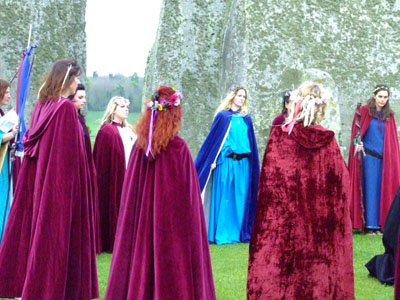
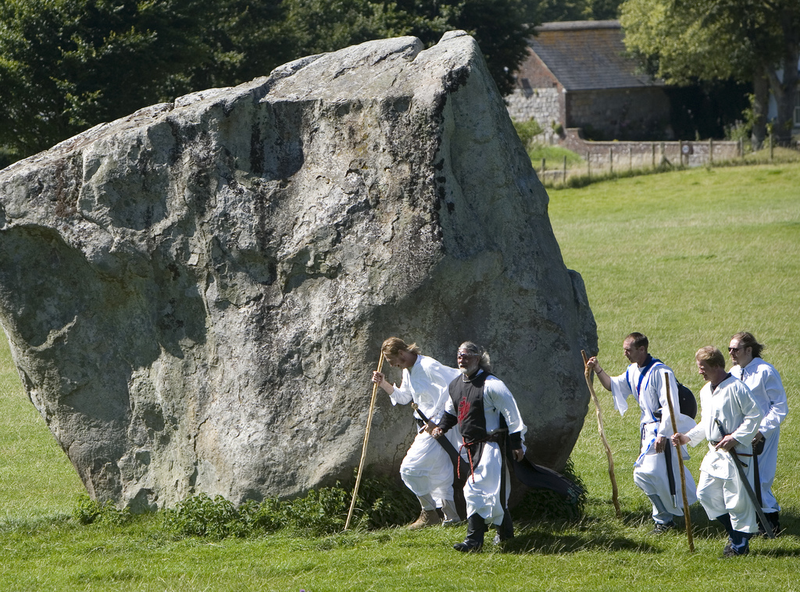
Maidens at Stonehenge

Beltane rituals would often include courting: for example, young men and women collecting blossoms in the woods and lighting fires in the evening. These rituals would often lead to matches and marriages, either immediately in the coming summer or autumn.

Other festivities involved fire which was thought to cleanse, purify and increase fertility. Cattle were often passed between two fires and the properties of the flame and the smoke were seen to ensure the fertility of the herd.

Today Pagans believe that at Beltane the God (to whom the Goddess gave birth at the Winter Solstice) achieves the strength and maturity to court and become lover to the Goddess. So although what happens in the fields has lost its significance for most Pagans today, the creation of fertility is still an important issue.

Emma Restall Orr, a modern day Druid, speaks of the ‘fertility of our personal creativity’. (Spirits of the Sacred Grove, pub. Thorsons, 1998, pg.110). She is referring to the need for active and creative lives. We need fertile minds for our work, our families and our interests.

Fire is still the most important element of most Beltane celebrations and there are many traditions associated with it. It is seen to have purifying qualities which cleanse and revitalise. People leap over the Beltane fire to bring good fortune, fertility (of mind, body and spirit) and happiness through the coming year.

Although Beltane is the most overtly sexual festival, Pagans rarely use sex in their rituals although rituals often imply sex and fertility. The tradition of dancing round the maypole contains sexual imagary and is still very popular with modern Pagans.

The largest Beltane celebrations in the UK are held in Edinburgh. Fires are lit at night and festivities carry on until dawn. All around the UK fires are lit and private celebrations are held amongst covens and groves (groups of Pagans) to mark the start of the summer.

Merlin @ Stonehenge
Stonehenge Stone Circle Website


Dramatic Sunsets at Stonehenge due to Volcanic ash

18 04 2010

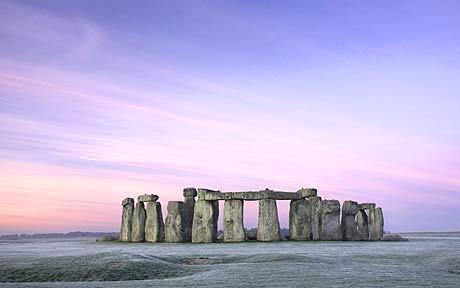
Stonehenge is in line for some spectacular sunsets as the sun’s rays reflect off the volcanic particles, creating beautiful skies around Salisbury plain and Wiltshire.

110425142_8a4b028dd2.jpg

110425142_8a4b028dd2.jpg

Dramatic: Volcanic ash can bring out dramatic pinks and purples during sunset, as shown by the latest erupting volcano in Iceland

While yesterday’s eruption caused chaos for travellers, some scientists said there could be an unexpected upside to the phenomenon.

But there were further downsides as motorists were told to look out for a layer of ash on their cars from remnants of the explosion. There could also be colder temperatures as tiny particles of ash high in the atmosphere block out light from the sun.

Red sky at night: The sun sets over Heathrow Airport as an ash cloud from an Icelandic volcano grounded all flights
Forecaster Jonathan Powell said: ‘Long-term, the eruption could well have a long term affect on global weather patterns. Cloud particles, basically minuscule grains of crushed rock and glass, can remain in the atmosphere for many years.

‘The Mount Pinatubo eruption of 1991 went on to cool the global climate by just under half a degree, although that volcano was on a much larger scale.’

eather forecaster Brendan Jones from MeteoGroup, said: ‘If you look back in history there have been some periods where the weather has been changed by big volcanic eruptions like Mount Tambora and Mount St Helens.

‘They have been proved to lower temperatures. There is so much ash in the atmosphere that it reduces the amount of sunlight getting to the ground.’

‘If the ash remains in our atmosphere for weeks or months it can reduce temperatures slightly but we are talking about fractions of degrees.’

But while experts said the ash could irritate conditions such as asthma, it was not expected to cause major health problems.

Volcanologist Dr Dougal Jerram said: ‘The high altitude of this plume above the UK means that it is air traffic that will suffer most.’

More powerful eruptions can emit large amounts of poisonous sulphur dioxide that is much more hazardous to health.

Volcanic ash can also create the appearance of a blue moon, if the particles are the right size (experts say that means one millionth of a metre or a micron).

However, ash thrown up into the atmosphere usually contains a mixture of particles with a wide range of sizes, which tends to scatter blue light so a reddish moon is more likely.

Experts fear the eruption of Eyjafjallajokull, which has sent this cloud of ash into the sky, could trigger a much larger explosion of nearby Mount Katla.

Katla is described as ‘enormously powerful’, and because it lies under a glacier its eruption would cause a huge glacial outburst flood and could spread its shadow over a much larger area.

The Mount Tambora eruption in 1816 caused such a drop in temperatures that it became known as ‘the year with no summer’.

Crops failed due to low daytime temperatures, late frosts and abnormally high rainfall, provoking food riots, famine and disease.

In Ireland, rain fell on 142 days that summer and across France the grape harvest was virtually non-existent.

In North America there was snow in June and lakes and rivers froze as far south as Pennsylvania during July and August. am passing through nature

Merlin @ Stonehenge
Stonehenge Stone Circle


The word ‘HENGE’ – What does it mean ?

12 04 2010
Dictionary meaning:
Henge definition
henge (henj)
noun
a Neolithic or Bronze Age monument of the British Isles, consisting of a circular bank or ditch enclosing, variously, stone or timber uprights, burial pits, etc.

What is a ‘Henge’ monument

Stone Henge – What is one?

Definition:

A henge is the term given to a large prehistoric earthwork, usually but not always circular, whether of stones, wood, or earth.

This word, interestingly, is a back-formation from Stonehenge. Additionally some spell it stone henge or stonehedge even though that is incorrect. Stonehenge was the Saxon name for the famous monument on the Salisbury plain, and the “henge” part is Old English for “hang,” not earthwork. Nonetheless, the term henge is in wide use in both popular and scientific literature to refer to megalithic monuments of the Neolithic and Bronze ages.

Whether you are thinking stone henge or Stonehenge, both are basically Megaliths. Megaliths are single large stones, or a group of “standing stones” usually arranged in a circular or semi-circular formation, and that archaeologists believe were religious temples or monuments. The earliest sites are thought to date back to the millenia. The word, “megalith” itself has Greek origins: “mega” meaning “great” and “lithos” meaning “stone”. Certain megalith sites, and there are thousands of them all around the world, were also known burial sites. England seems to have the greatest concentration of megaliths that carry names like Avebury, the Hurlers, the Merry Maidens, and the Rollright Stones. The most famous of these is, of course, Stonehenge.

People do commonly mistake the words stone henge for Stonehenge and should learn the difference so they may find the correct information.

Comments:
Titchmarsh on Telly the other evening in a prog on English buildings started with Stonehenge.
The ‘expert’ stated that the ‘henge’ element of the name ‘stonehenge’ meant, or referred to, the ditch and embankment surrounding Stonehenge.
I have always believed that ‘henge’ meant ‘hanging; ‘thus ‘Stonehenge means ‘hanging stones.’
That is ‘hanging,’ not in the sense of gallows where people were hung but, meaning ‘stones that appear to be suspended.’

The original sense is a difficult one to call: henge is obviously related to hangan. It could mean that even in ASJ times, some of the stones were leaning over (they were straightened dramatically in th C20th), or might be related to ME henge in the sense of “hinge” — possibly referring to the mortise-and-tenon joints. There again, “stone gallows” is a good description — ASJ gallows were two posts and an crossbeam , and we know it *was* used as a cwealmstow.
“Henge” was subsequently appropriated by the archæology-Johnnies to mean a monument with a ditch and bank like Stonehenge — though ironically, Stonehenge itself is no longer deemed to be a “henge” because the ditch is inside the bank…

The original sense is a difficult one to call: henge is obviously related to hangan. It could mean that even in ASJ times, some of the stones were leaning over (they were straightened dramatically in th C20th), or might be related to ME henge in the sense of “hinge” — possibly referring to the mortise-and-tenon joints. There again, “stone gallows” is a good description — ASJ gallows were two posts and an crossbeam , and we know it *was* used as a cwealmstow.
“Henge” was subsequently appropriated by the archæology-Johnnies to mean a monument with a ditch and bank like Stonehenge — though ironically, Stonehenge itself is no longer deemed to be a “henge” because the ditch is inside the bank…

Merlin @ Stonehenge
Stonehenge Stone Circle


Avebury Stone Circle, Wiltshire, UK

5 04 2010

Everybody needs to see Stonehenge. But  Avebury is the connoisseur’s circle: subtle and welcoming.

Avebury Stone Circle

The stone circle at Avebury is bigger (16 times the size), less touristy, and, for many, more interesting than Stonehenge. You’re free to wander among 100 stones, ditches, mounds, and curious patterns from the past, as well as the village of Avebury, which grew up in the middle of this fascinating, 1,400-foot-wide neolithic circle.

In the 14th century, in a kind of frenzy of religious paranoia, Avebury villagers buried many of these mysterious pagan stones. Their 18th-century descendants hosted social events in which they broke up the remaining pagan stones (topple, heat up, douse with cold water, and scavenge broken stones as building blocks). In modern times, the buried stones were dug up and re-erected. Concrete markers show where the missing broken-up stones once stood.

To make the roughly half-mile walk around the circle, you’ll hike along an impressive earthwork henge — a 30-foot-high outer bank surrounding a ditch 30 feet deep, making a 60-foot-high rampart. This earthen rampart once had stones standing around the perimeter, placed about every 30 feet, and four grand causeway entries. Originally, two smaller circles made of about 200 stones stood within the henge (free, always open).

Visit the Alexander Keiller Archaeology Museum, with an interactive exhibit in a 17th-century barn. Notice the pyramid-shapedSilbury Hill, a 130-foot-high, yet-to-be-explained mound of chalk just outside of Avebury. Over 4,000 years old, this mound is the largest man-made object in prehistoric Europe (with the surface area of London’s Trafalgar Square and the height of Nelson’s Column). It’s a reminder that you’ve just scratched the surface of England’s mysterious, ancient, and religious landscape.

Eating in Avebury: The pleasant Circle Restaurant serves healthy, hearty à la carte meals, including at least one vegetarian soup, and cream teas on most days. The Red Lion Pub (The only thatched haunted Pub in the middle of a Stone Circle in the World) has inexpensive, greasy pub grub; a creaky, well-worn, dart-throwing ambience; and a medieval well in its dining room.

Sleeping in Avebury: This makes lots of sense since the stones are lonely and wide open all night. Mrs. Dixon’s B&B, directly across from Silbury Hill on the main road just beyond the tourist parking lot, rents three cramped and homey rooms for a fine price.

Tours to Avebury: The most convenient and quickest way to see Avebury and Stonehenge if you don’t have a car is to take a scheduled tour from London – The Stonehenge Tour Company (http://www.StonehengeTours.com) opertate daily tours from London or a truly great way is to organise your own private tour from Salisbury or Bath:
Merlin highly recommends:
HisTOURies UK – They have the best local guides and best reputation and seem to be the most competitive.

Drivers can do a loop from Bath to Avebury (25 miles) to Glastonbury (56 miles) to Wells (6 miles) and back to Bath (20 miles).

Good luck and enjoy!
Merlin @ Stonehenge Stone Circle


The Welsh blue chip ‘healing secrets’ of Stonehenge

28 03 2010

WHY transport more than 80 two- tonne megaliths over 156 miles of mountain, river and sea to build a stone circle at Stonehenge? It hasremained one of Britain’s most enduring mysteries. Some have claimed the iconic site on Salisbury Plain was an ancient observatory for lunar and solar events. Others claimed it was a burial site for the high-born while Arthurian legend has it Merlin transported the stones. But now a Welshman from Pembrokeshire, the place where many believe the stones originate, claims he has the answer. Professor Geoffrey Wainwright, an honorary fellow of Lampeter and Cardiff Universities, released findings yesterday to support a theory that Stonehenge was a “prehistoric Lourdes”. The findings suggesting its significance as a healing centre for pilgrims were made in a historic dig at the World Heritage Site earlier this year. The first excavation of Stonehenge for more than 40 years uncovered fragments of stone which experts believe could have been used as lucky charms. Professor Wainwright believes that Stonehenge was a centre of healing to which the sick and injured travelled from far and wide, to be healed “by the powers of the bluestones”. He noted during the dig that “an abnormal number” of the bodies found in tombs near Stonehenge displayed signs of serious physical injury and disease. And analysis of teeth recovered from graves show that around half of the corpses were from people who were not native to the Stonehenge area. Archaeology expert Professor Wainwright, chairman of the Society of Antiquaries of London, and Professor Tim Darvill of Bournemouth University, have been working together for years to find out why Stonehenge was built. English Heritage agreed to the dig on Salisbury Plain, the first since 1964, following consent by the Secretary of State for Culture, Media and Sport. The academics said they could now pinpoint the date at which the blue stones – which the archaeologists believe hold the key to Stonehenge – were brought to the site in Wiltshire from West Wales, as 2300BC, 300 years later than previously thought. The stones were once believed to have come from a crag in the Preseli Hills called Carn Menyn. But a newer theory is that they were brought from glacial deposits much nearer the site, which had been carried down from the northern side of the Preselis to southern England by the Irish Sea Glacier. The professors also told a press conference at the Society of Antiquaries in London that people remained interested in the magical, healing qualities of the stones for many hundreds of years after Stonehenge was built. Prof Darvill said: “It could have been a temple at the same time as it was a healing centre, just as Lourdes is a religious centre.” Prof Darvill suggested the blue stones, which have tiny white spots, could have acted in a similar way to the bones of saints. They argued that as thousands of pilgrims flocked to see them at Stonehenge the resulting wealth enabled an “elaborate shell” of more stone pillars to be built. Prof Wainwright said he was inspired to investigate the area in his native Pembrokeshire while watching a television programme about why Stonehenge was built. He said: “I thought the answer really had to be found in the place where the stones came from. That is in north Pembrokeshire, so Tim and I went and did a survey around the crag. “We found various reasons which led us to believe the stones were used as part of a belief in a healing process.” But he said they needed to study the Stonehenge site to find out when the bluestones arrived there and how long they were used. The radiocarbon dating of the original double bluestone circle held significance for the start of Stonehenge being used as a healing centre. The date – 2300BC – links the introduction of the bluestones with a time of great activity at the site, including the death of the Amesbury archer. His remains were discovered about five miles from Stonehenge and the professors believe he was a pilgrim hoping to benefit from the healing powers of the monument. Prof Wainwright said: “We now know, much to our surprise and delight, that Stonehenge was not just a prehistoric monument, it was a Roman and medi- aeval monument.” Were the huge stones transported all the way from West Wales? The stone pillars of Stonehenge are natural columns of white spotted dolerite and occur only in the Preseli Hills’ Carn Menyn area. They were first identified as of Welsh origin by Dr John HH Thomas in 1923. Archaeologists have uncovered the remains of a “band of brothers” found near Stonehenge and scientists have proved they were Welsh, suggesting it was people from Pembrokeshire who actually transported them. The skeletons, three adults, a teenager and three children, were found by workmen laying a pipe on Boscombe Down and chemical analysis of their teeth revealed they were brought up in the South West Wales area. Experts believed the family accompanied the stones on their epic journey from the Preseli Hills to Salisbury Plain. As an extension of the theory that Stonehenge was a healing centre, on digs around the country, archaeologists will now look for any evidence of bluestone being transported from Wales to other monuments. Professors Wainwright and Darvill also said they hope to return to the Preseli Hills next year to excavate part of a burial mound near the main bluestone outcrops. Prof Darvill said of the bluestones: “Their meaning and importance to prehistoric people was sufficiently powerful to warrant the investment of time, effort and resources to move the bluestones from the Preseli Hills of Wales to the Wessex downs.”#

Merlin @ Stonehenge
Stonehenge Stone Circle


Spring Equinox at Avebury, one of Britain’s stone circles

27 03 2010

Druids and King Arthur at Avebury Stone CircleThe sun is slowly sinking in a golden glow behind the stones of Avebury, the largest stone circle in Europe. The massive Swindon stone becomes a silhouette, its 60-tonne bulk solid and unmoved against the sky just as it has been since it was first placed here by Ancient Britons more than 4,000 years ago.

 Mention stone circles, and most people think of Stonehenge and Druids. In fact, there are more than 1,000 stone circles in Britain, and none was built by Druids (the stones are far older than Druidism). Avebury Ring is the largest, some 14 times the size of Stonehenge, and a particular joy to visit. There are no tickets, no fences, no restrictions and no crowds. You – and the sheep – move freely around the prehistoric sites, taking your time, choosing your viewpoint and touching the stones at will.

We climb to the top of the ancient bank that surrounds the stones and look out over the landscape. We can see the mysterious Silbury Hill, Europe’s largest prehistoric, man-made mound that sits 40m high like a vast upturned pudding, visible for miles around. Then there’s the avenue of paired stones leading away into the distance. The route once linked Avebury to The Sanctuary, another Neolithic sacred site. Further away, towards an even earlier monument, we can spot the 5,500-year-old ancestral stone grave of West Kennet Long Barrow.

Prehistory and contemporary life intermingle. A road cuts through the site, but manages not to intrude too much even though the village of Avebury sits partly within the largest stone circle. The material for some of the 18th-century houses has been hacked from the circle’s sarsen stones.

The National Trust museum, which is housed in two barns, displays artefacts found on the site, as well as providing plenty of background information. The older of the two galleries, the Stables Museum, pays particular attention to how we know about the society that built and used Avebury – and just how little is certain. There are some intriguing objects, too, including one for the children: a chunk of Neolithic dog poo.

The newer Barn Gallery is much higher tech and generally more child-friendly, with interactive displays and activities, and an excellent world time-line showing that Avebury and Silbury Hill were built about the same time as the earliest Egyptian pyramid and long before King Tutankhamun.

From the museum, a few steps take you straight up into the circle. It is 1.3km round the largest ring, with 27 of the original 100 or so stones still standing. There are two smaller circles and a row of stones in the interior. None has been dressed (cut), as some have at Stonehenge. At Avebury the stones were simply selected, dragged to the site and positioned. Go for a stroll on Fyfield Down above Avebury and you’ll still find vast sarsen stones “in the wild”, just lying around in the grass.

What exactly Avebury, or any other stone circle, was built for remains uncertain. Some rings do have sight lines to astronomical phenomena, but as Aubrey Burl, an expert on stone circles remarks in his excellent introduction to the subject, Prehistoric Stone Circles: “The possibility of a ring being an observatory is a matter of conjecture, the presence of human cremations is not.”

The chances are the circles had a ritual use, perhaps some kind of ancestral cult. Certainly, walking up The Avenue towards the Avebury Circle it is easy to imagine a ritual procession. The Avenue is clearly designed to bring you glimpses of the circle before a triumphal arrival at its entrance. The circles may also have been meeting places, or were even used for trading purposes, and probably had different uses at different times.

Some modern visitors insist they feel special energies and spirituality at Avebury. I don’t know about that, but I do feel a tremendous sense of history – and it is a very beautiful place.

‘Prehistoric Stone Circles’ is published by Shire at £5.99. Avebury, near Marlborough, Wiltshire (01672 539250 begin_of_the_skype_highlighting              01672 539250      end_of_the_skype_highlighting; nationaltrust. org.uk; english-heritage.org. uk/avebury; stone pages.com /england/avebury. html). The museum is open November-March 10am-4pm, April-October 10am-6pm. Adults £4.20, children £2.10, English Heritage and National Trust members free. There is a car park on the A4361 south of Avebury, a café, and a shop selling ‘The Prehistoric Monuments of Avebury’, price £1.75

So solid crew

STONEHENGE

A World Heritage site, Stonehenge, in Wiltshire, is the most spectacular stone circle in Britain, with carefully crafted standing stones and unique horizontal lintels held in place by carved joints. The atmosphere is adversely affected by two main roads and the approach through a tunnel. Visitors are routed around the monument for a comprehensive view. Stone Circle Access visits (01722 343834 begin_of_the_skype_highlighting              01722 343834      end_of_the_skype_highlighting) can be arranged outside opening hours. (0870 3331181 begin_of_the_skype_highlighting              0870 3331181      end_of_the_skype_highlighting; english-heritage.org.uk/ stonehenge). The new ‘Stonehenge Guidebook’ by Julian Richards costs £4.99.

CASTLERIGG

This is a large and highly atmospheric site on the top of a Cumbrian fell, near Keswick, with stunning views of surrounding hills. An early circle – probably built in 3,200-3,000BC – it has significant astronomical alignments in its 30m-diameter ring of 38 stones and its unique 10-stone rectangle. (english-heritage. org.uk; visitcumbria.com/kes/ casstone.htm).

STANTON DREW

There are two main circles at this site near Bristol, one 113m across, the other 30m. There are also single stones that were perhaps once part of an avenue. (english-heritage. org. uk/ stantondrew; easyweb. easy net. co.uk/ ~aburnham/eng/ stant1.htm).

RING OF BRODGAR

Part of the Heart of Neolithic Orkney World Heritage Site, the largest stone circle in Scotland, near Stromness (pictured), is set in a ritual landscape of other standing stones and Bronze Age round barrows. They stand, unusually, in a true circle. Historic Scotland World Heritage Site Ranger Service (01856 841732 begin_of_the_skype_highlighting              01856 841732      end_of_the_skype_highlighting; orkneyrangers@scotland.gov.uk; easyweb.easy net.co.uk/ ~aburnham/scot/brog.htm)

OTHER STONE CIRCLES

There are hundreds of other circles that can be visited, from the Rollright Stones in Oxfordshire to Callanish on the Isle of Lewis, as well as many lesser-known ones. Standing stones may be found almost anywhere in Britain, other than in the east.

FURTHER INFORMATION

Go to megalithic.co.uk for maps and information. ‘A Guide to the Stone Circles of Britain, Ireland and Brittany’ by Aubrey Burl includes map references and directions. It is published by Yale University Press and costs £8.95.

 Merlin @ Avebury Stone Circle
Stonehenge Stone Circle


How and Why Was Stonehenge Built?

22 03 2010

StonehengeFrom the grassy deserted plains of southern England rises a circle of standing stones, some of them up to 24 feet tall. For centuries they have towered over visitors, offering tantalizing hints about their prehistoric past. For centuries, everyone who has stood before them has wondered the same thing: Who built this mysterious rock monument? And why? “Since Stonehenge was built and rebuilt over a period of centuries, no one group has sole credit for its construction, but the main building seems to have been done by a people known as the ‘Beaker Folk,’” says Benjamin Hudson, professor of History and Medieval Studies at Penn State. The Beaker Folk (who earned their name from the distinctive inverted bell-shaped pottery drinking vessels they made) scattered throughout prehistoric western Europe. The earliest construction at Stonehenge began about 3000 B.C., says Hudson, with a stone circle inside a ditch and bank. Within that circle lay a timber building; researchers have excavated from the site about 56 pits containing the remains of human cremations. Construction continued for 600 years, in several phases of landscaping: Burial mounds (most pointing east-to-west) and ceremonial pathways were added to the site. In 2400 B.C., the builders erected the large sandstone blocks which give the site its name. (Coined by Henry of Huntingdon, a twelfth-century English historian, “Stonehenge” means “hinged or supported stones.”) The means of moving those enormous standing stones has provoked centuries of speculation, with theories ranging from demonic powers to Merlin’s magic to alien technology. The reality is much more ordinary, says Hudson. “Much of the construction was little more than putting enough men under a stone to move it into place,” he notes, “although some basic engineering was required for the larger stones and the lintels.” One theory holds that the builders used simple inclines and levers to move the stones into place. Like the Egyptian pyramid-builders, the Stonehenge constructors relied more on brute labor than sophisticated technology. Though one of the most complete and monumental examples of Neolithic and Bronze Age construction, Stonehenge was not alone in its time. Hudson notes one estimate that places it among 300 surviving stone monuments throughout the British Isles—including the famous stone circle in Avebury. The connections between and among these sites often remain murky, and undoubtedly many creations of the Beaker Folk have returned to nature, leaving few traces of their existence. “Stonehenge forces us to reconsider the period of history that is not accompanied by written records,” Hudson says. Since the builders left no explanation, the precise purpose of their work remains obscure. One theory sees Stonehenge as a temple, pointing to the elaborate landscaping surrounding the site. More recently, historians and archaeologists have suggested it provided an observatory for either moon or sun cults. The Beaker Folk are believed to have been sun worshipers who aligned Stonehenge with certain important sun events, such as mid summer and winter solstices. While the absence of records makes it nearly impossible to be certain about Stonehenge’s purpose, the site itself does leave us with a portrait of Beaker Folk society. “The building of the monument required knowledge of civil engineering, transportation, and quarrying,” he says. “The society that constructed it was wealthy enough to afford such an expensive venture and it also had a developed theology that provided the guidance for the designs whose meanings still elude us.” Perhaps it is that elusive meaning that has, for centuries, drawn people to Stonehenge, to sit and wonder among the silent stones.

Stonehenge Guide
Stonehenge Stone Circle


Spring Equinox at Stonehenge

19 03 2010
This is the second of the four ‘sky points’ in our Wheel of the Year and it is when the sun does a perfect balancing act in the heavens.


At the Spring (or Vernal) Equinox the sun rises exactly in the east, travels through the sky for 12 hours and then sets exactly in the west. So all over the world, at this special moment, day and night are of equal length hence the word equinox which means ‘equal night’.

Of course, for those of us here in the northern hemisphere it is this equinox that brings us out of our winter.

For those in the southern hemisphere, this time is the autumnal equinox that is taking you in to your winter. And this is very much how I think of the equinoxes – as the ‘edges’ of winter. This is why they can be quite hard on our bodies as it is a major climatic shift, so it is a good time to give a boost to your immune system with natural remedies and cleansing foods.

Here in Wiltshire (as with the rest of rural Britain), it was traditional to drink dandelion and burdock cordials at this time as these herbs help to cleanse the blood and are a good tonic for the body after its winter hardships.

As the Vernal Equinox heralds the arrival of spring, it is a time of renewal in both nature and the home, so time for some spring-cleaning!

This is more than just a physical activity, it also helps to remove any old or negative energies accumulated over the dark, heavy winter months preparing the way for the positive growing energy of spring and summer.

As with all the other key festivals of the year, there are both Pagan and Christian associations with the Spring Equinox.

To Pagans, this is the time of the ancient Saxon goddess, Eostre, who stands for new beginnings and fertility.

This is why she is symbolized by eggs (new life) and rabbits/hares (fertility).

Her name is also the root of the term we give to the female hormone, oestrogen.By now, you may be beginning to see the Christian celebration derived from this festival – Easter.

And this is the reason why the ‘Easter Bunny’ brings us coloured eggs (and if you’re lucky chocolate ones!) at this time of year.

So, as nature starts to sprout the seeds that have been gestating in her belly throughout the winter, maybe you can start to think about what you want to ‘sprout’ in your life now and start to take action. 

Celti Wheel

Celtic Wheel

In between these ‘sky points’ are the Cross-quarter days which mark ‘gear shifts’ in the energy of the earth. These times are also important agriculturally.

Imbolc (Beginning of February) is when the first lambs are born and ewe’s milk is available again after the long winter. The year is beginning to stir and wake-up.

Beltane (Beginning of May) is the transition from spring to summer when Nature is pumping with life-force and fertility.

Lammas (Beginning of August) is the time of ripeness and when the earth starts to give up her harvest.

Samhain (Beginning of November) is the end/beginning of the Celtic year. It is a time when the veil between the worlds is thinnest and it is possible to commune with the ancestors.

There is great joy in being aware of the seasons in this way and celebrating them in simple ways.

As the year unfolds, we will look in detail at the eight energy-points of the year and the ways in which they affect us.

We will also look at how these festivals have been celebrated in Wiltshire, both past and present.

Merlin – Stonehenge Tour Guide
Stonehenge Stone Circle


Durrington Walls, Wiltshire: Walk of the week

13 03 2010

The first of our new series of weekly walks, provided by the National Trust, is a ramble around mysterious Durrington Walls in Wiltshire, with views towards Stonehenge.

View Durrington Walls: Walk of the week in a larger map
THE EXPERT’S VIEW

Mike Dando, Head Warden: “The walk starts at the largest henge monument in the country and takes you past ancient monuments such as Round Barrows and the ‘Cuckoo Stone’ where it is easy to imagine the landscape as it was some 4,000 years ago. The walk takes in beautiful grazed grassland, strips of mature Beech trees and offers fantastic views across the Stonehenge Landscape.

Download an OS map of this walk

“My favourite part of this walk would have to be walking past the New King Barrows, the large Bronze Age burial mounds. A stop here on a warm summers’ day, listening to the skylarks and the beech leaves rustling, is hard to beat, especially on top of the view over to Stonehenge itself.

“Unique to this walk is the sense of being in an ancient and sacred place; the combination of the natural and historic sights is simply spectacular. My top tip for first time walkers would be to bring binoculars to take in the wildlife and views.”

ESSENTIALS
Start: Woodhenge car park
Grid ref: SU151434
Map: OS Landranger 184

Getting there
Bike: National Cycle Network route 45 runs south-east of the property. See http://www.sustrans.org.uk

Bus: Wilts & Dorset 5 or 6, between Salisbury, Pewsey, Marlborough and Swindon. Service 16 from Amesbury, request stop at Woodhenge

Rail: Salisbury station, 9 miles from Woodhenge car park

Road: Woodhenge car park is 1¾ miles north of Amesbury, follow signs from A345

Distance, terrain and accessibility

4 mile (6.4km) across open access land, including Rights of Way, with gates, at several points. The ground is uneven in places, with a few short, steep slopes. Sheep graze the fields and there are ground-nesting birds, so please keep dogs under control.

Local facilities
Picnic area (not NT) and information panel at Woodhenge car park
WCs
Outdoor café
Picnic area (not NT) at Stonehenge car park, 0.75 miles from this walking route.
THINGS TO LOOK OUT FOR

Durrington Walls: The largest complete henge in Britain is 500m in diameter and encloses a natural valley. It once contained timber circles and what appear to have been shrines. The area outside the ditch and bank was once a settlement, perhaps containing hundreds of houses, making Durrington Walls potentially the largest village in north-west Europe at the time. People travelled for miles to feast and take part in ceremonies, probably at the midwinter solstice. Woodhenge stood nearby as an impressive timber circle surrounded by a bank and ditch.

The Cuckoo Stone: This standing stone now lies on its side, but over millennia it has been a focus for Bronze Age urn burials, an Iron Age boundary line and Roman remains. It is made of sarsen, a kind of sandstone, the same as the largest stones in the Stonehenge stone circle. The reason for its name remains a mystery.

The Stonehenge Avenue: A two mile long ceremonial way linking Stonehenge with the River Avon and crossing King Barrow Ridge. Interestingly, Durrington Walls is also connected to the river, leading experts to believe the Avon symbolically linked the two monuments, forming part of a ritual journey; maybe leading to the afterlife.

DIRECTIONS

Download an OS map of this walk

1. At Woodhenge car park, go through the gate nearest to you and into a field. Walk downhill into Durrington Walls (taking care of rabbit holes).

2. At the centre of Durrington Walls, looking around you, you can appreciate the nature of the henge as an enclosed valley. Standing here 4,500 years ago, you would have been viewing several “shrines” around the slopes. Next, turn left and walk to the corner of this field. Pass through gates either side of the road, heading towards a low rock.

3. The Cuckoo Stone is one of very few stones in the area that is made from sarsen – most local rock is chalk or flint. From here, continue forwards to the next gate.

4. You are now on the route of the old military railway between Amesbury and Larkhill; turn right and follow the path.

5. When you reach a crossroads and National Trust sign to King Barrow Ridge, turn left and follow the shaded bridleway.

6. At the junction, turn right through a gate to continue along the ridge, crossing the Stonehenge Avenue on your way to a line of 200-year-old beech trees and a fine view of Stonehenge. At winter solstice, Neolithic people may have marked the occasion of the midwinter sunset at Stonehenge, before travelling to Durrington Walls to celebrate the new sunrise.

7. Continue forward to New King Barrows, a fine row of Early Bronze Age burial mounds, originally capped in white chalk so they would have been visible from a far distance. Return to point 6, turn right and follow the stony track to point 8.

8. Take a left turn through a gap in the hedge, to join the old military railway once more. This leads back to the gate in the corner of the Cuckoo Stone field.

9. Head across the grassland to Woodhenge and back to Woodhenge car park.

STONEHENGE STONE CIRCLE


Syria’s Stonehenge: Neolithic stone circles, alignments and possible tombs discovered

3 03 2010


Just read this in my morning newspaper – wow. I will do some more reserach and update you all.
For Dr. Robert Mason, an archaeologist with the Royal Ontario Museum, it all began with a walk last summer. Mason conducts work at the Deir Mar Musa al-Habashi monastery, out in the Syrian Desert. Finds from the monastery, which is still in use today by monks, date mainly to the medieval period and include some beautiful frescoes.

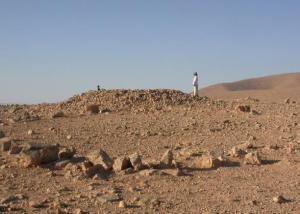
Photo courtesy Dr. Robert Mason. One of the corbelled stone structures found in the Syrian desert. Archaeologists suspect that its an ancient stone tomb. In the front of it are the remains of a stone circle.

Dr. Mason explains that he “went for a walk” into the eastern perimeter of the site – an area that hasn’t been explored by archaeologists. What he discovered is an ancient landscape of stone circles, stone alignments and what appear to be corbelled roof tombs. From stone tools found at the site, it’s likely that the features date to some point in the Middle East’s Neolithic Period – a broad stretch of time between roughly 8500 BC – 4300 BC.

It is thought that in Western Europe megalithic construction involving the use of stone only dates back as far as ca. 4500 BC. This means that the Syrian site could well be older than anything seen in Europe.

At a recent colloquium in Toronto, Canada, Mason described his shock at discovering the apparent tombs, stone circles and stone alignments: “I was standing up there thinking, oh dear me, I’ve wandered onto Salisbury Plain,”

At the southern end of the landscape there are three apparent tombs. They are about eight metres in diameter and each of them “actually has a chamber in the middle”. The roof is corbelled which suggests that beneath them is “something you would want to seal in.” Each of these corbelled structures had a stone circle beside it, which is about two meters in diameter.

Dr. Mason cautioned that the team did not have the chance to do more than survey the area, so it’s still possible that these corbelled structures could have a purpose other than burial. More work also needs to be done to get a precise date of construction.

Dr. Mason set out to look for more stone circles and chambered structures. This time he brought a monk with him, from the monastery:

“Lurking around in the hills above a Syrian military base with a digital camera in one hand and a GPS unit in the other is the sort of thing that makes you want to have a monk in your presence,” he explained.

The two of them went to a rock outcrop – a place that would have been a good source of flint in ancient times – where he found the remains of several corbelled structures. In the valley below they found another corbelled structure with a stone circle right beside it.

The monk who travelled with him sensed that this high outcrop would have been of great importance to the people who lived here. “This is a high place” he told Mason.

As Mason gazed at the landscape, from the height of the outcrop, he saw stone lines, also known as alignments, going off in different directions. Dr. Mason has a strong background in geology, and knew immediately that these could not be natural features.

“I know what rocks look like, where they belong – these rocks don’t belong in that.”

One of stone lines was “very bizarre,” snaking its way up a hill. Mason followed the line and found that it led to the “biggest complex of tombs of all.”

This particular stone structure has three chambers and was probably the burial place for “the most important person.” In the front of the tomb are the remains of a stone circle. Dr. Mason can’t confirm for sure that this was used as a tomb, until further archaeological work takes place.

The lithics the team found in the landscape are also quite unusual – they don’t seem to be made from local material. Mason explained that local flint is white or dark red, but the material they found is “very good quality brown chert.”

The Neolithic period is a time period when people in the Middle East were beginning to grow crops and adopt farming. They didn’t live in settlements larger than a village. There were no cities in the Middle East or anywhere else in the world.

Professor Edward Banning is a University of Toronto anthropology professor and Neolithic period expert, and has done extensive fieldwork in the Middle East, including Jordan. He said that we need to be careful about drawing conclusions before more fieldwork is done.

“Virtually all the burials that archaeologists have ever discovered from Neolithic sites in that part of the world come from inside settlements – in fact even below floors and houses,” he said. If the corbelled structures are confirmed as burial structures, then this site will represent something new.

“It’s possible that this landscape that Dr. Mason has identified could be an example of off-site burial practices in the Neolithic which would be very interesting.”

This would help settle a mystery that archaeologists have long faced. Banning said that while burials have been found in Neolithic settlements, “Those burials are not high enough in number to account for the number of people who must have died in those settlements. So a number of us for many years have assumed that there must have been off-site mortuary practices of some kind.”

Dr. Mason goes a step further. He says that this site “sounds like Western Europe” and he wonders if this could be an early example of the stone landscapes seen at places like Stonehenge.

Dr. Julian Siggers of the Royal Ontario Museum, another Neolithic specialist, pointed out that it has been argued that agriculture spread from the Near East to Europe. This find creates a question – could these stone landscapes have travelled with them?

“It’s such an important hypothesis if it’s right that it’s worth telling people about now,” said Mason. “We’ve found something that’s never been found in the Middle East before.”

Professor Banning is sceptical about this idea. He said that stone structures are found throughout the world, pointing to the dolmens found in East Asia. He claims that people in Western Europe could have developed the techniques independently of the people who built the landscape near the Deir Mar Musa al-Habashi monastery.

Prof. Banning also said that Mason’s site may not be entirely unique in the Near and Middle East. He said that archaeologists have detected, via satellite photos, what appear to be cairns and stone circles in other areas, including the deserts of Jordan and Israel. However, he admits that most of these things have not received a lot of archaeological investigation.

That situation is about to change. Dr. Mason plans to return to the Deir Mar Musa al-Habashi site this summer with a team of Neolithic experts. The results of their investigations may well put Britain’s Stonehenge in the shade.

Tour Guide
Stonehenge Stone Circle