Stonehenge opens to Druids for Vernal Equinox

26 03 2010
 

English Heritage site welcomes worshippers to mark the start of spring

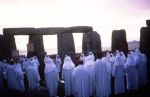
Druids celebrate the sping equinox at Stonehenge(Panasonic)

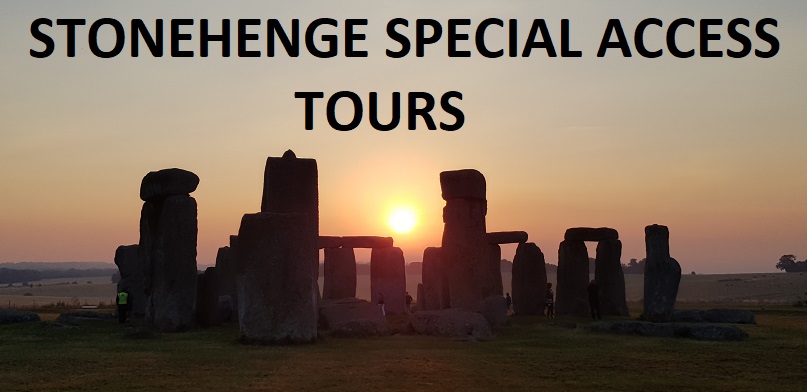
A handful of lucky Druids took advantage of a rare opportunity to walk amongst Stonehenge this Saturday, 20 March in celebration of the Spring Equinox. Less than a hundred visitors, including Druids and pagan worshippers met at around 5.30am to watch the sunrise and welcome in the spring.

Despite the wet, windy weather, traditional customs such as blessings, chants and drum choruses went ahead in the middle of the ordinarily protected English Heritage site.

With characters dressed in outfits of white robes, floral headdresses, witches brooms and even stag’s antlers, attendees worshipped as the sun rose directly above the equator.

Despite heavy cloud cover, the gathered crowd enjoyed a brief glimpse of the sun before taking advantage of their rare chance to touch and interact with the stones.

Formal proceedings were overseen by renowned Arch Druid of Stonehenge Rollo MaughFling, leading both traditional chants and calling for more contemporary solutions, too. When talking about the upcoming General Election, the Arch Druid strayed away from a political bias and instead asked that, “Whoever is best fitted to lead us out of recession and back into prosperity be the party that wins as many people are suffering.”

One fellow Druid not afraid of showing his political stance was notorious eco-campaigner, Arthur Uther Pendragon, announcing his decision to run as an independent candidate in the forthcoming election.

“I have stood three times previously,” he told MSN UK, “The first time, I embarrassed the British National Party into last place, the second time, the new leader of the Monster Raving Looney Party into last place, and the third time I embarrassed myself into last place, but still polling 1% of the Vote.”

The day was also saw a posthumous appearance by Wally Hope, the founder of the Stonehenge festival. Since his death in 1975, the ashes of Wally Hope have been carried to the stones by their official keepers.


How and Why Was Stonehenge Built?

22 03 2010

StonehengeFrom the grassy deserted plains of southern England rises a circle of standing stones, some of them up to 24 feet tall. For centuries they have towered over visitors, offering tantalizing hints about their prehistoric past. For centuries, everyone who has stood before them has wondered the same thing: Who built this mysterious rock monument? And why? “Since Stonehenge was built and rebuilt over a period of centuries, no one group has sole credit for its construction, but the main building seems to have been done by a people known as the ‘Beaker Folk,’” says Benjamin Hudson, professor of History and Medieval Studies at Penn State. The Beaker Folk (who earned their name from the distinctive inverted bell-shaped pottery drinking vessels they made) scattered throughout prehistoric western Europe. The earliest construction at Stonehenge began about 3000 B.C., says Hudson, with a stone circle inside a ditch and bank. Within that circle lay a timber building; researchers have excavated from the site about 56 pits containing the remains of human cremations. Construction continued for 600 years, in several phases of landscaping: Burial mounds (most pointing east-to-west) and ceremonial pathways were added to the site. In 2400 B.C., the builders erected the large sandstone blocks which give the site its name. (Coined by Henry of Huntingdon, a twelfth-century English historian, “Stonehenge” means “hinged or supported stones.”) The means of moving those enormous standing stones has provoked centuries of speculation, with theories ranging from demonic powers to Merlin’s magic to alien technology. The reality is much more ordinary, says Hudson. “Much of the construction was little more than putting enough men under a stone to move it into place,” he notes, “although some basic engineering was required for the larger stones and the lintels.” One theory holds that the builders used simple inclines and levers to move the stones into place. Like the Egyptian pyramid-builders, the Stonehenge constructors relied more on brute labor than sophisticated technology. Though one of the most complete and monumental examples of Neolithic and Bronze Age construction, Stonehenge was not alone in its time. Hudson notes one estimate that places it among 300 surviving stone monuments throughout the British Isles—including the famous stone circle in Avebury. The connections between and among these sites often remain murky, and undoubtedly many creations of the Beaker Folk have returned to nature, leaving few traces of their existence. “Stonehenge forces us to reconsider the period of history that is not accompanied by written records,” Hudson says. Since the builders left no explanation, the precise purpose of their work remains obscure. One theory sees Stonehenge as a temple, pointing to the elaborate landscaping surrounding the site. More recently, historians and archaeologists have suggested it provided an observatory for either moon or sun cults. The Beaker Folk are believed to have been sun worshipers who aligned Stonehenge with certain important sun events, such as mid summer and winter solstices. While the absence of records makes it nearly impossible to be certain about Stonehenge’s purpose, the site itself does leave us with a portrait of Beaker Folk society. “The building of the monument required knowledge of civil engineering, transportation, and quarrying,” he says. “The society that constructed it was wealthy enough to afford such an expensive venture and it also had a developed theology that provided the guidance for the designs whose meanings still elude us.” Perhaps it is that elusive meaning that has, for centuries, drawn people to Stonehenge, to sit and wonder among the silent stones.

Stonehenge Guide
Stonehenge Stone Circle


Spring Equinox at Stonehenge

19 03 2010
This is the second of the four ‘sky points’ in our Wheel of the Year and it is when the sun does a perfect balancing act in the heavens.


At the Spring (or Vernal) Equinox the sun rises exactly in the east, travels through the sky for 12 hours and then sets exactly in the west. So all over the world, at this special moment, day and night are of equal length hence the word equinox which means ‘equal night’.

Of course, for those of us here in the northern hemisphere it is this equinox that brings us out of our winter.

For those in the southern hemisphere, this time is the autumnal equinox that is taking you in to your winter. And this is very much how I think of the equinoxes – as the ‘edges’ of winter. This is why they can be quite hard on our bodies as it is a major climatic shift, so it is a good time to give a boost to your immune system with natural remedies and cleansing foods.

Here in Wiltshire (as with the rest of rural Britain), it was traditional to drink dandelion and burdock cordials at this time as these herbs help to cleanse the blood and are a good tonic for the body after its winter hardships.

As the Vernal Equinox heralds the arrival of spring, it is a time of renewal in both nature and the home, so time for some spring-cleaning!

This is more than just a physical activity, it also helps to remove any old or negative energies accumulated over the dark, heavy winter months preparing the way for the positive growing energy of spring and summer.

As with all the other key festivals of the year, there are both Pagan and Christian associations with the Spring Equinox.

To Pagans, this is the time of the ancient Saxon goddess, Eostre, who stands for new beginnings and fertility.

This is why she is symbolized by eggs (new life) and rabbits/hares (fertility).

Her name is also the root of the term we give to the female hormone, oestrogen.By now, you may be beginning to see the Christian celebration derived from this festival – Easter.

And this is the reason why the ‘Easter Bunny’ brings us coloured eggs (and if you’re lucky chocolate ones!) at this time of year.

So, as nature starts to sprout the seeds that have been gestating in her belly throughout the winter, maybe you can start to think about what you want to ‘sprout’ in your life now and start to take action. 

Celti Wheel

Celtic Wheel

In between these ‘sky points’ are the Cross-quarter days which mark ‘gear shifts’ in the energy of the earth. These times are also important agriculturally.

Imbolc (Beginning of February) is when the first lambs are born and ewe’s milk is available again after the long winter. The year is beginning to stir and wake-up.

Beltane (Beginning of May) is the transition from spring to summer when Nature is pumping with life-force and fertility.

Lammas (Beginning of August) is the time of ripeness and when the earth starts to give up her harvest.

Samhain (Beginning of November) is the end/beginning of the Celtic year. It is a time when the veil between the worlds is thinnest and it is possible to commune with the ancestors.

There is great joy in being aware of the seasons in this way and celebrating them in simple ways.

As the year unfolds, we will look in detail at the eight energy-points of the year and the ways in which they affect us.

We will also look at how these festivals have been celebrated in Wiltshire, both past and present.

Merlin – Stonehenge Tour Guide
Stonehenge Stone Circle


Durrington Walls, Wiltshire: Walk of the week

13 03 2010

The first of our new series of weekly walks, provided by the National Trust, is a ramble around mysterious Durrington Walls in Wiltshire, with views towards Stonehenge.

View Durrington Walls: Walk of the week in a larger map
THE EXPERT’S VIEW

Mike Dando, Head Warden: “The walk starts at the largest henge monument in the country and takes you past ancient monuments such as Round Barrows and the ‘Cuckoo Stone’ where it is easy to imagine the landscape as it was some 4,000 years ago. The walk takes in beautiful grazed grassland, strips of mature Beech trees and offers fantastic views across the Stonehenge Landscape.

Download an OS map of this walk

“My favourite part of this walk would have to be walking past the New King Barrows, the large Bronze Age burial mounds. A stop here on a warm summers’ day, listening to the skylarks and the beech leaves rustling, is hard to beat, especially on top of the view over to Stonehenge itself.

“Unique to this walk is the sense of being in an ancient and sacred place; the combination of the natural and historic sights is simply spectacular. My top tip for first time walkers would be to bring binoculars to take in the wildlife and views.”

ESSENTIALS
Start: Woodhenge car park
Grid ref: SU151434
Map: OS Landranger 184

Getting there
Bike: National Cycle Network route 45 runs south-east of the property. See http://www.sustrans.org.uk

Bus: Wilts & Dorset 5 or 6, between Salisbury, Pewsey, Marlborough and Swindon. Service 16 from Amesbury, request stop at Woodhenge

Rail: Salisbury station, 9 miles from Woodhenge car park

Road: Woodhenge car park is 1¾ miles north of Amesbury, follow signs from A345

Distance, terrain and accessibility

4 mile (6.4km) across open access land, including Rights of Way, with gates, at several points. The ground is uneven in places, with a few short, steep slopes. Sheep graze the fields and there are ground-nesting birds, so please keep dogs under control.

Local facilities
Picnic area (not NT) and information panel at Woodhenge car park
WCs
Outdoor café
Picnic area (not NT) at Stonehenge car park, 0.75 miles from this walking route.
THINGS TO LOOK OUT FOR

Durrington Walls: The largest complete henge in Britain is 500m in diameter and encloses a natural valley. It once contained timber circles and what appear to have been shrines. The area outside the ditch and bank was once a settlement, perhaps containing hundreds of houses, making Durrington Walls potentially the largest village in north-west Europe at the time. People travelled for miles to feast and take part in ceremonies, probably at the midwinter solstice. Woodhenge stood nearby as an impressive timber circle surrounded by a bank and ditch.

The Cuckoo Stone: This standing stone now lies on its side, but over millennia it has been a focus for Bronze Age urn burials, an Iron Age boundary line and Roman remains. It is made of sarsen, a kind of sandstone, the same as the largest stones in the Stonehenge stone circle. The reason for its name remains a mystery.

The Stonehenge Avenue: A two mile long ceremonial way linking Stonehenge with the River Avon and crossing King Barrow Ridge. Interestingly, Durrington Walls is also connected to the river, leading experts to believe the Avon symbolically linked the two monuments, forming part of a ritual journey; maybe leading to the afterlife.

DIRECTIONS

Download an OS map of this walk

1. At Woodhenge car park, go through the gate nearest to you and into a field. Walk downhill into Durrington Walls (taking care of rabbit holes).

2. At the centre of Durrington Walls, looking around you, you can appreciate the nature of the henge as an enclosed valley. Standing here 4,500 years ago, you would have been viewing several “shrines” around the slopes. Next, turn left and walk to the corner of this field. Pass through gates either side of the road, heading towards a low rock.

3. The Cuckoo Stone is one of very few stones in the area that is made from sarsen – most local rock is chalk or flint. From here, continue forwards to the next gate.

4. You are now on the route of the old military railway between Amesbury and Larkhill; turn right and follow the path.

5. When you reach a crossroads and National Trust sign to King Barrow Ridge, turn left and follow the shaded bridleway.

6. At the junction, turn right through a gate to continue along the ridge, crossing the Stonehenge Avenue on your way to a line of 200-year-old beech trees and a fine view of Stonehenge. At winter solstice, Neolithic people may have marked the occasion of the midwinter sunset at Stonehenge, before travelling to Durrington Walls to celebrate the new sunrise.

7. Continue forward to New King Barrows, a fine row of Early Bronze Age burial mounds, originally capped in white chalk so they would have been visible from a far distance. Return to point 6, turn right and follow the stony track to point 8.

8. Take a left turn through a gap in the hedge, to join the old military railway once more. This leads back to the gate in the corner of the Cuckoo Stone field.

9. Head across the grassland to Woodhenge and back to Woodhenge car park.

STONEHENGE STONE CIRCLE


£20m Stonehenge visitor centre criticised by Government design watchdog

10 03 2010

The Commission for Architecture and the Built Environment (CABE) believes the centre’s “twee paths” are “more appropriate for an urban garden” and its “delicate roof” is unsuitable for the wind and rain that sweeps across the majestic Wiltshire plains where the stones stand.

Although the plans, by Australian architecture firm Denton Corker Marshall, have been approved by Wiltshire county council planners and are backed by local architects on the Wiltshire Design Forum, CABE said the “architectural approach” was wrong.

“We question whether, in this landscape of scale and huge horizons and with a very robust end point that has stood for centuries and centuries, this is the right design approach?” Diane Haigh, the watchdog’s director of design review, told The Guardian.

“You need to feel you are approaching Stonehenge. You want the sense you are walking over Salisbury Plain towards the stones.”

She said the intended location of the centre, at Airman’s Corner, is appropriate and that CABE was pleased that “something was happening at last” to enhance the appeal of the 5,000-year-old World Heritage site.

She said that she recognised the columns were meant to be “lots of trunks” holding up a “very delicate roof”, but added: “Is this the best approach on what is actually a very exposed site. In particular, if it’s a windy, rainy day, as it is quite often out there, it’s not going to give you shelter.

“We are concerned it’s very stylish nature will make it feel a bit dated in time, unlike the stones which have stood the test of time”.

The comments are the latest setback for long-running plans backed by English Heritage to make the site more suitable for visitors, 800,000 of whom make the journey to Stonehenge each year.

Traffic continues to rumble past the site today after the Government decided, two years ago, to scrap a highly-ambitious £65m scheme to build a tunnel to re-route traffic to protect the site on the grounds of cost.

English Heritage said it recognised that the visitor centre would prove controversial and divisive.

“Innovative architectural designs will always polarise opinion, and often nowhere more so that within the architectural world itself,” it said in a statement.

“The Stonehenge project has to overcome a unique set of challenges,” it said. “This has required a pragmatic approach and, following widespread consultation, we maintain the current plans offer the best solution”.

Stephen Quinlan, partner at Denton Corker Marshall, said the roof was meant to be a “sun canopy” and not meant to entirely keep out the elements since the visitor centre is part of the “an outdoor experience”.

“It’s not an iconic masterpiece. It’s a facility to help you appreciate the Stonehenge landscape. It’s intellectually ­deferential in a big, big way to Stonehenge as a monument,” he said.

“I wouldn’t even mind if you couldn’t remember what the building looked like when you left. The visitor centre is not the destination.”

But he said that his firm did not take criticism from CABE lightly. “We are crawling through their comments to see if there are any improvements we can make,” he said.

Denton Corker Marshall has previously designed the Manchester Civil Justice Centre, the Australian Embassies in Beijing and Tokyo and The Melbourne Museum.


New Stonehenge Tour

4 03 2010

Evan Evan Tours have just launched a new tour that includes Stonehenge Private access. In my opinion its a little ambitious (see below) but thats my opinion. There is a link below if you want to book
Their itinerary is as follows:

A PRIVATE VIEWING OF THE INNER CIRCLE AT STONEHENGE – an early start gives the opportunity to visit the inner circle of Stonehenge at sunrise, a walking tour of Oxford and visit to the state apartments at Windsor Castle.
Included Highlights
•Private Viewing at Sunrise of the Inner Circle at Stonehenge
•Walking tour of Oxford
•Visit Christ Church college (where Harry Potter was filmed)
•Entrance to Windsor Castle and a tour of the State Apartments and St George’s Chapel
•First-class luxury Motor-coach and the services of a Professional Guide

Private Viewing of Stonehenge
Most visitors to Stonehenge are not allowed direct access to the stones. On this special day trip from London, you’ll be invited to enter the stone circle itself, and stand beside the mysterious rocks towering above you. Your guide will unlock the secrets of this ancient World Heritage site. Enjoy the peace, away from the crowds, as you experience Stonehenge at its atmospheric best at sunrise.

Oxford
The colleges in Oxford date back to the 13th century and among its famous students were Bill Clinton, C.S. Lewis, J.R.R. Tolkien and Lewis Carroll. We take you on a fascinating walking tour, which includes visiting the Great Hall in Christ Church, where many scenes from Harry Potter were filmed. We’ll also see the Bodleian Library and the picture perfect college courtyards for which Oxford is famous.

Windsor Castle
Our day continues with a visit to Windsor Castle, the largest and oldest occupied Castle in the world, and home of the Royal Family for 900 years. Its proud, strong walls dominate the delightful town that has grown around the castle over the years. You’ll see the lavishly decorated State Apartments containing priceless furniture in glorious colours and St George’s Chapel, home to the 14th Century Order of the Royal Garter, our senior chivalric order.

Evan Evans Coach Tours – Click Here

The Stonehenge Tour Company

Histouries UK


Syria’s Stonehenge: Neolithic stone circles, alignments and possible tombs discovered

3 03 2010


Just read this in my morning newspaper – wow. I will do some more reserach and update you all.
For Dr. Robert Mason, an archaeologist with the Royal Ontario Museum, it all began with a walk last summer. Mason conducts work at the Deir Mar Musa al-Habashi monastery, out in the Syrian Desert. Finds from the monastery, which is still in use today by monks, date mainly to the medieval period and include some beautiful frescoes.

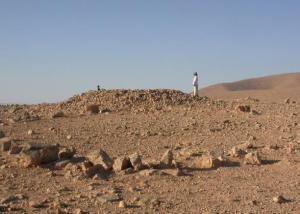
Photo courtesy Dr. Robert Mason. One of the corbelled stone structures found in the Syrian desert. Archaeologists suspect that its an ancient stone tomb. In the front of it are the remains of a stone circle.

Dr. Mason explains that he “went for a walk” into the eastern perimeter of the site – an area that hasn’t been explored by archaeologists. What he discovered is an ancient landscape of stone circles, stone alignments and what appear to be corbelled roof tombs. From stone tools found at the site, it’s likely that the features date to some point in the Middle East’s Neolithic Period – a broad stretch of time between roughly 8500 BC – 4300 BC.

It is thought that in Western Europe megalithic construction involving the use of stone only dates back as far as ca. 4500 BC. This means that the Syrian site could well be older than anything seen in Europe.

At a recent colloquium in Toronto, Canada, Mason described his shock at discovering the apparent tombs, stone circles and stone alignments: “I was standing up there thinking, oh dear me, I’ve wandered onto Salisbury Plain,”

At the southern end of the landscape there are three apparent tombs. They are about eight metres in diameter and each of them “actually has a chamber in the middle”. The roof is corbelled which suggests that beneath them is “something you would want to seal in.” Each of these corbelled structures had a stone circle beside it, which is about two meters in diameter.

Dr. Mason cautioned that the team did not have the chance to do more than survey the area, so it’s still possible that these corbelled structures could have a purpose other than burial. More work also needs to be done to get a precise date of construction.

Dr. Mason set out to look for more stone circles and chambered structures. This time he brought a monk with him, from the monastery:

“Lurking around in the hills above a Syrian military base with a digital camera in one hand and a GPS unit in the other is the sort of thing that makes you want to have a monk in your presence,” he explained.

The two of them went to a rock outcrop – a place that would have been a good source of flint in ancient times – where he found the remains of several corbelled structures. In the valley below they found another corbelled structure with a stone circle right beside it.

The monk who travelled with him sensed that this high outcrop would have been of great importance to the people who lived here. “This is a high place” he told Mason.

As Mason gazed at the landscape, from the height of the outcrop, he saw stone lines, also known as alignments, going off in different directions. Dr. Mason has a strong background in geology, and knew immediately that these could not be natural features.

“I know what rocks look like, where they belong – these rocks don’t belong in that.”

One of stone lines was “very bizarre,” snaking its way up a hill. Mason followed the line and found that it led to the “biggest complex of tombs of all.”

This particular stone structure has three chambers and was probably the burial place for “the most important person.” In the front of the tomb are the remains of a stone circle. Dr. Mason can’t confirm for sure that this was used as a tomb, until further archaeological work takes place.

The lithics the team found in the landscape are also quite unusual – they don’t seem to be made from local material. Mason explained that local flint is white or dark red, but the material they found is “very good quality brown chert.”

The Neolithic period is a time period when people in the Middle East were beginning to grow crops and adopt farming. They didn’t live in settlements larger than a village. There were no cities in the Middle East or anywhere else in the world.

Professor Edward Banning is a University of Toronto anthropology professor and Neolithic period expert, and has done extensive fieldwork in the Middle East, including Jordan. He said that we need to be careful about drawing conclusions before more fieldwork is done.

“Virtually all the burials that archaeologists have ever discovered from Neolithic sites in that part of the world come from inside settlements – in fact even below floors and houses,” he said. If the corbelled structures are confirmed as burial structures, then this site will represent something new.

“It’s possible that this landscape that Dr. Mason has identified could be an example of off-site burial practices in the Neolithic which would be very interesting.”

This would help settle a mystery that archaeologists have long faced. Banning said that while burials have been found in Neolithic settlements, “Those burials are not high enough in number to account for the number of people who must have died in those settlements. So a number of us for many years have assumed that there must have been off-site mortuary practices of some kind.”

Dr. Mason goes a step further. He says that this site “sounds like Western Europe” and he wonders if this could be an early example of the stone landscapes seen at places like Stonehenge.

Dr. Julian Siggers of the Royal Ontario Museum, another Neolithic specialist, pointed out that it has been argued that agriculture spread from the Near East to Europe. This find creates a question – could these stone landscapes have travelled with them?

“It’s such an important hypothesis if it’s right that it’s worth telling people about now,” said Mason. “We’ve found something that’s never been found in the Middle East before.”

Professor Banning is sceptical about this idea. He said that stone structures are found throughout the world, pointing to the dolmens found in East Asia. He claims that people in Western Europe could have developed the techniques independently of the people who built the landscape near the Deir Mar Musa al-Habashi monastery.

Prof. Banning also said that Mason’s site may not be entirely unique in the Near and Middle East. He said that archaeologists have detected, via satellite photos, what appear to be cairns and stone circles in other areas, including the deserts of Jordan and Israel. However, he admits that most of these things have not received a lot of archaeological investigation.

That situation is about to change. Dr. Mason plans to return to the Deir Mar Musa al-Habashi site this summer with a team of Neolithic experts. The results of their investigations may well put Britain’s Stonehenge in the shade.

Tour Guide
Stonehenge Stone Circle


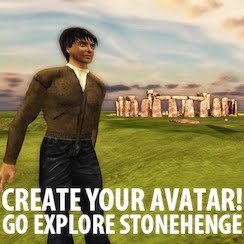
Stonehenge Virtual Download

26 02 2010


There is a new download available so you can explore Stonehenge virtually, Its quick to register and you will mixing with the Druids in minutes. Link at bottom of page.

What they say…………

“The druid beckons us to travel back in time with him, to find out all about the mysteries of Stonehenge. He swivels to face away from us; we follow him. Suddenly the land around us changes – we’re right in the heart of a dense forest, with all the plants, animals and atmosphere of Stonehenge brought to life right before our eyes.

“The druid carries on regardless. He turns, and he’s changed: his clothes have dated thousands of years. A quick smile and a wink reassures us as we’re whisked away through millennia of human history.

“And here we are – Stonehenge circa 2,400 BC, right around the time the last famous stones are being put in their fateful place. The giant megaliths resonate through the ages; just as breathlessly beautiful as they are today…”

Storylines
This is just the smallest tip of an epic story we at Heritage Key are developing, in the journey through Stonehenge Virtual.

Mystery

A place intertwined with history, controversy and ethereal mystery, Stonehenge has been a subject of speculation for centuries – its stones tell a silent story of thousands of years of clandestine ceremony, royal burials and celestial ambitions.

From the twisted bodies of the land’s first people, to the majestic beauty of the midsummer’s sunrise over its sarsens, Stonehenge raises just as many questions as it answers about life in prehistoric Britain.

Come with us!

Heritage Key invites you on an exclusive tour back thousands of years to the dawn of British history with Stonehenge Virtual.

•Explore the Neolithic settlement of Durrington Walls
•See the wonder of Stonehenge as it once stood over four thousand years ago.
•Interact with the people of the time, and take part in an ancient sunset ritual.
•Experience life as one of the ancient people who built Stonehenge.
Learn everything about Britain’s most spectacular prehistoric landmark. Explore the plants, animals and food which made Bronze Age Britain such an awe-inspiring place. Invite your friends along to a modern-day Druid ritual at the world-famous summer solstice festival, and learn about its greatest characters.

Incredible people

There’s so much more to the story of Stonehenge than its magnificent stones – fierce foreign warriors who came seeking magical medical redemption; powerful leaders who lived and died for the magnificent monument.

An amazing place

Stonehenge is one of the world’s greatest landmarks, with a history that never ends – and we want you to be able to explore it in all its incredible glory while you enjoy our Virtual Experience.

Unlock the wonders of Stonehenge with Stonehenge Virtual: Coming soon to Heritage Key. Go to website


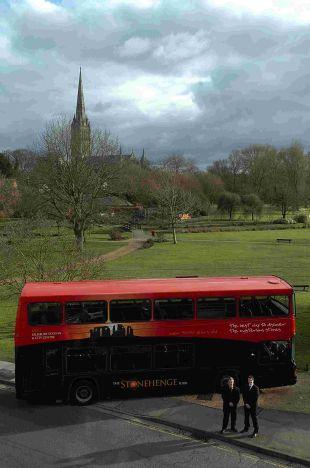
Stonehenge Tour to expand

23 02 2010


VISITORS to Stonehenge will now be able to take advantage of an expansion to the always popular Stonehenge Tour.

The new package for 2010/11, beginning on March 16, will feature Salisbury Cathedral and the Magna Carta and enable visitors to explore Stonehenge, the hillfort of Old Sarum, and the cathedral using a single ticket.

The tour allows visitors to step off trains at Salisbury station and straight onto the dedicated bus service.

Stuart Maughan, English Heritage head of visitor operations for Stonehenge and Old Sarum, said “Neatly wrapping up three of the area’s top heritage attractions into one easy package like this will have real appeal for tourists and most especially for overseas visitors.

“I feel sure it will encourage them to visit all three attractions – and inspire them to explore the city of Salisbury and surrounding countryside – so that everyone benefits from this new partnership.”

Customers join The Stonehenge Tour buses at Salisbury rail station, the bus station or any of the stops in Salisbury city centre or at the historic sites themselves.

Buses run every 30 minutes during the summer and once an hour for the remainder of the year. Tickets are bought from the driver. Adult ticket prices range from £11 (tour only) to £22 (including admission to Stonehenge, Old Sarum and a donation to Salisbury Cathedral).

Stonehenge Tours


Concrete Post Henge is Oldest Structure In England

22 02 2010


English Heritage, working in conjunction with The National Trust, are fighting ‘tooth and nail’ to preserve the newly discovered ancient Henge found in Wiltshire, England.

Also located in Wiltshire is Stonehenge thought to have been erected in around 3000BC. Coincidently, Concrete Post Henge is only, a remarkable, fifty feet away from the former, just over a small hill. Chartered Surveyors were called to the scene immediately and were able to verify that the structure had been around since at least two days after The Big Bang. Primitive drill bit markings and circular saw striations were, apparently, the most obvious clues in the age determining process.

“I can’t believe we didn’t spot it before; it was right under our noses. The significance of this find cannot be underestimated. I’ve seen a few henges in my time, nobody knows what the heck a henge is yet, but I know this is a good one.”

National Trust stalwart Walter Ernest made only one comment to The Spoof:

“It’s a sad day here for us in Wiltshire. I’ve put my life, heart and soul into promoting ‘old stoney’ as the nation’s oldest treasure, since my divorce it’s been like a friend to me. No doubt some young bucks will get the job of looking after the new find and I’ll probably have to go back to a career
in druid stone circles now…”

Now that was funny! The story above is a satire or parody. It is entirely fictitious.

This was from the Spoof website.