Stonehenge Tours at Christmas and the New Year

14 12 2011

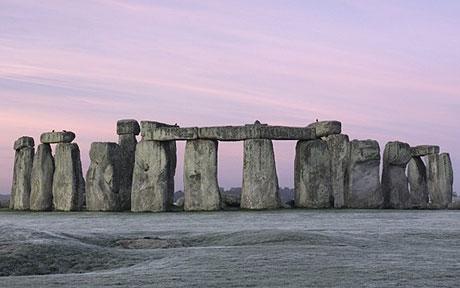
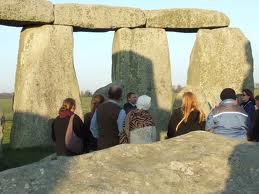
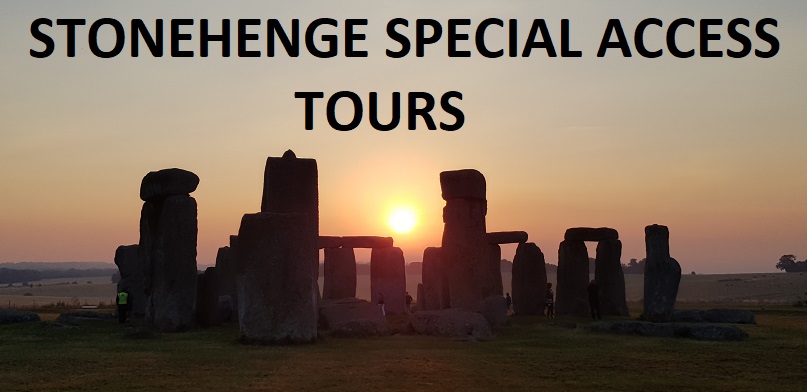
There are a number of tours departing from London that include Stonehenge on Christmas Day, the New Year and over the festive period.  Please use the link below to view the available coach tours.

All are discounted and have printable tickets

Top Stonehenge tour operators:
The Stonehenge Experts – www.StonehengeTours.com
Coach tours departing from London- www.SightseeingTours.co.uk
Histouries UK (Bespoke Tours),  – www.Histouries.co.uk

Stonehenge Christmas Toursclick here

Christmas Eve in Windsor, Stone
Christmas in Windsor, Stonehenge and Bath
Boxing Day in Windsor, Stonehenge and BathPrivate Viewing of Stonehenge including Bath and Lacock


Melin says:  Its a good time to visit Wiltshire, in particular Salisbury

Merlin @ Stonehenge
The Stoneheneg Stone Circle Website


Stonehenge transformed into an eerie blaze of colour by light-art expert

11 12 2011

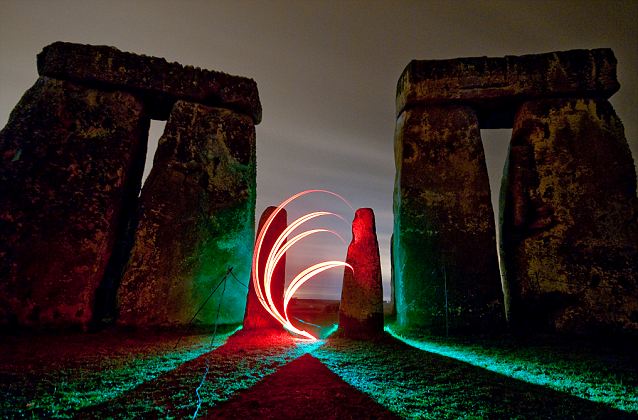
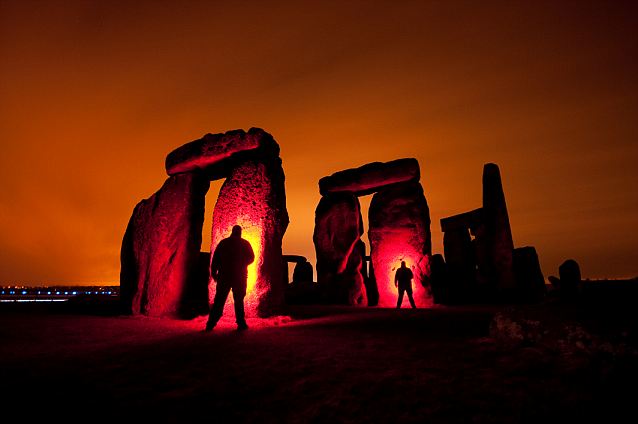
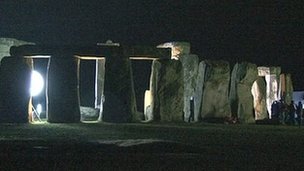
It’s a stunning illuminating technique which when used at Stonehenge turned the ancient British wonder into an amazing after-dark spectacular .. welcome to the world of light-painting.

Light-painter Marc Bowyer-Briggs has fused his photographic creativity and technological skills to turn the Wiltshire standing stones into a technicolour lightshow.

Using a technique involving electroluminescent wire and a long exposure on his camera, the 33-year-old from Portsmouth brought the dark stone monoliths to life with dazzling multi-coloured effects.

Light fantastic: Stonehenge as it has never been seen before

Light fantastic: Stonehenge as it has never been seen beforeMarc was granted exclusive access to the World Heritage site was given just two hours to transform the ancient standing stones into light art.The light artist explained: 'It was always my dream to go to Stonehenge.'It has to be one of the most iconic landmarks in the country.'I got the chance to shoot there at night so I snapped it up. I was only allowed two hours, so I really had to think on my feet.'I'm forever looking for locations, as whilst it's great to make a shot purely out of your light tools, it's also great to combine the location you're at within the shot.'Glow in the dark: Stonhenge in Wiltshire proves an incredible setting for the illuminating 'light painting' techniques

The dark nature of his art means that Marc is constantly roaming Britain’s countryside and cities by night – a task that comes with its own challenges.

Glow in the dark: Stonhenge in Wiltshire proves an incredible setting for the illuminating 'light painting' techniques

Glow in the dark: Stonhenge in Wiltshire proves an incredible setting for the illuminating 'light painting' techniques

‘It can get very exciting when you’re shooting in an inner city at night, especially when a group of drunk people are coming your way,’ he said.

‘In the past I’ve watching security guards at Stonehenge spot people trying to mount the fence.

‘Then with military precision dart over and explain why they shouldn’t be doing it.’

Marc, who has been honing his talent for light painting over four years, explained how he is able to create such fantastic images.

He said: ‘There are many methods to the madness but ultimately, you just need a camera that’ll take a long exposure.

‘You can keep the shutter of your camera open for as long as you wish.

‘Coupled with a cable release and a tripod, some light tools and some imagination, anyone can do it – the limit is purely your imagination.

‘You can use a simple torch to start with to illuminate objects, or draw stick men, then

‘I get such a sense of pride at a certain shot I’m happy with.’

Marc’s previous works include green laser tunnels and light painted UFOs gliding over the shadowy English countryside.

He has received popular enthusiasm for his work – so much so that he has now started to share his expertise with others.

He said: ‘Once people understand how the picture is created, more often than not, they’re in awe and want to go out and try it for themselves.

‘I’ve recently run an evening training course that I’m looking to increase the frequency of with a couple of friends.

‘The first half starts with the theory behind night photography, and how to do it, and the second half is a practical hands on.

‘The reaction we had from the first evening was fantastic.

‘My dream is to make it into the TATE Modern with some of my art.’ For  For more information see www.marcbb.co.uk

Full story by Daily Mail reporter: http://www.dailymail.co.uk/news/article-2072069/Stonehenge-transformed-eerie-blaze-colour-light-art-expert.html?ito=feeds-newsxml

Sponsored by ‘The Stonehenge Tour Company’ www.StonehengeTours.com

Merlin says: Trippy stuff man………………

Merlin @ Stonehenge
The Stonehenge Stone Circle Website


Hidden dimension of Stonehenge revealed

8 12 2011

A project directed by academics at the University of Sheffield has made the archaeology of the world-famous Stonehenge site more accessible than ever before.

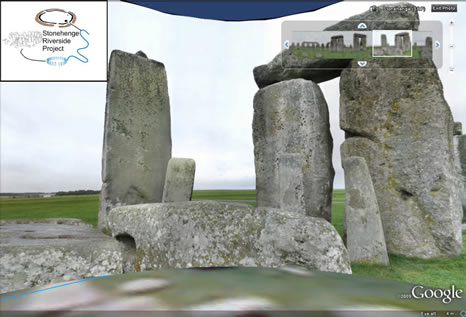
StonehengeGoogle Under-the-Earth: Seeing Beneath Stonehenge is the first application of its kind to transport users around a virtual prehistoric landscape, exploring the magnificent and internationally important monument, Stonehenge.

The application used data gathered from the University of Sheffield´s Stonehenge Riverside Project in conjunction with colleagues from the universities of Manchester, Bristol, Southampton and London. The application was developed by Bournemouth University archaeologists, adding layers of archaeological information to Google Earth to create Google Under-the-Earth.

The unique visual experience lets users interact with the past like never before. Highlights include taking a visit to the Neolithic village of Durrington Walls and a trip inside a prehistoric house. Users also have the opportunity to see reconstructions of Bluestonehenge at the end of the Stonehenge Avenue and the great timber monument called the Southern Circle, as they would have looked more than 4,000 years ago.

The project is funded through Google Research Awards, a program which fosters relationships between Google and the academic world as part of Google’s ambition to organise the world’s information and make it universally accessible and useful.

Professor Mike Parker-Pearson from the University of Sheffield’s Department of Archaeology said: “Google Under Earth: Seeing Beneath Stonehenge is part of a much wider project led by myself and colleagues at other universities – the Stonehenge Riverside Project – which began in 2003. This new Google application is exciting because it will allow people around the world to explore some of the fascinating discoveries we’ve made in and around Stonehenge over the past few years.”

Archaeological scientist Dr Kate Welham, project leader at Bournemouth University, explained that the project could also be the start of something much bigger:

“It is envisaged that Google Under-the-Earth: Seeing Beneath Stonehenge could be the start of a new layer in Google Earth. Many of the world’s great archaeological sites could be added, incorporating details of centuries’ worth of excavations as well as technical data from geophysical and remote sensing surveys in the last 20 years.” she said.

Dr Nick Snashall, National Trust Archaeologist at Stonehenge said: “The National Trust cares for over 2,000 acres of the Stonehenge Landscape. Seeing Beneath Stonehenge offers exciting and innovative ways for people to explore that landscape. It will allow people across the globe, many of whom may never otherwise have the chance to visit the sites, to share in the thrill of the discoveries made by the Stonehenge Riverside team and to appreciate the remarkable achievements of the people who built and used the monuments.”

You can download the application from the Google Under-the-Earth: Seeing Beneath Stonehenge site. The tool is easy to use and requires Google Earth to be installed on your computer.

Notes for Editors:
Google Under-the-Earth: Seeing Beneath Stonehenge was created at Bournemouth University by Dr Kate Welham, Mark Dover, Harry Manley and Lawrence Shaw. It is jointly directed by Dr Kate Welham and Professor Mike Parker Pearson at the University of Sheffield.

To find out more about the University of Sheffield’s Department of Archaeology, visit: Department of Archaeology

The Stonehenge Riverside Project was a joint collaboration between Universities of Bournemouth, Bristol, Manchester, Sheffield and University College London. It was led by Professor Mike Parker Pearson, University of Sheffield, and co-directed by Professor Julian Thomas, University of Manchester, Dr Joshua Pollard, University of Southampton (formally University of Bristol), Dr Colin Richards, University of Manchester, Dr Chris Tilley, University College London and Dr Kate Welham, Bournemouth University.

This project has been supported by: The Arts and Humanities Research Council, the British Academy, the Royal Archaeological Institute, the Society of Antiquaries, the Prehistoric Society, the McDonald Institute, Robert Kiln Charitable Trust, Andante Travel, University of Sheffield Enterprise Scheme, the British Academy, the National Geographic Society, with financial support from English Heritage and the National Trust for outreach. The project was awarded the Bob Smith Prize in 2004 and the Current Archaeology Research Project of the Year award for Bluestonehenge in 2010.
Links: www.shef.ac.uk/

Sponsored by ‘The Stonehenge Tour Company’ www.StonehengeTours.com

Merln says: The tool is easy to use and requires Google Earth to be installed on your computer.

Melin @ Stonehenge Stone Cirle
The Stonehenge Stone Circle Website


Stonehenge: Up Close 12th December 2011

4 12 2011

Stonehenge access guided tourGain a rare and fascinating insight into the famous World Heritage Site with an exclusive tour around the site led by one of English Heritage’s experts. Start the tour with exclusive early morning access to the stone circle at Stonehenge accompanied by our expert. Visit key archaeology sites including Durrington Walls, Woodhenge and The Cursus and learn more about the archaeological landscape and investigative work that has gone on in recent years. Includes tea and coffee.

MEMBERS EXCLUSIVE EVENT

How to Book

Purchase your tickets today by calling our dedicated Ticket Sales Team on 0870 333 1183 (Mon – Fri 8.30am – 5.30 Sat 9am – 5pm). Please note: Booking tickets for this event is essential as places are limited 

Prices

Ticket price includes entry to event site only

TYPE PRICE
Member (Adult) £30.00
 
Link: http://www.english-heritage.org.uk/daysout/events/stonehenge-up-close-s-12-dec/

Durrington Walls – is the site of a large Neolithic settlement and later henge enclosure. It is 2 miles north-east of Stonehenge. Recent excavation at Durrington Walls, support an estimate of a community of several thousand, thought to be the largest one of its age in north-west Europe. At 500m in diameter, the henge is the largest in Britain and recent evidence suggests that it was a complementary monument to Stonehenge

Woodhenge – Neolithic monument, dating from about 2300 BC, six concentric rings, once possibly supported a ring-shaped building.

Stonehenge Cursus –  (sometimes known as the Greater Cursus) is a large Neolithic cursus monument next to Stonehenge. It is roughly 3km long and between 100 and 150m wide. Excavations by the Stonehenge Riverside Project in 2007 dated the construction of the earthwork to between 3630 and 3375 BC. This makes the monument several hundred years older than the earliest phase of Stonehenge in 3000 BC.

Bronze Age round barrows – The Stonehenge UNESCO world heritage site is said to contain the most concentrated collection of prehistoric sites and monuments in the world. One monument type missed by the casual observer is that of the Bronze Age round barrow (burial mounds). As we walk through this landscape, you will come into contact with these intriguing ancient burial sites and through the expertise of our tour leaders, you will come face to face with the customs and people of Bronze Age society buried in close proximity to the unique stone circle of Stonehenge. Stonehenge Avenue – Walk along the Stonehenge Avenue and approach this unique stone circle as was the intended route experienced by the Stonehenge’s contempories.

Sponsored by ‘The Stonehenge Tour Company’ www.StonehengeTours.com
http://www.stonehengetours.com/html/stonehenge_archaeology_avebury_landscape_tour.htm

Merlin says: The Stonehenge landscape is more important than the Stone Circle – do this tour with the English Heritage………..

Merlin @ Stonehenge


Stonehenge lit up ‘will make it theme park’ claims Druid

4 12 2011

Lighting up Stonehenge at night would turn it into a “theme park”, says a senior Druid.

Lady Mimi Pakenham from Warminster sparked the idea of illuminating the stones to “really display them” in a letter to a national newspaper.

Stonehenge was lit up at night for a period in the 1970s and early 1980s

Stonehenge was lit up at night for a period in the 1970s and early 1980s

Senior Druid, King Arthur Pendragon, said it would “detract from the very purpose of Stonehenge”.

English Heritage, which manages the site, said it could be a distraction for nearby traffic.

Lady Pakenham, who raised the idea on the letters pages of the Times, said lights would give the monument dignity.

“I can’t understand why they haven’t at least done a trial run of very subtle lighting,” she said.

“I think very soft illumination, sort of like moonlight, for a few hours in the evening would really display it far more than it is now – where it’s looking rather abandoned.

“It’s all fenced in like a concentration camp, so soft lights for a few hours in the dark of the night – it would actually be the real jewel in England’s wonderful, wonderful monuments and buildings.”

‘Dark and broody’

King Arthur Pendragon, battle chieftain of the Council of British Druid Orders, said: “The place is supposed to be dark and broody – that’s part of the mysticism of Stonehenge – and illuminating it would only detract from its very purpose as a sun temple.

“It’s not designed to be illuminated at night and in my opinion it smacks of theme park Stonehenge which is everything I stand against.”

According to English Heritage, Stonehenge was lit up at night for a period in the 1970s and early 1980s.

“But that practice was stopped due to an increase in road accidents caused by vehicles slowing down to observe the monument,” said a spokesperson.

“As there is even more traffic today on the A303, that risk cannot be ignored.”

Full story: http://www.bbc.co.uk/news/uk-england-wiltshire-15998526

Sponsored by ‘The Stonehenge Tour Company’ www.StonehengeTours.com

Merlin say: No! moonlight only please………….

Merlin @ Stonehenge
The Stonehenge Stone Circle Website


The Celtic Stonehenge: Eccentric builds replica of famous ruins on island off Irish coast

1 12 2011

He hit the headlines when he drove his cement mixer, emblazoned with the words ‘Toxic Bank Anglo’, into the gates of the Irish parliament.

Two months later, self-styled Anglo Avenger Joe McNamara was back in Dublin city centre, this time staging a protest from atop a cherry picker crane.  When he was later acquitted of criminal damage, he became a popular hero.

Now it looks as though the 42-year-old developer has gone stone mad.

For his latest stunt, he has built his own version of Stonehenge on a hilltop on Achill Island off the Mayo coast.

The 15ft high circle is 30m in diameter and almost 100m in circumference, with 39 standing stones and lintels.

What it does not have, however, is planning permission.

And the Anglo Avenger – or should that be the Achill Stonehenger – will have another day in court this Friday, when Mayo County Council seeks a High Court injunction against the megalithic structure.

 
Believed to be more than six months in planning, it was built during the course of a single weekend, starting last Friday.

Council officials visited several times and issued legal threats, but the work went ahead.

It is still not clear what the purpose of the structure is.

But if it is intended as another protest against bank bailouts, it is certainly the biggest and most conspicuous yet.

And it might even be more difficult to remove than the cement mixer and cherry picker.

Yesterday, Mr McNamara declined to comment on any aspect of the development.

A spokesman for Mayo County Council would only say: ‘The matter is the subject of ongoing enforcement proceedings’.

Full story: http://www.dailymail.co.uk/news/article-2068116/Anglo-Avenger-Joe-McNamara-builds-Stonehenge.html

Sponsored by ‘The Stonehenge Tour Company ‘ www.StonehengeTours.com

Merlin @ Stonehenge
The Stonehenge Stone Circle Website


Pagan stone circle built at US Air Force training academy

29 11 2011

The US military has built a stone circle in its Air Force academy to give pagans, druids and witches somewhere to practice their religion.

Stonehenge, UK: The Colarado base has spent around £50,000 building the Stonehenge-like structure

Stonehenge, UK: The Colarado base has spent around £50,000 building the Stonehenge-like structure


The Colorado base has spent around £50,000 building the Stonehenge-like structure to allow witches to cast spells, and pagans to form “circles of power” by night.

it is situated on top of a wooded hill and includes a fire pit.

The academy says it is for cadets who practice ‘Earth based’ religions including druids, witches and North American faiths.

Despite the expenses it is believed only three out of the 4,300 cadets have openly admitted that they are pagan.

Bob Barr, a former Republican congressman, campaigned to ban witches from the military, saying: “What’s next? Will armoured divisions be forced to travel with sacrificial animals for Satanic rituals? Will Rastafarians demand the inclusion of ritualistic marijuana cigarettes in their rations?”

The Wiccan religion was added to the US Army’s chaplain’s handbook in the 1970s and includes details on how covens are organised and how Druids worship ‘Mother Earth and Father Sky.’

“Most Wiccan groups also practise magic, by which they mean the direction and use of ‘psychic energy’ — those natural but invisible forces which surround all living things,” it explains.

The air force says the site is to help to protect the constitutional right to religious freedom.

But some think it is an attempt to attract more Wiccans to the army.

“Many men attracted to wicca are also attracted to this fantasy of the ancient warrior who is spiritually adept, but also a great fighter,” Margot Adler, a renowned witch and broadcaster, said.

The American Religious Identification Survey estimated that there were 700,000 pagans and wiccans in the US

US Army says Wiccan work it out

Sponsored by ‘The Stonehenge Tour Company’ www.StonehengeTours.com

Merlin @ Stonehenge
The Stonehenge Stone Circle Website


Stonehenge ‘should be lit at night’ campaigner claims

29 11 2011

Calls for Stonehenge to be lit up at night to capitalise on its appeal have been resisted by experts who claim it would spoil enjoyment of the prehistoric Wiltshire monument.

I was listening to this discussion on Radio 2 (Chris Evans) this morning so thought I would share this article by Andy Bloxham in the Telegraph today

Some people believe Stonehenge should be lit at night

Some people believe Stonehenge should be lit at night

After years of little progress, a multi-million-pound development plan was recently adopted to improve the site, which abuts the busy A303.

However, some people believe more could be done to ensure that Stonehenge can be appreciated around the clock.

They suggest the ancient stone circle could be lit at night “like the pyramids in Egypt or Castel Sant’Angelo in Rome”.

The discussion became a national debate when Lady Mimi Pakenham, of Warminster, in Wiltshire, raised it in a newspaper.

She said: “The magic of Stonehenge could be shared every evening with all who pass, many of whom can’t afford a ticket, just as it was a magical place thousands of years ago, sometimes with the Moon and clouds shining as well.

With subtle lighting sunk well out of view and endless possibilities of solar energy, the monumental power of ancient man’s achievement in another age would inspire all who pass by.

“Perhaps in depressing times a cocktail of cost-free magic is the very least we can expect from the guardians of the national heritage.”

However, some archaeologists disagreed.

Clive Ruggles, a professor of archaeoastronomy – the study of how ancient cultures understood the sky, said seeing Stonehenge alongside the stars was a key part of its appeal.

He said: “Stonehenge is iconic of the connections between ancient monuments and the sky, not only with strong connections to the annual cycles of the Sun but also very likely to the Moon and stars.

“Lighting up the monument would cut the visual connection between the monument and the starry night sky at a stroke.”

A number of groups, including the Royal Astronomical Society and the International Astronomical Union, have been working alongside English Heritage for several years to try to preserve as dark a night sky as possible in the area.

They have also been exploring ways in which “night tourism” might be permitted and encouraged in the future, Prof Ruggles said.

However, the debate is likely to only make the ongoing struggle to acceptably improve the site more knotted.

Link: http://www.telegraph.co.uk/earth/environment/archaeology/8922352/Stonehenge-should-be-lit-at-night-campaigner-claims.html

Sponsored by ‘The Stonehenge Tour Company’ www.StonehengeTours.com

Merlin @ Stonehenge
The Stonehenge Stone Circle Website


Archaeological discovery provides evidence of a celestial procession at Stonehenge

27 11 2011
BIRMINGHAM.- Archaeologists led by the University of Birmingham with the Ludwig Boltzmann Institute for Archaeological Prospection have discovered evidence of two huge pits positioned on celestial alignment at Stonehenge. Shedding new light on the significant association of the monument with the sun, these pits may have contained tall stones, wooden posts or even fires to mark its rising and setting and could have defined a processional route used by agriculturalists to celebrate the passage of the sun across the sky at the summer solstice.

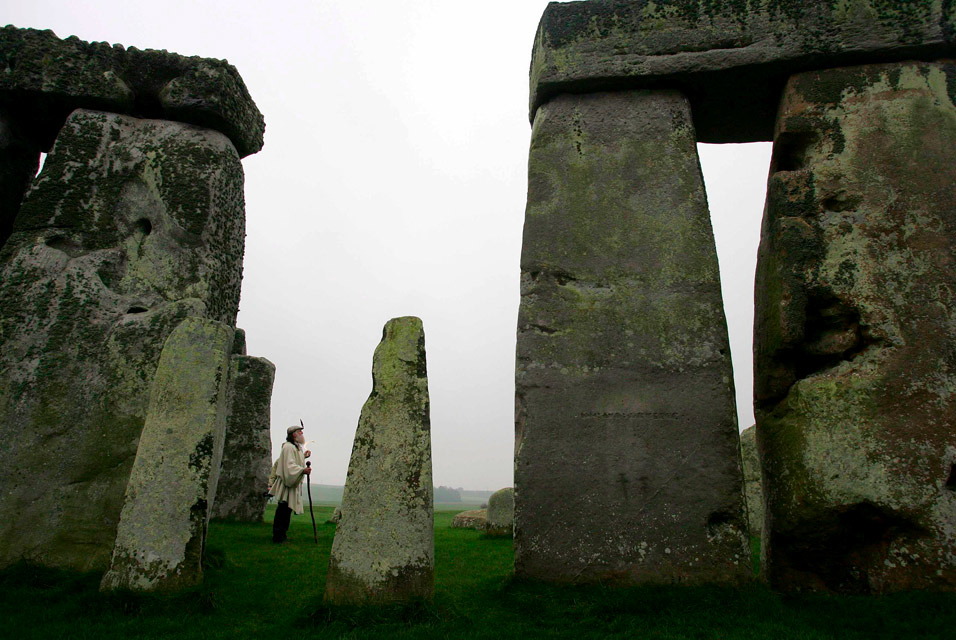
 photograph showing Arch Druid Keeper of the Stones Terry Dobney inspecting the famous British landmark Stonehenge in Wiltshire, south west England.

photograph showing Arch Druid Keeper of the Stones Terry Dobney inspecting the famous British landmark Stonehenge in Wiltshire, south west England.

Positioned within the Cursus pathway, the pits are on alignment towards midsummer sunrise and sunset when viewed from the Heel Stone, the enigmatic stone standing just outside the entrance to Stonehenge. For the first time, this discovery may directly link the rituals and celestial phenomena at Stonehenge to activities within the Cursus.

The international archaeological survey team, led by the University of Birmingham’s IBM Visual and Spatial Technology Centre (VISTA), with the Ludwig Boltzmann Institute for Archaeological Prospection and Virtual Archaeology in Vienna (LBI ArchPro) have also discovered a previously unknown gap in the middle of the northern side of the Cursus, which may have provided the main entrance and exit point for processions that took place within the pathway. Stretching from west to east, the Cursus is an immense linear enclosure, 100 metres wide and two and a half kilometres across, north of Stonehenge.

Professor Vince Gaffney, archaeologist and project leader from the IBM Visual and Spatial Technology Centre at the University of Birmingham, explains: “This is the first time we have seen anything quite like this at Stonehenge and it provides a more sophisticated insight into how rituals may have taken place within the Cursus and the wider landscape. These exciting finds indicate that even though Stonehenge was ultimately the most important monument in the landscape, it may at times not have been the only, or most important, ritual focus and the area of Stonehenge may have become significant as a sacred site at a much earlier date.

“Other activities were carried out at other ceremonial sites only a short distance away. The results from this new survey help us to appreciate just how complex these activities were and how intimate these societies were with the natural world. The perimeter of the Cursus may well have defined a route guiding ceremonial processions which took place on the longest day of the year.”

Archaeologists have understood for a long time that Stonehenge was designed to mark astronomical events, built by farming societies whose everyday concerns with growing crops linked their daily lives to the passage of the seasons and in particular the sun, on which their livelihoods depended. This new evidence raises exciting questions about how complex rituals within the Stonehenge landscape were conducted and how processions along or around the Cursus were organised at the time Stonehenge was in use.

Professor Gaffney adds: “It now seems likely that other ceremonial monuments in the surrounding landscape were directly articulated with rituals at Stonehenge. It is possible that processions within the Cursus moved from the eastern pit at sunrise, continuing eastwards along the Cursus and, following the path of the sun overhead, and perhaps back to the west, reaching the western pit at sunset to mark the longest day of the year. Observers of the ceremony would have been positioned at the Heel Stone, of which the two pits are aligned.”

Dr Henry Chapman, Senior Lecturer in Archaeology and Visualisation observes: “If you measure the walking distance between the two pits, the procession would reach exactly half-way at midday, when the sun would be directly on top of Stonehenge. This is more than just a coincidence, indicating that the exact length of the Cursus and the positioning of the pits are of significance.”

Stonehenge, while certainly the most important monument in the later Neolithic and Bronze Age landscape, was surrounded by a dense concentration of other sacred sites, some of which were already ancient when Stonehenge itself was built. The team has also revealed a new horseshoe arrangement of large pits north-east of Stonehenge which may have also contained posts and, together with the henge-like monument discovered last year and a number of other small monuments, may have functioned as minor shrines, perhaps serving specific communities visiting the ceremonial centre.

Paul Garwood, Lecturer in Prehistory at the University of Birmingham, comments: “Our knowledge of the ancient landscapes that once existed around Stonehenge is growing dramatically as we examine the new geophysical survey results. We can see in rich detail not only new monuments, but entire landscapes of past human activity, over thousands of years, preserved in sub-surface features such as pits and ditches. This project is establishing a completely new framework for studying the Stonehenge landscape.”

These new discoveries have come to light as part of the Stonehenge Hidden Landscape Project, which began in summer 2010 as the world’s biggest-ever virtual excavation using the latest geophysical imaging techniques to reveal and visually recreate the extraordinary prehistoric landscape surrounding Stonehenge.

Professor Wolfgang Neubauer, Director of the Ludwig Boltzmann Institute, adds: “The LBI provides the best academics, technicians and young researchers in a team of 20 people and uses multiple systems designed for use on projects where the scale of work was previously unachievable. The use of non-invasive technologies provides information for virtual archaeologies that can be disseminated to the public via the web, iPad or mobile phone.”

Dr Christopher Gaffney, lecturer in Archaeological Geophysics at the University of Bradford, concludes:

“Building on our work from last year we have added even more techniques and instruments to study this remarkable landscape. It is clear that one technique is not adequate to study the complexity of the monuments and landscape surrounding our most important archaeological monument and the battery of techniques used here has significantly increased the certainty of our interpretation.”

Link: http://www.artdaily.org

Sponsored by ‘The Stonehenge Tourv Company’ – www.StonehengeTours.com

Merlin @ Stonehenge
The Stonehenge Stone Circle Website


Secret history of Stonehenge revealed

26 11 2011

 Ancient site may have been place of worship 500 years before the first stone was erected

Extraordinary new discoveries are shedding new light on why Britain’s most famous ancient site, Stonehenge, was built – and when.
Current research is now suggesting that Stonehenge may already have been an important sacred site at least 500 years before the first Stone circle was erected – and that the sanctity of its location may have determined the layout of key aspects of the surrounding sacred landscape.

What’s more, the new investigation – being carried out by archaeologists from the universities’ of Birmingham, Bradford  and Vienna – massively increases the evidence linking Stonehenge to pre-historic solar religious beliefs. It increases the likelihood that the site was originally and primarily associated with sun worship

The investigations have also enabled archaeologists  to putatively reconstruct the detailed route of a possible religious procession or other ritual event which they suspect may have taken place annually to the north of Stonehenge.

That putative pre-historic religious ‘procession’ (or, more specifically, the evidence suggesting its route) has implications for understanding Stonehenge’s prehistoric religious function – and suggests that the significance of the site Stonehenge now occupies emerged earlier than has previously been appreciated.

The crucial new archaeological evidence was discovered during on-going survey work around Stonehenge in which archaeologists have been ‘x-raying’ the ground, using ground-penetrating radar and other geophysical investigative techniques. As the archaeological team from Birmingham and Vienna were using these high-tech systems to map the interior of a major prehistoric enclosure (the so-called ‘Cursus’) near Stonehenge, they discovered two great pits, one towards the enclosure’s eastern end, the other nearer its western end.

When they modelled the relationship between these newly-discovered Cursus pits and Stonehenge on their computer system, they realised that, viewed from the so-called ‘Heel Stone’ at Stonehenge, the pits were aligned with sunrise and sunset on the longest day of the year – the summer solstice (midsummer’s day). The chances of those two alignments being purely coincidental are extremely low.

The archaeologists then began to speculate as to what sort of ritual or ceremonial activity might have been carried out at and between the two pits. In many areas of the world, ancient religious and other ceremonies sometimes involved ceremonially processing round the perimeters of monuments. The archaeologists therefore thought it possible that the prehistoric celebrants at the Cursus might have perambulated between the two pits by processing around the perimeter of the Cursus.

Initially this was pure speculation – but then it was realized that there was, potentially a way of trying to test the idea. On midsummer’s day there are in fact three key alignments – not just sunrise and sunset, but also midday (the highest point the sun reaches in its annual cycle). For at noon the key alignment should be due south.

One way to test the ‘procession’ theory (or at least its route) was for the archaeologists  to demonstrate that the midway point on that route had indeed a special relationship with Stonehenge (just as the two pits – the start and end point of the route – had).  The ‘eureka moment’ came when the computer calculations revealed that the midway point (the noon point) on the route aligned directly with the centre of Stonehenge, which was precisely due south.

This realization that the sun hovering over the site of  Stonehenge at its highest point in the year appears to have been of great importance to prehistoric people, is itself of potential significance. For it suggests that the site’s association with the veneration of the sun was perhaps even greater than previously realized.

But the discovery of the Cursus pits, the discovery of the solar alignments and of the putative ‘processional’ route, reveals something else as well – something that could potentially turn the accepted chronology of the Stonehenge landscape on its head.

For decades, modern archaeology has held that Stonehenge was a relative latecomer to the area – and that the other large monument in that landscape – the Cursus – pre-dated it by up to 500 years.

However, the implication of the new evidence is that, in a sense, the story may have been the other way round, i.e. that the site of Stonehenge was sacred before the Cursus was built, says Birmingham archaeologist, Dr. Henry Chapman, who has been modelling the alignments on the computerized reconstructions of the Stonehenge landscape

The argument for this is simple, yet persuasive. Because the ‘due south’ noon alignment of the ‘procession’ route’s mid-point could not occur if the Cursus itself had different dimensions, the design of that monument has to have been conceived specifically to attain that mid-point alignment with the centre of Stonehenge.

What’s more, if that is so, the Stonehenge Heel Stone location had to have been of ritual significance before the Cursus pits were dug (because their alignments are as perceived specifically from the Heel Stone).

Those two facts, when taken together, therefore imply that the site, later occupied by the stones of Stonehenge, was already sacred before construction work began on the Cursus. Unless the midday alignment is a pure coincidence (which is unlikely), it  would imply  that the Stonehenge site’s sacred status is at least 500 years older than previously thought – a fact which raises an intriguing possibility.

For 45 years ago, archaeologists found an 8000 BC Mesolithic (‘Middle’ Stone Age) ritual site in what is now Stonehenge’s car park. The five thousand year gap between that Mesolithic sacred site and Stonehenge itself meant that most archaeologists thought that ‘sacred’ continuity between the two was inherently unlikely. But, with the new discoveries, the time gap has potentially narrowed. Indeed, it’s not known for how long the site of Stonehenge was sacred prior to the construction of the Cursus. So, very long term traditions of geographical sanctity in relation to Britain’s and the world’s best known ancient monument, may now need to be considered.

The University of Birmingham  Stonehenge area survey – the largest of its type ever carried out anywhere in the world – will take a further two years to complete, says Professor Vince Gaffney, the director the project.

Virtually every square meter in a five square mile area surrounding the world most famous pre-historic monument will be examined geophysically to a depth of  up to two metres, he says.

It’s anticipated that dozens, potentially hundreds of previously unknown sites will be discovered as a result of the operation.

The ongoing discoveries in Stonehenge’s sacred prehistoric landscape – being made by Birmingham’s archaeologists and colleagues from the University of Vienna’s Ludwig Boltzmann Institute – are expected to transform scholars’ understanding of the famous monument’s origins, history and meaning.

Full Article: http://www.independent.co.uk/life-style/history/secret-history-of-stonehenge-revealed-6268237.html

Sponsored by the Stonehenge Tour Company – www.StonehengeTours.com

Merlin @ Stonehenge
The Stonehenge Stone Circle Website