English Heritage is celebrating 30 years of World Heritage Site status for Stonehenge this weekend.
To launch the 30th Anniversary celebrations, students from local Stonehenge School and Avon Valley College are today unveiling a special plaque highlighting the World Heritage Site status of the iconic Wiltshire monument.
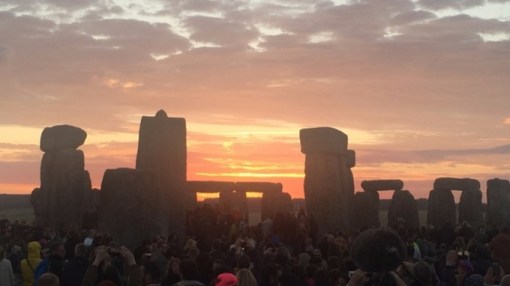
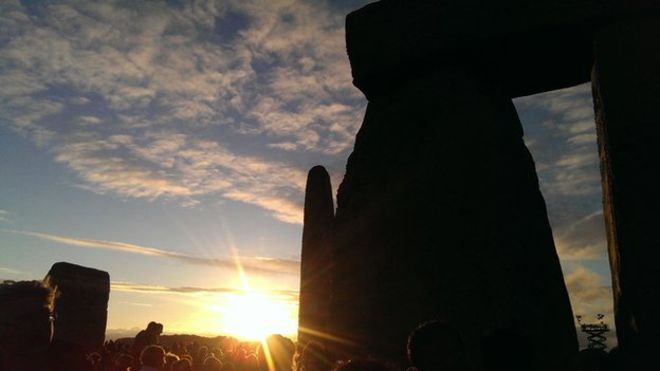
Thousands flock to the site for summer solstice every year. Photo: ITV West Country
n 1986 Stonehenge and Avebury were among the first seven sites in the UK to be inscribed on the UNESCO World Heritage List.
World Heritage Site status gives Stonehenge and Avebury international recognition alongside sites such the Egyptian Pyramids, the Great Wall of China and the Galapagos Islands as a place of exceptional importance to all humanity.
I am really pleased to be asked to help unveil the plaque at Stonehenge. World Heritage status is important because it means that a place is valuable to everyone, from all over the world and we must all look after it well so that everyone in the future can enjoy and understand it too.
– ERIN GALLAGHER,YEAR 9 STUDENT FROM AVON VALLEY COLLEGE
On 19th and 20th November, 30 Goody Bags will be given out at random; 30 Golden Tickets will be hidden around the site and every visitor will receive a special souvenir postcard.
Kate Davies, English Heritage General Manager of Stonehenge, said:
“This year we are celebrating thirty years of World Heritage status and we are excited to be joined by local schools as part of the Kids Takeover day, as we unveil a World Heritage Site plaque and launch our special 30th Anniversary weekend.
” Young people are the future guardians of our heritage, and it is fantastic to see that our local young community are so interested in learning about Stonehenge and what it means to have a World Heritage Site, one of 30 in the UK, on their doorstep.”
This year Stonehenge and Avebury World Heritage Site is celebrating 30 years since its inscription on to the World Heritage list in 1986. A number of events are taking place throughout this year.
The Stonehenge and Avebury WHS Coordination Unit, with the support of their partners, is holding a 30th anniversary conference on 19 and 20 November 2016 to celebrate the many aspects of the World Heritage Site and the gains made over the past 30 years.
On Saturday 19 November in the Ceres Hall, the Corn Exchange, Devizes, a number of speakers including Dr Serge Cassen (University of Nantes), Dr Alison Sheridan (National Museums of Scotland), Dr Heather Sebire (English Heritage), Prof Tim Darvill (University of Bournemouth), Dr Josh Pollard (University of Southampton), Prof Vince Gaffney (University of Bradford) will be joining us to examine developments in conservation, changes in our knowledge through research and archaeology, the impact on culture and how Stonehenge fits into the European and British culture at that time.
There will be a panel discussion to think about what advances in our knowledge there might be in the next 30 years as well as opportunities to find out about the work of the key partners in helping to manage the World Heritage Site.
On Sunday 20 November there will be limited opportunities for delegates to attend exclusive expert led tours to both Stonehenge and Avebury and to The Salisbury Museum and Wiltshire Museum to explore their related collections.
Tickets are open to all and must be booked in advance through Eventbrite.
This event is supported by Historic England and Wiltshire Council
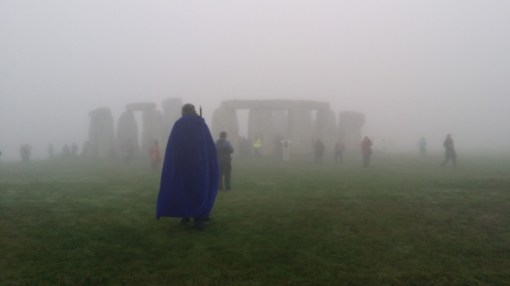
The 2016 Autumn Equonox is September 22nd at 14:21 GMT
English Heritage are expected to offer short period of access, from first light or safe enough to enter the monument field (approximately 06.30am) until 08:30am. More details as we get them.(source)
The Autumn Equinox (Mabon) It is the time of the autumn equinox, and the harvest is winding down. The fields are nearly empty, because the crops have been plucked and stored for the coming winter. Mabon is the mid-harvest festival, and it is when we take a few moments to honor the changing seasons, and celebrate the second harvest. On or around September 21st, for many Pagan and Wiccan traditions it is a time of giving thanks for the things we have, whether it is abundant crops or other blessings. It’s a time of plenty, of gratitude, and of sharing our abundance with those less fortunate.
Mabon is a harvest festival, the second of three, that encourages pagans to “reap what they sow,” both literally and figuratively. It is the time when night and day stand equal in duration; thus is it a time to express gratitude, complete projects and honor a moment of balance.
The word ‘equinox’ itself actually mean ‘equal’ (equi) and ‘night’ (nox).
Here’s everything you need to know about the longest day of the year and traditions surrounding the summer solstice
Party time: Druids, pagans and revellers take part in a winter solstice ceremony at Stonehenge
Every year, around this time, we start talking about the summer solstice.
Mostly it’s because it’s the longest day of the year, and there’s a very British pessimism that says the days will immediately start to shorten into winter from now on.
But there’s also the shenanigans at Stonehenge, general celebrations and a pause to celebrate the summer.
But what does it all mean?
What is it?
It’s generally understood to mark the middle of summer – even though some of us may feel like we haven’t really had the first half yet in the UK.
Technically, it’s when the tilt of Earth’s axis is most inclined towards the sun, and that’s why we get the most daylight of the year.
In the winter solstice, we’re tilted furthest away from the sun, hence shorter hours of daylight and the shortest day.
The word solstice is derived from the Latin words sol (sun) and sistere (to stand still).
In the northern hemisphere, the summer solstice takes place between June 20 and 22. This year it’s on Monday, June 20.
As it happens twice annually, the winter solstice in the UK is between December 20 and 22.
In London on the summer solstice, the sun will rise at 04:43 and set at 21:21.
Near Stonehenge in Salisbury, sunrise will be at 04:52 and sunset will occur at 21:26.
Why Stonehenge?
The midsummer solstice is being celebrated at Stonehenge on Saturday into Sunday and at the Avebury stone circle from Friday until Monday.
Thousands flock to the English Heritage site for the solstice in a tradition which has its roots in pagan times, when Midsummer Day was considered to have power.
Of those who attend, many are druids, but some are tourists.
This year it’s falling on a weekend for the first time in more than a decade and is expected to draw much larger crowds.
The way that the stones are positioned is said to be aligned with sunrises on the two annual solstices.
Although not much is known about its formation, those facts are thought to be involved with whatever religious, mystical or spiritual elements were central to its construction.
The monument field at Stonehenge is open from 19:00 on Monday 20 June to 08:00 on Tuesday 21 June. Admission is free, but parking fees apply.
The Solstice Car Park opens at 7pm on 20th June with last admissions at 6am (or when full, if earlier) on 21st June. The car park will close at 12 noon on 21st June.
Visitors, including sunrise-worshipping Druids for whom it is a religious occasion, are encouraged to use public transport or arrange to car share.
How else do people celebrate it?
It’s not just for the arch-druids in Wiltshire – there are celebrations worldwide among lots of different cultures.
The holidays, festivals and rituals do tend to have themes of religion or fertility.
In Latvia there’s Jāņi, when women wear wreaths on their heads. Estonia has Jaanipäev or St John’s Day, which marks a change in the farming year.
Wianki happens in Poland, with roots in a pagan religious event, and Kupala Night happens in Russia and Ukraine, where people jump over the flames of bonfires in a ritual test of bravery and faith.
Are the days going to be shorter now?
They will of course get shorter between now and the winter solstice on December 21, but don’t worry, we’re not talking early dark nights quite yet.
“We strongly advise anyone planning to come to Stonehenge for solstice to leave their cars at home and travel by public transport. Salisbury is easily accessible by train and the local Salisbury Reds bus company will be running a special service from Salisbury to Stonehenge through Saturday night and into the next day. Solstice Events are offering their usual transport from Bath and Stonehenge guided tours are offering their small group tour from London.
Take part in Stonehenge experiment: How many people does it take to lift one block?
Heavy lifting: the smallest stones at the prehistoric site weigh about two tonnes REUTERS/Kieran Doherty
Anyone who has wondered what it took to lift a piece of Stonehenge into place has a chance to have a go themselves in a mass experiment.
Experts from University College London are seeking volunteers to help them lift a replica stone using prehistoric technology and brute strength.
Doctoral student Barney Harris, who is organising the event in Gordon Square near the UCL campus on Monday, said he believed it would take 40 to 50 people to lift a single stone, which at one tonne is half the weight of the smallest block at Stonehenge.
Mr Harris said: “We will be using a model of a sledge that might have been used, but other than that it will be people power. It’s on a much smaller scale than the real thing, but it will help us work out what it took to create it.”
The event, from 2pm to 4pm, is one of 80 being held during the university’s Festival of Culture next week.
Article Source: The Evening Standard
As part of the UCL Festival of Culture participants will have the chance to become part of an experimental team that will attempt to transport a large replica Stonehenge stone using Neolithic technology. click here for UCL
The Stonehenge News Blog
Stonehenge News on Twitter
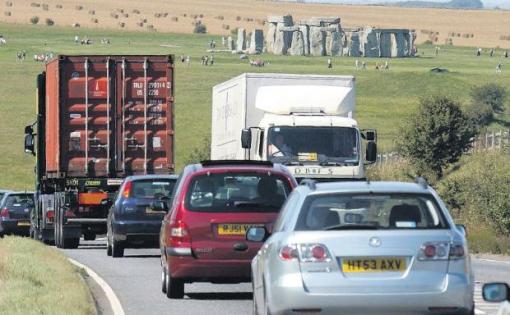
A YEAR after the Government announced plans to build a 2.9km tunnel under Stonehenge three public bodies have released a film promoting the benefits of burying the A303.
Film promoting Stonehenge tunnel released by public bodies
Historic England, the National Trust and English Heritage hope that construction of the tunnel will improve wildlife and nature at the World Heritage Site.
Ian Wilson, Assistant Director of Operations for the National Trust in Dorset and Wiltshire, said: “We really hope the film brings to life the very real benefits that a tunnel could bring to the Stonehenge Landscape, for people and for wildlife.
“A full scheme has yet to be designed, but the Trust supports the Government’s proposals in principle and we are committed to engaging with Highways England and others to ensure that any scheme will be fully and carefully considered and assessed.”
Given it was on the market 16 years earlier for £125,000, lawyer Cecil Chubb bagged a bargain when he picked up Stonehenge at a 1915 auction for £6600, two years after Druids cursed the relic’s owner.
First angering Druid worshippers by building a fence and charging admission, in 1913 Edmund Antrobus, whose family bought 525ha on Salisbury Plain around Stonehenge in 1824, banned Druid solstice celebrations in 1913.
Druid leader Macgregor Reid called down a “kara” on Antrobus, chanting “in grief and sorrow I call down the curse of Almighty God”.
Antrobus died at 67 in February 1915, four months after his only son, Edmund Jr, 28, perished on Belgian battlefields. A Grenadier Guards lieutenant, he died fighting Germans on October 24, 1914, and was buried in an orchard in a village outside Ypres.
Estate agents Knight, Franck and Rutley put the historic site under the hammer at Salibury’s Palace Theatre on September 21, 1915. Chubb placed the winning bid for “Lot 15: Stonehenge with 30 acres of adjoining land”.
Sir Cecil Chubb purchased the Stonehenge site in 1915.
Chubb reportedly placed the bid on a whim, either to purchase the site as a gift for his wife or because be believed a “Salisbury man ought to buy it”.
Chubb was born in 1876 at Shrewton, 6km west of Stonehenge, to saddler Alfred and his wife Mary. He attended Bishop Wordsworth’s School in Salisbury, working as a student teacher from age 14, when he met his future wife Mary Finch at a school cricket game.
Chubb earned a double first in science and law at Christ’s College, Cambridge and in 1902 married Mary, whose uncle Corbin Finch owned Fisherton House mental asylum.
After Finch’s death in 1905, the business and buildings were transferred to Mary. A limited company ran the hospital in 1924, with Chubb, then Sir Cecil, as chairman.
Under his management it became Europe’s largest private mental hospital. He also served on Salisbury City Council, became a successful racehorse owner and cattle breeder.
An 1800 engraving of Stonehenge.
Stonehenge ownership records date to at least 1620, when a “Mr Newdick”, probably Robert Newdyk who bought land at Amesbury, Wiltshire, in 1614, refused “any offer from George, Duke of Buckingham”. Amesbury, 3km east of Stonehenge, is the oldest continuously occupied site in Britain, dating to 8820BC.
By 1639 Stonehenge had passed to knight Laurence Washington. His friend, architect Inigo Jones visited to write in 1665 of “the most notable Antiquity of Great Britain, vulgarly called Stonehenge”.
When antiquarian William Stuckley described walking “hard and dry, chalky soil” in 1740 in “Stonehenge, A Temple Restor’d to the British Druids”, it stood “in the lordship of … Armesbury, the possession of Rev Mr Thomas Hayward … the Arch-Druid of the Island”.
It belonged to William, Duke of Queensberry, in 1778, passing on his death in 1810 to Archibald, Lord Douglas, who in 1824 sold the Amesbury estates to Cheshire baronet Edmund Antrobus. His great-nephew Edmund, 4th Baronet and former Grenadier Guards colonel, put Stonehenge on the market in September, 1899.
Druids at Stonehenge in 1998.
“The most splendid relic of man’s work in Britain … is under offer to the British Government by owner Sir Edmund Antrobus, who asks no less than £125,000,” the Spectator reported. “This includes 1300 acres of land surrounding the great stone circles. The proposal … will, no doubt, receive serious consideration. It cannot be disputed that if so priceless a relic of antiquity is to pass from a private owner, who has never interfered with the public’s enjoyment of it, the State should be the purchaser.”
Today the ancient site attracts millions of visitors from all over the world.
But the Spectator suggested a value of £25,000, allowing “£10 an acre for the land, which from an agricultural point of view is probably the worst in England and … the remoteness of Stonehenge from the beaten tracks of tourists and sightseers”, encouraging few visitors. The government refused, so in 1901 Antrobus enclosed Stonehenge and charged 1 shilling, or about £5, admission. Some 700 brothers joined an Ancient Order of Druids ceremony at Stonehenge in August, 1905, when Antrobus was inducted into the society.
In June, 1912, Reid led his Universal Bond of Zoroastrian-inspired Druids in “Sun-worship at Stonehenge”. Antrobus banned the gathering in 1913, when police attempted to stop Reid entering the site. He clashed with police again at the 1914 solstice. Chubb, who died in 1934, permitted Druid celebrations before donating Stonehenge to the British nation in October, 1918.
You now park over a 2 kilometres from Stonehenge itself, out of sight of the Stonehenge monument. Here there is a modern visitor centre and excellent exhibition and education facilities plus a spacious cafe and souvenir gift shop. A Stonehenge shuttle bus transports you between the visitor centre and the Stone Circle. English Heritage advise to budget for a visit of around 2 hours. The Visit Wiltshire App is a must for those visiting Stonehenge and the surrounding area.
Last admission time is 2 hours before the advertised closing time.
Entrance to Stonehenge is now managed through timed tickets and advance booking is required. Booking is the only way to guarantee entry on the day and at the time of your choice. Advance bookings are advised!
This includes FREE visits by English Heritage and National Trust members (applicable to members of the National Trust in England only – does not include National Trust Scotland or other National Trust affiliated organisations).
A new theory that the tallest stone at Stonehenge points towards the midsummer sunset has been observed to be correct, it has been claimed.
Stonehenge steward Tim Daw said his pictures of the midsummer solstice sunset on 20 June 2015 showed how it aligned to the tallest stone
Earlier this year Tim Daw, a steward at the site, said he had discovered the previously unknown alignment, involving a line of stones at 80 degrees to the axis of the monument.
The theory was tested when the solstice sun set at 21:26 BST on Saturday.
Mr Daw said he was “really thrilled” at the finding.
“It wasn’t the best evening for a sunset picture as a bank of cloud came in at the wrong moment but it was close enough to prove the point,” he added.
“I put forward this theory. I said ‘this stone, the sun will set along its back’ [on] Midsummer. Yes it did.
“[There was] a wonderful sunset last night. We could see the sun going down directly in line with… the back of this stone. It was fantastic.”
The tallest stone at Stonehenge points towards the sunrise on the midwinter solstice, according to a new theory from an English Heritage steward.
The newly observed alignment (red line) is at 80 degrees to the line of the axis of the monument (blue line)
Historians have long known the circle of stones is aligned with the midsummer sunrise but Tim Daw says the tallest one is lined up with the midwinter sun.
It was previously thought the stone had been put back at the wrong angle when it was re-erected in 1901.
But Mr Daw, who works there, says his research shows its angle is deliberate.
‘Botched job’
Mr Daw said: “The largest stone at Stonehenge is not where it ‘should’ be, it is twisted.
“This stone, Stone 56, is the tallest one at the end of the inner horseshoe of sarsen stones.
“Because it was put back to the vertical in 1901 it has been assumed that the twist is the result of the modern excavators botching the job.
The tallest stone in the monument was straightened in 1901
“My research shows that not only was the standing stone out of symmetry with the central solstice alignment originally, but that its now fallen partner had also been, and so were surrounding stones, including the Altar Stone.”
“The stones point to the midwinter solstice sunrise and midsummer sunset,” he said.
“This alignment had been missed by previous investigators… as they used an idealised plan rather than an actual plan for their calculations.”
“This isn’t some nebulous sighting line on a distant star; this is 100 tonnes of stone deliberately pointing to the major event at the other end of the day the rest of the monument celebrates.
“One stone out of line might be a coincidence but that it is five of the major stones, at least, shows it was a designed feature.
“It shows what can be discovered by simple observation even in such a well-researched site as Stonehenge.”
Tim Daw said the tallest stone (centre) was positioned to align with the midwinter sunrise
Director of the Wiltshire Archaeological and Natural History Society (WANHS), David Dawson, said: “This is an interesting new idea which highlights the “skew” of the Stonehenge trilithons, which has been known for some time.
“It highlights the significance of the summer and winter solstices at Stonehenge, and the 80 degree angle between them.
“We know that the Bush Barrow lozenge, on display at the Wiltshire Museum, hints at this same significant astronomical feature.
“There will now be a debate between archaeologists and a re-examination of the evidence to test this new hypothesis.”
Jessica Trethowan from English Heritage said it was “an interesting idea”.
Mr Daw’s theory has been published in the latest WANHS magazine.
People traditionally gather at Stonehenge for the winter and summer solstices
We aim to make this the ultimate source of the latest Stonehenge news available on the web. This blog is updated almost daily and promises to deliver accurate 'up to date' information on new theories, new digs, solstice events, Druid gatherings, the new visitor centre, general megalithic links and some fun along the way. We welcome your input....
"There is so much misinformation about Stonehenge on the web, so it’s really refreshing to see such a clear and lucid presentation, what you have here looks like best general overview of Stonehenge to date, well done!"
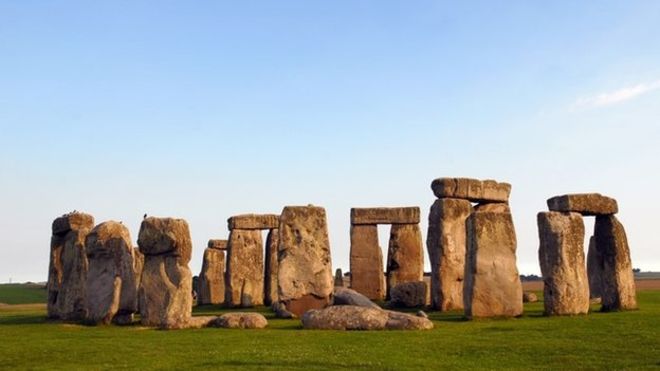
Mystery surrounds this 5,000 year old monument in the centre of the World Heritage Site. Visit this prehistoric South West site near Salisbury in Wiltshire, and decide for yourself whether Stonehenge was a place of sun worship, a healing sanctuary, a sacred burial site, or something different altogether!
THIS BLOG claims no credit for any images posted on this site unless otherwise noted. Images on this blog are copyright to its respectful owners. If there is an image appearing on this blog that belongs to you and do not wish for it appear on this site, please E-mail with a link to said image and it will be promptly removed.

 The Autumn Equinox (Mabon)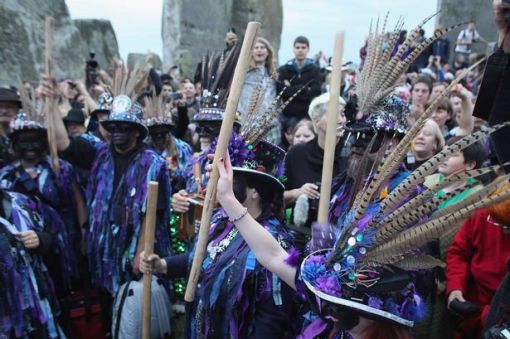







 StonehengeNews
 travelstonehenge

 Stonehenge Stone Circle News and Information