Mission to save Stonehenge gets underway to reclaim its ancient natural landscape

25 06 2013

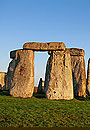
STONEHENGE yesterday began reclaiming its ancient natural landscape with the closure of a busy road running through the World Heritage site.

Stonehenge is undergoing a massive renovation

Stonehenge is undergoing a massive renovation

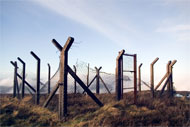
The A344, which carried 6,000 cars a day past the monument’s Heel Stone, will now be turfed over and the high fences removed  to recreate the traditional downland pasture.

The closed section of the A344 is between the junction with the A303, the main road to the southwest,  and Byway 12 which  severs Stonehenge from  its ancient processional approach, the Avenue.

The move is part of a £27million English Heritage programme to protect the site and improve the experience for visitors.

This includes a new visitor’s centre, due to open in December,  which will be 1.5 miles form the monument instead of on its doorstep.

The remaining section of the A344 will become  the route of a new visitor shuttle service to and from the Stones.

The closure fulfils a pledge   given by the  Government to UNESCO 27 years ago to remove the A344 where it crosses the Avenue.

And this time next year, once the landscaping is complete, visitors will be able to walk in the footsteps of ancient Britons and approach  the monument from the Avenue.

Loraine Knowles, Stonehenge Director, English Heritage, said: “The Stones have never failed to impress visitors, but for too long their setting has marred people’s appreciation and enjoyment of this special place. At last, this is going to change. For the first time in centuries, when all the works are complete, people will be able to experience this complex and extraordinary monument in a more tranquil, natural setting.”

Jan Tomlin, the National Trust General Manager for Wiltshire Landscape, said: “We welcome the closure of the A344 past Stonehenge – it is an important step towards the vision for the future of the monument. We have worked over the past decade to restore much of the land we own around Stonehenge to grassland and this is an important step in linking Stonehenge to the ancient landscape.”

John Ingham (http://www.express.co.uk/news/uk/409933/Mission-to-save-Stonehenge-gets-underway-to-reclaim-its-ancient-natural-landscape)

Merlin at Stonehenge
The Stonehenge News Blog


The Welsh blue chip ‘healing secrets’ of Stonehenge

28 03 2010

WHY transport more than 80 two- tonne megaliths over 156 miles of mountain, river and sea to build a stone circle at Stonehenge? It hasremained one of Britain’s most enduring mysteries. Some have claimed the iconic site on Salisbury Plain was an ancient observatory for lunar and solar events. Others claimed it was a burial site for the high-born while Arthurian legend has it Merlin transported the stones. But now a Welshman from Pembrokeshire, the place where many believe the stones originate, claims he has the answer. Professor Geoffrey Wainwright, an honorary fellow of Lampeter and Cardiff Universities, released findings yesterday to support a theory that Stonehenge was a “prehistoric Lourdes”. The findings suggesting its significance as a healing centre for pilgrims were made in a historic dig at the World Heritage Site earlier this year. The first excavation of Stonehenge for more than 40 years uncovered fragments of stone which experts believe could have been used as lucky charms. Professor Wainwright believes that Stonehenge was a centre of healing to which the sick and injured travelled from far and wide, to be healed “by the powers of the bluestones”. He noted during the dig that “an abnormal number” of the bodies found in tombs near Stonehenge displayed signs of serious physical injury and disease. And analysis of teeth recovered from graves show that around half of the corpses were from people who were not native to the Stonehenge area. Archaeology expert Professor Wainwright, chairman of the Society of Antiquaries of London, and Professor Tim Darvill of Bournemouth University, have been working together for years to find out why Stonehenge was built. English Heritage agreed to the dig on Salisbury Plain, the first since 1964, following consent by the Secretary of State for Culture, Media and Sport. The academics said they could now pinpoint the date at which the blue stones – which the archaeologists believe hold the key to Stonehenge – were brought to the site in Wiltshire from West Wales, as 2300BC, 300 years later than previously thought. The stones were once believed to have come from a crag in the Preseli Hills called Carn Menyn. But a newer theory is that they were brought from glacial deposits much nearer the site, which had been carried down from the northern side of the Preselis to southern England by the Irish Sea Glacier. The professors also told a press conference at the Society of Antiquaries in London that people remained interested in the magical, healing qualities of the stones for many hundreds of years after Stonehenge was built. Prof Darvill said: “It could have been a temple at the same time as it was a healing centre, just as Lourdes is a religious centre.” Prof Darvill suggested the blue stones, which have tiny white spots, could have acted in a similar way to the bones of saints. They argued that as thousands of pilgrims flocked to see them at Stonehenge the resulting wealth enabled an “elaborate shell” of more stone pillars to be built. Prof Wainwright said he was inspired to investigate the area in his native Pembrokeshire while watching a television programme about why Stonehenge was built. He said: “I thought the answer really had to be found in the place where the stones came from. That is in north Pembrokeshire, so Tim and I went and did a survey around the crag. “We found various reasons which led us to believe the stones were used as part of a belief in a healing process.” But he said they needed to study the Stonehenge site to find out when the bluestones arrived there and how long they were used. The radiocarbon dating of the original double bluestone circle held significance for the start of Stonehenge being used as a healing centre. The date – 2300BC – links the introduction of the bluestones with a time of great activity at the site, including the death of the Amesbury archer. His remains were discovered about five miles from Stonehenge and the professors believe he was a pilgrim hoping to benefit from the healing powers of the monument. Prof Wainwright said: “We now know, much to our surprise and delight, that Stonehenge was not just a prehistoric monument, it was a Roman and medi- aeval monument.” Were the huge stones transported all the way from West Wales? The stone pillars of Stonehenge are natural columns of white spotted dolerite and occur only in the Preseli Hills’ Carn Menyn area. They were first identified as of Welsh origin by Dr John HH Thomas in 1923. Archaeologists have uncovered the remains of a “band of brothers” found near Stonehenge and scientists have proved they were Welsh, suggesting it was people from Pembrokeshire who actually transported them. The skeletons, three adults, a teenager and three children, were found by workmen laying a pipe on Boscombe Down and chemical analysis of their teeth revealed they were brought up in the South West Wales area. Experts believed the family accompanied the stones on their epic journey from the Preseli Hills to Salisbury Plain. As an extension of the theory that Stonehenge was a healing centre, on digs around the country, archaeologists will now look for any evidence of bluestone being transported from Wales to other monuments. Professors Wainwright and Darvill also said they hope to return to the Preseli Hills next year to excavate part of a burial mound near the main bluestone outcrops. Prof Darvill said of the bluestones: “Their meaning and importance to prehistoric people was sufficiently powerful to warrant the investment of time, effort and resources to move the bluestones from the Preseli Hills of Wales to the Wessex downs.”#

Merlin @ Stonehenge
Stonehenge Stone Circle


Stonehenge opens to Druids for Vernal Equinox

26 03 2010
 

English Heritage site welcomes worshippers to mark the start of spring

Druids celebrate the sping equinox at Stonehenge(Panasonic)

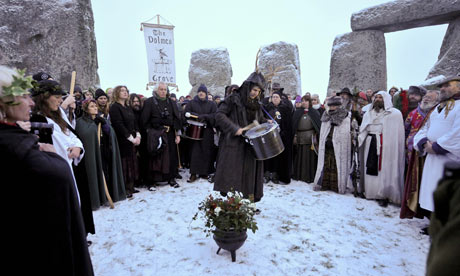
A handful of lucky Druids took advantage of a rare opportunity to walk amongst Stonehenge this Saturday, 20 March in celebration of the Spring Equinox. Less than a hundred visitors, including Druids and pagan worshippers met at around 5.30am to watch the sunrise and welcome in the spring.

Despite the wet, windy weather, traditional customs such as blessings, chants and drum choruses went ahead in the middle of the ordinarily protected English Heritage site.

With characters dressed in outfits of white robes, floral headdresses, witches brooms and even stag’s antlers, attendees worshipped as the sun rose directly above the equator.

Despite heavy cloud cover, the gathered crowd enjoyed a brief glimpse of the sun before taking advantage of their rare chance to touch and interact with the stones.

Formal proceedings were overseen by renowned Arch Druid of Stonehenge Rollo MaughFling, leading both traditional chants and calling for more contemporary solutions, too. When talking about the upcoming General Election, the Arch Druid strayed away from a political bias and instead asked that, “Whoever is best fitted to lead us out of recession and back into prosperity be the party that wins as many people are suffering.”

One fellow Druid not afraid of showing his political stance was notorious eco-campaigner, Arthur Uther Pendragon, announcing his decision to run as an independent candidate in the forthcoming election.

“I have stood three times previously,” he told MSN UK, “The first time, I embarrassed the British National Party into last place, the second time, the new leader of the Monster Raving Looney Party into last place, and the third time I embarrassed myself into last place, but still polling 1% of the Vote.”

The day was also saw a posthumous appearance by Wally Hope, the founder of the Stonehenge festival. Since his death in 1975, the ashes of Wally Hope have been carried to the stones by their official keepers.


How and Why Was Stonehenge Built?

22 03 2010

StonehengeFrom the grassy deserted plains of southern England rises a circle of standing stones, some of them up to 24 feet tall. For centuries they have towered over visitors, offering tantalizing hints about their prehistoric past. For centuries, everyone who has stood before them has wondered the same thing: Who built this mysterious rock monument? And why? “Since Stonehenge was built and rebuilt over a period of centuries, no one group has sole credit for its construction, but the main building seems to have been done by a people known as the ‘Beaker Folk,’” says Benjamin Hudson, professor of History and Medieval Studies at Penn State. The Beaker Folk (who earned their name from the distinctive inverted bell-shaped pottery drinking vessels they made) scattered throughout prehistoric western Europe. The earliest construction at Stonehenge began about 3000 B.C., says Hudson, with a stone circle inside a ditch and bank. Within that circle lay a timber building; researchers have excavated from the site about 56 pits containing the remains of human cremations. Construction continued for 600 years, in several phases of landscaping: Burial mounds (most pointing east-to-west) and ceremonial pathways were added to the site. In 2400 B.C., the builders erected the large sandstone blocks which give the site its name. (Coined by Henry of Huntingdon, a twelfth-century English historian, “Stonehenge” means “hinged or supported stones.”) The means of moving those enormous standing stones has provoked centuries of speculation, with theories ranging from demonic powers to Merlin’s magic to alien technology. The reality is much more ordinary, says Hudson. “Much of the construction was little more than putting enough men under a stone to move it into place,” he notes, “although some basic engineering was required for the larger stones and the lintels.” One theory holds that the builders used simple inclines and levers to move the stones into place. Like the Egyptian pyramid-builders, the Stonehenge constructors relied more on brute labor than sophisticated technology. Though one of the most complete and monumental examples of Neolithic and Bronze Age construction, Stonehenge was not alone in its time. Hudson notes one estimate that places it among 300 surviving stone monuments throughout the British Isles—including the famous stone circle in Avebury. The connections between and among these sites often remain murky, and undoubtedly many creations of the Beaker Folk have returned to nature, leaving few traces of their existence. “Stonehenge forces us to reconsider the period of history that is not accompanied by written records,” Hudson says. Since the builders left no explanation, the precise purpose of their work remains obscure. One theory sees Stonehenge as a temple, pointing to the elaborate landscaping surrounding the site. More recently, historians and archaeologists have suggested it provided an observatory for either moon or sun cults. The Beaker Folk are believed to have been sun worshipers who aligned Stonehenge with certain important sun events, such as mid summer and winter solstices. While the absence of records makes it nearly impossible to be certain about Stonehenge’s purpose, the site itself does leave us with a portrait of Beaker Folk society. “The building of the monument required knowledge of civil engineering, transportation, and quarrying,” he says. “The society that constructed it was wealthy enough to afford such an expensive venture and it also had a developed theology that provided the guidance for the designs whose meanings still elude us.” Perhaps it is that elusive meaning that has, for centuries, drawn people to Stonehenge, to sit and wonder among the silent stones.

Stonehenge Guide
Stonehenge Stone Circle


Concrete Post Henge is Oldest Structure In England

22 02 2010


English Heritage, working in conjunction with The National Trust, are fighting ‘tooth and nail’ to preserve the newly discovered ancient Henge found in Wiltshire, England.

Also located in Wiltshire is Stonehenge thought to have been erected in around 3000BC. Coincidently, Concrete Post Henge is only, a remarkable, fifty feet away from the former, just over a small hill. Chartered Surveyors were called to the scene immediately and were able to verify that the structure had been around since at least two days after The Big Bang. Primitive drill bit markings and circular saw striations were, apparently, the most obvious clues in the age determining process.

“I can’t believe we didn’t spot it before; it was right under our noses. The significance of this find cannot be underestimated. I’ve seen a few henges in my time, nobody knows what the heck a henge is yet, but I know this is a good one.”

National Trust stalwart Walter Ernest made only one comment to The Spoof:

“It’s a sad day here for us in Wiltshire. I’ve put my life, heart and soul into promoting ‘old stoney’ as the nation’s oldest treasure, since my divorce it’s been like a friend to me. No doubt some young bucks will get the job of looking after the new find and I’ll probably have to go back to a career
in druid stone circles now…”

Now that was funny! The story above is a satire or parody. It is entirely fictitious.

This was from the Spoof website.


‘Stonehenge? It’s more like a city garden’

8 02 2010


Design watchdog hits out at plans for £20m visitor centre at megalithic jewel in England’s cultural crown

Its footpaths are “tortuous”, the roof likely to “channel wind and rain” and its myriad columns – meant to evoke a forest – are incongruous with the vast landscape surrounding it.

So says the government’s design ­watchdog over plans for a controversial £20m visitor centre at Stonehenge, the megalithic jewel in England’s cultural crown. CABE, the Commission for Architecture and the Built Environment, has criticised the design of the proposed centre, claiming the futuristic building by Denton Corker Marshall does little to enhance the 5,000-year-old standing stones which attract more than 800,000 visitors each year.

Its concerns are the latest chapter in the long saga surrounding the English Heritage-backed project, and follow a ­government decision two years ago to scrap on cost grounds a highly ambitious £65m scheme to build a tunnel to reroute traffic to protect the World Heritage site.

The centre, which has been approved by Wiltshire county council planners, has divided opinion.

“We question whether, in this landscape of scale and huge horizons and with a very robust end point that has stood for centuries and centuries, this is the right design approach?” said Diane Haigh, CABE’s director of design review.

“You need to feel you are approaching Stonehenge. You want the sense you are walking over Salisbury Plain towards the stones.”

But the “twee little winding paths” were “more appropriate for an urban ­garden” than the “big scale open air ­setting the stones have”, she added.

The many columns were meant to be “lots of trunks” holding up a “very delicate roof”, she said. “Is this the best approach on what is actually a very exposed site. In particular, if it’s a windy, rainy day, as it is quite often out there, it’s not going to give you shelter. We are concerned it’s very stylish nature will make it feel a bit dated in time, unlike the stones which have stood the test of time”.

CABE believed the location of the ­centre, at Airman’s Corner, is good, and were pleased “something was happening at last”, but questioned the “architectural approach”. The centre has the full support of local architects on the Wiltshire Design Forum, and has been passed by the local planning committee. Nevertheless English Heritage recognised it was an emotional and divisive subject.

“Innovative architectural designs will always polarise opinion, and often nowhere more so that within the architectural world itself,” it said in a statement.

“The Stonehenge project has to overcome a unique set of challenges,” it said. “This has required a pragmatic approach and, following widespread consultation, we maintain the current plans offer the best solution”.

Stephen Quinlan, partner at Denton Corker Marshall, defended the design. The roof was meant to be a “sun canopy” and not offer weather protection in what was, principally “an outdoor experience”.

“It’s not an iconic masterpiece. It’s a facility to help you appreciate the Stonehenge landscape. It’s intellectually ­deferential in a big, big way to Stonehenge as a monument.

“I wouldn’t even mind if you couldn’t remember what the building looked like when you left. The visitor centre is not the destination,” Quinlan said.

However, he added: “We don’t take criticism from CABE lightly. And we are ­crawling through their comments to see if there are any improvements we can make.”


Doctor Who filming at Stonehenge

5 02 2010


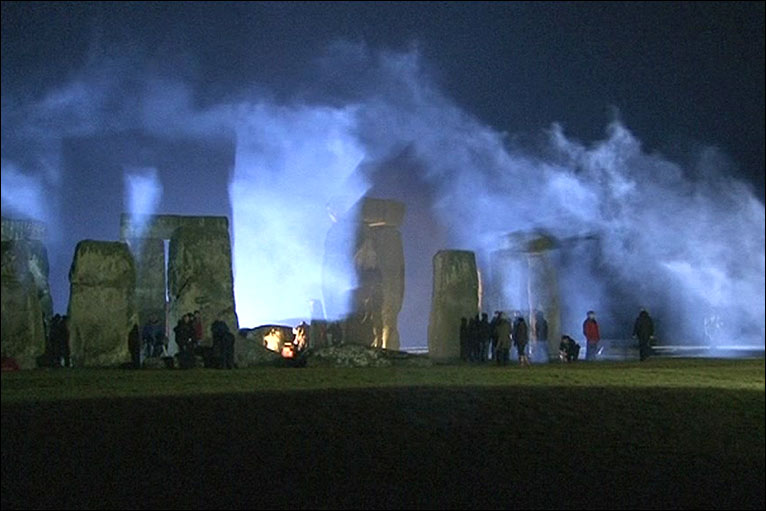
On Tuesday night, February 2, Wiltshire’s ancient stone monument was taken over by a film crew…..filming season five of BBC 1’s Doctor Who.

Exclusive leak….
Turns out that when the moon lies above the stone circle and the sun is on the opposite side of the earth, the stone circle acts as a gateway to a parallel time and place. Standing in the centre of the circle can allow one to be at one with the entire universe but unfortunately induces runaway ageing and exposure to other more evil personalities bent upon conquest. Dr Who finds himself imprisoned within the stone circle of an advanced extra-galactic civilisation and is held as a hostage until dastardly demands are met. The clock is running and the Doctor is rapidly ageing towards infancy. A twist in the tale is the entity that is allowed into the modern Human world when the stone circle is activated. Sadly, the choices are harsh…..either allow the proposed McDonalds drive-through planned for the Avenue, the bowling alley, the souvenir shop and the vast visitor facilities or, the Doctor will be wearing nappies for the remainder of this series and the evil personality (a hybrid mutation of David Icke and Schliemann) will win executive control of English Heritage.

Doctor Who at Stonehenge
Despite it being a closed set…
Local fans, braved the rain hoping to catch a glimpse of the action: “I’ve been a fan of Doctor Who since I was five, that’s 35 years now, and this has been the first chance I’ve had to see it being filmed.”

…plus returning professor River Song (Alex Kingston) have all been spotted on set – along with a brazier or two – the rumour is that the latest episodes including The Eleventh Hour, The Beast Below and Victory of the Daleks will all be set ‘some time in the past’.

With early filming reports claiming that the Doctor aka Matt Smith along with his sexy assistant Amy Pond played by Karen Gillan…