Walking the Dead: Exploring the Stonehenge Ceremonial Landscape

12 09 2015

A guided tour of the amazing collections of the Wiltshire Museum, followed by a guided walk from Durrington Walls to Stonehenge. This full day tour will be led by Museum Director, David Dawson.

Note: this event was previously advertised for Saturday 19th September.and is now Thursday, 08th October, 2015Walking the Dead: Exploring the Stonehenge Ceremonial Landscape

The morning visit to the Museum starts at 10.30am and the walk begins at 2pm. We should reach the Stonehenge Visitor Centre at about 5.30pm.

The day begins with coffee and a guided tour of the Wiltshire Museum. The early story of Wiltshire is told in new galleries featuring high quality graphics and leading-edge reconstructions. On display are dozens of spectacular treasures dating to the time of Stonehenge and worn by people who worshiped inside the stone circle.

The tour is followed by a light lunch at the Museum and minibus transport to the start of the walk, if required.

The walk will take approximately 3.5 hours, and starts at Durrington Walls and Woodhenge, close to the River Avon. The route passes the Cuckoo Stone, a megalithic standing stone, before following the Apple Track – a WW1 light railway. The route then passes the prehistoric Cursus, before passing the Bronze Age barrows of Kings Barrow ridge.

The route then follows the Avenue – the Neolithic ceremonial route that leads to Stonehenge following the line of the solstice.

At Stonehenge, you have three options:

1. Visit Stonehenge. This is free for English Heritage and National Trust members, but is not included in the cost. If you are not a member, then you should book your visit online from the English Heritage and you should choose a timed ticket for about 4.30 pm. You can then take the English Heritage shuttle bus to the Stonehenge Visitor Centre.
2. Continue to the Cursus barrows and the Western end of the cursus, before continuing to the Stonehenge Visitor Centre.
3. Take the English Heritage shuttle bus to the Stonehenge Visitor Centre and purchase a well-earned snack and cup of tea.

At about 5.30pm, at the end of the walk, there will be minibus transport back to your car at the start of the walk, or back to the Wiltshire Museum in Devizes.

Cost: £35 (WANHS member), £40 (non-member)

Booking:CLICK HERE TO BOOK DIRECT

The Stonehenge News Blog


Stonehenge researchers ‘may have found largest prehistoric site’

7 09 2015
Standing stones found buried near Stonehenge could be the “largest” intact prehistoric monument ever built in Britain, archaeologists believe.Large stones at Durrington Walls
The large stones are located around the edge of the henge at Durrington Walls (Image copyrigh Ludwig Boltzmann Institute)

Using ground-penetrating radar, some 100 stones were found at the Durrington Walls “superhenge”, a later bank built close to Stonehenge.

The Stonehenge Living Landscapes team has been researching the ancient monument site in a five-year project.

Finding the stones was “fantastically lucky”, researchers said.

The stones may have originally measured up to 4.5m (14ft) in height and had been pushed over the edge of Durrington Walls.

The site, which is thought to have been built about 4,500 years ago, is about 1.8 miles (3km) from Stonehenge, Wiltshire.

The stones were found on the edge of the Durrington Walls “henge”, or bank, an area which had not yet been studied by researchers.

Large stones at Durrington Walls
The stones could have measured up to 4.5m in height (Image copyright Ludwig Boltzmann Institute)

Lead researcher, Vince Gaffney said the stones were “lost to archaeology” but found thanks to modern technology.

National Trust archaeologist, Dr Nick Snashall said there were “hints” the stones could be buried in the landscape.

“In the field that lies to the south we know there’s a standing stone which is now the only standing stone, now fallen, that you can go up to and touch in the whole of the Stonehenge landscape,” he said.

“It’s called the Cuckoo Stone.

“If there are stones beneath the bank… they’re probably looking at stones of pretty much the same size as the Cuckoo Stone.”

Radar scanning at Durrington Walls, Wiltshire
Ground-penetrating radar was used to detect the large stones at Durrington Walls (Image copyright Geert Verhoeven)

Dr Snashall added there was a “sense” of an area set aside for the living and another for the dead at Durrington Walls – and that had changed over time.

“This gives us a a whole new phase that shows us that has started within 40 years of the site going out of use, or even less than that,” he said.

The findings are being announced later on the first day of the British Science Festival being held at the University of Bradford.

Large stones at Durrington Walls
The row of stones were standing over the edge of the bank of the henge (Image copyright Ludwig Boltzmann Institute)

Source and full story : BBC Wiltshire

The Stonehenge News Blog


Stonehenge Riverside Project. A film from the AHRC

16 05 2015

This film from the AHRC is the latest in our specially commissioned series which celebrates the AHRC’s 10th anniversary. This film looks back to the year 2007 and the Stonehenge Riverside Project.

Led by Professor Mike Parker Pearson, the Stonehenge Riverside Project brought together academics from around the globe in one of the largest field archaeology research studies of the 21st Century.

The project set out to further understanding of Stonehenge and neighbouring complex, Durrington Walls. The project looked at the sites in the context of the surrounding landscape, and in doing so several remarkable discoveries were made including a new stone circle dubbed, ‘Bluehenge.’ The discovery catapulted the project to the forefront of the world‘s media and made front page of newspapers all over the world.

Link: http://www.ahrc.ac.uk/News-and-Events/Watch-and-Listen/Pages/Stonehenge-Riverside-Project.aspx

The Stonehenge News Blog


Did you know today (April 18th) is World Heritage Day? Celebrate it with a visit to Stonehenge or Avebury.

18 04 2015

World Heritage is the shared wealth of humankind. Protecting and preserving this valuable asset demands the collective efforts of the international community. This special day offers an opportunity to raise the public’s awareness about the diversity of cultural heritage and the efforts that are required to protect and conserve it, as well as draw attention to its vulnerability.

On 18th April 1982 on the occasion of a symposium organised by ICOMOS in Tunisia, the holding of the “International Day WHSfor Monuments and Sites” to be celebrated simultaneously throughout the world was suggested. This project was approved by the Executive Committee who provided practical suggestions to the National Committees on how to organise this day.

The idea was also approved by the UNESCO General Conference who passed a resolution at its 22nd session in November 1983 recommending that Member States examine the possibility of declaring 18th April each year “International Monuments and Sites Day”. This has been traditionally called the World Heritage Day.

Stonehenge, Avebury and Associated Sites

Stonehenge and Avebury, in Wiltshire, are among the most famous groups of megaliths in the world. The two sanctuaries consist of circles of menhirs arranged in a pattern whose astronomical significance is still being explored. These holy places and the nearby Neolithic sites are an incomparable testimony to prehistoric times.

Stonehenge and Avebury form part of one of the UK’s UNESCO World Heritage Sites. The explanations behind why the sites are located where they are and what their exact purposes are still remain a mystery to this day.

Stonehenge

Managed by English Heritage dates back approximately 5,000 years. Evolving between 3,000 and 1,600 BC, Stonehenge is aligned with the rising and setting of the sun at the solstices. The summer solstice in June often attracts up to 20,000 visitors to view the sunrise. When visiting Stonehenge pick up one of their audio guides (available in different languages) giving details of the history and legends behind the site. For a more intimate experience there’s an inner circle tour which takes place before and after the site is open to the general public (pre-booking is essential) or view tour companies who offer general and inner circle visits to the stones.

Around the Stonehenge landscape there are other sites of notable importance including Durrington Walls, the largest henge monument in Britain and Woodhenge, a Neolithic monument dating from around 2,300 BC.

Avebury

The largest stone circle in the World, Avebury was erected around 4,500 years ago and consists of around 100 stones. Many of the stones were re-erected by Alexander Keiller in the 1930s.

The Alexander Keiller Museum in the village holds many of the archaeological finds that Keiller discovered during the excavations of Avebury during this time and the history of the excavations. Today Avebury is managed by the National Trust.

The site is open daily (due to its village location) and visitors can not only explore the stone circle but also the Avenue, the West Kennett Long Barrow and can look over at Silbury Hill – the largest man-made hill in Europe. Similarly to Stonehenge, Avebury is also plays host to both Winter and Summer Solstices.

In 2012, Avebury Manor opened its doors following the BBC TV programme ‘The Manor Reborn’ which also saw the kitchen garden transformed into a working Victorian kitchen garden.

See objects excavated from the World Heritage Site at Salisbury Museum and the new prehistory displays at Wiltshire Museum in Devizes. Salisbury Museum has recently reopened its Wessex Gallery. The Wiltshire Museum in Devizes has new displays featuring gold from the Time of Stonehenge, including Britain’s richest Bronze Age burial.
Visit Wiltshire Website

“Celebrate it with a visit to Stonehenge or Avebury and observe a minute of silence for the ones we have lost to insensitive developments”

The Stonehenge News Blog


Events at Stonehenge: Up Close

4 01 2015

Stonehenge: Up Close

Gain a rare and fascinating insight into the famous World Heritage Site with an exclusive tour around the site led by one of English Heritage’s experts. The event starts with exclusive early morning access to the stone circle at Stonehenge accompanied by our expert.

Stonehenge Landscape

Following a light breakfast, we will then go on to explore key archaeological sites including Durrington Walls, Woodhenge and The Cursus to learn more about the archaeological landscape and investigate work that has taken place in recent years.

There is plenty of walking, sometimes over uneven ground on this tour, so we have graded it as moderate access.

15th January 2015 SOLD OUT
9th February 2015 SOLD OUT
9th March 2015

Heaven and Earth Tours
Special evening bookable tour learning about the stars and planetary movements and how early man may have utilised them.

24th January 2015
21st February 2015

How to Book
Tickets are available to purchase by calling the English Heritage dedicated ticket sales team on 0370 333 1183. (Mon-Fri 8.30am – 5.30pm, Sat 9am – 5pm) Visit their website here

There are tour operators who offer special access trips and include transport from London.  Visit Wiltshire have links to local tour operators offering inner circle tours from Salisbury

Merlin at Stonehenge
The Stonehenge News Blog


Midwinter walk: Explore the ancient Stonehenge Landscape on the Winter Solstice with National Trust

5 12 2014

On the midwinter solstice, explore the ancient monuments of the Stonehenge landscape. This walk is around four and a half miles.

21st December 2014: Ancient ceremonial landscape of great archaeological and wildlife interest:Stonehenge Landscape

Within the Stonehenge World Heritage Site, the National Trust manages 827 hectares (2,100 acres) of downland surrounding the famous stone circle.

Walking across the grassland, visitors can discover other prehistoric monuments, including the Avenue and King Barrow Ridge with its Bronze Age burial mounds.

Nearby, Winterbourne Stoke Barrows is another fascinating example of a prehistoric cemetery. While Durrington Walls hides the remains of a Neolithic village.

Today thanks to their extensive programme turning ploughed fields into pasture, you can explore the landscape and follow in the footsteps of the people who built and used Stonehenge.

Booking essential: http://www.nationaltrust.org.uk/stonehenge-landscape/things-to-see-and-do/events/

National Trust Stonehenge Landscape Tours:  http://www.nationaltrust.org.uk/stonehenge-landscape/

Merlin at Stonehenge
The Stonehenge News Blog


The Stonehenge Hidden Landscapes Project

3 10 2014

The Stonehenge Hidden Landscapes Project is an unprecedented initiative to survey a vast tract of land around the iconic stones. Now that the bulk of the practical work is complete, Carly Hilts spoke to Vince Gaffney and Chris Gaffney to find out more.

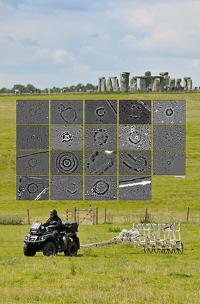
An ambitious programme of geophysical survey, covering 12 square kilometres around Stonehenge, has revealed a landscape scattered with previously-unknown features. Credit: All images courtesy of the University of Birmingham and LBI ArchPro

An ambitious programme of geophysical survey, covering 12 square kilometres around Stonehenge, has revealed a landscape scattered with previously-unknown features. Credit: All images courtesy of the University of Birmingham and LBI ArchPro

Stonehenge could confidently claim to be one of the most-studied, and certainly most hotly debated, prehistoric sites in Britain. However, much of the local landscape, so important to any interpretation or understanding of the site, was largely terra incognita – until the launch of The Stonehenge Hidden Landscapes Project, the largest geophysical mapping survey of its kind yet undertaken.

Begun in July 2010, and headed by the University of Birmingham and the Ludwig Boltzmann Institute for Archaeological Prospection and Virtual Archaeology  in Vienna, the four-year Project has explored a massive 12 square kilometres around the celebrated stones, and revealed the footprints of hundreds of previously unknown features, invisible to the naked eye, including henge-like monuments, burial mounds, ditches, and pits spanning thousands of years.

Clocking up 120 days in the field, the team used the latest non-invasive survey techniques – including magnetometry, ground penetrating radar (GPR), earth resistance surveys, and 3D laser scanning – to explore the Stonehenge landscape in unprecedented detail, allowing researchers to see features buried as much as 3m below the modern ground level.

‘We created a palimpsest,’ said geophysics expert Dr Chris Gaffney of the University of Bradford. ‘Unpicking it is one of the joys of geophysics, but also one of its conundrums – we don’t have a ditch detector or a wall detector, so after gathering this incredible explosion of data, you still have to delve in and interpret it manually.’

So far, eagle-eyed project members have picked out 17 shapes from the vast amounts of resulting data that are thought to represent Neolithic monuments roughly contemporary with Stonehenge, as well as field enclosures, barrows, settlements, and other signs of human activity ranging in date from the Bronze Age to the 20th century.

We approach the features as we would if we were using aerial photography, by looking at their shape and comparing them to known sites,’ said project co-director Professor Vince Gaffney of the University of Birmingham (and brother of Chris Gaffney). ‘The tricky thing is that prehistoric monuments come in a variety of forms, they do not conform to standards – even Stonehenge is not a typical henge, as its ditch lies outside its bank – so once you spot something, it is not always easy to categorise it.’

Professor Wolfgang Neubauer, Director of the Ludwig Boltzmann Institute, added: ‘No landscape deserves to benefit from a study at this level of detail more than Stonehenge. The terabytes of digital survey data collected, processed and visualised by LBI ArchPro provide the base for the precise mapping of the monuments and archaeological features buried in the subsurface or still visible in the landscape surrounding Stonehenge. After centuries of research, the analysis of all mapped features makes it possible, for the first time, to reconstruct the development of Stonehenge and its landscape through time.’

High-speed survey

With an ambitiously large area designated for investigation, the team called on other modern technologies to help cover the uneven terrain. Although hand-pushed carts were used to explore more difficult or sensitive sites, much of the project survey equipment was mounted on the back of quad bikes.

‘This means we were collecting data at up to 40kmph,’ said Vince. ‘It was georeferenced and its location logged as it came in, and the information would already be partly processed before you reached the end of the field – that’s how we managed to so much data in a relatively short time.’

Beyond the stones of Stonehenge

This multi-technology approach has proven a particular boon in revisiting well-known sites, where a host of unexpected new details have been revealed. Around 3km from Stonehenge lies , the largest-known henge in the world at over 0.5km in diameter, and home to a Neolithic settlement that some interpret as a possible base camp for the builders of Stonehenge (CA 270). Although the site has been studied in detail during previous investigations, the recent survey identified traces of a previously unknown row of holes along the site’s southern border, which could have held around 70 posts or stones.

While investigating a known long barrow at Woodhenge, the team found the remains of a large timber building hidden inside it. This reconstruction shows how it may have looked

Another enigmatic find comes from the adjacent site of ‘Woodhenge’, once home to a Neolithic timber circle. The chalk long barrow standing in the same field had long been known to archaeologists, and so it came as a complete surprise to discover that the monument seems to have a kind of forecourt in front of it – and that within the mound itself there once stood a massive timber building some 33m long. With the outline of its walls marked out by lines of holes that once contained huge wooden posts, the team has provisionally interpreted the building as a mortuary, possibly used in excarnation rituals.

Interpreting the Cursus

Stonehenge_new_monuments_distribution

Over at the Cursus ­– the c.3km long Neolithic earthwork just north of Stonehenge, thought to predate the earliest phase of the monument’s construction by several centuries –exploratory work has revealed new links between the two sites, as well as potentially significant astrological associations. At each end of the Cursus, the team has identified a massive pit measuring around 5m in diameter. More excitingly, Vince said, if you stand at Stonehenge and look towards the Cursus on the Summer Solstice, the easternmost pit aligns with the rising sun, and the westernmost with the sunset.

‘As the Cursus runs East-West it has long been suspected that it had some kind of association with the sun, so these pits forming a triangle with the site of Stonehenge are very interesting,’ he said. ‘It seems like a massive coincidence if their alignment was not intentional. We don’t know their date, but something else that is interesting to note is that while you can get a clear view of the sunrise pit from Stonehenge, looking down the first section of the Avenue, the sunset pit is hidden behind a bank. You might be able to see it if it was filled with fire and smoke, though – perhaps a future excavation will reveal traces of burning.’


This is an extract, but you can read the full article in Current Archaeology 296

Stonehenge’s hidden landscape


The Stonehenge News Blog


Bradford researchers help uncover hidden secrets of Stonehenge

12 09 2014

Bradford archaeologists are part of an international research team that has uncovered a host of previously unknown archaeological monuments around Stonehenge in a project that will transform our knowledge of this iconic site.

Operation Stonehenge: What Lies Beneath, can be seen on BBC iPlaver here: http://www.bbc.co.uk/iplayer/episode/b04hc5v7/operation-stonehenge-what-lies-beneath-episode-1

Results from the Stonehenge Hidden Landscapes Project are unveiled today at the Stonehenge_new_monumentsBritish Science Festival in Birmingham. They show how, using new remote sensing techniques and geophysical surveys, the team has uncovered 17 previously unknown ritual monuments around the site, along with dozens of burial mounds – all of which have been mapped in minute detail.

Researchers at the University of Bradford are partners in the project, which is led by the University of Birmingham and the Ludwig Boltzmann Institute for Archaeological Prospection and Virtual Archaeology, in Austria.

Alongside previously unknown features, the team has also uncovered new information on other monuments, including the Durrington Walls ‘super henge’, a vast ritual monument of more than 1.5 kilometers in circumference which is situated a short distance from Stonehenge.

Hundreds of burial mounds, and settlements from the Bronze Age, Iron Age and Roman period have also been surveyed at a level of detail never previously seen. Taken together, the results show how new technology is reshaping how archaeologists understand the landscape of Stonehenge and its development over a period of more than 11,000 years.

Dr Chris Gaffney, Head of Archaeological Sciences at Bradford, says: “The Stonehenge Hidden Landscapes project is the pinnacle of a recent trend to apply new and rapid technologies to collect accurate non-invasive data for mapping our buried heritage.

“In many respects, the Stonehenge project goes far beyond any other project – both in the complexity of the data sets generated but also in the immense impact it will have on our understanding of Britain’s greatest and best-known archaeological site.

He adds: “Archaeology studies the past, but, in the application of remote sensing at this scale, the Stonehenge Hidden Landscapes Project demonstrates how future researchers will investigate our archaeological heritage. Increasingly, the investigation and understanding of iconic sites across the globe will be enhanced by rapidly mapping the larger-scale environment that they have come to dominate.”

British project leader Professor Vincent Gaffney, Chair in Landscape Archaeology and Geomatics at the University of Birmingham, and Chris Gaffney’s brother, said:

“This project has revealed that the area around Stonehenge is teeming with previously unseen archaeology and that the application of new technology can transform how archaeologists and the wider public understand one of the best-studied landscapes on Earth.

“New monuments have been revealed, as well as new types of monument that have previously never been seen by archaeologists. All of this information has been placed within a single digital map, which will guide how Stonehenge and its landscape are studied in the future.

“Stonehenge may never be the same again.”

The results of the project will be featured in a major new BBC Two series, Operation Stonehenge: What Lies Beneath, is due to be broadcast at 8pm on Thursday 11 September.

Full article: http://www.bradford.ac.uk/life-sciences/news-and-events/news/bradford-researchers-help-uncover-hidden-secrets-of-stonehenge.php

The Stonehenge News Blog



Neolthic Houses at Stonehenge Visitor Centre

25 03 2014

NEOLITHIC buildings are being painstakingly recreated in the new outdoor exhibition area of the Stonehenge visitor centre.

Salisbury Journal: Neolithic houses at Stonehenge

Neolithic houses at Stonehenge

When complete, the houses will showcase what life would have been like at the time that Stonehenge was built. The re-created huts are based on archaeological evidence unearthed at the nearbyDurrington Walls.


Volunteers are weaving hundreds of hazel rods through the main supporting stakes, thatching the roofs with hand-knotted wheat straw, and starting to cover the walls with a daub of chalk, straw and water.

Once the buildings are completed, volunteers will be on hand to talk to visitors about the project and to demonstrate the daily activities of our Neolithic ancestors.


Link source:
Salisbury Journal http://www.salisburyjournal.co.uk/news/11097745.Neolithic_houses_at_Stonehenge/

Link resource:
Follow their progress here: http://neolithichouses.wordpress.com/
English Heritage Link: http://www.english-heritage.org.uk/daysout/properties/stonehenge/discover/neolithic-houses

Follow the project and progress on Twitter:

https://twitter.com/ST0NEHENGE

Merlin at Stonehenge
The Stonehenge and local area news blog


Stonehenge revealed: Why Stones Were a “Special Place”

22 06 2013

Lead archaeologist at Stonehenge discusses his team’s discoveries in new book

The eerie megaliths of Stonehenge have inspired speculation for centuries.

Druids—and sometimes aliens—have been suspected of planting the 4,500-year-old stones. Is Stonehenge an astronomical calendar or a place of healing or a marker for magical energy lines in the ground? For a long time, no one really knew, though some theories were more grounded in reality than others.

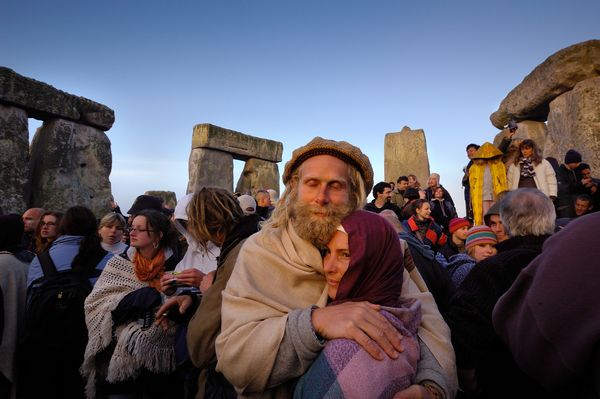
Each year revelers like these travel to Stonehenge to celebrate the summer solstice. Photograph by Jim Richardson, National Geographic

Each year revelers like these travel to Stonehenge to celebrate the summer solstice.
Photograph by Jim Richardson, National Geographic

But now, we may be a little bit closer to understanding the monumental Neolithic site. Archaeologist Mike Parker Pearson and his colleagues at the Stonehenge Riverside Project, whose research was funded in part by the National Geographic Society, spent seven years excavating Stonehenge and its surroundings. This month, Parker Pearson published the project’s findings in a new book, Stonehenge—A New Understanding: Solving the Mysteries of the Greatest Stone Age Monument.

National Geographic writer Rachel Hartigan Shea spoke with Parker Pearson about what he and his colleagues discovered and how modern celebrants greeting the summer solstice at Stonehenge may have gotten the wrong day.

What got you first interested in researching Stonehenge?

Well, I have to say I didn’t actually have any interest at all in Stonehenge. I was working with Ramilisonina, a Malagasy archaeologist. He comes from a megalith-building culture, so I thought he’d be interested to see Stonehenge. I took him to take a look, and he said, “What do you mean you don’t know what it’s for? It’s obvious.” Then he said, “Mike, have you learned nothing in all of our work together with standing stones in Madagascar?”

He explained to me it was surely built for the ancestors. In Madagascar, they build in stone for the ancestors because it is a permanent medium—permanent like the ancestors—whereas they live in wooden houses because those will perish just like human life will end. I laughed initially and said, “Well, I don’t think that’s necessarily really going to have anything to do with Britain 5,000 years ago.”

But I realized that actually we did have timber circles very close to the stone circle of Stonehenge. That was quite a bombshell for me.

How were the excavations that you worked on at Stonehenge different from previous excavations there?

I think the important thing was not to dig just at Stonehenge but to actually investigate the wider landscape around it and to begin by looking at this area of the timber circles close by. It was there that we found that the place of wood had indeed to do with the living. (See Stonehenge pictures.)

When we came back to Stonehenge and dug there, we recovered some 60 cremation burials inside Stonehenge. What we now know is that Stonehenge was the largest cemetery of its day.

Ramilisonina’s ideas about a place in stone for the dead and a place in wood for the living started as a theory but has actually become a fact as a result of our investigations.

The timber circles were located at a site called Durrington Walls. How was that the place of the living?

At Durrington Walls, we have two of these great timber circles—a bit like Stonehenge in wood—at the center of an enormous village. From where we’ve excavated, you’re looking at a fairly dense settlement of houses.

We discovered that they’d been feasting there on a very large scale. We estimate that about four to five thousand people may have gathered there at the time they were building Stonehenge. (Take a Stonehenge quiz.)

We also know that there were seasonal influxes into the settlement at Durrington Walls. Through analysis of the age patterns on the teeth of pigs, we can see that there are particularly high points in the slaughtering patterns. The pigs had given birth in spring, and what we’re seeing is a culling in the middle of the winter.

Here we are on the summer solstice, but this evidence suggests that people were gathering in large numbers at the winter solstice. We’ve been getting it wrong in modern times about when to gather at Stonehenge.

So Stonehenge was built to commemorate the dead?

Stonehenge wasn’t built in order to do something, in the same way you might build a Greek temple to use it for worship. It seems much more likely that everything was in the act of building—that you’d construct it, then you’d go away. You’d come back 500 years later, you’d rebuild it in a new format, and then you’d go away.

I think we have to shake off this idea of various sorts of priests or shamans coming in every year over centuries to do their thing. This is a very different attitude to religious belief. It’s much more about the moment. It’s about what must have been these upwellings of religious—almost millennial—belief, and once the thing is done, then everyone disperses and goes back to their lives.

What do the summer and midwinter solstices have to do with where Stonehenge is located?

One of our discoveries in 2008 was on the avenue that leads out of Stonehenge. As you are moving along the avenue away from Stonehenge, you are looking toward where the sun rises on the midsummer solstice. If you turn 180 degrees and look back toward Stonehenge, that’s where the sun sets on the midwinter solstice. Underneath the avenue, we discovered a natural landform, formed in a previous ice age, where there are grooves and ridges that by sheer coincidence are aligned on that solstitial axis.

Right next to this landform are pits dug to hold posts that were put up 10,000 years ago, much older than Stonehenge. Another archaeological team has discovered down by the river next to Stonehenge a huge settlement area for hunters and gatherers, which seems to have been occupied on and off for something like 4,000 years before Stonehenge itself was ever built.

We think that long before Stonehenge this location was already a special place. These hunters and gatherers may have been the people who first recognized this special feature in the land where the earth and the heavens were basically in harmony.

This interview has been edited and condensed.
Full Article: : http://news.nationalgeographic.com/news/2013/13/130621-stonehenge-summer-solstice-archaeology-science/

Follow Rachel Hartigan Shea on Twitter.
Follow Stonehenge on Twitter

Merlin @ Stonehenge
The Stonehenge News Blog