Taking a Guided Tour of Stonehenge Aotearoa – Hire a Henge!

14 07 2011

Taking a Guided Tour of Stonehenge (New Zealand?)

Stonehenge Aotearoa, a full-size model based on the ancient English stone circle, shows how the Sun, Moon and stars can be used “for life and survival”.
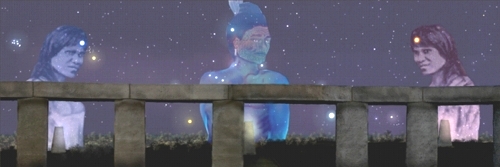
stonehenge-audio-visual

Apart from its majestic and mysterious appearance a stone circle has little meaning unless one knows how it works and why people built them eons ago.  The people who built Stonehenge Aotearoa have put together a special presentation that unravels ancient mysteries and takes the visitor on a journey of discovery.  Our tours include tales from antiquity of the solstices and equinoxes and signs of the Zodiac.  You will discover how stones, posts and shadows were used to unlock mysteries of the earth and sky which formed a cornerstone to the rise of civilization.

Allow enough time
A guided tour runs for just over an hour.  Do allow yourself time to check in before the presentation begins. We suggest that you arrive not less than 10 minutes before your tour is scheduled to start.   In addition, it is advisable to allow some free time following your tour.  Visitors often wish to ask questions, take a second look at some of the stone structures, or visit our Stonehenge shop.

When ?
Stonehenge Guided Tours are available to the public at 11am on Saturdays, Sundays and public holidays. At other times you may book a private tour – see below.  From December 27 through to January 15 there will be a tour every day at 11am.   The number of participants on any one tour are limited so bookings are recommended. 

What does it cost?
Adults $15, Senior Citizens (65+) $12, Students (13-17yrs) $10, Children (pre-teens) $6. Bookings recommended: Phone (06) 377 1600 or book online here.

PRIVATE & GROUP TOURS
may be held on any day at a time by arrangement. The fees per person are the same as those for a public tour:- $15 for adults, $12 for senior citizens (65+), $10 for students (13-17yrs), $6 for children (pre-teens), except that there is a minimum charge of $90. Thus, if you have 6 adults in your party this will cover the $90 minimum charge. Phone (06) 377 1600 or book online here.

Each tour is tailored to the weather conditions. It usually begins in our lecture theatre with an introductory talk on the historical significance of stone circles and the reasons why star-lore formed a cornerstone to the rise of civilization.  This part of the presentation may include an audio-visual about the Stonehenge on Salisbury Plain and Stonehenge Aotearoa.  We then explore the stone circle, listen to tales from antiquity, and discover how stones and shadows can be used to unlock mysteries of the universe.

 SUNRISE & SUNSET TOURS
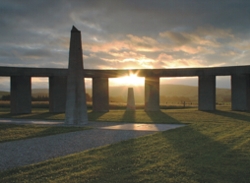
Stonehenge Aotearoa can be magnificent at the time of sunrise or sunset.  These tours include (weather permiting) viewing the sun rise or set over the Henge. Of special interest is the times of the equinoxes and solstices when the sun can be observed to rise or set over one of the heel stones.  At these times we often have a special presentation about the equinox or solstice.  See “Special Events”.

Unless otherwise advertised Sunrise and Sunset Tours are only  available by arrangement as private or group bookings. 

 Maybe we should build one of these in Wilsthire?
Visit our sponsors for tours of the real Stonehenge – www.StonehengeTours.com

Merlin @ Stonehenge
The Stonehenge Stone Circle Website


Bulldozed Stonehenge would incur monolithic backlash

3 07 2011

So why has the eradication of the 4,000-year-old prehistoric Priddy Circles site not caused more national interest?
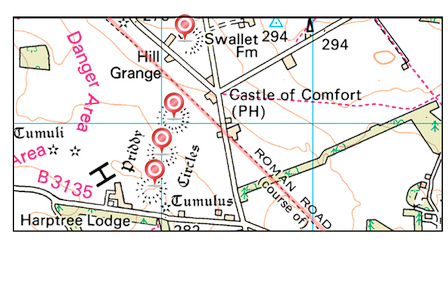
Priddy Circle Map

Hands-up folks, which of you had even heard of the Priddy Circles before last week? I would not anticipate there to be a large number of people, even locals, who had and I’m afraid to admit that I would not be among them.

It’s not surprising that they’re so little known as any reference to them makes only vague speculation as to their former purpose. The same could also be said to be true of Stonehenge, but, as any users of the A303 will attest, the mysterious splendour Stonehenge has captured the imagination of many, whereas Priddy Circles have remained unacknowledged by most.

I align them with Stonehenge because academic research on the phenomenon has claimed that ‘although no dating evidence has been found, they appear to be contemporary with Stonehenge’.

They are also said to probably be ‘Neolithic ritual or ceremonial monuments similar to a henge, they are external rather than internal ditches makes them unique in Britain and all this makes the circles the most important surviving Neolithic sites in Somerset’.

The recent rise in interest of the site is as a result of discoveries that English Heritage experts have been investigating claims that one of the four Priddy Circles has been obliterated.

Land near the circles appears to have been recently re-seeded and tree saplings have been planted close by.

The Ancient Monuments and Archaeological Areas Act 1979 makes it a criminal offence to destroy or damage a scheduled monument including agriculture, forestry, flooding and tipping.

If you want to view the site for yourself, they can be located using the map above – you are looking for an arrangement of four circular earthwork enclosures. The circles, each nearly 200m across, are best seen from the air. The damaged circle was the most clearly defined of the four. The total arrangement covers roughly 1.2km.

Other eyewitness accounts can be found at the Modern Antiquarian website. English Heritage has refused to be drawn on the extent of the alleged damage at this stage. 

To see the full extent of the damage from an aerial perspective, check-out these astounding photos by Pete Glastonbury.

Sponsored by the Stonehenge Tour Company – www.StonehengeTours.com

Merlin @ Stonehenge
The Stonehenge Stone Circle Website


Costly changes to Stonehenge

30 06 2011

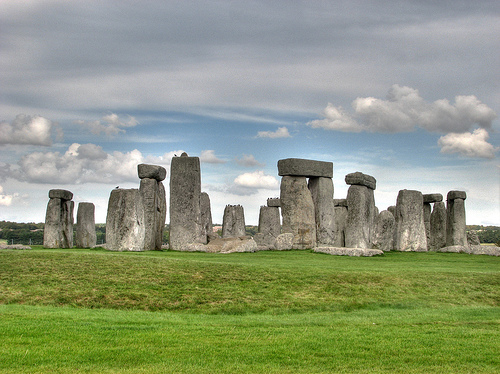
English Heritage seems determined to spend millions of pounds of taxpayers’ money on not altogether necessary changes to the site around Stonehenge in Wiltshire.

The saga began last summer when the Coalition government cancelled a proposed £25m scheme to replace the current visitor centre and shift it one and a half miles away from the stones, as well as diverting the nearby A344. This was all for aesthetic reasons so as to present the Neolithic stones in a more pleasing environment away from horrid cars and pesky tourists.

At the time, the Chief Secretary to the Treasury said the scheme had been devised when the previous government was going on a ‘pre-election spending spree’ and the English Heritage proposal did not ‘represent good value for money’.
Stonehenge

Five months later, however, the scheme was back on when English Heritage received a £10m grant towards the new visitor centre and closure of the A344. Now, it is happy to see taxpayers’ money spent on a costly public inquiry into diverting the road away from the site so as to ‘restore the dignity’ of the stones.

Chief Druid Arthur Pendragon, however, smells a rat, believing the costly shifting of visitor centre and road will actually reduce public access to the prehistoric monument and give English Heritage a monopoly over visiting it.

‘We will not shrink from our responsibilities,’ he says, ‘to ensure that future generations can enjoy the environs of Stonehenge and the World Heritage site without being excluded for fiscal reasons.’

Still, maybe we should be grateful for small mercies, as English Heritage had earlier asked for £500m so they could place the section of road that runs nearest the stones to be hidden away in a tunnel. Even the previous free spending government thought this was going too far and binned the extravagant scheme in 2007.

Sponsored by the Stonehenge Tour Company – www.StonehengeTours.com

Merlin @ Stonehenge
The Stonehenge Stone Circle Website


Inquiry into Stonehenge A344 closure plans

26 06 2011

Plans to close the main road east of Stonehenge and return it to grass are being scrutinised at a public inquiry.

English Heritage wants to stop traffic from travelling close to the stones and

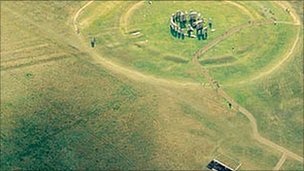
An aerial view of Stonehenge without the A344 road

An aerial view of Stonehenge without the A344 road

“restore the dignity” of the World Heritage Site by closing the A344.

Those opposed include chief druid Arthur Pendragon who has argued that it would give English Heritage a monopoly on access to the site.

The inquiry in Salisbury, Wiltshire, begins on Wednesday.

In June 2010 Wiltshire Council granted planning permission for a new visitors centre at Airman’s Corner, 1.5 miles (2km) west of Stonehenge.

Grassed over

Under the current scheme, the existing car park and visitor facilities at the stones will be removed and the area “returned to grass”.

English Heritage has said it will be necessary to close the A344 between Stonehenge Bottom and Byway 12 and close part of the B3086.

A new roundabout will replace the current Airman’s Corner junction to cope with the increased traffic caused by the road closures.

The Longbarow Roundabout on the A303 will also be improved.

English Heritage said it believed “everyone agrees that Stonehenge’s landscape setting is severely compromised by the intrusion of roads and traffic”.

Mr Pendragon said he was strongly opposed to the proposed traffic regulation order to restrict motorised vehicles on the remaining A344 west of Stonehenge and on two nearby byways.

He said: “We will not shrink from our responsibilities to ensure that future generations can enjoy the environs of Stonehenge and the World Heritage site without being excluded for fiscal reasons.”

Sponsored by ‘The Stonehenge Tour Company’ – www.StonehengeTours.com

Merlin @ Stonehenge
The Stonehenge Stone Circle Website


18,000 gather at a cloudy Stonehenge for all-night summer solstice party

22 06 2011

Tens of thousands of revellers gathered at Stonehenge for an all-night party to celebrate the longest day of the year this morning – despite grey clouds that obscured the sunrise.

Here comes the sun: Revellers cheer as the sun finally breaks through the clouds, more than a couple of hours after daybreak

Here comes the sun: Revellers cheer as the sun finally breaks through the clouds, more than a couple of hours after daybreak

English Heritage say 18,000 revellers descended on the site that is usually roped off to the public to witness dawn at exactly 4.43am. The event is significant for druids, who were joined by hippies, pagans and tourists as well as hordes of younger visitors in search of a good party.

However the number of people who camped out overnight or arrived early to witness the dawn was down on previous years because of the poor weather and the solstice falling on a weekday.

There was no beautiful sunrise into clear blue skies – heavy overnight rain gave way to overcast but dry skies as the sun rose, greeted by cheering and applause.

The self-styled King Arthur Pendragon, the veteran druid who led the event, said it had passed off smoothly.

‘We didn’t get a great sunrise but it was dry,’ he said. ‘Everyone seems happy with the result.

‘It is great to see the stones being used in this way, as opposed to the usual manner with tourists being herded around.’

Stonehenge, which is between 4,000 and 5,000 years old, has in past years been the site of confrontations between revellers and police.

But Superintendent Gavin Williams, of Wiltshire Police, said the majority of the crowd this year were well-behaved and ‘came to see the sunrise in the spirit of the event’, which was policed in the same way as night spots in the county. However, two men were photographed fighting at the event.

Of the 20 arrests, 11 were for drugs offences and five for public

Mr Williams said: ‘Although it was disappointing that some individuals chose to bring drugs with them, they were dealt with robustly.’

English Heritage, which manages the Stonehenge site on Salisbury Plain in Wiltshire, said the atmosphere had been ‘peaceful and good natured’.

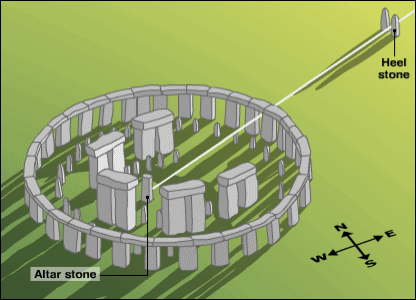
The annual event is a modern take on solstice celebrations which were once a highlight of the pre-Christian calendar. Celebrations focus on the Heelstone, which sits just outside the main circle, and is aligned with the midsummer sunrise.

The solstice is one of the few times access is granted inside the stone circle, which has been roped off since 1978 following years of erosion and vandalism.

Stonehenge’s origins remain a mystery, but one theory is that it is a huge astronomical calendar. Others say an ancient sun-worshipping culture aligned the structure with the midsummer sunrise and the midwinter sunset.

The World Heritage site was used as a cremation cemetery since its inception, archaeologists say, but it is unclear if that was its principal function.

It was build in three phases, with stones brought from up to 150 miles away, between 3000 BC and 1600 BC

http://www.dailymail.co.uk/news/article-2006112/Summer-solstice-18-000-gather-cloudy-Stonehenge-night-party.html

Sponsored by the Stonehenge Tour Company – www.StonehengeTours.com

Merlin @ Stonehenge
The Stonehenge Stone Circle website


Druids celebrate summer solstice at Stonehenge for first time as mainstream faith

17 06 2011

When robed Druids gather at Stonehenge for the summer solstice in next week, they will be worshipping at the prehistoric stone-circle monument for the first time as members of an established religion under British charity law. The classification means members of the ancient pagan tradition, which some see as a curiosity of Britain’s ancient past, have mainstream status equal to the Church of England. The change of status, which is controversial, gives them tax advantages.
Stonehenge Druid

Opponents of the change of status regard it as a mistake made for the sake of political correctness by a government agency, the Charity Commission. The see it as the first step to recognition of Scientology, sorcery, witchcraft or even the Jedi as religions eligible for tax-exempt status. The 2001 census recorded the country as having some 390,127 Jedi, the fictional Star Wars religion, in England and Wales.

After a four-year campaign by the Druids, the Charity Commission says it accepts that they worship nature and believe in the spirits of places such as mountains and rivers, as well as in divine guides.

Druids are best known for the gathering at Stonehenge each year on Jun 21 to greet the dawn, but they hold festivals eight times a year to mark stages in the solar and lunar cycles. Encyclopedia Britannica describes the ancient Druids as members of the learned class among the Celts. They do not worship a single god or creator, but seek to cultivate a sacred relationship with the natural world. The earliest known records of the Druids come from the 3rd Century BC. 

RELATED READING:

Druids: Worshippers of nature who were said to sacrifice humans (Telegraph 2 Oct 2010)
http://www.telegraph.co.uk/news/newstopics/religion/8037258/Druids-Worshippers-of-nature-who-were-said-to-sacrifice-humans.html

MELANIE PHILIPS: Druids as an official religion? Stones of Praise here we come (Daily Mail 4 Oct 2010)
http://www.dailymail.co.uk/debate/article-1317490/Druids-official-religion-Stones-Praise-come.html?ito=feeds-newsxml

Stonehenge preperations
THOUSANDS of revellers are expected to descend upon Stonehenge for this year’s Summer Solstice.
Sunrise will occur at about 4.45am on June 21, which is the longest day of the year.
English Heritage is opening Stonehenge to the public from 7pm on Monday, June 20, to 8am the following day.
The Solstice car park, just off the A303, will open from 7pm on Monday, June 20, with last admission at 6am on Tuesday, June 21. Access to the stones and car park will be free of charge but organisers have advised people to use public transport where possible.
Wilts and Dorset bus company will be running a regular service from Salisbury railway station, via the bus station, from 6.30pm on the Monday evening through to 1.15am on Tuesday. A return service will operate frequently from 4am to 9.45am on Tuesday – with buses stopping at any recognised bus stop along the Amesbury route

Sponsored by ‘The Stonehenge Tour Company’  www.StonehengeTours.com

Merlin at Stonehenge
The Stonehenge Stone Circle website


Stonehenge Summer Solstice advice for drivers – 2011

15 06 2011

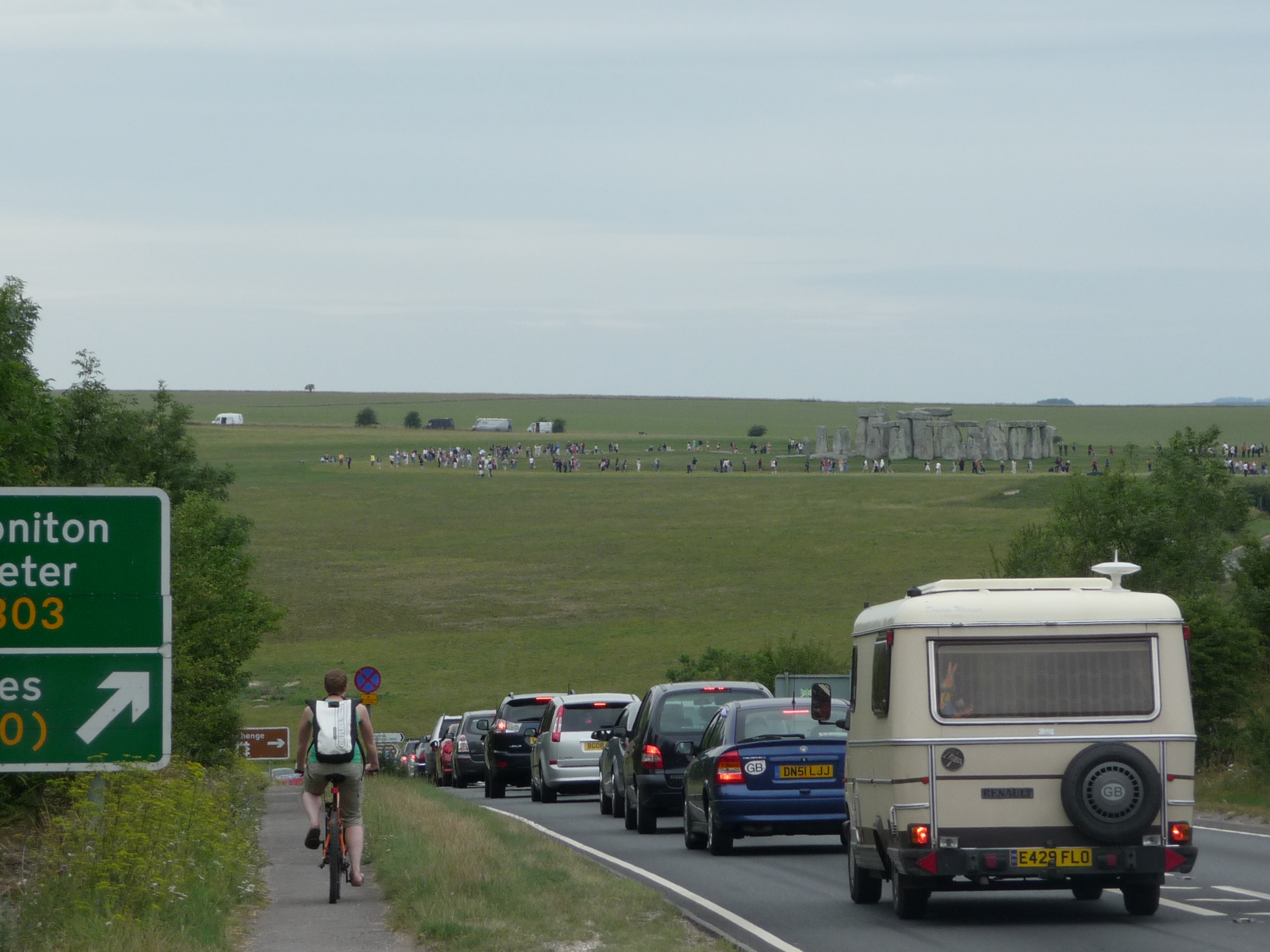
Traffic on the A303 at Stonehenge is expected to be very busy on Monday 20th and Tuesday 21st June during the summer solstice celebrations.
A303 Stonehenge trafficPeople travelling to Stonehenge are advised to use public transport where possible. People arriving by car and through traffic on the A303 are advised to allow longer for their journeys.

Motorists can get up-to-the-minute advice about roadworks and travelling conditions by visiting the Highways Agency website www.highways.gov.uk, or telephone the Highways Agency Information Line on 0300 123 5000 at any time. Calls from landlines to 0300 and 08700 numbers can cost up to 8p per minute but are free from some landline providers: calls from mobiles usually cost more.

Before using any mobile, find a safe place to park. Never stop on the hard shoulder of a motorway except in an emergency. Make sure it’s safe and legal before you call.

http://www.hgvuk.com/06/15/stonehenge-summer-solstice-advice-for-drivers/

Follow Stonehenge on twitter for all the latest news and updates during the solstice celebrations:  http:www.TWITTER.COM/ST0NEHENGE.COM

Merlin @ Stonehenge
The Stonehenge Stone Circle Website


Total Lunar Eclipse visible at Stonehenge tonight

15 06 2011

Todays’s total eclipse of the Moon may be the most striking for years but observers at Stonehenge must be content with a view of only the closing act of the drama.
Lunar Eclipse Stonehenge
The Moon stands over the southern Indian Ocean as it passes through the central dark umbra of the Earth’s shadow, plunging deeper into the shadow than during any eclipse since 2000. This may well result in an unusually dark eclipse, with the Moon’s disc turning a deep reddish-brown as all direct sunlight is blocked.

In fact, the umbra is never black. A little light must reach the Moon from the parts of the Sun’s outer atmosphere, the corona, that are not hidden by the Earth. But more sunlight is refracted and scattered around the edge of the Earth by our planet’s atmosphere. Just as sunsets and sunrises appear orange or red, so this light is predominantly red.

The umbra is not illuminated evenly, though, since less of this indirect light penetrates to its core and the amount reaching different zones of the umbra is affected by varying atmospheric conditions. In particular, dust thrown up by major volcanic eruptions can render the atmosphere less transparent and the eclipsed Moon so dark that it practically disappears.

Our image shows the previous total lunar eclipse as viewed from Florida last December. On that occasion, the Moon traversed the northern part of the umbra and its southern regions, which just missed the shadow’s core, are relatively dark. This week, the Moon passes about a half Moon’s-breadth farther southwards with respect to the shadow, so it will be interesting to discover just how dark and colourful it appears.

Wednesday’s eclipse begins when the Moon’s eastern limb begins to enter the penumbra of the Earth’s shadow at 18:25 BST. While within the penumbra, some direct sunlight falls on the Moon but little darkening of the disc will be noticed until a few minutes before the Moon begins to enter the umbra at 19:23. Totality, with the Moon entirely within the umbra, lasts from 20:22 until 22:03 with mid eclipse at 21:13. The Moon’s W limb has withdrawn from the umbra by 23:02 and finally exits the penumbra at 00:01.

For Britain, other than the far NW, the Moon rises in the SE during the latter half of totality. Observers in SE England may just glimpse the end of totality, but most of us may see nothing until it begins to emerge from the umbra. From London and Manchester, for example, the Moon stands less than 5° and 3° high respectively at 22:03 BST, with the Sun only a little way below the NW horizon and the sky brightly twilit. The Moon should be more obvious another 5° higher in a darker sky by 23:02.

Sponsored by ‘The Stonehenge Tour Company’ www.StonehengeTours.com

Merlin @ Stonehenge
The Stonehenge Stone Circle Website


World Heritage Site Landscape Project: Stonehenge, Amesbury, Wiltshire

10 06 2011

Summary of an English Heritage Report on Stonehenge by David Field and Trevor Pearson:

Analytical survey of the ground surface at Stonehenge revealed the presence of a number of interesting earthworks that have a bearing on interpretation and the development of the monument. Chief among these is a low mound that was revealed within the stone settings. Its location focuses attention on that part of the arrangement which is ruinous and supplements former reservations as to whether the monument was ever complete. Survey also revealed that the Y and Z holes are visible asStonehenge plan earthworks and that each circuit has a shallow bank within it. The feature known as the North ‘Barrow’ may have preceded the enclosure and therefore be one of the earliest elements at the site. The South ‘Barrow’ by contrast is, at least in one of its phases, a later feature. These are clearly not barrows and the more neutral term ‘circles’ is therefore preferred. An outer bank to the enclosure has been largely truncated by cultivation, while a mis-match of the Avenue at the enclosure entrance indicates that the two may have been mutually exclusive entities. The eastern ditch and bank of the Avenue is revealed to have changed course, perhaps in an attempt to avoid the pre-existing ditch around the Heel Stone.

http://services.english-heritage.org.uk/ResearchReportsPdfs/109_2010WEB.pdf
http://heritageaction.wordpress.com

Sponsored by ‘The Stonehenge Tour Company’ www.StonehengeTours.com

Merlin @ Stonehenge
The Stonehenge Stone Circle Website


Druids celebrate summer solstice for first time as mainstream faith

8 06 2011

When robed Druids gather at Stonehenge for the summer solstice in 2011, they will be worshipping at the prehistoric stone-circle monument for the first time as members of an established religion under British charity law. The classification means members of the ancient pagan tradition, which some see as a curiosity of Britain’s ancient past, have mainstream status equal to the Church of England. The change of status, which is controversial, gives them tax advantages.
Stonehenge solstice druids

Opponents of the change of status regard it as a mistake made for the sake of political correctness by a government agency, the Charity Commission. The see it as the first step to recognition of Scientology, sorcery, witchcraft or even the Jedi as religions eligible for tax-exempt status. The 2001 census recorded the country as having some 390,127 Jedi, the fictional Star Wars religion, in England and Wales.

After a four-year campaign by the Druids, the Charity Commission says it accepts that they worship nature and believe in the spirits of places such as mountains and rivers, as well as in divine guides.

Druids are best known for the gathering at Stonehenge each year on Jun 21 to greet the dawn, but they hold festivals eight times a year to mark stages in the solar and lunar cycles. Encyclopedia Britannica describes the ancient Druids as members of the learned class among the Celts. They do not worship a single god or creator, but seek to cultivate a sacred relationship with the natural world. The earliest known records of the Druids come from the 3rd Century BC. 

RELATED READING:
Druids: Worshippers of nature who were said to sacrifice humans (Telegraph 2 Oct 2010)
http://www.telegraph.co.uk/news/newstopics/religion/8037258/Druids-Worshippers-of-nature-who-were-said-to-sacrifice-humans.html

MELANIE PHILIPS: Druids as an official religion? Stones of Praise here we come (Daily Mail 4 Oct 2010)
http://www.dailymail.co.uk/debate/article-1317490/Druids-official-religion-Stones-Praise-come.html?ito=feeds-newsxml

Sponsored by ‘The Stonehenge Tour Company’ www.StonehengeTours.com

Merlin @ Stonehenge
The Stonehenge Stone Circle Website
Follow me on twitter for all the Solsice news: http:/www.TWITTER.COM/ST0NEHENGE