Neolthic Houses at Stonehenge Visitor Centre

25 03 2014

NEOLITHIC buildings are being painstakingly recreated in the new outdoor exhibition area of the Stonehenge visitor centre.

Salisbury Journal: Neolithic houses at Stonehenge

Neolithic houses at Stonehenge

When complete, the houses will showcase what life would have been like at the time that Stonehenge was built. The re-created huts are based on archaeological evidence unearthed at the nearbyDurrington Walls.


Volunteers are weaving hundreds of hazel rods through the main supporting stakes, thatching the roofs with hand-knotted wheat straw, and starting to cover the walls with a daub of chalk, straw and water.

Once the buildings are completed, volunteers will be on hand to talk to visitors about the project and to demonstrate the daily activities of our Neolithic ancestors.


Link source:
Salisbury Journal http://www.salisburyjournal.co.uk/news/11097745.Neolithic_houses_at_Stonehenge/

Link resource:
Follow their progress here: http://neolithichouses.wordpress.com/
English Heritage Link: http://www.english-heritage.org.uk/daysout/properties/stonehenge/discover/neolithic-houses

Follow the project and progress on Twitter:

https://twitter.com/ST0NEHENGE

Merlin at Stonehenge
The Stonehenge and local area news blog


Stonehenge Vernal (Spring) Equinox 2014

19 03 2014

An equinox occurs twice a year (around 20th March and 22nd September), when the tilt of the Earth’s axis is inclined neither away from nor towards the Sun, the center of the Sun being in the same plane as the Earth’s equator. The exact time of the Equinox this year is March 20th at 16:57 GMT

The name “equinox” is derived from the Latin aequus (equal) and nox (night), because around the equinox, the night and day have approximately equal length.

The ‘Managed Open Access’ at Stonehenge for the Vernal (Spring) Equinox, will be from approximately 05.45 am until 08.30 on 20th March 2014.Stonehenge Equinox Druids

Parking will be limited and cars will have to be moved by 9:00 am.

• Access to Stonehenge for the Spring Equinox will take place on the morning of 20 March 2014.

• Entrance to the monument will commence as soon as ‘light-levels’ are deemed safe enough to permit. For the past couple of years this has occurred around 0545h however EH would ask that people are patient should the morning prove ‘overcast’ and a slight delay occurs.

• Access to Stonehenge will cease at 0830h and the cooperation of all of visitors in ensuring the monument is vacated at this time would be most appreciated. Please note that, in previous years, access for the Equinox ceased earlier at 0800h, however English Heritage has permitted an additional half an hour within the monument for our visitors.

• Temporary toilets (Porta-Loos) will be available at the monument once the site is open for public access. This includes a provision for those with disabilities.

•The Cafe and Shop at the new Visitor Centre at Airmans Cross should be opening for visitors from approximately 0800h on the morning of 20 March. Please note that the toilets at this location will also become available for use at this time. Although the Cafe will be opening only hot and cold drinks will be available for the first hour. Pasties etc will become available after 0900h.

Link source: http://www.sarsen.org/2014/03/spring-or-vernal-equinox-stonehenge-2014.html
Link: http://www.thewhitegoddess.co.uk/the_wheel_of_the_year/solstice_and_equinox_dates_2010_to_2020.asp

Follow Stonehenge Stone Circle on Twitter for live pictures from the Stones: https://twitter.com/ST0NEHENGE
Follow English Heritage on Twitter: https://twitter.com/eh_stonehenge

Have fun and respect the Stones!

Merlin at Stonehenge
Stonehenge Stone Circle Blog


Stonehenge bluestones had acoustic properties, study shows

4 03 2014

The giant bluestones of Stonehenge may have been chosen because of their acoustic properties, claim researchers.

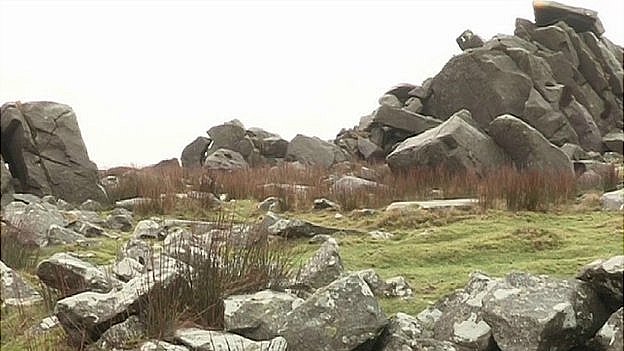
A study has discovered that rocks in the Preseli Hills, the source of some the stones at Stonehenge, have a sonic property

A study has discovered that rocks in the Preseli Hills, the source of some the stones at Stonehenge, have a sonic property

A study shows rocks in the Preseli Hills, the Pembrokeshire source of part of the monument, have a sonic property.

Researcher Paul Devereux said: “It hasn’t been considered until now that sound might have been a factor.”

The study, by London’s Royal College of Art, was to try and record what “Stone Age eyes and ears” would have heard and seen in a prehistoric landscape.

Since the 1920s, it has been known stones quarried in Mynydd Preseli were hauled 199 miles (320 km) to Wiltshire by its makers. But, trying to establish why has been more difficult.

‘Like a bell’

With this study, thousands of stones along the Carn Menyn ridge were tested and a high proportion of them were found to “ring” when they were struck.

“The percentage of the rocks on the Carn Menyn ridge are ringing rocks, they ring just like a bell,” said Mr Devereux, the principal investigator on the Landscape and Perception Project.

“And there’s lots of different tones, you could play a tune.

“In fact, we have had percussionists who have played proper percussion pieces off the rocks.”

Thousands of stones along the Carn Menyn ridge were tested and a high proportion were found to "ring" when struck

Thousands of stones along the Carn Menyn ridge were tested and a high proportion were found to “ring” when struck

According to Mr Devereux, the discovery of the “resonant rocks” could explain why they were selected for Stonehenge.

“There had to be something special about these rocks,” he said.

“Why else would they take them from here all the way to Stonehenge?”

‘Pre-historic glockenspiel’

Built between 3,000 BC and 1,600 BC, it has remained a mystery why the monument’s bluestones were lugged all the way from north Pembrokeshire.

But Prof Tim Darvill, who has undertaken hundreds of excavations at Stonehenge, insists “pre-historic attitudes to stone” must have been very different to those of today.

“We don’t know of course that they moved them because they rang but ringing rocks are a prominent part of many cultures,” he said.

“You can almost see them as a pre-historic glockenspiel, if you like and you could knock them and hear these tunes.

“And soundscapes of pre-history are something we’re really just beginning to explore.”

Inside Out was on  BBC1 at 19:30 GMT on Monday.
Full article here: http://www.bbc.co.uk/news/uk-england-wiltshire-26417976

Merlin @ Stonehenge
The Stonehenge News Blog


#Stonehenge – 5 musical tributes.

22 02 2014

Alan S's avatarThe Heritage Journal

Heritage Action and the Heritage Journal, as previously documented, had their beginnings on a web site forum “The Modern Antiquarian“, after the book of the same name written by Julian Cope. Mr Cope is possibly better known for his prime activity as a musician, and yet I don’t recall having had many musically themed entries here on the Journal.

A search on the major music sites for names of ancient monuments brings up a plethora of results, depending upon the monument selected. We decided to start with an obvious one – ‘Stonehenge’. This alone returns over 600 songs on AllMusic.com, with many more on Spotify and YouTube – although the YouTube results are somewhat skewed by videos of festivals, documentaries and travelogues, and duplicate entries. But here are five versions that may, or may not be familiar.

Ylvis – (What’s the Meaning of) Stonehenge (3:55)

This tribute…

View original post 373 more words


Stonehenge Community Open Days: 20th February and 20th March

13 02 2014

StonehengeNews's avatarStonehenge and Salisbury Guided Tours

There are still some spaces left for the 20th February and 20th March open days from 12pm -2pm at the new Stonehenge Visitor Centre. These are free events but you must pre book and call 0870 3331183 stating Stonehenge Community Open Days as the event you want to book onto.  You can book up to 4 people and must be a Wiltshire resident.

The Stonehenge Learning and Outreach Group with ourselves, Salisbury and South Wiltshire Museum, English Heritage Stonehenge open daysWiltshire Museum Devizes,Wessex Archaeology and National Trust will meet this week and share their learning events that are happening too.

Join us for a series of open days for the local community at the new Stonehenge visitor centre, featuring a special tour with Susan Greaney, Senior Properties Historian and Lisa Holmes, Community Projects manager.

Come and find out about the making of the exhibition, the opportunities for local voices to contribute to…

View original post 26 more words


18th Century William Stukeley book on Stonehenge is now online.

3 02 2014

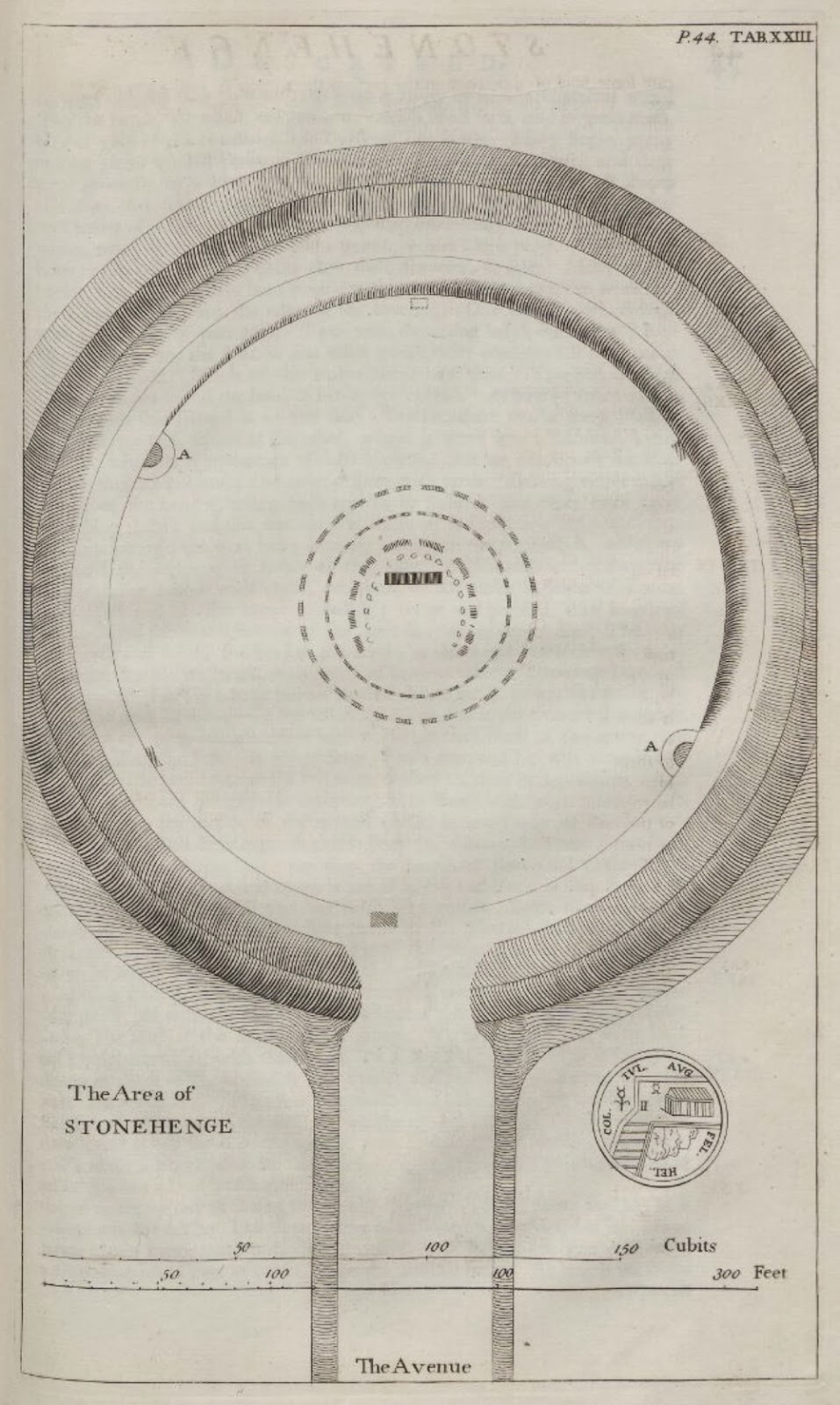
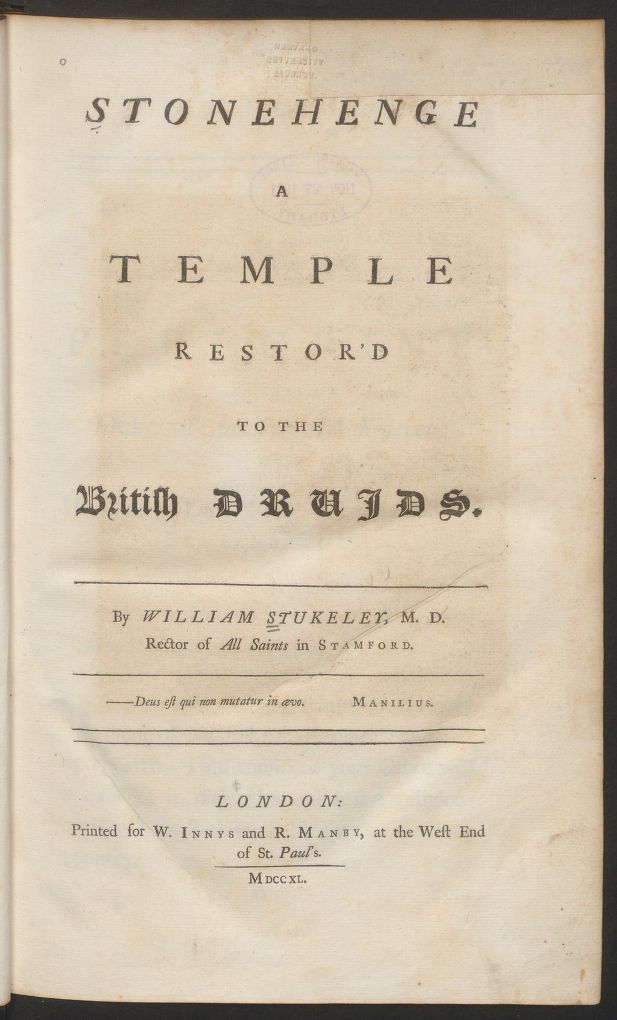
In 1740, British vicar William Stukeley published Stonehenge, A Temple Restor’d to the British Druids.

In more than 30 illustrations, Stukeley’s book documents the way Stonehenge appeared when he visited it in the early 18th century. The historian was only the 1-stukely-stonehengesecond scholarly investigator (after the 17th-century antiquarian John Aubrey) to take an interest in the site, and the first to publish a comprehensive account of what he found on his visits,  including images of the way that the monument looked in context of the  surrounding farmland.

In maps and vistas, Stukeley tried to capture the layout of the  monument’s stones. Much of his sense of urgency in the task came from  his belief that the stones’ arrangement needed preservation, as the  monument was under constant threat of vandalism and interference. For  example, Aubrey found and documented 20 stones in one area of the monument; a century later, Stukeley found only five remaining.

Stonehenge Visitor Centre: English Heritage current ‘Set in Stone’ exhibition includes an oil portrait of William Stukeley: http://www.english-heritage.org.uk/daysout/properties/stonehenge/discover/set-in-stone-exhibition

Link: http://tywkiwdbi.blogspot.co.uk/2014/01/1740-book-on-stonehenge-now-online.html
Stonehenge area news on twitter: https://twitter.com/ST0NEHENGE

The Stonehenge News Blog
Sponsored by ‘Stonehenge Guided Tours’ www.StonehengeTours.com


William Stukeley’s 1740 book on Stonehenge now online

2 02 2014

The Heritage Trust's avatarThe Heritage Trust

 
Stonehenge, a temple restor’d to the British Druids by William Stukeley
Harvard University Library
 
Harvard University Library has made available a digitised copy of William Stukeley’s 1740 book, Stonehenge, a temple restor’d to the British Druids. Printed in London in 1740 the book includes more than 30 illustrations showing how Stonehenge appeared when Stukeley visited it in the early 18th century, along with his theories concerning the monument’s origins and use.
 
 
Prospect of STONEHENGE from the southwest from William Stukeley’s, Stonehenge, a temple restor’d to the British Druids
Harvard University Library
 

View original post


Stonehenge: Winter Archaeology Walk

31 01 2014

The Heritage Trust's avatarThe Heritage Trust

 
Stonehenge in Winter by Walter Williams (1834-1906)
 
A Stonehenge: Winter Archaeology Walk will take place on Saturday, 15 February 2014 from 2:00pm to 4.30pm. In this guided, three mile walk (with views of Stonehenge) participants will visit some of the ancient earthworks that have revealed much about the people who once lived or visited the area. Other points of interest will include the Stonehenge Cursus, the many and varied barrows in the area, and an ancient Avenue that perhaps once connected ceremonial centres.
 
Booking required. Further information here.
   

View original post


Stonehenge: one road gone but fog surrounds the future of the other

29 01 2014

heritageaction's avatarThe Heritage Journal

SH fog

The Prime Minister has just said  the Government is “committed” to ending the traffic nightmare on the A303 between Devon and London. Everyone will welcome that (although even the preliminary study isn’t going to be produced before the next election). But from the point of view of prehistory fans the big issue that springs to mind is what will it mean for Stonehenge? There are three big reasons for concern:

1. For years English Heritage supported putting the A303 at Stonehenge in a massively damaging cut-and-cover tunnel.

2. Then, they supported a bored “short tunnel” despite the opposition of UNESCO and nearly all archaeological and heritage organisations on the grounds it too was very damaging.

3. It was cancelled due to cost but just last month Simon Thurley said they’d continue to argue for the tunnel, “with all our strength”.

We did ask WHICH tunnel [

View original post 40 more words


Neolithic-looking extras finding work for Stonehenge Empire Film

25 01 2014

It was perhaps the most bizarre request for extras issued in the West for a while – skinny men and women were required who had the look of the Neolithic about them.

Stonehenge, WiltshireThat meant “lean or athletic-framed” men and women who might have been just about fit enough to pull a huge lump of rock from west Wales to Salisbury Plain.

Filming has continued this week on a multi-national new TV series which sets out to be the definitive docu-drama about the building and use of Stonehenge ever made.

The BBC has joined forces with TV channels in the US, Canada, France, Austria, Germany and more to commission Stonehenge Empire, an epic documentary telling the story of the West’s most famous landmark.

And that means as well as discovering the latest from the so far ten-year project investigating the stones, re-enactments of the days when Neolithic people dragged the huge stones to the final spot near Amesbury are included.

So actors and jobbing extras across the West were summoned to be the Neolithic people.

And being in the background requires a certain look.

“They would have been Caucasian and fairly classic looking,” a spokesman for the extras agency said and added “Character faces are also good.”

Females had long hair with a natural tone, while males needed to be either bald, semi-bald with long hair at the back, or have longish hair.

“Beards are also beneficial,” the notice said.

Some actors went further than others in the pursuit of the perfect recreation of the world of the henge builders.  Lee Ravitz, an actor from Hertfordshire, played a “trepanning patient” in the docu-drama – which involved pretending to have a hole drilled in his skull.

The film will be screened over two, one-hour-long episodes and will change the way we look at Stonehenge, according to the creative director from film company October, Adam Bullmore.

“Stonehenge Empire will dramatically change the way we understand Stonehenge and the prehistoric culture that flourished around it,” he said. “Instead of seeing Stonehenge as an extraordinary achievement of an otherwise relatively primitive, prehistoric people, it will reveal Stonehenge as the epicentre of a truly remarkable and highly sophisticated ancient civilisation.”

The BBC are excited by the prospect of the film, which could be screened later this year, and uses CGI to recreate the vast scenes of thousands working on the stones.

Martin Davidson, BBC commissioner, said: “This is a really exciting project which will, using drama, CGI and the latest archaeological discoveries, allow us to properly understand the achievements and character of the people that built it; people who mastered deep mining and sophisticated engineering.”

Tristan Cork: tristan.cork@b-nm.co.uk
Article source from The Western Daily Press: : http://www.westerndailypress.co.uk/Neolithic-looking-extras-finding-work/story-20492638-detail/story.html#ixzz2rO9iDeQj

Stonehenge Empire Film: http://realscreen.com/2013/12/04/wcsfp-13-bbc-cbc-unite-for-stonehenge-copro/

Stonehenge Film links: http://www.stonehenge-avebury.net/Media/Stonehenge&AveburyFilms.html

The Stonehenge News Blog