Time to Elect a King.

2 07 2024

On July 4th 2024, the UK goes to the polls to choose who’ll govern us for the next five years. You’d be forgiven for thinking that nothing will ever change – that they’re all in it for themselves and that there’s no point in engaging with the process.

Hardly surprising really, the last 14 years have revealed just how self-serving the “political elite” can be when they become emboldened by the lack of proper scrutiny or accountability.

A supine broadcast media, in the case of the BBC largely because they are always terrified of the consequences of upsetting those who control whether their Charter is renewed, doesn’t help.

Newspapers (who reads them these days?) controlled mostly by offshore moguls whose only interest is in manipulating the levers of power behind the scenes are the plant-based media’s version of echo chambers for their audience.

What’s needed is to break the stranglehold of vested interests and start electing people who don’t give a stuff about the existing power structures and trample roughshod over conventional ideas of who our politicians should be.

In the Salisbury constituency there’s an option to do just that.

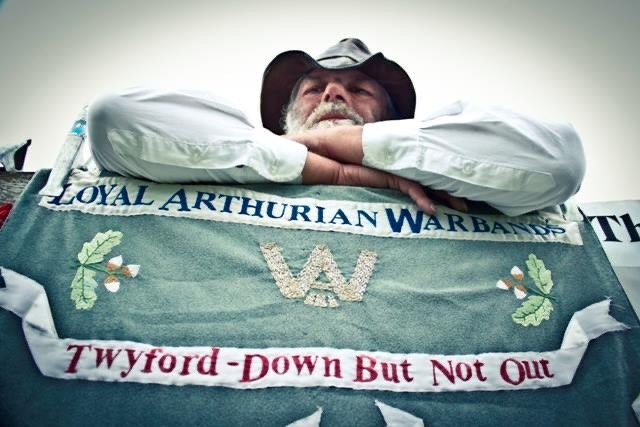
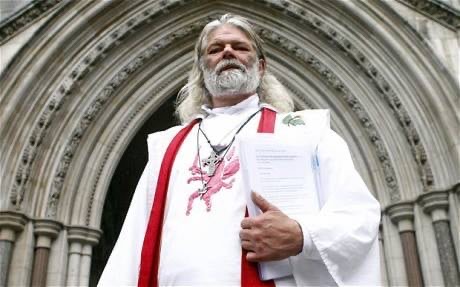
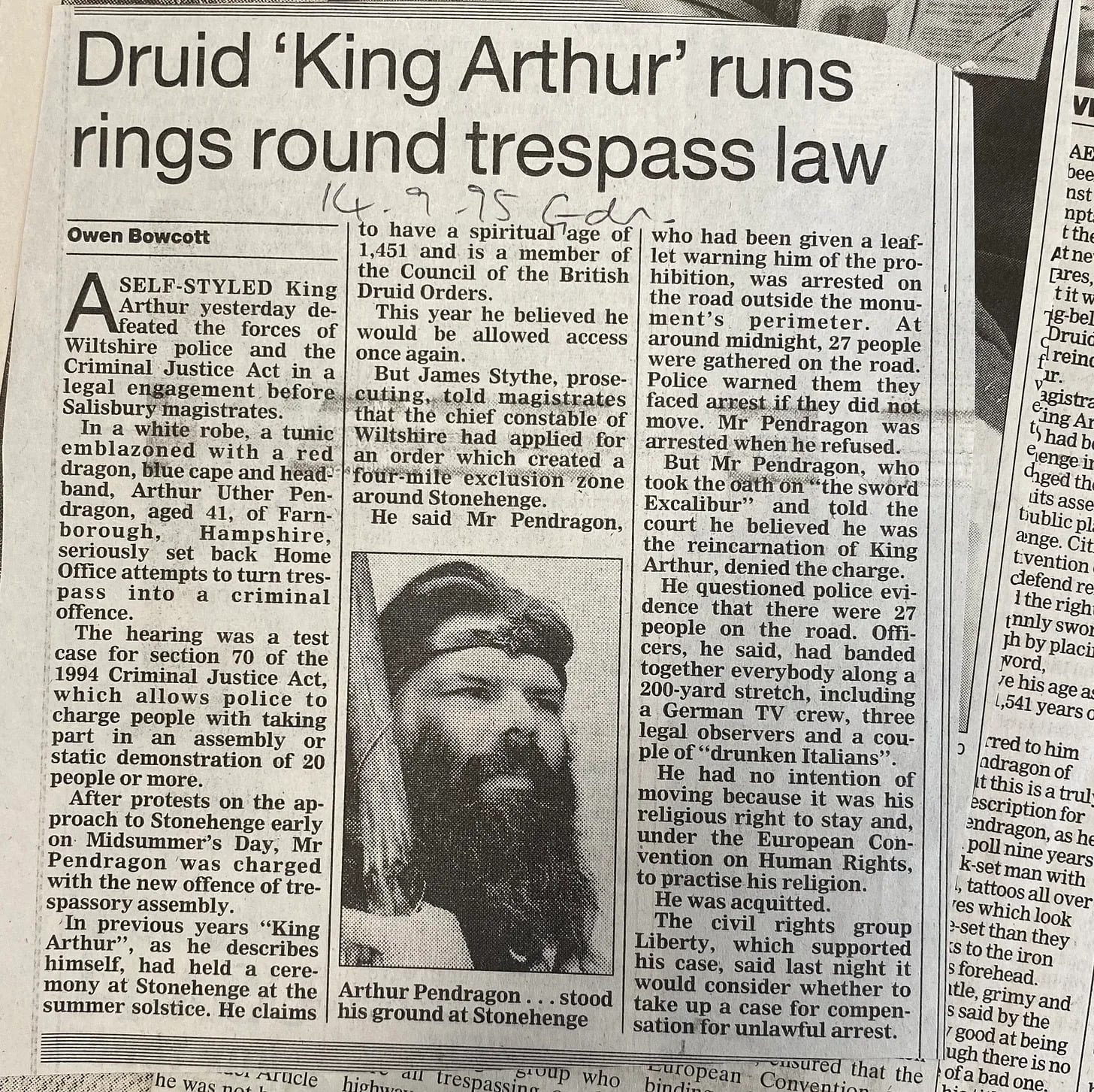
Step forward, King Arthur Uther Pendragon. Leader of the Loyal Arthurian Warband, Druid and environmental campaigner since before it became fashionable, and a firebrand who has been a thorn in the side of “The Authorities” for decades.

Loud, annoying and surprisingly effective at raising the profile of causes that may otherwise be ignored, Arthur’s nothing like the usual herd of career politicians.

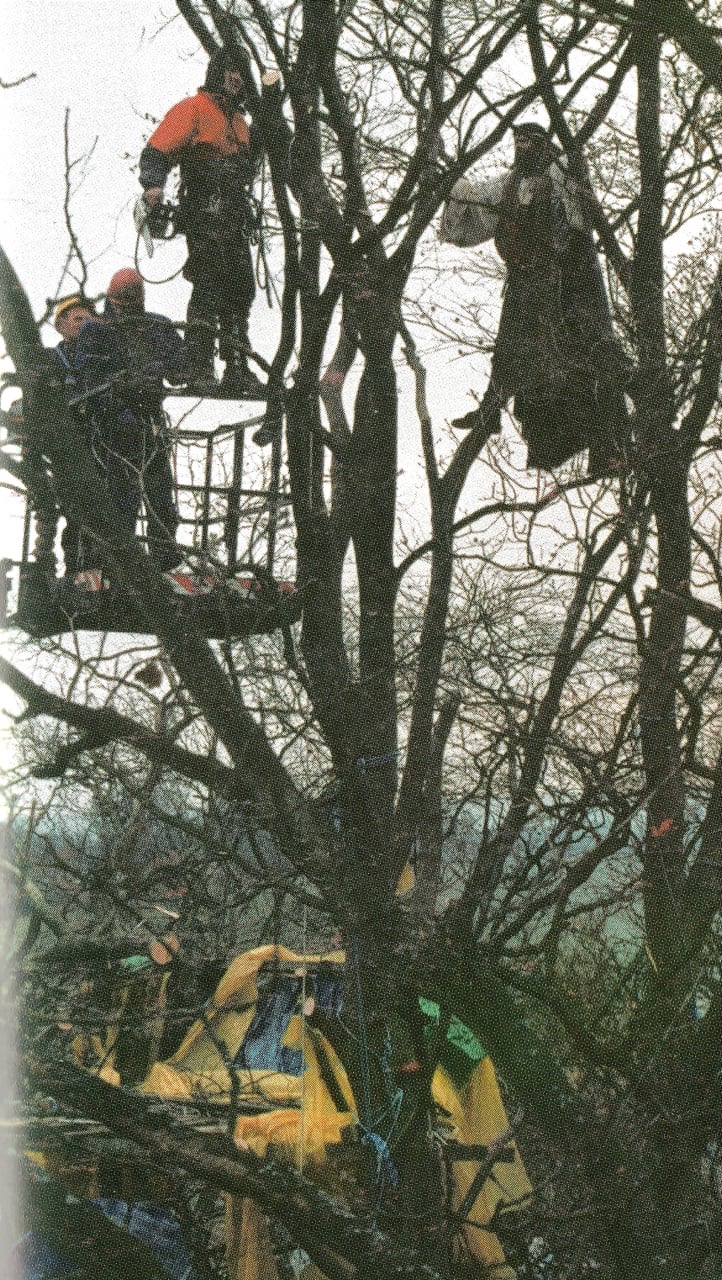
Ex-Army, ex-biker, once photographed defying the bailiffs and a bloke with a chainsaw at the top of a tree during the 3rd Battle of Newbury while protesting against the bypass.

Levitating Druid from “The Trials of Arthur”, photo Clive Odinson

He’s stood  an independent in every Parliamentary election in Salisbury since 2010, without the backing of any party machinery and supported only by grass-roots contributions.

As Prof. Ronald Hutton once put it, in “The Trials of Arthur” (ISBN 0-00-712114-8):

“A contemporary historian has therefore, to take Arthur Pendragon seriously. Upon the one hand he is a major figure in modern Druidry, leading one of the largest orders and representing a distinctive form of spirituality. On the other, he has an equally important place in the history of groups concerned with environmental issues and civil rights. It is an impressive dual achievement.”

A measure of the strength of the existing political system is that Arthur has mysteriously failed to be invited to a large number of the Hustings events held in the constituency.

The last thing the “ruling class” want is some independent-minded chap showing up and speaking uncomfortable truths it seems.

If we’re all content to carry on as we are, feeling powerless and shrugging our shoulders as Parliament becomes ever less relevant to the daily struggles of the public then fine.

If instead we think that it’s time for a change, then – at least in Salisbury – we get the chance to do it differently and elect a King.

Arthur Pendragon Links:
Vote for me as your champion, says senior druid standing to be MP – THE INDEPENENT
King Arthur Pendragon: ‘The people of Salisbury deserve a champion’ – THE SALISBURY JOURNAL
GE Interviews: Arthur Pendragon – Independent – SALISBURY RADIO
General Election: Who will be standing to be Salisbury’s next MP – SALISBURY JOURNAL
Arthur Pendragon – FACEBOOK
Druid Leader King Arthur Uther Pendragon, Head of the Loyal Arthurian Warband – STONEHENGE NEWS
Arthur Pendragon, Stonehenge and the Solstice – STONEHENGE NEWS BLOG

The Stonehenge News Blog
Follow us on Twitter and Facebook for all the latest Stonehenge News
http://www.Stonehenge.News


Just Stop… Protests?

25 06 2024

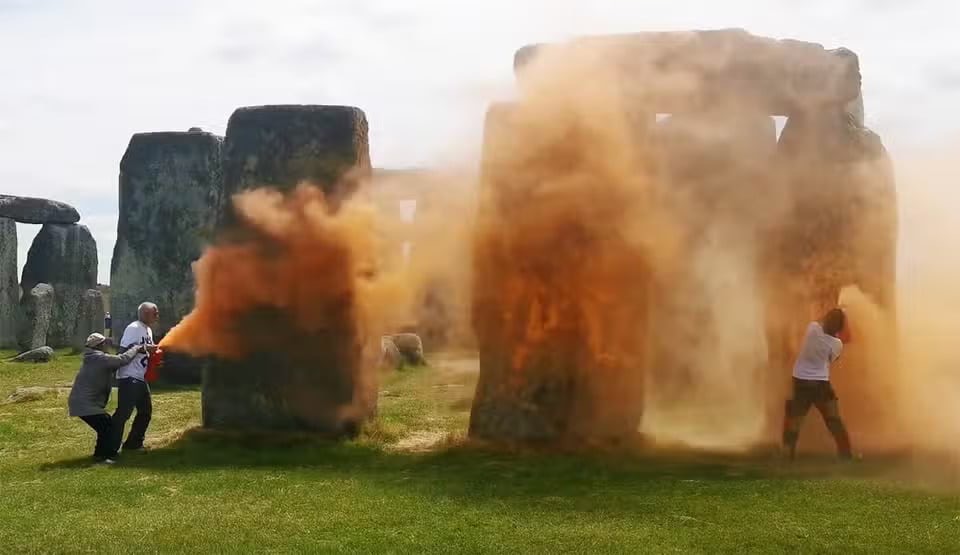
Just before Summer Solstice 2024, two protesters from the Just Stop Oil campaign group jumped the rope barrier between the paying public and Stonehenge itself to douse three stones in orange-coloured cornstarch using a pair of fire extinguishers.

In this particular instance, there was limited damage to the monument (the orange powder was removed with a leaf blower) but far, far more to the cause of JSO. It was almost universally condemned by anyone who was asked to comment – aside from those who felt the ends justified the means.

This isn’t the first time that this icon of British prehistory has been the target of stunts like this, and it probably won’t be the last.

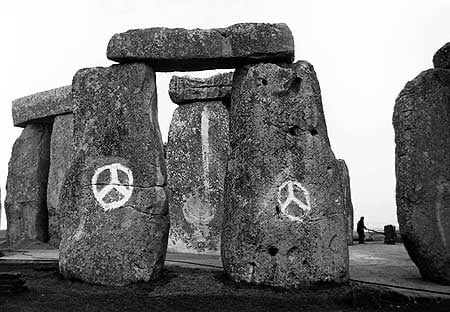
Back in the late 1950s the monument was daubed overnight with white paint depicting what was supposed to be the Peace symbol in protest at nuclear proliferation. Whoever did it wasn’t as effective as they’d hoped because what they actually drew was the Mercedes Benz logo.

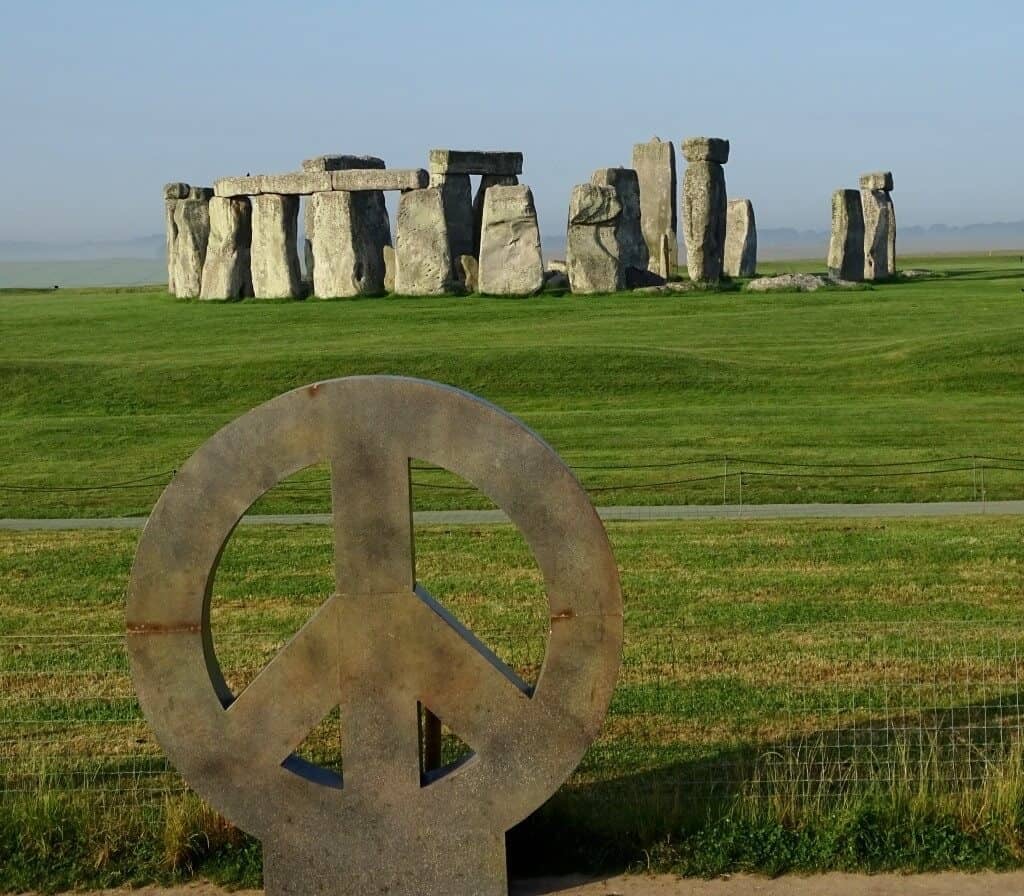
To be fair, the icon had only been invented a year or so beforehand and in a pre-Internet age such memes were slower to propagate. By the early 21st century CND used a 3D version of the symbol against a backdrop of Stonehenge to get their point across.

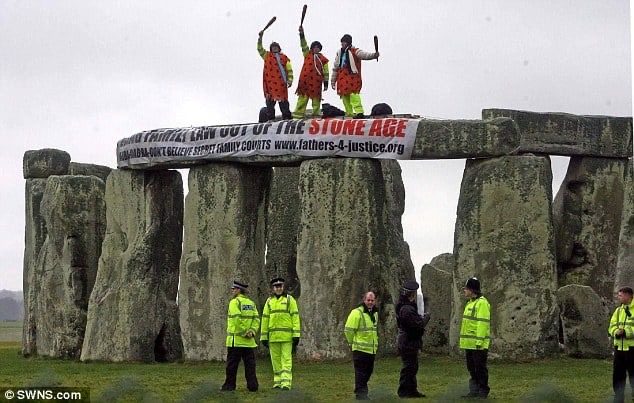
2007 saw the campaign group Fathers For Justice storm the monument dressed as the Flintstones and equipped with ladders to make their case. Baffled Police could do nothing except wait for them to get down of their own accord.

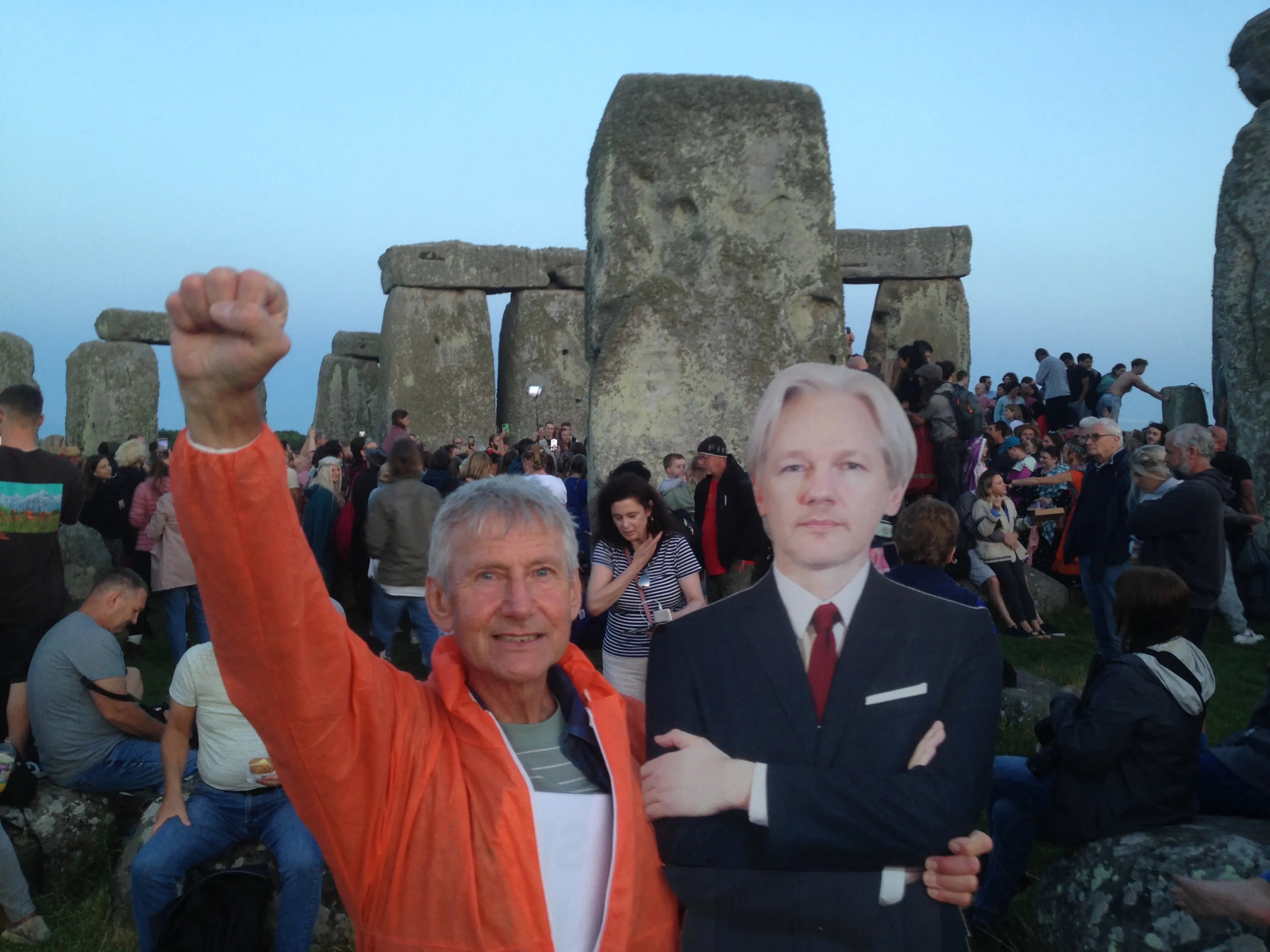
More recently, the ongoing saga of the imprisonment of Julian Assange has been highlighted at most solstices by campaigners armed with no more than a cardboard cutout. Simple, effective, and no threat to anyone – unlike Julian, apparently.

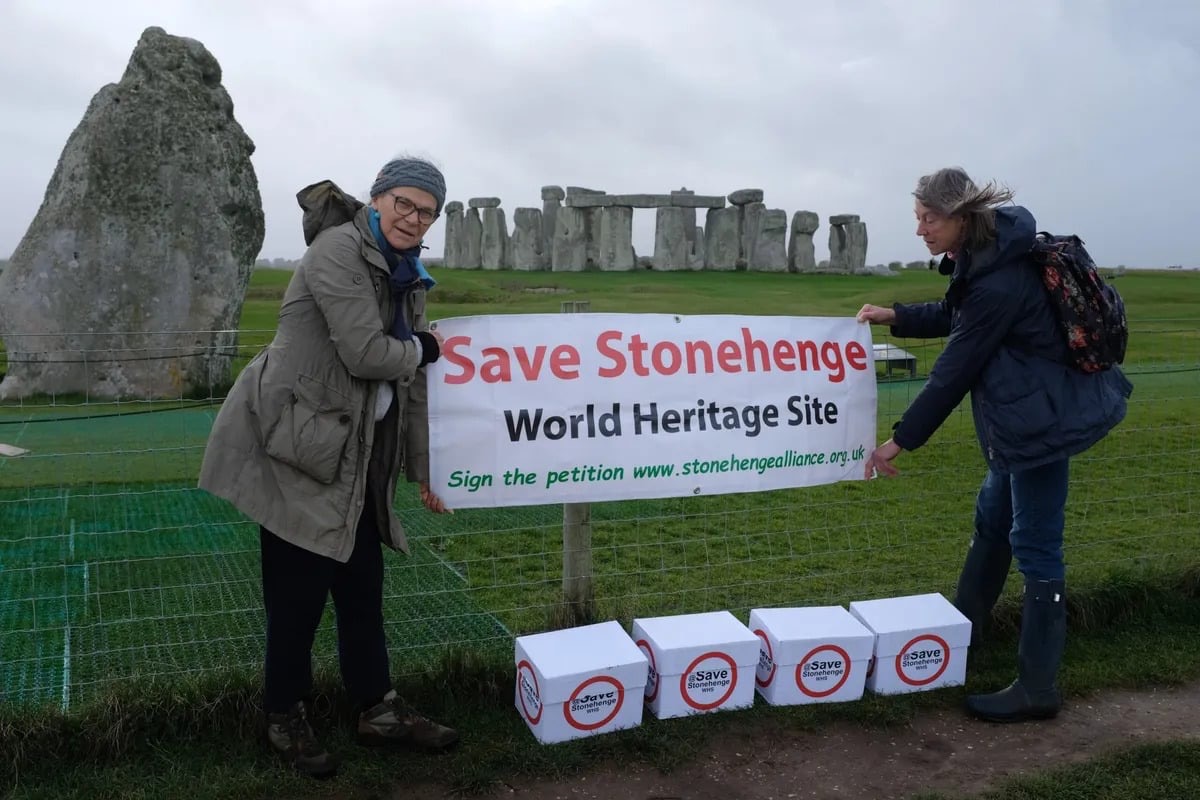
The eternal quest to drive from London to the southwest of England 8 minutes quicker, necessitating the building of a £2.5Bn four lane expressway across the World Heritage Site with some of it in a tunnel but a lot of it at ground level, has birthed a world-wide campaign against the plan – headed up by the Stonehenge Alliance.

Their tactics involve more conventional means like leafleting, Judicial Reviews, petitions and banners and obviously use Stonehenge as the backdrop since it is at the centre of the controversy.

At the time of writing (June 24th 2024) UNESCO has just said it is recommending putting Stonehenge on the list of World Heritate Sites “At Risk” at its 46th Session in New Delhi in July as a consequence of the tunnel project “despite repeated warnings from the World Heritage Committee since 2017”.

There is, though, one protester who has been front and centre for decades – King Arthur Uther Pendragon, Leader of the Loyal Arthurian Warband. An eco-warrior Druid veteran of anti-road schemes and tireless campaigner for the rights of all people to celebrate freely at Stonehenge.

After the appalling scenes of the Battle of the Beanfield in 1985 – when a large mob of largely anonymous Police and drafted in military personnel ambushed, attacked and violently beat up a convoy of peaceful folk attempting to make their way to Stonehenge for the free music festival that had been ongoing for 11 years and had just been banned by the authorities – a 4 mile exclusion zone was created around the site in summer to prevent further festival attempts in subsequent years.

In the 1990s, Arthur set up a (mostly) one-person protest camp by the Heelstone and camped on a nearby byway so he could draw attention to the exclusion issue as well as that of charging for access to Stonehenge. He was arrested every year as he tried to make his way to the monument for Solstice across the exclusion zone and became a royal pain in the arse to the authorities.

When jailed he refused to wear prison uniform and insisted on being allowed his Druid robes. When this was denied, he refused to wear clothes at all.

The media didn’t know what to make of it – on the one hand he was a troublemaker with a weird name and a stranger appearance who kept banging on about an odd cause, and on the other he was a charismatic underdog with a weird name and a stranger appearance who kept banging on about an odd cause!

In the end, in 1999, the UK Law Lords ruled that people had a right to free assembly on the public highway provided it was peaceful and unobstructive. The exclusion zone became unenforceable and everything changed.

The following year the first Managed Open Access to Stonehenge for the Summer Solstice took place, and any who wanted to attend to celebrate were freely allowed to do so for the first time in 15 years.

Stonehenge, of course, cares nothing for all of this. In 5000 years it has seen it all.

At least two murders – one in the Bronze Age, by arrowshot (“The Stonehenge Archer”) buried with care in the encircling ditch, and another in Saxon times by being (partially) beheaded then crammed into a crude grave just outside the sarsen circle, hammering by “picnickers” to extract souvenirs or engrave their initials on the stones reported through the 1700s and 1800s, clashes between early 20th century Druids and the lone Policeman charged with guarding the monument against the deposition of cremation ashes, painted graffiti perpetrated by everyone from drunk Army officers in 1938 to Radio Caroline fans in the 1960s – the list of slights to Stonehenge is almost endless.

If we are outraged by protesters using it to garner headlines, perhaps we should instead ask ourselves why we are apparently incapable as a society of engaging in meaningful civilised debate on vital topics in the first place.

POST BY GUEST BLOGGER AND LOCAL STONEHENGE EXPERT – SIMON BANTON

RELEVANT LINKS:
Two arrested after Stonehenge vandalised by Just Stop Oil – SALISBURY JOURNAL
Just Stop Oil spray Stonehenge with orange paint as heroic passer-by steps in to try to drag them away
DAILY MAIL

The Stonehenge News Blog
Follow us on Twitter and Facebook for all the latest Stonehenge News
http://www.Stonehenge.News



2024 Stonehenge Summer Solstice Celebrations

13 06 2024

This years Summer solstice will be celebrated from the evening of Thursday 20th June to the morning of Friday 21st June 2024. Sunrise and sunset will be live streamed on the official English Heritage YouTube channel. If you plan to attend in person, please read the following page carefully.

English Heritage are pleased to provide free Managed Open Access to Stonehenge summer solstice. We ask that if you are planning to join us for this peaceful and special occasion that you read the Conditions of Entry and the information provided below before deciding whether to come.

Please note: English Heritage are operating a pre-booking system for parking at Stonehenge during summer solstice in order to make best use of limited car parking on site and reduce local road congestion. We recommend travel by public transport or car sharing. If you do choose to drive, there are a limited number of parking spaces which you may wish to prebook online. Otherwise, parking will be available on the night until the carpark is full.

We anticipate significant delays in the immediate area due to temporary road closures:
Drivers face traffic carnage near popular tourist site with ‘incredibly damaging’ three-month road closure
A360 temporary closure update – 12 April 2024

FULL LIST OR LOCAL ROAD / BYWAY CLOSURES

Parking charges apply. Visit our Travelling to Stonehenge page for more details.

Stonehenge is a significant World Heritage Site and to many it is sacred – please respect the stones and all those who are attending.

Stonehenge is an ancient prehistoric world heritage site which has been a place of worship and celebration at the time of Summer Solstice for thousands of years. Stonehenge is a world renowned historic Monument and part of a World Heritage Site. It is seen by many who attend as a sacred place. The Stonehenge summer solstice is a popular annual event that sees thousands of people descend on Wiltshire to celebrate the changing seasons. Summer solstice falls on the longest day of the year.

What is the summer solstice?

At the summer solstice, the sun travels the longest path through the sky, and therefore that day has the most daylight. The exact moment of the solstice is the time of year that the Earth is closest to the sun.

According to the astronomical definition of the seasons, the summer solstice also marks the beginning of summer, which lasts until the autumnal equinox (22 or 23 September in the Northern Hemisphere, and 20 or 21 March in the Southern Hemisphere). Under the meteorological definition, which splits the year into four seasons of three full months each based on the Gregorian calendar, winter starts on 1 December every year, and summer starts on 1 June.

2024 Stonehenge Summer Solstice Links:

The summer solstice: When is it and what causes it? SPACE.COM
When is the summer solstice 2024? The first day of summer and meaning behind it – Evening Standard
Druid Leader King Arthur Uther Pendragon, Head of the Loyal Arthurian Warband. STONEHENGE NEWS BLOG
Respecting the Stones.  Managed Open Access –STONEHENGE NEWS BLOG
Solstice at Stonehenge. From Past to Present. – STONEHENGE NEWS BLOG
The Stonehenge Solstice Pilgrims – STONEHENGE NEWS BLOG
Respecting the Stones.  Managed Open Access –STONEHENGE NEWS BLOG
Summer Solstice at Stonehenge. From Past to Present. Stonehenge New Blog
Why Thousands Of Pagans Gather At Stonehenge For The Solstice Stonehenge News Blog

The Stonehenge News Blog
Follow us on Twitter and Facebook for all the latest Stonehenge News and 2025 Summer Solstice updates
http://www.Stonehenge.News


Experts believe the Stonehenge Altar Stone could have come from as far away as northern England or Scotland. We anticipate an exciting revelation shortly.

22 04 2024

Altared States: The Altar Stone at Stonehenge is one of the most mysterious of the 900 tons of rock that has been deliberately brought to the site by humans over the last 5000 years.

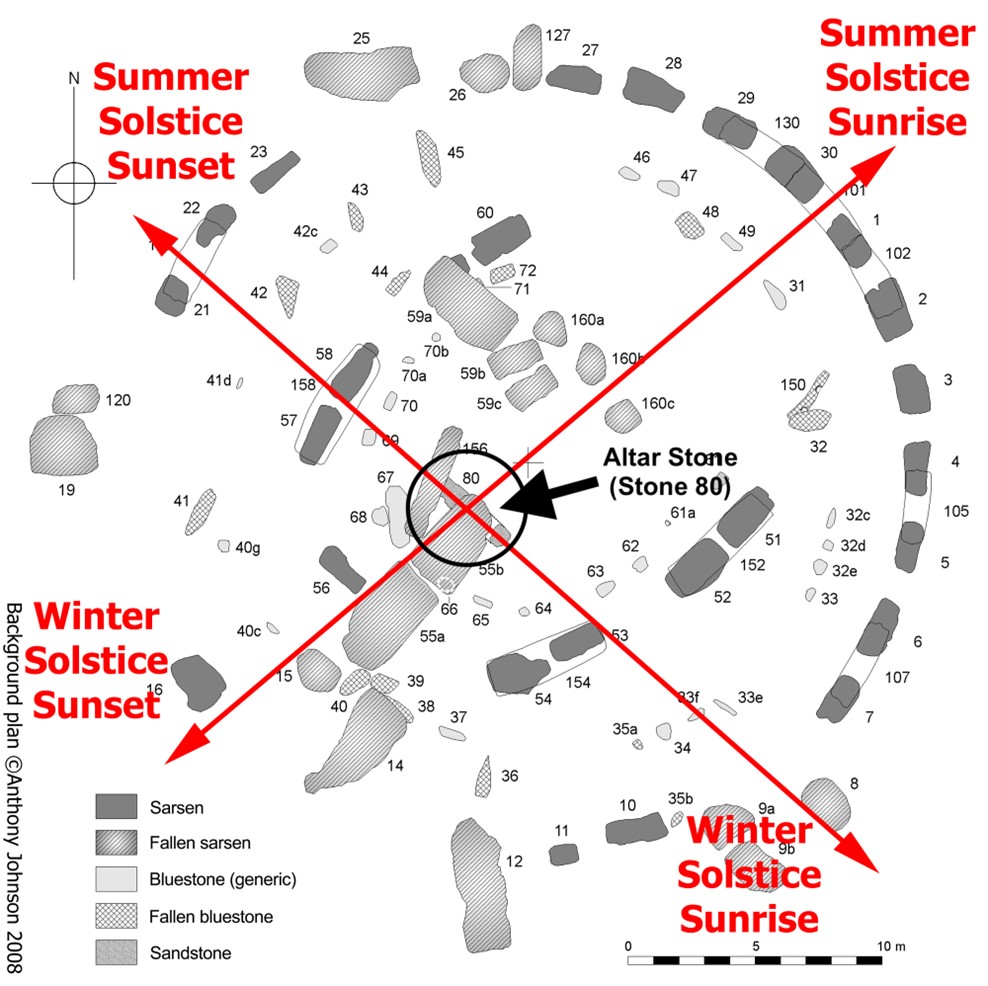
It sits inside the stone circle in a very special position – lying prone, mostly buried in the turf, directly in front of what was once the tallest trilithon on the site of which only a single stone still stands, the slim and elegant Stone 56.

It’s tricky to see as it’s mostly obscured by the collapsed upright and lintel of that tallest trilithon, but this image shows the eastern half of it highlighted in red – the dotted lines indicate that it continues off-picture to the right.

The primary axis of the monument – from Summer Solstice Sunrise to Winter Solstice Sunset – crosses directly over the centre of the Altar Stone, and the secondary axis – from Winter Solstice Sunrise to Summer Solstice Sunset – runs down the midline of this 16’ long x 3’ 6” wide x 1’ 9” deep lump of fine grained greenish sandstone. It therefore lies precisely on the intersection of the main solar alignments at Stonehenge.

It has always been recognised that the Altar Stone is a “foreign” stone, that it is not a locally-sourced sarsen.

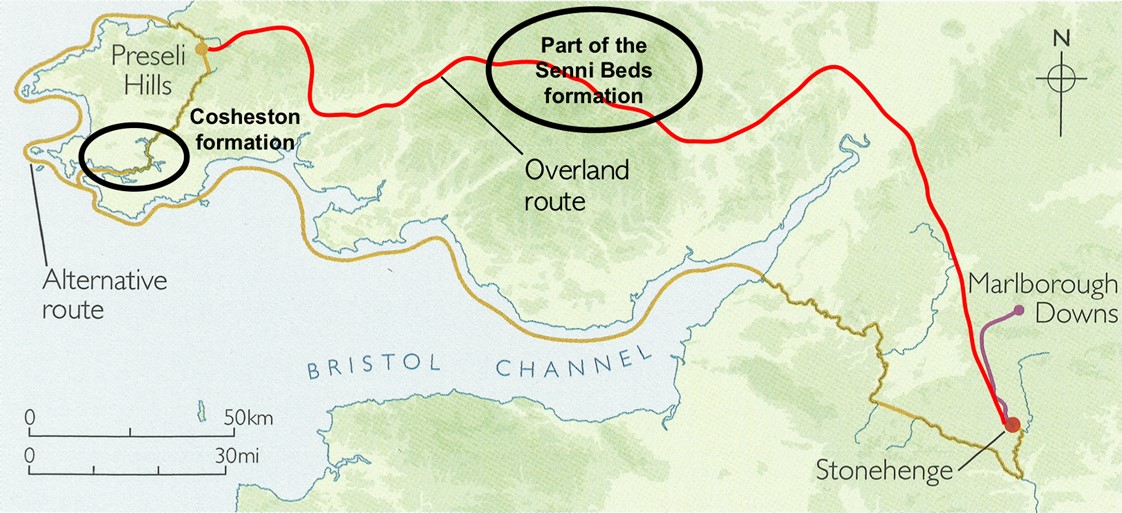
For over a century it had been grouped with the bluestones that originate in the Preseli Hills of Pembrokeshire in south west Wales but – being a sandstone rather than a dolerite or rhyolite – its likely source was thought to be the Cosheston Beds of Old Red Sandstone near Milford Haven.

The suggestion was that it had been collected along the supposed coastal route that the bluestones were assumed to have taken.

However…

As recently as 2020, detailed analysis revealed that the unique Altar Stone didn’t closely match the Cosheston Beds mineralogy. This led to its provenance changing to a possible source in the Bannau Brycheiniog (Brecon Beacons) in south east Wales –  the formation known as the Senni Beds – just north of Abergavenny.

This was particularly interesting because it bolstered the idea that the bluestones had been transported to Stonehenge by a land route rather than being rafted by sea around the coast.

The story didn’t stop there. Further analysis revealed another wrinkle – the Altar Stone has a very high level of barium, much higher than the samples extracted from the Anglo-Welsh basin for comparison. The historical linking of the Altar Stone and bluestones as “foreign” stones had biased researchers towards looking for a South Wales source for it, and the evidence was now pointing a different way.

In 2023, via a paper entitled “The Stonehenge Altar Stone was probably not sourced from the Old Red Sandstone of the Anglo-Welsh Basin: Time to broaden our geographic and stratigraphic horizons?” (https://doi.org/10.1016/j.jasrep.2023.104215) Ixer, Pearce, Bevins et al dropped a bombshell.

Looking at the geological map of Britain, there are only a few possible sources of an Old Red Sandstone with such high levels of baryte cement – the West Midlands, the north of England and… Orkney.

It is far too early to know whether this last possibility is in fact true, but there are established links in the archaeology between Orkney and Stonehenge and it’s an intriguing idea that the Altar Stone may conceivably have made a 500+ mile journey. We expect exciting news this week, you heard here 1st!

GUEST BLOGGER: SIMON BANTON

RELEVANT LINKS:
New mystery over origins of Stonehenge after remarkable discovery – THE GUARDIAN
100-year-old origin theory of Stonehenge’s iconic Altar Stone could be wrong, scientists say – LIVE SCIENCE
Tours of Stonehenge with local guided experts – STONEHENGE GUIDED TOURS
Analyze This: Stonehenge’s ‘Altar Stone’ has mysterious origins – SCIENCE NEWS
Stonehenge Guided Landscape Tours – STONEHENGE TOUR COMPANY
Stonehenge Altar Stone is probably not from Wales – THE PAST

The Stonehenge News Blog
Follow us on Twitter and Facebook for all the latest Stonehenge News and Equinox updates.
http://www.Stonehenge.News


Stonehenge: Eclipse of the Moonmen

21 04 2024

The media has, this week, been running a story about the upcoming Major Lunar Standstill – an event that only occurs only 18.6 years – discussing how academics from a variety of institutions are planning to carry out observations to see if Stonehenge has any alignments to the Moon.

One quote from an article in The Guardian’s piece on this topic says:

“It is also possible that four “station stones” forming a rectangle at the site – two of which are still standing – may have been positioned to mark the major lunar standstill.”

Not a single mention is made, in either this article or in any of the others that have appeared, of the two people who first proposed this hypothesis over 60 years ago – Professor of Astronomy at Boston University, Gerald Hawkins, and amateur astronomer C. A. “Peter” Newham, a retired Group General Manager of the North Eastern Gas Board.

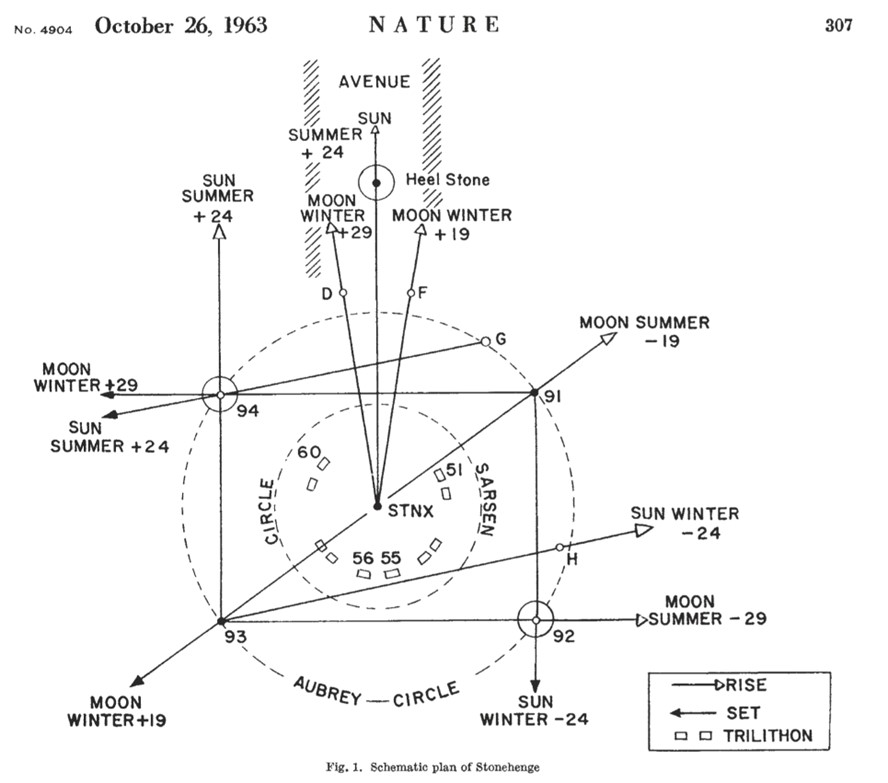
Working independently, and unknown to each other, they each suggested that the long sides of the Station Stone Rectangle at Stonehenge was aligned to the extremest possible southerly Moonrise and northerly Moonset positions on the SE and NW horizons.

Newham’s idea was first reported in a newspaper article about his work which appeared in the 16th March 1963 edition of the Yorkshire Post.

“The first remarkable discovery he made was that a line drawn from mound 94 to 91 would appear to coincide with the point on the horizon where the moon rises at its most southerly point during its 19-year cycle. Conversely, the line from 92 to 93 marks the moonset at its most Northerly setting point.”

Hawkins’ identical realisation was first published in his paper “Stonehenge Decoded” in the journal “Nature” vol 200, 26th October 1963.

It is fascinating that these two individuals arrived at the same conclusion, publishing mere months apart, having never previously corresponded or met with each other. Subsequently, of course, they became very aware of their fellow megalithomaniac and both contributed papers to Nature in the succeeding years.

Prof. Richard Atkinson, the acknowledged authority on all matters Stonehengey at the time, had a clear fondness and respect for Peter Newham in stark contrast to his antipathy towards Gerald Hawkins. He lambasted Hawkins’ work in a letter to Antiquity in 1966 entitled “Moonshine on Stonehenge”, but wrote a touching obituary for Newham following Peter’s death in April 1974 saying:

“He was also the first to give a detailed analysis and interpretation of the enigmatic array of postholes on the entrance causeway of the circular earthwork; and the first again to provide an astronomical explanation of the three huge postholes found during the extension of the Stonehenge car-park in 1966. For this and for much else besides he will be remembered with affection and gratitude.”

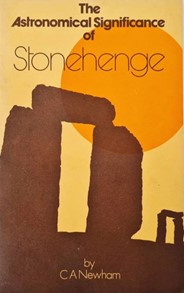
Gerald Hawkins’ insights continue to be unfairly decried in the official story as told in the new Stonehenge Visitor Centre exhibition, but Peter Newham doesn’t even rate a mention – although his excellent little book “The Astronomical Significance of Stonehenge” used to be stocked in the gift shop at the old site and was extremely popular.

As the Major Lunar Standstill of 2024/5 approaches, we should take the chance to remember Peter as one of those gifted amateurs who – by dint of keen observations made by an enquiring mind – recovered some of the lost understanding of this enigmatic monument’s purpose.

Major Standstill Southernmost Moonrise having just risen over Station Stone 91
as seen from the position of Station Stone 94 on 9th July 2006
© Simon Banton

GUEST BLOGGER: SIMON BANTON

RELEVANT LINKS:
Rare lunar event to shed light on Stonehenge’s links to the moon – THE GUARDIAN
Were Stonehenge’s Builders Guided by the Moon? – SMITHSONIAN MAG
Tours of Stonehenge with local guided experts – STONEHENGE GUIDED TOURS
Stonehenge may have aligned with the Moon as well as the Sun – THE CONVERSATION
Mysterious secret behind Stonehenge could be ‘linked to the moon’ say scientists – THE MIRROR
Bid to shed light on whether Moon could have influenced – THE STANDARD
Stonehenge Walking Tours – STONEHENGE TOUR COMPANY

The Stonehenge News Blog
Follow us on Twitter and Facebook for all the latest Stonehenge News and Equinox updates.
http://www.Stonehenge.News


Stonehenge: Tunnel Vision.

12 04 2024

In December 2014 the then coalition UK Government announced to great fanfare that the decades long saga of the on-again-off-again A303 Stonehenge Tunnel project would be revived once more.

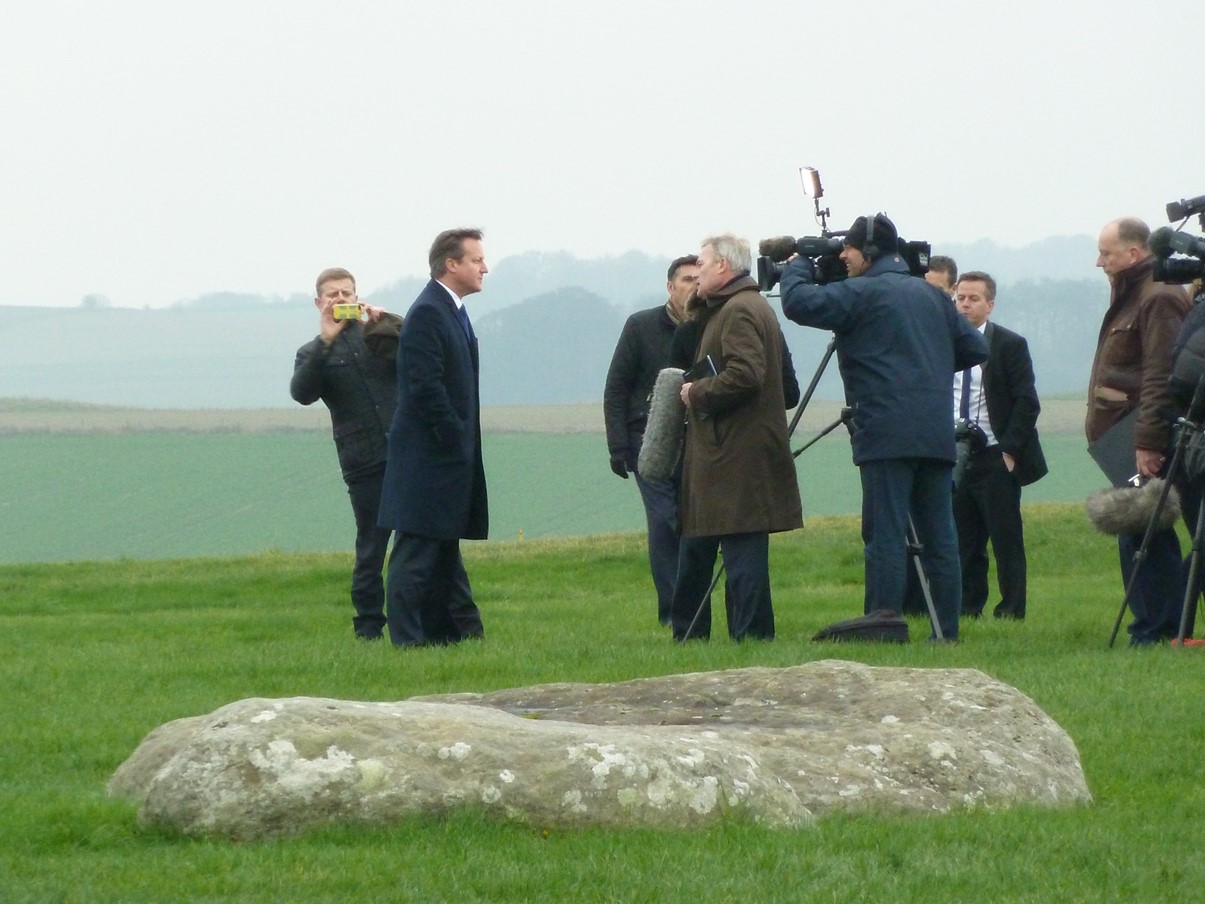
The sound of zombie horses attempting the crawl away from yet another flogging pervaded the World Heritage Site, as first Deputy Prime Minister Clegg then Prime Minister Cameron descended on Stonehenge accompanied by the usual press, TV and English Heritage top brass.

A previous version of the project, estimated at £400M, had been cancelled several years earlier by a Government of a different colour on the basis of the cost, so it was somewhat surprising to learn that its reanimated corpse was now expected to require an eye-watering £1.7B – £2.5B.

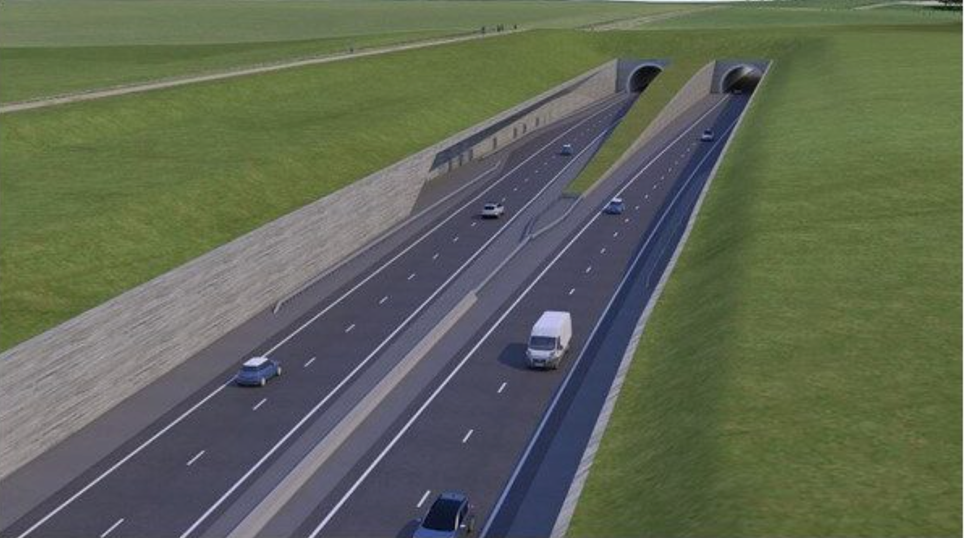
To be fair, according to the plan this time the tunnel will be fully bored rather than cut-and-cover and will be somewhat longer. Not long enough, mind you, to go the full distance from the eastern edge of the World Heritage Site all the way to the western edge.

Instead, it will put its portals in the ground well inside the area of Outstanding Universal Value, obliterating whatever might be in the way.

A brand new dual carriageway will run from the western portal across 1k of farmland, sunk into a trench around 9m deep and 50m wide, to a new junction with the A360 at Longbarrow Roundabout.

At the eastern portal, the new dual carriageway will emerge to soar over the current A303/A345 junction at Countess Roundabout on a 10m high flyover, bringing 60mph HGV traffic noise to the delighted locals.

Almost 10 years on from the announcement, here’s where we are.

After an Enquiry in Public (where the independent Examiners decided against the whole idea), a doleful procession of vacant-eyed Secretaries of State for Transport (some of whom lasted less than 2 months in the job), a determination by one of them to approve the scheme’s Development Consent Order despite UNESCO’s and many others’ misgivings, a Judicial Review into that decision which found the Sec. of State had acted “irrationally” in doing so, then a “re-determination” of the application by a subsequent incumbent which again gave approval, and a further legal challenge (recently lost by anti-tunnel campaigners), we are now awaiting an impending appeal against that ruling.

Over a quarter of a million people have signed petitions against the scheme, crowdfunding an expensive ongoing legal process to the tune of hundreds of thousands of pounds.

UNESCO have threatened that Stonehenge World Heritage Site may be placed on the World Heritage in Danger register (a precursor to delisting) if the scheme goes ahead in its present form.

In the event that the tunnel does get built – estimated costs are now above £3B, and look likely to rise even more over the 5 years the build is optimistically slated to take – one certain outcome is that the casual view of a 4,500 year old global icon of prehistory from the A303 will be lost forever.

From being something freely glimpsed in the magnificent early dawn light surrounded by mist as you crest King Barrow Ridge making your way westwards, or appearing unexpectedly nearby, glowing rose-golden in the rays of the setting Sun as you head past it eastwards, it will become an experience only available to those who are either willing and able to pay the ever-increasing entrance fee or are lucky enough to be capable of walking the couple of miles from the nearest available parking or bus stop.

Meanwhile Stonehenge looks on impassively, perhaps whispering to those who will listen that humanity’s obsession with getting to the next traffic bottleneck a whole 8 minutes faster really may not be worth the cultural, let alone the financial, cost in the long run.

GUEST BLOGGER: Simon Banton (April 2024)

The Stonehenge News Blog
Follow us on Twitter and Facebook for all the latest Stonehenge News and Equinox updates.
http://www.Stonehenge.News

April 2024


Section of A360 Road from Stonehenge to Salisbury will be closed for three months from 2nd April 2024

31 03 2024

A major A-road through Wiltshire will shut for three months during a significant roadworks project. Drivers warned of three month road closure ahead of A303 Stonehenge upgrade.

Motorists could face traffic carnage near popular tourist area with plans to close key road for three months

The A360 will close between its junction with The Avenue, near Salisbury, and the Longbarrow junction with the A303 from Tuesday, April 2.
During the closure, traffic will be diverted via the A345 and sections of the A303 and A36, as per the diagram below, and a comprehensive signage system is being developed to inform road users around Salisbury and as far away as Devizes and Shaftesbury to point traffic to alternate routes.

The busy route will remain shut for three months while works are carried out by Scottish and Southern Electricity Networks in relation to the planned A303 Amesbury to Berwick Down upgrade past Stonehenge.

National Highways said it would be “working hard” to minimise disruption before the summer

This scheme is being implemented on behalf of National Highways and will involve installing high voltage and fibre optic cabling along the road.

These cables will provide electricity for the major upgrade scheme on the A303, powering both construction and the planned tunnel in the long term.

A full closure is necessary during this period for safety reasons due to the narrow width of the road and the minimal spaces along the verges.

Work will be carried out seven days a week with some overnight working to allow the closure to be lifted before the school summer holidays.

National Highways says the works could have taken up to a year if single-lane closures and traffic signals were employed.

The diversion route will see drivers follow the A345, and sections of the A303 and A36, and National Highways has warned delays are likely.

Motorists have been advised to plan their journeys ahead of time and allow extra time to reach their destination.

Andrew Clark, National Highways’ project manager for the A303 Stonehenge scheme, says measures are in place to minimise the impact of the road closure.

He added: “The road scheme will ultimately tackle the longstanding issue of rat running and provide a real benefit to local communities, and for this essential preliminary work, we are doing all we can to put in measures to lessen the impact for local communities and the travelling public.

“We need to carry out the work now to maintain our programme, we appreciate that roadworks and road closures can be frustrating and we’d like to thank motorists, local residents, and businesses in advance for their patience.

“Without the full closure, the work would take a lot longer to complete, and working with Wiltshire Council, we’re making every effort to ensure that the impact on drivers and local communities is kept to an absolute minimum.”
A comprehensive signage system will be in place all the way from Devizes to Salisbury to point traffic to the alternative routes. SOURCE: Swindon Advertiser

Road Closure Links:
A360 set to be closed for FOUR MONTHS for Stonehenge tunnel project – Wiltshire Times
Drivers warned of three month road closure ahead of A303 Stonehenge upgrade – ITV
Section of A360 soon to be closed for three months – Salisbury Journal
Diversion route for A360 closure confirmed – Salisbury Radio
A360 temporary closure – English Highways

The Stonehenge News Blog
Follow us on Twitter and Facebook for all the latest Stonehenge News and Equinox updates.
http://www.Stonehenge.News


Stonehenge Spring (Vernal) Equinox. Managed Open Access: 20th March 2024

7 03 2024

This year Spring Equinox will be celebrated on Wednesday 20th March 2024.

English Heritage is pleased to give a short period of managed open access on the 20th March. Sunrise is at 6:11am, and access will commence as soon as it is safe, this is likely to be from approximately 5:45am and will end at 8:30am. The Stonehenge car park will open at 05:15am. All vehicles must vacate the car parks by 11am.

The spring equinox is one of the rare occasions that English Heritage opens up the stones for public access. Equinox open accesses attract fewer people than the Solstices – in the several hundreds rather than tens of thousands – and there are modern Druid ceremonies which are held in the circle around dawn.

Spring equinox 2024

This is the first of the four ‘sky points’ in our Wheel of the Year and it is when the sun does a perfect balancing act in the heavens. This is the point of the year when once again day and night are equal – 12 hours. The equinox, (the Latin word for Equinox means time of equal days and nights) is only the very moment the sun crosses the equator.

WHY CAN PAGANS AND DRUIDS GET SO CLOSE TO THE STONES FOR THE EQUINOX?

The famous Stonehenge circle is normally roped off to the public, but special access is granted four times a year. This is only on the mornings of the summer solstice, winter solstice, spring equinox and autumn equinox. English Heritage has ‘managed open access’, meaning the public can stand among the stones on these days. Anyone can turn up on the day to get close to the stones, but people are asked not to touch or climb on them. Organisers also have a ban on bringing glass bottles or pets onto the site and on playing amplified music. Stonehenge is expected to open at 5.45am when it was deemed light enough to safely allow people into the field and visitors must leave by 8.30am. English Heritage open to the paying public as normal at 9.30am.

Public access to Stonehenge currently takes place on four of the so-called ‘quarter festivals’. What exactly are the quarter festivals? And why are these occasions so celebrated by the Druids? The Quarter Festivals and the Druids

You can find out more about attending Solstice and Equinox by clicking on the links below.

Travelling to Stonehenge

What (and what not) to bring

Respect the stones

Safety, facilities and welfare

Accessibility

Accommodation

Related Equinox Links:
How the Spring Equinox marks the changing seasons – The Telegraph
What is the vernal equinox? Why does it mark the first day of spring? – Express
Summer Solstice at Stonehenge. From Past to Present – Stonehenge News Blog
Stonehenge Spring Equinox Tours and Transport – Stonehenge Guided Tours
Solstice at Stonehenge – English Heritage
The Stonehenge Pilgrims – Stonehenge News Blog
What Exactly Is the Spring Equinox? – Country Living
Stonehenge Equinox / Solstice Guided Tours – Solstice Events UK
Visiting Stonehenge this year for the Spring Equinox Celebrations? RESPECT THE STONES

The Stonehenge News Blog
Follow us on Twitter and Facebook for all the latest Stonehenge News and Equinox updates.
http://www.Stonehenge.News


History Makers at Stonehenge this Half Term:(10th -18th Feb 2024)

10 02 2024

English Heritage is hosting  Half Term History Makers  activities at Stonehenge over the February half-term from 10-18 February. Families will be able to step back in time to the Neolithic period and find out what life was like through fun, hands on games.

Join characters from the past for historical hijinks and hands on shenanigans at Stonehenge this half term.

Step back in time with us to the Neolithic period and find out what life was like through fun, hands on games. Practice your skills in spear throwing, make your own slingshot to try out on their targets and decide if you could face a Neolithic dinner!

Book online and save 15%

The Stonehenge News Blog
Follow us on Twitter and Facebook for all the latest Stonehenge News
http://www.Stonehenge.News



Stonehenge Winter Solstice Celebrations 2023. Managed Open Access Arrangements

24 11 2023

Winter Solstice at Stonehenge will take place at sunrise on Friday 22nd December 2023. English Heritage are expected to offer a short period of access, from first light or safe enough to enter the monument field (approximately 07.45am until 10.00am)

Winter Solstice, access to the stones themselves is free and without restriction, and visitors can get up close with the marvel that is Stonehenge. After it passes, the days will begin to get longer and longer until June when the Summer Solstice takes place.

The Winter Solstice, marking the shortest day and longest night of the year approaches, drawing neo-druid and neo-pagan pilgrims to Stonehenge to watch the sunrise through the sacred site.

This is a twice-yearly pilgrimage for many visitors, including Druids and Pagans, with the Summer Solstice in June being the largest of the two events. The festivals which have celebrated the passing of the seasons and new beginnings throughout human history, offer a unique opportunity to visit Stonehenge with no barriers and draws crowds every year.

Whatever the weather, it could be cold and wet. So please dress accordingly.  Shuttle buses will be running to take you from the car parks to the stones. However, you may choose to walk from the Visitor Centre up to the stones. This takes 30 minutes on average and will be in low-light. So a torch would be essential.

Why is open access on the 22nd December?
Many people believe the Winter Solstice always falls on December 21, but because of a mismatch between the calendar and solar year, the December solstice is not fixed to a specific date.

This year, English Heritage says based on advice from the druid and pagan communities, the Solstice will be marked at Stonehenge on the morning of Friday December 22nd December – the first sunrise following the astronomical solstice which occurs after sunset the previous day.

Access to Stonehenge for Winter Solstice is is subject to the Conditions of Entry. Please read these before deciding whether to attend.  Stonehenge is in a field on Salisbury Plain and the weather in December will be cold and wet.  Even if it isn’t raining, the ground will be wet from the dew and there may also be frost. Sensible footwear and warm, waterproof clothing is essential. Please note, parking charges apply.

Can I watch the sunrise on a live stream?
English Heritage will be live streaming the sunrise on the morning of 22nd December for free on their digital channels. Visit the official Stonehenge or English Heritage Facebook page, or the English Heritage YouTube channel. Please beware of fake/scam Facebook pages, events and groups that might have been set up.

Getting there:

Extremely limited parking available and strongly recommend using public transport to avoid disappointment. Salisbury Reds are operating a dedicated Solstice service from Salisbury train station via Amesbury. Please check their website for details. We also have a dedicated car sharing website which is available here.

Limited parking is available in the Winter Solstice car parks, which will open at 6am on the 22nd December 2023. Please follow the brown tourist route signage to Stonehenge. There will be signs to direct you to the car parks.  Please do not arrive early as there is no waiting on roads in the area and you will be moved on.

There will be a parking charge for all vehicles in the official car parks for Winter Solstice 2023 – £5 for cars and minibuses up to 16 seats and £2 for motorbikes. This can be paid by cash or card.

As you approach Stonehenge, please follow signs to the car park. This is located close to Airman’s Corner Roundabout just off the A303. We ask that you park sensibly and only where directed by a steward or police officer.  This will help us make full use of the car park.

Stonehenge Winter Solstice Links:
Stonehenge Winter Solstice 2023 – ENGLISH HERITAGE
When is the shortest day of the year — date of winter solstice and what it means – DAILY MIRROR
The Rebirth of the Sun: the Winter Solstice at Stonehenge – STONEHENGE NEWS BLOG
Winter Solstice: Wild tales of slaughtered bulls, human sacrifice and much merriment – THE SCOTSMAN
The Rebirth of the Sun: the Winter Solstice at Stonehenge – STONEHENGE NEWS BLOG
Solstice Transport service rom London or Bath with expert guides – STONEHENGE GUIDED TOURS
Winter solstice: Why do pagans celebrate the shortest day of the year? THE TELEGRAPH
The Sun Stones: The Story of the Winter Solstice at Stonehenge – STONEHENGE NEWS BLOG
Solstice at Stonehenge. From Past to Present. – STONEHENGE NEWS BLOG
What has Stonehenge got to do with the winter solstice? – METRO NEWS
Stonehenge Winter Solstice Tours from Bath – SOLSTICE TOURS U.K
Celebrate Winter Solstice at Stonehenge – HOLIDAY EXTRAS
Solstice and Equinox Experience Tours – SOLSTICE EVENTS UK
The Stonehenge Solstice Pilgrims – STONEHENGE NEWS BLOG
Stonehenge, the Winter Solstice, and the Druids – INTERESTRING ENGINEERING
Respecting the Stones.  Managed Open Access –STONEHENGE NEWS BLOG

The Stonehenge News Blog
Follow us on Twitter and Facebook for all the latest Stonehenge News and Winter Solstice updates.