Bluehenge unearthed: Prehistoric site that could be famous stone circle’s little sister

14 02 2010

Bluehenge unearthed: Prehistoric site that could be famous stone circle’s little sister

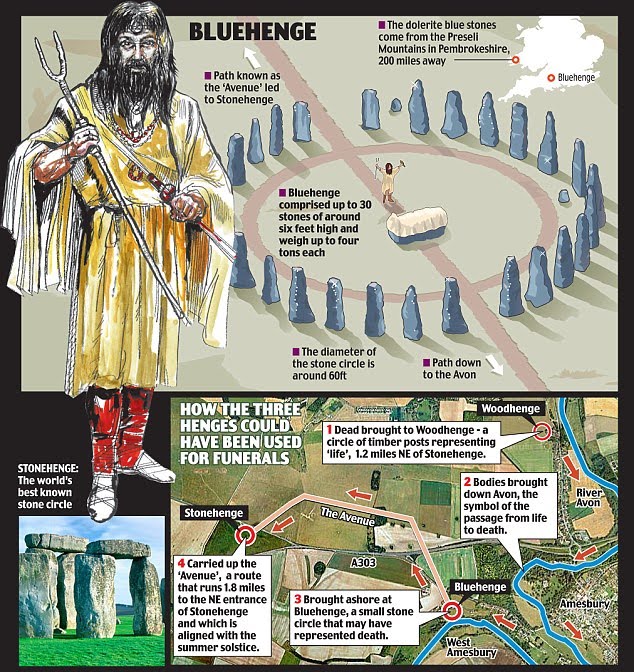
The prehistoric circle has been named Bluehenge after the colour of the 27 giant stones it once incorporated
The find is already challenging conventional wisdom about how Stonehenge was built – and what it was used for.
Bluehenge was put up 5,000 years ago – around the same time as work began on Stonehenge – and appears to have been a miniature version of it.
The two circles stood together for hundreds of years before Bluehenge was dismantled. Researchers believe its stones were used to enlarge Stonehenge during one of a number of redevelopments.
Professor Tim Darvill, Stonehenge
‘We thought we knew it all, but over the last few years we have discovered that something as familiar as Stonehenge is still a challenge to explore and understand. It wouldn’t surprise me if there weren’t more circles.’
All that remains of the 60ft wide Bluehenge are the holes of 27 giant stones set on a ramped mount. Chips of blue stone found in the holes appear to be identical to the blue stones used in Stonehenge.

The four-ton monsters, made of Preseli Spotted Dolerite – a chemically altered igneous rock harder than granite – were mined in the Preseli Mountains in Pembrokeshire and then rolled, dragged and floated the 200 miles to the site on the banks of the Avon in Wiltshire.

Once installed, the stones would have been polished to a dark blue with silver flecks resembling the night sky. Bluehenge lies at the end of the ‘Avenue’ – a ritual pathway that connected Stonehenge to the Avon.
Stonehenge itself was built and rebuilt over 600 years in three main phases. The first – begun in 3000BC – saw the creation of a ditch and bank which later enclosed a circle of 56 holes for posts or stones.

Around 2600BC the site was transformed into two circles of 82 blue stones brought from the Welsh mountains.
Then, 150 years later, the ancient Britons set up 50-ton sarsen stones quarried at Marlborough, 25 miles away.
The blue stones were dug up and repositioned, and the sarsens used to create the Stonehenge familiar today. The new find changes this account of this history.

It suggests that the creators of Stonehenge originally built two circles – one with 56 stones at Stonehenge, and another with 27 at Bluehenge. The stones of the smaller circle were eventually incorporated into the bigger one.
Bluehenge was discovered by Professor Mike Parker Pearson, of Sheffield University, who argues the monuments were linked to rituals of life and death.
Julian Richards, archaeologist and presenter of BBC2 TV series Meet The Ancestors, believes, however, that such certainty is beyond our reach.

‘Any one person who says they have the answer is being a bit over-confident,’ he said.
‘If you think that Stonehenge was created, used and modified over 1,400 years then it probably was used for many different things.’
Professor Geoffrey Wainwright, who found the source of the Stonehenge stones in Wales with Professor Darvill, said: ‘This [new] henge is very important because it forms part of the picture of ceremonial monuments in the area and puts Stonehenge into context.
‘It’s no longer Stonehenge standing alone, but it has to be seen in context with the landscape.’

Lovers of prehistoric sites will have to wait until February before the full details of Bluehenge are published.
The creators of Stonehenge – who saw the Stone Age pass into the Bronze Age – were farmers who lived in small villages in huts made of wooden stakes and twigs, covered with a thick layer of clay and chalk.
Farming had been established for at least 1,000 years and the builders of Stonehenge were skilled at growing wheat and barley and keeping pigs and sheep.
Some experts believe they made cider and beer and ground wheat into flour to make bread and cakes.
But they were still forced to depend on wild fruit, peas, lentils, nuts and honey. Clothes were primitive leather coats and jackets, woollen leggings and simple shoes made of skins bound with twine.
No one knows what gods they worshipped, but the alignment of Stonehenge to the solstice shows that the Sun – and maybe the Moon – was important.

Has anybody noticed that stone henge is 1.31 miles from bluehenge and that bluehenge is 1.31 miles from woodhenge? since they worshipped the 4 seasons does that mean there is another henge? and that it could be buried 1.31 miles from stonehenge and wooodhenge to make a giant circle? you can check it out on google earth if you like :0)

Tour Guide


‘Stonehenge? It’s more like a city garden’

8 02 2010


Design watchdog hits out at plans for £20m visitor centre at megalithic jewel in England’s cultural crown

Its footpaths are “tortuous”, the roof likely to “channel wind and rain” and its myriad columns – meant to evoke a forest – are incongruous with the vast landscape surrounding it.

So says the government’s design ­watchdog over plans for a controversial £20m visitor centre at Stonehenge, the megalithic jewel in England’s cultural crown. CABE, the Commission for Architecture and the Built Environment, has criticised the design of the proposed centre, claiming the futuristic building by Denton Corker Marshall does little to enhance the 5,000-year-old standing stones which attract more than 800,000 visitors each year.

Its concerns are the latest chapter in the long saga surrounding the English Heritage-backed project, and follow a ­government decision two years ago to scrap on cost grounds a highly ambitious £65m scheme to build a tunnel to reroute traffic to protect the World Heritage site.

The centre, which has been approved by Wiltshire county council planners, has divided opinion.

“We question whether, in this landscape of scale and huge horizons and with a very robust end point that has stood for centuries and centuries, this is the right design approach?” said Diane Haigh, CABE’s director of design review.

“You need to feel you are approaching Stonehenge. You want the sense you are walking over Salisbury Plain towards the stones.”

But the “twee little winding paths” were “more appropriate for an urban ­garden” than the “big scale open air ­setting the stones have”, she added.

The many columns were meant to be “lots of trunks” holding up a “very delicate roof”, she said. “Is this the best approach on what is actually a very exposed site. In particular, if it’s a windy, rainy day, as it is quite often out there, it’s not going to give you shelter. We are concerned it’s very stylish nature will make it feel a bit dated in time, unlike the stones which have stood the test of time”.

CABE believed the location of the ­centre, at Airman’s Corner, is good, and were pleased “something was happening at last”, but questioned the “architectural approach”. The centre has the full support of local architects on the Wiltshire Design Forum, and has been passed by the local planning committee. Nevertheless English Heritage recognised it was an emotional and divisive subject.

“Innovative architectural designs will always polarise opinion, and often nowhere more so that within the architectural world itself,” it said in a statement.

“The Stonehenge project has to overcome a unique set of challenges,” it said. “This has required a pragmatic approach and, following widespread consultation, we maintain the current plans offer the best solution”.

Stephen Quinlan, partner at Denton Corker Marshall, defended the design. The roof was meant to be a “sun canopy” and not offer weather protection in what was, principally “an outdoor experience”.

“It’s not an iconic masterpiece. It’s a facility to help you appreciate the Stonehenge landscape. It’s intellectually ­deferential in a big, big way to Stonehenge as a monument.

“I wouldn’t even mind if you couldn’t remember what the building looked like when you left. The visitor centre is not the destination,” Quinlan said.

However, he added: “We don’t take criticism from CABE lightly. And we are ­crawling through their comments to see if there are any improvements we can make.”


Stonehenge’s secret: archaeologist uncovers evidence of encircling hedges

5 02 2010


Survey of landscape suggests prehistoric monument was surrounded by two circular hedges.
The Monty Python knights who craved a shrubbery were not so far off the historical mark: archaeologists have uncovered startling evidence of The Great Stonehenge Hedge.

Inevitably dubbed Stonehedge, the evidence from a new survey of the Stonehenge landscape suggests that 4,000 years ago the world’s most famous prehistoric monument was surrounded by two circular hedges, planted on low concentric

banks. The best guess of the archaeologists from English Heritage, who carried out the first detailed survey of the landscape of the monument since the Ordnance Survey maps of 1919, is that the hedges could have served as screens keeping even more secret from the crowd the ceremonies carried out by the elite allowed inside the stone circle.

Their findings are revealed tomorrow in British Archaeology magazine, whose editor, Mike Pitts, an archaeologist and expert on Stonehenge himself, said: “It is utterly surprising that this is the first survey for such a long time, but the results are fascinating. Stonehenge never fails to reveal more surprises.”

“The time these two concentric hedges around the monument were planted is a matter of speculation, but it may well have been during the Bronze Age. The reason for planting them is enigmatic.”

Pitts wonders if the hedges might have been to shelter the watchers from the power of the stones, as much as to ward off their impious gaze.

If the early Bronze Age date is correct, when the hedges were planted the Stonehenge monument already had the formation now familiar to millions of tourists, after centuries when the small bluestones from west Wales and the gigantic sarsens from the Stonehenge plain were continually rearranged.

The survey also found puzzling evidence that there may once have been a shallow mound among the stones, inside the circle. It was flattened long ago, but is shown in some 18th century watercolours though it was written off as artistic licence by artists trying to make the site look even more picturesque. The archaeologists wonder if the circle originally incorporated a mound which could have been a natural geological feature, or an even earlier monument.


Doctor Who filming at Stonehenge

5 02 2010


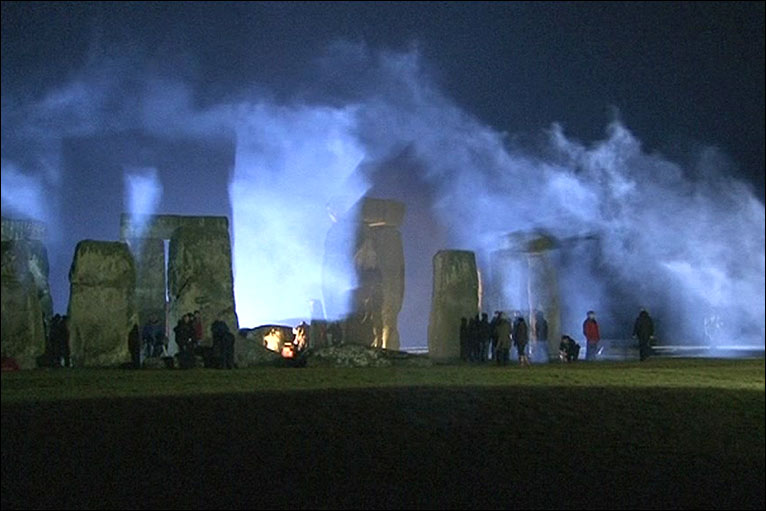
On Tuesday night, February 2, Wiltshire’s ancient stone monument was taken over by a film crew…..filming season five of BBC 1’s Doctor Who.

Exclusive leak….
Turns out that when the moon lies above the stone circle and the sun is on the opposite side of the earth, the stone circle acts as a gateway to a parallel time and place. Standing in the centre of the circle can allow one to be at one with the entire universe but unfortunately induces runaway ageing and exposure to other more evil personalities bent upon conquest. Dr Who finds himself imprisoned within the stone circle of an advanced extra-galactic civilisation and is held as a hostage until dastardly demands are met. The clock is running and the Doctor is rapidly ageing towards infancy. A twist in the tale is the entity that is allowed into the modern Human world when the stone circle is activated. Sadly, the choices are harsh…..either allow the proposed McDonalds drive-through planned for the Avenue, the bowling alley, the souvenir shop and the vast visitor facilities or, the Doctor will be wearing nappies for the remainder of this series and the evil personality (a hybrid mutation of David Icke and Schliemann) will win executive control of English Heritage.

Doctor Who at Stonehenge
Despite it being a closed set…
Local fans, braved the rain hoping to catch a glimpse of the action: “I’ve been a fan of Doctor Who since I was five, that’s 35 years now, and this has been the first chance I’ve had to see it being filmed.”

…plus returning professor River Song (Alex Kingston) have all been spotted on set – along with a brazier or two – the rumour is that the latest episodes including The Eleventh Hour, The Beast Below and Victory of the Daleks will all be set ‘some time in the past’.

With early filming reports claiming that the Doctor aka Matt Smith along with his sexy assistant Amy Pond played by Karen Gillan…


Avebury and Stonehenge go live on Google

28 01 2010

WOW 360-degree views of Stonehenge – click here

Avebury and Stonehenge can be explored with the click of a mouse from today as the National Trust’s most famous sites have been added to Google’s Street View mapping.

Over 20 historic locations across the UK – including castles, landscapes and country houses – have been scanned using a panoramic camera, bolted to the back of a tricycle, and added to Google’s online mapping service.

Users can now take a 360-degree, ground-level tour of sites such as Corfe Castle in Dorset, Fountains Abbey in North Yorkshire, Lindisfarne Castle in Northumberland, and Plas Newydd in Wales.

Austen fans with a romantic sensibility can even take a virtual turn around Lyme Park in Cheshire – made famous by Colin Firth’s emergence from its lake as Mr Darcy in the BBC’s adaptation of Pride And Prejudice.

Google’s Street View cyclists pedalled over 125 miles on the 18-stone trike, following marked routes around the National Trust sites to capture them from every angle.

Ed Parsons, technologist at Google, said: “We were delighted to be able to open up some of the UK’s most famous landmarks to the rest of the world via the web.”

However, he does not believe the online experience will discourage tourists from visiting the sites in person.

“It’s a fun way to preview what to see and do on a day out,” he said.

“Or whet your appetite for where to go next.”

Google will continue to collect images from other National Trust sites throughout 2010, including UNESCO World Heritage Site the Giant’s Causeway, in County Antrim.