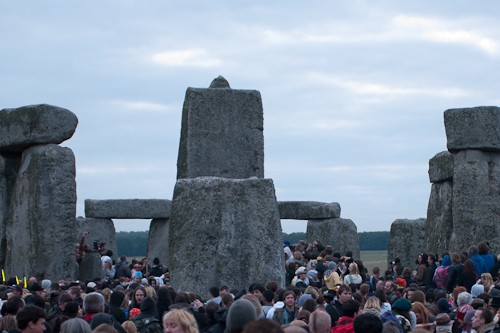
Stonehenge Summer Solstice 2010

28 05 2010

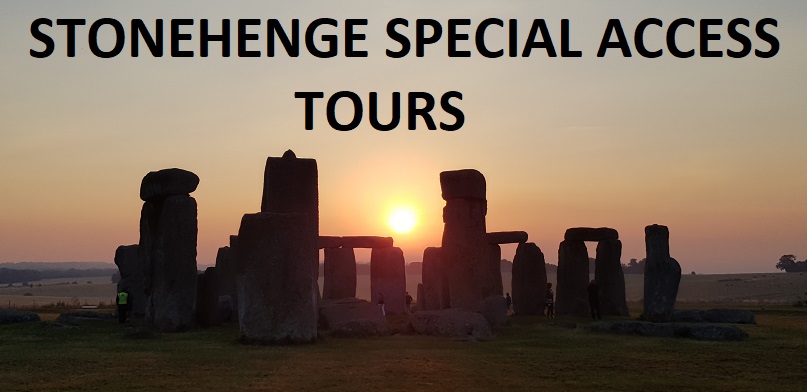
Open Access at Stonehenge

 
Date:  Monday 21st June 10
Location:  Stonehenge, Wiltshire – MAP
Cost:  FREE (including FREE car park)
| |

There are 3 weeks and 3 days until Stonehenge 2010

English Heritage are again expected to provide “Managed Open Access” to Stonehenge for the Summer Solstice. Please help to create a peaceful occasion by taking personal responsibility and following the conditions (see below).

The car park (enter off the A303 from the roundabout – it’s signposted) will open at around 7pm on Sunday 20th June, and close at around noon on Monday 21st June. Note that last admission to the car park for vehicles is at around 6am.

Access to the stones themselves is expected to be from around 8.30pm on Sunday 20th June until 8am on Monday 21st June.

There’s likely to be casual entertainment from samba bands & drummers but no amplified music is allowed.

Van loads of police have been present in the area in case of any trouble, but generally a jovial mood prevails. Few arrests have been made in previous years, mostly in relation to minor drug offences.

Toilets and drinking water are available and welfare is provided by festival welfare services. There are normally one or two food and drink vans with reasonable prices but huge queues, all well away from the stones themselves.

Sunrise is at around 4:45am.

Rules include no camping, no dogs, no fires or fireworks, no glass bottles, no large bags or rucksacks, and no climbing onto the stones. Please respect the rules so that we’re all able to enjoy the solstice morning at Stonehenge for years to come.

More information will be here when available.

English Heritage Message

English Heritage is pleased to be providing Managed Open Access to Stonehenge for the Summer Solstice.  Please help us to create a peaceful occasion by taking personal responsibility and following the Conditions of Entry.

Please note that a high volume of traffic is anticipated in the Stonehenge area on the evening of Sunday 20th June.

Getting To Stonehenge

Where possible, please travel to Stonehenge using public transport.  The local bus company, Wilts & Dorset, will be running a service from Salisbury railway and bus stations to Stonehenge over the Solstice period.  This bus service will commence at 1830 hours (6.30pm) on Sunday 20th June and run regularly until 0115 hours (1.15am) on Monday 21st June. A service taking people back to Salisbury will start again at 0400 hours (4am) and run frequently until 0945 hours (9.45am). Access to Stonehenge from the bus drop off point is through the National Trust farmland.

The buses will stop at any recognised bus stop along the line of the route, which is via Amesbury.

Bus Service Information

Wilts and Dorset Bus Company
www.wdbus.co.uk
Tel: 01983 827005 begin_of_the_skype_highlighting              01983 827005      end_of_the_skype_highlighting

Train Information

South West Trains
www.southwesttrains.co.uk
Tel: 0845 6000 650 begin_of_the_skype_highlighting              0845 6000 650      end_of_the_skype_highlighting

Merlin @ Stonehenge
The Stonehenge Web Site


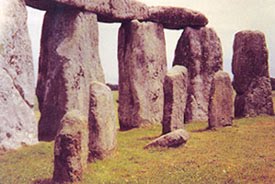
Stonehenge: How Did The Stones Get There?

14 05 2010
We  explain how the myth of the stones transported from south Wales to Salisbury Plain arose and why it is wrong.

History is full of enjoyable myths but Stonehenge has too many. They mutate. Hardly had modern scholars got rid of the pre-Roman druids than those soothsayers reappeared in the guise of 3rd-millennium BCE astronomer-priests who are said to have designed the great circle as a celestial computer for the prediction of eclipses.

There are other common fallacies. The Greek explorer, Pytheas of Marseilles, who provided the first written account of Britain when he visited the islands c.300 BCE, is sometimes said to have visited Stonehenge. In fact, he landed near the splendid circle of Callanish in the Outer Hebrides 500 miles to the north. Just as mistakenly, Stonehenge is  described as a British stone circle though it is not this at all, but rather an imitation in stone of a lintelled timber ring, with architectural influences from Brittany.

Perhaps the most persistent of these myths is that men ferried scores of enchanted Welsh stones hundreds of miles. Returning across the Irish Sea from the Wicklow mountains to their home in southern Britain some time after 3000 BCE, a group of gold- and copper-prospectors are said to have steered towards the landmark of the Preseli mountain range in south-west Wales. Regarding the Preselis as magical and their bluestones life-enhancing, the crews felt compelled to plunder them one by one for an intended megalithic sanctuary on Salisbury Plain. The romance has been repeated ….
Hear all the latest theories, myths and legends from a Stonehenge tour guide – try the excellent  local based ‘HisTOURies UK’ private tour company or Premium Tours based in London

Merlin @ Stonehenge
The Stonehenge Stone Circle Website


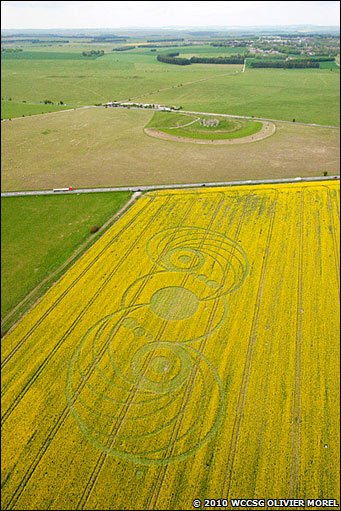
Stonehenge Crop Circle – May 10th 2010

11 05 2010

Wow – look at this!  A guide for Histouries UK, a tour company based in Salisbury has sent reports of this amazing crop sircle directly opposite Stonehenge Stone Circle.  There are further
reports of more in the area – watch this space……….

Merlin @ Stonehenge
The Stonehenge Stone Circle Website


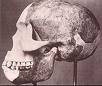
Two great hoaxes: Piltdown Skull and Bluestone Quarry?

10 05 2010

Some see a bluestone quarry — others don’t.
Some see a Missing Link — others see a hoax.


There was a piece on the telly the other day about the Piltdown Man hoax of 1912. One thing struck me in the commentary — namely the “fertile ground” which existed in Britain at the time, providing perfect conditions for the hoax to take root, to flourish and eventually (in spite of the reservations of some experts) to become part of mainstream thinking. This is what one web site says about the hoax:

“Perhaps the most famous hoax was Piltdown man. In 1912, at a time when Darwin’s evolutionary theory was new, and people were looking for missing links between humans and apes, someone planted two fake skulls which came to be known as Piltdown Man.
The part medieval man, part Orang-utang fossil was found, in the very English village of Piltdown in Sussex. Piltdown man’s scientific name, Eoanthropus dawsoni, reflected its finder’s name Dawson. To get a flavour of those times, the British Empire was still riding high, and Germany had their Heidelberg man fossil, Britain was desperate for a more important ‘ missing link’ between man and monkey.”

The key to this is national pride, and a desire in Britain to demonstrate that whatever important discoveries there were in Germany, Britain had even better ones, showing the world what wonderful ancient civilizations we had here, and what brilliant archaeologists we had to uncover them and to expound new theories of evolution to the world…… OK, petty, nationalistic, xenophobic and even absurd, but that was the world around the time of the First World War. Germany had Neanderthal Man, and now Britain had the “Missing Link” — even more important.

So what about HH Thomas and the bluestones? Well, I have suspected for some time that Thomas might have been guilty of simplification and selective citation of his samples and his rock identifications, in order to flag up the Carn Meini area as the source of the bluestones. I have also expressed my amazement in earlier posts that he “got away with murder” in that NOBODY seems to have seriously examined his evidence or questioned his wacky idea that the stones had been hauled by tribesmen all the way from Presely to Stonehenge in a totally unique feat of Stone Age long-distance transport. And why did people not scrutinize his theory more closely? Why, because there had been great discoveries about megalithic structures in Germany, and because British archaeologists were desperate to show that in these islands we had even more advanced prehistoric civilisations and even cleverer engineers and technicians.

Sounds absurd? I don’t think so — and a number of other authors have suggested that Thomas’s idea was carefully put together around the time of the First World War as part of a national “feel good” strategy, and that the whole nation (and not just the archaeologists) just loved the idea when he announced it, and were disinclined to examine it carefully.

So Thomas became famous, then the bluestones became famous, and the “bluestone transport story” entered the mythology of Britain. It is still trotted out ad infinitum, even though there is even less evidence for it now than there was in 1920. And anybody who dares to question it, or to undermine our cosy assumptions about the extraordinary skills of our Neolithic ancestors, is likely to get short shrift from the archaeology establishment. Look at what happened to poor Geoffrey Kellaway…….

So was the Carn Meini / bluestone quarry / human transport story all a hoax? I think it’s a distinct possibility. How much longer will it be before the whole mad idea about human transport is finally consigned to the scrapheap? Not long, I suspect, since the new geology being done by Rob Ixer and colleagues in the Stonehenge area is revealing so many new sources for the stones and fragments at Stonehenge that we are going to have to talk about 20 quarries all over western Britain, rather than one. And that would be to stretch things to a rather extraordinary degree……

All hoaxes have their day, and eventually bite the dust, leaving senior academics looking very foolish.

Merlin @ Stonehenge
The Stonehenge Stone Circle Website


Vote for King Arthur this election!

29 04 2010
Minute Manifesto: King Arthur Pendragon (Independent)

King Arthur

Vote for Arthur

King Arthur Pendragon is an Independent candidate for Salisbury. He is a Senior Druid and Swordbearer and was brought up in Aldershot.

He served with the Royal Hampshire Regiment. He’s worked as a General Foreman for a Parish Council and Senior Supervisor for Hampshire and Surrey County Councils on the Basingstoke Canal restoration project

King Arthur Pendragon’s manifesto

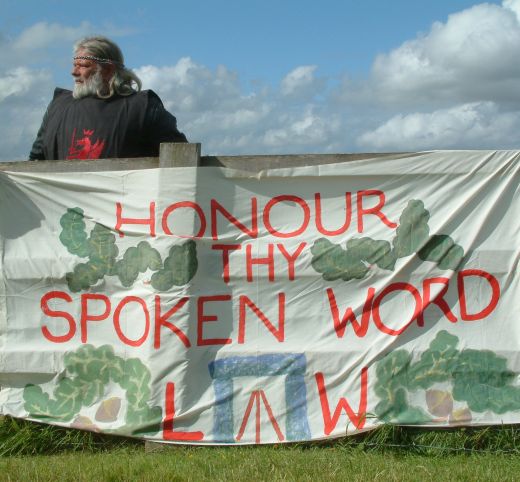
My name’s Arthur Pendragon, I’m a Senior Druid sworn to fight for Truth, Honour and Justice, who wants to scrap our nuclear arsenal and bring our boys back from Afghanistan.

The main thing I believe in is democracy, by, for and of the people, not by, for and of the Party.

At present, you can have a Scottish MP representing a Welsh constituency and living in London, but in reality representing no-one save their Party line, and let’s face it, there’s not much to choose between any of them.

Well, I’m different.

Don’t be put off by the robes – I may be spiritual but I’m certainly political, and to date have embarrassed two National Parties into last place and taken Her Majesty’s Government to High and European Courts.

Another thing I believe in is leadership from the front, motivation by example, and I’m not afraid to get my hands dirty.

Having opposed the Newbury Bypass, and fought continually for Stonehenge not only was I arrested ‘up the trees’ and on the ‘picket’ argued the cases in Court, but guess who dug the latrine?

If you want an MP with a hands-on approach, by, for and of the people, vote for me. If you want much of the same, vote for anyone else.

I don’t care what London, Brussels, Washington or even Andover want

Elect me and you elect a warrior with a proven track record to represent and fight for the Salisbury constituency, nothing more and certainly nothing lesS

He’s got my vote!

Merlin @ Stonehenge
The Stonehenge web site


Do Dartmoor’s ancient stones have link to Stonehenge?

27 04 2010

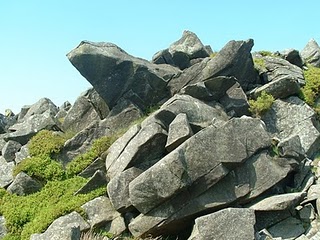
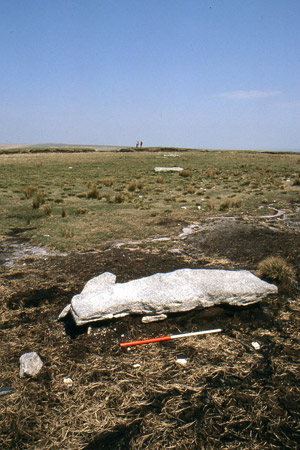
LITTERED across the hills of Dartmoor in Devon, southern England, around 80 rows and circles of stones stand sentinel in the wild landscape. Now, striking similarities between one of these monuments and Stonehenge, 180 kilometres to the east, suggest they may be the work of the same people. The row of nine stones on Cut Hill was discovered in 2004 on one of the highest, most remote hills of Dartmoor national park. “It is on easily the most spectacular hill on north Dartmoor,” says Andrew Fleming, president of the Devon Archaeological Society. “If you were looking for a distant shrine in the centre of the north moor, that’s where you would put it.” Ralph Fyfe of the University of Plymouth and independent archaeologist Tom Greeves have now carbon-dated the peat surrounding the stones. This suggests that at least one of the stones had fallen – or been placed flat on the ground – by between 3600 and 3440 BC, and another by 3350 to 3100 BC (Antiquity, vol 84, p 55). That comes as a surprise to archaeologists, who, on the strength of artefacts found nearby, had assumed that Dartmoor monuments like Cut Hill and Stall Moor (pictured) dated from the Bronze Age, around 2100 to 1600 BC. Instead, Fyfe suggests that Cut Hill is from the Neolithic period, the same period that Stonehenge was built. Unlike Stonehenge, the 2-metre-tall Cut Hill stones lie flat on the ground, parallel to each other and between 19 metres and 34.5 metres apart, like the sleepers of a giant railway track. Packing stones discovered at the end of one of the megaliths suggest at least one of them stood erect at some point, but the regularity of their current layout makes it likely they were deliberately placed that way, Greeves says. What’s more, the stones’ alignment with the summer and winter solstices seems identical to that of Stonehenge, Newgrange in Ireland and Maes Howe in Scotland. “It could be coincidence, but it’s striking,” says archaeologist Mike Pitts.

Merlin @ Stonehenge
The Stonehenge Stone Circle website


Celebrate St.Georges Day – Morris Dancing at Stonehenge

23 04 2010

Morris Dancing – Maypole and morris dancing for St George’s Day
Thought you would like this old picture I found in the archives showing ‘Morris Dancing’ at Stonehenge on Saint Georges Day.
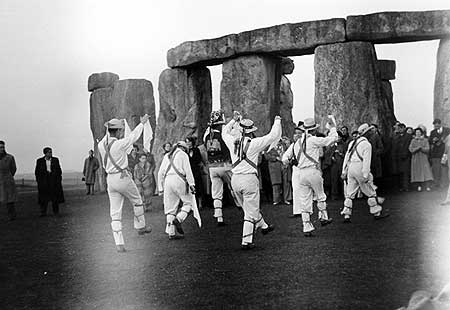
 

Morris Dancers at Stonehenge

 Although the link between Druids and megalithic sites is tenuous at best, there seems to be no reason to doubt that both the celebration of ancient Celtic festivals and the rituals performed at stone circles and other megalithic sites included dancing in one form or another. Evidence for the latter is virtually non-existent, but folklore and other clues suggest, for example, that dance may have been performed at Stonehenge if only through the suggestive description by Geoffrey of Monmouth, writing in the 12th century, who calls Stonehenge the Dance of the Giants (“chorea gigantum”). Much later, Morris dancing used to take place around the ancient barrow at St. Weonards in Herefordshire. Morris dancing, in fact, has been claimed to be a remnant of a pre-Christian Celtic, or Druidic, fertility dance.

Morris dancing also figures among the evidence in support of the claim that dancing formed part of the celebration of Celtic festivals. Among the earliest references to Morris dancing are those made by Shakespeare, who, in “All’s Well that Ends Well” (II.ii.21), makes it clear that the Morris dance was commonly performed on May Day (May 1). That Morris dancing was associated with May Daycelebrations in the early 17th century is also suggested through King James I’s “Book of Sports” which permitted among the amusements to be enjoyed on a Sunday the continuation of “May games, Whitsun ales and morris dances, and the setting up of May-poles…” The Whitsun ales referred to are a beer produced for Whitsun (or Whitsunday, celebrated in the Christian calendar as Pentacost) which Shakespeare, in “Henry V” (II.iv.18), says was also a time when Morris dances were performed.


The origins of Morris dancing are lost in the mists of time. It survives today as a form of folk dance performed in the open air in villages in rural England by groups of specially chosen and trained men and women. It is a ritual rather than a social dance which the dancers take seriously. It is felt that the dances have a magic power and serve both to bring luck and to ward of evil. Attempts to uncover the origins of Morris dancing have focused mostly on the name. Some believe Morris to be a corruption of the word “Moorish” and therefore to have originated in Africa. In order to explain how African dancing could crop up in England, it has been suggested that Moorish captives were brought back from the Holy Land by crusaders. Or, alternatively, it has been suggested that John of Gaunt (1340-1399), Duke of Lancaster, following the failure of his campaign in Spain to claim the kingship of Castile and Leon, returned to England with Spanish Moors as captives.In this sense, the word “morris” would seem to be related to “morisco”, which is a form of court dance performed in Italy. However, Joseph Strutt (1749-1802), in his “Sports and Pastimes of the People of England”, doubts this was the origin of Morris dancing, stating that “the Morisco or Moor dance is exceedingly different from the morris-dance…being performed with the castanets, or rattles, at the end of the fingers, and not with bells attached to various parts of the dress.” Otherwise, Strutt suggests that the morris-dance originated from the “Fool’s Dance” (traceable to the 14th century), in which the dancers dressed in the manner of the court fool, and from which can be traced the bells used by morris dancers. 

If Morris is a corruption of a similar-sounding word, it could equally well be “moorish” in reference to, at the time of Shakespeare, boggy land, and later used in connection with moorland or heathland. It has also been suggested that the word Morris is derived from the Latin word “moris” meaning tradition or custom. Then again, it might be derived from the game “merelles”, forms of which were called “ninepenny morris” or “nine men’s morris” (referred to, for example, by Shakespeare in “A Midsummer Night’s Dream”, II, i, 98). On the continent, the name was applied to the stepping, dance-like game of ‘hop-scotch.’ 

Attempts to discover the origins of the dances performed have revealed a general connection with other ritual folk dances elsewhere in the world such as santiagos, moriscas, and matachinas of the Mediterranean and Latin America, and the calusari of Romania. The ultimate source of this type of dancing, however, remains hidden. The suspicion, though, is that they are of pagan origin performed as part of ancient fertility rites. The music and dances were perhaps intended to attract beneficial influences, while the bells, fluttering handkerchiefs, and clashing sticks served as the means to scare away malevolent spirits. 

Traditional Morris dancing is today associated with the Cotswolds, a region of England located between Oxford and the Welsh border. Cotswold Morris is danced in sets of six dancers arranged in two rows of three. For some dances, handkerchiefs are held in each hand, while for other dances short sticks are carried, and struck against each other or against those of a partner. Part of the costume includes bells, usually worn tied below the knees. 

Costume varies from one Morris team, or ‘set’, to another, with each village also producing its own steps and dances. Morris men usually wear a white shirt, white trousers or dark breeches, and black shoes. Coloured sashes or baldrics worn over one or both shoulders, or a waistcoat, serve to distinguish different teams. The Stroud Morris Dancers in Stroud, Gloucestershire, for example, wear white trousers and shirts with red and green sashes (the colours of Stroud) shown performing the Stick Dance, Sidmouth, England 

Shown (left) are the Manley Morris Men dancing in the North West tradition. 


Other teams, such as that dancing in front of the Old Neighbourhood Inn at Chalford Hill in Gloucestershire, are dressed in dark breeches and bowler hats. A variant of Cotswold Morris is Border Morris, associated with the Welsh border counties, which has sides of four, six, or eight men who darken their faces and wear ‘rags’ and dark trousers. Border Morris is danced more vigorously than Cotswold Morris and involves much clashing of sticks. Cotswold Morris is usually performed from May 1 to September, while Border Morris is traditionally performed in the winter months. Another form is North West Morris, in the North West of England, which is more of a processional dance with sides of at least nine men wearing clogs. 

Merlin @ Stonehenge – Happy Saint Georges Day!
The Stonehenge Stone Circle Website


Stonehenge Down Under: Australians copy Neolithic rock structure to draw tourists

21 04 2010

A full-sized replica of Stonehenge will be built on a beach in western Australia after a small town gave the green light for construction in a bid to draw tourists.

The shire council in Esperance, 460 miles south-west of Perth, has approved plans for the A$1.2m (£722,749) project, which it hopes will generate much-needed tourist revenue for the small coastal community – its only attraction at the moment is small piece of the US Skylab which fell onto a nearby farm in 1979.

“Stonehenge Down Under” is being spearheaded by the local Rotary club, which wants to build the structure from local pink granite on a council-owned site overlooking Twilight Beach, just outside the town.

 Kim Beale, a spokesman for the Esperance Rotary Club, said the Australian version would be a faithful reproduction of the original Neolithic structure in Wiltshire and will consist of 100 stones, each weighing up to 45 tons.

“Obviously some people may wonder why you’d build Stonehenge at Esperance, but the stone is already here and I think it’s a good opportunity. I reckon it’s quite fascinating,” he said.

Although local tourism operators have thrown their weight behind the prehistoric theme park, other townspeople remain sceptical – an earlier Stonehenge proposal ran into financial difficulties. Rotary, however, is confident that it can raise the necessary funds to complete the new project with giant cut stones donated by a local quarry. Work on Stonehenge Mk 2 is due to begin shortly.

MERLIN @ STONEHENGE
Stonehenge Stone Circle


Beltane – May 1st 2020 – The beginning of Summer!

19 04 2010

On the cusp between spring and summer, Beltane is a fire festival that celebrates the fertility of the coming year.
The beginning of Summer – Summer is a comin in !

Beltane is a Celtic word which means ‘fires of Bel’ (Bel was a Celtic deity). It is a fire festival that celebrates of the coming of summer and the fertility of the coming year.

Celtic festivals often tied in with the needs of the community. In spring time, at the beginning of the farming calendar, everybody would be hoping for a fruitful year for their families and fields.

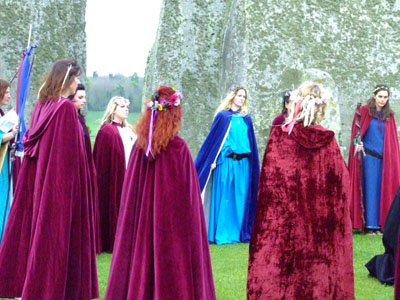
Maidens at Stonehenge

Beltane rituals would often include courting: for example, young men and women collecting blossoms in the woods and lighting fires in the evening. These rituals would often lead to matches and marriages, either immediately in the coming summer or autumn.

Other festivities involved fire which was thought to cleanse, purify and increase fertility. Cattle were often passed between two fires and the properties of the flame and the smoke were seen to ensure the fertility of the herd.

Today Pagans believe that at Beltane the God (to whom the Goddess gave birth at the Winter Solstice) achieves the strength and maturity to court and become lover to the Goddess. So although what happens in the fields has lost its significance for most Pagans today, the creation of fertility is still an important issue.

Emma Restall Orr, a modern day Druid, speaks of the ‘fertility of our personal creativity’. (Spirits of the Sacred Grove, pub. Thorsons, 1998, pg.110). She is referring to the need for active and creative lives. We need fertile minds for our work, our families and our interests.

Fire is still the most important element of most Beltane celebrations and there are many traditions associated with it. It is seen to have purifying qualities which cleanse and revitalise. People leap over the Beltane fire to bring good fortune, fertility (of mind, body and spirit) and happiness through the coming year.

Although Beltane is the most overtly sexual festival, Pagans rarely use sex in their rituals although rituals often imply sex and fertility. The tradition of dancing round the maypole contains sexual imagary and is still very popular with modern Pagans.

The largest Beltane celebrations in the UK are held in Edinburgh. Fires are lit at night and festivities carry on until dawn. All around the UK fires are lit and private celebrations are held amongst covens and groves (groups of Pagans) to mark the start of the summer.

Merlin @ Stonehenge
Stonehenge Stone Circle Website


Dramatic Sunsets at Stonehenge due to Volcanic ash

18 04 2010

Stonehenge is in line for some spectacular sunsets as the sun’s rays reflect off the volcanic particles, creating beautiful skies around Salisbury plain and Wiltshire.

110425142_8a4b028dd2.jpg

110425142_8a4b028dd2.jpg

Dramatic: Volcanic ash can bring out dramatic pinks and purples during sunset, as shown by the latest erupting volcano in Iceland

While yesterday’s eruption caused chaos for travellers, some scientists said there could be an unexpected upside to the phenomenon.

But there were further downsides as motorists were told to look out for a layer of ash on their cars from remnants of the explosion. There could also be colder temperatures as tiny particles of ash high in the atmosphere block out light from the sun.

Red sky at night: The sun sets over Heathrow Airport as an ash cloud from an Icelandic volcano grounded all flights
Forecaster Jonathan Powell said: ‘Long-term, the eruption could well have a long term affect on global weather patterns. Cloud particles, basically minuscule grains of crushed rock and glass, can remain in the atmosphere for many years.

‘The Mount Pinatubo eruption of 1991 went on to cool the global climate by just under half a degree, although that volcano was on a much larger scale.’

eather forecaster Brendan Jones from MeteoGroup, said: ‘If you look back in history there have been some periods where the weather has been changed by big volcanic eruptions like Mount Tambora and Mount St Helens.

‘They have been proved to lower temperatures. There is so much ash in the atmosphere that it reduces the amount of sunlight getting to the ground.’

‘If the ash remains in our atmosphere for weeks or months it can reduce temperatures slightly but we are talking about fractions of degrees.’

But while experts said the ash could irritate conditions such as asthma, it was not expected to cause major health problems.

Volcanologist Dr Dougal Jerram said: ‘The high altitude of this plume above the UK means that it is air traffic that will suffer most.’

More powerful eruptions can emit large amounts of poisonous sulphur dioxide that is much more hazardous to health.

Volcanic ash can also create the appearance of a blue moon, if the particles are the right size (experts say that means one millionth of a metre or a micron).

However, ash thrown up into the atmosphere usually contains a mixture of particles with a wide range of sizes, which tends to scatter blue light so a reddish moon is more likely.

Experts fear the eruption of Eyjafjallajokull, which has sent this cloud of ash into the sky, could trigger a much larger explosion of nearby Mount Katla.

Katla is described as ‘enormously powerful’, and because it lies under a glacier its eruption would cause a huge glacial outburst flood and could spread its shadow over a much larger area.

The Mount Tambora eruption in 1816 caused such a drop in temperatures that it became known as ‘the year with no summer’.

Crops failed due to low daytime temperatures, late frosts and abnormally high rainfall, provoking food riots, famine and disease.

In Ireland, rain fell on 142 days that summer and across France the grape harvest was virtually non-existent.

In North America there was snow in June and lakes and rivers froze as far south as Pennsylvania during July and August. am passing through nature

Merlin @ Stonehenge
Stonehenge Stone Circle