A Stonehenge found in America. Is it bigger and better ? Probably…..

28 05 2011

A Stonehenge under Lake Michigan
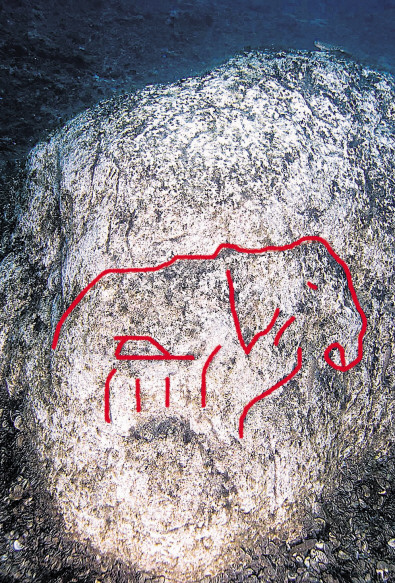
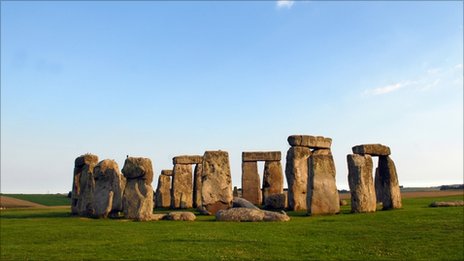
While scanning underneath the waters of Lake Michigan for shipwrecks, archeologists found something a lot more interesting than they bargained for, as they discovered a boulder with a prehistoric carving of a mastodon, as well as a series of stones arranged in a Stonehenge-like manner.

Stonehenge found under Lake Michigan

Stonehenge found under Lake Michigan

At a depth of about 40 feet into Lake Michigan’s Grand Traverse Bay, using sonar techniques to look for shipwrecks, archeologists discovered sunken boats and cars and even a Civil War-era pier, but among all these they found this prehistoric surprise, which a trained eye can guess by looking at the sonar scans photos in this article.

“When you see it in the water, you’re tempted to say this is absolutely real,” said Mark Holley, a professor of underwater archaeology at Northwestern Michigan University College who made the discovery, during a news conference with photos of the boulder on display in 2007. “But that’s what we need the experts to come in and verify.

The boulder with the markings is 3.5 to 4 feet high and about 5 feet long. Photos show a surface with numerous fissures. Some may be natural while others appear of human origin, but those forming what could be the petroglyph stood out, Holley said.

Viewed together, they suggest the outlines of a mastodon-like back, hump, head, trunk, tusk, triangular shaped ear and parts of legs, he said.

“We couldn’t believe what we were looking at,” said Greg MacMaster, president of the underwater preserve council.

Specialists shown pictures of the boulder holding the mastodon markings have asked for more evidence before confirming the markings are an ancient petroglyph, said Holley.

“They want to actually see it,” he said. Unfortunately, he added, “Experts in petroglyphs generally don’t dive, so we’re running into a little bit of a stumbling block there.”

If found to be true, the wannabe petroglyph could be as much as 10,000 years old – coincident with the post-Ice Age presence of both humans and mastodons in the upper midwest. The formation, if authenticated, wouldn’t be completely out of place. Stone circles and other petroglyph sites are located in the area.

The discovery was made back a few years ago, and surprisingly enough the find hasn’t been popularized at all, with little to no information available online, but I’ll be sure to update this post as soon as I can get ahold of more info. So, who’s from Michigan?

Sponsored by the ‘Stonehenge Tour Company’ – www.StonehengeTours.com

Come and visit Stonehenge in England – you went get wet at this one!

Merlin @ Stonehenge
The Stonehenge Stone Circle website

Follow me on twitter for all the latest Stonehenge (U.K) news:
http://www.twitter.com/ST0NEHENGE


Archaeostrononomer Gerald Hawkins died today 2003

26 05 2011

Gerald Stanley Hawkins

Gerald Hawkins

Gerald Hawkins

Astronomer who claimed Stonehenge was a computer

· Gerald Stanley Hawkins, archaeoastronomer and author, born April 20 1928; died May 26 2003.

(1928–2003) was an English astronomer and author most famous for his work in the field of archaeoastronomy. A professor and chair of the astronomy department at Boston University in the United States. In 1965 he published an analysis of Stonehenge in which he was the first to propose its purpose as an ancient astronomical observatory used to predict movements of sun and stars. Archeologists and other scholars have since demonstrated such sophisticated, complex planning and construction at other prehistoric earthwork sites, such as Cahokia in the United States.

Gerald Hawkins’ work
Gerald Hawkins’ work on Stonehenge was first published in Nature in 1963 following analyses he had carried out using the Harvard-Smithsonian IBM computer. Hawkins found not one or two alignments but dozens. He had studied 165 significant features at the monument and used the computer to check every alignment between them against every rising and setting point for the sun, moon, planets, and bright stars in the positions they would have been in 1500 BC. Thirteen solar and eleven lunar correlations were very precise against the early features at the site with precision falling during the megalithic stages. Hawkins also proposed a method for using the Aubrey holes to predict lunar eclipses by moving markers from hole to hole. In 1965 Hawkins wrote (with J. B. White) Stonehenge Decoded, which detailed his findings and proposed that the monument was a ‘Neolithic computer’.

Atkinson replied with his article “Moonshine on Stonehenge” in Antiquity in 1966, pointing out that some of the pits which Hawkins had used for his sight lines were more likely to have been natural depressions, and that he had allowed a margin of error of up to 2 degrees in his alignments. Atkinson found that the probability of so many alignments being visible from 165 points to be close to 0.5 (or rather 50:50) rather that the “one in a million” possibility which Hawkins had claimed. That the Station Stones stood on top of the earlier Aubrey Holes meant that many of Hawkins’ alignments between the two features were illusory. The same article by Atkinson contains further criticisms of the interpretation of Aubrey Holes as astronomical markers, and of Fred Hoyle’s work.

A question exists over whether the English climate would have permitted accurate observation of astronomical events. Modern researchers were looking for alignments with phenomena they already knew existed; the prehistoric users of the site did not have this advantage.

Later Stonehenge theories

Although Stonehenge has become an increasingly popular destination during the summer solstice, with 26,000 people visiting in 2010, scholars have developed growing evidence that indicates prehistoric people visited the site only during the winter solstice. The only megalithic monuments in the British Isles to contain a clear, compelling solar alignment are Newgrange and Maeshowe, which both famously face the winter solstice sunrise.

The most recent such evidence supporting the theory of winter visits includes bones and teeth from pigs which were slaughtered at nearby Durrington Walls. Their age at death indicating that they were slaughtered either in December or January every year. Mike Parker Pearson of the University of Sheffield has said, “We have no evidence that anyone was in the landscape in summer.”

From the Guardian 2003

In 1961, Gerald Hawkins, who has died of a heart attack aged 75, was professor of physics and astronomy at Boston University in Massachusetts. It was then that he returned to Salisbury Plain to film the sun rise over the marker Heelstone at Stonehenge. Assistants meanwhile plotted every stone and pit, punched coordinates on to cards and fed them, and astronomical data, into an IBM 704.This was at a time when computers were rare and glamorous. Asking that age’s technological wonder to decipher the ancient world’s icon was a gesture of timely genius. The journal Nature published Hawkins’s first results in 1963. Two years later Stonehenge Decoded, written by Hawkins with John B White, was published in the US.The IBM machines, Hawkins argued, showed Stonehenge to be a neolithic computer-observatory for predicting eclipses of the sun and moon. From New York to Iraq, newspapers praised the professor and his computer for rewriting prehistory. Stone-age savages were revealed as skilled scientists.

Archaeologists were less happy. They sniffed at his “overconfident style”, resented his publicity and questioned his results. Hawkins’s statistics were shown to be dodgy; he had contrived a computer from a monument believed to have developed piecemeal over centuries.

Stonehenge excavator Richard Atkinson described Hawkins’s book as: “tendentious, arrogant, slipshod, and unconvincing” – for him the builders of Stonehenge were “howling barbarians”.

The popular archaeologist Jacquetta Hawkes, meanwhile, observed that “every age has the Stonehenge it deserves – or desires”.

Hawkins claimed surprise at the response. That contribution to Nature was his 61st scientific paper and many of his others, on subjects such as tektites, meteors and steady-state universe theory seemed to him more exciting. But none of his other dozen books was as successful.

Hawkins had changed the way we think about Stonehenge, and inspired the science of archaeo-astronomy. Repeated studies have failed to do more than support a few solar, and perhaps lunar alignments, and deny a computational function. Yet in the public mind, Stonehenge is now fixed as an observatory and computer. Stonehenge Decoded initiated a debate still alive, and inspired the first generation of archaeo-astronomers.

Hawkins also analysed the Nazca lines in Peru and the temple of Amun at Karnak, Egypt. He recently developed a crop circles theory based on Euclidean geometry and musical intervals. He first saw Stonehenge in 1953, when working at nearby Larkhill camp. He read that the monument was aligned on midsummer sunrise, a fact first noted by William Stukeley in the 18th century, and made much of by Sir Norman Lockyer in 1906.

Hawkins’s hometown was Great Yarmouth. He obtained his first degree at Nottingham University in 1949 in physics, with pure maths subsidiary, and a PhD in radio astronomy under Sir Bernard Lovell at Manchester University in 1952.

Manchester awarded him a DSc in 1963 for astronomical research at the Harvard-Smithsonian Observatories. He was professor of astronomy and chairman of the department at Boston University (1957-69), and dean of the liberal arts Dickinson College in Carlisle, Pennsylvania (1969-71).

Boston presented him with the Shell award for distinguished writing in 1965. Other awards came from the Smithsonian Institution and the National Academy of Sciences, and he was a proud member of the prestigious intellectual Cosmos Club, Washington DC. He was a science advisor to the US Information Agency.

Hawkins was dedicated to his research, and enthusiastic and generous with those ready to listen. He was due to address an Oxford conference with a new Stonehenge study and, to the surprise of some British academics, he continued to see himself as an Englishman. He leaves his second wife, Julia Dobson.

Links: http://www.megalithic.co.uk/article.php?sid=2146410963
Sponsors: The Stonehenge Tour Company, www.StonehengeTours.com

Respect!

Merlin @ Stonehenge
The Stonehenge Stone Circle Website


Magic circles: walking from Avebury to Stonehenge

14 05 2011

A new walking path links Britain’s two greatest prehistoric sites, Avebury and Stonehenge, and is as epic as the Inca Trail

The Great Stones Way is one of those ideas so obvious it seems amazing that no one has thought of it before: a 38-mile walking trail to link England’s two greatest prehistoric sites, Avebury and Stonehenge, crossing a landscape covered with Neolithic monuments.

But like any project involving the English countryside, it’s not as straightforward as it might seem. The steering group has had to secure permission from landowners and the MoD, who use much of Salisbury Plain for training. They hope to have the whole trail open within a year, but for now are trialling a 14-mile southern stretch, having secured agreement from the MoD and parish councils. The “Plain & Avon” section leads from the iron age hill fort of Casterley Camp on Salisbury Plain down the Avon valley to Stonehenge. Walkers are being encouraged to test the route, and detailed directions can be found on the Friends of the Ridgeway website.

It’s an area all but the boldest have avoided: negotiating the MoD areas needed careful planning. Few walkers come here and not a single garage or shop along the Avon valley sells local maps. The Great Stones Way should change that.

What makes the prospect of the Great Stones Way so exciting is the sense that for more than a millennium, between around 3000 and 2000BC, the area it crosses was the scene of frenzied Neolithic building activity, with henges, burial barrows and processional avenues criss-crossing the route.

Stones mapAt Casterley Camp, high on Salisbury Plain, it takes me a while to realise what is strange about the landscape, as wild and empty as anywhere in southern England, and with a large burial mound directly ahead. Then it hits me: this is perfect high grazing country, but there’s not a single sheep. Maybe they have read the MoD notice which points out that “‘projectile’ means any shot or shell or other missile or any portion thereof”, and that over much of what you can see you’re liable to be hit by one. You can also be arrested without a warrant. But the trail cleverly and legally threads its way past the firing ranges towards a delightful and ancient droving road that plunges down between cow parsley to an old farm.

Five minutes in we are passed by a lone woman wearing Dolce & Gabbana sunglasses and heading determinedly towards the shooting area, where the red flags are up to signify that it’s a “live” day. In a Kensington and Chelsea accent, she tells us that she regularly drives down from London as it’s one of the few places “where you don’t run the risk of meeting anybody else”. I murmur that this might be because they know they’ll get shot at. “Oh, I love all that. It gets my endorphins going. I got back to the car once and found it ringed by military police. When I told them that I just enjoyed the walking, they didn’t believe me. They said, ‘How can you claim to enjoy walking when you don’t have a dog?'”

One animal practising its duck-and-cover technique here is the remarkable great bustard, recently reintroduced to the UK after its local extinction two centuries ago. At 40lbs, the male bird is one of the largest flying animals in the world, so it’s unmistakable even for the most hesitant birdwatcher. As we reach an isolated farm building, we pass a Land Rover full of enthusiasts heading off to track some down.

The trail curves below to cross and then follow the Avon, a river that loomed large in the affairs of Neolithic man. It was along the Avon that the bluestones of the Preseli hills in Wales are thought to have been transported by boat to Stonehenge, after being moved an almost unimaginable distance around both the Pembrokeshire and Cornish peninsulas to the river mouth at Christchurch.

There are some pretty villages along the upper Avon: Enfold, with its flint and stone church, and old funeral wagon in the nave; Longstreet, with the Swan pub appearing at the right moment for a lunchtime reappraisal of the route; Coombe and Fittleton, with their judas trees, mill ponds and dovecotes. At Figheldean (pronounced “file-dean”), an allotment holder tells me he doesn’t grow courgettes “because they’re foreign food”.

Woodhenge, WiltshireWoodhenge, Wiltshire. Photograph: AlamyIt’s a peaceful valley to stroll along, with some beautiful stretches under beech trees and past bluebell woods. Which is why it comes as a shock to have to stop for a couple of tanks to trundle past at Brigmerston ford. The route follows the tank tracks back across the river and out onto the plain, so the last stretch again has wide-open vistas of the prehistoric landscape. At Durrington Walls, the trail cuts through a huge enclosed area where the builders of Stonehenge may have lived – the site is aligned to face sunset on the summer solstice – and on past Woodhenge, with its concentric circles of wooden posts (marked now by concrete posts).

As the walk gets into its finishing stride, you pass the King Barrows still sleeping along their ridge, some of the few sites that remain unexcavated (the local farmer didn’t want the trees cut down), and the mysterious Cursus group of Bronze Age barrows, so named because 18th-century antiquarian William Stukeley thought it must have been built by the Romans for chariot races. Across a meadow land of dandelions and buttercups, the familiar silhouette of the stone and lintel circle finally appears, at the end of the processional avenue that once led there from the river. In the distance, the stones themselves are a flat grey. What gleams all around them, like fish circling, is the traffic on the A303.

I can’t help thinking how much better it is to arrive at Stonehenge on foot. The comparison that comes to mind, and which I know well, is the Inca Trail to Machu Picchu. The experience of trekking to both sites is immeasurably richer, not just because you’ve “earned it”, but because both sets of ruins are only properly understood in the context of the sacred landscape that surrounds them.

• For details of this 14-mile section of the walk, and accommodation and transport, see the Friends of the Ridgeway website: ridgewayfriends.org.uk/plainandavonwalk.html

Hugh Thomson’s The White Rock: An Exploration of the Inca Heartland (Phoenix, £10.99) has just been reissued to mark the centenary of the discovery of Machu Picchu. His most recent book is Tequila Oil(Phoenix, £8.99)

There are already ‘Crop Circles’ in Stonehenge and Avebury area well worth exploring.  If you do not have the time or require a guide try the excellent ‘Stonehenge Tour Company’
There is also a new ‘Henge Hopper service covering this area

Links:  http://www.guardian.co.uk
The Henge Hopper

Merlin @ Stonehenge
The Stonehenge Stone Circle Website


Mystery origins of Stonehenge unravelling

9 05 2011

Stonehenge is an ancient site which dominates Salisbury Plain in the south Stonehenge Blue Stoneswest of England. Much of where the stones came from and how they were moved is still an enigma.

Built around 3100 BC, the origins and purpose remains the subject of much debate around the world.

At the National Museum of Wales in Cardiff some detective work is taking place that could help solve this historical conundrum.

With precision and patience Dr. Richard Bevins is examining a minute piece of stone that is part of a 5000-year-old mystery.
Under his microscope is a sample taken from Stonehenge.

Bevins says the whereabouts of some of the stones is already known.

“Stonehenge comprises an outer circle, an inner circle and an inner horseshoe. The outer circle, which are the very big stones are actually local to the Stonehenge area, to Salisbury Plain.”

In the 1920s scientists traced the origins of the remaining stones, known as Bluestones, to an unspecified part of the Preseli Hills in Pembrokeshire, West Wales.

This is 240km from Stonehenge. It remains unclear how an ancient civilisation would have transported such heavy stones such a huge distance.

Bevins says: “These stones that form the inner circle and the inner horseshoe, the Bluestones, they still weigh two to three tons so they’re substantial pieces of rock to be moving around the countryside, if it was humans.”

A unique discovery is now fuelling further debate about how the architects of Stonehenge moved their building materials from Wales to the south west of England.

Dr. Bevins and a team of scientists have matched stone samples from Stonehenge with ones taken from the Preseli Hills and uncovered their precise origin.

They have done it by using new technologies by analysing and comparing their mineral content.

“We got a good match in terms of what they looked like in hand specimen and down the microscope,” says Bevins. “But we wanted to go one stage further, we wanted to have a diagnostic technique, we wanted some data.”

Still in Wales, at the University of Aberystwyth, geochemist Dr Nick Pearce was tasked with analysing the zircon crystals that are embedded in the stone samples.

He pioneered a technique that uses a laser to vaporise the crystals so that their chemical make up can be scrutinised.

Pearce explains how the technique works.

“We get hold of the samples as thin sections. We’ve identified in those where the grains of zircon are that we want to analyse and then we put those samples into the glazer abrasion ISO PMS system, fire a very powerful laser on top of the samples, on the individual grains within the sample. The vapour gets transported then into a mass spectrometer and we analyse the components of that mineral grain.”

By matching the chemical finger prints of their stone samples they have proven the origin of stones used to build parts of Stonehenge.

In a picturesque and quiet corner of West Wales called Pont Saesnon is a rocky outcrop that looks like any other in this mountainous country.

But thousands of years ago it provided the building blocks for the ancient structure of Stonehenge that still captivates people today.

Pearce says their research has located the exact spot the stones came from.

“It pins them down to place where nobody has really considered they came from before; on the north side of the Preseli Hills in North Pembrokeshire and not localities on the top of the Presellis.”

The unearthing of the stone’s origins also challenges the theories on how the builders of Stonehenge transported their materials to Salisbury Plain.

“It was always thought they were transported by humans south down towards the Bristol Channel and put onto rafts at Milford Haven. Well this location changes that perspective,” Bevins says.

It’s now thought the stones took an alternative route and travelled 16km west to the natural harbours that dot the Welsh coastline then shipped to their final resting place on Salisbury Plain, in England.

This theory now needs to be tested by archaeologists.

These new discoveries bring people who are fascinated with Stonehenge one step closer to unlocking its mysteries.

More information: http://www.3news.co.nz/
Sponsored by ‘The Stonehenge Tour Company’ www.StonehengeTours.com

Merlin @ Stonehenge
The Stonehenge Stone Circle Website


Stonehenge: Could 2011’s solstice mass event be the last?

8 05 2011
 

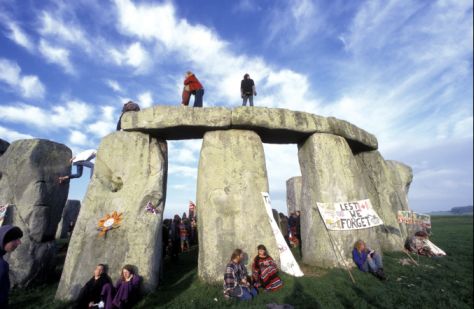
As we recently observed people are fully entitled to see Stonehenge as their temple. However, while such claims are harmless in themselves they have also been responsible for some unwelcome effects. For isn’t it clear that a wish to avoid offending people of a spiritual nature has led to a reluctance to say that no, access by tens of thousands of revellers at Summer Solstice is unseemly and damaging and really must end?
1995 Stonehenge Summer Solstice

Get off those Stones! 1995 Stonehenge Summer Solstice

It seems to us there’s an easy and equitable solution that balances tourism, spirituality and conservation in a proper manner:

1. No more thousands of tipsy revellers standing on the stones. (It’s recent, not traditional, it carries a risk of damage to both the monument and the revellers and brings shame on our country – and it simply shouldn’t happen as English Heritage knows full well.)
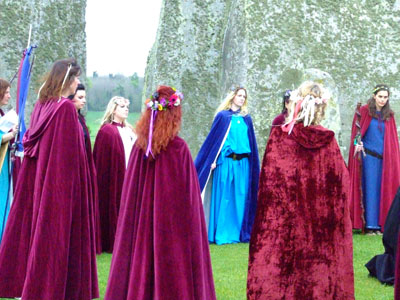
2. Spiritual people yes. Of course. But in limited numbers, selected by ballot from the membership of well established pagan organisations.
3. Other people (whether non-spiritual or spiritual but without demonstrable group affiliations), yes of course and also in limited numbers, selected by ballot from those who apply.

So how many in total? That’s entirely EH’s affair, depending purely on how many they think can be safely and sensibly admitted without imposing a risk of damage or broadcasting an image to the world that we don’t treat Stonehenge as it should be treated.  It’s certainly time they decided what they could cope with rather than unsuccessfully trying to cope with many times more than they can!

So let’s SHARE Stonehenge, it’s the obvious thing to do. But not abuse it, which is also obvious.

If spiritual people agree to that and people in general agree to that (following a consultation) then English Heritage could surely have a mandate to make radical changes to what happens at Stonehenge as soon as next year? 

How about it?

Article extracted rom the excellent Heritage Journal – http://heritageaction.wordpress.com/
Sponsored by the Stonehenge Tour Company

Follow us on twitter for all the Stonehenge Summer Solstice News: http://www/twitter.com/ST0NEHENGE

Merlin @ Stonehenge
The Stonehenge Stone Circle Website


Beltane Facts (May Day)

1 05 2011

May Day is Beltane, which means ‘day of fire’. It is an ancient Pagan festival. Bel was the Celtic God of the sun. May Day marks the seasonal transition from Winter to Summer and celebrated the first spring planting.

Beltane Celebrations at Stonehenge

Beltane Celebrations at Stonehenge

Beltane kicks off the merry month of May, and has a long history. This fire festival is celebrated on May 1 with bonfires, Maypoles, dancing, and lots of good old fashioned sexual energy. The Celts honored the fertility of the gods with gifts and offerings, sometimes including animal or human sacrifice. Cattle were driven through the smoke of the balefires, and blessed with health and fertility for the coming year. In Ireland, the fires of Tara were the first ones lit every year at Beltane, and all other fires were lit with a flame from Tara.

  • May Day is Beltane, which means ‘day of fire’. It is an ancient Pagan festival. Bel was the Celtic God of the sun.
     
  • May Day marks the seasonal transition from Winter to Summer and celebrated the first spring planting.
  • Putting a Maypole up involved taking a growing tree from the wood and bringing it to the village to mark the coming of Summer. Single men and women would dance around the Maypole holding on to ribbons until they became entwined with their (hoped for) new loves.
  • Social hierarchy was set aside on May Day to involve everyone from the highest to the lowest.
  • May Day is a celebration of fertility. In the old days whole villages would go to the woods and all sorts of temporary sexual liaisons would take place.
  • Robin Goodfellow, also known as the Green Man was the Lord of Misrule on May Day. He and his supporters would make jokes and poke fun at the local authorities.
     
  • Parliament banned May Day festivities in 1644.
  • Unlike Easter, Whitsun, or Christmas, May Day is the one festival of the year with no significant church service.
     
  • In previous centuries working people would take the day off to celebrate, often without the support of their employer.
     
  • William Davidson, a black trade unionist and a revolutionary, was executed on May Day 1820. Davidson was born in the then pirate capital, Kingston, Jamaica and put a skull and crossbones on a black flag to say:“Let us die like men and not be sold like slaves.” He was executed for being part of a conspiracy to kill the entire cabinet, which was hoped to give the spark to a revolution in Britain.
  • May Day is recognized throughout the world as International Workers’ Day, or Labour Day. In 1884 US and Canadian trade unions declared that after May 1st 1886, 8 hours would constitute a legal days work.
  • May 1st was declared a holiday by the International Working Men’s Association (First International) in Paris in 1889. This was to commemorate the Haymarket Martyrs of 1886: 8 anarchists were wrongly accused of throwing a bomb at police and 4 were executed.
  • The USA and Canada do not recognize May Day. The US government attempted to erase the its history by declaring that May 1st was ‘Law Day’ instead. They pronounced that Labour Day was to be on the first Monday of September, a date of no significance.

    Links: http://www.new-age.co.uk/celtic-festivals-beltane.htm
    Sponsors: The Stonehenge Tour Company – www.StonehengeTours.com

    Happy Beltane everybody!
    Merlin @ Stonehenge Stone Circle


Stonehenge Summer Solstice Celebrations 2011 – June 20th / June 21st

27 04 2011

English Heritage are again expected to provide “Managed Open Access” to Stonehenge for the Summer Solstice. Please help to create a peaceful occasion by taking personal responsibility and following the conditions (see below).

Please note that a high volume of traffic is anticipated in the Stonehenge area on the evening of Sunday 20th June. The car park (enter off the A303 from the roundabout – it’s signposted) will open at around 7pm on Monday 20th June, and close at around noon on Tuesday 21st June.
Note that last admission to the car park for vehicles is at around 6am. Access Access to the stones themselves is expected to be from around 8.30pm on Monday 20th June until 8am on Tuesday 21st June.

Stonehenge Summer Solstice

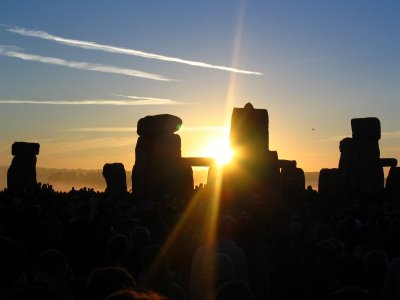
 There’s likely to be casual entertainment from samba bands & drummers but no amplified music is allowed. When you visit Stonehenge for the Solstice, please remember it is a Sacred Place to many and should be respected. Van loads of police have been present in the area in case of any trouble, but generally a jovial mood prevails. Few arrests have been made in previous years, mostly in relation to minor drug offences.

Facilities Toilets and drinking water are available and welfare is provided by festival welfare services. There are normally one or two food and drink vans with reasonable prices but huge queues, all well away from the stones themselves.

Sunrise is at around 4:45am.

Conditions Rules include no camping, no dogs, no fires or fireworks, no glass bottles, no large bags or rucksacks, and no climbing onto the stones. Please use the bags given free on arrival and take them out, filled with your litter, to the skips provided.

Please respect the rules so that we’re all able to enjoy the solstice morning at Stonehenge for years to come.

Getting there: Where possible, please travel to Stonehenge using public transport. The local bus company, Wilts & Dorset, will be running a service from Salisbury railway and bus stations to Stonehenge over the Solstice period. This bus service will commence at 1830 hours (6.30pm) on Monday 20th June and run regularly until 0115 hours (1.15am) on Tuesday 21st June. A service taking people back to Salisbury will start again at 0400 hours (4am) and run frequently until 0945 hours (9.45am). Access to Stonehenge from the bus drop off point is through the National Trust farmland. More information will be here when available.  Needless to say this service is extremly busy, please allow plenty of time.

From London: Our friends at the ‘Stonehenge Tour Company’ will be offering their usual small group unobtrusive tours to the solstice from London.  There are two services departing London at 4pm and 1am – Click here: ‘Stonehenge Summer Solstice Tour 2011’
Stonehenge summer solstice tours

LINKS: http://www.efestivals.co.uk/festivals/stonehenge/2011/
http://www.english-heritage.org.uk/daysout/properties/stonehenge/explore/summer-solstice-2011/:
http://www.thestonehengetour.info/

TWITTER: Follow Stonehenge on twitter.  Get all the latest news and Solstice uddates – http://twitter.com/ST0NEHENGE

FACEBOOK: Join Stonehenge on facebook: http://www.facebook.com/stonehenge.tours

See you all at the Summer Solstice, yipee……………..

Merlin @ Stonehenge
The Stonehenge Stone Circle Website


Why the future of Stonehenge must live up to its past

25 04 2011

Interesting article by Steve Kemp of Amesbury, Wiltshire in This is Devon.

Western Daily Press reader Steve Kemp, of Amesbury, Wiltshire, met foreign tourists as they marvelled at the Stonehenge World Heritage site – and asked them for their impressions. Many shared his view that more could be done to present the stones more helpfully and favourably when the world comes visiting. The nearby A303 is a major distraction for many visitors, Steve found. Pictured right are some of the visitors he met, and some famous images of Stonehenge over the years
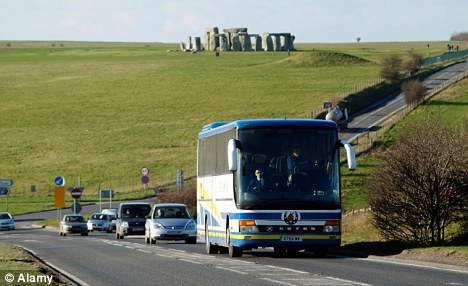
 A303 Stonehenge

It’s around 5,000 years old, a World Heritage site since 1986 and as well known throughout the universe as the Taj Mahal and the Great Wall. It’s in Wiltshire. It has to be Stonehenge.

Cared for by English Heritage, the ‘stones’ are visited by just over a million people each year. That’s a few less than the Roman Baths and Spa but more than the Eden Project. Well over half that number come from abroad. Having paid an entrance fee of up to £7.50, selected one of the audio headsets available in ten different languages from Japanese to Russian, Mandarin to French, what do our guests really think of the Stonehenge experience? Living within walking distance of the stones, and having a free pass (courtesy of the previous owner, Sir Cecil Chubb) I thought I’d try and find out.

Four young men from Singapore approached me with a request to take their picture in front of the monument. They had hired a car for a week, done Bath yesterday and next up was Portsmouth.

One of them, George Tong, who spoke excellent English, said: “I thought there might have been more to see. Been here a quarter of an hour and that’s it really. There’s an awful lot of people here, is it always this busy?” The site was indeed heaving, perhaps due to the fact that everybody has to stay on the roped path.

Rohak and Anchal Singh and their three-year-old son had travelled from India. Rohak was on his third trip to Stonehenge. “This time I’ve brought my wife and son. Otherwise two visits were more than enough. What do I think? Well it’s cold and dreary, but a duty to take my family here.” Mrs. Singh was clearly unimpressed; perhaps she just wanted to see her relatives in Birmingham.

A group of Americans from Michigan listened intensely as their guide explained to them they had one hour before the coach left for Salisbury Cathedral, the rest rooms were over there and you were not allowed to touch the “ruins” as she called them.

 Kathleen Barbour asked me when the fog would disappear so they could see something, whilst Mike Guinn was just astounded at “how old everything was here”. “It’s incredible people could have put this together all those thousands of years ago, but I have to tell you it’s not as impressive as our Grand Canyon.” With that they headed back to the coach.

Many of us will remember visiting the stones in our childhood, cars parked on the field, walking up to and touching the monument. In British archaeologist Christopher Chippendale’s book, Stonehenge Complete, he traced the first tourist back to 1562.

A Swiss chap, by the name of Hermon, escaping religious persecution, took refuge at the Bishop of Salisbury’s residence. With time on his hands he asked the bishop to take him to “something that will astound me”. The bishop duly obliged with a day out at Stonehenge, at that time owned by Edward Seymour, Earl of Hertford. What an experience he must have had.

About 20 French students were listening to their audio sets, and I asked their tutor, Claude Thierry, for his views. “Very honoured to be here, much interest and questions from my pupils. This visit will be high on a list for our practical work. Have you noticed how well behaved the group is?” Yes, I had, and how several of them had chosen the English language audio sets. Again I was asked to take a picture of a couple, this time from Hong Kong. They were so polite, and obviously enjoying the experience. Chen Qingi said that back home the stones were very well known and had been on their wish list for years. “What an amazing place, it was so mysterious early on with the mist surrounding. Glad we came.”

There were at least two dozen Japanese tourists there, one young couple dressed up against the chill in reindeer and rabbit hats. They said they had bought them in London. Sadakazu Nogami told me: “It is 6,000 miles from our home. We had been planning this journey for many months, and despite the tsunami, our parents wanted us to go ahead. “We’re very pleased with what we see here. Stonehenge deserves our respect.

The birds nesting in the cracks are from the past, that’s what we believe.” Coaches and different languages were piling up all over the place. There was Polish, Russian, Danish and Dutch, plus Australian and New Zealand accents. I didn’t ask who was who, as from previous experience I know how our Antipodean cousins can get upset if you get it wrong. Perhaps something to do with rugby and cricket. There was no mistaking the Germans though. Herr Schroder said he had all the time in the world to give his views. He and his wife had travelled over in their own car from Munich, calling in at Avebury before here. “This is fascinating, what skill to have put these stones up, and get them here in the first place. You do know we Germans were involved,” he said. No, I did not, but please go on. “A long time ago, when there was no sea separating us, people moved around. Remember there was no borders then. “If I had my way that road (A303) wouldn’t be there. In Germany we would have solved problems like that years ago. We could still solve it for you, but you haven’t got the money now,” he concluded. You can’t help but notice, and indeed feel, how both roads completely throw the whole experience for visitors.

Even English Heritage staff whom I spoke to now find the whole situation an “embarrassment”. “These people, who have travelled in many cases thousands of miles to see the stones, are being let down. A proper Stonehenge Experience would be a world beater,” said one staff member. With a fair wind, work on a new visitor centre, one and a half miles away at Airman’s Corner, could start in April 2012, plus low noise surfacing for the main road, at a total cost of £30 million.

So there is the prospect of a proper experience and existence for Stonehenge. The people who built Stonehenge, wherever they came from, must have felt proud when the work was finished, I think the least we can do is put the pride back into the Stonehenge Experience.
http://www.thisisdevon.co.uk

Merlin @ Stonehnenge
The Stonehenge Stone Circle Website

Sponsored by ‘The Stonehenge Tour Company’ – www.SonehengeTours.com
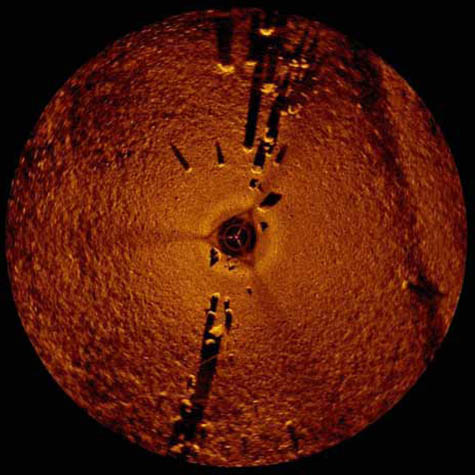


Prehistoric man ‘used crude sat nav’

20 04 2011

Prehistoric man navigated his way across England using a crude version of sat nav based on stone circle markers, historians have claimed.

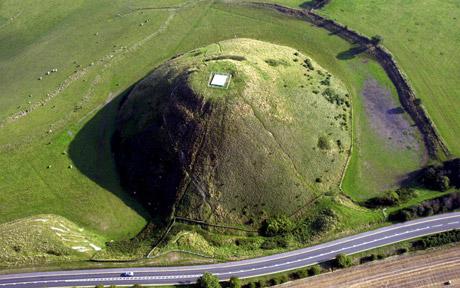
Silbury Hill, Wiltshire which may have been part of an ancient navigational aid for prehistoric

They were able to travel between settlements with pinpoint accuracy thanks to a complex network of hilltop monuments.

These covered much of southern England and Wales and included now famous landmarks such as Stonehenge and The Mount.

New research suggests that they were built on a connecting grid of isosceles triangles that ‘point’ to the next site.

Many are 100 miles or more away, but GPS co-ordinates show all are accurate to within 100 metres.

This provided a simple way for ancient Britons to navigate successfully from A to B without the need for maps.

According to historian and writer Tom Brooks, the findings show that Britain’s Stone Age ancestors were ”sophisticated engineers” and far from a barbaric race.

Mr Brooks, from Honiton, Devon, studied all known prehistoric sites as part of his research.

He said: ”To create these triangles with such accuracy would have required a complex understanding of geometry.

”The sides of some of the triangles are over 100 miles across on each side and yet the distances are accurate to within 100 metres. You cannot do that by chance.

”So advanced, sophisticated and accurate is the geometrical surveying now discovered, that we must review fundamentally the perception of our Stone Age forebears as primitive, or conclude that they received some form of external guidance.

”Is sat-nav as recent as we believe; did they discover it first?”

Mr Brooks analysed 1,500 sites stretching from Norfolk to north Wales. These included standing stones, hilltop forts, stone circles and hill camps.

Each was built within eyeshot of the next.

Using GPS co-ordinates, he plotted a course between the monuments and noted their positions to each other.

He found that they all lie on a vast geometric grid made up of isosceles ‘triangles’. Each triangle has two sides of the same length and ‘point’ to the next settlement.

Thus, anyone standing on the site of Stonehenge in Wiltshire could have navigated their way to Lanyon Quoit in Cornwall without a map.

Mr Brooks believes many of the Stone Age sites were created 5,000 years ago by an expanding population recovering from the trauma of the Ice Age.

Lower ground and valleys would have been reduced to bog and marshes, and people would have naturally sought higher ground to settle.

He said: ”After the Ice Age, the territory would have been pretty daunting for everyone. There was an expanding population and people were beginning to explore.

”They would have sought sanctuary on high ground and these positions would also have given clear vantage points across the land with clear visibility untarnished by pollution.

”The triangle navigation system may have been used for trading routes among the expanding population and also been used by workers to create social paths back to their families while they were working on these new sites.”

Mr Brooks now hopes his findings will inspire further research into the navigation methods of ancient Britons.

He said: ”Created more than 2,000 years before the Greeks were supposed to have discovered such geometry, it remains one of the world’s biggest civil engineering projects.

”It was a breathtaking and complex undertaking by a people of profound industry and vision. We must revise our thinking of what’s gone before.”

‘Prehistoric Geometry in Britain: the Discoveries of Tom Brooks’ is now on sale priced £13.90.

Sponsored by the Stonehenge Tour Company – www.StonehengeTours.com
http://www.telegraph.co.uk/news/uknews/8461290/Sat-nav-Prehistoric-man-used-crude-sat-nav.html

 Merlin @ Stonehenge
The Stonehenge Stone Circle Website


The Henge Hopper

3 04 2011

The Wiltshire Heritage Museum is planning to launch a bus service to link Stonehenge and Avebury. At the moment, it is extremely difficult to travel between the two, and the Museum hopes to be able to boost tourism in the Vale of Pewsey and the Avon Valley. They hope to launch a service in due course.

Stonehenge

Stonehenge

The Community Bus Service will be operated by minibuses, and the route would take in a range of archaeological sites and monuments in the Stonehenge and Avebury World Heritage Site, including Silbury Hill, West Kennet Long Barrow and Woodhenge.

The ‘hop on, hop off’ service would include free entry to the Wiltshire Heritage Museum in Devizes, encouraging people to discover the collections excavated from the World Heritage Site.

The Henge Hopper enables you to visit:

Avebury
Britain’s largest stone circle, at the centre of a remarkable complex of monuments, including stone circles, burial mounds, two stone-lined avenues and Silbury Hill.

Alexander Keiler Museum, Avebury Manor
Explore the world famous stone circle. The bus starts from just outside the Museum, which features fascinating finds from Alexander Keiler’s excavations at Avebury, and, in the barn, interactive displays bring the Avebury landscape to life. Explore also Avebury Manor and its wonderful garden. Cafe, toilets and shop.

Silbury Hill
The largest man-made mound in Europe, mysterious Silbury Hill compares in height and volume to the roughly contemporary Egyptian pyramids.

West Kennet Long Barrow
One of the largest, most impressive and most accessible Neolithic chambered tombs in Britain. Built in around 3650 BC, it was used for a short time as a burial chamber, nearly 50 people being buried here before the chambers were blocked.

Wansdyke / White Horse Trail
Massive Saxon defensive ditch and bank running along the top of the North Wessex Downs. Walk along the Wansdyke, following the White Horse Trail, with stunning views over the Vale of Pewsey.

Marden Henge
Britain’s largest henge, Excavations in 2010 have revealed much about its fascinating story.

Alton Barnes White Horse
Dominates the landscape of the Vale of Pewsey.

Adam’s Grave / Wansdyke
Neolithic chambered tomb on the summit of the Downs. Walk along the Wansdyke, following the White Horse Trail.

Stonehenge

The most sophisticated stone circle in the world, at the centre of a remarkable sacred landscape. Includes the cursus, a 3km long earthwork and the Avenue, leading from the River Avon.

Winterbourne Stoke

The most impressive barrow cemetery – a Neolithic long barrow and a line of Bronze Age burial mounds.

Normanton Down
Cemetery of over 50 round barrows, including the famous Bush Barrow.

Amesbury

Amesbury is an attractive small town embraced by a loop of the River Avon as it cuts through the high plateau of Salisbury Plain. The town has served the needs of travellers for centuries. Highlights include the Amesbury is the closest settlement to Stonehenge.

Durrington Walls / Woodhenge
Durrington Walls is a massive henge, the site of the recent discovery of Neolithic houses, where the people who used Stonehenge may have lived. Nearby is Woodhenge, where excavations showed a series of concentric circles of wooden posts, enclosed by a bank and ditch.

Where to Stay
Local accomodation listed by VisitWiltshire.

Alternatvley you could join a guided sightseeing coach tour with ‘The Stonehenge Tour Company’ or a privat tour with ‘Histouries UK’ or ‘SalisburyGuidedTours‘ based is Salisbury

The Henge Hopper – http://www.stonehenge-avebury-bus.org.uk/
Stonehehenge Tour Companies – http://www.stonehenge-stone-circle.co.uk/stonehenge-tours.htm

However you get there, get there…………………….

Merlin @ Stonehenge
The Stonehenge Stone Circle Website