Secrets of the Stones

30 05 2011

As the summer solstice will soon see thousands gather at Stonehenge, an archaeologist discusses his belief that the Wiltshire monument is evidence of a great civilisation which once thrived there
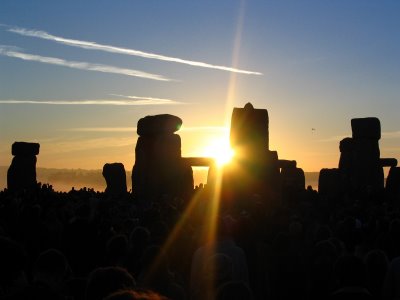
Sunrise at Stonehenge - June 21st

Sunrise at Stonehenge - June 21st

IN three weeks’ time, thousands of devotees will gather in the dark in a field in Wiltshire. They do this every year and each time their number grows.

They are there to celebrate the midsummer Solstice, the longest day of the year, and will wait until daybreak when the sun sends a piercing ray of light through Stonehenge, the ancient ruin they have come to venerate.

This primordial circle of stones, eight miles north of Salisbury in Wiltshire, exerts an extraordinary power over the people of Britain.

Some, like the Druids, claim it is the source of a mystical power while others, curious but sceptical, believe it to be the site of an ancient monument that has no relevance to the way we live today.

Whatever their conviction they are all missing the point according to one man who has studied the location for 30 years and believes he knows the real reason why Stonehenge is so special.

“Stonehenge is unique; it is already recognised as a World Heritage Site but it’s more than just an ancient curiosity, it is the place where civilisation began,” says writer and archaeologist Robert John Langdon.

“It’s simply the most amazing place in the world and we should all be celebrating the meaning of this incredible place.”

Robert fell under the spell of Stonehenge as a boy. He explored the massive stone monoliths and was intrigued by the official explanation of their origin. As the years passed and he learned more he was puzzled by contradictions in official explanation of its origins.

“The carbon dating of the stones is not consistent. I have discovered that stone post holes in what is now the car park for the site predate the accepted date for Stonehenge by 5,000 years. If this evidence is accepted, and it has been denied for years, it turns the conventional history of Stonehenge, and the rest of the world for that matter, on its head.”

If Robert is right, and he says he has the scientific evidence to prove he is, Stonehenge is the most important archaeological site in the world. It would mean Salisbury Plain is home to the first and most significant civilisation on earth. So how could this have happened?

“The geography and landscape of the site would have been very different. Britain would have been emerging from the last Ice Age, so much of the country we now recognise would have been under water. Stonehenge would have been on an estuary that led to the open sea. Too many important facts have been ignored,” says Robert.

“There is evidence that water was close, but that has been classified as a moat which I believe is wrong. It is also believed the stones were dragged over land from Wales which is misleading.

“The large sarsen stones came from an area close to Avebury which is not far from Stonehenge.  To have brought them overland all the way from Wales takes no account of the fact that according to the official time scale Salisbury Plain at that time would have been heavily forested which would have made that access all but impossible. The bluestones, which are the key to the secret of Stonehenge, were smaller and did come from Wales but they were brought there by boat.”

Robert’s hypothesis is based on his conviction that the men who built Stonehenge were much more skilled and sophisticated than is currently believed. In 10,000 BC, the Mesolithic period, he believes that men in ancient Britain developed the first recognisable civilisation and that Stonehenge was their greatest achievement.

“These were extremely capable people who found a way of drilling into stone and used sophisticated mortice and tenon joints to erect Stonehenge but most importantly they mastered the seas. These boat people, as we can call them, travelled widely and traded and these are the people I believe that Plato referred to in his writings on the origins of civilisation.”

So why did these people make such an effort to build Stonehenge? what was it intended to do?

“Stonehenge was accessible to boat people from  all over Europe and Mesolithic men and women came there to be cured of their ailments and to depart from this world. The alignment of the site to the sun and the moon is immensely significant but so is the presence of the bluestones in the circle.

“Bluestone turns blue in water, and was believed to have incredible powers of healing. Evidence from bones found close to Stonehenge suggests that the original inhabitants practised sophisticated medical procedures which included dentistry, limb removal and even brain surgery.

“These were not the fur-clad hunter gatherers living in mud huts that many mistakenly believe were the builders of Stonehenge. They were instead members of a great civilisation that moved out, leaving Stonehenge as the only surviving physical evidence of their genius.”

If Robert Langdon is right Stonehenge is much older than the Pyramids and there is a surprising connection between the two ancient stone monuments.

“Over the centuries the climate and landscape in Britain changed. Mesolithic men used their seafaring skills to move to a more sympathetic environment. They traded widely and sailed south to what is now the Mediterranean and moved in along the coast from Egypt to Greece and Italy. The ancient Egyptians’ skill at engineering and building with stone had its roots in the lessons learnt by the men who built Stonehenge.”

It is not only archaeologists with a theory about the significance of Stonehenge. The Druids regard it as a sacred place where they perform spiritual rituals.

Robert says: “I don’t have any disputes with the Druids and they don’t seem to mind me. I’ll be rubbing shoulders with lots of them at the midsummer solstice. The Druids may well have their beliefs but they came on the Stonehenge scene very late in the day.

“They would have discovered the site as an ancient and abandoned temple and taken it over but that’s all right. I get on pretty well with other archaeologists too although they do tend to dismiss my work, but that’s their loss. Stonehenge has a special hold on me and the more I learn about it the more fascinated I become. I’m already working on a new book which I think will ruffle quite a lot of feathers.

“In a sense what we know as Stonehenge is almost the foundations of a much bigger edifice. Stonehenge is, despite all the myths that have been fostered, a very special place. It is, I believe, the birthplace of civilisation and we all ought to give it the respect that it really deserves.”

Article from The Express Newspaper
Sponosred by ‘The Stonehenge Tour Compant’ www.StonehengeTours.com

Merlin @ Stonehenge
The Stonehenge Stone Circle Website
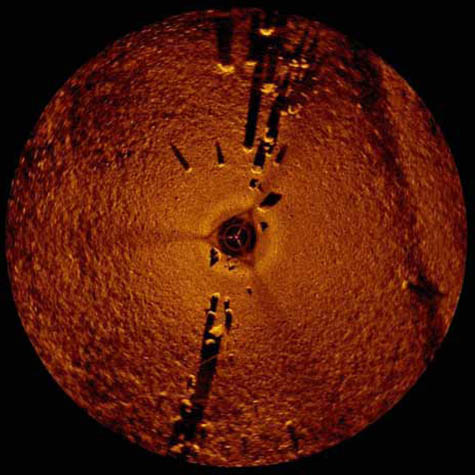


A Stonehenge found in America. Is it bigger and better ? Probably…..

28 05 2011

A Stonehenge under Lake Michigan
While scanning underneath the waters of Lake Michigan for shipwrecks, archeologists found something a lot more interesting than they bargained for, as they discovered a boulder with a prehistoric carving of a mastodon, as well as a series of stones arranged in a Stonehenge-like manner.

Stonehenge found under Lake Michigan

Stonehenge found under Lake Michigan

At a depth of about 40 feet into Lake Michigan’s Grand Traverse Bay, using sonar techniques to look for shipwrecks, archeologists discovered sunken boats and cars and even a Civil War-era pier, but among all these they found this prehistoric surprise, which a trained eye can guess by looking at the sonar scans photos in this article.

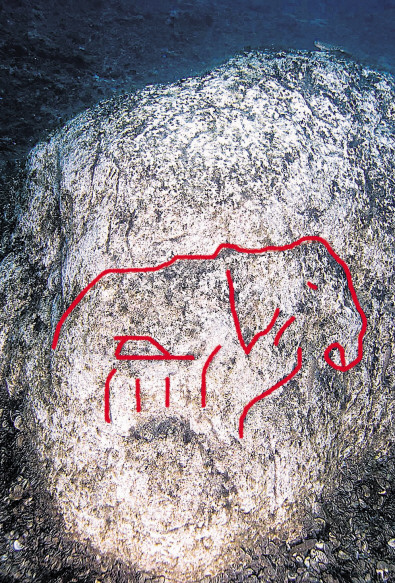
“When you see it in the water, you’re tempted to say this is absolutely real,” said Mark Holley, a professor of underwater archaeology at Northwestern Michigan University College who made the discovery, during a news conference with photos of the boulder on display in 2007. “But that’s what we need the experts to come in and verify.

The boulder with the markings is 3.5 to 4 feet high and about 5 feet long. Photos show a surface with numerous fissures. Some may be natural while others appear of human origin, but those forming what could be the petroglyph stood out, Holley said.

Viewed together, they suggest the outlines of a mastodon-like back, hump, head, trunk, tusk, triangular shaped ear and parts of legs, he said.

“We couldn’t believe what we were looking at,” said Greg MacMaster, president of the underwater preserve council.

Specialists shown pictures of the boulder holding the mastodon markings have asked for more evidence before confirming the markings are an ancient petroglyph, said Holley.

“They want to actually see it,” he said. Unfortunately, he added, “Experts in petroglyphs generally don’t dive, so we’re running into a little bit of a stumbling block there.”

If found to be true, the wannabe petroglyph could be as much as 10,000 years old – coincident with the post-Ice Age presence of both humans and mastodons in the upper midwest. The formation, if authenticated, wouldn’t be completely out of place. Stone circles and other petroglyph sites are located in the area.

The discovery was made back a few years ago, and surprisingly enough the find hasn’t been popularized at all, with little to no information available online, but I’ll be sure to update this post as soon as I can get ahold of more info. So, who’s from Michigan?

Sponsored by the ‘Stonehenge Tour Company’ – www.StonehengeTours.com

Come and visit Stonehenge in England – you went get wet at this one!

Merlin @ Stonehenge
The Stonehenge Stone Circle website

Follow me on twitter for all the latest Stonehenge (U.K) news:
http://www.twitter.com/ST0NEHENGE


Archaeostrononomer Gerald Hawkins died today 2003

26 05 2011

Gerald Stanley Hawkins

Gerald Hawkins

Gerald Hawkins

Astronomer who claimed Stonehenge was a computer

· Gerald Stanley Hawkins, archaeoastronomer and author, born April 20 1928; died May 26 2003.

(1928–2003) was an English astronomer and author most famous for his work in the field of archaeoastronomy. A professor and chair of the astronomy department at Boston University in the United States. In 1965 he published an analysis of Stonehenge in which he was the first to propose its purpose as an ancient astronomical observatory used to predict movements of sun and stars. Archeologists and other scholars have since demonstrated such sophisticated, complex planning and construction at other prehistoric earthwork sites, such as Cahokia in the United States.

Gerald Hawkins’ work
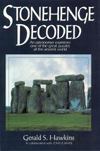
Gerald Hawkins’ work on Stonehenge was first published in Nature in 1963 following analyses he had carried out using the Harvard-Smithsonian IBM computer. Hawkins found not one or two alignments but dozens. He had studied 165 significant features at the monument and used the computer to check every alignment between them against every rising and setting point for the sun, moon, planets, and bright stars in the positions they would have been in 1500 BC. Thirteen solar and eleven lunar correlations were very precise against the early features at the site with precision falling during the megalithic stages. Hawkins also proposed a method for using the Aubrey holes to predict lunar eclipses by moving markers from hole to hole. In 1965 Hawkins wrote (with J. B. White) Stonehenge Decoded, which detailed his findings and proposed that the monument was a ‘Neolithic computer’.

Atkinson replied with his article “Moonshine on Stonehenge” in Antiquity in 1966, pointing out that some of the pits which Hawkins had used for his sight lines were more likely to have been natural depressions, and that he had allowed a margin of error of up to 2 degrees in his alignments. Atkinson found that the probability of so many alignments being visible from 165 points to be close to 0.5 (or rather 50:50) rather that the “one in a million” possibility which Hawkins had claimed. That the Station Stones stood on top of the earlier Aubrey Holes meant that many of Hawkins’ alignments between the two features were illusory. The same article by Atkinson contains further criticisms of the interpretation of Aubrey Holes as astronomical markers, and of Fred Hoyle’s work.

A question exists over whether the English climate would have permitted accurate observation of astronomical events. Modern researchers were looking for alignments with phenomena they already knew existed; the prehistoric users of the site did not have this advantage.

Later Stonehenge theories

Although Stonehenge has become an increasingly popular destination during the summer solstice, with 26,000 people visiting in 2010, scholars have developed growing evidence that indicates prehistoric people visited the site only during the winter solstice. The only megalithic monuments in the British Isles to contain a clear, compelling solar alignment are Newgrange and Maeshowe, which both famously face the winter solstice sunrise.

The most recent such evidence supporting the theory of winter visits includes bones and teeth from pigs which were slaughtered at nearby Durrington Walls. Their age at death indicating that they were slaughtered either in December or January every year. Mike Parker Pearson of the University of Sheffield has said, “We have no evidence that anyone was in the landscape in summer.”

From the Guardian 2003

In 1961, Gerald Hawkins, who has died of a heart attack aged 75, was professor of physics and astronomy at Boston University in Massachusetts. It was then that he returned to Salisbury Plain to film the sun rise over the marker Heelstone at Stonehenge. Assistants meanwhile plotted every stone and pit, punched coordinates on to cards and fed them, and astronomical data, into an IBM 704.This was at a time when computers were rare and glamorous. Asking that age’s technological wonder to decipher the ancient world’s icon was a gesture of timely genius. The journal Nature published Hawkins’s first results in 1963. Two years later Stonehenge Decoded, written by Hawkins with John B White, was published in the US.The IBM machines, Hawkins argued, showed Stonehenge to be a neolithic computer-observatory for predicting eclipses of the sun and moon. From New York to Iraq, newspapers praised the professor and his computer for rewriting prehistory. Stone-age savages were revealed as skilled scientists.

Archaeologists were less happy. They sniffed at his “overconfident style”, resented his publicity and questioned his results. Hawkins’s statistics were shown to be dodgy; he had contrived a computer from a monument believed to have developed piecemeal over centuries.

Stonehenge excavator Richard Atkinson described Hawkins’s book as: “tendentious, arrogant, slipshod, and unconvincing” – for him the builders of Stonehenge were “howling barbarians”.

The popular archaeologist Jacquetta Hawkes, meanwhile, observed that “every age has the Stonehenge it deserves – or desires”.

Hawkins claimed surprise at the response. That contribution to Nature was his 61st scientific paper and many of his others, on subjects such as tektites, meteors and steady-state universe theory seemed to him more exciting. But none of his other dozen books was as successful.

Hawkins had changed the way we think about Stonehenge, and inspired the science of archaeo-astronomy. Repeated studies have failed to do more than support a few solar, and perhaps lunar alignments, and deny a computational function. Yet in the public mind, Stonehenge is now fixed as an observatory and computer. Stonehenge Decoded initiated a debate still alive, and inspired the first generation of archaeo-astronomers.

Hawkins also analysed the Nazca lines in Peru and the temple of Amun at Karnak, Egypt. He recently developed a crop circles theory based on Euclidean geometry and musical intervals. He first saw Stonehenge in 1953, when working at nearby Larkhill camp. He read that the monument was aligned on midsummer sunrise, a fact first noted by William Stukeley in the 18th century, and made much of by Sir Norman Lockyer in 1906.

Hawkins’s hometown was Great Yarmouth. He obtained his first degree at Nottingham University in 1949 in physics, with pure maths subsidiary, and a PhD in radio astronomy under Sir Bernard Lovell at Manchester University in 1952.

Manchester awarded him a DSc in 1963 for astronomical research at the Harvard-Smithsonian Observatories. He was professor of astronomy and chairman of the department at Boston University (1957-69), and dean of the liberal arts Dickinson College in Carlisle, Pennsylvania (1969-71).

Boston presented him with the Shell award for distinguished writing in 1965. Other awards came from the Smithsonian Institution and the National Academy of Sciences, and he was a proud member of the prestigious intellectual Cosmos Club, Washington DC. He was a science advisor to the US Information Agency.

Hawkins was dedicated to his research, and enthusiastic and generous with those ready to listen. He was due to address an Oxford conference with a new Stonehenge study and, to the surprise of some British academics, he continued to see himself as an Englishman. He leaves his second wife, Julia Dobson.

Links: http://www.megalithic.co.uk/article.php?sid=2146410963
Sponsors: The Stonehenge Tour Company, www.StonehengeTours.com

Respect!

Merlin @ Stonehenge
The Stonehenge Stone Circle Website


Stonehenge Winter Solstice 2012 – The end of the world is nigh, or is it ?

18 05 2011

 Stonehenge Stone Circle and 2012

I am surprised at the number of people asking questions and talking about the Stonehenge winter solstice next year.  Many connections are being made to the Mayan calander and ‘the end of the world’   Will we see a record number of people turning up for ‘open access’  from around the world on the December 21st 2012 ?

Stonehenge dates back to being built around 3100 BC. This is in collaboration with creation of the Mayan calendar and the invention of the Sumerian language. On analyzing the Stonehenge several historians have suggested the possibility of the Stonehenge giving clues to the end of time in the same way the Mayan calendar does; thus showing a link between the two.
Stonehenge 2012

It was believed that the Stonehenge was used to tell time using the Sun’s solstice. With the rising and setting of the sun, one can observe time. During one day of summer the sun is set as far in the sky as possible. At this time the sun rises in direct alignment to a section of the Stonehenge known as the “heal stone”. This stone serves the same purpose as the hands of a clock as it casts a shadow over the Stonehenge sector. Coincidentally, this clock goes backward and acts as a countdown to the end of time – on December 21st 2012! On this day due to the wobble of the Earth on its axis and several other alignments, the heal stone will cease to cast a shadow indicating that time has run out.

Moreover, archaeologists have found various carvings in the stone. Using carbon dating archaeologists some of these carvings include Sumerian numbers and writings. The numbers “33” and “32” is significantly engraved on the stones. Interestingly enough, with the Sumerian sexagesimal system, the number 33 is multiplied by 60 and then added to 32 giving 2012 ironically.

End of the world 2012Stonehenge and the Mayan Calendar

The writings of the Mayans and the Sumerians have suggested the world might come to end on December 21st 2012. Furthermore, the Mayan Long Count calendar ends on this particular date. These ancient civilizations lived in close proximity to each other; thus, had a lot of influence from each other to similarly predict the future. Yet, there are other objects that have marked the same date – Stonehenge! Could one of the “Seven Wonders of the World” really foretell the fate of our future?

It was believed that the Stonehenge was used to tell time using the Sun’s solstice. With the rising and setting of the sun, one can observe time. During one day of summer the sun is set as far in the sky as possible. At this time the sun rises in direct alignment to a section of the Stonehenge known as the “heal stone”. This stone serves the same purpose as the hands of a clock as it casts a shadow over the Stonehenge sector. Coincidentally, this clock goes backward and acts as a countdown to the end of time – on December 21st 2012! On this day due to the wobble of the Earth on its axis and several other alignments, the heal stone will cease to cast a shadow indicating that time has run out.

Moreover, archaeologists have found various carvings in the stone. Using carbon dating archaeologists some of these carvings include Sumerian numbers and writings. The numbers “33” and “32” is significantly engraved on the stones. Interestingly enough, with the Sumerian sexagesimal system, the number 33 is multiplied by 60 and then added to 32 giving 2012 ironically.

Stonehenge holds many secrets that mankind has yet to discover. It is possible that something will happen on December 21st 2012, as it is not only limited to one side of the world since the Mayans and Sumerians lived in Meso-America; 2012 is also a big part of history in other countries. As time passes, we might be able to discover more. Hopefully all this information should give us a better insight of what is to come.

What will happen after December 21st 2012 ?  hopefully December 22nd 2012 because I will be there trying to enjoy the sunrise and celebrations.

Links:
http://www.the2012discovery.com/2012-videos/2012-mayan-calendar-doomsday-stonehenge-link-video/
http://www.2012hoax.org/stonehenge
http://www.stonehengetours.com/html/stonehenge-winter-solstice-tour.htm

Sponsored by ‘The Stonehenge Tour Company’

Merlin @ Stonehenge
The Stonehenge Stone Circle Website

P.S My opinion – Stonehenge isn’t a doomsday clock!


Prehistoric man ‘used crude sat nav’

20 04 2011

Prehistoric man navigated his way across England using a crude version of sat nav based on stone circle markers, historians have claimed.

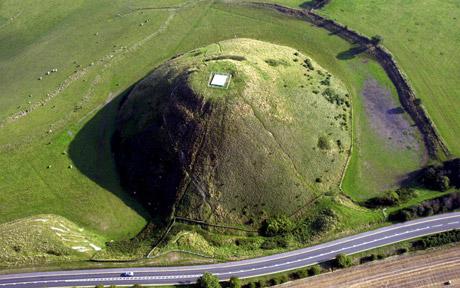
Silbury Hill, Wiltshire which may have been part of an ancient navigational aid for prehistoric

They were able to travel between settlements with pinpoint accuracy thanks to a complex network of hilltop monuments.

These covered much of southern England and Wales and included now famous landmarks such as Stonehenge and The Mount.

New research suggests that they were built on a connecting grid of isosceles triangles that ‘point’ to the next site.

Many are 100 miles or more away, but GPS co-ordinates show all are accurate to within 100 metres.

This provided a simple way for ancient Britons to navigate successfully from A to B without the need for maps.

According to historian and writer Tom Brooks, the findings show that Britain’s Stone Age ancestors were ”sophisticated engineers” and far from a barbaric race.

Mr Brooks, from Honiton, Devon, studied all known prehistoric sites as part of his research.

He said: ”To create these triangles with such accuracy would have required a complex understanding of geometry.

”The sides of some of the triangles are over 100 miles across on each side and yet the distances are accurate to within 100 metres. You cannot do that by chance.

”So advanced, sophisticated and accurate is the geometrical surveying now discovered, that we must review fundamentally the perception of our Stone Age forebears as primitive, or conclude that they received some form of external guidance.

”Is sat-nav as recent as we believe; did they discover it first?”

Mr Brooks analysed 1,500 sites stretching from Norfolk to north Wales. These included standing stones, hilltop forts, stone circles and hill camps.

Each was built within eyeshot of the next.

Using GPS co-ordinates, he plotted a course between the monuments and noted their positions to each other.

He found that they all lie on a vast geometric grid made up of isosceles ‘triangles’. Each triangle has two sides of the same length and ‘point’ to the next settlement.

Thus, anyone standing on the site of Stonehenge in Wiltshire could have navigated their way to Lanyon Quoit in Cornwall without a map.

Mr Brooks believes many of the Stone Age sites were created 5,000 years ago by an expanding population recovering from the trauma of the Ice Age.

Lower ground and valleys would have been reduced to bog and marshes, and people would have naturally sought higher ground to settle.

He said: ”After the Ice Age, the territory would have been pretty daunting for everyone. There was an expanding population and people were beginning to explore.

”They would have sought sanctuary on high ground and these positions would also have given clear vantage points across the land with clear visibility untarnished by pollution.

”The triangle navigation system may have been used for trading routes among the expanding population and also been used by workers to create social paths back to their families while they were working on these new sites.”

Mr Brooks now hopes his findings will inspire further research into the navigation methods of ancient Britons.

He said: ”Created more than 2,000 years before the Greeks were supposed to have discovered such geometry, it remains one of the world’s biggest civil engineering projects.

”It was a breathtaking and complex undertaking by a people of profound industry and vision. We must revise our thinking of what’s gone before.”

‘Prehistoric Geometry in Britain: the Discoveries of Tom Brooks’ is now on sale priced £13.90.

Sponsored by the Stonehenge Tour Company – www.StonehengeTours.com
http://www.telegraph.co.uk/news/uknews/8461290/Sat-nav-Prehistoric-man-used-crude-sat-nav.html

 Merlin @ Stonehenge
The Stonehenge Stone Circle Website


Stonehenge is a landing strip.

5 04 2011

Aircraft at Stonhenge for first time in 90 years

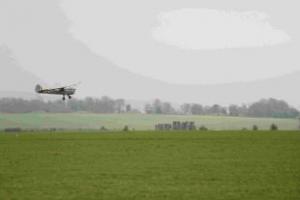
AIRCRAFT landed at the former Stonehenge airfield on Friday for the first time in 90 years.

Stonehenge landing strip

Stonehenge landing

The event was arranged by the National Trust to commemorate the centenary of the formation of the first British military aeroplane unit.

Although overcast weather and strong winds hampered the occasion, three Auster planes, the oldest dating back to 1942, did manage to land.

A number of other planes including some replica First World War aircraft were due to take part but were unable to take off because of the conditions.

The airfield, RFC Stonehenge, was part of the Royal Flying Corps, although part of the site was also used by the Royal Naval Air Service as RNAS Stonehenge.

It became part of the Royal Air Force when it was formed in 1918 and the airfield remained open until March 1921.

The fly-in commemorated the formation of No 2 (Aeroplane) Company, Air Battalion, Royal Engineers which was formed at Larkhill on April 1, 1911.

“We are delighted to bring this aspect of the history of Stonehenge to life again, with the fly-in by this wonderful collection of aircraft,” said Stonehenge project officer Lucy Evershed.

National Trust volunteer guide Ted Mustart added: “Although No 2 Company was based at Larkhill, much of their flying in 1911 and 1912 was over the Stonehenge landscape.

“The Austers which have visited were used in the same roles as those of the first military aeroplanes – scouting, artillery co-operation and liaison in the period immediately after World War II.”

The National Trust has also organised a series of walks revealing the aviation history of the Stonehenge landscape.

The Wings over Stonehenge walks have taken visitors to the former airfield and more walks are planned for the summer, including one commemorating the first fatal military aircraft accident.

More information is available at www.nationaltrust.org.uk/stonehengelandscape
http://www.salisburyjournal.co.uk
http://www.StonehengeTours.com

Merlin @ Stonehenge
The Stonehenge Stone Circle Website


Scientists ‘step closer’ to solving Stonehenge mystery

23 02 2011

IT is a mystery that has baffled geologists and historians for centuries… how were the Stonehenge rocks transported from Wales’ Preseli mountains to their resting place 120 miles away.

Scientists are today one step closer to solving the 4,000-year- old mystery after making their most significant discovery in 15 years.

Of the six to eight different bluestone types found in the inner circle of rocks on Salisbury Plain, only one, the so- called “spotted dolerite”, was convincingly traced to the Mynydd Preseli area in north Pembrokeshire in the early 1920s.

But modern technology has now assisted geologists at Amgueddfa Cymru – National Museum Wales – in creating a “fingerprint” for one of the other rock types found in Wiltshire.

And that “fingerprint” has been identically matched to stones found in an area north of the Mynydd Preseli range, in the vicinity of Pont Saeson.

The discovery means archaeologists are now a step closer to retracing the footsteps of Neolithic engineers who moved the stones in the first place.

Dr Richard Bevins, Keeper of Geology at Amgueddfa Cymru, said: “The outer circle of Stonehenge is made up from stones sourced locally in Salisbury Plain but it is the mismatch of rocks found in the inner circle that have caused so much mystery.

“We have known for some time that spotted dolerite came from Preseli but of those remaining stones we think that six to eight more may have come from Pembrokeshire, until now though we haven’t been able to be sure because the stones are very fragile and we didn’t previously have the technology to extract their DNA.”

Dr Bevins added: “Theoretically if we could trace the source of the other rhyolites (rock types) we could create a map with six or more locations pinpointing where each stone was sourced.

“Archeologists could then essentially see the route that was taken by these people, they could re-trace those steps, set up archaeological digs and make who knows how many new discoveries.

“In terms of looking at where the stones came from this is the most important discovery we’ve made regarding Stonehenge in 10 or 15 years.”

Dr Bevins, in partnership with Dr Rob Ixer at the University of Leicester and Dr Nick Pearce of Aberystwyth University, made the discovery by analysing microscopic crystals found in the rock, vaporising them and analysing the gases found as a result.

The composite of gases makes up the rock’s DNA which can then be matched to other rock forms.

Sourcing the rhyolites also provides the opportunity for new thoughts on how the stones might have been transported to the Stonehenge area.

Much of the archaeology in recent years has been based on the assumption that Neolithic Age man had a reason to transport bluestones all the way from West Wales to Stonehenge and the technical capacity to do it.

Dr Bevins said: “It has been argued that humans transported the spotted dolerites from the high ground of Mynydd Preseli down to the coast at Milford Haven and then rafted them up the Bristol Channel and River Avon to the Stonehenge area.

“However, the outcome of our research questions that route, as it is unlikely that they would have transported the Pont Saeson stones up slopes and over Mynydd Preseli to Milford Haven, we would assume that they would not carry the rocks up and over a steep mountain range.

“If humans were responsible then an alternative route might need to be considered.”

Some believe that the stones were transported by the actions of glacier sheets during the last glaciation and so the Pont Season discovery will need appraising in the context of this hypothesis.

Mike Parker Pearson, Professor of Archaeology at Sheffield University, added: “This is a hugely significant discovery which will fascinate everyone interested in Stonehenge.

“It forces us to re-think the route taken by the bluestones to Stonehenge and opens up the possibility of finding many of the quarries from which they came.

“It’s a further step towards revealing why these mysterious stones were so special to the people of the Neolithic.”

Read More http://www.walesonline.co.uk/news/wales-news/2011/02/23/scientists-step-closer-to-solving-stonehenge-mystery-91466-28216698/#ixzz1ElvHUPjT

Merlin @ Stonehenge


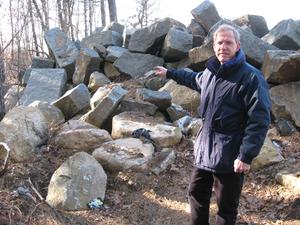
Stonehenge replica envisioned for Thompson’s Field in Harwich

20 02 2011
HARWICH — (USA) Tom Leach wears many hats: Top cop for the town’s waterways as harbormaster; expert on all things wild as natural resources director; and in a hobbyist role, an avid astronomer.

But now, he’s found a new calling to build something unlike anything else in town.  A monument of sorts, made out of huge pieces of granite. Leach wants to construct a version of the world famous Stonehenge, right in Harwich.

Stonehenge, near Amesbury, England, is a famous circle of standing stones erected around 2,500 B.C. World renown, this ancient site is both intriguing and mysterious, especially since no one has ever really figured out why it was originally built. Was it a burial ground? A marketplace? A temple for druid practices?

Many have concluded that its main purpose was as a calendar of sorts, to track the sun, planets and stars.

The idea of building a modern Stonehenge hit Leach as he sat in the back of a selectmen’s meeting a few years ago. The board was discussing whether to give the town of Wellfleet up to 90 large granite stones, some up to 9 feet tall and 3 feet wide, once used in a now-dismantled railroad bridge off Old Main Street.

The board knew the granite stones were valuable and decided against giving them away.

“Building our own Stonehenge would be absolutely unique,” Leach said. “Since we already have the stone and plenty of open space, we are part of the way there.”

“I think it would be a big draw for the town,” he added. “And I love the possibility of using Thompson’s Field as the setting.”

But the idea has not taken hold – yet. Leach knows the project requires a moderate sized group of volunteers and advocates. The layout and design must be drawn up and a proposal must be drafted for the conservation commission, which oversees the land on Thompson’s Field, to review.

Then comes the sheer logistics of moving the stones and positioning them at whatever site is chosen.

“This is such a mountain to climb and I can’t climb it by myself,” Leach admits. “You need dozens of volunteers and lots of heavy equipment.”

MichaelLach, executive director of Harwich Conservation Trust, agreed that the project would need “a real groundswell,” adding that, “It sounds interesting.”

Lach said that he needs to see a more refined plan before the trust takes a position.

He noted that a solar calendar on Wing Island in Brewster, built in the 1980s, has recently been maintained through a collaborative effort between the town and Cape Cod Museum of Natural History.

“That’s something to study as an example,” he added.

Highway department director Link Hooper noted that in 1999, the stones would have been buried as part of the landfill-capping project.

“I personally went and got the material and dug it up with heavy equipment before it was capped. It took a couple of days to put them off to the edge of the landfill,” said Hooper.

When asked about the idea of using the granite to build a small version of Stonehenge, Hooper didn’t want to take a position but said it was possible.

“The town could move it all – That’s no big problem. We’ve got front-end loaders and forks and flatbed trucks to do the job,” he said. “If the board of selectmen support it, I think this could move ahead.”

Selectman Ed McManus said that several of the stones have been used for markers across town.

“It’s an interesting idea,” he said of the Stonehenge concept. “But Thompson’s Field being conservation land, it would have to go in front of the conservation commission because they have the ultimate say on that land.”

For now, Leach is still hoping to pull together a bigger band of volunteers to help launch the project.

“I even bought a couple of books on Stonehenge to better understand the scope of the project,” he said. “It was done in stages over a thousand years, taking generations to complete the project.”

“We have the land, we have the material, we just need the manpower,” he said.

“We’re missing only that one element. With that, I know we can move ahead.”

http://threeharbors.com/stonehenge.html
http://www.wickedlocal.com

Merlin @ Stonehenge (UK)
The Stonehenge website


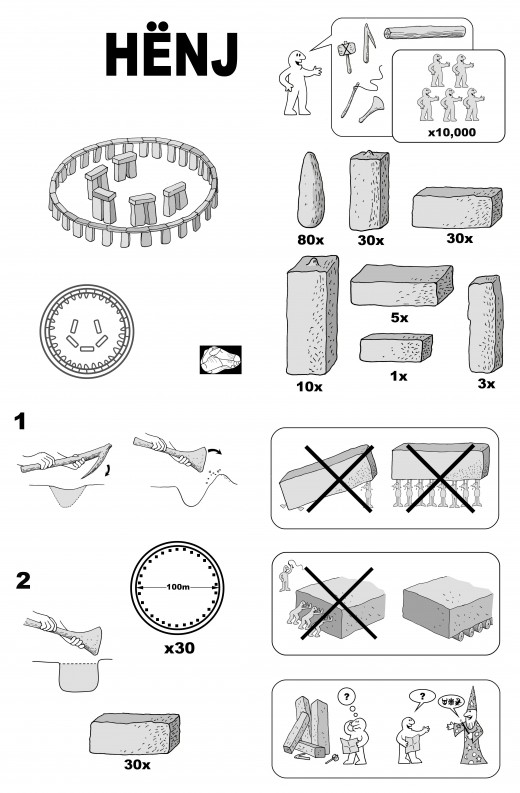
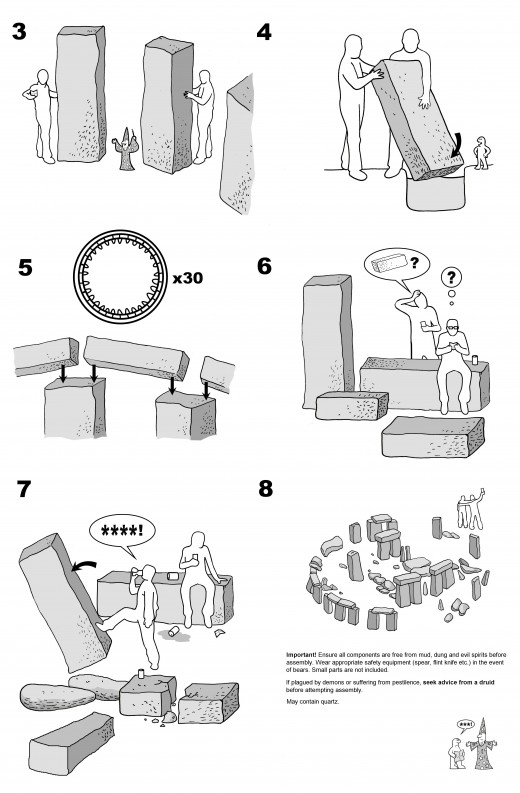
Ikea Stonehenge (HENJ) DIY flat-pack henge.

18 02 2011

Ikea Henge

Ikea Henge

Ikea Henge (Henj)

Ikea Henge (Henj)


Don’t forget “When all else fails, read the instructions”

Have a great weekend…………..
Merlin @ Stonehenge
The Stonehenge Website


Sarsen stones – Shaped like wood 42 centuries ago

5 02 2011

Sarsen stones are the very large stones that forms the outer circle at Stonehenge.

These stones are a very hard type of sandstone. Now to give one a clear idea as to how hard this particular stone is we will take a look at the Mohs scale.

The Mohs scale is simply a measurement used to measure the surface resistance to abrasion of any hard substance.

That just means that if we take a hammer and bash the stone how much will it resist before we can knock a chunk off it.

Sarsen stone measures a seven (7) on the Mohs scale.

Now, if we compare the surface resistance of sarsen stone to that of steel we find that steel measures 6,7 on the same scale.

So, we now know that sarsen stone is a very hard stone and we can appreciate how difficult it must have been to shape the stone with ancient tools.

Sarsen stones were worked and dressed with other sarsen stone which were round balls of stone known as mauls. The mauls were of various sizes and can today be viewed at the Salisbury museum.

From exploration at Stonehenge it would appear that there were 30 stones that were used as “uprights”.

Of these “uprights” 29 of them were shaped to the same basic size.

When the sarsen “uprights” were placed into position they were then capped with a line of sarsen stone lintels.

The lintels weighs up to seven tons ( 7,000kg.) each.

To fix the lintels securely in position thirteen feet or 4m. above the ground these lintels were locked together like pieces in a jigsaw.

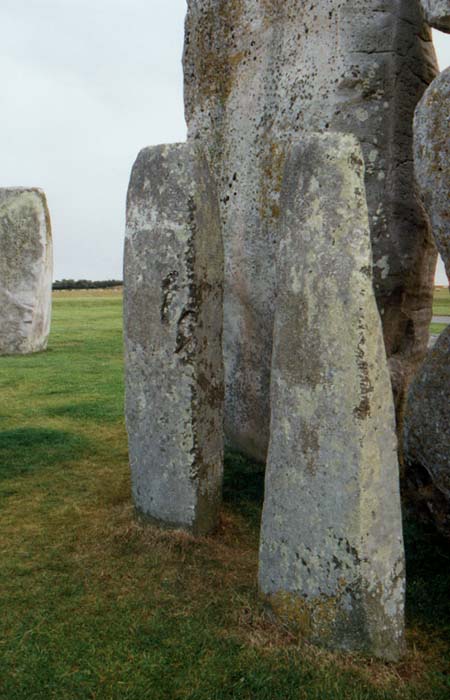
The lintels were held in place on the upright sarsen stones by mortice-and-tenon joints which was carved out of the solid stone.

The lintels in the circle were then locked end-to-end by a method known as vertical tongue and groove joints.

The vertical tongue and groove jointing techniqueThe jointing techniques used on the sarsen stones are all from the wood joiners craft.

Another amazing feature is that the lintel circle of sarsen stones were shaped to follow the curve of the circle which is both a design and engineering feature.

Merlin @ Stonehenge
The Stonehenge Stone Circle Website