The Holy Grail of standing stone circles found as NASA spacecraft captures lunar Stonehenge image

2 01 2012

Space – Dismissed in 1959 by the USSR Luna 3 probe as a pile of inconsequential volcanic trash a 3,000ft diameter standing stone formation has been captured on camera by NASA’s latest mission.

The Lunar Stonehenge puts its Wiltshire, UK counterpart at the center of current human civilization

The Lunar Stonehenge puts its Wiltshire, UK counterpart at the center of current human civilization

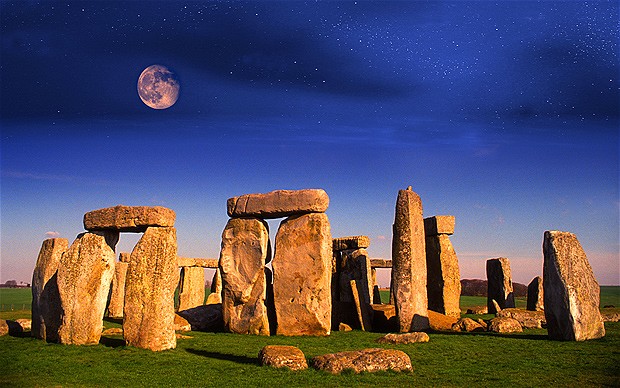
Stunning pictures from the Grail-A spacecraft reveal a giant lunar Stonehenge close to the Mare Ingenii – or Sea of Ingenuity – impact crater.

NASA HQ astrophysicists said today they’d long suspected the existence of a Stonehenge-like structure on the Moon’s far side after decades of studying decrypted ancient Egyptian creation texts.

An Agency press release confirmed the Grail-A’s high definition close-ups depict some mysterious hieroglyphs hewn into the monoliths.

“The Pope will have a fit, heheh!” the head of the NASA Jet Convulsion Laboratory’s space artefucts division chuckled this morning, “these symbols hail Isis as the Mother of Creation!”

The news may also cause blood to boil at the European Space Agency where the possibility that Stonehenge’s Wiltshire site was chosen ‘by a vastly superior intelligence’ to copy the lunar edifice would place the UK at the heart of the current human civilization.

Belgian nationalism has always maintained the center of the Universe is located in Brussels, home of the Euro and of the moules-frites gastronomic delicacy (sick).

That gung-ho spin now faces oblivion as NASA pictures emerge from the shadows, echoing a June 2009 report claiming crumbling remains of the former palatial Atlantis fortress were filmed by International Space Station cameras focused on the Moon’s dark side.

Confirmation of the lunar Stonehenge creation could be the first step to unravelling the astrophysics of ‘As Above, So Below’ ancient pagan lore, the NASA source added.

Later today NASA’s Grail-B twin craft will track its companion’s lunar orbit and carry out its own 3D surveillance.

The Prime Minister and the US President have asked to be kept informed.

Merlin says: “Its not all serious”  Link- http://www.thespoof.co.uk

Sponsored by ‘The Stonehenge Tour Company’ www.StonehengeTours.com

Merlin @ Stonehenge
The Stonehenge Stone Circle Website


Stonehenge: Closure of A344 near monument to go ahead

1 01 2012

Plans to close a main road running past Stonehenge are to go ahead.

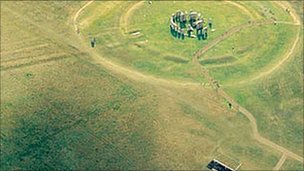
An aerial view of Stonehenge without the A344 road

An aerial view of Stonehenge without the A344 road

English Heritage wants to stop traffic from travelling close to the stones and “restore the dignity” of the World Heritage Site by closing the A344.

The road from the A303 at Stonehenge Bottom to west of the visitor centre has already been approved for closure.

Now, following a public inquiry, Wiltshire Council has approved an independent inspector’s report to close the remaining section of road.

In June 2010 the council granted planning permission for a new visitors centre at Airman’s Corner, 1.5 miles (2km) west of Stonehenge.

And in November, roads minister Mike Penning approved plans to close an 879m (2,884ft) section of the A344 from its junction with the A303 at Stonehenge Bottom with a stopping up order.

Byways remain open

Now the council has approved a traffic regulation order (TRO) for the remainder of the A344 to Airman’s Corner.

But proposals to close a number of byways around the ancient monument were refused.

Druid leader King Arthur Pendragon said the inspector’s recommendations and resulting council decision had “erred on the side of common sense”.

“I invited the inspector to recommend a modification to the order be made in that should the stopping up order be placed on the lower section of the A344 the remaining section of the metalled road be restricted by a traffic regulation order as requested.

“And he recommended that the proposed TRO be made with modification to the A344 only, leaving the byways in the World Heritage Site still open to all traffic, as they have been.”

Link: http://www.bbc.co.uk/news/uk-england-wiltshire-16352307

Sponsored by ‘The Stonehenge Tour Compant’ www.StonehengeTours.com

Merlin says “Good news”

Merlin @ Stonehenge


Stonehenge road will close, council confirms

29 12 2011

A ROAD passing by Wiltshire’s most well known landmark will close, it has been confirmed.

Wiltshire Council has accepted the recommendations of planning inspector Alan Boyland to close a section of the A344 to improve the setting of Stonehenge.

The recommendations were made following two public inquiries held earlier this year into English Heritage proposals to return the area to grass as part of plans for a new visitor centre at Airman’s Corner.

The decision comes despite objections from objectors including Orcheston Parish Council and residents who fear extra traffic through the village as a result.

A proposal was also made to close the byways around the ancient monument but this was refused.

Mr Boyland said: “I accept that Wiltshire has a considerably greater length of byways than any other country. This is not however, in itself, a reason for allowing a further loss for recreational motor vehicle users.

“In this case, the loss of a further 7km, particularly given the strategic importance of those routes, and without similar alternative routes being available, would in my view be significantly detrimental to the current users.”

Druid leader King Arthur Pendragon objected to the proposals to close the byways as he said it would be a violation of his human rights not to be able to access the area, particularly during Pagan ceremonies such as celebrations of the solstices and equinox.

However, Mr Pendragon approved of proposals to close part of the A344 to improve the amenity of the area.

The new visitor centre has planning permission and despite funding problems English Heritage hopes it can be completed by 2013

Link: http://www.salisburyjournal.co.uk/news/9435205.Stonehenge_road_will_close__council_confirms/

Sponsored by ‘The Stonehenge Tour Company’ www.StonehengeTours.com

Merlin @ Stonehenge


Stonehenge: Up Close 12th December 2011

4 12 2011

Stonehenge access guided tourGain a rare and fascinating insight into the famous World Heritage Site with an exclusive tour around the site led by one of English Heritage’s experts. Start the tour with exclusive early morning access to the stone circle at Stonehenge accompanied by our expert. Visit key archaeology sites including Durrington Walls, Woodhenge and The Cursus and learn more about the archaeological landscape and investigative work that has gone on in recent years. Includes tea and coffee.

MEMBERS EXCLUSIVE EVENT

How to Book

Purchase your tickets today by calling our dedicated Ticket Sales Team on 0870 333 1183 (Mon – Fri 8.30am – 5.30 Sat 9am – 5pm). Please note: Booking tickets for this event is essential as places are limited 

Prices

Ticket price includes entry to event site only

TYPE PRICE
Member (Adult) £30.00
 
Link: http://www.english-heritage.org.uk/daysout/events/stonehenge-up-close-s-12-dec/

Durrington Walls – is the site of a large Neolithic settlement and later henge enclosure. It is 2 miles north-east of Stonehenge. Recent excavation at Durrington Walls, support an estimate of a community of several thousand, thought to be the largest one of its age in north-west Europe. At 500m in diameter, the henge is the largest in Britain and recent evidence suggests that it was a complementary monument to Stonehenge

Woodhenge – Neolithic monument, dating from about 2300 BC, six concentric rings, once possibly supported a ring-shaped building.

Stonehenge Cursus –  (sometimes known as the Greater Cursus) is a large Neolithic cursus monument next to Stonehenge. It is roughly 3km long and between 100 and 150m wide. Excavations by the Stonehenge Riverside Project in 2007 dated the construction of the earthwork to between 3630 and 3375 BC. This makes the monument several hundred years older than the earliest phase of Stonehenge in 3000 BC.

Bronze Age round barrows – The Stonehenge UNESCO world heritage site is said to contain the most concentrated collection of prehistoric sites and monuments in the world. One monument type missed by the casual observer is that of the Bronze Age round barrow (burial mounds). As we walk through this landscape, you will come into contact with these intriguing ancient burial sites and through the expertise of our tour leaders, you will come face to face with the customs and people of Bronze Age society buried in close proximity to the unique stone circle of Stonehenge. Stonehenge Avenue – Walk along the Stonehenge Avenue and approach this unique stone circle as was the intended route experienced by the Stonehenge’s contempories.

Sponsored by ‘The Stonehenge Tour Company’ www.StonehengeTours.com
http://www.stonehengetours.com/html/stonehenge_archaeology_avebury_landscape_tour.htm

Merlin says: The Stonehenge landscape is more important than the Stone Circle – do this tour with the English Heritage………..

Merlin @ Stonehenge


The Celtic Stonehenge: Eccentric builds replica of famous ruins on island off Irish coast

1 12 2011

He hit the headlines when he drove his cement mixer, emblazoned with the words ‘Toxic Bank Anglo’, into the gates of the Irish parliament.

Two months later, self-styled Anglo Avenger Joe McNamara was back in Dublin city centre, this time staging a protest from atop a cherry picker crane.  When he was later acquitted of criminal damage, he became a popular hero.

Now it looks as though the 42-year-old developer has gone stone mad.

For his latest stunt, he has built his own version of Stonehenge on a hilltop on Achill Island off the Mayo coast.

The 15ft high circle is 30m in diameter and almost 100m in circumference, with 39 standing stones and lintels.

What it does not have, however, is planning permission.

And the Anglo Avenger – or should that be the Achill Stonehenger – will have another day in court this Friday, when Mayo County Council seeks a High Court injunction against the megalithic structure.

 
Believed to be more than six months in planning, it was built during the course of a single weekend, starting last Friday.

Council officials visited several times and issued legal threats, but the work went ahead.

It is still not clear what the purpose of the structure is.

But if it is intended as another protest against bank bailouts, it is certainly the biggest and most conspicuous yet.

And it might even be more difficult to remove than the cement mixer and cherry picker.

Yesterday, Mr McNamara declined to comment on any aspect of the development.

A spokesman for Mayo County Council would only say: ‘The matter is the subject of ongoing enforcement proceedings’.

Full story: http://www.dailymail.co.uk/news/article-2068116/Anglo-Avenger-Joe-McNamara-builds-Stonehenge.html

Sponsored by ‘The Stonehenge Tour Company ‘ www.StonehengeTours.com

Merlin @ Stonehenge
The Stonehenge Stone Circle Website


Stonehenge ‘should be lit at night’ campaigner claims

29 11 2011

Calls for Stonehenge to be lit up at night to capitalise on its appeal have been resisted by experts who claim it would spoil enjoyment of the prehistoric Wiltshire monument.

I was listening to this discussion on Radio 2 (Chris Evans) this morning so thought I would share this article by Andy Bloxham in the Telegraph today

Some people believe Stonehenge should be lit at night

Some people believe Stonehenge should be lit at night

After years of little progress, a multi-million-pound development plan was recently adopted to improve the site, which abuts the busy A303.

However, some people believe more could be done to ensure that Stonehenge can be appreciated around the clock.

They suggest the ancient stone circle could be lit at night “like the pyramids in Egypt or Castel Sant’Angelo in Rome”.

The discussion became a national debate when Lady Mimi Pakenham, of Warminster, in Wiltshire, raised it in a newspaper.

She said: “The magic of Stonehenge could be shared every evening with all who pass, many of whom can’t afford a ticket, just as it was a magical place thousands of years ago, sometimes with the Moon and clouds shining as well.

With subtle lighting sunk well out of view and endless possibilities of solar energy, the monumental power of ancient man’s achievement in another age would inspire all who pass by.

“Perhaps in depressing times a cocktail of cost-free magic is the very least we can expect from the guardians of the national heritage.”

However, some archaeologists disagreed.

Clive Ruggles, a professor of archaeoastronomy – the study of how ancient cultures understood the sky, said seeing Stonehenge alongside the stars was a key part of its appeal.

He said: “Stonehenge is iconic of the connections between ancient monuments and the sky, not only with strong connections to the annual cycles of the Sun but also very likely to the Moon and stars.

“Lighting up the monument would cut the visual connection between the monument and the starry night sky at a stroke.”

A number of groups, including the Royal Astronomical Society and the International Astronomical Union, have been working alongside English Heritage for several years to try to preserve as dark a night sky as possible in the area.

They have also been exploring ways in which “night tourism” might be permitted and encouraged in the future, Prof Ruggles said.

However, the debate is likely to only make the ongoing struggle to acceptably improve the site more knotted.

Link: http://www.telegraph.co.uk/earth/environment/archaeology/8922352/Stonehenge-should-be-lit-at-night-campaigner-claims.html

Sponsored by ‘The Stonehenge Tour Company’ www.StonehengeTours.com

Merlin @ Stonehenge
The Stonehenge Stone Circle Website


Archaeological discovery provides evidence of a celestial procession at Stonehenge

27 11 2011
BIRMINGHAM.- Archaeologists led by the University of Birmingham with the Ludwig Boltzmann Institute for Archaeological Prospection have discovered evidence of two huge pits positioned on celestial alignment at Stonehenge. Shedding new light on the significant association of the monument with the sun, these pits may have contained tall stones, wooden posts or even fires to mark its rising and setting and could have defined a processional route used by agriculturalists to celebrate the passage of the sun across the sky at the summer solstice.
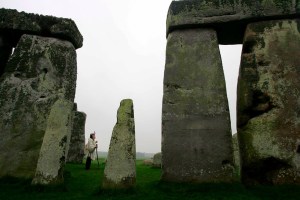
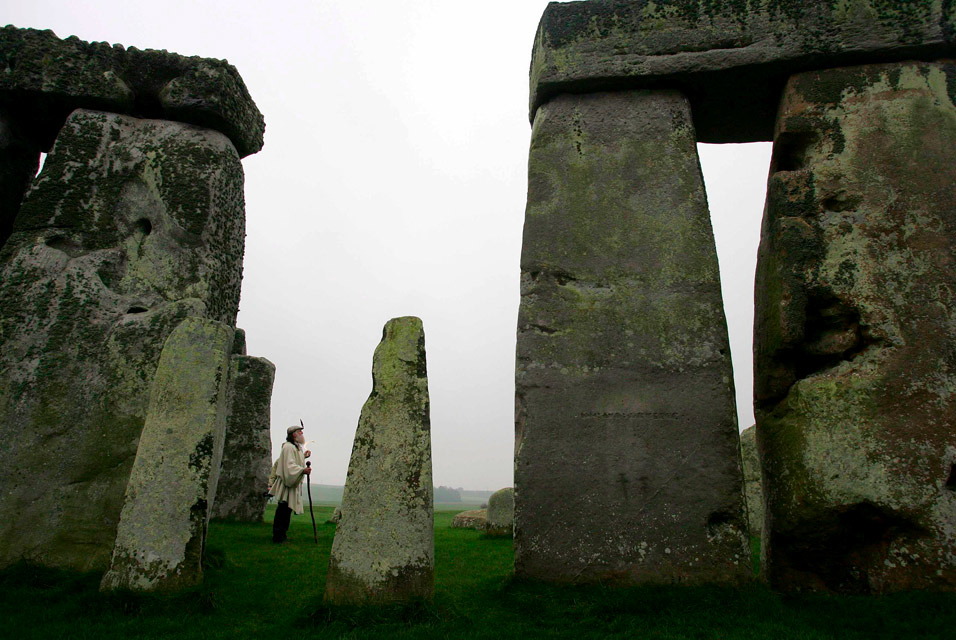
 photograph showing Arch Druid Keeper of the Stones Terry Dobney inspecting the famous British landmark Stonehenge in Wiltshire, south west England.

photograph showing Arch Druid Keeper of the Stones Terry Dobney inspecting the famous British landmark Stonehenge in Wiltshire, south west England.

Positioned within the Cursus pathway, the pits are on alignment towards midsummer sunrise and sunset when viewed from the Heel Stone, the enigmatic stone standing just outside the entrance to Stonehenge. For the first time, this discovery may directly link the rituals and celestial phenomena at Stonehenge to activities within the Cursus.

The international archaeological survey team, led by the University of Birmingham’s IBM Visual and Spatial Technology Centre (VISTA), with the Ludwig Boltzmann Institute for Archaeological Prospection and Virtual Archaeology in Vienna (LBI ArchPro) have also discovered a previously unknown gap in the middle of the northern side of the Cursus, which may have provided the main entrance and exit point for processions that took place within the pathway. Stretching from west to east, the Cursus is an immense linear enclosure, 100 metres wide and two and a half kilometres across, north of Stonehenge.

Professor Vince Gaffney, archaeologist and project leader from the IBM Visual and Spatial Technology Centre at the University of Birmingham, explains: “This is the first time we have seen anything quite like this at Stonehenge and it provides a more sophisticated insight into how rituals may have taken place within the Cursus and the wider landscape. These exciting finds indicate that even though Stonehenge was ultimately the most important monument in the landscape, it may at times not have been the only, or most important, ritual focus and the area of Stonehenge may have become significant as a sacred site at a much earlier date.

“Other activities were carried out at other ceremonial sites only a short distance away. The results from this new survey help us to appreciate just how complex these activities were and how intimate these societies were with the natural world. The perimeter of the Cursus may well have defined a route guiding ceremonial processions which took place on the longest day of the year.”

Archaeologists have understood for a long time that Stonehenge was designed to mark astronomical events, built by farming societies whose everyday concerns with growing crops linked their daily lives to the passage of the seasons and in particular the sun, on which their livelihoods depended. This new evidence raises exciting questions about how complex rituals within the Stonehenge landscape were conducted and how processions along or around the Cursus were organised at the time Stonehenge was in use.

Professor Gaffney adds: “It now seems likely that other ceremonial monuments in the surrounding landscape were directly articulated with rituals at Stonehenge. It is possible that processions within the Cursus moved from the eastern pit at sunrise, continuing eastwards along the Cursus and, following the path of the sun overhead, and perhaps back to the west, reaching the western pit at sunset to mark the longest day of the year. Observers of the ceremony would have been positioned at the Heel Stone, of which the two pits are aligned.”

Dr Henry Chapman, Senior Lecturer in Archaeology and Visualisation observes: “If you measure the walking distance between the two pits, the procession would reach exactly half-way at midday, when the sun would be directly on top of Stonehenge. This is more than just a coincidence, indicating that the exact length of the Cursus and the positioning of the pits are of significance.”

Stonehenge, while certainly the most important monument in the later Neolithic and Bronze Age landscape, was surrounded by a dense concentration of other sacred sites, some of which were already ancient when Stonehenge itself was built. The team has also revealed a new horseshoe arrangement of large pits north-east of Stonehenge which may have also contained posts and, together with the henge-like monument discovered last year and a number of other small monuments, may have functioned as minor shrines, perhaps serving specific communities visiting the ceremonial centre.

Paul Garwood, Lecturer in Prehistory at the University of Birmingham, comments: “Our knowledge of the ancient landscapes that once existed around Stonehenge is growing dramatically as we examine the new geophysical survey results. We can see in rich detail not only new monuments, but entire landscapes of past human activity, over thousands of years, preserved in sub-surface features such as pits and ditches. This project is establishing a completely new framework for studying the Stonehenge landscape.”

These new discoveries have come to light as part of the Stonehenge Hidden Landscape Project, which began in summer 2010 as the world’s biggest-ever virtual excavation using the latest geophysical imaging techniques to reveal and visually recreate the extraordinary prehistoric landscape surrounding Stonehenge.

Professor Wolfgang Neubauer, Director of the Ludwig Boltzmann Institute, adds: “The LBI provides the best academics, technicians and young researchers in a team of 20 people and uses multiple systems designed for use on projects where the scale of work was previously unachievable. The use of non-invasive technologies provides information for virtual archaeologies that can be disseminated to the public via the web, iPad or mobile phone.”

Dr Christopher Gaffney, lecturer in Archaeological Geophysics at the University of Bradford, concludes:

“Building on our work from last year we have added even more techniques and instruments to study this remarkable landscape. It is clear that one technique is not adequate to study the complexity of the monuments and landscape surrounding our most important archaeological monument and the battery of techniques used here has significantly increased the certainty of our interpretation.”

Link: http://www.artdaily.org

Sponsored by ‘The Stonehenge Tourv Company’ – www.StonehengeTours.com

Merlin @ Stonehenge
The Stonehenge Stone Circle Website


The Stonehenge Landscape Project. Lecture: 10th December 2011

19 11 2011


Recent Analytical survey and investigation in the World Heritage Site, by David Field.

Saturday LectureMonuments within the Stonehenge Landscape have rarely been subject to survey techniques in modern times and in many cases reliance has been placed on Ordnance Survey depictions of the early 20th century. In advance of the establishment of a new visitor centre and to complement and support the recent university programmes of excavation in the area, English Heritage has been conducting the Stonehenge WHS Landscape Project to determine what non-destructive survey techniques can tell us about the area. Using ground survey, aerial photography, lidar and laser scanning a number of fresh and sometimes surprising conclusions emerge. This talk will outline the results so far.

David Field is a senior landscape archaeologist at English Heritage. He has undertaken extensive research into the prehistory of Salisbury Plain and the Vale of Pewsey, including the Stonehenge World Heritage Site. Publications include ‘Earthen Long Barrows’ 2006),‘The story of Silbury Hill’ (co author with Jim Leary, 2010), ‘The Field Archaeology of the Salisbury Plain Training Area’ (2002) and ‘Ancient water management on Salisbury Plain’ in Patterns of the Past: Essays in Landscape Archaeology (1999). He has also contributed a number of articles to WANHM, most recently as one of the joint authors of the reports on the Breamore jadeite axehead and the Late Bronze Age and Early Iron Age Midden at East Chisenbury, in Volume 103 (2010).

Saturday afternoon lectures start at 2.30pm and last approx. one hour.

Booking:

Contact the Bookings Secretary if you would like to be added to a reserve list:
* Tel: 01380 727369 (10am to 5pm Monday to Saturday)
* Send an e-mail.
Cost:   £5 (£3 for WANHS members)

Visiting Stonehenge ?  Visit the Wiltshire Heritage Museum in Devizes:  http://www.wiltshireheritage.org.uk

Sponsored by The Stonehenge Tour Company – www.StonehengeTours.com

Merlin @ Stonehenge
The Stonehenge Stone Circle Website


The Stonehenge Landscape

8 09 2011

Stonehenge is the best known of all the prehistoric monuments in the British Isles and probably also in Europe. Along with the Neolithic monuments around Avebury situated 28km to the north, it forms a UNESCO recognised World Heritage Site (WHS), the parts of which are separated by the southern edge of the Marlborough Downs, Pewsey Vale and the Salisbury Plain military training area.

Much of the Avebury portion of the WHS, along with the military ranges, has been investigated from an archaeological landscape perspective during recent decades, as has the area to the south and west of the WHS, but ironically the Stonehenge area has not been treated in this way and it lacks the solid base of landscape surveys on which to build interpretations and understanding. The fresh Government-led imperative to ensure that new visitor facilities are in place by 2012 demands the provision of modern archaeological site plans, interpretations and other data which can feed into educational and presentational programmes as well as serving academic, management and conservation needs. 
Stonehenge Landscape

English Heritage are therefore undertaking an analytical landscape investigation of the Stonehenge World Heritage Site. This draws upon the considerable existing work provided by excavation, aerial, metric and geophysical survey but it fills a gap in this suite because there has been no modern detailed survey of the earthworks and other upstanding historicphysical remains within the Site – the barrow cemeteries, field systems and linear ditches, but also the tracks, ponds and military remains of more recent date.

Consequently there are no adequate plans of most of the upstanding archaeological remains within the WHS and no synthesis of the landscape history, especially in regard to its medieval and post-medieval phases. Analytical earthwork survey and analysis,supported by aerial survey and lidar data, is the key to understanding landscape change and will provide the framework in which individual small-scale site specific interventions can rest. Recommendations for other work, eg geophysical survey or coring to explore the extent of buried land surfaces, may arise from this.

The knowledge gained from this project is needed to inform displays in the new Visitor Centre, but also to inform various ongoing management issues, such as visitor pressure, and animal burrowing. The requirements of the new Visitor Centre include the best possible visualisation of the stones and their environs; digital terrain modelling of the surrounding land surface will provide the latter while it is hoped that laser scanning of the former will complete the package
For further detaisl visit: http://www.english-heritage.org.uk/

Sponsored by the Stonehenge Tour Companywww.StonehengeTours.com

Merlin @ Stonehenge
The Stonehenge News Website