‘The Computer at Stonehenge’ Poem of the week

9 11 2010

THE COMPUTER AT STONEHENGE

Strange things are done to be number one
In selling the computer
IBM has their stratagem
Which steadily grows acuter,
And Honeywell competes like Hell,
But the story’s missing link
Is the system old at Stonehenge sold
By the firm of Druids, Inc.

The Druids were entrepreneurs,
And they built a granite box
It tracked the moon, warned of monsoons,
And forecast the equinox
Their price was right, their future bright,
The prototype was sold;
From Stonehenge site their bits and byte
Would ship for Celtic gold.

The movers came to crate the frame;
It weighed a million ton!
The traffic folk thought it a joke
(the wagon wheels just spun);
“They’ll nay sell that,” the foreman spat,
“Just leave the wild weeds grow;
It’s Druid-kind, over-designed,
And belly up they’ll go.”

The man spoke true, and thus to you
A warning from the ages;
Your stock will slip if you can’t ship
What’s in your brochure’s pages.
See if it sells without the bells
And strings that ring and quiver;
Druid repute went down the chute
Because they couldn’t deliver.

On a more serious note. Stonehenge: Eclipse Computer?
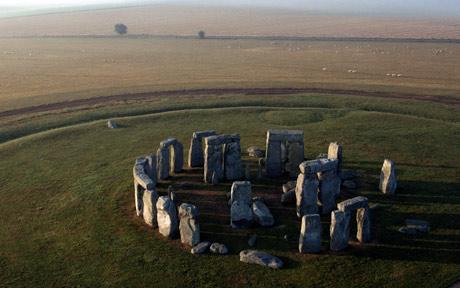
Every year on the first day of summer, the Sun rises at a point that is farther north than on any other day of the year. At the ruins of Stonehenge in England, this solstice sunrise appears on the horizon in direct alignment with the massive heel stone. This is the most outstanding feature of this ancient monument, built during the same era as the Great Pyramid of Egypt. There is little doubt that the builders of Stonehenge used it to mark this special day as the beginning of each year. By counting the number of days between these annual alignments, they could determine the length of the year. This could serve as a practical calendar to mark holidays and seasonal festivals and to ensure the timely planting and harvesting of crops.
But to predict eclipses, knowledge of two other cycles is required. One of these — the length of the lunar month — is easily determined. It is simply the number of days between one full Moon and the next. This cycle of 29-1/2 days is marked at Stonehenge by two rings of 29 and 30 holes, which together average 29-1/2. The other cycle, however, is of an altogether different character: it is a cycle of rotation of two invisible points in space. The evidence shows that the builders of Stonehenge probably discovered this cycle and could have used it to predict eclipses.

These two invisible points in space are called the lunar nodes (from the Latin for “knot”). They are the points where the Moon’s orbit, which is tilted at a slight angle, intersects the plane of the Earth’s orbit. It would have taken many decades of watching countless risings and settings of the Moon to figure out the cycle of the lunar nodes. This information — which must have been passed on from generation to generation — is preserved at Stonehenge. All the Moon alignments necessary for determining this cycle are marked by massive stones.

Who were these people who observed this subtle cycle even before the first metal tools were used by humankind? Some have suggested that Stonehenge was built by Druids, but we don’t really know much about the builders. We do know that the actual motions of the Sun and the Moon are reflected in the structure of Stonehenge, and we can reason how it may have been used to keep track of these cycles. The number of stones or holes in the ground in the various rings around Stonehenge each represents a certain number of days or years in the cycles. By moving markers (such as stones) around a ring in time with the cycles, the positions of the Sun and Moon — and the two invisible points — can be tracked. (The details of this method are explained in Chapter 2 of the book ECLIPSE, by Bryan Brewer.)

An eclipse can occur only when the Sun is close to being aligned with a node. By using Stonehenge to keep track of the position of the Sun and the nodes, these “danger periods” for eclipses can be predicted. A new (or full) Moon appearing during one of these periods would call for a special vigil to see if the solar (or lunar) eclipse would be visible from Stonehenge. A total solar eclipse would be a rarity. But the law of averages confirms that either a partial solar eclipse or a lunar eclipse can be seen (weather permitting) from the same point on the Earth about once every year.

Why would eclipses have been so important to the ancient people of Stonehenge? Perhaps they considered the darkening of the Sun or the Moon a fearsome event — a celestial omen of doom or disaster. Many cultures have interpreted eclipses this way. But the sophistication of the astronomy of Stonehenge suggests that the builders had something different in mind. Their understanding of the solar and lunar cycles must have led to a high regard for the cosmic order. Eclipses may have been seen as affirmations of the regularity of these cycles. Or perhaps the unseen lunar nodes formed an element of their religion as invisible gods capable of eclipsing the brightest objects in the heavens.

The idea that Stonehenge may have been a center for some kind of worship has occurred to many. It is not hard to imagine Stone Age people gathering at a “sacred place” at “sacred times” (such as solstices, equinoxes, and eclipses) to reaffirm their religious beliefs through ritual practices. British antiquarian Dr. William Stukeley, who in 1740 was the first to note the summer solstice alignment at Stonehenge, advanced the notion that the monument was built by Druids to worship the serpent. He claimed that Stonehenge and similar stone circles had been serpent temples, which he called “Dracontia.” Could this serpent symbolism be related to eclipses? Recall that the key to eclipses is the position of the lunar nodes. The length of time for the Moon to return to a node (about 27.2 days) astronomers call the draconic month. (Draco is the Latin word for “serpent” or “dragon.) Perhaps the mythical serpents of Stonehenge and the legendary dragon that eats the Sun are symbols of the same thing: the invisible presence in time and space that eclipses the Sun and the Moon.

Merlin @ Stonehenge
The Stonehenge Stone Circle Website


The man who bought Stonehenge

22 10 2010

It was 95 years ago, this week, that a man walked into a property auction in Salisbury and came out £6,600 poorer and the owner of Stonehenge.
Stonehenge had never been put up for auction before and never would again.
Sir Cecil Chubb, a wealthy Shrewton resident, was the new owner of Stonehenge.  He was also the last man to own it.

Bought ‘on a whim’

Stonehenge had been in private hands since the middle ages and been in the Antrobus family since the early 1800s.

But when the heir to the Antrobus baronetcy was killed in the Great War the estate was put up for sale.

Restoration of Stonehenge in 1950

Stonehenge undergoes restoration work in 1950

In the hands of Messrs Knight, Franck and Rutley, on the 21st September 1915, the historic site went under the hammer.

And Lot 15: Stonehenge with 30 acres of adjoining down land was sold at the Palace Theatre in Salisbury to the highest bidder.

Sir Cecil Chubb, who’d had no intention of bidding at the sale, bought it ‘on a whim’ as a gift for his wife who, it’s claimed, was none too pleased.

For the price of £6,600, the equivalent of £392,00 in today’s money, Sir Cecil Chubb’s intention that a “Salisbury man ought to buy it” was realised.

Stonehenge worth £51m

Just 95 years on and, according to a survey of 500 estate agents invited to put a price on national monuments across the UK, Stonehenge is now worth a monumental £51m.

Whilst the recommended estate agent’s blurb, suggested in the same survey carried out by findaproperty.com, could read:

Stonehenge “Airy property with bags of potential. Comes with land but needs serious renovation, including new roof and double-glazing.”

We would still advise our client to sell it at auction
Andrew Rome, Knight and Franck

But how would Messrs Knight, Franck and Rutley, the estate agents who originally handled the sale, sell Stonehenge today?

“We would still advise our client to sell it at auction,” says Andrew Rome from Knight and Franck.

“And to sell it as a going concern as a business based on the income it generates.”

With Stonehenge attracting around 900,000 visitors a year, paying an average of £5 per head, a £51m valuation starts to sound like a good investment.

Free admission

For Sir Cecil, however, Stonehenge belonged to the nation, and in 1918 after owning it for just three years he formerly handed it over to the country with a number of conditions.

His conditions were that the entrance fee should never be more then a shilling (5p) and that local residents should have free access.

“The 1918 deed of gift didn’t actually specify free access for local residents,” says Joy Kaarnijoki at English Heritage, “it was an agreement with the Parish Council.

“The road passed very close to the stones. The Council agreed that the rights of way could be diverted further from the stone circle on condition that local residents would be granted free access.”

Whether it was stipulated by Sir Cecil Chubb himself, or not, it’s an agreement that has continued to the present day.

According to English Heritage, the 30,000 local residents living in and around Stonehenge can still take up the offer of free access to one of England’s most famous monuments

Merlin @ Stonehenge
The Stonehenge Stone Circle Website

In 1915 Stonehenge was bought for just £6,600, its current valuation is estimated at £51m

In 1915 Stonehenge was bought for just £6,600, its current valuation is estimated at £51m


Stonehenge archaeologists reveal global warming theory behind crashed UFO remains

8 10 2010

Stonehenge, Wiltshire – (TinFoilHat Mess): Archaeologists excavating Stonehenge have found the remains of a pre-Atlanis era UFO which may have crashed during a flight from the Lunar base discovered by the moon-walking astronuts of the Apollo mission.

Stonehenge Quarantined

Stonehenge Quarantined

Much of the craft is believed to be intact with little corrosion to the mystery amalgam which makes up 90% of its structure.

Professor Tim Darvill of the Search for Extraterrestrial Intelligence (SETI) team that made the discovery said today that the next stage of the tricky operation would be entering the ancient craft and locating its cryogenic freezer units. ”

At this stage we don’t know if anything actually works inside,” Darvill commented, “but fingers crossed – we might be able to do a bit of thawing. “Without this intervention we’d have to wait for the natural phenomenon known as Global Warming to dictate the delicate process of unfreezing these alien remains.

 “Unfortunately we can’t wait that long. So our plan is to gently resurrect some of this advanced species – no blowtorches, microwaves or thermic lances, please chaps! – as well as any embryos and/or frozen infant offspring who clearly came here to seed our planet.” If the operation is successful the next stage will involve specialist scientists who are familiar with alien parenting techniques.

Professor Geoff Wainwright of the Yearling Extraterrestrial Intelligence (YETI) team in London’s Royal Freak Hospital will then take over while the Stonehenge site is quarantined.
Operation Homo erectus is being hailed as a triumph.

Now thats a story……………
Merlin @ Stonehenge Stone Circle


Clonehenge – Bonsai style.

5 09 2010

Bonsai Stonehenge–Yes, It’s Salisbury But It Isn’t Plain!

Photo courtesy of Salisbury Newspapers www.journalphotos.co.uk

No one does a Stonehenge like the locals! Above we see bonsai hengers (wouldn’t Bonsai Hengers be a great name for a rock band?!) and gardener/artists Tony Oswin & Wilf Colston with their prize-winning creation at the Salisbury Community Show recently–a charming Stonehenge model landscaped with bonsai trees and a bit of whimsy.

We have to say this is one of the finest and prettiest Stonehenge models we have seen! True, the landscape around it is not true-to-life, but we see no reason English Heritage shouldn’t run out and make it so. It would cost a great deal less than not putting in the tunnel and not putting in the new visitor centre has cost them so far!

The photo above, used courtesy of the Salisbury Bonsai Society, to which the gentlemen belong, shows the thought that must have been put into the Stonehenge section of the display. The stones themselves were cast in molds to make blocks all the same size and then hand carved with a knife and painted. No buying a little Stonehenge kit and quickly standing the plastic pieces in a circle for these fellows!* Care has been taken to make the assemblage resemble the original. We’re impressed!

Score: 8 druids! (New readers–no we do not believe druids built Stonehenge. Our scoring is a bit of a joke.) That’s very good for a small model. Mr. Oswin and Mr. Colson now have Clonehenge score bragging rights. That and £3 will get you a cup of coffee at Starbucks. Unless prices have gone up!

We want to thank Matt Penny, aka @salisbury_matt , friend of the blog, Salisbury and Stonehenge enthusiast, and perpetrator of the Salisbury and Stonehenge website for spotting this Stonehenge replica and sending us a link. We count on you, alert readers! Here’s a deal: you keep sending us Stonehenge replicas and we’ll keep wasting your time with our drivel! We promise.

Merlin @ Stonehenge
Stonehenge Stone Circle News Website and Blog


Stonehenge Comedy

27 07 2010

I did promise a few laughs along the way…..
Hope you like this classic Eddie Izzard comedy sketch of Stonehenge (18+)

Merlin @ Stonehenge
The Stonehenge Stone Circle Website


Crop circle found next to Stonehenge

13 05 2010

A huge intricate crop circle sculpted in a sea of barley has appeared near an ancient British burial mound in Wiltshire

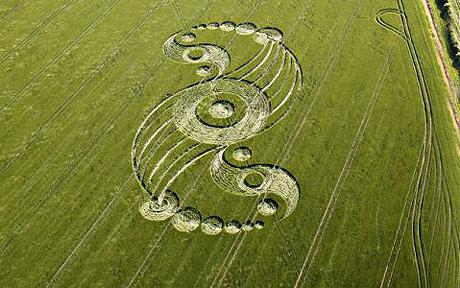
As many other crop circles previously spotted in the area, it seems to follow the Yin and Yang theme Photo: APEX

The formation, measuring approximately 350ft (100 metres), seems to depict a Yin Yang pattern and appeared on May 25 beneath Windmill Hill, near Devizes.

It was captured on camera at an area close to the great man-made mound of Silbury Hill, Wiltshire.

 Related Articles
  • Crop circle picture gallery shows more complex forms

  • Mayan ‘apocalypse’ crop circle appears at Silbury Hill

  • Phoenix crop circle may predict end of the world

  • Dragonfly crop circle appears in Wiltshire

  • Man arrested for shooting over heads of crop circle fans

  • Ten great sightseeing campsites

  • As many other crop circles previously spotted in the area, it seems to follow the Yin and Yang theme.

    The green and then golden fields of the world’s crop circle capital of Wiltshire have spawned an array of patterns in the past that have fascinated those who seek them out.

    Enthusiasts and experienced crop pattern hunters have often spotted formations appearing close to these sacred sites.

    The crop circle season extends from April to harvesting in September, and is believed to be worth millions of pounds to the local economy.

    Windmill Hill is thought to date to the Early Neolithic period some 5000 years ago, 3700 BC and was constructed as a causeway enclosure. It is the largest known of its kind measuring 21 acres (8.5ha).

    It consists of three rings of concentric ditches, which were probably dug out in the same manner as the deep Avebury ditch, using antlers and oxen shoulder blades.

    It was a major task taking many man-hours over many years.

    It is thought that the camp was at its most important as a farming community during a relatively peaceful and prosperous time of approximately 3000- 3500 years until the advent of the Romans when their presence is evidenced by traces of a villa found on the western slopes of the mound.

    Merlin @ Stonehenge
    The Stonehenge Stone Circle Website


    Stonehenge Crop Circle – May 10th 2010

    11 05 2010

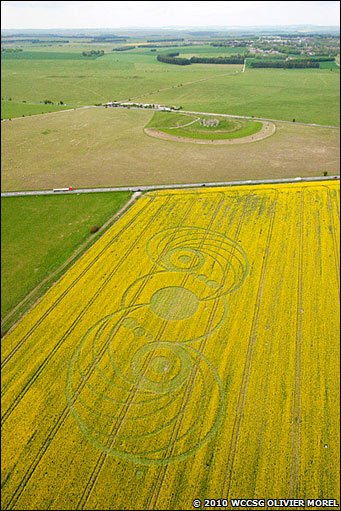
    Wow – look at this!  A guide for Histouries UK, a tour company based in Salisbury has sent reports of this amazing crop sircle directly opposite Stonehenge Stone Circle.  There are further
    reports of more in the area – watch this space……….

    Merlin @ Stonehenge
    The Stonehenge Stone Circle Website


    Vote for King Arthur this election!

    29 04 2010
    Minute Manifesto: King Arthur Pendragon (Independent)

    King Arthur

    Vote for Arthur

    King Arthur Pendragon is an Independent candidate for Salisbury. He is a Senior Druid and Swordbearer and was brought up in Aldershot.

    He served with the Royal Hampshire Regiment. He’s worked as a General Foreman for a Parish Council and Senior Supervisor for Hampshire and Surrey County Councils on the Basingstoke Canal restoration project

    King Arthur Pendragon’s manifesto

    My name’s Arthur Pendragon, I’m a Senior Druid sworn to fight for Truth, Honour and Justice, who wants to scrap our nuclear arsenal and bring our boys back from Afghanistan.

    The main thing I believe in is democracy, by, for and of the people, not by, for and of the Party.

    At present, you can have a Scottish MP representing a Welsh constituency and living in London, but in reality representing no-one save their Party line, and let’s face it, there’s not much to choose between any of them.

    Well, I’m different.

    Don’t be put off by the robes – I may be spiritual but I’m certainly political, and to date have embarrassed two National Parties into last place and taken Her Majesty’s Government to High and European Courts.

    Another thing I believe in is leadership from the front, motivation by example, and I’m not afraid to get my hands dirty.

    Having opposed the Newbury Bypass, and fought continually for Stonehenge not only was I arrested ‘up the trees’ and on the ‘picket’ argued the cases in Court, but guess who dug the latrine?

    If you want an MP with a hands-on approach, by, for and of the people, vote for me. If you want much of the same, vote for anyone else.

    I don’t care what London, Brussels, Washington or even Andover want

    Elect me and you elect a warrior with a proven track record to represent and fight for the Salisbury constituency, nothing more and certainly nothing lesS

    He’s got my vote!

    Merlin @ Stonehenge
    The Stonehenge web site


    Celebrate St.Georges Day – Morris Dancing at Stonehenge

    23 04 2010

    Morris Dancing – Maypole and morris dancing for St George’s Day
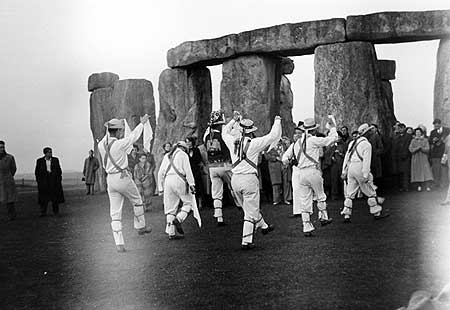
    Thought you would like this old picture I found in the archives showing ‘Morris Dancing’ at Stonehenge on Saint Georges Day.
     

    Morris Dancers at Stonehenge

     Although the link between Druids and megalithic sites is tenuous at best, there seems to be no reason to doubt that both the celebration of ancient Celtic festivals and the rituals performed at stone circles and other megalithic sites included dancing in one form or another. Evidence for the latter is virtually non-existent, but folklore and other clues suggest, for example, that dance may have been performed at Stonehenge if only through the suggestive description by Geoffrey of Monmouth, writing in the 12th century, who calls Stonehenge the Dance of the Giants (“chorea gigantum”). Much later, Morris dancing used to take place around the ancient barrow at St. Weonards in Herefordshire. Morris dancing, in fact, has been claimed to be a remnant of a pre-Christian Celtic, or Druidic, fertility dance.

    Morris dancing also figures among the evidence in support of the claim that dancing formed part of the celebration of Celtic festivals. Among the earliest references to Morris dancing are those made by Shakespeare, who, in “All’s Well that Ends Well” (II.ii.21), makes it clear that the Morris dance was commonly performed on May Day (May 1). That Morris dancing was associated with May Daycelebrations in the early 17th century is also suggested through King James I’s “Book of Sports” which permitted among the amusements to be enjoyed on a Sunday the continuation of “May games, Whitsun ales and morris dances, and the setting up of May-poles…” The Whitsun ales referred to are a beer produced for Whitsun (or Whitsunday, celebrated in the Christian calendar as Pentacost) which Shakespeare, in “Henry V” (II.iv.18), says was also a time when Morris dances were performed.


    The origins of Morris dancing are lost in the mists of time. It survives today as a form of folk dance performed in the open air in villages in rural England by groups of specially chosen and trained men and women. It is a ritual rather than a social dance which the dancers take seriously. It is felt that the dances have a magic power and serve both to bring luck and to ward of evil. Attempts to uncover the origins of Morris dancing have focused mostly on the name. Some believe Morris to be a corruption of the word “Moorish” and therefore to have originated in Africa. In order to explain how African dancing could crop up in England, it has been suggested that Moorish captives were brought back from the Holy Land by crusaders. Or, alternatively, it has been suggested that John of Gaunt (1340-1399), Duke of Lancaster, following the failure of his campaign in Spain to claim the kingship of Castile and Leon, returned to England with Spanish Moors as captives.In this sense, the word “morris” would seem to be related to “morisco”, which is a form of court dance performed in Italy. However, Joseph Strutt (1749-1802), in his “Sports and Pastimes of the People of England”, doubts this was the origin of Morris dancing, stating that “the Morisco or Moor dance is exceedingly different from the morris-dance…being performed with the castanets, or rattles, at the end of the fingers, and not with bells attached to various parts of the dress.” Otherwise, Strutt suggests that the morris-dance originated from the “Fool’s Dance” (traceable to the 14th century), in which the dancers dressed in the manner of the court fool, and from which can be traced the bells used by morris dancers. 

    If Morris is a corruption of a similar-sounding word, it could equally well be “moorish” in reference to, at the time of Shakespeare, boggy land, and later used in connection with moorland or heathland. It has also been suggested that the word Morris is derived from the Latin word “moris” meaning tradition or custom. Then again, it might be derived from the game “merelles”, forms of which were called “ninepenny morris” or “nine men’s morris” (referred to, for example, by Shakespeare in “A Midsummer Night’s Dream”, II, i, 98). On the continent, the name was applied to the stepping, dance-like game of ‘hop-scotch.’ 

    Attempts to discover the origins of the dances performed have revealed a general connection with other ritual folk dances elsewhere in the world such as santiagos, moriscas, and matachinas of the Mediterranean and Latin America, and the calusari of Romania. The ultimate source of this type of dancing, however, remains hidden. The suspicion, though, is that they are of pagan origin performed as part of ancient fertility rites. The music and dances were perhaps intended to attract beneficial influences, while the bells, fluttering handkerchiefs, and clashing sticks served as the means to scare away malevolent spirits. 

    Traditional Morris dancing is today associated with the Cotswolds, a region of England located between Oxford and the Welsh border. Cotswold Morris is danced in sets of six dancers arranged in two rows of three. For some dances, handkerchiefs are held in each hand, while for other dances short sticks are carried, and struck against each other or against those of a partner. Part of the costume includes bells, usually worn tied below the knees. 

    Costume varies from one Morris team, or ‘set’, to another, with each village also producing its own steps and dances. Morris men usually wear a white shirt, white trousers or dark breeches, and black shoes. Coloured sashes or baldrics worn over one or both shoulders, or a waistcoat, serve to distinguish different teams. The Stroud Morris Dancers in Stroud, Gloucestershire, for example, wear white trousers and shirts with red and green sashes (the colours of Stroud) shown performing the Stick Dance, Sidmouth, England 

    Shown (left) are the Manley Morris Men dancing in the North West tradition. 


    Other teams, such as that dancing in front of the Old Neighbourhood Inn at Chalford Hill in Gloucestershire, are dressed in dark breeches and bowler hats. A variant of Cotswold Morris is Border Morris, associated with the Welsh border counties, which has sides of four, six, or eight men who darken their faces and wear ‘rags’ and dark trousers. Border Morris is danced more vigorously than Cotswold Morris and involves much clashing of sticks. Cotswold Morris is usually performed from May 1 to September, while Border Morris is traditionally performed in the winter months. Another form is North West Morris, in the North West of England, which is more of a processional dance with sides of at least nine men wearing clogs. 

    Merlin @ Stonehenge – Happy Saint Georges Day!
    The Stonehenge Stone Circle Website


    Stonehenge Down Under: Australians copy Neolithic rock structure to draw tourists

    21 04 2010

    A full-sized replica of Stonehenge will be built on a beach in western Australia after a small town gave the green light for construction in a bid to draw tourists.

    The shire council in Esperance, 460 miles south-west of Perth, has approved plans for the A$1.2m (£722,749) project, which it hopes will generate much-needed tourist revenue for the small coastal community – its only attraction at the moment is small piece of the US Skylab which fell onto a nearby farm in 1979.

    “Stonehenge Down Under” is being spearheaded by the local Rotary club, which wants to build the structure from local pink granite on a council-owned site overlooking Twilight Beach, just outside the town.

     Kim Beale, a spokesman for the Esperance Rotary Club, said the Australian version would be a faithful reproduction of the original Neolithic structure in Wiltshire and will consist of 100 stones, each weighing up to 45 tons.

    “Obviously some people may wonder why you’d build Stonehenge at Esperance, but the stone is already here and I think it’s a good opportunity. I reckon it’s quite fascinating,” he said.

    Although local tourism operators have thrown their weight behind the prehistoric theme park, other townspeople remain sceptical – an earlier Stonehenge proposal ran into financial difficulties. Rotary, however, is confident that it can raise the necessary funds to complete the new project with giant cut stones donated by a local quarry. Work on Stonehenge Mk 2 is due to begin shortly.

    MERLIN @ STONEHENGE
    Stonehenge Stone Circle