Fascinating “Facts”: Holding StoneHenge up to a Mirror

20 09 2013

Alan S's avatarThe Heritage Journal

Fact

Show anyone a picture of the British Archaeology Trust’s logo for RESCUE (seen below), and ask them to describe it, and 9 times out of ten the answer will be along the lines of “Stonehenge on a bulldozer”. And of course, that’s what the logo depicts, but being totally pedantic, it actually depicts just the stones of Stonehenge. The ‘henge‘ part tends to get forgotten. Why is that?

Probably because henges are among the least understood of the monuments left behind by our ancient ancestors, and are often not very visually stimulating, consisting of a circular bank, and inner ditch with one or more entrance causeways.

In fact, stone settings associated with henges are often very much in the minority. Stonehenge we’ve already mentioned of course, and Avebury (where the henge component of the monument is on a much larger scale) is similarly well known. A henge such…

View original post 357 more words


Summer Discoveries at Stonehenge Stone Circle

13 09 2013

Two ditches belonging to the Stonehenge Avenue buried beneath the modern roadbed of the A344 have been uncovered during works to decommission the road as part of English Heritage’s project to transform the setting and visitor experience of Stonehenge.

The two ditches represent either side of The Avenue, a long linear feature to the north-east of Stonehenge

The Avenue, severed by the A344, will be reconnected to Stonehenge soon

The Avenue, severed by the A344, will be reconnected to Stonehenge soon

linking it with the River Avon. It has long been considered as the formal processional approach to the monument and is aligned with the solstice axis of Stonehenge. But its connection with Stonehenge had been severed by the A344 for centuries as the road cut through the delicate earthwork at an almost perpendicular angle.

The two ditches were found in excavations undertaken by Wessex Archaeology in their expected positions near to the Heel Stone, about 24 metres from the entrance to monument.


Missing Piece in the Jigsaw

Heather Sebire, properties curator and archaeologist at English Heritage, said: “The part of the Avenue that was cut through by the road has obviously been destroyed forever, but we were hopeful that archaeology below the road would survive.  And here we have it – the missing piece in the jigsaw.  It is very exciting to find a piece of physical evidence that officially makes the connection which we were hoping for.”

Dr Nick Snashall, National Trust Archaeologist for the World Heritage Site, said “This is a once in several life time’s opportunity to investigate the Avenue beneath the old road surface.  It has enabled us to confirm with total certainty for the first time that Stonehenge and its Avenue were once linked and will be so again shortly.”

The Avenue is difficult to identify on the ground but is clearly visible on aerial photographs. Once the A344 has been restored to grass in the summer of 2014, interpretation features will be put in place to clearly mark out the solstice alignment to enable visitors to appreciate the position of the Avenue and its intimate connection with and significance to Stonehenge.


Parchmarks discovered at Stonehenge by staff Simon Banton and Timothy Daw © Simon Banton/English Heritage

Parchmarks discovered at Stonehenge by staff Simon Banton and Timothy Daw
© Simon Banton/English Heritage

Parchmarks at the Stone Circle

The recent prolonged spell of dry weather has also led to some exciting discoveries within the stone circle. Two eagle-eyed members of staff spotted some dry areas of grass, or parchmarks, amongst the stone circle in July. After investigation by English Heritage experts they seem to be positions of three holes where stones 17, 18 and 19 might have stood on the south-west side of the outer sarsen circle.

Susan Greaney, senior properties historian at English Heritage, said: “There is still debate among archaeologists whether Stonehenge was a full or incomplete circle, and the discovery of these holes for missing stones has strengthened the case for it being a full circle, albeit uneven and less perfectly formed in the south-west quadrant.”

NOTE: This story as reported in the Guardian on 9 September contains a number of inaccuracies. The article, including the headline, failed to distinguish between fact and interpretation, and presented one expert’s view as established fact. It also gives the impression that the expert’s view has been adopted by English Heritage. This is very confusing. English Heritage is firmly of the view that Stonehenge was built as a prehistoric temple aligned with the movements of the sun, contrary to what was implied in the article.

Professor Mike Parker Pearson’s theory about the naturally formed ridges is interesting, but is by no means established. English Heritage’s role was to record any archaeology that survived under the A344 and present the results of the recent discoveries clearly to the public. English Heritage’s interpretation of Stonehenge in general will be presented at the new visitor centre due to open in December 2013.

Article Source from English Heritage: http://www.english-heritage.org.uk/about/news/summer-discoveries-stonehenge/

The Stonehenge News Blog


A NEW DAWN: STONEHENGE TRANSFORMED

12 09 2013

A PRACTICAL PLANNER for Groups & Travel Trade Professionals

The new guide from English Heritage provides tour operators, group travel organisers, guides and other professionals with step-by-step information to help plan visits to Stonehenge, following its transformation when superb new facilities open from the end of 2013. Split into three easy-to-read colour coded sections, it provides practical information, tips and ideas to smooth your way through advance planning and procedures to the day of the visit and beyond.

Stonehenge-visitor-centre

PLANNING AHEAD:
Turn to the yellow section to discover other attractions to build into a Stonehenge itinerary, plus details in brief on English Heritage services and products for travel trade professionals and group travel organisers and how to obtain them.

THE NEW VISIT
With so much more to see at the transformed Stonehenge, the bronze section is a step-by-step guide on the new facilities and how to make the best of a visit, with an at a glance map, images and suggested timings for a two hour stay.

INFORMATION AND SUPPORT
Giving essential planning information, the green section explains pre-booking and ticketing procedures, contains prices and admission times and handy hints on reaching and arriving at Stonehenge.

Download the full guide here: http://gallery.mailchimp.com/4f19fb7ce76ee0800348d53d5/files/EH_Stonehenge_A6_PocketBook_LRPDF.PDF

Follow Stonehenge News on Twitter: https://twitter.com/ST0NEHENGE

The Stonehenge News Blog


Stonehenge was built on solstice axis, dig confirms

9 09 2013

English Heritage excavations show site has nothing to do with sun worshipping, and find evidence circle was once complete

Archeologists found ridges, formed by Ice Age meltwater, that align Stonehenge with the solstice axis. Photograph: Francis Dean/Rex

Archeologists found ridges, formed by Ice Age meltwater, that align Stonehenge with the solstice axis. Photograph: Francis Dean/Rex

English Heritage says it has discovered a “missing piece in the jigsaw” in our understanding of Stonehenge, England’s greatest prehistoric site. Excavations  along the ancient processional route to the monument have confirmed the theory that it was built along an ice age landform that happened to be on the solstice axis.

The Avenue was an earthwork route that extended 1.5 miles from the north-eastern entrance to Wiltshire’s standing stones to the River Avon at West Amesbury. Following the closure of the A344 road, which cut across the route, archaeologists have been able to excavate there for the first time.

Just below the tarmac, they have found naturally occurring fissures that once lay between ridges against which prehistoric builders dug ditches to create the Avenue. The ridges were created by Ice Age meltwater that happen to point directly at the mid-winter sunset in one direction and the mid-summer sunrise in the other.

Professor Mike Parker Pearson, a leading expert on Stonehenge, said: “It’s hugely significant because it tells us a lot about why Stonehenge was located where it is and why they [prehistoric people] were so interested in the solstices. It’s not to do with worshipping the sun, some kind of calendar or astronomical observatory; it’s about how this place was special to prehistoric people.

“This natural landform happens to be on the solstice axis, which brings heaven and earth into one. So the reason that Stonehenge is all about the solstices, we think, is because they actually saw this in the land.”

The findings back theories that emerged in 2008 following exploration of a narrow trench across the Avenue. Parker Pearson said: “This is the confirmation. It’s being able to see the big picture.”

Dr Heather Sebire, English Heritage’s Stonehenge curator, said: “The part of the Avenue that was cut through by the road has obviously been destroyed forever, but we were hopeful that archaeology below the road would survive. And here we have it: the missing piece in the jigsaw. It is very exciting to find a piece of physical evidence that officially makes the connection which we were hoping for.”

The excavation was conducted by Wessex Archaeology for English Heritage.

The A344 will be grassed over next year as part of English Heritage’s £27m transformation of the World Heritage Site, which receives more than 1m visitors annually. There will be a new visitor centre, 1.5 miles away out of sight, to allow Stonehenge to reconnect with the surrounding landscape.

Sebire, who likens the Avenue to The Mall leading to Buckingham Palace, said that the latest findings should prompt vigorous academic debate.

The excavations have also uncovered three holes where missing stones would have stood on the outer sarsen circle, evidence, it is believed, that the circle was indeed once complete. Surprisingly, even the most sophisticated surveys failed to spot them. Two members of staff noticed dry areas of grass, or parchmarks.

Susan Greaney, an English Heritage historian, said: “The discovery … has certainly strengthened the case for it being a full circle.”

Asked why no one noticed them until now, Parker Pearson said: “The problem is we’ve not had a decent dry summer in many years. Stonehenge is always regularly watered, and the only reason these have shown up is because – for some reason this year – their hose was too short … So we’re very lucky.”

Article source: : The Guardian: http://www.theguardian.com/culture/2013/sep/08/stonehenge-ice-age-solstice-axis

Merlin @ Stonehenge
The Stonehenge News Blog  


Fascinating “Facts”: When is a stone circle not a stone circle?

6 09 2013

Alan S's avatarThe Heritage Journal

FactIt is well known that the vast majority of stone circles in the British Isles are not actually circles. In fact, there are very few that are truly ‘circular’ in the sense of having a regular, circular ground plan. The shapes can vary from circular, through regular ovals to ovoid, to flattened version of any of these. But there is one form of stone circle that doesn’t fit into any of these categories, that of the ‘Four Poster’.

Four Poster ‘circles’, as their name suggests usually consist of just four uprights, laid on the plan of a circle, sometimes with a fifth recumbent stone. The majority of this type can be found in Scotland, though there are several examples throughout England and some in Ireland. The stones in a true Four Poster are generally placed at the cardinal compass points. Those that have been dated were constructed in the Bronze…

View original post 311 more words


Discovery of 5,000-year-old skull ‘in fabulous condition’ on side of river sparks mystery as archaeologists claim it would not have survived in water

1 09 2013
  • Skull is  believed to be of a middle aged woman living in 3,300 BC
  • Unbroken  skull found on the banks of the River Avon in Worcestershire
  • Carbon  dating technology places the piece between 3,338BC and 3,035  BC
  • The  ‘exceptional’ find suggests there is an undiscovered burial site  nearby

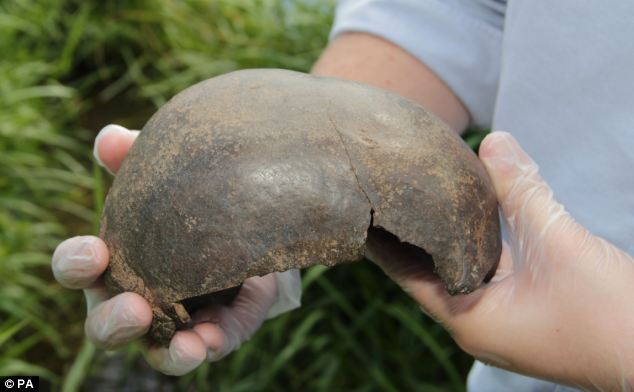
A 5,000-year-old human skull in ‘fabulous’  condition has been discovered on the banks of a river in Worcershire by a walker  who thought it was a coconut.
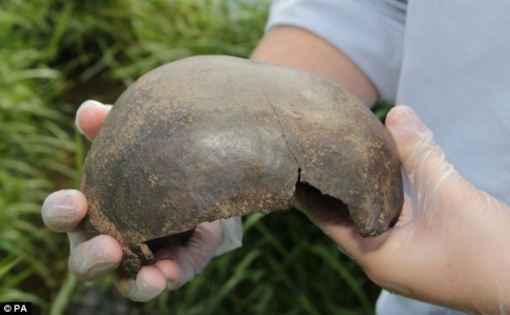
Remarkable discovery: Nick Daffern, senior archaeologist with Worcestershire Archaeology holds the 5,000-year-old skull which has baffled experts

Remarkable discovery: Nick Daffern, senior archaeologist with Worcestershire Archaeology holds the 5,000-year-old skull which has baffled experts

Experts said the piece of ancient skull is an  ‘exceptional find’ as the intricate marks  from blood vessels are still visible on the inner surface.

The smooth dark outer side gives only a  tantalising glimpse as to what the person may have looked like, although there  are ‘tentative’ suggestions it may have belonged to a woman in middle age living  in the Neolithic period – around the time Stonehenge was built.

The skull is not only prompting questions  about the person it belonged to, but where it may have come.

A dog walker first stumbled across the skull  piece, which is about 15cms (6ins) in length and 10cm (4ins) in width, earlier  this year but initially thought it was a ball or a coconut shell.

Detectives from West Mercia Police  investigated the scene and contacted experts at Worcestershire Archaeology, who  sent the skull to be radiocarbon dated.

‘When I first saw the skull, I thought it may  have been Anglo-Saxon or Roman but I knew that it was not recent due to the  colour,’ said Nick Daffern, senior archaeologist.

‘But we were all surprised when the  radiocarbon dating put it at between 3,338 BC and 3,035 BC, or about the middle  Neolithic period.’

‘It is so well preserved, it is unthinkable  that this had been in the river for any length of time which begs the question  as to where it has come from.

‘We know of Roman, Saxon and medieval burials  along the river, but this is very rare – it is an exceptional  find.

‘What it suggests is that we have a Neolithic  burial site very near here – we just don’t know where.’

He said: ‘I don’t think it was found where  the remains were buried, I think we’ve got a riverside burial and then flooding  has brought this down the river.

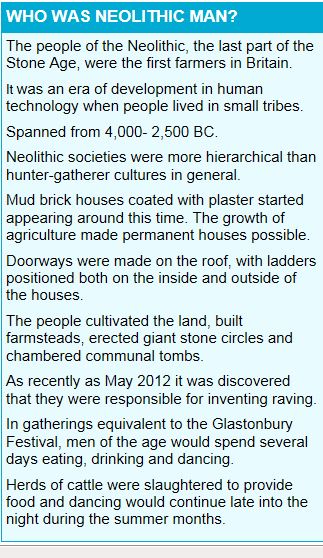
‘Finding that burial site though would be  like finding a needle in a haystack.’Who was neolithic man
Mr Daffern said that without the rest of the  skeleton it was difficult to draw conclusions about the person found, and  certainly there is no clue as to how they met their death.

‘Both myself and a forensic anthropologist  believe it is a woman due to the slightness of the skull and the lack of any  brow ridges although our conclusions are very tentative because we’re dealing  only with the top of a skull,’ he added.

‘There’s no trauma to the bone, and where it  has broken those are natural breaks, nor is there any sign of disease so we’ve  no idea as to cause of death.

‘The natural fusion of the bone in the skull  leads me to believe it may be an older woman, possibly in her 50s, but that is  very tentative again.

‘Unfortunately, it remains a bit of a  mystery.’

The find is a few miles from Bredon Hill,  which has been a scene of human activity down the ages and still boasts the  earthen ramparts of what was an Iron Age hill fort, however finds of Neolithic  remains are rare.

‘Whenever we come across Neolithic remains,  there seems to be a solid dividing line between where they buried their dead,  and where they lived and that is no accident,’ he said.

‘But it is frustrating as an archaeologist  because although we have the physical evidence, we still don’t have the answers  as to why.’

The skull is only the second set of Neolithic  remains to be found in the county, although two large 6,000-year-old ‘halls of  the dead’ were found in nearby Herefordshire this year but without any human  remains present.

Article source: By  Daily Mail Reporter – http://www.dailymail.co.uk/sciencetech/article-2407337/Discovery-5-000-year-old-skull-fabulous-condition-sparks-mystery.html

Merlin @ Stonehenge
The Stonehenge News Blog


“Free Stonehenge”, Sir Cecil Chubb and two dead horses

30 08 2013

heritageaction's avatarThe Heritage Journal

Calls for “Free Stonehenge” are legion, usually citing that the donor, Sir Cecil Chubb, stipulated that “the public shall have free access to the premises”. It’s a bit academic as his covenants are no longer enforceable but let’s pretend they are and consider if the campaigners have a moral case at least. Their wish for “free access” can mean one or both of the following:

1. Access for free
In other words, free of charge. But look what the Deed actually says: “the public shall have free access to the premises on the payment of such reasonable sum per head not exceeding one shilling for each visit.” So it wasn’t access for free, it was access for payment, up to a maximum of 1 shilling – at a time when the average weekly wage was 30 shillings. Nowadays, a thirtieth of average weekly earnings is about £16. People can…

View original post 285 more words


Where was the Stonehenge Festival?

29 08 2013

Mike Pitts's avatarMike Pitts Digging Deeper


All over the place really. On my first summer solstice visit in 1971 it was little more than a gaggle of people sleeping in the ditch around the stones. These two photos from Julian Richards’ excellent collection published by English Heritage show where it went from there: first immediately outside the earthwork to the south-west, so that it faced the rising sun on June 21; then across the road into what we call the Cursus field, National Trust land between Byway 12 and the Fargo Plantation. At its greatest extent it did run onto the Cursus itself (thanks for the comment, Francis Stoner), and spread eastwards into the Avenue field. Damage was reported at the time to the woodland at Fargo and to some of the barrows.

It’s high time a proper academic study was done of this story. There must be a great deal of information out there…

View original post 45 more words


A344 memories: Real archaeology at Stonehenge, as work continues to remove the road and car park

29 08 2013

Mike Pitts's avatarMike Pitts Digging Deeper

car park panorama small

If you visit Stonehenge now – as huge numbers did in August – you’ll really see signs that things are changing. Work continues in the car park to prepare a turning circle at the end of what will be the stub of the old A344. The road itself as it once continued eastwards to Stonehenge Bottom has now all but gone, exposing the chalk below. Wessex Archaeology has been monitoring it, and has excavated parts of the two parallel Avenue ditches, and a small part of what looks like the lip of the Heelstone ditch, as Ollie Good kindly showed me.

My interest in this was naturally strengthened by my excavations immediately beside the road there in 1979 and 1980. We had several advantages over the modern archaeologists.

The team were almost all volunteers, archaeology students and staff from Southampton University, so brought considerable skill, but at no cost to…

View original post 444 more words


Stonehenge Autumn Equinox 2013

22 08 2013

The Autumn Equinox occurs at 8.44pm on Sunday 22 September 2013. 

Celebration of the Autumn Equinox will take place at Stonehenge at sunrise on Monday 23rd September 2013.

Stonehenge Autumn Equinox Visitors wishing to celebrate the Autumn Equinox at Stonehenge will be given access into the monument when it is considered sufficiently light and therefore safe to do so. This is likely to be from approximately 6.15am.

Sunrise that morning will be at approximately 6.56am. Visitors will be asked to vacate the site by 8am.

Please note that access to Stonehenge might not be possible if the ground conditions are poor or if it is considered that access might result in severe damage to the monument.   Limited facilities are available at Stonehenge for the duration of the access although these facilities will not be open prior to the access commencing.

If you require disabled parking, please email Sally Gardner at sally.gardner@english-heritage.org.uk.

Lin: http://www.english-heritage.org.uk/daysout/events/autumn-equinox-sh-23-sep/

The Autumn Equinox

Autumn Equinox (also known as Mabon or Harvest Home) is celebrated when day and night are of equal duration before the descent into increasing darkness and is the final festival of the season of harvest.

In nature, the activity of the summer months slows down to the hibernation for the winter. For many Pagans, now is time to reflect on the past season.

It is also a time to recognise that the balance of the year has changed, the wheel has turned and summer is now over.

Astrologers will recognise this as the date the sun enters the sign of Libra – the Scales of Balance.

This is one of the least celebrated of the Pagan festivals although a harvest festival may be held to thank the Goddess for giving enough food to last the winter.

Merlin @ Stonehenge
The Stonehenge News Blog