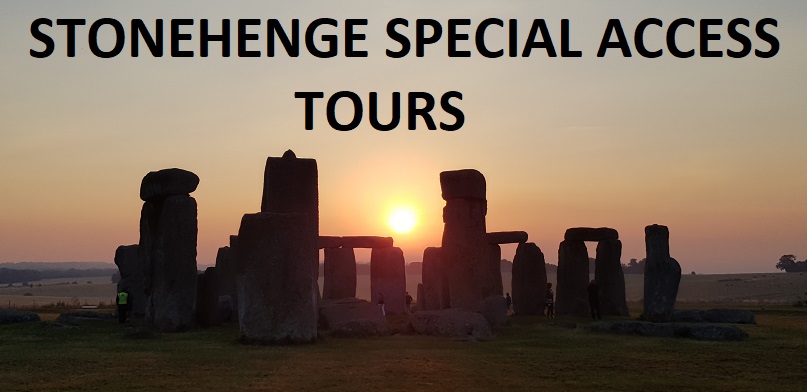
Golden age: Ancient possessions of Stonehenge worshippers go on display

14 10 2013

Golden treasures from prehistoric Britain’s Stonehenge era, most of which have never previously been on public display, are today being unveiled at a small provincial museum.

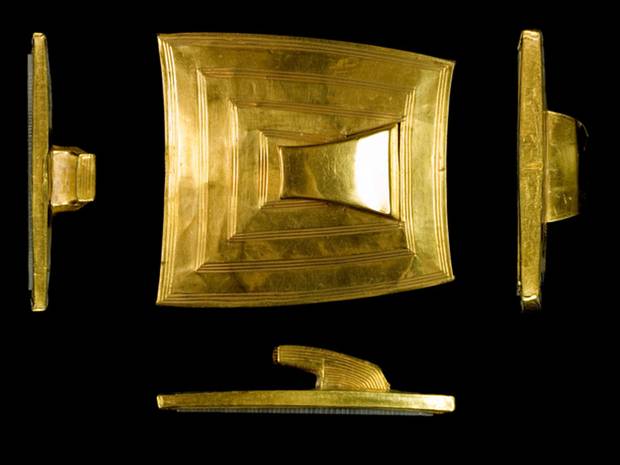
Copyright: David Keys

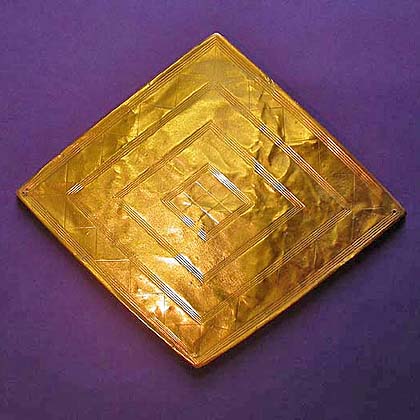
Copyright: David Keys

The exhibition is the largest collection of early Bronze-Age gold ever put on public display in England.

It was impossible to exhibit most of the gold treasures before because of security concerns. Up until now the closest the public got to them was by seeing photographs.

Housed in a new, high-security and humidity-controlled series of galleries inside the Wiltshire Museum in Devizes, 15 miles north of Stonehenge, the gold treasures and other objects are being used to reveal the remarkable cultural story behind the world famous prehistoric stone monument.

The new Stonehenge-era galleries will feature at least 500 Neolithic and Bronze-Age objects from Wiltshire, many of them from the once sacred landscape around the monument itself, including a beautifully decorated golden cloak fastener, a magnificent bronze dagger with a gold-covered hilt, a gold decoration from a dagger sheath, the golden tip of a ceremonial sceptre and gold necklaces, earrings and pendants – as well as other high- status precious objects made of jet, amber and stone.

“These and other spectacular treasures from the age of Stonehenge were unearthed by antiquarians and archaeologists in the late 18th and early 19th centuries, but until now it’s never been possible to give the public permanent access to them,” said the museum’s director, David Dawson.

“Stonehenge is an iconic monument – but this is the first time that such a wide range of high-status objects from the spectacular burials of the people who used it, has ever been put on permanent display”.

They will tell the story of the people who lived in and around the Stonehenge landscape when the monument was one of the great religious centres of Western Europe.

“Many of the items may well have been worn by Bronze-Age priests and chieftains as they worshipped inside Stonehenge,” said Mr Dawson. Axes and daggers on display in the new purpose-built galleries are identical to images of weapons carved into the giant stones of Stonehenge itself.

“We believe the new displays are a major step forward in helping to explain the extraordinary sophistication of the remarkable people who used the world’s most famous prehistoric monument,” said Mr Dawson.

Over the past few years, an unprecedented amount of new research has been carried out on Stonehenge and its ancient culture – and the new galleries reflect that new knowledge, especially an increased understanding of how the different prehistoric artefacts were made and what they were originally used for.

Around 30 gold objects, made by craftsman between the 2200 and 1800BC, will be on permanent display along with hundreds of other Stonehenge-era treasures.

The creation of the new high-security Stonehenge-period galleries puts Devizes’ Wiltshire Museum into a totally different league in terms of exhibits and their interpretation.

The new galleries have cost £750,000 to build – with funding coming from, among others,  the Heritage Lottery Fund, English Heritage and Wiltshire Council.

Devizes has its magnificent collection because it is the home of one of Britain’s oldest local archaeology organisations – the Wiltshire Archaeological and Natural History Society which has been collecting Wiltshire archaeological material since its foundation 160 years ago.

Over that period it has conducted more than 50 excavations which have provided the museum with more than 50,000 archaeological finds. The town itself is located between prehistoric Britain’s two top monuments – Stonehenge and the Avebury stone circles.

The launch of the new permanent display at the town is part of a wider display of Stonehenge-era archaeology. On 18 December, just one and half miles from Stonehenge itself, English Heritage will open its new Stonehenge visitor centre, complete with around 300 Stonehenge-period exhibits – while, next spring, Salisbury Museum will unveil newly redesigned archaeological galleries including material of a similar age.
including material of a similar age.

David Keys: Independent: http://www.independent.co.uk/news/science/archaeology/news/golden-age-ancient-possessions-of-stonehenge-worshippers-go-on-display-8877704.html

Stonehenge News Blog


Crown jewels of Stonehenge go on dazzling display: new prehistory galleries opening 14th October!

12 10 2013

In September 1808, William Cunnington, who was Britain’s first professional archaeologist, wrote to his patron to tell him that he had discovered what were to become known as the crown jewels of the “King of Stonehenge”.

On Monday, some of the treasures he found will go on permanent public display for the first time.

Gold from the time of Stonehenge:  new prehistory galleries at the Wiltshire Bush Barrow LozangeMuseum in Devizes Opening on 14 October, a completely new display over 4 galleries will tell the story of the Stonehenge and Avebury World Heritage Site.

On display for the first time are dozens of gold items dating to the time of Stonehenge. Many were found Bronze Age burial mounds within sight of Stonehenge, and were worn by people who worshipped inside the stone circle. These nationally important objects have never been on permanent display, and are now on show as part of this £750,000 gallery development at the Wiltshire Museum – home of Britain’s richest Bronze Age collection.

The centrepiece of the stunning new displays is Britain’s most important Bronze Age burial. The Bush Barrow chieftain lived almost 4,000 years ago and was buried in a barrow overlooking Stonehenge wearing the objects that showed his power and authority – including a gold lozenge, a ceremonial mace and a gold-decorated dagger. Axes and daggers like those found in the grave are carved onto the Sarsen stones at Stonehenge. The precision and design of the Bush Barrow lozenge proves that the people who built and used Stonehenge had a detailed knowledge of mathematics and geometry. The gold finds from Bush Barrow have never before been on permanent display in Wiltshire.

The image alongside show Sebastian Foxley of the Wiltshire Council Conservation Service and David Dawson, Director, moving the Stonehenge Urn to its new home.

Wiltshire Heritage Museum: http://www.wiltshireheritage.org.uk/news/index.php?Action=8&id=162&page=0

Follow Stonehenge News on Twitter: https://twitter.com/ST0NEHENGE

Merlin @ Stonehenge
The Stonehenge News Blog


Shape the future of Stonehenge. English Heritage Roashow

10 10 2013

There’s a chance for us to have a say on the way Stonehenge is looked after at a series of meetings around South Wiltshire Stonehengethis month.

English Heritage are taking their World Heritage Site Management Plan on a roadshow, so as many local people as possible can see it.

It’s thought there are many major changes in the document, but the plan has to be renewed this year.

Events are due to take place at:

Durrington Library – Wednesday October 23rd from 2.00 – 5.00pm
The Bowman Centre, Amesbury – Thursday October 24th from 12.00 – 3.00pm
Amesbury Library – Thursday October 24th from 4.00 – 7.00pm
Shrewton Recreation Hall – Tuesday October 29th from 10.00 – 1.00pm
Salisbury Library – Tuesday October 29th from 4.00 – 7.00pm

Story from Spire FM: http://www.spirefm.co.uk/news/local-news/1094590/shape-the-future-of-stonehenge/

Merlin @ Stonehenge
The Stonehenge News Blog


Chairman needed for Stonehenge panel

6 10 2013

A NEW partnership panel set up to coordinate cooperation between the Stonehenge and Avebury is looking for a chairman.

Following a recent review it is hoped managers of the two parts of the World Heritage Site (WHS) will be working more closely together and it has been decided there will be a partnership panel led by an independent chairman.

This panel will also act as a representative for the whole WHS. It will be made up of the three key partners – English Heritage the National Trust and Wiltshire Council – together with the chairmen of the local Stonehenge and Avebury steering committees and a representative from the research community

“The new panel and chair will play a key role in ensuring this continues and that new opportunities to protect and present the World Heritage Site are identified.”

For more information go to jobs.wiltshire.gov.uk.

By Morwenna Blake: Salisbury Journal
http://www.salisburyjournal.co.uk/news/10720098.Chairman_needed_for_Stonehenge_panel/


Merlin @ Stonehenge
The Stonehenge News Blog


Multi-million pound Stonehenge visitor centre to open in time for winter solstice

1 10 2013

Visitors to Stonehenge will get the chance to  explore an impressive new visitor centre close to the ancient site later this  year.

English Heritage today announced that the  first phase of its long-awaited £27million improvements  to the area will be launched to the public on 18 December, in time for  winter solstice on 21 December.

Exploring the past: The impressive new visitor centre will open on 18 December

Exploring the past: The impressive new visitor centre will open on 18 December

The new visitor centre will house a permanent  exhibition that will offer visitors the chance to learn more about the famous  monument.

They will be able to ‘stand in the stones’  thanks to a 360-degree virtual experience before they enter a gallery where they  will be able to view nearly 300 prehistoric artefacts and displays that reveal  facts and theories about the ancient monument.

Many of the archaeological finds – which are  on loan from various museums including the Salisbury and South Wiltshire Museum  – will be on public display for the first time.

Ancient artefacts: A permanent exhibition will feature nearly 300 prehistoric objects

Ancient artefacts: A permanent exhibition will feature nearly 300 prehistoric objects

The first temporary exhibition will chart  over 800 years of theories about who built Stonehenge – from 12th-century  legends to radiocarbon dating reports in the 1950s.

The environmentally-friendly building,  which  has been designed by Denton Corker Marshall,  features a café, shop, dedicated  education space and visitor’s car park, and will offer tourists free audio  guides.

The centre is 1.5 miles from Stonehenge and  visitors will be transported to the monument on a special shuttle  service

Ambitious: The £27million project features three stages, the first of which is the opening of the visitor centre

Ambitious: The £27million project features three stages, the first of which is the opening of the visitor centre

English Heritage’s chief executive Simon  Thurley said: “This world famous monument, perpetually described as a mystery,  finally has a place in which to tell its story.

“The exhibition will change the way people  experience and think about Stonehenge forever – beyond the clichés and towards a  meaningful inquiry into an extraordinary human achievement in the distant  past.”


Easy access: The centre will be 1.5 miles from Stonehenge and visitors will be transported between the sites on a shuttle service

Easy access: The centre will be 1.5 miles from Stonehenge and visitors will be transported between the sites on a shuttle service


Volunteers will begin work on the  construction of a group of Neolithic houses in January. The buildings, which are  expected to be finished by Easter, will be based on houses where the builders of  Stonehenge may have lived, complete with furniture and fittings.

The final phase of the project – the  restoration of the landscape around Stonehenge – will be completed by next  summer.

The Avenue, Stonehenge’s ancient  processional approach, has been reconnected to the stone circle after  being  severed by the A344 road for centuries.

The £27million project has been financed  almost entirely by Heritage Lottery Fund money (£10million), English Heritage  commercial income and donations.

From 18 December, entrance to the site will  be managed through timed tickets and online booking opens on 2  December at www.english-heritage.org.uk/stonehenge.

Stepping back into the past: Construction of a group of Neolithic houses will begin in January next year

Stepping back into the past: Construction of a group of Neolithic houses will begin in January next year

Stonehenge, which was constructed between  3,000 BC and 1,600 BC, attracts around 900,000 visitors a year, and is  particularly popular during the summer and winter solstice.

It is still shrouded in mystery as nobody is  sure how or why the giant boulders were transported hundreds of miles to be  constructed at the site.

However, scientists now believe that  Neolithic engineers may have used ball bearings in the construction of  Stonehenge.

The same technique that allows vehicles and  machinery to run smoothly today could have been used to transport the monument’s  massive standing stones from Wales to Wiltshire more than 4,000 years ago,  according to the theory.

Full story: http://www.dailymail.co.uk/travel/article-2438896/Stonehenge-visitor-centre-open-time-winter-solstice.html
By  Travelmail Reporter

Merlin @ Stonehenge
The Stonehenge News Blog


Stonehenge visitor centre and museum to open on 18th December 2013

30 09 2013

A new visitor centre at Stonehenge will open in time for the winter solstice, English Heritage has said.

The £27m project also includes grassing over the A334 alongside the ancient monument and closing another section of the busy road.

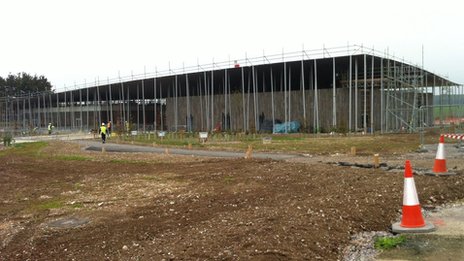
The visitor centre and museum will be located about a mile-and-a-half (2km) from the stones.

Stonehenge Visitor Centre

The visitor centre and museum will be located about a mile-and-a-half from the stones

Visitors will be shuttled to Stonehenge by a little train, pulled by a Land Rover.

Stonehenge, built between 3,000 BC and 1,600 BC, is thought to have been used for a variety of religious ceremonies.

It attracts around 900,000 visitors a year, about 70% of whom come from abroad.

Lorraine Knowle, from English Heritage, said the “beautifully and sensitively designed” centre “fits into the rolling landscape of Salisbury Plain very well”.

“It will give visitors a real sense of anticipation because the building is really just a stepping stone on the way to seeing the monument,” she added.

Also included is a museum which will be lent artefacts found around the stones, from local collections housed in Salisbury and Devizes.

Joe Studholme, from the Salisbury Museum said for the first time visitors to the stones will be able to put the exhibits in context.

“Before people go to the stones they need to know much more about the background. Previously there hasn’t been any background about the story of the stones.

“We’re thrilled to be in partnership with English Heritage and to be able to tell the whole story about Stonehenge and the wonderful area”

Link source: http://www.bbc.co.uk/news/uk-england-wiltshire-24329692

Follow developments on Twitter: https://twitter.com/ST0NEHENGE

Merlin @ Stonehenge
The Stonehenge News Blog


Salisbury – A Purple Flag City

29 09 2013


Saturday thought ….

28 09 2013

heritageaction's avatarThe Heritage Journal

Rather than needlessly upsetting a sizeable proportion of global visitors to the new Stonehenge Visitor Centre that will inevitably be offended by a display of human remains, let alone the spectacle being posed disrespectfully upright like a titillating prop in a fairground Ghost Train,….

…. wouldn’t it be simpler (and cheaper) to purchase Budget Bucky? for £182.75 ?

bucky

P. S. – Buying Bucky might have another advantage as well. The new “Stonehenge Social Media Content Executive” (part of whose job will be to help manage “the reputation of the English Heritage brand”) may find life a lot easier!

View original post


Stonehenge: English Heritage unveils its new visitor centre

27 09 2013

Despite being one of the world’s most valued heritage sites Stonehenge has never been treated with the respect that it deserves. A new visitor centre will change the way we view this national treasure.

Pondering the enigma of the imposing stone circle that stands on Salisbury Plain early in the 17th century King James I commissioned his architect general, Inigo Jones, to prepare a report on the stones’ condition and their origins. Jones concluded that only the Romans could have built such a sophisticated structure, backing up his case with crisp drawings of the stones in a pre-ruinous state, while dismissing the ancient Britons as savages incapable of building such ‘stately structures’.

Four hundred years later much the same questions are still being asked about Stonehenge. Who built it? What was it for? But in more recent years the focus has been how best to preserve the stones and protect them from the modern-day savagery of the motor-car and mass tourism.

Stonehenge is perhaps the most famous Neolithic site in the world, drawing thousands of visitors each day. A Unesco World Heritage Site, it is a ‘must-see’ monument, part of the identity of Britain itself. But as the site’s fame has grown over the centuries, the question of how to deal with all these visitors while protecting the stones themselves, and their surroundings, has become ever more taxing.

The current visitor centre – little more than a collection of portable buildings and lavatories arranged around a car-park – was built in 1968 and was barely adequate even then. ‘Stonehenge has been a national humiliation,’ Simon Thurley, the chief executive of English Heritage, guardians of the stones since 1984, says. ‘I think it’s really extraordinary that the only man-made structure in Britain that is instantly recognisable, from Patagonia to Serbia and beyond, has been treated as though it was a motorway service station.’ But now, after decades of controversy and failure to find an answer to the ‘Stonehenge problem’, it looks as if a solution, or at least a partial solution, has been found.

In December a new visitor centre and museum opens within a fresh and thoughtful building designed by the Anglo-Australian architectural practice Denton Corker Marshall (DCM). It is part of a whole package of measures that will also see the A344 roadway to one side of the stones removed, although the busy A303 trunk road to the West Country on the other side, which many campaigners have wanted to see put in a tunnel, remains, for now. Thurley sums up what has been achieved. ‘It has been an incredibly controversial saga and has involved three or four different schemes along the way. The most important thing has been the removal of the 1960s car-park and the closing of the road, and clearly getting rid of the terribly outdated stuff requires us to replace it with something new. So the corollary to the ambition to get rid of the road and the existing facilities has been the very long quest to decide where to put the new stuff.’

The ambition has long been to leave the stones themselves in splendid isolation, clearing the old visitor centre away and building something new well out of sight of the monument itself. After looking at a range of locations, English Heritage finally opted for a site at Airman’s Corner – one and a half miles from the stones themselves, within a natural dip in the landscape. ‘One of the key issues over the years has been where we should locate the new facilities,’ Lorraine Knowles, English Heritage’s Stonehenge director, says. ‘There was no disagreement that we needed to do something and close the road and that we needed to improve the setting around the stones. But the big question has been about where we should put the new centre.’

Having settled on the new site, the question became how to deliver a sensitively conceived building that responded to the open farmland setting, with scarcely another building in sight apart from an occasional barn. That includes the stones themselves, which will be accessed either by foot or by transit vehicles from the visitor centre. It is clear that the experience of visiting and understanding Stonehenge will be completely transformed.

The finished centre is a considered and respectful design, but also distinctly modern in approach, which may not please everyone. While the stones are all about mass and weight, the new building is purposefully light, low slung and partially transparent, allowing the eye to pass through and connect with the landscape beyond. It is a subtle presence in the landscape, with a sweeping roof supported by a small forest of slim supporting columns. The canopy shelters a cafe and shop to one side, within a more transparent section, while a museum sits at the other side protected by a facade of weathered chestnut. Between the two there is a sheltered courtyard and a ticket pod.

Stephen Quinlan, the director of DCM’s British office, has been involved in a substantial part of the story himself. Quite soon after establishing the British branch of a practice that was founded in Melbourne in the 1970s, Quinlan entered a 1992 competition for a new Stonehenge visitor centre that was eventually won by the architect Edward Cullinan, but later dropped. In 2001 DCM won a competition for a visitor centre at Countess East – about two miles from the stones – with its design for a building partly burrowed into the side of a sloping valley. In 2004 English Heritage gained Government backing for the idea of rerouting the A303 trunk road into a new tunnel out of view of the stones. It even got as far as getting planning permission in 2007, only for the whole scheme to be shelved when the Government decided that the new tunnel would be too expensive after all. Nevertheless, when English Heritage announced a new competition, for a £27 million building at Airman’s Corner, Quinlan decided it was worth having another go.

‘I know Stonehenge really, really well,’ Quinlan says. ‘It’s been a long time and a big part of my professional life. We had always hoped that we would get bounced on to the new project but it wasn’t like that at all and the new scheme had to go back out again into the market. So it was by no means a certainty that we would reapply to do it. We thought long and hard and in the end, because we are eternal optimists, we thought we might as well throw our hat in the ring, even though we didn’t rate our chances particularly highly. But the shortlist started getting smaller and smaller and we were incredibly excited when it happened again. We couldn’t believe our luck. It is a once in a lifetime opportunity.’

‘Quite early on we came up with this idea of an undulating roof with eccentric, irregular columns, which would fit well in this rolling countryside,’ continues Quinlan, who collaborated on the design with his colleagues in Melbourne, including the founding partners Barrie Marshall and John Denton. ‘It is quite a big building, with a million visitors going through it every year, so if you had a pitched roof it would become massive, like a cathedral, which didn’t fit in with our approach. We wanted the building to sit lightly in the landscape.’ Quinlan compares the supporting columns to reeds, or slim tree trunks, with a feeling of lightness. It looks as if they are supporting the roof, although they are actually holding it down, as the wind could catch the canopy and turn it into a giant sail without all of these vertical anchors.

‘With the buildings and sites that English Heritage owns itself we generally build in a way that’s very traditional,’ Thurley says. ‘Most of the buildings we have done over the past 10 years have been essentially timber framed and timber clad – out of oak normally – and silver down to get the same sort of colour register as the stone buildings that are often close by. So with our own estate we haven’t been champions of ultra-modern stuctures, although in our wider work we have supported many such buildings. But Stonehenge is completely different and in this case we think a traditional response would have been wrong and would have ended up looking far too solid. This building has a degree of permeability that makes it a lighter proposition. The aim was always to have something that felt like a leaf lying on the land, and hopefully it will feel something like that.’

For Quinlan the building will be a success only if it is seen as quiet and discreet. It forms the polar opposite to so much modern urban architecture, where drama and eye-catching, sculptural forms are so often seen as vital, within the aim of creating statement buildings. Purposefully the Stonehenge visitor centre makes no attempt to reference the stones themselves in its design language and never tries to compete with them in any way. The palette of materials – glass, limestone, chestnut, zinc for the roof – is also tempered and calm. ‘It is quite a big building, because of the job it has to do,’ Quinlan says. ‘But when you approach it, the building doesn’t seem that big at all, largely because there is a lot of landscape going on with the building placed within it. It almost disappears from some perspectives, which is fantastic. Although as an architect I probably shouldn’t be saying that.’

The museum is a key part of the development project, creating dedicated exhibition space for the first time and drawing on pieces lent by the Wiltshire Heritage Museum and the Salisbury and South Wiltshire Museum. ‘Between us we have agreed that we can tell the whole story of Stonehenge with thousands of objects on display,’ Thurley says. ‘It means that the million-plus people who come and see the stones every year will, for the first time, be able to come face to face with some of the actual artefacts that have been excavated on the site. We are building a major museum in the middle of Salisbury Plain, which is a quite extraordinary thing to do.’

An outdoor gallery alongside the new building will play host to three reconstructed Neolithic houses, made with walls of chalk cob over a willow framework and topped by thatched roofs. ‘They are based on some houses excavated at the nearby henge of Durrington Walls,’ Susan Greaney, an archaeologist and the museum’s curator, says. ‘They date from 2500bc, the same time as the large sarsen stones were being raised at Stonehenge and probably where the builders of Stonehenge lived. It will be a real hands-on, immersive experience. We hope the exhibition will show that the prehistoric people who built and used Stonehenge were sophisticated and clever. They were able to pool together vast resources to construct this extraordinary monument using only simple tools.’

The museum helps put Stonehenge into context for visitors, including a 360-degree film showing the henge in its various stages as it evolved over the centuries. But just as importantly the new building sits within a strategy of slowing down the experience of visiting the stones, with the aim of building a sense of anticipation by the time you reach Stonehenge itself. Visitors have the option of walking all the way or the final half of the way, adding to the idea of a journey along a path of discovery.

English Heritage is continuing to push for the A303 to go into a tunnel eventually. But for the time being the road has been resurfaced with a noise-reduction coating in the hope that the sound of constant traffic might be less intrusive when the visitor is contemplating the stones and asking the big questions of how and why they were put here in the first place.

english-heritage.org.uk

Merlin @ Stonehenge
The Stonehenge News Blog


A bit of a champion for Stonehenge and Avebury, but only a bit!

25 09 2013

heritageaction's avatarThe Heritage Journal

Wltshire Council has just published an advert for an Independent Chair of Stonehenge and Avebury World Heritage Site Partnership. It’s because it has been agreed that both parts of the WHS should work more closely together with input from English Heritage, the National Trust and Wiltshire Council so co-ordination is needed. So “The post holder will champion Stonehenge and Avebury’s World Heritage status.”

.

Hurrah! What could be more justified or better timed? The combined WHS is a huge earner of foreign currency (which will soon rocket as the Stonehenge admission fee goes up to £13.90) and Avebury has recently been judged by “Which Magazine” as the second best World Heritage site in the whole world.

.

But the advert also says:

It may on occasion be appropriate for them to attend the Stonehenge and Avebury local Steering Committees.”  

It is hard to set prescriptive time requirements but…

View original post 114 more words