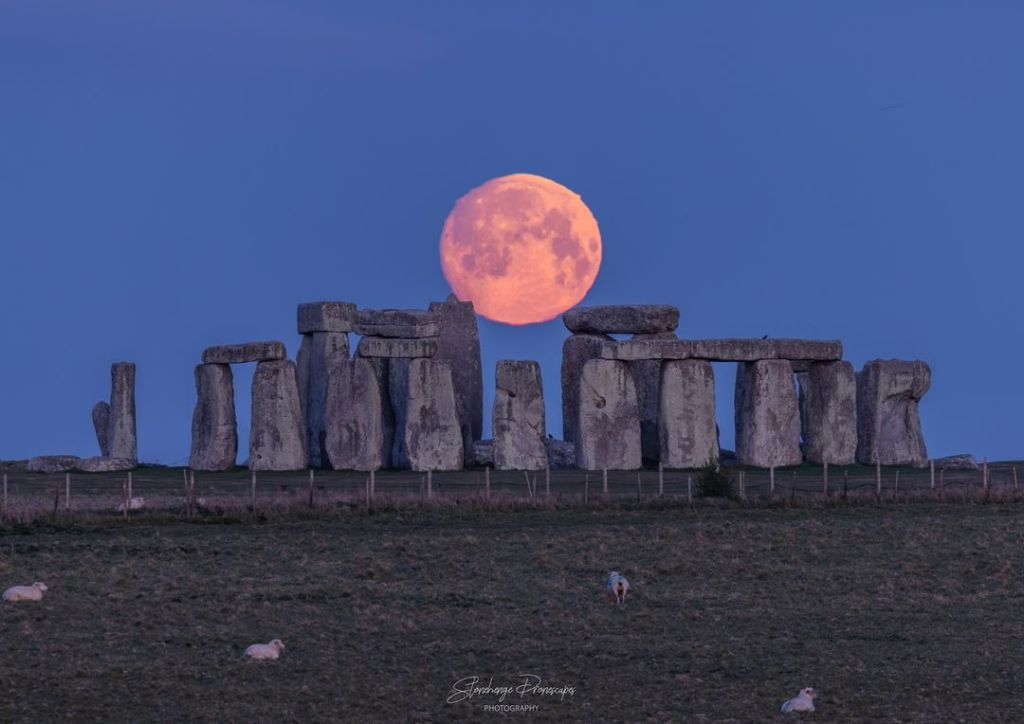
Experts claim breakthrough in ancient 4000-Year-Old Stonehenge tool kit puzzle

19 12 2022

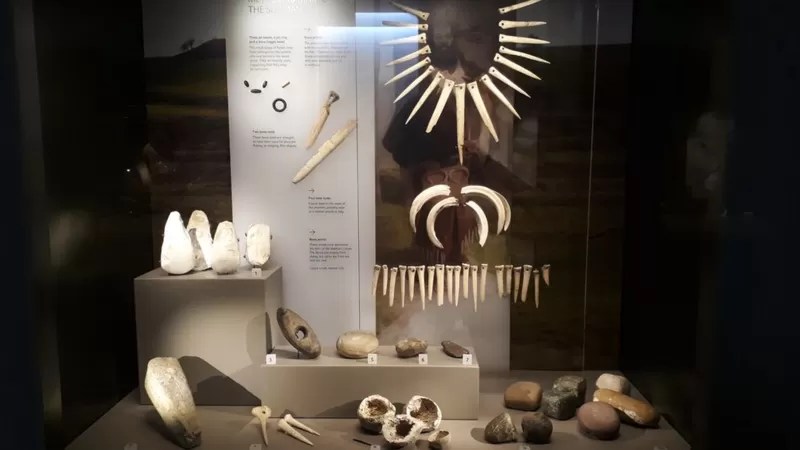
Archaeologists say a 4,000-year-old tool kit found among the grave of a Bronze Age spiritual leader was used for working with gold.

  • A Bronze Age burial site in Wiltshire contained the skeletons of two people
  • One was buried with stone and metal artefacts indicating they were a shaman
  • Scientists have analysed these and found traces of gold on the surface
  • This suggests the shaman was also a skilled goldsmith and metalworker 

The stone tool kit was found near Stonehenge more than two centuries ago but its use until now has been unknown.

Archaeologists from the University of Leicester detected traces of gold on their surface, indicating they were once used as hammers or anvils for metalworking. Pictured: Gold traces on stone used for polishing and smoothing

Researchers at the University of Leicester have re-examined grave goods discovered within the burial and found they were gold-working tools.

Lead author Dr Rachel Crellin said the discovery was “really exciting”.

The tools were first found at the Upton Lovell G2a Bronze Age burial, which was excavated in 1801.

They are now on display at the Wiltshire Museum in Devizes where Dr Christina Tsoraki, from the University of Leicester, carried out wear-analysis of the grave goods.

She noticed what appeared to be gold residues on their surfaces and concluded the stone tools had been used for a range of different purposes.

‘Highley skilled craftsman’

Some were used like hammers and anvils whereas others had been used to smooth other materials, Dr Tsoraki said.

The University of Leicester also worked alongside experts from the University of Southampton on the project.

The Wiltshire Museum said the man buried at Upton Lovell near Stonehenge, was a “highly skilled craftsman” who specialised in making gold objects.

The grave also consisted of a ceremonial cloak decorated with pierced animal bones which the museum say hints that he was a “spiritual leader” and one of the few people in the early Bronze Age who understood the magic of metal-working.

Dr Crellin, from the University of Leicester, said “At the recent ‘World of Stonehenge’ exhibition at the British Museum, we know that the public was blown away by the amazing 4000-year-old goldwork on display.

“What our work has revealed is the humble stone toolkit that was used to make gold objects thousands of years ago.”

RELEVANT STONEHENGE LINKS:

Experts claim breakthrough in ancient Stonehenge tool kit puzzle – BBC NEWS
Ancient goldsmith’s toolkit found near Stonehenge – DAILY MAIL
4,000-year-old ‘shaman’ burial near Stonehenge has a golden secret – LIVE SCIENCE
Visit Stonehenge with the experts and hear all the latest discoveries and theories – STONEHENGE GUIDED TOURS
3,800-Year-Old Toolkit Unearthed Near Stonehenge Was Used to Work Gold – ANCIENT ORIGINS
4000-YEAR-OLD GOLD WORKING TOOL KIT IDENTIFIED FROM BARROW NEAR STONEHENGE – DAILY HERITAGE
Archaeologists say find near Stonehenge is ancient goldsmith’s toolkit – THE GUARDIAN
Private Guided Tours of Stonehenge with local expert tour guides – STONEHENGE AND SALISBURY GUIDED TOURS

The Stonehenge News Blog
Follow us on Twitter and Facebook for all the latest Stonehenge News
http://www.Stonehenge.News


Stonehenge Winter Solstice Managed Open Access Arrangements 2022

24 11 2022

Winter Solstice at Stonehenge will take place on Thursday 22nd December 2022. English Heritage are expected to offer a short period of access, from first light or safe enough to enter the monument field (approximately 07.45am until 10.00am)

At Winter Solstice, access to the stones themselves is free and without restriction, and visitors can get up close with the marvel that is Stonehenge. After it passes, the days will begin to get longer and longer until June when the Summer Solstice takes place.

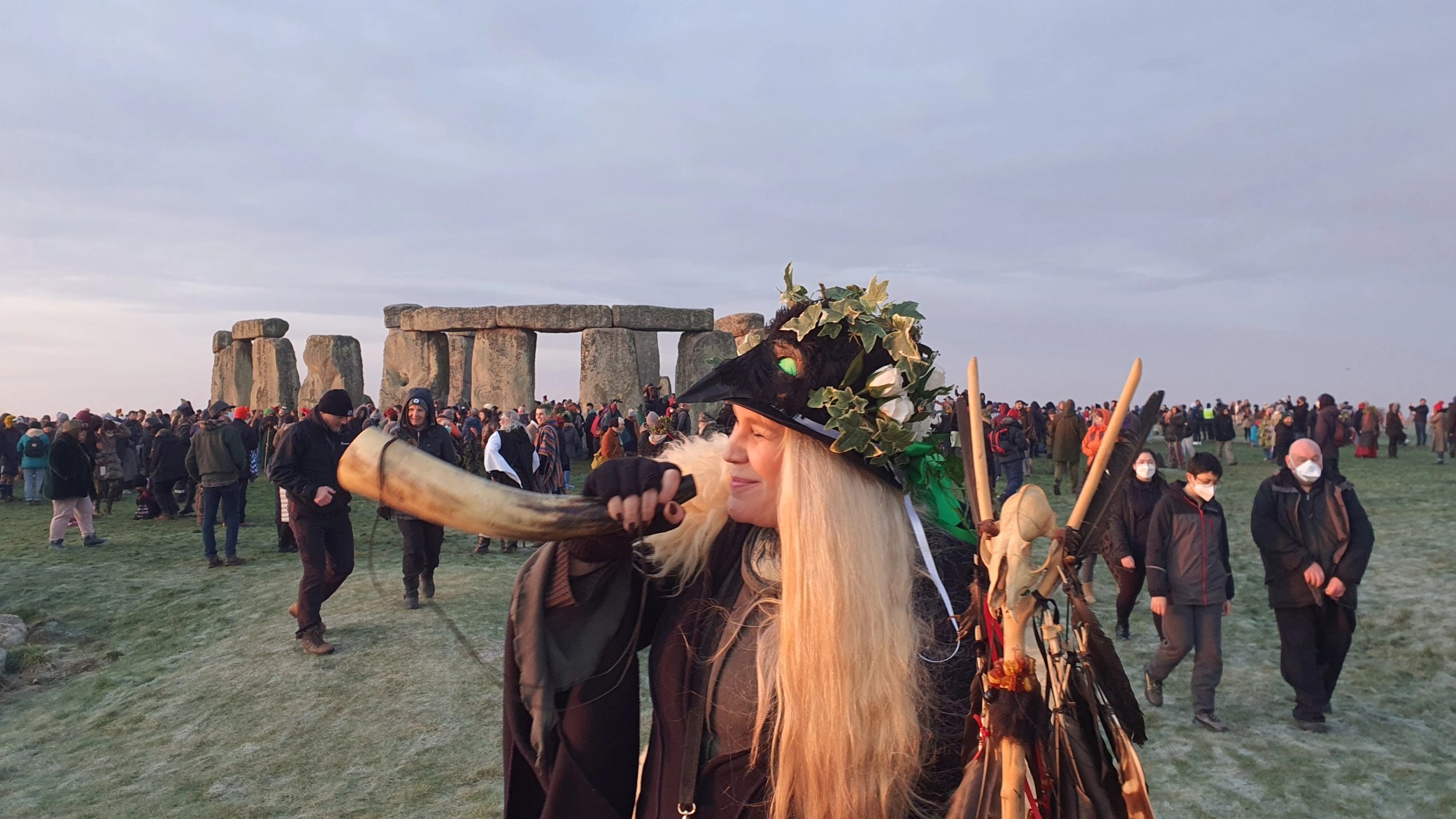
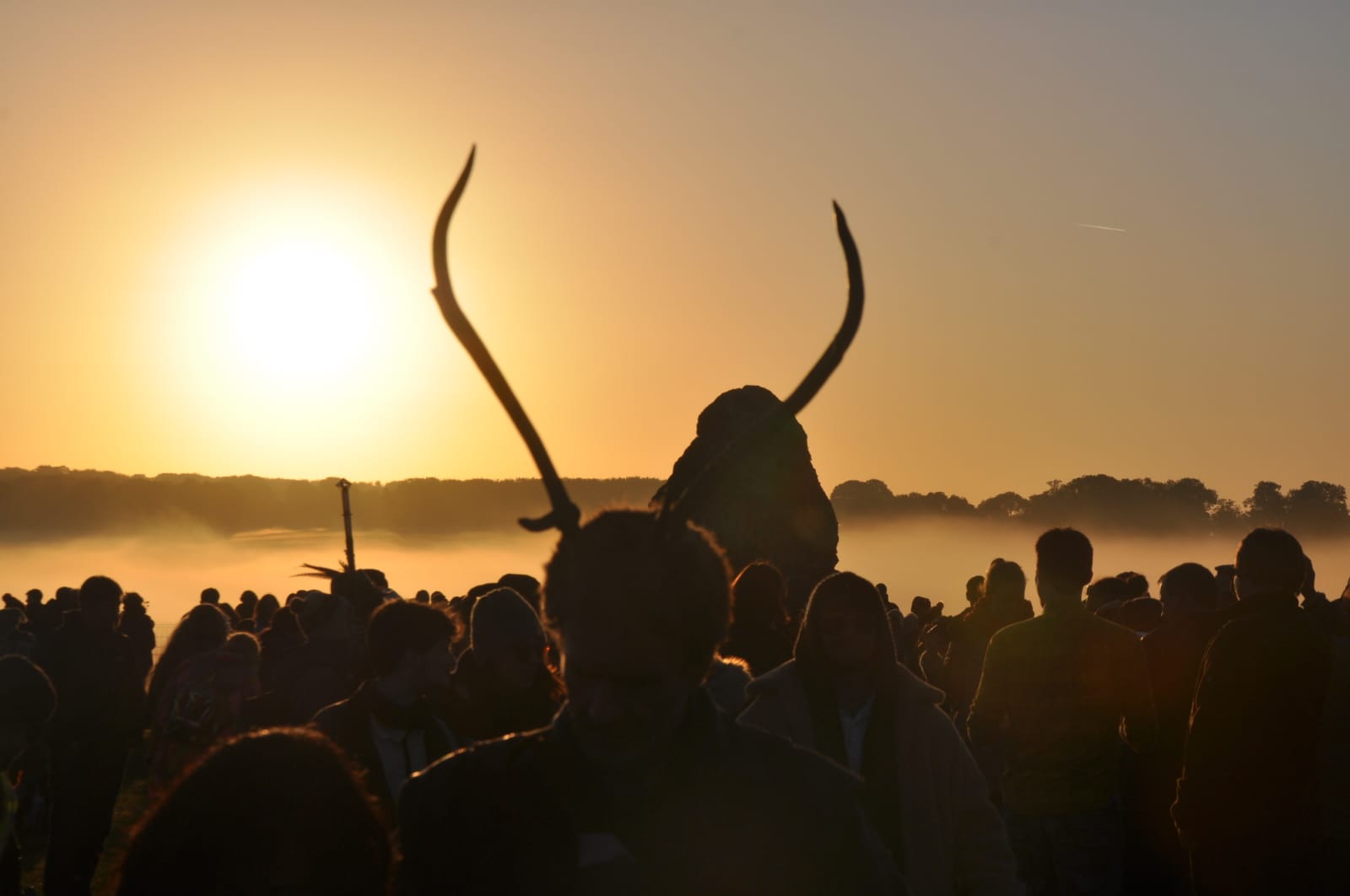
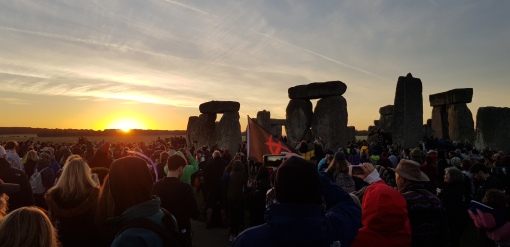
The Winter Solstice, marking the shortest day and longest night of the year approaches, drawing neo-druid and neo-pagan pilgrims to Stonehenge to watch the sunrise through the sacred site.

This is a twice-yearly pilgrimage for many visitors, including Druids and Pagans, with the Summer Solstice in June being the largest of the two events. The festivals which have celebrated the passing of the seasons and new beginnings throughout human history, offer a unique opportunity to visit Stonehenge with no barriers and draws crowds every year.

Whatever the weather, it could be cold and wet. So please dress accordingly.  Shuttle buses will be running to take you from the car parks to the stones. However, you may choose to walk from the Visitor Centre up to the stones. This takes 30 minutes on average and will be in low-light. So a torch would be essential.

Why is open access on the 22nd December?
Many people believe the Winter Solstice always falls on December 21, but because of a mismatch between the calendar and solar year, the December solstice is not fixed to a specific date.

This year, English Heritage says based on advice from the druid and pagan communities, the Solstice will be marked at Stonehenge on the morning of Thursday December 22 December – the first sunrise following the astronomical solstice which occurs after sunset the previous day.

Access to Stonehenge for Winter Solstice is is subject to the Conditions of Entry. Please read these before deciding whether to attend.  Stonehenge is in a field on Salisbury Plain and the weather in December will be cold and wet.  Even if it isn’t raining, the ground will be wet from the dew and there may also be frost. Sensible footwear and warm, waterproof clothing is essential. Please note, parking charges apply.

Can I watch the sunrise on a live stream?
English Heritage will be live streaming the sunrise on the morning of 22 December for free on their digital channels. Visit the official Stonehenge or English Heritage Facebook page, or the English Heritage YouTube channel. Please beware of fake/scam Facebook pages, events and groups that might have been set up.

Getting there:

Extremely limited parking available and strongly recommend using public transport to avoid disappointment. Salisbury Reds are operating a dedicated Solstice service from Salisbury train station via Amesbury. Please check their website for details. We also have a dedicated car sharing website which is available here.

Limited parking is available in the Winter Solstice car parks, which will open at 6am on the 22nd December 2022. Please follow the brown tourist route signage to Stonehenge. There will be signs to direct you to the car parks.  Please do not arrive early as there is no waiting on roads in the area and you will be moved on.

There will be a parking charge for all vehicles in the official car parks for Winter Solstice 2022 – £5 for cars and minibuses up to 16 seats and £2 for motorbikes. This can be paid by cash or card.

If you are considering visiting Stonehenge for the Winter Solstice celebrations and do not have tour own transport, you may want to consider joining an organised tour with transport from London, Bath or Salisbury and save all the hassle and expense. Stonehenge Guided Tours offer such tours and are the longest established company. Solstice Events offer small group tours from Bath and The Stonehenge Tour Company use only local expert guides and have a great reputation.

Stonehenge Winter Solstice Links:
Winter Solstice at Stonehenge 2022: Everything you need to know – WILTSHIRE LIVE
Stonehenge Winter Solstice Tours from London – STONEHENGE GUIDED TOURS
English Heritage Conditions of Entry – ENGLISH HERITAGE
When is the shortest day of the year — date of winter solstice and what it means – DAILY MIRROR
The Rebirth of the Sun: the Winter Solstice at Stonehenge – STONEHENGE NEWS BLOG
Winter Solstice: Wild tales of slaughtered bulls, human sacrifice and much merriment – THE SCOTSMAN
The Rebirth of the Sun: the Winter Solstice at Stonehenge – STONEHENGE NEWS BLOG
Winter solstice: Why do pagans celebrate the shortest day of the year? THE TELEGRAPH
The Sun Stones: The Story of the Winter Solstice at Stonehenge – STONEHENGE NEWS BLOG
Solstice at Stonehenge. From Past to Present. – STONEHENGE NEWS BLOG
What has Stonehenge got to do with the winter solstice? – METRO NEWS
Stonehenge Winter Solstice Tours from Bath – SOLSTICE TOURS U.K
Celebrate Winter Solstice at Stonehenge – HOLIDAY EXTRAS
Solstice and Equinox Experience Tours – SOLSTICE EVENTS UK
The Stonehenge Solstice Pilgrims – STONEHENGE NEWS BLOG
Stonehenge, the Winter Solstice, and the Druids – INTERESTRING ENGINEERING
Respecting the Stones.  Managed Open Access –STONEHENGE NEWS BLOG

The Stonehenge News Blog
Follow us on Twitter and Facebook for all the latest Stonehenge News and Winter Solstice updates.


Circles of Stone: New exhibition at Stonehenge probes Japan’s prehistoric cultures

3 10 2022

An exhibition opened at Stonehenge on Friday, showing the remarkable similarities between prehistoric cultures in Britain and Japan.

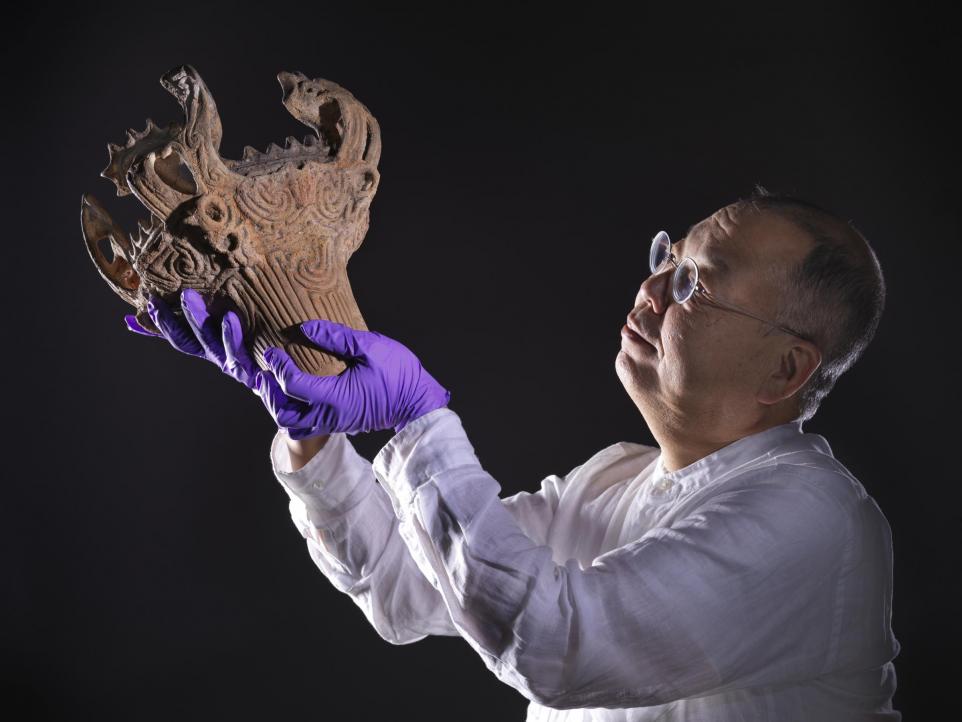
The exhibition features over 80 Japanese artifacts, none of which have been displayed in Britain before, including a 5,000-year-old Jomon Flame Pot, according to English Heritage, the body which cares for Stonehenge.

Miyao Toru, the curator at Niigata Prefectural Museum, with the 5000-year-old Jomon Flame Pot which will be on display at Circles of Stone: Stonehenge and Prehistoric Japan exhibition Picture by English Heritage

Circles of Stone: Stonehenge and Prehistoric Japan opened on Friday (September 30) will feature ancient Japanese artefacts – none of which have been displayed in Britain before.

It will be Britain’s first ever exhibition about Japanese stone circles, and through more than 80 objects, will tell the story of prehistoric cultures six thousand miles apart.

The star of the show, the ‘flame pot’ is designated in Japan as a national treasure and is a highly decorated type of Jomon ceramic made in central Japan about 5,000 years ago. The Jomon period in Japan spanned the European Mesolithic, Neolithic and early Bronze Age periods put.

Senior curator for English Heritage, Martin Allfrey said: “Exploring what is happening elsewhere in the prehistoric world is key to understanding the significance of Stonehenge. It’s tantalising to look at what these extraordinary objects from Japan tell us about the similarities between these communities who, while thousands of miles apart, were perhaps ideologically closer than one might imagine.”

The exhibition also explores more recent connections between Stonehenge and Japan through the art of Japanese woodblock printer Yoshijiro Urushibara who worked in Britain in the 1920s and British archaeologist William Gowland.

Gowland used the techniques he had learnt in Japan to influence the way in which he carried out excavations and interpreted the evidence at Stonehenge at the dawn of the 20th century.

Martin added: “Equally intriguing is the fact that William Gowland’s experience working on archaeological sites in Japan at the end of the nineteenth century helped him to develop the first scientific study of Stonehenge and to formulate new theories about the building of Stonehenge and its alignment with the sun.

“We are thrilled to tell the story of this extraordinary place and time, and hope to bring a little bit of Japanese inspiration and wonder to the visitor centre at Stonehenge.”

Also featured in the exhibition will be fragments of clay figurines, known as dogu in Japanese.

These have been found at Jomon settlements and stone circles and it has been suggested they may have represented earth goddesses or spirits, for use in fertility or healing rituals.

The exhibition is a partnership project with the Sainsbury Institute for the Study of Japanese Arts and Cultures at the University of East Anglia.

The exhibition runs until August 2023.


Stonehenge Autumn Equinox Managed Open Access Arrangements: 23rd September 2022

8 09 2022

The Autumn Equinox (Mabon) is rapidly approaching as the last days of summer slowly come to an end. English Heritage are expected to offer a short period of access, from first light or safe enough to enter the monument field (approximately 06.15am until 08:30am) on the 23rd September.

Stonehenge is an ancient prehistoric site which has been a place of worship and celebration for thousands of years.

The Autumn Equinox is one of the rare occasions that English Heritage opens up the stones for public access. Equinox open access attracts fewer people than the Solstices – in the several hundreds rather than tens of thousands – and there are modern Druid ceremonies which are held in the circle around dawn, so if you prefer a quieter experience then attending the Autumn Equinox is a good choice.

English Heritage has facilitated Managed Open Access (MOA) to Stonehenge for the celebration of the summer solstice, winter solstice, spring and autumn equinox (spring and autumn equinox fall outside of this contract). English Heritage provides access to the stone circle and the monument field, free of charge to anyone who wishes to attend, but asks all those attending to comply with conditions of entry to ensure the safety of all visitors and to protect the monument. To safely provide MOA across the year, English Heritage works in partnership with Wiltshire Police and Wiltshire Council and engages experienced event managers and health and safety experts.

Mabon is a harvest festival, the second of three, that encourages pagans to “reap what they sow,” both literally and figuratively. It is the time when night and day stand equal in duration; thus is it a time to express gratitude, complete projects and honor a moment of balance.

What is the Equinox?
The equinox is when day and night are actually the same length. It happens several days before the spring equinox, and a few days after the autumn one.

The reason day and night are only almost equal on the equinox is because the sun looks like a disk in the sky, so the top half rises above the horizon before the centre

The Earth’s atmosphere also refracts the sunlight, so it seems to rise before its centre reaches the horizon. This causes the sun to provide more daylight than many people might expect, offering 12 hours and 10 minutes on the equinox.

The word ‘equinox’ itself actually mean ‘equal’ (equi) and ‘night’ (nox).

Respecting the Stones
Stonehenge is protected under the Ancient Monuments and Archaeological Areas Act and you must adhere to the regulations outlined in the act or face criminal prosecution. No person may touch, lean against, stand on or climb the stones, or disturb the ground in any way. View the conditions of entry and respect the Stones

If you are considering visiting Stonehenge for the Autumn Equinox and do not have transport or simply want a hassle free experience you can join a specialist organised tour.  Use a reputable tour operator who respect the conditions of entry – Stonehenge Guided Tours are the longest established company offering discreet tours from London or Bath, view their exclusive Autumn Equinox tour 

Equinox Links:
Autumn Equinox Celebrations 2021 Stonehenge News Blog
What is the autumnal equinox? Royal Museums Greenwich
What is the Autumn equinox? Here’s what you need to know. National Geographic
Stonehenge and the Druids – Who are the Druids? Stonehenge News Blog
Stonehenge Autumn Equinox Tours – Stonehenge Guided Tours
The Stonehenge Pilgrims – Stonehenge News Blog

Follow us on Twitter and Facebook for Equinox updates and Stonehenge news
The Stonehenge News Blog


Stonehenge Summer Solstice Open Access 2022

12 06 2022

Summer Solstice Sunrise Celebrations at StonehengeThe summer solstice is one of the few times access is granted inside the stones.
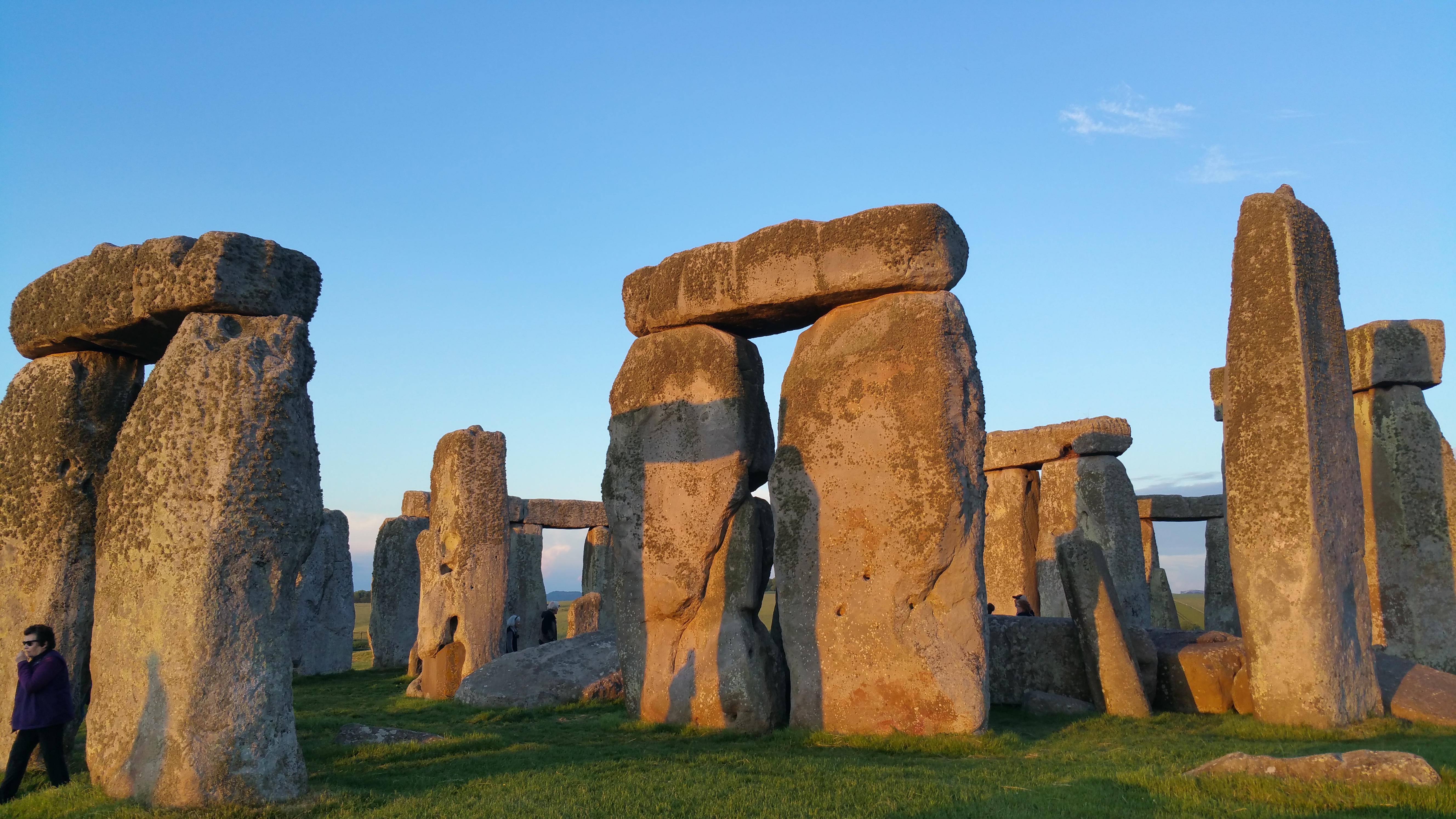
The summer solstice will be on 21 June 2022: Stonehenge is an ancient prehistoric world heritage site which has been a place of worship and celebration at the time of Summer Solstice for thousands of years. Stonehenge is a world renowned historic Monument and part of a World Heritage Site. It is seen by many who attend as a sacred place. The Stonehenge summer solstice is a popular annual event that sees thousands of people descend on Wiltshire to celebrate the changing seasons. Summer solstice falls on the longest day of the year.

Please note that last normal admissions to Stonehenge is on Thursday 20th June at 13:00 and the site will close at 15:00 in preparation for Summer Solstice Managed Open Access. Stonehenge will re-open for normal admissions on the afternoon of Friday 21st June. Please check our social media channels for the exact time.

English Heritage is pleased to provide free Managed Open Access to Stonehenge for Summer Solstice. We ask that if you are planning to join us for this peaceful and special occasion that you read the Conditions of Entry and the information provided on the following page before deciding whether to come.

What is the summer solstice?

At the summer solstice, the sun travels the longest path through the sky, and therefore that day has the most daylight. The exact moment of the solstice is the time of year that the Earth is closest to the sun.

According to the astronomical definition of the seasons, the summer solstice also marks the beginning of summer, which lasts until the autumnal equinox (22 or 23 September in the Northern Hemisphere, and 20 or 21 March in the Southern Hemisphere). Under the meteorological definition, which splits the year into four seasons of three full months each based on the Gregorian calendar, winter starts on 1 December every year, and summer starts on 1 June.

When is summer solstice in 2022?

The summer solstice will be on 21 June 2022. It most commonly falls on this date, but can be anywhere between 20-22 June. The exact time of the solstice will be 10.13am in the UK.

Stonehenge is a significant World Heritage Site and to many it is sacred – please respect the stones and all those who are attending.

Admission to the Summer Solstice at Stonehenge is free of charge.  We hope the weather will be kind and wish you a peaceful and celebratory solstice.

THURSDAY 20th JUNE 2022 
SOLSTICE CAR PARK OPENS19.00 hours
ACCESS TO STONEHENGE MONUMENT FIELD19.00 hours
SUNSET21.26 hours
FRIDAY 21st JUNE 2022 
SUNRISE04.52 hours
LAST ADMISSION TO SOLSTICE CAR PARK06.00 hours (or when full)
STONEHENGE MONUMENT FIELD CLOSESSOLSTICE CAR PARK TO BE VACATED08.00 hours12.00 hours (Noon)

How much are tickets to Stonehenge?

Entry is free of charge and you won’t need tickets to attend. Usually, tickets to the site cost £17.50. You will however have to pay for parking.

English Heritage says on its website: “We are pleased to provide free Managed Open Access to Stonehenge for Summer Solstice. We ask that if you are planning to join us for this peaceful and special occasion that you read the Conditions of Entry and the information provided before deciding whether to come.”

How to watch the summer solstice online

ENGLISH Heritage plan to make use of technology once more to enable enthusiasts to enjoy the summer solstice from the comfort of their own homes If you’re not able to get there in person, you can watch the summer solstice from Stonehenge online by using the Stonehenge Skyscape website. It has been set up by English Heritage to enable anyone from around the world the experience it. The event will also be livestreamed on the Stonehenge Facebook group and the English Heritage YouTube channel.

The charity is asking people to be mindful of the environmental issues if travelling to the stones and to car share or use public transport wherever possible. This would help to reduce CO2 emissions at the World Heritage Site.

English Heritage advise those who wish to celebrate the solstice at Stonehenge to bring only essential items with them and to check the website.

USEFUL SOLSTICE INFORMATION

For further information about Managed Open Access for Summer Solstice at Stonehenge, please call English Heritage Customer Services Solstice Information Hotline on 0370 333 1181.

Stonehenge Summer Solstice Links:
Experience the summer solstice and Stonehenge without leaving the house – SALISBURY JOURNAL
Druid Leader King Arthur Uther Pendragon, Head of the Loyal Arthurian Warband. STONEHENGE NEWS BLOG
Stonehenge summer solstice 2022: Tickets won’t be needed to attend ancient site – WILTSHIRE LIVE
Summer Solstice 2022 – when is the longest day of the year? DAILY EXPRESS
When is the longest day of the year? Summer solstice 2022 date and how it’s celebrated at Stonehenge – INEWS
Respecting the Stones.  Managed Open Access –STONEHENGE NEWS BLOG
Solstice at Stonehenge. From Past to Present. – STONEHENGE NEWS BLOG
Stonehenge Summer Solstice Tours from London / Bath – SOLSTICE TOURS U.K
Solstice and Equinox Experience Tours – SOLSTICE EVENTS UK
The Stonehenge Solstice Pilgrims – STONEHENGE NEWS BLOG
Respecting the Stones.  Managed Open Access –STONEHENGE NEWS BLOG
Summer Solstice at Stonehenge. From Past to Present. Stonehenge New Blog
Why Thousands Of Pagans Gather At Stonehenge For The Solstice Stonehenge News Blog

The Stonehenge News Blog
Follow us on Twitter and Facebook for all the latest Stonehenge News and 2022 Summer Solstice updates
http://www.Stonehenge.News


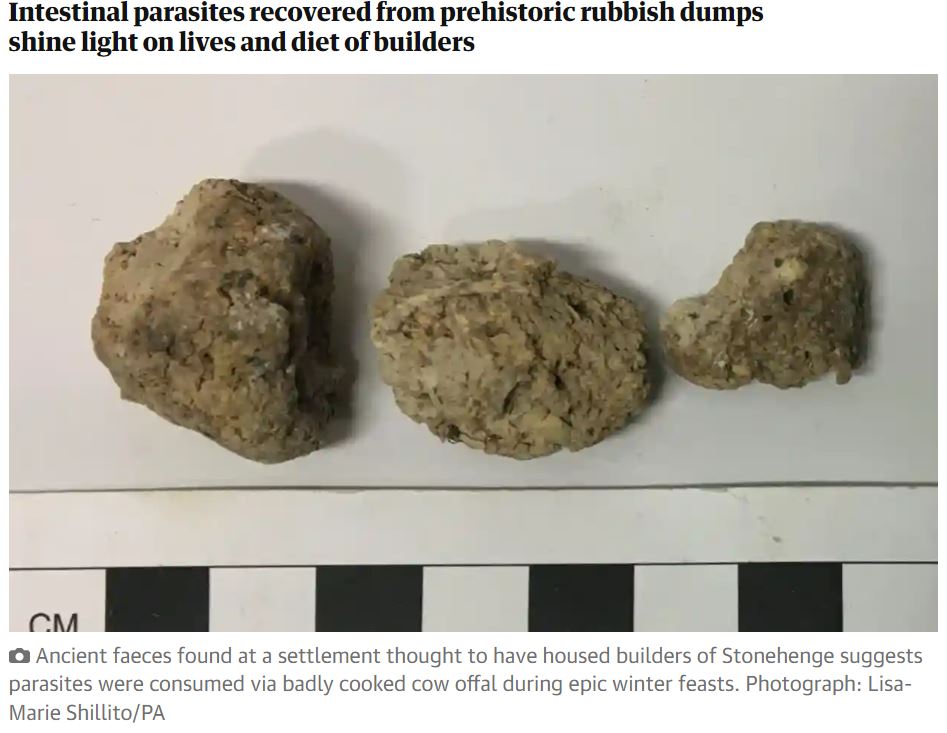
Ancient faeces suggests that Stonehenge builders ate badly cooked cow offal during epic winter feasts.

23 05 2022

An analysis of fossilised poo found at the site of a prehistoric village near the monument has uncovered evidence of eggs laid by parasitic worms.

This suggests the inhabitants feasted on the internal organs of cattle and fed leftovers to their dogs, scientists say.

The Neolithic settlement at Durrington Walls is just 1.7 miles from Stonehenge and dates back to 2500 BC, when much of the famous site was constructed.

A team of archaeologists led by the University of Cambridge analysed 19 pieces of faeces which had been preserved at the settlement for more than 4,500 years.

Five of them — one belonging to a human and four to dogs — contained the eggs of parasitic worms.

The researchers suggest this is the earliest evidence for intestinal parasites in the UK where the host species that produced the faeces has also been identified.

‘This is the first time intestinal parasites have been recovered from Neolithic Britain, and to find them in the environment of Stonehenge is really something,’ said lead author Dr Piers Mitchell, from Cambridge’s Department of Archaeology.

‘The type of parasites we find are compatible with previous evidence for winter feasting on animals during the building of Stonehenge.’

Scientists believe that the presence of these parasites indicates the person had eaten the raw or undercooked lungs or liver from an already infected animal.

RELEVANT STONEHENGE LINKS:
Prehistoric poo gives hints about the builders of Stonehenge – The Metro
Stonehenge builders ate undercooked offal, ancient faeces reveals – The Guardian
Stonehenge builders ate parasite-infested meat during ancient feasts, according to their poop – Live Science
Visit Stonehenge with the megalithic experts and hear all the latest theories – STONEHENGE GUIDED TOURS
Stonehenge breakthrough as Neolithic chefs’ ‘winter feast’ secrets unveiled for first time – The Express
Secrets surrounding 5,000-year-old Stonehenge revealed in ancient fossilised POO – The Mirror

The Stonehenge News Blog
Follow us on Twitter and Facebook for all the latest Stonehenge News
http://www.Stonehenge.News


Red deer, wild boar and elk would have roamed the Stonehenge area 4,000 years before the stones were constructed, according to new research.

3 05 2022

Scientists examined a nearby Mesolithic site and found the area was not a forest as previously thought.

Instead they believe it would have been populated by grazing animals and hunter-gatherers.

Scientists from the University of Southampton have examined Blick Mead, a Mesolithic archaeological site about a mile away from Stonehenge.

The work has helped build a picture of the habitat at the Wiltshire site from up to the Neolithic period (4,000 BC).

Samuel Hudson, from the University of Southampton, explained: “There has been intensive study of the Bronze Age and Neolithic history of the Stonehenge landscape, but less is known about earlier periods.

“Past theories suggest the area was thickly wooded and cleared in later periods for farming and monument building.

“However, our research points to pre-Neolithic, hunting-gatherer inhabitants, living in open woodland which supported aurochs and other grazing herbivores.”

The research team analysed pollen, fungal spores and traces of DNA preserved in ancient sediment, combined with optically stimulated luminescence and radiocarbon dating to produce an environmental history of the UNESCO World Heritage site.

“The study indicates that later Mesolithic populations at Blick Mead took advantage of more open conditions to repeatedly exploit groups of large ungulates (hoofed mammals), until a transition to farmers and monument-builders took place,” explained a university spokesman.

“In a sense, the land was pre-adapted for the later large-scale monument building, as it did not require clearance of woodland, due to the presence of these pre-existing open habitats.”

The findings of the team from Southampton, working with colleagues at the universities of Buckingham, Tromso and Salzburg, are published in the journal PLOS ONE.

RELEVANT STONEHENGE NEWS:
Stonehenge ‘built on land inhabited by deer and wild boar’ – BBC
New study reveals landscape 4,000 years before Stonehenge construction – HERITAGE DAILY
Stonehenge ‘built on land inhabited by deer and wild boar 4,000 years earlier’ – SALISBURY JOURNAL
Pre-Stonehenge Landscape Was Perfect for Hunter-Gatherers, Study Shows – ANCIENT ORIGINS
Visit Stonehenge with the megalithic experts and hear all the latest theories – STONEHENGE GUIDED TOURS
Stonehenge ‘was built on land inhabited by deer and wild boar 4,000 years earlier’ – THE INDEPENDENT

The Stonehenge News Blog
Follow us on Twitter and Facebook for all the latest Stonehenge News
http://www.Stonehenge.News


A new study suggests that Stonehenge once served as a solar calendar.

29 03 2022

It had long been thought that the famous site of Stonehenge served as an ancient calendar, given its alignment with the solstices. Now, research has identified how it may have worked.

  • Researchers argues that the design of Stonehenge was one big solar calendar 
  • The entire site was the physical representation of one month, lasting 30 days
  • One theory is Stonehenge served as an ancient calendar, although others exist

Research showed the stones were added about 2500BC and remained in the same formation, indicating they worked as a single unit such as a calendar.

New analysis suggests the design of Stonehenge may have represented a calendar, which enabled people to track a solar year of 365.25 days based on the alignment of the sun on the solstices. The large sarsens at the site appear to reflect a calendar with 12 months of 30 days – Source – Daily Mail

Professor Timothy Darvill said the Wiltshire stone circle’s layout served as a physical representation of the year.

He said the research indicated “the site was a calendar based on a tropical solar year of 365.25 days”.

Although the origins of the site remain a mystery, in a paper published in the journal Antiquity, Prof Darvill deduced that the stones are displayed to represent a solar year of 365.25 days and were once used to help people keep track of time.

His analysis also includes new finds about the site’s history, along with analysis of other ancient calendar systems.

The prehistorian, who works at Bournemouth University, said that “the clear solstitial alignment of Stonehenge has prompted people to suggest that the site included some kind of calendar since the antiquarian William Stukeley.

“Now, discoveries brought the issue into sharper focus and indicate the site was a calendar based on a tropical solar year of 365.25 days.”

The significance of the layout is highlighted during the Winter and Summer solstices, when the sun is framed by the same stones every time.

The solstitial alignment helps to calibrate the calendar and any errors would be easily detectable as the sun would be in the wrong place during the biannual event.

Professor Darvill said: “The proposed calendar works in a very straightforward way. Each of the 30 stones in the sarsen circle represents a day within a month, itself divided into three weeks each of 10 days.”

The solar calendar was developed in eastern Mediterranean countries after 3000BC and adopted in Egypt as the Civil Calendar around 2700BC. It was widely used around 2600BC, at the start of the Old Kingdom.

This information raises the possibility that the calendar that Stonehenge tracks may be influenced by other cultures. SOURCE: BBC NEWS

Putting Darvill’s Stonehenge Solar Calendar Theory To the Test! – ANCIENT ORIGINS
Stonehenge served as an ancient solar calendar, new study suggests – BOURNEMOUTH UNIVERSITY
Stonehenge may have served as an ancient solar CALENDAR, helping people track the 365 days of the year, study claims – DAILY MAIL
Mystery of Stonehenge ‘solved’ as ancient Egyptians used it for solar calendar – THE INDEPENDENT

Blog sponsored by Stonehenge Guided Tours

The Stonehenge News Blog
Follow us on Twitter and Facebook for all the latest Stonehenge News
http://www.Stonehenge.News


First Day of Spring: Stonehenge crowd gathers for sunrise to celebrate the 2022 Vernal Equinox.

20 03 2022

The first day of spring has been marked by 1000 revellers who gathered at Stonehenge to watch the sunrise.

Open access to the stones was given from first light, 05:45 GMT, by English Heritage which manages the site. Please visit our Twitter and Facebook page for more pics and videos.

Blog sponsored by Stonehenge Guided Tours

The Stonehenge News Blog
Follow us on Twitter and Facebook for all the latest Stonehenge News
http://www.Stonehenge.News


Has the mystery of Stonehenge finally been solved? A new study suggests that Stonehenge once served as a solar calendar.

4 03 2022
  • Researchers argues that the design of Stonehenge was one big solar calendar 
  • The entire site was the physical representation of one month, lasting 30 days
  • One theory is Stonehenge served as an ancient calendar, although others exist

Research showed the stones were added about 2500BC and remained in the same formation, indicating they worked as a single unit such as a calendar.

It had long been thought that the famous site of Stonehenge served as an ancient calendar, given its alignment with the solstices. Now, research has identified how it may have worked

Professor Timothy Darvill said the Wiltshire stone circle’s layout served as a physical representation of the year.

He said the research indicated “the site was a calendar based on a tropical solar year of 365.25 days”.

Although the origins of the site remain a mystery, in a paper published in the journal Antiquity, Prof Darvill deduced that the stones are displayed to represent a solar year of 365.25 days and were once used to help people keep track of time.

His analysis also includes new finds about the site’s history, along with analysis of other ancient calendar systems.

The prehistorian, who works at Bournemouth University, said that “the clear solstitial alignment of Stonehenge has prompted people to suggest that the site included some kind of calendar since the antiquarian William Stukeley.

“Now, discoveries brought the issue into sharper focus and indicate the site was a calendar based on a tropical solar year of 365.25 days.”

The significance of the layout is highlighted during the Winter and Summer solstices, when the sun is framed by the same stones every time.

The solstitial alignment helps to calibrate the calendar and any errors would be easily detectable as the sun would be in the wrong place during the biannual event.

Professor Darvill said: “The proposed calendar works in a very straightforward way. Each of the 30 stones in the sarsen circle represents a day within a month, itself divided into three weeks each of 10 days.”

The solar calendar was developed in eastern Mediterranean countries after 3000BC and adopted in Egypt as the Civil Calendar around 2700BC. It was widely used around 2600BC, at the start of the Old Kingdom.

This information raises the possibility that the calendar that Stonehenge tracks may be influenced by other cultures. SOURCE

Relevant Stonehenge News Links:
Stonehenge was a solar calendar, according to research – BBC
Stonehenge may have been a giant calendar and now we know how it works – New Scientist
Stonehenge mystery solved as a solar calendar – with links to ancient Egypt – Evening Standard
Stonehenge mystery unravelled as scientists detail key use ‘Very straightforward’ – The Express
Stonehenge may have served as an ancient solar CALENDAR, helping people track the 365 days of the year, study claims – Daily Mail
Visit Stonehenge with the megalithic experts and hear all the latest theories – Stonehenge Guided Tours
Visit Stonehenge on the Summer Solstice – Solstice Tours UK

The Stonehenge News Blog
Follow us on Twitter and Facebook for all the latest Stonehenge News