Preparations are underway in the Stonehenge half of the World Heritage Site to excavate a small area of the arc of anomalies under the turf that caused such a media sensation in September 2015: Fro…
Source: Durrington Walls Dig
Preparations are underway in the Stonehenge half of the World Heritage Site to excavate a small area of the arc of anomalies under the turf that caused such a media sensation in September 2015: Fro…
Source: Durrington Walls Dig
Some say EH should have tackled solstice overcrowding long ago. Still, this year they finally did, imposing both a parking charge and an alcohol ban. It seems to have produced less overcrowding and less misbehaviour. Might they conclude that decisive management works better than endless negotiations?
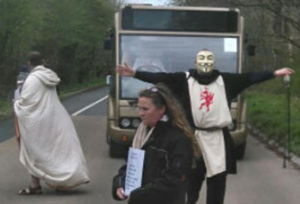
Pointless activity? Demonstrating against parking charges and an alcohol ban by delaying people who have paid and haven’t brought any booze!
Our friend spent the last year on the Open Access to Stonehenge Facebook Group, calling for a fresh start and a letter to EH saying: “We recognise that the welfare and dignity of the monument is paramount. We would like to enter into discussions to optimise access on the above bases.” Sadly (with a few exceptions) this was greeted with hostility (and accusations he was an EH or police spy!) and he was summarily ejected. It’s to be hoped that in future…
View original post 20 more words
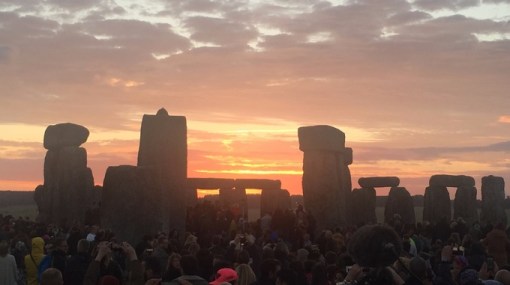
Around twelve thousand people have flocked to Stonehenge to witness the sun rising over the stones for the summer solstice.
There were clear skies at the Wiltshire monument this year as the sun rose just before 5am.

Sunrise over Stonehenge Credit: ITV West Country
English Heritage charged for parking at the event for the first time this year and also issued a ban on alcohol.
Stonehenge is a special place and this is a wonderful occasion for people to come together, as they probably have done for thousands of years, to celebrate the longest day of the year.
As guardians of Stonehenge, it is our job to look after the monument. We ask all attending the summer solstice to respect the stones and the people around you.
This year was the first that saw car parking charges and a total ban on alcohol.
Once upon a time (until 1977, actually) it was possible to turn up and wander around the world-famous prehistoric monument of Stonehenge, touching ancient stones and experiencing wonderment at being in such an atmospheric place, often alone. Not any more – all those hands were contributing to erosion and today’s multitudinous visitors may look but not touch.

Stonehenge began as a circular ditch and earth bank constructed around 3100 BC, with the standing stone circle erected some nine centuries later. Research suggests that Stonehenge marked an important burial site, but this prosaic explanation is not accepted by everyone. The purpose of Stonehenge has long been passionately debated with diverse theories mooted – these include religious ritual, astronomical observation and assorted complex and often outlandish supernatural notions. Was it really a landing site for space travellers? Probably not.
Whatever the truth, the place retains an aura of mystery. It was the site of the
Stonehenge Free Festival 1972 and 1984, when revellers gathered to celebrate alternative culture at the summer solstice. That laid-back era came to end in 1985 when the police did battle with ‘New Agers’ bent on reaching Stonehenge after the festival was banned.
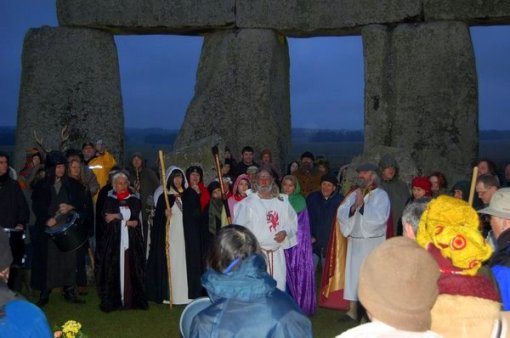
Guardians English Heritage relented in 1999, and those who wish to experience the summer solstice in the company of like-minded people are now permitted to do so. Many thousands who gather to do just that invariably experience powerful emotion at the moment when the sun rises over the mystical circle on solstice morning, and find themselves amidst all sorts of alternative believers like neo-pagans and druids in fantastic garb who are conducting esoteric ceremonies. It’s a magical moment, but reality soon intrudes – the site must be cleared by 08.00 so Stonehenge can revert to lucrative ‘tourist business as usual’. (content extracted from 501 Must-be-there Events (501 Series) by David Brown and Arthur Findlay)
English Heritage are pleased to welcome people to Stonehenge to celebrate this year’s Summer Solstice. This is the 17th year that English Heritage has provided access to the stones and are looking forward to a peaceful and sober celebration.
MONDAY 20th JUNE
Access to monument field – 7pm
Sunset – 9:26pm
TUESDAY 21st JUNE
Sunrise – 4:52am
Monument field closes – 8am
“We strongly advise anyone planning to come to Stonehenge for solstice to leave their cars at home and travel by public transport. Salisbury is easily accessible by train and the local Salisbury Reds bus company will be running a special service from Salisbury to Stonehenge through Saturday night and into the next day. Solstice Events are offering their usual transport from Bath and Stonehenge Guided Tours are offering their popular annual tour / transfer from London.
Follow @St0nehenge @EH_Stonehenge @HighwaysEngland @Wiltshirepolice and @VistWiltshire for #summersolstice updates on the night.
If you are unable to visit Stonehenge on the Solstice you can watch our LIVE PERISCOPE BROADCAST
The Stonehege News Blog
Respect the Stones and each other!
Follow the Solstice News on Twitter: @St0nehenge and Facebook
Here’s everything you need to know about the longest day of the year and traditions surrounding the summer solstice
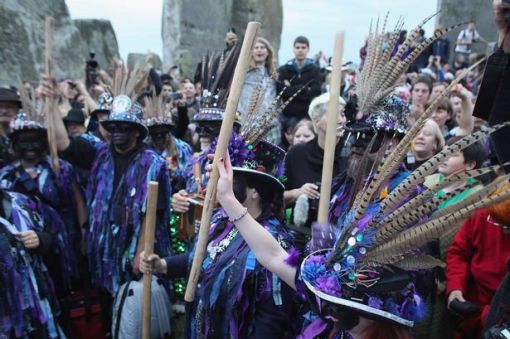
Party time: Druids, pagans and revellers take part in a winter solstice ceremony at Stonehenge
Every year, around this time, we start talking about the summer solstice.
Mostly it’s because it’s the longest day of the year, and there’s a very British pessimism that says the days will immediately start to shorten into winter from now on.
But there’s also the shenanigans at Stonehenge, general celebrations and a pause to celebrate the summer.
But what does it all mean?
It’s generally understood to mark the middle of summer – even though some of us may feel like we haven’t really had the first half yet in the UK.
Technically, it’s when the tilt of Earth’s axis is most inclined towards the sun, and that’s why we get the most daylight of the year.
In the winter solstice, we’re tilted furthest away from the sun, hence shorter hours of daylight and the shortest day.
The word solstice is derived from the Latin words sol (sun) and sistere (to stand still).
Read more: New Stonehenge alignment theory proved right as monument’s tallest stone points at solstice sunset
In the northern hemisphere, the summer solstice takes place between June 20 and 22. This year it’s on Monday, June 20.
As it happens twice annually, the winter solstice in the UK is between December 20 and 22.
In London on the summer solstice, the sun will rise at 04:43 and set at 21:21.
Near Stonehenge in Salisbury, sunrise will be at 04:52 and sunset will occur at 21:26.
The midsummer solstice is being celebrated at Stonehenge on Saturday into Sunday and at the Avebury stone circle from Friday until Monday.
Thousands flock to the English Heritage site for the solstice in a tradition which has its roots in pagan times, when Midsummer Day was considered to have power.
Of those who attend, many are druids, but some are tourists.
This year it’s falling on a weekend for the first time in more than a decade and is expected to draw much larger crowds.
The way that the stones are positioned is said to be aligned with sunrises on the two annual solstices.
Read more: Stonehenge attracts thousands as Pagans mark longest day of the year with celebration
Although not much is known about its formation, those facts are thought to be involved with whatever religious, mystical or spiritual elements were central to its construction.
The monument field at Stonehenge is open from 19:00 on Monday 20 June to 08:00 on Tuesday 21 June. Admission is free, but parking fees apply.
The Solstice Car Park opens at 7pm on 20th June with last admissions at 6am (or when full, if earlier) on 21st June. The car park will close at 12 noon on 21st June.
Visitors, including sunrise-worshipping Druids for whom it is a religious occasion, are encouraged to use public transport or arrange to car share.
It’s not just for the arch-druids in Wiltshire – there are celebrations worldwide among lots of different cultures.
The holidays, festivals and rituals do tend to have themes of religion or fertility.
Read more: ‘Fridgehenge’ pranksters mark summer solstice with homage to Stonehenge – made out of white goods
In Latvia there’s Jāņi, when women wear wreaths on their heads. Estonia has Jaanipäev or St John’s Day, which marks a change in the farming year.
Wianki happens in Poland, with roots in a pagan religious event, and Kupala Night happens in Russia and Ukraine, where people jump over the flames of bonfires in a ritual test of bravery and faith.
They will of course get shorter between now and the winter solstice on December 21, but don’t worry, we’re not talking early dark nights quite yet.
Read more: Stonehenge and Statue of Liberty ‘in direct and immediate danger’ from climate change
Article Source: By Kirstie McCrum , Sophie Curtis (Daily Mirror)
Stonehenge Summmer Solscice Open Access
“We strongly advise anyone planning to come to Stonehenge for solstice to leave their cars at home and travel by public transport. Salisbury is easily accessible by train and the local Salisbury Reds bus company will be running a special service from Salisbury to Stonehenge through Saturday night and into the next day. Solstice Events are offering their usual transport from Bath and Stonehenge guided tours are offering their small group tour from London.
Follow @St0nehenge @EH_Stonehenge @HighwaysEngland and @Wiltshirepolice for#summersolstice updates on the night.
If you are unable to visit Stonehenge on the Solstice you can watch our LIVE PERISCOPE BROADCAST
The Stonehenge News Blog
An experiment by University College London has just shown that mounting huge stones on a sycamore sleigh and dragging it along timbers required far less effort than was expected. According to Prof Mike Parker-Pearson: “It was a bit of a shock to see how easy it was to pull the stone.”
It reminded us of experiments starting in 2005 organised by Gordon Pipes, a carpenter from Derbyshire and a member of Heritage Action. He formed a group of interested amateur antiquarians, including mainly our members, called ‘the Stonehengineers’ and staged a demonstration (appropriately, at the National Tramway Museum) of a method he believed may have been used. He called it “stone rowing” and his idea was that lifting the stones on levers and moving them along in a series of short steps would involve less friction and therefore require less effort than hauling them on rollers – so far fewer…
View original post 153 more words
Take part in Stonehenge experiment: How many people does it take to lift one block?

Heavy lifting: the smallest stones at the prehistoric site weigh about two tonnes REUTERS/Kieran Doherty
Anyone who has wondered what it took to lift a piece of Stonehenge into place has a chance to have a go themselves in a mass experiment.
Experts from University College London are seeking volunteers to help them lift a replica stone using prehistoric technology and brute strength.
Doctoral student Barney Harris, who is organising the event in Gordon Square near the UCL campus on Monday, said he believed it would take 40 to 50 people to lift a single stone, which at one tonne is half the weight of the smallest block at Stonehenge.
Mr Harris said: “We will be using a model of a sledge that might have been used, but other than that it will be people power. It’s on a much smaller scale than the real thing, but it will help us work out what it took to create it.”
The event, from 2pm to 4pm, is one of 80 being held during the university’s Festival of Culture next week.
Article Source: The Evening Standard
As part of the UCL Festival of Culture participants will have the chance to become part of an experimental team that will attempt to transport a large replica Stonehenge stone using Neolithic technology. click here for UCL
The Stonehenge News Blog
Stonehenge News on Twitter
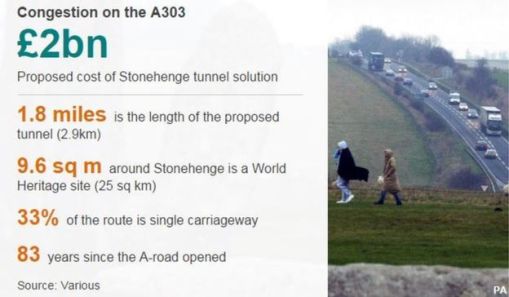
Plans to build a tunnel under Stonehenge have been welcomed in an influential report.

The A303 past Stonehenge is a highly congested route
The report by UNESCO and the International Council on Monuments and Sites recognised the benefits the 1.8m (2.9km) project.
In 2014 the government announced it would commit to building a tunnel, removing the A303 from the landscape.
Historic England, the National Trust and English Heritage also support the plans.
The report highlighted the scheme’s potential to become a “best practice case” for a World Heritage Site.
It said the scheme must “both protect the outstanding universal value” of the site and also “benefit road users”.

At the moment the congested A303 cuts through the middle of the area.
Helen Ghosh, director general of the National Trust, said the report “recognises the unmissable opportunity” the government’s road improvement scheme offers to address “the blight of the existing A303”.
Duncan Wilson, chief executive of Historic England, welcomed the report but said “sensitive design” would be needed.
Kate Mavor, chief executive of English Heritage, added: “Provided that it is designed and built in the right way, a tunnel would reunite the wider landscape around the ancient stones, helping people to better understand and enjoy them.”
FULL STORY: UNESCO report backs Stonehenge tunnel plans – BBC News
The Stonehenge News Blog
English Heritage is pleased to welcome people to Stonehenge to celebrate this year’s Summer Solstice. This is the 17th year that English Heritage has provided access to the stones and are looking forward to a peaceful celebration.

Conditions of Entry
Amplified music is not permitted in or around the monument field.
No alcohol is allowed within the monument or the monument field. Alcohol will be
confiscated or individuals in possession of alcohol will be asked to leave.
Drunken, disorderly and anti-social behaviour will not be tolerated and anybody
considered to be behaving in this way will be asked to leave by security staff and/or
the police and will not be allowed back in.
Illegal drugs are illegal at Stonehenge as they are anywhere else. The police will be
on site and will take action against anyone breaking the law.
Please don’t bring any glass in to the monument field. Many people walk barefoot
and livestock and wildlife also graze in the area. Any glass items will be confiscated.
Please do not climb or stand on any of the stones – this includes the stones that
have fallen. This is for your own safety and also to protect this special site and
respect those around you.
Please be aware that in order to keep everybody safe, random searching may be
undertaken. Any items found that might be used in an illegal or offensive manner will
be confiscated.
Camping equipment, fires, Chinese lanterns, fireworks, candles, tea-lights or BBQs
are not permitted at Stonehenge, in the Solstice Car Park, or anywhere in the
surrounding National Trust land.
In the interests of safety, sleeping bags or duvets are not allowed on site. Sleeping
on the ground creates a trip hazard and can interfere with the work of emergency
services and hinder their ability to help people. Small ground sheets and blankets are
permitted for people to sit on but please do not bring chairs etc (unless used as a
recognised disability aid). Shooting-sticks are not permitted.
To help us reduce the amount of litter on site, leafleting or flyering is not allowed.
Drones or any type of remote-controlled flying devices are not permitted at
Stonehenge or in any of the Solstice Car Parks.
Admission to Stonehenge
• Admission to the Summer Solstice at Stonehenge is free of charge.
• There is a charge for parking – cars: £15, commercial coaches and minibuses: £50,
motorcycles: £5.
• Public transport is available from Salisbury.
• Access to the car park will start at 7pm
• Children under 16 must be accompanied by a responsible adult.
Please remember that you will not be allowed access to the Monument with the following
items:
– Alcohol
– Drugs
– Large bags or rucksacks (or similar items)
– Sleeping bags or duvets
– Flaming torches, Chinese lanterns, fireworks or candles etc.
– Dogs (with the exception of registered assistance dogs), pets or other creatures
– Camping equipment, including foldaway chairs, garden furniture, shooting-sticks
– BBQs or gas cylinders
– Glass bottles or other glass objects
– Trolleys, wheel barrows or any other form of porterage
– Pushchairs or buggies that are not exclusively used for a child
– Large “golf-style” umbrellas, gazebos
– Drones or any kind of remote control aircraft
From :http://www.english-heritage.org.uk/visit/places/stonehenge/plan-your-visit/summer-solstice/
“We strongly advise anyone planning to come to Stonehenge for solstice to leave their cars at home and travel by public transport. Salisbury is easily accessible by train and the local Salisbury Reds bus company will be running a special service from Salisbury to Stonehenge through Saturday night and into the next day. Solstice Events are offering their usual transport from Bath and Stonehenge guided tours are offering their small group tour from London.
Follow @St0nehenge @EH_Stonehenge @HighwaysEngland and @Wiltshirepolice for #summersolstice updates on the night.
If you are unable to visit Stonehenge on the Solstice you can watch our LIVE PERISCOPE BROADCAST