Stargazing in June: From the Stonehenge summer solstice to a cosmic embrace

1 06 2015
Two of our solar system’s most sensational planets will get together for a tryst

Two of our solar system’s most sensational planets will get together for a tryst

Let’s start by winnowing out the mythical chaff from the factual wheat. The Druids didn’t build Stonehenge; they came on the scene about 2,000 years later, and – according to the Roman writer Pliny – they didn’t worship in stone temples but in ‘‘forests of oak’’.

It was only in the 7th century that the antiquarian John Aubrey associated the Druids with Stonehenge. In 1740, a fellow neo-Druid called William Stukeley measured Stonehenge, and realised that its central line pointed ‘‘full northeast, being the point where the sun rises at the summer solstice’’. At that point, the link between Stonehenge, the Druids and the midsummer sunrise was set in tablets of stone.

But hang on. Instead of standing in the centre of the great stone circle and looking outwards, you could equally well place yourself at the Heel Stone and look through the centre of Stonehenge, towards the south-east. That’s the direction where the Sun sets, at midwinter.

In fact, Stukeley’s original account describes this bearing, with ‘‘the principal diameter or groundline of Stonehenge, leading from the entrance up to the middle of the temple to the high altar’’. So why did he choose the opposite direction as being critical to the Druids?

Stukeley was a Freemason. For Masons, the western part of the sky is the direction of death. The north-east is spiritually all-important because it is the point where the Sun rises on the feast of St John (the traditional Christian date for midsummer, on 24 June).

That’s why Stukeley picked out midsummer as the key season for Stonehenge. There’s no reason, though, to believe that our distant ancestors felt the same way. In fact, there are two great monuments in the British Isles which are unambiguous markers for the solstice, because they contain deep passageways that are lit up by Sun only once a year. In the case of Newgrange in Ireland and Maeshowe in Orkney, that date is the winter solstice..

Now archaeologists have provided the clinching evidence that Stonehenge, too, was erected to mark midwinter’s day. Mike Parker Pearson has excavated Durrington Walls, a huge settlement near Stonehenge. Here he’s found the remains of orgiastic feasts: bones of cows and pigs that had been brought vast distances – some from Cornwall, and others from the far north. Clearly, people came from all over the country to hold ceremonies at Stonehenge.

And the bones reveal the season that they travelled. The growth of the pigs’ teeth, and the amount they had worn, showed that they had been slaughtered for the table at the age of nine months. Given that piglets are naturally born in the spring, Parker Pearson is adamant that people were ‘‘feasting on pork at midwinter  most likely around the midwinter solstice’’.

So, if you want to truly celebrate as our ancestors did, don’t go to Wiltshire this month. Instead, go to Stonehenge on 22 December, to view the sun setting behind the giant portals of stone.

What’s Up

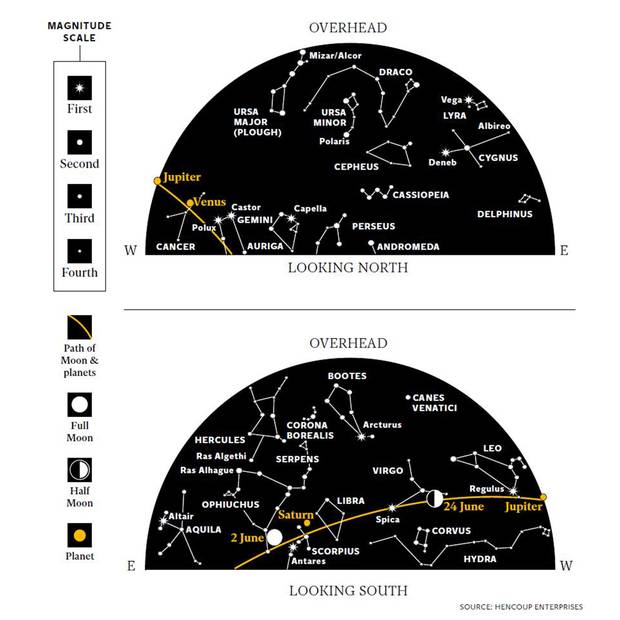
This month, two of our solar system’s most sensational planets are about to get together for a tryst. For the whole of spring, luminous giant Jupiter has been lighting up our evening skies. But dazzling Venus – Earth’s twin in size – has been sneaking up in the opposite part of the sky. Our neighbour world, cloaked in a dense atmosphere of carbon dioxide, reflects sunlight amazingly: it is the brightest object in the sky after the Sun and Moon.

On 30 June, the two brilliant worlds tangle in a cosmic embrace. Separated by a space less than the diameter of the moon, Jupiter and  Venus will make a stunning sight low in the western sky. Otherwise, the summer constellations are making their appearance. Orange Arcturus, in Boötes, lords it over the night skies. Next to it, the small-but-perfectly-formed Corona Borealis – the Northern Crown – is a beautiful reminder that warmer days are on the way.

What to look out for

1 June: 5.19 pm: full moon

6 June: Venus at greatest eastern elongation

9 June 4.42 pm: moon at last quarter

16 June 3.05 pm: new moon

24 June 12.03 pm: moon at first quarter; Mercury at greatest western elongation

30 June: Venus and Jupiter close conjunction

Read the full story in the Independent. Heather Couper , Nigel Henbest

The Stonehenge News Blog


NEW THEORY: Stonehenge’s tallest stone ‘points at winter sunrise’

22 04 2015

The tallest stone at Stonehenge points towards the sunrise on the midwinter solstice, according to a new theory from an English Heritage steward.

Aerial photograph of Stonehenge
The newly observed alignment (red line) is at 80 degrees to the line of the axis of the monument (blue line)

Historians have long known the circle of stones is aligned with the midsummer sunrise but Tim Daw says the tallest one is lined up with the midwinter sun.

It was previously thought the stone had been put back at the wrong angle when it was re-erected in 1901.

But Mr Daw, who works there, says his research shows its angle is deliberate.

‘Botched job’

Mr Daw said: “The largest stone at Stonehenge is not where it ‘should’ be, it is twisted.

“This stone, Stone 56, is the tallest one at the end of the inner horseshoe of sarsen stones.

“Because it was put back to the vertical in 1901 it has been assumed that the twist is the result of the modern excavators botching the job.

Drawing of Stonehenge prior to 1901
The tallest stone in the monument was straightened in 1901

“My research shows that not only was the standing stone out of symmetry with the central solstice alignment originally, but that its now fallen partner had also been, and so were surrounding stones, including the Altar Stone.”

Mr Daw, who last year came up with evidence that the outer stone circle at Stonehenge was once complete, said his newly discovered alignment was at 80 degrees to the line of the axis of the monument, which points to midsummer solstice sunrise and midwinter sunset.

‘100 tonnes of stone’

“The stones point to the midwinter solstice sunrise and midsummer sunset,” he said.

“This alignment had been missed by previous investigators… as they used an idealised plan rather than an actual plan for their calculations.”

“This isn’t some nebulous sighting line on a distant star; this is 100 tonnes of stone deliberately pointing to the major event at the other end of the day the rest of the monument celebrates.

“One stone out of line might be a coincidence but that it is five of the major stones, at least, shows it was a designed feature.

“It shows what can be discovered by simple observation even in such a well-researched site as Stonehenge.”

Stonehenge
Tim Daw said the tallest stone (centre) was positioned to align with the midwinter sunrise

Director of the Wiltshire Archaeological and Natural History Society (WANHS), David Dawson, said: “This is an interesting new idea which highlights the “skew” of the Stonehenge trilithons, which has been known for some time.

“It highlights the significance of the summer and winter solstices at Stonehenge, and the 80 degree angle between them.

“We know that the Bush Barrow lozenge, on display at the Wiltshire Museum, hints at this same significant astronomical feature.

“There will now be a debate between archaeologists and a re-examination of the evidence to test this new hypothesis.”

Jessica Trethowan from English Heritage said it was “an interesting idea”.

Mr Daw’s theory has been published in the latest WANHS magazine.

Midwinter sunrise at Stonehenge
People traditionally gather at Stonehenge for the winter and summer solstices

Read the full story on the BBC News website

The Stonehenge News Blog


Midwinter walk: Explore the ancient Stonehenge Landscape on the Winter Solstice with National Trust

5 12 2014

On the midwinter solstice, explore the ancient monuments of the Stonehenge landscape. This walk is around four and a half miles.

21st December 2014: Ancient ceremonial landscape of great archaeological and wildlife interest:Stonehenge Landscape

Within the Stonehenge World Heritage Site, the National Trust manages 827 hectares (2,100 acres) of downland surrounding the famous stone circle.

Walking across the grassland, visitors can discover other prehistoric monuments, including the Avenue and King Barrow Ridge with its Bronze Age burial mounds.

Nearby, Winterbourne Stoke Barrows is another fascinating example of a prehistoric cemetery. While Durrington Walls hides the remains of a Neolithic village.

Today thanks to their extensive programme turning ploughed fields into pasture, you can explore the landscape and follow in the footsteps of the people who built and used Stonehenge.

Booking essential: http://www.nationaltrust.org.uk/stonehenge-landscape/things-to-see-and-do/events/

National Trust Stonehenge Landscape Tours:  http://www.nationaltrust.org.uk/stonehenge-landscape/

Merlin at Stonehenge
The Stonehenge News Blog


Countdown to a New Dawn. New Stonehenge Visitor Centre opening on 18th December 2013

6 12 2013


The new Stonehenge visitor centre will open on the 18th December, in time for the winter solstice. Over the festive period you can visit Stonehenge without booking and from 1st February 2014, entrance to Stonehenge will be managed through timed tickets and advance booking is strongly recommended.

For the first time ever at the site, they will be able to learn more about this complex monument in a stunning, museum-quality permanent exhibition curated by English Heritage experts.

“The exhibition will change the way people experience and think about Stonehenge forever”

The £27m project also includes grassing over the A334 alongside the ancient monument and closing another section of the busy road.

Exploring the past: The impressive new visitor centre will open on 18 December

Exploring the past: The impressive new visitor centre will open on 18 December

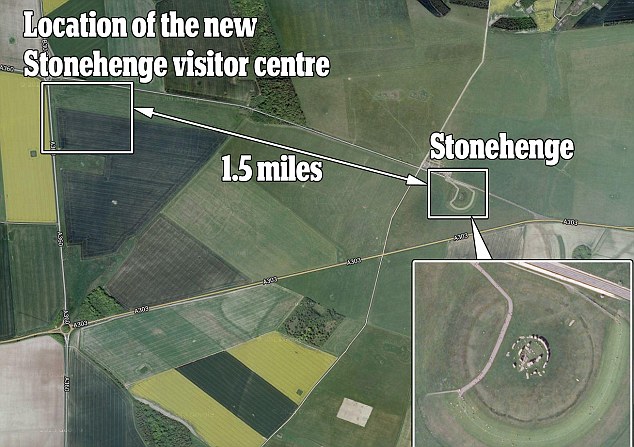
The visitor centre and museum will be located about a mile-and-a-half from the stones.  Visitors will be shuttled to Stonehenge by a little train, pulled by a Land Rover.

The first part of the long-awaited environmental improvements to Stonehenge will be the unveiling of a new visitor experience. This includes the new visitor centre and exhibition facilities to enhance your visit to the Stones.

A 360-degree virtual, immersive experience will let visitors ‘stand in the stones’ before they enter a gallery presenting the facts and theories surrounding the monument through various displays and nearly 300 prehistoric artefacts.

The archaeological finds on display are on loan from the Salisbury and South Wiltshire Museum, the Wiltshire Museum in Devizes, and the Duckworth Collection, University of Cambridge. All were found inside the World Heritage Site and many are on public display for the first time.

Set in Stone? How our ancestors saw Stonehenge, will be the first special temporary exhibition. It will chart more than 800 years of ideas and debate – from 12th-century legends to radiocarbon dating reports in the 1950s – on who built Stonehenge and when, and features objects on loan from many national museums.

Down the road: An aerial view of the site shows how developers have managed to place the site nearby, without spoiling the immediate surroundings of Stonhenge

Down the road: An aerial view of the site shows how developers have managed to place the site nearby, without spoiling the immediate surroundings of Stonehenge

In Easter 2014, visitors can look forward to the opening of a group of reconstructed Neolithic houses. The Neolithic houses are the highlight of the outdoor gallery and will be built from January 2014 onwards by volunteers based on houses where the builders of Stonehenge may have lived, complete with furniture and fittings.

Advance booking will be available shortly to give you guaranteed entry on the day and at the time of your choice.

Please note: road access to Stonehenge has changed and permits are being issued to vehicles driving on the A344 to Stonehenge until the new visitor centre opens at Airman’s Corner.  Please go to the Directions page for more details.

Stonehenge Links:
http://www.english-heritage.org.uk/daysout/properties/stonehenge/
http://www.visitwiltshire.co.uk/explore/stonehenge-and-avebury/stonehenge-visitor-centre
Stonehenge on Twitter: https://twitter.com/ST0NEHENGE

The Stonehenge News Blog