All aboard the ‘Stonehenge Express’

7 12 2010

Two crucial aspects of the Stonehenge proposals have yet to be clarified…

 1. The transit system.

Will it be like one of the two examples shown here ? Not one like the Eden Project, please! That one is called “Percy”. Very tasteful! So more like the Dover Castle one? It may be, if this video is a true representation. But the video one pulls four carriages, not two. Is the vehicle up to it? And what about the livery? Can we be solemnly promised it will never ever carry advertising? And what’s wrong with buses? And what about talk in The Times letters column of Lord Lansdowne saying Stonehenge would be turned into a toytown with visitors approaching in dinky electric vehicles? Isn’t anything that prompts thoughts of Noddyland (which it’s hard not to think of when watching the video) to be absolutely avoided at our national icon? 

http://www.english-heritage.org.uk/daysout/properties/stonehenge/our-plans/our-proposals/

 2. The fences 

Will the fences be removed? Surely it has been decided upon? After all, if the detailed design of the new Visitor Centre and the colour of the transit system coaches have been decided then surely it is inconceivable that the matter of access to the stones (in other words the fences) hasn’t been been decided as well? English Heritage as good as says it has : “The need to care for Stonehenge properly has been recognised for many years. Improvement to its landscape setting and presentation to visitors are identified as priorities in the WHS Management Plan ……… The proposals to address this need have been agreed by a group of key stakeholders led by English Heritage

So what HAS been decided about the fences? The reason the question needs to be asked is because the video appears to show that there will be no fences – and although that would be very nice we have concerns that behind the scenes a different view might have been taken. The practicalities suggest that having no fences at all would prove impossible. Security is one problem. And erosion is another. But the video seems to suggests that nearly a million people a year will be free to walk amongst the stones, not held back by fences, ropes or rules. It seems unlikely.

A lot of people hold the “no fences and free access to the stones” concept very dear. If it is not going to happen then it would be better if people were told, not given a contrary impression by a video. Indeed, the public has the right to know does it not? Open access to the stones may or may not be impractical but open access to information about this matter certainly isn’t!

Exteran Links: http://heritageaction.wordpress.com/

Merlin @ Stonehenge
The Stonehenge Stone Circle Website


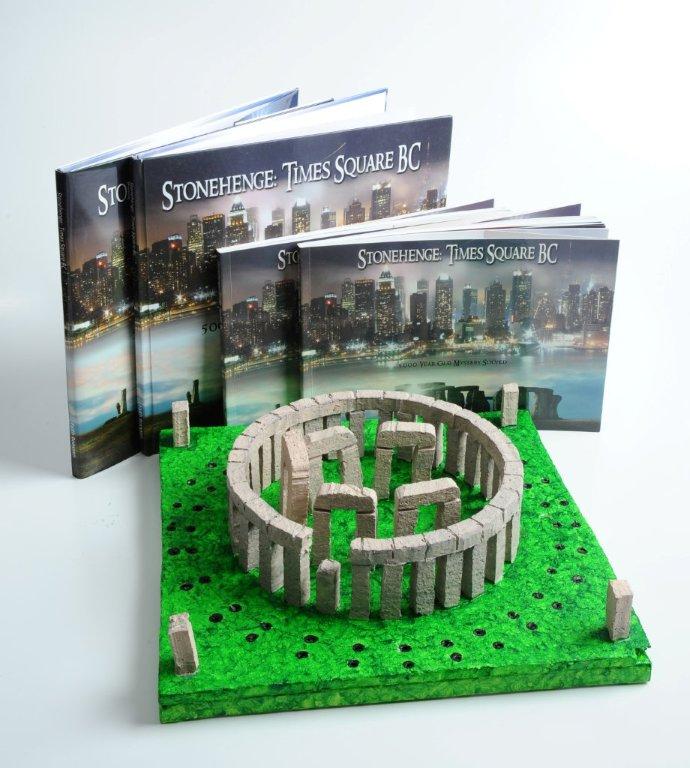
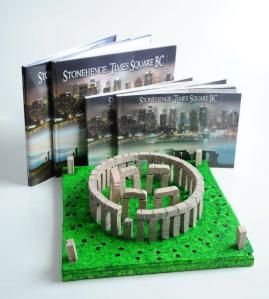
New Stonehenge book launched – Stonehenge Times Square BC

26 11 2010

New Stonehenge book

New Stonehenge book

Discover the Ultimate Function and Purpose of Stonehenge
Where would you be without your diary to check your appointments for the week, or your calendar to work out dates?

We are all ruled by hours, days, weeks and months – from getting up in the morning, to working out schedules, to planning holidays and important functions. In addition to this, most of us have heard of the mysterious, starkly beautiful monument, Stonehenge, and have wondered as to its construction. Be this as it may, how often have we given any thought as to how (and why) this Heritage Site was originated? Are we at all aware of the key role it has played in the concept of ‘time’ and in our New Year celebrations?

Once you have an understanding of the four ancient calendars, revealed and explained in this fascinating window to the past, you will realise that Stonehenge was a site of enormous importance and significance to the ancients. The monument was in fact a device or tool, for revealing the exact date of the year.

More importantly, we are given a glimpse of how the ancients discovered and designed their calendars with little more than sticks and stones to work with. Discover too, the accuracy of their calendars, which were accurate to within a day. Their solar calendar consisted of 365 days had 52 weeks, with 3 seasons of 91 days and 1 season of 92 days. Discover how 12, 30 day months were introduced around 3600 years ago with 5 tagged on days at the end of the year. This last calendar is known to have been used by both the Babylonians and Egyptians.

About the BookThe key points in any solar calendar are alignments with both midsummer and midwinter. Very early on, an important discovery made at Stonehenge was that certain of the megaliths would have aligned perfectly with the midsummer and midwinter solstices approximately 5000 years ago, when the monument was built.

Stonehenge, as it is seen today, is impressive and has fostered many theories as to its original function and purpose. However, this megalithic monument, impressive as it is, is not the full story. Archaeologists have discovered that before the Megaliths (Sarsen stones) were erected, there were earlier structures dating back to as far as 5000 years ago. The area at Stonehenge was in use long before the Sarsen megaliths were erected.

The author of Stonehenge: Times Square BC, Faith Booysen, realized that although some theories held for certain of the structures, taken as a whole, most theories did not explain the older structures.

Working on the assumption that these structures were calendars, her calculations proved that this was, indeed, so.

Her book, Stonehenge: Times Square BC sets out in detail the remarkable calculations and details of four calendars at Stonehenge. The brilliance of the ancient designers and builders are reflected in these calendars. With little more than primitive tools, they designed and built calendars that lasted for hundreds, if not thousands of years. The calendars formed the basis of the calendar we use to this day. Discover how the calendars evolved over a period of 1650 years from a circle of 56 wooden posts to the massive monument we see today.

Extract from the BookWe might never truly know whether the designers were local or foreign to Britain. What we do know is that designing and building calendars with primitive tools, required genius. Civilisation, it can be said, is built upon such genius, dedication and persistence.

These stone structures were built to last and because of this, crucial knowledge was passed down to future generations. Everything from a simple coffee in the morning to space exploration, testifies to this. Sadly, with the advent of written language, these structures fell into disuse and disrepair. Even so, after 5000 years and with little more than holes in the ground, scattered stones and a few remaining megaliths, we are able to reconstruct and understand their calendars.” Extract from Stonehenge: Times Square BC

About the AuthorThe author, Faith Booysen, has always had an overwhelming interest in the stone structures of the ancient world. Stonehenge in particular, held a strong fascination and in 2006, while watching a TV program on “Foamhenge” (a precise model of Stonehenge in polystyrene), she realized that the monument was only part of an equation and that the ancients would have used either loose stones or logs to mark their calendars daily.

It soon became obvious that the ruin of the Stonehenge monument seen today was preceded by other calendars. Stonehenge: Times Square BC is the result. Once the author had resolved the oldest calendar (the Aubrey Posts), she studied the remaining structures at Stonehenge and Woodhenge and these were revealed to be precise solar calendars. Mount Pleasant, a Neolithic henge in Dorset that supported wooden posts, proved to be a precise solar calendar as well.

Merlins CommentIt is obvious that the author knows and loves her subject and she has done some meticulous research to compile this fascinating account of the origins of our modern-day calendars and traditions behind our New Year celebrations.

Even those who are not ruled by the clock, or who are science buffs, will find that this absorbing account of the early designers who built one of the most fascinating monuments known to man and who made time and motion as we know it today all possible, makes you forget all about the time.

Link to TimeHenge book – http://www.timehenge.com/Link to Stonehenge Book Shop

Merlin @ Stonehenge
The Stonehenge Stone Circle Website


English Heritage Gift of Membership makes the ideal Christmas present

24 11 2010

Gift of Membership
For the person who has everything.  Why not buy them an English Heritage membership
English Heritage Membership
English Heritage Gift of Membership makes the ideal Christmas present – free entry to over 400 English Heritage properties for a whole year! The gift of membership comes as a beautifully branded card, plus we offer felixible delivery options. 

Your Gift of Membership also includes:

  • exclusive members’ magazine Heritage Today
  • free English Heritage Handbook worth £8.95
  • free entry for up to six accompanying children (under 19 – within the family group)
  • free or reduced price entry to 100s of special events
  • free or reduced price entry to over 100 associated attractions

Please bear in mind that the last order dates for Christmas delivery are: delivery to UK: Friday 17th December, delivery to Western Europe: Thursday 9th December, delivery to Rest of World: Thursday 2nd December.

External Link: http://www.stonehenge-stone-circle.co.uk/overseas-visitor-pass.htm

Thats my Mum and Dad sorted!

Merlin @ Stonehenge
The Stonehenge Stone Circle Website


£10m investment from the Heritage Lottery Fund for Stonehenge

19 11 2010

Today, the Heritage Lottery Fund (HLF) has announced confirmed funding¹ of £10m for Stonehenge in Wiltshire. 

Heritage Lottery Fund (HLF)

Heritage Lottery Fund (HLF)


Dame Jenny Abramsky, Chair of the Heritage Lottery Fund, said:

“Stonehenge is one of the archaeological wonders of the world. It demonstrates the vital role heritage plays within the UK’s tourism industry as well as being a great example of our fascinating history. This Heritage Lottery Fund investment will help transform this site and give people a much greater understanding of why it is so significant.”

Stonehenge, described as ‘the most architecturally sophisticated pre-historic stone circle in the world’², was constructed and in use between 3,000BC to 1,600BC. It is thought to have been used for a variety of religious ceremonies and the surrounding landscape – a World Heritage Site -contains over 700 known archaeological features. Stonehenge attracts 900,000 visitors every year from across the globe.

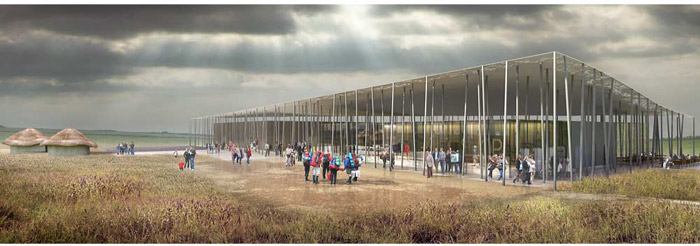
Stonehenge visitor centre

New Stonehenge visitor centre design

Neil Oliver, archaeologist, historian and broadcaster, said:

“Stonehenge is one of the most famous and important archaeological sites in the world – right up there with the Pyramids of Egypt and the Colosseum in Rome.  Just the sound of the word makes us wonder about our ancient past and our ancestors.” 

“It’s therefore fantastic news that thanks to this grant from the Heritage Lottery Fund, visitors will have an even better experience than before.  Perhaps more importantly, the money will help ensure the magic of that special place will be retained, and looked after into the future.  Stonehenge has always been a mind- blowing experience.  With this kind of support, it hopefully always will be.”

Dr Simon Thurley, Chief Executive of English Heritage, said,

”We are tremendously grateful for this generous grant. Not only does it help to narrow the funding gap for the project considerably, it also sends out a message of confidence about the transformational benefits that the project will bring – to tourism,  local economy, and the conservation and public enjoyment of Stonehenge and its landscape. “

HLF’s grant will support work to remove the existing visitor facilities allowing the experience of the stones to be more naturally integrated with its ancient processional approach and the surrounding landscape. These much-needed wider improvements will give people the chance to explore what the site would have been like thousands of years ago. The project aims to improve the visitor experience, including the creation of a new carefully designed visitor centre which will include education and exhibition spaces to help people learn more about Stonehenge’s history. The project will also support training opportunities and a new volunteering programme.

-Ends-

Notes to Editors

  • ¹ A confirmed award means that money had already been earmarked by HLF for the project in question and that the full amount has now been secured. 
  • ²The World Heritage Committee described Stonehenge as ‘the most architecturally sophisticated pre-historic stone circle in the world.’
  • Using money raised through the National Lottery, the Heritage Lottery Fund (HLF) sustains and transforms a wide range of heritage for present and future generations to take part in, learn from and enjoy. From museums, parks and historic places to archaeology, natural environment and cultural traditions, we invest in every part of our diverse heritage.  HLF has supported 33,900 projects, allocating £4.4billion across the UK. 

    Website:
    www.hlf.org.uk 
    www.English-Heritage.org.uk

    Progress, at last……………………… £10 million should do the job nicely!

    Merlin @ Stonehenge
    The Stonehenge Stone Circle Website


‘The Computer at Stonehenge’ Poem of the week

9 11 2010

THE COMPUTER AT STONEHENGE

Strange things are done to be number one
In selling the computer
IBM has their stratagem
Which steadily grows acuter,
And Honeywell competes like Hell,
But the story’s missing link
Is the system old at Stonehenge sold
By the firm of Druids, Inc.

The Druids were entrepreneurs,
And they built a granite box
It tracked the moon, warned of monsoons,
And forecast the equinox
Their price was right, their future bright,
The prototype was sold;
From Stonehenge site their bits and byte
Would ship for Celtic gold.

The movers came to crate the frame;
It weighed a million ton!
The traffic folk thought it a joke
(the wagon wheels just spun);
“They’ll nay sell that,” the foreman spat,
“Just leave the wild weeds grow;
It’s Druid-kind, over-designed,
And belly up they’ll go.”

The man spoke true, and thus to you
A warning from the ages;
Your stock will slip if you can’t ship
What’s in your brochure’s pages.
See if it sells without the bells
And strings that ring and quiver;
Druid repute went down the chute
Because they couldn’t deliver.

On a more serious note. Stonehenge: Eclipse Computer?
Every year on the first day of summer, the Sun rises at a point that is farther north than on any other day of the year. At the ruins of Stonehenge in England, this solstice sunrise appears on the horizon in direct alignment with the massive heel stone. This is the most outstanding feature of this ancient monument, built during the same era as the Great Pyramid of Egypt. There is little doubt that the builders of Stonehenge used it to mark this special day as the beginning of each year. By counting the number of days between these annual alignments, they could determine the length of the year. This could serve as a practical calendar to mark holidays and seasonal festivals and to ensure the timely planting and harvesting of crops.

But to predict eclipses, knowledge of two other cycles is required. One of these — the length of the lunar month — is easily determined. It is simply the number of days between one full Moon and the next. This cycle of 29-1/2 days is marked at Stonehenge by two rings of 29 and 30 holes, which together average 29-1/2. The other cycle, however, is of an altogether different character: it is a cycle of rotation of two invisible points in space. The evidence shows that the builders of Stonehenge probably discovered this cycle and could have used it to predict eclipses.

These two invisible points in space are called the lunar nodes (from the Latin for “knot”). They are the points where the Moon’s orbit, which is tilted at a slight angle, intersects the plane of the Earth’s orbit. It would have taken many decades of watching countless risings and settings of the Moon to figure out the cycle of the lunar nodes. This information — which must have been passed on from generation to generation — is preserved at Stonehenge. All the Moon alignments necessary for determining this cycle are marked by massive stones.

Who were these people who observed this subtle cycle even before the first metal tools were used by humankind? Some have suggested that Stonehenge was built by Druids, but we don’t really know much about the builders. We do know that the actual motions of the Sun and the Moon are reflected in the structure of Stonehenge, and we can reason how it may have been used to keep track of these cycles. The number of stones or holes in the ground in the various rings around Stonehenge each represents a certain number of days or years in the cycles. By moving markers (such as stones) around a ring in time with the cycles, the positions of the Sun and Moon — and the two invisible points — can be tracked. (The details of this method are explained in Chapter 2 of the book ECLIPSE, by Bryan Brewer.)

An eclipse can occur only when the Sun is close to being aligned with a node. By using Stonehenge to keep track of the position of the Sun and the nodes, these “danger periods” for eclipses can be predicted. A new (or full) Moon appearing during one of these periods would call for a special vigil to see if the solar (or lunar) eclipse would be visible from Stonehenge. A total solar eclipse would be a rarity. But the law of averages confirms that either a partial solar eclipse or a lunar eclipse can be seen (weather permitting) from the same point on the Earth about once every year.

Why would eclipses have been so important to the ancient people of Stonehenge? Perhaps they considered the darkening of the Sun or the Moon a fearsome event — a celestial omen of doom or disaster. Many cultures have interpreted eclipses this way. But the sophistication of the astronomy of Stonehenge suggests that the builders had something different in mind. Their understanding of the solar and lunar cycles must have led to a high regard for the cosmic order. Eclipses may have been seen as affirmations of the regularity of these cycles. Or perhaps the unseen lunar nodes formed an element of their religion as invisible gods capable of eclipsing the brightest objects in the heavens.

The idea that Stonehenge may have been a center for some kind of worship has occurred to many. It is not hard to imagine Stone Age people gathering at a “sacred place” at “sacred times” (such as solstices, equinoxes, and eclipses) to reaffirm their religious beliefs through ritual practices. British antiquarian Dr. William Stukeley, who in 1740 was the first to note the summer solstice alignment at Stonehenge, advanced the notion that the monument was built by Druids to worship the serpent. He claimed that Stonehenge and similar stone circles had been serpent temples, which he called “Dracontia.” Could this serpent symbolism be related to eclipses? Recall that the key to eclipses is the position of the lunar nodes. The length of time for the Moon to return to a node (about 27.2 days) astronomers call the draconic month. (Draco is the Latin word for “serpent” or “dragon.) Perhaps the mythical serpents of Stonehenge and the legendary dragon that eats the Sun are symbols of the same thing: the invisible presence in time and space that eclipses the Sun and the Moon.

Merlin @ Stonehenge
The Stonehenge Stone Circle Website


Stonehenge builders had geometry skills to rival Pythagoras

8 11 2010

Stone Age Britons had a sophisticated knowledge of geometry to rival

The Stone Age Britons who built Stonehenge had a knowledge of advanced geometry, 2,000 years before Pythagoras

The Stone Age Britons who built Stonehenge had a knowledge of advanced geometry, 2,000 years before Pythagoras

Pythagoras – 2,000 years before the Greek “father of numbers” was born, according to a new study of Stonehenge. Five years of detailed research, carried out by the Oxford University landscape archaeologist Anthony Johnson, claims that Stonehenge was designed and built using advanced geometry.

The discovery has immense implications for understanding the monument – and the people who built it. It also suggests it is more rooted in the study of geometry than early astronomy – as is often speculated. Mr Johnson believes the geometrical knowledge eventually used to plan, pre-fabricate and erect Stonehenge was learnt empirically hundreds of years earlier through the construction of much simpler monuments. He also argues that this knowledge was regarded as a form of arcane wisdom or magic that conferred a privileged status on the elite who possessed it, as it also featured on gold artefacts found in prehistoric graves.

The most complex geometrical achievement at Stonehenge is an 87-metre diameter circle of chalk-cut pits which mark the points of a 56-sided polygon, created immediately within themonument’s perimeter earthwork. Mr Johnson used computer analysis and experimental archaeology to demonstrate that this outer polygon was laid out using square and circle geometry. He believes the surveyors started by using a rope to create a circle, then laid out the four corners of a square on its circumference, before laying out a second similar square, thus creating an inner octagon. The points of the octagon were then utilised as anchors for a surveyor’s rope which was used to “draw” arcs which intersected the circumference so as to progressively create the sides of a vast polygon. Indeed, his work has demonstrated that a 56-sided polygon is the most complex that can easily be created purely through square and circle geometry using a single piece of rope.

The Stonehenge Tour Company

The Stonehenge Tour Company

It is likely that this basic limitation determined the number of sides of Stonehenge’s outer polygon – and may also have led to the 56-sided polygon concept becoming important within wider European religious belief. Ancient Greek classical mythology associated just such a 56-sided polygon with Zeus’s great rival for divine supremacy, the weather god Typhon. Johnson’s research, published as a book this week, shows that Stonehenge derived its design from geometrical knowledge and features no less than six concentric polygons – a 56-sided outer one built around 2950BC; a regular octagon built around 2500BC) inside that; two concentric (though partly inaccurate) 30-sided polygons built around 1650BC, which were based on a series of hexagons; a 30-sided inner polygon (the sarsen stone ring which was built around 2500BC) also based on hexagonal geometry; and two probable 40-sided concentric polygons (probable former blue stone positions built around 2600BC) that were later modified to 30-sided ones.

They also created the famous central stone “horseshoe” utilising the survey markers used to create the thirty-sided sarsen polygon. The experimental archaeology demonstrates that most of the monument was pre-planned and that the great stones were pre-fabricated off-site and then installed by surveyor-engineers. “For years people have speculated that Stonehenge was built as a complex astronomical observatory. My research suggests that, apart from mid-summer and mid-winter solar alignments, this was not the case,” said Mr Johnson. “It strongly suggests that it was the knowledge of geometry and symmetry which was an important component of the Neolithic belief system.” “It shows the builders of Stonehenge had a sophisticated yet empirically derived knowledge of Pythagorean geometry 2000 years before Pythagoras,” he said.

A leading British prehistorian, Sir Barry Cunliffe, from Oxford University, believes that Anthony Johnson’s research is “a major step forward in solving the puzzle of Stonehenge”.  Details of Anthony Johnson’s research can be found in his book ‘Solving Stonehenge’ published by Thames and Hudson. Further information can be found at solvingstonehenge.co.uk/

Merlin @ Stonehenge
The Stonehenge Stone Circle Website


Stonehenge Private Access tours 2011 – Go beyond the fences!

4 11 2010

Hot off the press – Stonehenge Access Dates!
I have just been sent 2011 dates for Stonehenge ‘private access’ tours (see below)  If you are planning on visiting Stonehenge in the next 12 months then I highly recommend joing one of these trips.

Stonehenge Inner Circle Tours - Go beyond the fences

Stonehenge Inner Circle Tours – Go beyond the fences

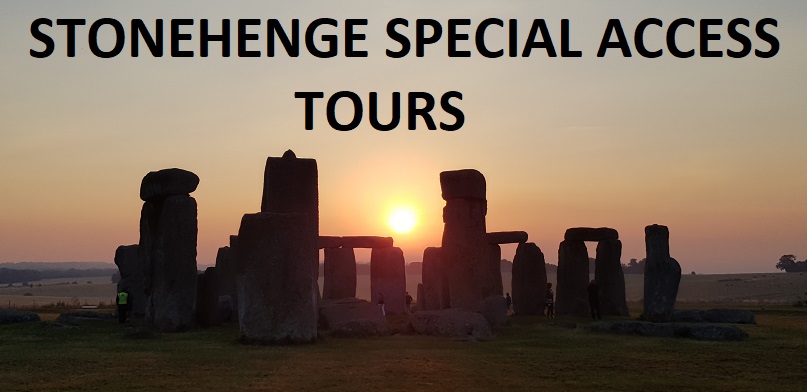
For those of you who have not visited this sacred site, I should mention that the complex is roped off. Visitors observe the stones from a distance and are not permitted within the temple complex……….Stonehenge special access tours allow you to be amongst the stones and to experience the magic.

There are a few sightseeing tour operators who offer this service and I have just been advised of the 2011 dates.  There are limited spaces and I highly recommend booking sooner rather than later – this is a very popular tour.  A fantastic photograph opportunity!

  • Stonehenge Special Access dates 2011
    January 2011 – 2nd, 14th, 21st, 24th, 31st
    February 2011 – 4th, 7th, 18th, 28th
    March 2011 – 7th, 14th, 25th, 28th
    April 2011 – 3rd, 6th, ,7th, 10th, 11th, 14th, 17th, 20th, 21st, 24th, 25th, 28th
    May 2011 – 1st, 4th, 5th, 8th, 9th, 12th, 15th, 18th, 22nd, 23rd, 26th, 29th
    June 2011 – 1st, 2nd, 5th, 6th, 9th, 12th, 15th, 21st
    July 2011 – 3rd, 6th, 7th, 11th, 10th, 14th, 17th, 18th, 21st, 24th, 28th, 31st
    August 2011 – 4th, 7th, 8th, 10th, 11th, 14th, 17th, 18th, 21st, 22nd, 25th, 28th
    September 2011 – 1st, 5th, 8th, 11th, 15th, 18th, 29th

Private tours can often be arranged for alternative other dates for families and small groups  but need to be booked well  in advance

These Stonehenge access tours can be booked through the excellent  ‘Stonehenge Tour Company’  website.  For a selection of other Stonehenge Tours from London that can also include:  Bath, Lacock Village, Salisbury Cathedral, Windsor Castle, Avebury Stone Circle, The Cotswolds, Oxford etc click here

The Stonehenge Tour Company

The Stonehenge Tour Company

Avebury Stone Circle

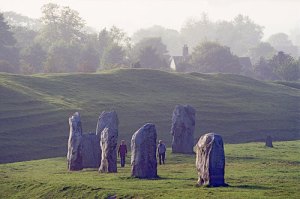
One or two operators offer tours that include Stonehenge and Avebury plus nearby Silbury Hill, West Kennet Long Barrow, Chalk hill figures and even crop circles (April – September) Try The Stonehenge Tour CompanyHistouries UK and Salisbury Guided ToursShould you need any unbias advice on organising a tour to Stonehenge please do email me – tours@stonehenge-stone-circle.co.uk

Merlin @ Stonehenge
The Stonehenge Stone Circle Website


Silbury Hill – David Attenborough’s big dig

26 10 2010

Silbury Hill is as ancient and enigmatic as Stonehenge. David Attenborough tells us why he set out to crack it

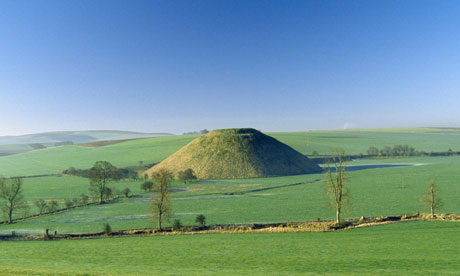
Tomb or temple? ... Silbury Hill, Wiltshire.

Tomb or temple? ... Silbury Hill, Wiltshire.


The past,” says David Attenborough, “is a haunting and fascinating place.” The great naturalist is revealing a little-known side of himself: his love of archaeology – and his fascination with Silbury Hill in Wiltshire. The tallest prehistoric man-made mound in Europe, Silbury Hill rises to a height of 37 metres, making it comparable with the Egyptian pyramids and the ziggurats of Mesopotamia.

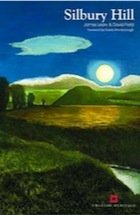
In a new English Heritage book about the hill, Attenborough tells how, in 1968 as controller of BBC2, he commissioned a programme that involved tunnelling into its depths to discover why it was there. At the time, the programme was judged a flop, since it found no treasure, no tomb, no real answers at all.

The-Story-of-Silbury-Hill

The-Story-of-Silbury-Hill

Attenborough is now seeking to set the record straight. He argues that, far from failing, TV’s first live dig triggered an unlikely chain of events that recently led to the tunnel being reopened and re-examined, using modern techniques. “They did not unearth any material treasure either,” he writes, but instead “added more details to our knowledge and understanding.” And this, you could say, is the true purpose of archaeology. In fact, the reopening of the tunnel vindicated the project Attenborough is so proud of: it revealed perhaps as much as will ever be known about this most mysterious of ancient monuments.

Silbury Hill is near Avebury, a quaint English village set inside a prehistoric stone circle. The village is part of a world heritage site that takes in Stonehenge and Silbury Hill. Raised in the same era as the mighty Stonehenge, and just as much of an enigma, the hill boasts chalk sides covered with grass. Construction of the vast, flat-topped cone would have required hundreds of workers and taken an age, but the people who built it left no records as to why.

BBC2 was a new channel in the 60s, with a brief to experiment. “We were going to do new television,” says Attenborough. “Everything we did would be in some way identifiable as new. With archaeology we thought, ‘Why can’t we do a live excavation?’ We would have cameras there so, if necessary, we could interrupt other programmes.”

The plan was to dig a tunnel into the heart of the hill. Professor Richard Atkinson, who led the dig, had interesting ideas about what might be in there. “Richard was the first to notice Mycenean daggers on Stonehenge,” says Attenborough. These made Atkinson believe Stonehenge was built by a culture in contact with ancient Greece, whose chief wanted a dramatic tomb.

This was TV as real adventure, and it captured the public imagination. Some saw it as a treasure hunt; others as a mix of horror and science-fiction. “Atkinson,” says Attenborough, “didn’t necessarily think there was going to be a burial [site]. The press said, ‘This is a treasure hunt, isn’t it?’ I said, ‘No, it’s about little bits of mud.'”

As the tunnel took shape, with news reported continually, nothing much emerged. “People kept saying, ‘It’s a failure,'” says Attenborough. “But we did discover how it was made.” Some people maintained the dig was actually harmful. “Since then, if there have been slumps in the top, people have said, ‘Ah ha, it’s the BBC’s tunnel.’ ”

In 2000, not just a slump but a hole appeared. Was the tunnel collapsing? No: this was caused by an 18th-century shaft, but archaeologists were still worried. They decided to reopen the BBC tunnel, deploying the latest tools and tests, and then seal it forever.

The new dig suggested that the hill was not a tomb, but a temple – perhaps the greatest in Europe 4,000 years ago. It also showed the hill started as a sacred site, where people came bearing stones; they may have believed they possessed healing powers. Certainly, stones are embedded in the structure and are thought to be highly meaningful by archaeologists. It is like Britain’s later cathedrals, which rose up over shrines. Sun worship flourished in prehistoric Britain, so perhaps this was – like those ancient ziggurats – a stairway to heaven to let priests get closer to the sun.

Atkinson’s tunnel is now sealed, but its creation marked a time when TV set out to bring drama and glamour to archaeology. As Attenborough says: “Anybody would be thrilled to find a Roman coin in their garden. I know I would.”

Visit Silbury Hill, Stonehenge and Avebury in a small group day tour – The Stonehenge Tour Company are the only operators who offer such a trip.  Histouries UK based in nearby Salisbury and Bath also bespoke private guided tours of the region.  You can look at more discounted tour operators here

Merlin @ Stonehenge
The Stonehenge Stone Circle Website


STONEHENGE AND PHOTOGRAPHY – ENGLISH HERITAGE RESPONSE

22 10 2010

English Heritage looks after Stonehenge on behalf of the nation. But we do not control the copyright of all images of Stonehenge. And we have never tried to do so.

Stonehenge image

We have no problem with photographers sharing images of Stonehenge on Flickr and similar not-for-profit image websites. We encourage visitors to the monument to take their own photographs. If a commercial photographer enters the land within our care with the intention of taking a photograph of the monument for financial gain, we ask that they pay a fee and abide by certain conditions. English Heritage is a non-profit making organisation and this fee helps preserve and protect Stonehenge for the benefit of future generations. The majority of commercial photographers respect this position and normally request permission in advance of visiting. We regret the confusion caused by a recent email sent to a picture library.

Merlin @ Stonehenge
The Stonehenge Stone Circle Website


The man who bought Stonehenge

22 10 2010

It was 95 years ago, this week, that a man walked into a property auction in Salisbury and came out £6,600 poorer and the owner of Stonehenge.
Stonehenge had never been put up for auction before and never would again.
Sir Cecil Chubb, a wealthy Shrewton resident, was the new owner of Stonehenge.  He was also the last man to own it.

Bought ‘on a whim’

Stonehenge had been in private hands since the middle ages and been in the Antrobus family since the early 1800s.

But when the heir to the Antrobus baronetcy was killed in the Great War the estate was put up for sale.

Restoration of Stonehenge in 1950

Stonehenge undergoes restoration work in 1950

In the hands of Messrs Knight, Franck and Rutley, on the 21st September 1915, the historic site went under the hammer.

And Lot 15: Stonehenge with 30 acres of adjoining down land was sold at the Palace Theatre in Salisbury to the highest bidder.

Sir Cecil Chubb, who’d had no intention of bidding at the sale, bought it ‘on a whim’ as a gift for his wife who, it’s claimed, was none too pleased.

For the price of £6,600, the equivalent of £392,00 in today’s money, Sir Cecil Chubb’s intention that a “Salisbury man ought to buy it” was realised.

Stonehenge worth £51m

Just 95 years on and, according to a survey of 500 estate agents invited to put a price on national monuments across the UK, Stonehenge is now worth a monumental £51m.

Whilst the recommended estate agent’s blurb, suggested in the same survey carried out by findaproperty.com, could read:

Stonehenge “Airy property with bags of potential. Comes with land but needs serious renovation, including new roof and double-glazing.”

We would still advise our client to sell it at auction
Andrew Rome, Knight and Franck

But how would Messrs Knight, Franck and Rutley, the estate agents who originally handled the sale, sell Stonehenge today?

“We would still advise our client to sell it at auction,” says Andrew Rome from Knight and Franck.

“And to sell it as a going concern as a business based on the income it generates.”

With Stonehenge attracting around 900,000 visitors a year, paying an average of £5 per head, a £51m valuation starts to sound like a good investment.

Free admission

For Sir Cecil, however, Stonehenge belonged to the nation, and in 1918 after owning it for just three years he formerly handed it over to the country with a number of conditions.

His conditions were that the entrance fee should never be more then a shilling (5p) and that local residents should have free access.

“The 1918 deed of gift didn’t actually specify free access for local residents,” says Joy Kaarnijoki at English Heritage, “it was an agreement with the Parish Council.

“The road passed very close to the stones. The Council agreed that the rights of way could be diverted further from the stone circle on condition that local residents would be granted free access.”

Whether it was stipulated by Sir Cecil Chubb himself, or not, it’s an agreement that has continued to the present day.

According to English Heritage, the 30,000 local residents living in and around Stonehenge can still take up the offer of free access to one of England’s most famous monuments

Merlin @ Stonehenge
The Stonehenge Stone Circle Website

In 1915 Stonehenge was bought for just £6,600, its current valuation is estimated at £51m

In 1915 Stonehenge was bought for just £6,600, its current valuation is estimated at £51m