Full Moon this Winter Solstice 2010

7 12 2010

The exact time for the Winter Solstice is December 21st, 11.39pm (UK time). The sunset on the 21st is at 3.53pm and the sunrise on the 22nd of December at 8.04am. Exceptionally, we can also expect a full moon on December 21st

Since 1793, when The Old Farmer’s Almanac began tracking heavenly events and seasonal changes, the Moon has been full on the first day of winter just nine times. The next occurrence will be in this coming Winter Solstice


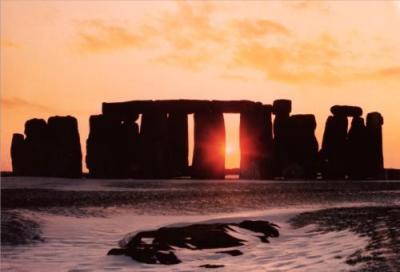
Full moon at Stonehenge this Winter Solstice

Full moon at Stonehenge this Winter Solstice


The rarity of a solstitial full Moon—the average interval is about 19 years—reinforces the Moon’s role as a beacon playing on human history. Although our research could not find a correlation between these lunar events and significant historical happenings on similar dates in the past*, the combination of astronomical forces certainly affect the tides.

As astronomer Bob Berman explains, during this time of proxigean tides [unusually high tides due to the Moon’s phase and proximity to Earth], coastal flooding could occur if there is one more little extra effect, such as a storm at sea, on-shore winds, or low barometric pressure.

If the solstice night is calm and cloudless, with the full Moon beaming down on a blanket of snow, it will be irresistibly attractive, and electrical illumination—even your car’s headlights—may seem superfluous.

Full moon - Winter Solstice

Full moon - Winter Solstice

2010
Spring equinox – Mar 20 at 5.35pm
Summer solstice – Jun 21
at 11.30am
Autumn equinox – Sep 23
at 3.10am
Winter solstice – Dec 21

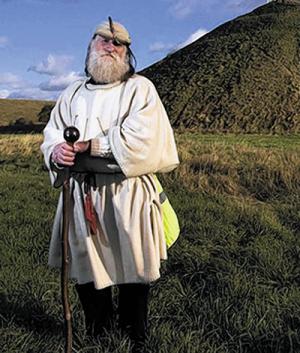
Merlin @ Stonehenge
The Stonehenge Stone Circle Website


Pagan Mistletoe Symbolism and Legend

4 12 2010

Mistletoe and Christmas After Celtic Pagans were converted to

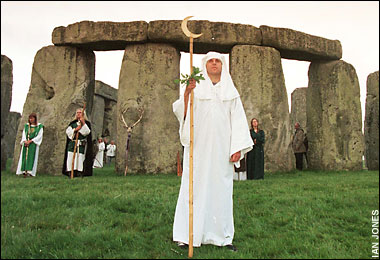
Druids cutting Mistletoe

Druids cutting Mistletoe

Christianity, Catholic bishops, with one exception, didn’t allow the mistletoe to be used in churches because it was one of the major symbols of Paganism. Before the Reformation, a priest at the Cathedral of York brought a bundle of mistletoe into the sanctuary each year during Christmastide and put it on the altar as symbolic of Jesus being the Divine Healer of nations.

‘Mistletoe, one of the most magickal and sacred plants of Paganism, symbolizes life and fertility and protects against poison. It was considered an aphrodisiac. ‘

The English used mistletoe as a Christmas decoration for their homes. In Medieval times, branches of mistletoe were hung from ceilings and put over houses and barn doors to repel evil spirits. People believed the plant could extinguish flames. Although much of the Pagan symbolism was forgotten, the plant represented good will, happiness, good fortune and friendship.

‘The sacred mistletoe is a hemiparasite, partial parasite that grows on branches or trunks of trees and has roots that penetrate into the tree for food. The American plant grows on trees while the European mistletoe can also be a green shrub with small yellow flowers and white berries. The plant contains toxins that can cause physical reactions including gastrointestinal disturbances and a slowed heartbeat.’

Mistletoe Sacred to Celtic Druids

The plant has qualities including the power of healing, rendering poisons harmless, good luck, great blessings, bestowing fertility on humans and animals, protection from witchcraft and banishing evil spirits. Enemies who met Druids under the forest mistletoe laid down their weapons, exchanged friendly greetings and kept a truce until the next day. The Celts suspended mistletoe over doorways or in rooms as a symbol of good will and peace to all who visited.

‘Mistletoe was revered by the ancient Druids both magically and medicinally. It’s possible that modern mistletoe traditions have their roots in ancient beliefs.’

Druid Mistletoe Ceremony

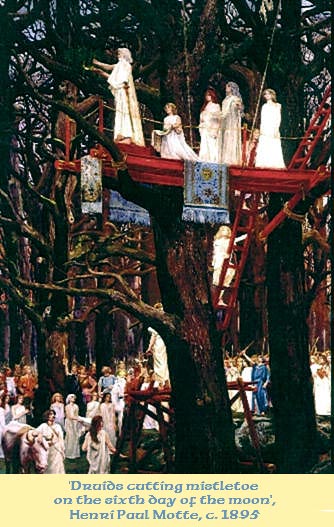
The plant is a fertility symbol and the soul of the oak tree. Belief was that the mistletoe could come to the oak tree during a lightning flash. Mistletoe was gathered at mid-summer and winter solstices. The plant, when it grew on the venerated oak tree, was especially sacred to the Celts. On the sixth night of the full moon after Yule, white-robed Druid priests gathered oak mistletoe by cutting the plant with golden sickles. Two white bulls were sacrificed with prayers that the recipients of mistletoe would prosper.

Mistletoe and the Ancient Druids

Pliny the Elder, a Roman historian interested primarily in natural history, recorded valuable information about the Druids and their religious and healing practices. These ancient priests of Celtic lands revered mistletoe as sacred. Pliny stated in Natural History, XVI, 95 that, “The Druids — that is what they call their magicians — hold nothing more sacred than mistletoe and a tree on which it is growing…Mistletoe is rare, and when found, it is gathered with great ceremony, and particularly on the sixth day of the moon.”

In the scene quoted above, the Druids are preparing for a ritual sacrifice which involves a white-robed priest carrying a golden scythe while climbing an oak tree to ritually cut the mistletoe. According to Pliny, it was the Valonia oak the Druid’s believed was the most sacred tree to gather mistletoe from and that it would heal poison and encourage fertility.

Mistletoe in Celtic Art

Celtic art is resplendent with what are believed to be mistletoe motifs. Some artifacts have been found that resemble human male heads adorned with a crown of comma-shaped leaves that resemble mistletoe. Historians believe these finds may be representations of crowned Druid priests.

External links:
http://www.mistletoe.org.uk/ A survey of Mistletoe use in Britain
http://www.mistletoes-r-us.co.uk/  Mistletoe matters
http://www.archaeology.co.uk/books/blood-and-mistletoe-the-history-of-the-druids-in-britain.htm The History of Druids – Blood and Mistletoe

 Next blog will be about -‘Yule’

Merlin @ Stonehenge
The Stonehenge Stone Circle Website


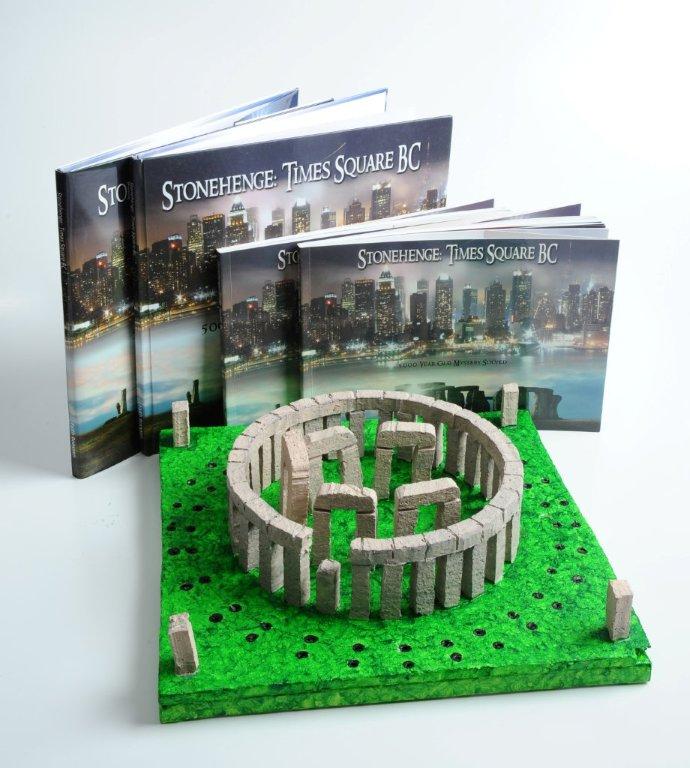
New Stonehenge book launched – Stonehenge Times Square BC

26 11 2010

New Stonehenge book

New Stonehenge book

Discover the Ultimate Function and Purpose of Stonehenge
Where would you be without your diary to check your appointments for the week, or your calendar to work out dates?

We are all ruled by hours, days, weeks and months – from getting up in the morning, to working out schedules, to planning holidays and important functions. In addition to this, most of us have heard of the mysterious, starkly beautiful monument, Stonehenge, and have wondered as to its construction. Be this as it may, how often have we given any thought as to how (and why) this Heritage Site was originated? Are we at all aware of the key role it has played in the concept of ‘time’ and in our New Year celebrations?

Once you have an understanding of the four ancient calendars, revealed and explained in this fascinating window to the past, you will realise that Stonehenge was a site of enormous importance and significance to the ancients. The monument was in fact a device or tool, for revealing the exact date of the year.

More importantly, we are given a glimpse of how the ancients discovered and designed their calendars with little more than sticks and stones to work with. Discover too, the accuracy of their calendars, which were accurate to within a day. Their solar calendar consisted of 365 days had 52 weeks, with 3 seasons of 91 days and 1 season of 92 days. Discover how 12, 30 day months were introduced around 3600 years ago with 5 tagged on days at the end of the year. This last calendar is known to have been used by both the Babylonians and Egyptians.

About the BookThe key points in any solar calendar are alignments with both midsummer and midwinter. Very early on, an important discovery made at Stonehenge was that certain of the megaliths would have aligned perfectly with the midsummer and midwinter solstices approximately 5000 years ago, when the monument was built.

Stonehenge, as it is seen today, is impressive and has fostered many theories as to its original function and purpose. However, this megalithic monument, impressive as it is, is not the full story. Archaeologists have discovered that before the Megaliths (Sarsen stones) were erected, there were earlier structures dating back to as far as 5000 years ago. The area at Stonehenge was in use long before the Sarsen megaliths were erected.

The author of Stonehenge: Times Square BC, Faith Booysen, realized that although some theories held for certain of the structures, taken as a whole, most theories did not explain the older structures.

Working on the assumption that these structures were calendars, her calculations proved that this was, indeed, so.

Her book, Stonehenge: Times Square BC sets out in detail the remarkable calculations and details of four calendars at Stonehenge. The brilliance of the ancient designers and builders are reflected in these calendars. With little more than primitive tools, they designed and built calendars that lasted for hundreds, if not thousands of years. The calendars formed the basis of the calendar we use to this day. Discover how the calendars evolved over a period of 1650 years from a circle of 56 wooden posts to the massive monument we see today.

Extract from the BookWe might never truly know whether the designers were local or foreign to Britain. What we do know is that designing and building calendars with primitive tools, required genius. Civilisation, it can be said, is built upon such genius, dedication and persistence.

These stone structures were built to last and because of this, crucial knowledge was passed down to future generations. Everything from a simple coffee in the morning to space exploration, testifies to this. Sadly, with the advent of written language, these structures fell into disuse and disrepair. Even so, after 5000 years and with little more than holes in the ground, scattered stones and a few remaining megaliths, we are able to reconstruct and understand their calendars.” Extract from Stonehenge: Times Square BC

About the AuthorThe author, Faith Booysen, has always had an overwhelming interest in the stone structures of the ancient world. Stonehenge in particular, held a strong fascination and in 2006, while watching a TV program on “Foamhenge” (a precise model of Stonehenge in polystyrene), she realized that the monument was only part of an equation and that the ancients would have used either loose stones or logs to mark their calendars daily.

It soon became obvious that the ruin of the Stonehenge monument seen today was preceded by other calendars. Stonehenge: Times Square BC is the result. Once the author had resolved the oldest calendar (the Aubrey Posts), she studied the remaining structures at Stonehenge and Woodhenge and these were revealed to be precise solar calendars. Mount Pleasant, a Neolithic henge in Dorset that supported wooden posts, proved to be a precise solar calendar as well.

Merlins CommentIt is obvious that the author knows and loves her subject and she has done some meticulous research to compile this fascinating account of the origins of our modern-day calendars and traditions behind our New Year celebrations.

Even those who are not ruled by the clock, or who are science buffs, will find that this absorbing account of the early designers who built one of the most fascinating monuments known to man and who made time and motion as we know it today all possible, makes you forget all about the time.

Link to TimeHenge book – http://www.timehenge.com/Link to Stonehenge Book Shop

Merlin @ Stonehenge
The Stonehenge Stone Circle Website


Delight for Druids says Avebury priest

18 10 2010

It has taken more than 11,000 years but finally the Druids, who lead the seasonal celebrations at Avebury and Stonehenge, can say they belong to an officially recognised religion.

No one is more delighted at this recognition than Druid priest Terry Dobney, who lives at West Kennett, and styles himself as the Archdruid of Avebury and Keeper of the Stones.

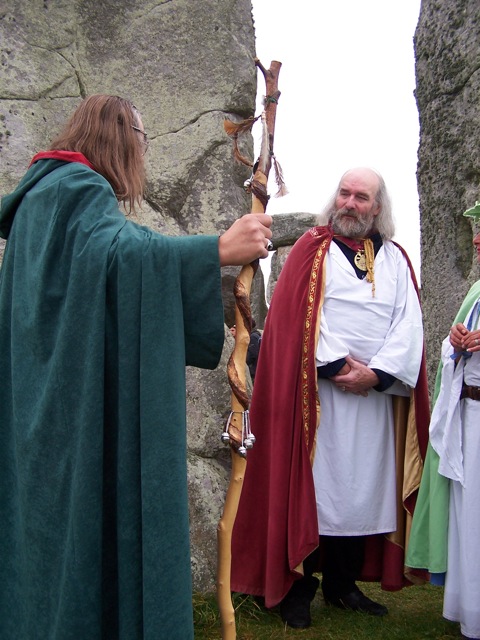
Every Midsummer’s Day Mr Dobney, 62, can be seen wearing his ceremonial robe, carrying his staff and with a pheasant feather in his flat cap leading the Summer Solstice celebrations in the stone circle at Avebury.

This week the Charity Commissioners revealed they were granting the Druid Network, the umbrella organisation for Druid groups across the UK, charitable status for the first time.

That decision establishes Druidry as a recognised religion under UK charity law for the first time giving it the same status as Christianity, Islam and Hinduism.

The ruling recognised that the Druid Network served “to advance religion for the public benefit” although in practice, said Phil Ryder, chairman of the Druid Network trustees, it means very little financial benefit for the Druids but established an important principle giving them official recognition.

Mr Ryder said: “It has been a long and frustrating process, exacerbated by the fact that the Charity Commissioners had no understanding of our beliefs and practices and examined us on every aspect of them.”

As well as regulating secular charities the Charity Commissioners decide what qualifies as a legitimate and genuine faith.

Mr Dobney, a practising Druid for more than 40 years, said: “It is high time that the Druids were recognised not only as a religion but as being one of the oldest religions in the world.

“Druidism dates back to more than 11,500 years ago and pre-dates Judaism.

“The early Druids were the priestly cast who ran societies and provided the leaders.”

To become a recognised Druid, he said, entrants had to serve an apprenticeship for seven years under a senior Druid and could not call themselves a Druid until completing 21 years of training.

As well as leading the summer solstice and other seasonal celebrations at Avebury, Mr Dobney also conducts Druid handfastings (marriages) and other religious ceremonies throughout the year.

Merlin @ Stonehenge
The Stonehenge Stone Circle Website


Druids as an official religion? Stones of Praise here we come

4 10 2010

This article written by Malanie Philips (Daily Mail) is sure to anger Pagans and the Druid Order

Will someone please tell me this is all a joke. Until now, Druids have been regarded indulgently as a curious remnant of Britain’s ancient past, a bunch of eccentrics who annually dress up in strange robes at Stonehenge to celebrate the summer solstice.

However, according to the Charity Commission, they are to be recognised as a religion and, as a result, afforded charitable status, with the tax exemptions and other advantages that follow.

After a four-year campaign, the Commission says it accepts that the Druids worship nature and that they also believe in the spirits of places such as mountains and rivers, as well as in ‘divine guides’.
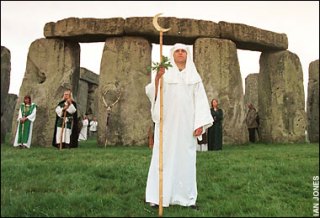
 This, apparently, makes them qualify as a religion.

Can it be long before the BBC transmits Stones Of Praise, or solemnly invites listeners to Radio 4’s Thought For The Day to genuflect to a tree?

Some might shrug this off. After all, the Druids don’t do any harm to anyone. What skin is it off anyone else’s nose how they are categorised?

CULT ?

Well, it actually matters rather a lot. Elevating them to the same status as Christianity is but the latest example of how the bedrock creed of this country is being undermined. More than that, it is an attack upon the very concept of religion itself.

This is because Druidry is simply not a religion. Now, it’s true that religion is notoriously difficult to define. But true religions surely rest on an established structure of traditions, beliefs, literature and laws.

Above all, they share a belief in a supernatural deity (or more than one) that governs the universe

By these standards, Druidry is surely not a religion but a cult — a group defined merely by ritual practices but which stands outside mainstream religion.

Nor does it seem to conform to the definition of a religion according to charity law.

When Radio 4’s Sunday Programme suggested yesterday morning to Phil Ryder, chairman of the Druid Network, that the legal definition of religion included a ‘significant belief in a supreme being or entity’, he saw no contradiction. Druids, he said cheerfully, might venerate many gods, inanimate objects or nature.

How very inclusive of them! But the key point is surely that none of these beliefs involves a ‘supreme’ being that exists beyond the Earth and the universe. On the contrary, Druids worship what is in or on the earth itself.

When asked further how Druidry benefited the public interest — the key test for charitable status — Mr Ryder burbled that its ethical framework consisted of forming ‘honourable and sustainable relationships’ with everything in the world, including animals, people and nature.

But there are many who subscribe to no belief system at all and who would say they, too, want to live in harmony with the earth and everything in it. Are they, therefore, also to be regarded as religious folk and given charitable status?

Maybe Prince Charles, who famously talks to his plants, could register himself on that basis as the founder of a new religion? Duchy Devotions, anyone?

If the Druids qualify as a religion, can other cults such as the Scientologists be far behind?

Can it be long, indeed, before the wise and learned theologians of the Charity Commission similarly grant charitable status to sorcery, witchcraft or even the Jedi — the fictional Star Wars ‘religion’ which the 2001 census recorded as having no fewer than 390,127 adherents in England and Wales.

The whole thing is beyond absurd. But it is also malevolent. For it is all of a piece with the agenda by the oh-so politically correct Charity Commission to promote the fanatical religious creed of the Left — the worship of equality.

The Commission was primed by Labour for this attempt to restructure society back in 2006, when charity law was redrawn to redefine ‘public benefit’ as helping the poor.

This put the independent schools in the front line of attack, since education was no longer itself considered a benefit — as it had been since time immemorial — but only insofar as it furthered the ideology of ‘equality’.

Extraordinary

Thus, we have arrived at the extraordinary situation where some of these schools, which have delivered such inestimable benefit to the nation, face the loss of their charitable status, which is to be given instead to people who dance naked around stones and worship the sun.

But the new respectability of paganism cannot be laid entirely at the Charity Commission’s door. For in recent years, pagan practices have been rapidly multiplying, with an explosion of the occult: witchcraft, parapsychology, séances, telepathy and mind-bending cults.

Astonishingly, around 100 members of the Armed Forces now classify themselves as pagans, and a further 30 as witches.

There are thought to be about 500 pagan police officers. A Pagan Police Association has even been set up to represent officers who ‘worship nature and believe in many gods’.

They have been given the right to take days off to perform rituals, such as leaving food out for the dead, dressing up as ghosts and casting spells, or celebrating the sun god with ‘unabashed sexuality and promiscuity’.

Britain’s prison authorities are equally hospitable to the occult: under instructions issued to every prison governor, pagan ‘priests’ are allowed to use wine and wands during ceremonies in jails. Inmates practising paganism are allowed a hoodless robe, incense and a piece of religious jewellery among their personal possessions.

Political correctness gone mad or what? As one disgusted police officer exploded: ‘What has it come to when a cop gets time off so he can sit about making spells or dance around the place drinking honey beer with a wand in his hand?’

Barking

How on earth has our supposedly rational society come to subscribe to so much totally barking mumbo-jumbo?

In part, it developed from the New Age embrace of Eastern beliefs in the inter-connectedness of everything in the universe. The defining characteristic of such faiths is a spirituality which is concerned with the self rather than the world beyond the individual.

These beliefs were, therefore, tailor-made for the ‘me society’ which turned against Biblical constraints on behaviour in the interests of others. They were subsequently given rocket fuel by environmentalism, at the core of which lies the pagan worship of ‘Mother Earth’.

And they were then legitimised by the doctrines of equality of outcomes and human rights — which, far from protecting the rights of truly religious people, aim to force Biblical morality and belief out of British and European public life altogether.

This is because human rights and equality of outcomes are held to be universal values. That means they invariably trump specific religious beliefs to impose instead equal status for all creeds.

But if all creeds, however absurd, have equal meaning then every belief is equally meaningless. And without the Judeo-Christian heritage there would be no morality and no true human rights.

There is nothing remotely enlightened about paganism. It was historically tied up with both communism and fascism, precisely because it is a negation of reason and the bedrock values behind Western progress.

The result is that, under the secular onslaught of human rights, our society is reverting to a pre-modern era of anti-human superstition and irrationality. From human rights, you might say, to pagan rites in one seamless progression.

Anyone who thinks radical egalitarianism is progressive has got this very wrong. We are hurtling backwards in time to a more primitive age**

 **Is that such a bad thing ?  Food for though!

Merlin @ Stonehenge
The Stonehenge Stone Circle Website


Druids Recognized As Religion For First Time In UK

3 10 2010
 

 Druids have been worshipping the sun and earth for thousands of years in Europe, but now they can say they’re practicing an officially recognized religion.

The ancient pagan tradition best known for gatherings at Stonehenge every summer solstice has been formally classed as a religion under charity law for the first time in Britain, the national charity regulator said Saturday. That means Druids can receive exemptions from taxes on donations — and now have the same status as such mainstream religions as the Church of England.

The move gives an old practice new validity, said Phil Ryder, the chairman of the 350-member Druid Network.

“It will go a long way to make Druidry a lot more accessible,” he said.

Druids have practiced for thousands of years in Britain and in Celtic societies elsewhere in Europe. They worship natural forces such as thunder and the sun, and spirits they believe arise from places such as mountains and rivers. They do not worship a single god or creator, but seek to cultivate a sacred relationship with the natural world.

Although many see them as robed, mysterious people who gather every summer solstice at Stonehenge — which predates the Druids — believers say modern Druidry is chiefly concerned with helping practitioners connect with nature and themselves through rituals, dancing and singing at stone circles and other sites throughout the country believed to be “sacred.”

Ancient Druids were known to be religious leaders, judges and sages among the Celts during pre-Christian times, although little evidence about their lives survived. There are now various Druid orders and about 10,000 practitioners in Britain — and believers said the numbers are growing because more people are becoming aware of the importance to preserve the environment.

The Druid Network fought for nearly five years to be recognized under the semi-governmental Charity Commission, which requires proof of cohesive and serious belief in a supreme entity and a moral framework.

After initially rejecting the Druid Network’s application, the Charity Commission decided this week that Druidry fit the bill.

“There is sufficient belief in a supreme being or entity to constitute a religion for the purposes of charity law,” the commission said.

Adrian Rooke, a Druid who works as a counselor, said Druidry appeals to people who are turning away from monotheistic religions but still long for an aspect of spirituality in their lives.

“It uplifts the spirit,” he said. “The world is running out of resources, and in that context it’s more important to people now to formulate a relationship with nature.”

2_Britain_Druids_Recognized.sff.jpg

Associated Press Druids performing pagan rituals as part of the Summer Solstice ceremonies at Stonehenge, Wiltshire, England, before dawn, Monday June 21, 2004. The stone circle at Stonehenge is believed to be at least 4,500 years old. Druidry has been officially recognized as a religion in Britain under charity law. The Charity Commission has granted the Druid Network charitable status, giving it tax breaks and equal status to mainstream religions like Christianity. The commission said Saturday Oct. 2, 2010, that druidry has a coherent and serious set of beliefs and that it offers a beneficial ethical framework.

1_Britain_Druids_Recognized.sff.jpg

 Associated Press This Tuesday Aug. 10, 1999 photo from files shows Arch Druid Ed Prynn as he calls down the sun during his sun dance around a ring of stones, in St. Merryn, England. The druid dance is to celebrate the total eclipse of the sun, which is due in this part of southwest England on August 11. Druidry has been officially recognized as a religion in Britain under charity law. The Charity Commission has granted the Druid Network charitable status, giving it tax breaks and equal status to mainstream religions like Christianity. The commission said Saturday that druidry has a coherent and serious set of beliefs and that it offers a beneficial ethical framework.

More information try these links:

British Druid Order

The British Druid Order (BDO) teaches and practices a shamanic, mystical, celebratory form of Druidry, inspired by the past but deeply relevant to the
www.druidry.co.uk/

The Official Website Of The Council Of British Druid Orders – (CoBDO)™

The Council of British Druid Orders, CoBDO, would like to recommend one of our initial co-founders, who at present is not a member, the Order of Bards,
http://www.cobdo.org.uk/

Merlin @ Stonehenge
The Stonehenge Stone Circle Website


Coach Tours to Stonehenge at Christmas 2010

30 09 2010

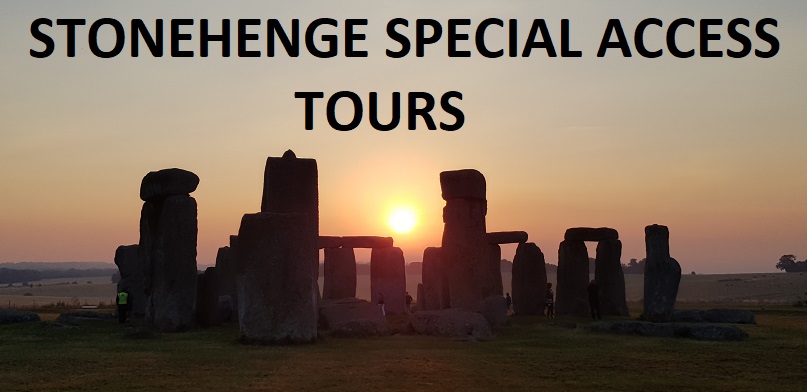
December 2010 Stonehenge ‘Special Access’ Tours
Private Viewing of Stonehenge
Most visitors to Stonehenge are not allowed direct access to the stones. On this special day trip from London, you’ll be invited to enter the stone circle itself, and stand beside the mysterious rocks towering above you. Your guide will unlock the secrets of this ancient UNESCO World Heritage Listed monument. Enjoy the peace, away from the crowds, as you experience Stonehenge at its atmospheric best at sunrise or sunset. Availability is strictly limited so book early, as private viewings regularly sell out and operate on selected days in 2010 only.  CLICK HERE

Stonehenge Christmas Coach Tours – departing from London
Some London tour operators are offering guided coach tours to Stonehenge on Christmas Day.  There are all sorts of tours available including Windsor Castle, Bath, Oxford, Canterbury, Avebury, Salisbury Cathedral, Christms markets and much more.  Click for discount tickets

Merlin @ Stonehenge
The Stonehenge Stone Circle Website


Autumn Equinox 2010 – Stonehenge Celebrations

23 09 2010

Stonehenge Autumn Equinox 2010

 The Autumn Equinox (also known as Mabon) is celebrated when day and night are of equal duration before the descent into increasing darkness and is the final festival of the season of harvest.  For many pagans, this is the time to reflect on the past season, and to recognize the balance of the year has changed.

Although the Summer Solstice at Stonehenge attrackts a large crowd, you may expect the Autumn Equinox celebrations to be less attended, with fewer than 1,000 people showing up.

The 2010 Autumnal Equinox takes place on September 23th, at 4.03am UK time (3.03 UTC), but when ‘open access’ to Stonehenge starts is decided by English Heritage and depends on visibility. The sunrise is at 6.48am, and it is expected access to the stones will be allowed from approximately 6.30 to 8.30am.

Public access to Stonehenge is denied after dark, so if you want to see the sunset on September 22th (18.59pm), you’ll have to stand on either the Avenue or on the side of the A344

The Autumnal Equinox

In September is the Fall Equinox, which has come to be called Mabon by many contemporary Neo-Pagans. Occuring approximately on September 21st, this is the day when the hours of daylight and nighttime are once again balanced. Calender days from now until the Winter Solstice will slowly get shorter and shorter in their daylight hours.

Agriculturally, this time of year the harvest is now in full swing, with late summer and fall fruits, vegetables and grains being gathered up before winter. This is the time of year a lot of canning or preserving of garden foods takes place. Hunting season also starts around this time, and this was when farmers would slaughter animals and preserve meat for the coming months as well.

This holiday is the last of the harvest holidays which began with the summer solstice and continued with Lammas.


21st/23rd September Harvest time!
The Autumn Equinox or Harvest Home is also called Mabon, pronounced ‘MAY-bon’, after the Welsh god Mabon ap Modron, which means literally ‘son of mother’. Mabon appears in ‘The Mabinogion’ tale. The Druids call this celebration, Mea’n Fo’mhair, and honour The Green Man, the God of the Forest, by offering libations to the trees. The Welsh know this time as ‘Alban Elfed’, meaning ‘light of autumn’. This is the point of the year when once again day and night are equal – 12 hours, as at Ostara, the Spring Equinox. The Latin word for Equinox means ‘time of equal days and nights’. After this celebration the descent into winter brings hours of increasing darkness and chiller temperatures. It is the time of the year when night conquers day. After the Autumn Equinox the days shorten and nights lengthen. To astrologers this is the date on which the sun enters the sign of Libra, the scales, reflecting appropriately the balanced day and night of the equinox. This was also the time when the farmers brought in their harvested goods to be weighed and sold.
Harvest festival This is the second festival of the season of harvest – at the beginning of the harvest, at Lammas, winter retreated to his underworld, now at the Autumn equinox he comes back to earth. For our Celtic ancestors this was time to reflect on the past season and celebrate nature’s bounty and accept that summer is now over. Harvest Home marks a time of rest after hard work, and a ritual of thanksgiving for the fruits of nature. This is the time to look back on the past year and what you have achieved and learnt, and to plan for the future. The full moon nearest to the Autumn Equinox is called the Harvest Moon and farmers would harvest their crops by then, as part of the second harvest celebration. Mabon was when livestock would be slaughtered and preserved (salted and smoked) to provide enough food for the winter. At the South Pole they will be celebrating the first appearance of the sun in six months. However, at the North Pole they will be preparing for six months of darkness. During Medieval times, the Christian Church replaced Pagan solstices and equinox celebrations with Christianized occasions. The Autumn equinox celebration was Michaelmas, the feast of the Archangel Michael.

The triple Goddess – worshipped by the Ancient Britons, is now in her aspect of the ageing Goddess and now passes from Mother to Crone, until she is reborn as a youthful virgin as the wheel of nature turns. At the Autumn equinox the goddess offers wisdom, healing and rest. Mabon Traditions The Wicker man There was a Celtic ritual of dressing the last sheaf of corn to be harvested in fine clothes, or weaving it into a wicker-like man or woman. It was believed the sun or the corn spirit was trapped in the corn and needed to be set free. This effigy was usually burned in celebration of the harvest and the ashes would be spread on the fields. This annual sacrifice of a large wicker man (representing the corn spirit) is thought by many to have been the origin of the misconception that Druids made human sacrifices. ‘The reaping is over and the harvest is in, Summer is finished, another cycle begins’ In some areas of the country the last sheaf was kept inside until the following spring, when it would be ploughed back into the land. In Scotland, the last sheaf of harvest is called ‘the Maiden’, and must be cut by the youngest female in attendance.
To Autumn O Autumn, laden with fruit, and stained With the blood of the grape, pass not, but sit Beneath my shady roof, there thou may’st rest, And tune thy jolly voice to my fresh pipe; And all the daughters of the year shall dance, Sing now the lusty song of fruits and flowers. William Blake Mabon is a time to reflect, as we reap the harvest of experience from the past year – the completion of another turn of the Great Wheel. Corn Dollies Corn dollies were also made from the last sheaf and kept in the house to protect the inhabitants from bad spirits during the long winter. Apples To honour the dead, it was also traditional at Mabon to place apples on burial cairns, as symbolism of rebirth and thanks. This also symbolizes the wish for the living to one day be reunited with their loved ones. Mabon is also known as the Feast of Avalon, deriving from the meaning of Avalon being, ‘the land of the apples’.

Merlin @ Stonehenge – A good time by all…….
The Stonehenge Stone Circle Website


Stonehenge Winter Solstice – 22nd December 2010

22 09 2010

Last year saw a large number of people (including Druids) turn up at Stonehenge on the wrong day in 2009?  I thought I would clarify the correct ‘Winter Solstice’ day for 2010 to save any embaresment.  The summer solstice is always on the 21st, however the winter solstice can fall on the 21st or the 22nd.  The celebration does not always fall on the same date as the solstice because the modern year does not correspond precisely to the solar one.

The exact time for the Winter Solstice is December 21st, 11.39pm (UK time). The sunset on the 21st is at 3.53pm and the sunrise on the 22nd of December at 8.04am. Exceptionally, you can also expect a full moon on December 21th.

English Heritage did not confirm the date for Open Access for Stonehenge for the Winter Solstice yet, but most likely this will be dawn on the 22nd of December. (The sunrise on the 22nd is closer to the actual solstice than that on the 21th of December.) Expect a short period of access, from approximately 7.30 to 9.00am

Stonehenge is carefully aligned on a sight-line that points to the winter solstice sunset (opposed to New Grange, which points to the winter solstice sunrise, and the Goseck circle, which is aligned to both the sunset and sunrise). It is thought that the Winter Solstice was actually more important to the people who constructed Stonehenge than the Summer Solstice. The Winter Solstice was a time when most cattle were slaughtered (so they would not have to be fed during the winter) and the majority of wine and beer was finally fermented.

Gerald Hawkins’ work

Gerald Hawkins’ work on Stonehenge was first published in Nature in 1963 following analyses he had carried out using the Harvard-Smithsonian IBM computer. Hawkins found not one or two alignments but dozens. He had studied 165 significant features at the monument and used the computer to check every alignment between them against every rising and setting point for the sun, moon, planets, and bright stars in the positions they would have been in 1500 BC. Thirteen solar and eleven lunar correlations were very precise against the early features at the site with precision falling during the megalithic stages. Hawkins also proposed a method for using the Aubrey holes to predict lunar eclipses by moving markers from hole to hole. In 1965 Hawkins wrote (with J. B. White) Stonehenge Decoded, which detailed his findings and proposed that the monument was a ‘Neolithic computer’.

Stonehenge – An Asronimical Calandar

Stonehenge features an opening in the henge earthwork facing northeast, and suggestions that particular significance was placed by its builders on the solstice and equinox points have followed. For example, the summer solstice sun rose close to the Heel Stone, and the sun’s first rays shone into the centre of the monument between the horseshoe arrangement. While it is possible that such an alignment can be coincidental, this astronomical orientation had been acknowledged since William Stukeley drew the site and first identified its axis along the midsummer sunrise in 1720.

Stukeley noticed that the Heel Stone was not precisely aligned on the sunrise. Year to year, the movement of the sun across the sky appears regular. However, due to temporal changes in obliquity of the ecliptic, illumination declinations change with time. The purported Heel Stone alignment with summer solstice sunrise would have been less accurate four to five thousand years ago. The Heel Stone, in fact, is located at 1/7th of circumference from due North, as noted by archaeologist James Q. Jacobs.[3] Stukeley and the renowned astronomer Edmund Halley were to attempt what amounted to the first scientific attempt to date a prehistoric monument. Stukeley concluded the Stonehenge had been set up “by the use of a magnetic compass to lay out the works, the needle varying so much, at that time, from true north.” He attempted to calculate the change in magnetic variation between the observed and theoretical (ideal) Stonehenge sunrise, which he imagined would relate to the date of construction. Their calculations returned three dates, the earliest of which, 460 BC, was accepted by Stukeley. That was incorrect, but this early exercise in dating is a landmark in field archaeology [4]. .

Early efforts to date Stonehenge exploited tiny changes in astronomical alignments and led to efforts such as H Broome’s 1864 theory that the monument was built in 977 BC, when the star Sirius would have risen over Stonehenge’s Avenue. Sir Norman Lockyer proposed a date of 1680 BC based entirely on an incorrect sunrise azimuth for the Avenue, aligning it on a nearby Ordnance Survey trig point, a modern feature. Petrie preferred a later date of AD 730. The necessary stones were leaning considerably during his survey, and it was not considered accurate.

Neolithic Computer

An archaeoastronomy debate was triggered by the 1963 publication of Stonehenge Decoded, by British-born astronomer Gerald Hawkins. Hawkins claimed to observe numerous alignments, both lunar and solar. He argued that Stonehenge could have been used to predict eclipses. Hawkins’ book received wide publicity, in part because he used a computer in his calculations, then a rarity. Archaeologists were suspicious in the face of further contributions to the debate coming from British astronomer C. A. ‘Peter’ Newham and Sir Fred Hoyle, the famous Cambridge cosmologist, as well as by Alexander Thom, a retired professor of engineering, who had been studying stone circles for more than 20 years. Their theories have faced criticism in recent decades from Richard J. C. Atkinson and others who have suggested impracticalities in the ‘Stone Age calculator’ interpretive approach.

There are a few tour companies offering Stonehenge Tours during the Solstice period.  Try the Stonehenge Tour Company, Best Value Tours, Salisbury Guided Tours and Premium Tours 

See you all at the Winter Sostice

Merlin @ Stonehenge
The Stonehenge Stone Circle Web site