Druid leader King Arthur loses legal fight over Stonehenge remains

24 08 2011

High court refuses judicial review of decision to remove 5,000-year-old ‘royal’ remains from Stonehenge for analysis

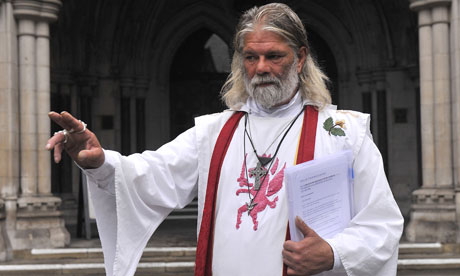
King Arthur Pendragon after losing the latest leg of his battle to have ancient human remains returned to Stonehenge

King Arthur Pendragon after losing the latest leg of his battle to have ancient human remains returned to Stonehenge

A druid leader who claims to be the incarnation of a legendary British king has suffered defeat in the latest legal skirmish of his long-running battle over the removal of ancient remains from Stonehenge.

King Arthur Pendragon appeared at the high court in London to argue that the “royal” remains should be returned to their age-old resting place in Wiltshire.

Pendragon, a 57-year-old former soldier and biker who changed his name by deed poll, wanted the high court to give permission for a judicial review of the government’s decision to allow the remains to be taken away for analysis.

But Mr Justice Wyn Williams refused King Arthur, ruling there was insufficient evidence to show the Ministry of Justice (MoJ) had acted unreasonably.

Outside court Pendragon, who styles himself as battle chieftain of the Council of British Druid Orders and “titular head and chosen chief” of the Loyal Arthurian Warband druid order, remained defiant.

Wearing white flowing robes, he called for a day of action on Monday to draw attention to the cause.

He said: “Even though on this occasion my appeal has been dismissed I am still very much hopeful that I can win in the future. “I wasn’t asking for the bones to be put back straight away, I simply wanted confirmation that they will be returned to the site as soon as possible.” He said druids felt the remains were “guardians” of the site.

The judge heard that the cremated remains of more than 40 bodies – thought to be at least 5,000 years old – were removed from a burial site at Stonehenge in 2008 , with ministers giving researchers from Sheffield University permission to keep the bones until 2015.

Pendragon, who represented himself, said the bones were remains of members of the “royal line” or “priest caste” who could have been the “founding fathers of this great nation”.

He told the judge he feared the remains would never be returned, but moved to a museum, adding that the MoJ had “unreasonably” failed to take account of his views. The MoJ denied the allegation.

Researchers say their work on the remains is yielding “fascinating insights” into the history of the site.

After the decision English Heritage, which manages the site, said the scientists wanted to keep the remains until 2015 so full analysis could be carried out. “Otherwise we will lose an opportunity to learn more about this important site,” a spokesman added.

A spokesperson for the University of Sheffield said: “Research on the cremated bones is beginning to yield fascinating insights about the people of Stonehenge.

“Due to the large number of remains and the fact many of them were mixed together by archaeologists in the 1920s, study of them has been difficult and time consuming. However, we will now be able to apply new scientific techniques, developed only in the last few years, to find out more about who these people were.

“Human remains are an important part of our shared past and they should be treated with respect. The benefit of the research is balanced with any ethical concerns that may be caused by excavations.”

Link: http://www.guardian.co.uk/travel/stonehenge

Sponsored by ‘The Stonehenge Tour Company’ www.StonehengeTours.com

Merlin @ Stonehenge
The Stonehenge Stone Circle Website


Stonehenge most visited tourist spot in South West

17 08 2011

Stonehenge has become the most visited paid-for tourist attraction in the South West.
Stonehenge

Figures from tourist board Visit England show that last year the iconic Wiltshire attraction had more visitors than the Eden Project in Cornwall.

Over 1m people visited the stone circle in 2010, up 1.9% on the previous year.

It is the first time it has surpassed the Eden Project for visitor numbers since the Cornwall tourist attraction opened in 2001.

David Andrews, chief executive for Visit Wiltshire, said: “Stonehenge is a fabulous site and we’re extremely lucky to have it in the county.”
Links: http://www.bbc.co.uk/news/uk-england-wiltshire-14554689

Sponsored by ‘The Stonehenge Tour Company’ – www.StonehengeTours.com

Merlin @ Stonehenge
The Stonehenge Stone Circle Website


Stonehenge news. Seven Wonders of the Ancient World ?

16 08 2011

Stonehenge may not be one of the seven wonders of the ancient world, but that’s probably only because Heroditus never came to Britain. If he came here now, he’d be appalled by the site of the stones – sandwiched as they are between two busy main roads, a car park complete with portaloos, and a visitor centre that makes you wish you were visiting something else.

A “national disgrace” is what a committee of MP’s called it more than a decade ago, and nothing much has changed since then. Until now that is. After years of wrangling over a series of schemes involving tunnels, by-passes and road closures, the Government believes it may finally have a plan that does Stonehenge justice. Others, including several prominent archaeologists, are not so sure and have set up The Stonehenge Alliance to fight the proposals.

When Sir Jocelyn Stevens took the reigns at English Heritage in 1992. He vowed to make Stonehenge his top priority, to “sort out” the mess of roads criss-crossing the site, and the inappropriate and inadequate visitor facilities that had been branded a national disgrace by the Public Accounts Committee:
From the top of the King Barrows Ridge heading south on the A303 it’s easy to see what the problem is. The road itself, and the smaller A344 that forks off to the right, dominate the landscape as the raised bowl in which Stonehenge sits opens out in front of you. The view of the stones is a good one – and is much appreciated by motorists – but it’s hardly an appropriate setting for such an historic monument.

Buried in the down right beside the stones themselves the bunker-like concrete visitor centre, with it’s shop, ticket office, take-away cafe, and portaloos, is little better. Everyone agrees something must be done. The question is what?

Earlier plans, for a 4 kilometre tunnel bored under the entire site were rejected by the then Conservative government in 1996 on the grounds of cost. The current proposal, the “master plan” as it’s called, is backed by both English Heritage and the National Trust which owns much of the land. The idea is to bury the A303 in a 2 kilometre cut-and-cover tunnel, to close and green-over the A344, and to re-locate and improve the visitor facilities at a site outside the boundary of the World Heritage Site:

Kate Fielden, is a founding member of the Stonehenge Alliance. The problem with the master plan is that a shorter tunnel, although missing the stones, would both start and finish well within the boundaries of the wider World Heritage Site. Opting for cut and cover construction rather than a bored tunnel would more than halve the cost, but means digging up the ground along its entire length. An act of archaeological vandalism the alliance says beggars belief:

And the Stonehenge Alliance is not alone. In July ICOMOS, the International Council on Monuments and Sites, urged the Government to “pay due regard to the World Heritage Site as a whole, and not just that part closest to the stones”. And now even the National Trust’s support for the scheme is under attack from within. A motion before this month’s AGM calls on the charity to abandon its position. The Trust’s Mark Harold accepts the master plan is far from perfect, but he believes, its a good compromise:

Sponsored by ‘The Stonehehenge Tour Company’ – www.StonehengeTours.com

Merlin @ Stonehenge
The Stonehenge Stone Circle Website


Perseid Meteor Shower at Stonehenge

12 08 2011

Star gazers prepare for Perseid meteor shower

Stonehenge in Wiltshire is one of the best places in Britain to witness this spectacular event.  As always I will be up all night overlooking Stonehenge as our ancestors have for 1000’s of years.
 

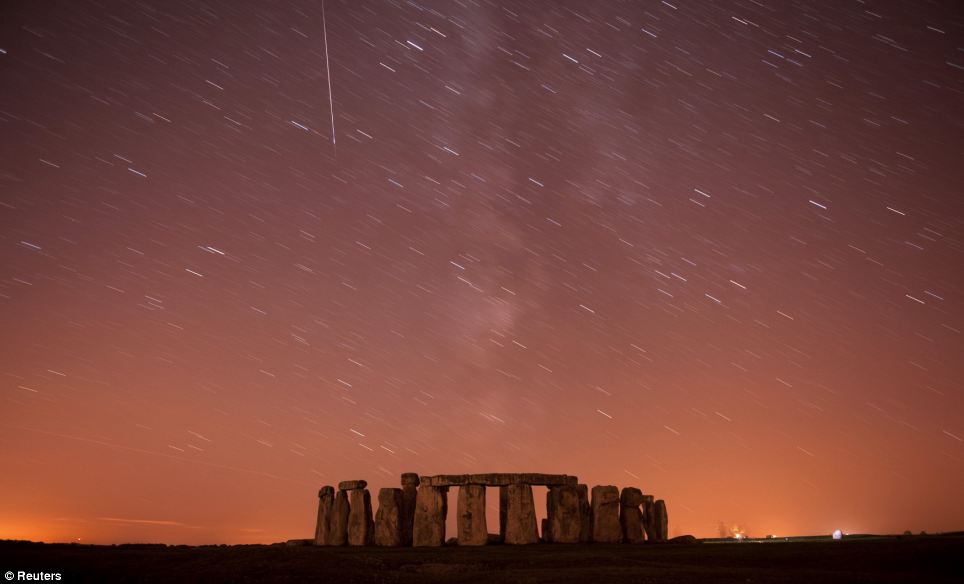
Perseid Meteor shower over Stonehenge.  Streaking down towards Stonehenge across the path of all the other stars in the sky, this shooting star is hurtling to Earth at 135,000 miles per hour – 100 times the speed of Concorde.

Perseid Meteor shower over Stonehenge. Streaking down towards Stonehenge across the path of all the other stars in the sky, this shooting star is hurtling to Earth at 135,000 miles per hour – 100 times the speed of Concorde.

Skywatchers were today given advice on how to enjoy this year’s display of Perseid meteors despite a full moon.

 The Perseids, which come every August, are normally one of the highlights of the celestial year for amateur astronomers.

Under ideal conditions up to 100 of the shooting stars an hour should be visible when the shower peaks tomorrow.
But the glare of the full moon will make it difficult to see the fainter meteors.

The moon generates natural light pollution that can be equal to that from an illuminated city centre.To help anyone hoping to spot the Perseids the National Trust has produced an online stargazing guide and listed some of its best “dark skies” locations.

Dr Marek Kukula, public astronomer at the Greenwich Royal Observatory in London, said: “The Perseids are always an exciting meteor shower to watch out for. Even in large cities it’s often possible to catch site of some of the brighter Perseid meteors streaking across the sky, but from a really dark site you can sometimes see dozens per hour.

 “Despite this year’s Perseid shower coinciding with the full moon it’s still well worth going out for a look. The meteors can appear anywhere in the sky so try looking away from the bright moon to maximise your chances of seeing one.”

 The Perseids are grains of dust shed from the tail of Comet Swift-Tuttle burning up in the atmosphere.

Every year in August the Earth ploughs through a cloud of the dust as it orbits the sun.

Among the locations highlighted by the National Trust are the area around Stonehenge in Wiltshire and Mam Tor in the Peak District, high above Sheffield.

Philip Broadbent, National Trust outdoors programme manager, said: “It’s worth spending the time to find the perfect spot to gaze up at the stars as once you’re there looking into the night sky it will take your breath away. And the best thing is that it won’t cost you a penny and this star time will always stay with you as one of those experiences that money can’t buy.”

 Alastair McBeath, director of the Society for Popular Astronomy’s meteor section, said: “As Perseid meteors near the peak are usually bright to occasionally very bright, this should mean observing will be quite rewarding despite the loss of fainter meteors to the moonlight.”

Sponsored by the ‘Stonehenge Tour Company’ www.StonehengeTours.com

Merlin at Stonehenge
The Stonehenge Stone Circle Wbsite


Visit Stonehenge on a Razorcat trike

29 07 2011

Visit Britain’s most iconic site on a Razorcat trike… 

Leave your daily routine behind and take a thrilling ride on board an exciting three-wheeler. Feel the exhilaration of the wind in your face and enjoy the freedom that only a Razorcat trike ride can give you.

 
Not only will you have a fantastic ride on our Razorcat trike but you will also experience the famous World Heritage site that has just got to be seen, Stonehenge.   On a spiritual level, it attracts people from all over the world. From an engineering point of view, it will astound you when you realise it was built over 3500 years ago and some of the stones weigh more than 40 tons – and came from Wales.

Time: 3½ hours
Distance: 75 miles
Cost: £260 – 2 people, including entrance fee

In brief:
Bath – Box – Melksham – Seend – Worton – Salisbury Plain – Stonehenge – Wyley Valley – Limpley Stoke – Bath

In detail:
From Bath we make our way over the toll bridge and on to Box. We pass Melksham and travel along the beautiful roads to Seend and Worton. We then hook up with the A360 that takes us over the Salisbury Plain. This is a fabulous road with fantastic views, taking us through some pretty little villages on the way.

As we top a rise in the road, Stonehenge is revealed in the distance for the first time – an awe-inspiring sight. We stop here for you to look around and take the tour and some photos.
Heading back, we ride a short distance on the Exeter road before cutting away to Warminster along the lovely Wyley Valley. By-passing Warminster, we make our way to Limpley Stoke and then back to Bath.

A fantastic ride to an iconic location – perfect.

When you take a ride on a Razorcat trike, YOU become the centre of attention.

Link: http://www.razorcattours.com/en/pages/tours-stonehenge.aspx

Sponsored by ‘The Stonehenge Tour Company’ www.StonehengeTours.com

Merlin @ Stonehenge
The Stonehenge Stone Circle Website


Lugnhasadh – The Celtic harvest festival on August 1st

27 07 2011

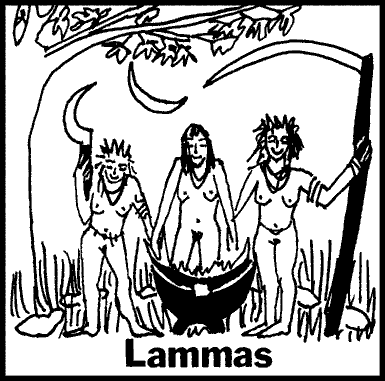
Lugnhasadh, also known as Lammas, First Harvest
The name of this festival is Irish Gaelic for “Commemoration of Lugh”. Some authors give the meaning as marriage, gathering or feast (in the name of) of Lugh. The meaning remains basically the same: Lugh is the Deity of Lughnasadh, and there is a feast.

Although Lugh gives his name to this festival, it is also associated with Lugh’s foster mother Tailtiu, who is said to have cleared the way for the introduction of agriculture in Ireland, thus linking Lughnasadh to the land and the harvest.

The modern Irish Gaelic name for the month of August is Lúnasa. In Scottish Gaelic Lunasda means the 1st of August.
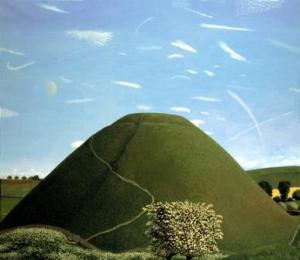
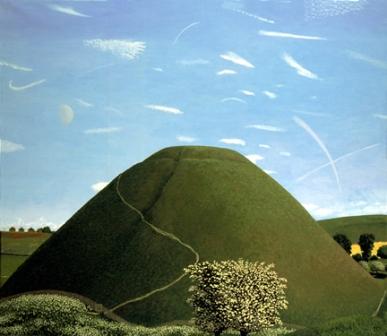
Silbury Hill

Silbury Hill -Wiltshire

One of several historic sources for the four Celtic fire festivals Imbolc, Bealtaine, Lughnasadh und Samhain is the early medieval Irish tale “Tochmarc Emire” (The Wooing of Emer), which is part of the Ulster Cycle. In the form we know it today it was written in the 10th or 11th century CE, but it is safe to assume that this tale – like so many others – contains a much older nucleus.

The tale narrates how the hero Cú Chulainn is courting Emer. He receives several tasks to fulfill, one of them being that he must go without sleep for one year. As Emer utters her challenge, she names the four major points of the Irish-Celtic year, as they are also mentioned in other Irish sources. Doing this, she does not use the solar festivals, nor Christian ones, which were certainly well known and established by the 10th century. Instead Emer choses the first days of each season.
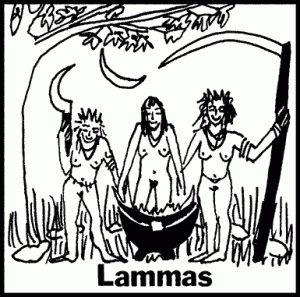
One of these days is Lughnasadh, marking the beginning of fall. It takes place on the 1st of August, a date internationally agreed upon, or on the day of the full moon next to this date, if you want to celebrate when the ancient Celts probably did.

Since the Celtic day started with sunset, the celebration takes place on the evening before the calendaric date.

Lughnasadh marks the begin of the noticeable descent of the Sun into the darkness of winter. From the connection between the Earth (female principle) and the Sun (male principle), the marriage of the Sky Father (Sun God) with the Earth Mother we celebrated at Bealtaine, emerge the fruits of the first harvest of the year. Lughnasadh is a time of joy about the first fruits. It is also a time of tension, because the dark days of winter are coming nearer, and most of the harvest is not brought in and stored away yet.

The God of the harvest is the Green Man (also known as John Barleycorn). He sacrifices himself every year in order to enable human life on Earth. In some areas his death is mourned with wreaths decorated with poppies or cornflowers.

The grain is cut, part of it goes into bread and nutrition, another part is stored away and used as seeds next spring, to create new life. Looking at that, thoughts about sacrifice, transformation, death and rebirth are also part of Lughnasadh.

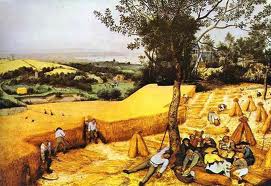
The celebration of Lughnasadh includes the ritual cutting of the first grain and an offering thereof, possibly the making of a first meal and the ritual eating of it, as well as dancing. Fires are mentioned, but fire or light do not play such a prominent role as with the other fire festivals. This is probably because August is a warm month in most of Europe, with still long daylight hours, where no fire is needed. Lughnasadh celebrations are reported from Ireland, Isle of Man, Scotland, Wales and Cornwall.

Another name used for Lughnasadh is “Lammas”, from the old-anglosaxon “hlaef-mass” (loaf mass, mass where the first loaf of bread is consecrated), which developed into the later medieval English and Scottish “Lammas”. As such it is first mentioned in old anglosaxon chronicles as early as 921 CE as “Feast of the First Fruits”. In an agricultural society the begin of the harvest was a natural occasion to celebrate and to give thanks to the Divine for Its gifts.

In Bavarian tradition, the most important festival in August is the “Ascension of Mary” on the 15th of August. On this day, numerous processions through the villages and along the fields are held. During these processions, decorated bundles of herbs, consisting of up to 77 different herbs, are carried along on wooden sticks. These herbs are specially consecrated and stored away then. They are used for ritual incense burning later in the year, e.g. during the “rough nights”, the time of the winter solstice. An older name for this festival is “Maria Kräuterweih”, meaning “Day of Mary and the Consecration of Herbs”.

The beginning of fall was marked by the day of St. Bartholomäus (Bartholomew) on August 24th.

The original Lughnasadh customs have obviously shifted to August 15th and additionally into numerous local and regional harvest celebrations. Lughnasadh is the therefore only one of the eight Celtic festivals which did not survive in Bavaria as a compact celebration ON or near the original date (August 1st). Harvest celebrations are instead dispersed over all of August. This might have to do with the geographical situation of Bavaria, where August tends to be a rather warm month, and harvest and fall are a bit later than elsewhere.

The Deities of Lughnasadh are Danu (Anu), the Mother of Gods and Men, and Lugh, the patron of scholars, craftsmen, warriors and magicians. Lugh is also known as Lugh Samildánach (the Many Skilled) and Lugh Lámhfada (Lugh with the Long Arm). It is disputed among authors whether this refers to Lugh’s magical spear or to the rays of the Sun. Lugh seems to have been worshipped, like his Greek and Roman correspondences Hermes and Mercury, mostly on elevations, hills or mountaintops.

The plant of Lughnasadh is any form of grain or corn, in a wider sense every fruit of field and garden.

The meaning of Lughnasadh on the inner planes is the start of the harvest of the fruits that we have sown in spring. Which things or projects are reaping in us in the moment? What would we like to finish, what to start anew? Do we have the insight that to every harvest there is a necessity of preparation?

The essence of Lughnasadh is the joy of life under the knowledge that darker times are moving in. We take in the warming rays of the Sun and store their power for the times coming. At the time we celebrate the next festival, Alban Elfed, it will be fall and the warm summer days will already be a memory.

Of course Lughnasadh is a very good time to express gratitude to the Gods and the Earth Spirits for their blessings and gifts that we are now receiving. In times of microwave and frozen pizza it may seem anachronistic to thank for the harvest. Many of our modern food stuffs make it hard to still recognize the waving grain on the field in them. And yet there is a way to connect with nature via the food that we eat. This is especially valid for self-harvested fruits. But also conscious eating, eating with focus on the food and not on TV or newspaper, is one way of expressing our thanks for the harvest – all year round, but especially at Lughnasadh.

Links:
http://www.mythinglinks.org/Lammas.html
http://www.chalicecentre.net/lughnasadh.htm

Sponsored by ‘The Stonehenge Tour Company’ – www.StonehengeTours.com

Merlin at Stonehenge (I will be at Avebury Stone Circle this year for Lammas)
The Stonehenge Stone Circle Website
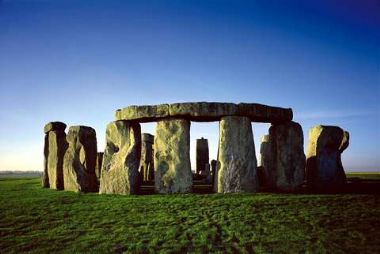


Stonehenge Crop Circle – Aliens, a hoax or energy rays from space?

18 07 2011

As if Stonehenge wasn’t mysterious enough, right across the road someone – aliens, hoaxers, or perhaps posessed lawnmowers – has created a giant crop circle. And nobody knows where it came from.

Stonehenge Crop Circle July 2011

Stonehenge Crop Circle July 2011

The ancient site is proving to be a popular attraction for crop circle-creators lately. Yesterday’s 60 metre wide effort is just the most recent in a string of field phenomena in Wiltshire over the last few weeks, reports the Daily Mail.

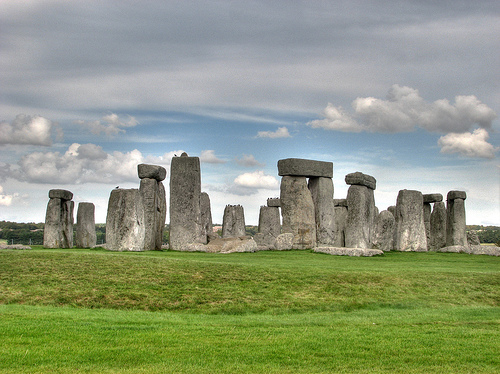
Stonehenge is the most important prehistoric monument in Britain.

The design spans 200ft and has sparked debate about its origin. Online enthusiast Eliakis Joseph-Sophia believes the “three half moons in the crop…could indicate plans due to budgets in the third quarter.”

“The crop is the other side of the road from Stonehenge. So clearly, the people involved in this crop cannot reach the sacred stones.”

Cynics claim crop circles are the work of computer scientists and volunteers, but enthusiasts argue nights – particularly in Summer – aren’t long enough for humans to get the work done by morning.

Many believe crop circles are the work of aliens or a message from God, while others are convinced it’s caused by the earth’s magnetic field or targeted energy zapped to the ground from the ionosphere

Sponsored by ‘The Stonehenge Tour Company’ www.StonehengeTours.com

Merlin at Stonehenge
The Stonehenge Stone Circle Website


Costly changes to Stonehenge

30 06 2011

English Heritage seems determined to spend millions of pounds of taxpayers’ money on not altogether necessary changes to the site around Stonehenge in Wiltshire.

The saga began last summer when the Coalition government cancelled a proposed £25m scheme to replace the current visitor centre and shift it one and a half miles away from the stones, as well as diverting the nearby A344. This was all for aesthetic reasons so as to present the Neolithic stones in a more pleasing environment away from horrid cars and pesky tourists.

At the time, the Chief Secretary to the Treasury said the scheme had been devised when the previous government was going on a ‘pre-election spending spree’ and the English Heritage proposal did not ‘represent good value for money’.
Stonehenge

Five months later, however, the scheme was back on when English Heritage received a £10m grant towards the new visitor centre and closure of the A344. Now, it is happy to see taxpayers’ money spent on a costly public inquiry into diverting the road away from the site so as to ‘restore the dignity’ of the stones.

Chief Druid Arthur Pendragon, however, smells a rat, believing the costly shifting of visitor centre and road will actually reduce public access to the prehistoric monument and give English Heritage a monopoly over visiting it.

‘We will not shrink from our responsibilities,’ he says, ‘to ensure that future generations can enjoy the environs of Stonehenge and the World Heritage site without being excluded for fiscal reasons.’

Still, maybe we should be grateful for small mercies, as English Heritage had earlier asked for £500m so they could place the section of road that runs nearest the stones to be hidden away in a tunnel. Even the previous free spending government thought this was going too far and binned the extravagant scheme in 2007.

Sponsored by the Stonehenge Tour Company – www.StonehengeTours.com

Merlin @ Stonehenge
The Stonehenge Stone Circle Website


Inquiry into Stonehenge A344 closure plans

26 06 2011

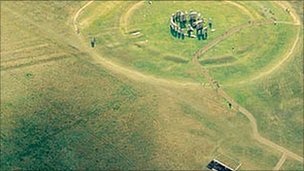
Plans to close the main road east of Stonehenge and return it to grass are being scrutinised at a public inquiry.

English Heritage wants to stop traffic from travelling close to the stones and

An aerial view of Stonehenge without the A344 road

An aerial view of Stonehenge without the A344 road

“restore the dignity” of the World Heritage Site by closing the A344.

Those opposed include chief druid Arthur Pendragon who has argued that it would give English Heritage a monopoly on access to the site.

The inquiry in Salisbury, Wiltshire, begins on Wednesday.

In June 2010 Wiltshire Council granted planning permission for a new visitors centre at Airman’s Corner, 1.5 miles (2km) west of Stonehenge.

Grassed over

Under the current scheme, the existing car park and visitor facilities at the stones will be removed and the area “returned to grass”.

English Heritage has said it will be necessary to close the A344 between Stonehenge Bottom and Byway 12 and close part of the B3086.

A new roundabout will replace the current Airman’s Corner junction to cope with the increased traffic caused by the road closures.

The Longbarow Roundabout on the A303 will also be improved.

English Heritage said it believed “everyone agrees that Stonehenge’s landscape setting is severely compromised by the intrusion of roads and traffic”.

Mr Pendragon said he was strongly opposed to the proposed traffic regulation order to restrict motorised vehicles on the remaining A344 west of Stonehenge and on two nearby byways.

He said: “We will not shrink from our responsibilities to ensure that future generations can enjoy the environs of Stonehenge and the World Heritage site without being excluded for fiscal reasons.”

Sponsored by ‘The Stonehenge Tour Company’ – www.StonehengeTours.com

Merlin @ Stonehenge
The Stonehenge Stone Circle Website


18,000 gather at a cloudy Stonehenge for all-night summer solstice party

22 06 2011

Tens of thousands of revellers gathered at Stonehenge for an all-night party to celebrate the longest day of the year this morning – despite grey clouds that obscured the sunrise.

Here comes the sun: Revellers cheer as the sun finally breaks through the clouds, more than a couple of hours after daybreak

Here comes the sun: Revellers cheer as the sun finally breaks through the clouds, more than a couple of hours after daybreak

English Heritage say 18,000 revellers descended on the site that is usually roped off to the public to witness dawn at exactly 4.43am. The event is significant for druids, who were joined by hippies, pagans and tourists as well as hordes of younger visitors in search of a good party.

However the number of people who camped out overnight or arrived early to witness the dawn was down on previous years because of the poor weather and the solstice falling on a weekday.

There was no beautiful sunrise into clear blue skies – heavy overnight rain gave way to overcast but dry skies as the sun rose, greeted by cheering and applause.

The self-styled King Arthur Pendragon, the veteran druid who led the event, said it had passed off smoothly.

‘We didn’t get a great sunrise but it was dry,’ he said. ‘Everyone seems happy with the result.

‘It is great to see the stones being used in this way, as opposed to the usual manner with tourists being herded around.’

Stonehenge, which is between 4,000 and 5,000 years old, has in past years been the site of confrontations between revellers and police.

But Superintendent Gavin Williams, of Wiltshire Police, said the majority of the crowd this year were well-behaved and ‘came to see the sunrise in the spirit of the event’, which was policed in the same way as night spots in the county. However, two men were photographed fighting at the event.

Of the 20 arrests, 11 were for drugs offences and five for public

Mr Williams said: ‘Although it was disappointing that some individuals chose to bring drugs with them, they were dealt with robustly.’

English Heritage, which manages the Stonehenge site on Salisbury Plain in Wiltshire, said the atmosphere had been ‘peaceful and good natured’.

The annual event is a modern take on solstice celebrations which were once a highlight of the pre-Christian calendar. Celebrations focus on the Heelstone, which sits just outside the main circle, and is aligned with the midsummer sunrise.

The solstice is one of the few times access is granted inside the stone circle, which has been roped off since 1978 following years of erosion and vandalism.

Stonehenge’s origins remain a mystery, but one theory is that it is a huge astronomical calendar. Others say an ancient sun-worshipping culture aligned the structure with the midsummer sunrise and the midwinter sunset.

The World Heritage site was used as a cremation cemetery since its inception, archaeologists say, but it is unclear if that was its principal function.

It was build in three phases, with stones brought from up to 150 miles away, between 3000 BC and 1600 BC

http://www.dailymail.co.uk/news/article-2006112/Summer-solstice-18-000-gather-cloudy-Stonehenge-night-party.html

Sponsored by the Stonehenge Tour Company – www.StonehengeTours.com

Merlin @ Stonehenge
The Stonehenge Stone Circle website