Leap Year Lark – Stonehenge Landscape Tour 29th February

29 02 2012

Make the most of your extra day with a lovely long walk in the outdoors!

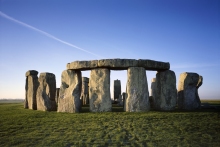
Celebrate the leap year with a walk in the Neolithic and Bronze Age Stonehenge landscape. Your guide will take you on a circuit of around 5 miles over the downs, exploring some of the less visited monuments that together form the Stonehenge World Heritage Site. Bring your binoculars and keep an eye out for hares and winter birds too.
We’re meeting in the Stonehenge Car Park SP4 7DE (not NT), at the two ‘touching stones’ at the top of the slope that leads down towards the Stonehenge Cafe. Please dress for the weather and wear stout footwear. Wrap up warm – it gets chilly up on the downs! Access is by pedestrian and farm gates; the terrain is mostly grassland and trackways, uneven underfoot.
Accessible W.C. in car park. Accompanied children welcome, free. Dogs on leads welcome.
Booking Essential 0844 249 1895. A 5% booking fee applies. Phone lines are open Mon to Fri 9am-5.30pm, plus Sat and Sun 9am-4pm.
Stonehenge Landscape
Amesbury, Salisbury
Wiltshire
SP4 7DETel: +44 (0) 844 249 1895

Day Opening Times
Wednesday 11:00 – 15:00

SPONSORED BY ‘THE STONEHENGE TOUR COMPANY’ – WWW.STONEHENGETOURS.COM

Merlin says “Get some fresh air and enjoy the Wilstshire Landscape – next one in 4 years”

Merlin @ Stonehenge


STONEHENGE: UNCOVERED – February 24th 2012

22 02 2012

Unlock the secrets of Stonehenge and the surrounding sites in this exclusive walking tour led by English Heritages’ Properties Historian Susan Greaney.Visit the World Heritage Site and key archaeological areas in this fascinating landscape. Along the way, gain an exclusive insight into the new and exciting discoveries made by recent research projects carried out in the area and discover for yourself more about this special landscape.
Stonehenge HOW TO BOOK

Purchase your tickets today by calling our dedicated Ticket Sales Team on            0870 333 1183       (Mon – Fri 8.30am – 5.30 Sat 9am – 5pm). Please note: Booking tickets for this event is essential as places are limited

Link: http://www.english-heritage.org.uk/daysout/events/stonehenge-uncovered-s-24-feb/

Sponsored by ‘The Stoneheng Tour Company’ http://www.StonehengeTours.com

Merlin say “You have to be an English Heritage member for this tour but its well worth joining”

Merlin @ Stonehenge 


Was Stonehenege built for sound effects?

17 02 2012

The origins of Stonehenge have long baffled historians – was it intended as a monument for the dead, a celestial observatory, a place or healing?

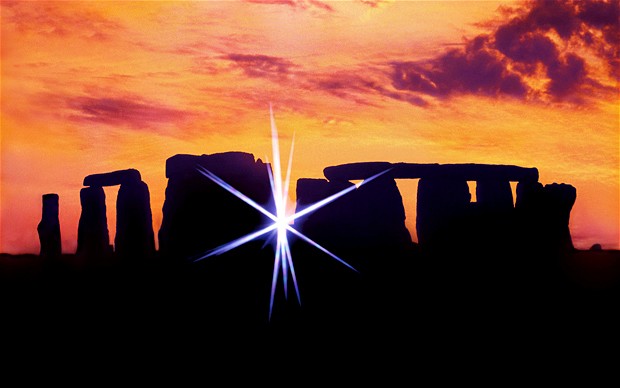
The widely accepted theory is that the arrangement of pillars at Stonehenge is related to the positioning of the Sun at the equinoxes Photo: ALAMY

The widely accepted theory is that the arrangement of pillars at Stonehenge is related to the positioning of the Sun at the equinoxes Photo: ALAMY

But now a US researcher has come up with an intriguing new theory, claiming that the ancient stones were actually arranged to create a special sound effect.

Steven Waller said the ordering of stones at the rock monument in Wiltshire could be an attempt to recreate a sound illusion known as an “interference pattern” during prehistoric pipe-playing rituals.

The effect happens when two sounds clash, and results in some people hearing a louder noise and some a softer noise, depending on where they stand in relation to the source.

People taking part in a ritual dance around a pair of pipers would have heard the music unexpectedly grow quieter as they moved past certain spots due to this natural phenomenon, Mr Waller said.

This would have created the illusion that the sound was intermittently being muffled by invisible obstacles as the dancers circled the pipers, he said.

Speaking at the American Association for the Advancement of Science (AAAS) annual meeting in Vancouver on Thursday, Mr Waller, an independent California-based researcher, said it could be a desire to recreate this natural phenomenon that provided the “blueprint” for the stone circle.

Although it remains a puzzle why our ancestors built Stonehenge, the theory contradicts the most widely accepted assertion that the arrangement of the pillars is related to the positioning of the Sun at the equinoxes.

When sound waves clash they either reinforce each other, making the noise louder, or cancel each other out, depending on the exact point at which the waves meet.

If two sound sources are positioned near one another, they will sound noticeably louder from some angles but quieter from others.

Mr Waller said: “Ancient people had myths about echos being spirits in rock. If they heard interference patterns, that would have been a mysterious thing they would have been unable to explain.

“I think they were experiencing this illusion, thinking it was magic pillars, and then constructed the actual structure.”

Mr Waller tested his theory by blindfolding three school pupils and moving them in a circle around a pair of pipes each playing the same note.

When asked to draw the field they had been in, most students sketched a series of pillars which they imagined had been responsible for blocking the sound at certain points, and which resembled the layout of Stonehenge.

Three blindfolded University of California students who took part in a similar test also believed that obstacles had been responsible for blocking the sound.

Mr Waller said: “It is unlikely this relationship is merely coincidental, because a number of megaliths are named ‘Pipers Stones’.

“There is a legend that two magic pipers led maidens into a field and enticed them to dance to music in a circle. And the pipers all turned to stone.”

Mike Pitts, editor of British Archaeology and a leading expert on Stonehenge, said researchers had established that the stone circle was built over several centuries and “Wasn’t thought up overnight”.

He said: “There is no question it’s main axis is aligned along the mid-summer sunrise and mid-winter sunset and there is widespread agreement that it was used for cremation burials.

“However, I don’t think you’ll find many archaeologists who know about Stonehenge giving this particular acoustic theory a lot of time.”

Source: http://www.telegraph.co.uk/culture/art/architecture/9086555/Was-Stonehenege-built-for-sound-effects.html

Sponsored by ‘The Stonehenge Tour Company”  www.StonehengeTours.com
Merlin @ Stonehenge


Stonehenge Summer Solstice Celebrations 2012 – June 20th / June 21st

15 02 2012

English Heritage are again expected to provide “Managed Open Access” to Stonehenge for the Summer Solstice. Please help to create a peaceful occasion by taking personal responsibility and following the conditions (see below).

Please note that a high volume of traffic is anticipated in the Stonehenge area on the evening of Wednesday 20th June. The car park (enter off the A303 from the roundabout – it’s signposted) will open at around 7pm on Wenesday 20th June, and close at around noon on Thursday 21st June.
Note that last admission to the car park for vehicles is at around 6am. Access Access to the stones themselves is expected to be from around 8.30pm on Wednesday 20th June until 8am on Thursday 21st June.

Stonehenge Summer Solstice

There’s likely to be casual entertainment from samba bands & drummers but no amplified music is allowed. When you visit Stonehenge for the Solstice, please remember it is a Sacred Place to many and should be respected. Van loads of police have been present in the area in case of any trouble, but generally a jovial mood prevails. Few arrests have been made in previous years, mostly in relation to minor drug offences.

Facilities Toilets and drinking water are available and welfare is provided by festival welfare services. There are normally one or two food and drink vans with reasonable prices but huge queues, all well away from the stones themselves.

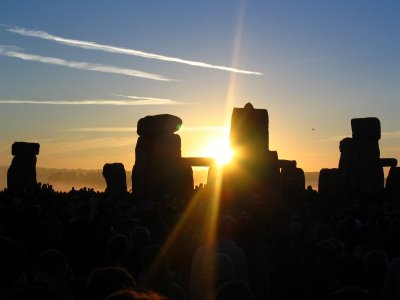
Sunrise is at around 5.14am.- in 2012

Conditions Rules include no camping, no dogs, no fires or fireworks, no glass bottles, no large bags or rucksacks, and no climbing onto the stones. Please use the bags given free on arrival and take them out, filled with your litter, to the skips provided.

Please respect the rules so that we’re all able to enjoy the solstice morning at Stonehenge for years to come.

Getting there: Where possible, please travel to Stonehenge using public transport. The local bus company, Wilts & Dorset, will be running a service from Salisbury railway and bus stations to Stonehenge over the Solstice period. This bus service will commence at 1830 hours (6.30pm) on Wednesday 20th June and run regularly until 0115 hours (1.15am) on Thursday 21st June. A service taking people back to Salisbury will start again at 0400 hours (4am) and run frequently until 0945 hours (9.45am). Access to Stonehenge from the bus drop off point is through the National Trust farmland. More information will be here when available.  Needless to say this service is extremly busy, please allow plenty of time.

From London: Our friends at the ‘Stonehenge Tour Company’ will be offering their usual small group unobtrusive tours to the solstice from London.  There are two services departing London at 4pm and 1am – Click here: ‘Stonehenge Summer Solstice Tour 2012’
Stonehenge summer solstice tours

LINKS: http://www.efestivals.co.uk/festivals/stonehenge/2011/
http://www.english-heritage.org.uk/daysout/properties/stonehenge/explore/summer-solstice-2011/:
http://www.thestonehengetour.info/

TWITTER: Follow Stonehenge on twitter.  Get all the latest news and Solstice updates – http://twitter.com/ST0NEHENGE

FACEBOOK: Join Stonehenge on facebook: http://www.facebook.com/stonehenge.tours

See you all at the Summer Solstice, yipee……………..

Merlin @ Stonehenge
The Stonehenge Stone Circle Website


Romance in the stones as Stonehenge monument tops poll

14 02 2012

It may have been a site of ritual slaughter and Druidic practices but a new poll of the UK’s top romantic locations puts Stonehenge in second place overall but top in England, beating Windermere and King Arthur’s Seat.

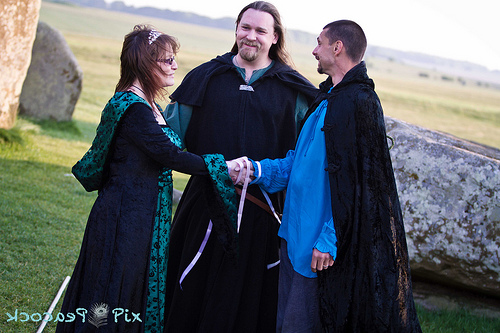
Stonehenge Handfasting

Despite its Druidic history Stonehenge has topped a poll of most romantic place in England to propose

The Welsh coastline tops the poll with 24 per cent of those surveyed voting the secluded beaches of the principality as the perfect leap year proposal spot. The Cotswolds, with its picturesque stone cottages and countryside comes third.

The survey, by PCH Prizes, also revealed that twice as many men as women voted for the turf of Wembley as their most romantic location.

Stonehenge has been attracting the spiritual and the curious for 5,000 years and while it may now be deemed romantic for Dorset novelist Thomas Hardy it was a symbol of isolation. In Tess of the d’Urbervilles Tess falls asleep on an ancient stone altar at Stonehenge after murdering Alec d’Urbeville, not the kind of future that leap-year brides are planning.
Source: http://www.thisissomerset.co.uk

Sponsored by ‘The Stonehenge Tour’ www.StonhengeTours.com

Merlin says “Happy Valentines Day, remember it is actually a Pagan festival!

Merlin @ Stonehenge
The Stonehenge stone Circle website


Mystery of Britain’s Largest Meteorite Solved. Found at Druids burial site near Stonehenge

10 02 2012

With a weight that rivals a baby elephant, a meteorite that fell from space some 30,000 years ago is likely Britain’s largest space rock. And after much sleuthing, researchers think they know where it came from and how it survived so long without weathering away.
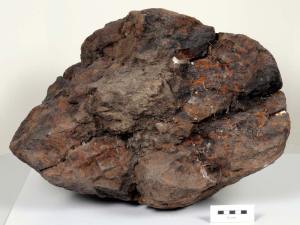
Likely the largest meteorite found in Britain, this one spans about 1.6 feet (0.5 meters) across and has been on Earth some 30,000 years.

Likely the largest meteorite found in Britain, this one spans about 1.6 feet (0.5 meters) across and has been on Earth some 30,000 years.

The giant rock, spanning about 1.6 feet (0.5 meters) across and weighing 205 pounds (93 kilograms), was likely discovered by an archaeologist about 200 years ago at a burial site created by the Druids (an ancient Celtic priesthood) near Stonehenge, according to said Colin Pillinger, a professor of planetary sciences at the Open University.

Pillinger curated the exhibition “Objects in Space,” which opens today (Feb. 9th) and is the first time the public will get a chance to see the meteorite. The exhibition will explore not only the mystery that surrounds the origins of the giant meteorite, but also the history and our fascination with space rocks.

As for how the meteorite survived its long stint on Earth, researchers point to the ice age.

“The only meteorites that we know about that have survived these long ages are the ones that were collected in Antarctica,” said Pillinger, adding that more recently, some ancient meteorites have been collected in the Sahara Desert. This rock came from neither the Sahara Desert nor Antarctica, but rather the Lake House in Wiltshire.

“Britain was under an ice age for 20,000 years,” Pillinger told LiveScience, explaining the climate would have protected the rock from weathering.

At some point, the Druids likely picked up the meteorite when scouting for rocks to build burial chambers. “They were keen on building burial sites for [the dead] in much the same way the Egyptians built the pyramids,” Pillinger said.

Then, years later, an archaeologist with ties to other, famous archaeologists, likely found the rock while excavating the Druids’ burial sites, he said. The archaeologist then brought the rock back to his house in Wiltshire, where its more recent residents took notice and alerted researchers.

“The men whose house this was found at spent a lot of time opening these burial sites 200 years ago for purposes of excavating them,” Pillinger said. “Our hypothesis is that the stone probably came out of one of those burial chambers.”

The meteorite is called a chondrite, a group that includes primitive meteorites that scientists think were remnants shed from the original building blocks of planets. Most meteorites found on Earth fit into this group.
The much smaller meteorite on display at the Royal Society's exhibit was excavated from a grain pit where ancient peoples of the Iron Age stored their crops.

The much smaller meteorite on display at the Royal Society's exhibit was excavated from a grain pit where ancient peoples of the Iron Age stored their crops.

Other objects on display include a much smaller meteorite, weighing about an ounce (32 grams), and excavated from a grain pit where ancient peoples of the Iron Age stored their crops. It was discovered in the 1970s at Danebury Hill Fort in Hampshire, though it wasn’t until the 1980s when scientists analyzed metal in the walnut-size object did they realize its extraterrestrial origin.

The exhibition will also include a Damien Hirst “spot painting,” which features the famous Beagle 2 spacecraft as its center spot. In addition, part of Newton’s apple tree will be on display.

The story of how researchers are uncovering the origins of these impressive specimens will astonish and delight visitors to this remarkable exhibition, which also contains letters and books charting the history of scientific interest in meteorites.  

The Royal Society’s London headquarters will house the exhibit through March 30.

Follow LiveScience for the latest in science news and discoveries on Twitter @livescienceand on Facebook.
Sore: http://www.livescience.com

Sponsored by ‘The stonehege Tour Company’www.StonehengeTours.com

Merlin says “Out of this world”

Merlin @ Stonehenge
The Stonehenge Stone Circle Website


Celebrations at Stonehenge for World Heritage Day 2012

7 02 2012

A CELEBRATION of World Heritage Day is set to take place at Stonehenge and Avebury in April.

Stonehenge heritage dayPeople are being invited to join English Heritage experts and discover the prehistoric landscapes and how World Heritage Site status is helping to conserve them.

The event, being held between 10am and 6pm on April 18, is also a celebration of the 40th anniversary of the World Heritage Convention.

Tickets cost £35 per person and must be booked in advance.

To find out more and to book a place, contact English Heritage customer services on 0870 333 1181.

Link: http://www.salisburyjournal.co.uk
Sponsored by ‘The Stonehnege Tour Companywww.StonehengeTours.com

Melin says “All good for Wiltshire Tourism, bring it on…….”

Merlin @ Stonehenge


Brand new image for Wiltshire’s historic stones

6 02 2012

The builders of Stonehenge and Salisbury Cathedral would be puzzled to hear their creations are now considered ‘brands’.

 But VisitWiltshire, the tourism organisation subsidised by £1.5million of council taxpayers’ money, has launched a new “group visits and travel trade guide” advertising the county’s many attractions.

A statement from the organisation said: “Major brands working with VisitWiltshire include Stonehenge, Salisbury Cathedral, Longleat, Bowood, STEAM, McArthurGlen Swindon Designer Outlet, English Heritage and the National Trust.”

 The guide also mentions events being organised during 2012, such as the Olympic torch relay, the illumination of the White Horses at Devizes and Alton Barnes, an elemental fire garden at Stonehenge and Le Concert du Feu in Salisbury.

David Andrews, chief executive of VisitWiltshire, said: “With a record number of members in the 2012 guide, we are increasing our focus on travel trade activity.

 “Tourism plays a vital role in Wiltshire’s economy, generating an estimated £1billion and creating 20,000 jobs.” For a copy of the guide, call (01722) 341760 or visit www. visitwiltshire.co.uk

Link: http://www.thisiswiltshire.co.uk

Sponsored by ‘The Stonehenge Tour Company’ www.StonehengeTours.com

Merlin @ Stonehenge


Trio collaborate for exhibition of Hardy’s Wessex

27 01 2012

THOMAS Hardy immortalised Wessex in his novels and poems. Three artists who share a common interest in the writer’s use of landscape, Dave Gunning, David Inshaw and Rob Pountney, have collaborated in a fascinating exhibition currently on show in the upstairs gallery at Salisbury and South Wiltshire Museum.

Salisbury Cathedral and The Close feature in Jude the Obscure (Salisbury became Melchester in Hardy novels), and it is fitting that the exhibition is in the museum. In Jude the Obscure, Hardy based the college that Sue Bridehead attends on the training college for schoolmistresses that his sisters attended. This was the King’s House, now home to the museum.

Stonehenge plays a starring role at the tragic end of Tess of the D’Urbervilles and Robert Pountney’s works in the exhibition capture the stones in a dramatic context.

Landscapes of Thomas Hardy’s Wessex is a beautifully crafted exhibition and well worth a visit. It runs until April 14

Sourse: http://www.salisburyjournal.co.uk

Sponsored  by ‘The Stonehenge Tour Company’ www.StonehengeTours.com


Stonehenge: Closure of A344 near monument to go ahead

1 01 2012

Plans to close a main road running past Stonehenge are to go ahead.

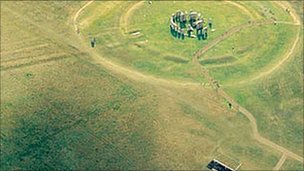
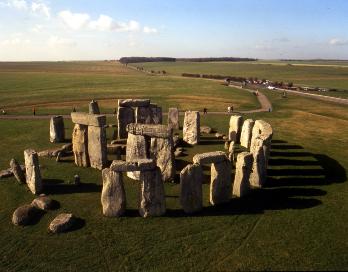
An aerial view of Stonehenge without the A344 road

An aerial view of Stonehenge without the A344 road

English Heritage wants to stop traffic from travelling close to the stones and “restore the dignity” of the World Heritage Site by closing the A344.

The road from the A303 at Stonehenge Bottom to west of the visitor centre has already been approved for closure.

Now, following a public inquiry, Wiltshire Council has approved an independent inspector’s report to close the remaining section of road.

In June 2010 the council granted planning permission for a new visitors centre at Airman’s Corner, 1.5 miles (2km) west of Stonehenge.

And in November, roads minister Mike Penning approved plans to close an 879m (2,884ft) section of the A344 from its junction with the A303 at Stonehenge Bottom with a stopping up order.

Byways remain open

Now the council has approved a traffic regulation order (TRO) for the remainder of the A344 to Airman’s Corner.

But proposals to close a number of byways around the ancient monument were refused.

Druid leader King Arthur Pendragon said the inspector’s recommendations and resulting council decision had “erred on the side of common sense”.

“I invited the inspector to recommend a modification to the order be made in that should the stopping up order be placed on the lower section of the A344 the remaining section of the metalled road be restricted by a traffic regulation order as requested.

“And he recommended that the proposed TRO be made with modification to the A344 only, leaving the byways in the World Heritage Site still open to all traffic, as they have been.”

Link: http://www.bbc.co.uk/news/uk-england-wiltshire-16352307

Sponsored by ‘The Stonehenge Tour Compant’ www.StonehengeTours.com

Merlin says “Good news”

Merlin @ Stonehenge