Druids as an official religion? Stones of Praise here we come

4 10 2010

This article written by Malanie Philips (Daily Mail) is sure to anger Pagans and the Druid Order

Will someone please tell me this is all a joke. Until now, Druids have been regarded indulgently as a curious remnant of Britain’s ancient past, a bunch of eccentrics who annually dress up in strange robes at Stonehenge to celebrate the summer solstice.

However, according to the Charity Commission, they are to be recognised as a religion and, as a result, afforded charitable status, with the tax exemptions and other advantages that follow.

After a four-year campaign, the Commission says it accepts that the Druids worship nature and that they also believe in the spirits of places such as mountains and rivers, as well as in ‘divine guides’.
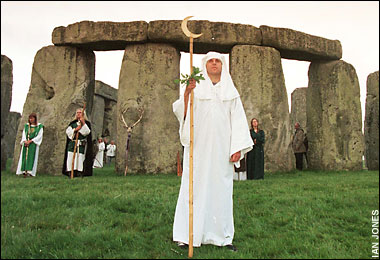
 This, apparently, makes them qualify as a religion.

Can it be long before the BBC transmits Stones Of Praise, or solemnly invites listeners to Radio 4’s Thought For The Day to genuflect to a tree?

Some might shrug this off. After all, the Druids don’t do any harm to anyone. What skin is it off anyone else’s nose how they are categorised?

CULT ?

Well, it actually matters rather a lot. Elevating them to the same status as Christianity is but the latest example of how the bedrock creed of this country is being undermined. More than that, it is an attack upon the very concept of religion itself.

This is because Druidry is simply not a religion. Now, it’s true that religion is notoriously difficult to define. But true religions surely rest on an established structure of traditions, beliefs, literature and laws.

Above all, they share a belief in a supernatural deity (or more than one) that governs the universe

By these standards, Druidry is surely not a religion but a cult — a group defined merely by ritual practices but which stands outside mainstream religion.

Nor does it seem to conform to the definition of a religion according to charity law.

When Radio 4’s Sunday Programme suggested yesterday morning to Phil Ryder, chairman of the Druid Network, that the legal definition of religion included a ‘significant belief in a supreme being or entity’, he saw no contradiction. Druids, he said cheerfully, might venerate many gods, inanimate objects or nature.

How very inclusive of them! But the key point is surely that none of these beliefs involves a ‘supreme’ being that exists beyond the Earth and the universe. On the contrary, Druids worship what is in or on the earth itself.

When asked further how Druidry benefited the public interest — the key test for charitable status — Mr Ryder burbled that its ethical framework consisted of forming ‘honourable and sustainable relationships’ with everything in the world, including animals, people and nature.

But there are many who subscribe to no belief system at all and who would say they, too, want to live in harmony with the earth and everything in it. Are they, therefore, also to be regarded as religious folk and given charitable status?

Maybe Prince Charles, who famously talks to his plants, could register himself on that basis as the founder of a new religion? Duchy Devotions, anyone?

If the Druids qualify as a religion, can other cults such as the Scientologists be far behind?

Can it be long, indeed, before the wise and learned theologians of the Charity Commission similarly grant charitable status to sorcery, witchcraft or even the Jedi — the fictional Star Wars ‘religion’ which the 2001 census recorded as having no fewer than 390,127 adherents in England and Wales.

The whole thing is beyond absurd. But it is also malevolent. For it is all of a piece with the agenda by the oh-so politically correct Charity Commission to promote the fanatical religious creed of the Left — the worship of equality.

The Commission was primed by Labour for this attempt to restructure society back in 2006, when charity law was redrawn to redefine ‘public benefit’ as helping the poor.

This put the independent schools in the front line of attack, since education was no longer itself considered a benefit — as it had been since time immemorial — but only insofar as it furthered the ideology of ‘equality’.

Extraordinary

Thus, we have arrived at the extraordinary situation where some of these schools, which have delivered such inestimable benefit to the nation, face the loss of their charitable status, which is to be given instead to people who dance naked around stones and worship the sun.

But the new respectability of paganism cannot be laid entirely at the Charity Commission’s door. For in recent years, pagan practices have been rapidly multiplying, with an explosion of the occult: witchcraft, parapsychology, séances, telepathy and mind-bending cults.

Astonishingly, around 100 members of the Armed Forces now classify themselves as pagans, and a further 30 as witches.

There are thought to be about 500 pagan police officers. A Pagan Police Association has even been set up to represent officers who ‘worship nature and believe in many gods’.

They have been given the right to take days off to perform rituals, such as leaving food out for the dead, dressing up as ghosts and casting spells, or celebrating the sun god with ‘unabashed sexuality and promiscuity’.

Britain’s prison authorities are equally hospitable to the occult: under instructions issued to every prison governor, pagan ‘priests’ are allowed to use wine and wands during ceremonies in jails. Inmates practising paganism are allowed a hoodless robe, incense and a piece of religious jewellery among their personal possessions.

Political correctness gone mad or what? As one disgusted police officer exploded: ‘What has it come to when a cop gets time off so he can sit about making spells or dance around the place drinking honey beer with a wand in his hand?’

Barking

How on earth has our supposedly rational society come to subscribe to so much totally barking mumbo-jumbo?

In part, it developed from the New Age embrace of Eastern beliefs in the inter-connectedness of everything in the universe. The defining characteristic of such faiths is a spirituality which is concerned with the self rather than the world beyond the individual.

These beliefs were, therefore, tailor-made for the ‘me society’ which turned against Biblical constraints on behaviour in the interests of others. They were subsequently given rocket fuel by environmentalism, at the core of which lies the pagan worship of ‘Mother Earth’.

And they were then legitimised by the doctrines of equality of outcomes and human rights — which, far from protecting the rights of truly religious people, aim to force Biblical morality and belief out of British and European public life altogether.

This is because human rights and equality of outcomes are held to be universal values. That means they invariably trump specific religious beliefs to impose instead equal status for all creeds.

But if all creeds, however absurd, have equal meaning then every belief is equally meaningless. And without the Judeo-Christian heritage there would be no morality and no true human rights.

There is nothing remotely enlightened about paganism. It was historically tied up with both communism and fascism, precisely because it is a negation of reason and the bedrock values behind Western progress.

The result is that, under the secular onslaught of human rights, our society is reverting to a pre-modern era of anti-human superstition and irrationality. From human rights, you might say, to pagan rites in one seamless progression.

Anyone who thinks radical egalitarianism is progressive has got this very wrong. We are hurtling backwards in time to a more primitive age**

 **Is that such a bad thing ?  Food for though!

Merlin @ Stonehenge
The Stonehenge Stone Circle Website


Druids Recognized As Religion For First Time In UK

3 10 2010
 

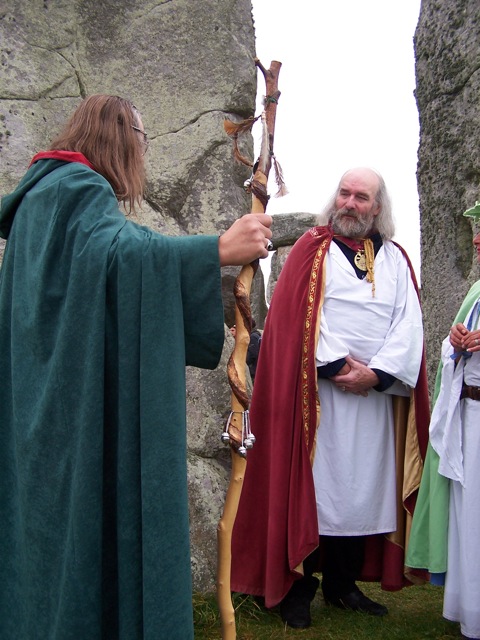
 Druids have been worshipping the sun and earth for thousands of years in Europe, but now they can say they’re practicing an officially recognized religion.

The ancient pagan tradition best known for gatherings at Stonehenge every summer solstice has been formally classed as a religion under charity law for the first time in Britain, the national charity regulator said Saturday. That means Druids can receive exemptions from taxes on donations — and now have the same status as such mainstream religions as the Church of England.

The move gives an old practice new validity, said Phil Ryder, the chairman of the 350-member Druid Network.

“It will go a long way to make Druidry a lot more accessible,” he said.

Druids have practiced for thousands of years in Britain and in Celtic societies elsewhere in Europe. They worship natural forces such as thunder and the sun, and spirits they believe arise from places such as mountains and rivers. They do not worship a single god or creator, but seek to cultivate a sacred relationship with the natural world.

Although many see them as robed, mysterious people who gather every summer solstice at Stonehenge — which predates the Druids — believers say modern Druidry is chiefly concerned with helping practitioners connect with nature and themselves through rituals, dancing and singing at stone circles and other sites throughout the country believed to be “sacred.”

Ancient Druids were known to be religious leaders, judges and sages among the Celts during pre-Christian times, although little evidence about their lives survived. There are now various Druid orders and about 10,000 practitioners in Britain — and believers said the numbers are growing because more people are becoming aware of the importance to preserve the environment.

The Druid Network fought for nearly five years to be recognized under the semi-governmental Charity Commission, which requires proof of cohesive and serious belief in a supreme entity and a moral framework.

After initially rejecting the Druid Network’s application, the Charity Commission decided this week that Druidry fit the bill.

“There is sufficient belief in a supreme being or entity to constitute a religion for the purposes of charity law,” the commission said.

Adrian Rooke, a Druid who works as a counselor, said Druidry appeals to people who are turning away from monotheistic religions but still long for an aspect of spirituality in their lives.

“It uplifts the spirit,” he said. “The world is running out of resources, and in that context it’s more important to people now to formulate a relationship with nature.”

2_Britain_Druids_Recognized.sff.jpg

Associated Press Druids performing pagan rituals as part of the Summer Solstice ceremonies at Stonehenge, Wiltshire, England, before dawn, Monday June 21, 2004. The stone circle at Stonehenge is believed to be at least 4,500 years old. Druidry has been officially recognized as a religion in Britain under charity law. The Charity Commission has granted the Druid Network charitable status, giving it tax breaks and equal status to mainstream religions like Christianity. The commission said Saturday Oct. 2, 2010, that druidry has a coherent and serious set of beliefs and that it offers a beneficial ethical framework.

1_Britain_Druids_Recognized.sff.jpg

 Associated Press This Tuesday Aug. 10, 1999 photo from files shows Arch Druid Ed Prynn as he calls down the sun during his sun dance around a ring of stones, in St. Merryn, England. The druid dance is to celebrate the total eclipse of the sun, which is due in this part of southwest England on August 11. Druidry has been officially recognized as a religion in Britain under charity law. The Charity Commission has granted the Druid Network charitable status, giving it tax breaks and equal status to mainstream religions like Christianity. The commission said Saturday that druidry has a coherent and serious set of beliefs and that it offers a beneficial ethical framework.

More information try these links:

British Druid Order

The British Druid Order (BDO) teaches and practices a shamanic, mystical, celebratory form of Druidry, inspired by the past but deeply relevant to the
www.druidry.co.uk/

The Official Website Of The Council Of British Druid Orders – (CoBDO)™

The Council of British Druid Orders, CoBDO, would like to recommend one of our initial co-founders, who at present is not a member, the Order of Bards,
http://www.cobdo.org.uk/

Merlin @ Stonehenge
The Stonehenge Stone Circle Website


Historic sites consultation – Stonehenge, Avebury and Associated Sites World Heritage Property

1 10 2010

A consultation has been launched to find out what people think about a document which will help manage and protect the Stonehenge and Avebury World Heritage Site.

Stonehenge, Avebury and Associated Sites World Heritage Property Consultation Draft

Stonehenge, Avebury and Associated Sites World Heritage Property Statement of Outstanding Universal Value

This consultation is being hosted on behalf of the Stonehenge and Avebury Steering Committees of which Wiltshire Council is a member.

The Stonehenge, Avebury and Associated Sites World Heritage Property is one of Wiltshire’s greatest assets.  This consultation provides an opportunity for local people, community groups and other organisations to comment on its Statement of Outstanding Universal Value.  This Statement sets out formally why Stonehenge and Avebury are internationally important and what qualifies them to appear on the World Heritage List.  It also sets out how requirements for management and protection of these qualities are being met. 

This document is important for the protection of what makes Stonehenge and Avebury internationally significant.  It defines the World Heritage Site’s Outstanding Universal Value (OUV).  The United Kingdom signed up to protect the OUV of its World Heritage Sites when it ratified the United Nations Educational, Scientific and Cultural Organisation (UNESCO) Convention Concerning the Protection of the World Cultural and Natural Heritage (1972). 

The planning system has a very important role in this protection.  Planning Circular 07/2009 states clearly the need to protect the Outstanding Universal Value of World Heritage Sites, while the guidance accompanying the new Planning Policy 5 on the Protection of the Historic Environment (2010) identifies the Statement of OUV as a critical resource for local planning authorities in plan-making and reaching decisions relating to the significance of World Heritage Sites.  The document will also inform all management decisions which should prioritise the protection OUV as defined in the Statement.  Your comments on the Statement of OUV could therefore contribute to protecting the very special qualities of Stonehenge and Avebury for this and future generations. 

Since 2007 UNESCO has required a Statement OUV for all new World Heritage Properties.  Stonehenge and Avebury were inscribed in 1986.  All sites inscribed prior to 2007 are now required to submit retrospectively a Statement of OUV. This must be based on the original reasons for inscription set out in evaluation and decision documents from 1986.  The process of producing the Statement of OUV is not an opportunity to change or add to the reasons for inscription but a chance to distil them into a single document which will be key the World Heritage Property’s protection. It is however possible to reflect challenges which have emerged over the last 25 years as well as changes in the management and protection context. 

The original documents submitted to UNESCO during the nomination of the Stonehenge, Avebury and Associated Sites World Heritage Property in 1986 can be accessed via this link to the UNESCO website: http://whc.unesco.org/en/list/373/documents/ 

The Statement of OUV consists of four sections:The first section, the Statement of Significance, was agreed by UNESCO’s World Heritage Committee in 2008 after a period of consultation and sign off by the Stonehenge and Avebury Steering Groups representing key local and national stakeholders. 

We are now due to submit the final three sections:

2. Statement of Integrity

3. Statement of Authenticity

4. Requirements for  Management and Protection

We would appreciate your comments to assist us in shaping a robust and comprehensive document.  

Please note comments are sought only on the last three sections: integrity, authenticity and management and protection.  The first section, the Statement of Significance, has already been agreed by UNESCO’s World Heritage Committee.

Guidance on the UNESCO definitions of authenticity and integrity can be found the World Heritage Operational Guidelines (paras 79 – 89 and Annex 4) which can be found at http://whc.unesco.org/en/guidelines/ Further background information can be found in the management plans for the two halves of the World Heritage Site.  They include sections summarising integrity and authenticity as well as the provisions for management and protection

You can access the Stonehenge Management Plan on the English Heritage website via this link http://www.english-heritage.org.uk/daysout/properties/stonehenge/world-heritage-sites/stonehenge-management-plan/

You can access the Avebury Management Plan on the Wiltshire Council website via this link http://www.wiltshire.gov.uk/leisureandculture/museumhistoryheritage/worldheritagesite/aveburyworldheritagesitemanagementplan.htm

Merlin @ Stonehenge
The Stonehenge Stone Circle Website


Stonehenge a monumental attraction since prehistory

1 10 2010

Stonehenge may have been a top international tourist attraction in prehistoric times – just as it is today.

 Ongoing scientific research suggests that around 30 per cent of the wealthiest individuals buried around the neolithic and Bronze Age temple came from hundreds and, in some cases, thousands of miles away.

 Recent isotopic tests carried out by the British Geological Survey and announced yesterday reveal that one very high-status individual – a teenage boy – found buried near Stonehenge, had in fact come from somewhere along the north coast of the Mediterranean, potentially Spain, southern France or Italy.

 Another individual, whose origins were revealed a few years ago, came from the Alps – and others came from Brittany (or possibly Wales).

 The Alpine individual suffered from a painful leg condition and the Mediterranean teenager died aged 14 or 15 and is likely therefore to have also suffered from serious illness.

 Some archaeologists have therefore begun to speculate that Stonehenge attracted health tourists who went there to be cured – and ended up being buried there instead.

 Interestingly, a healing function for Stonehenge is hinted at by Arthurian legend, which holds that the monument was indeed an ancient healing centre. Even as late as the 18th century, the stones of Stonehenge were regarded as having magical healing powers – and visitors to the site often chipped bits off to take away as talismans.

 Certainly the monument was internationally known in ancient times – and appears to have been described by a fourth-century BC Greek geographer, centuries after it had actually gone out of use.

 Stonehenge’s international visitors were extremely wealthy. The Alpine man was buried with gold and copper objects – including three copper daggers and a pair of gold hair clasps.

 The Mediterranean teenager was buried wearing a necklace of around 90 amber beads.

 “Isotopic analyses of tooth enamel from both these people shows that the two individuals provide a contrast in origin, which highlights the diversity of people who came to Stonehenge from across Europe,” said Professor Jane Evans, head of archaeological science at the British Geological Survey.

 Merlin @ Stonehenge
The Stonehenge Stone Circle Website


Stonehenge boy ‘was from the Mediterranean’

29 09 2010

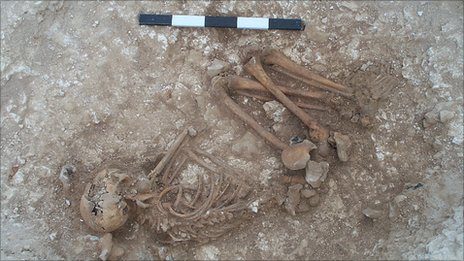
Chemical tests on teeth from an ancient burial near Stonehenge indicate that the person in the grave grew up around the Mediterranean Sea.


The bones belong to a teenager who died 3,550 years ago and was buried with a distinctive amber necklace.

 “The position of his burial, the fact he’s near Stonehenge, and the necklace all suggest he’s of significant status”

End Quote Professor Jane Evans British Geological Survey

The conclusions come from analysis of different forms of the elements oxygen and strontium in his tooth enamel.


Analysis on a previous skeleton found near Stonehenge showed that that person was also a migrant to the area.

 The findings will be discussed at a science symposium in London to mark the 175th anniversary of the British Geological Survey (BGS).

The “Boy with the Amber Necklace”, as he is known to archaeologists, was found in 2005, about 5km south-east of Stonehenge on Boscombe Down.

 The remains of the teenager were discovered next to a Bronze Age burial mound, during roadworks for military housing.

“He’s around 14 or 15 years old and he’s buried with this beautiful necklace,” said Professor Jane Evans, head of archaeological science for the BGS.

 “The position of his burial, the fact he’s near Stonehenge, and the necklace all suggest he’s of significant status.”

 Dr Andrew Fitzpatrick, of Wessex Archaeology, backed this interpretation: “Amber necklaces are not common finds,” he told BBC News.

“Most archaeologists would say that when you find burials like this… people who can get these rare and exotic materials are people of some importance.”

 Chemical record

Professor Evans likened Stonehenge in the Bronze Age to Westminster Abbey today – a place where the “great and the good” were buried.

 Tooth enamel forms in a child’s first few years, so it stores a chemical record of the environment in which the individual grew up.

Amber beads (BGS) The amber to make the beads almost certainly came from the Baltic Sea

Two chemical elements found in enamel – oxygen and strontium – exist in different forms, or isotopes. The ratios of these isotopes found in enamel are particularly informative to archaeologists.

Most oxygen in teeth and bone comes from drinking water – which is itself derived from rain or snow.

In warm climates, drinking water contains a higher ratio of heavy oxygen (O-18) to light oxygen (O-16) than in cold climates. So comparing the oxygen isotope ratio in teeth with that of drinking water from different regions can provide information about the climate in which a person was raised.

Most rocks carry a small amount of the element strontium (Sr), and the ratio of strontium 87 and strontium 86 isotopes varies according to local geology.

The isotope ratio of strontium in a person’s teeth can provide information on the geological setting where that individual lived in childhood.

By combining the techniques, archaeologists can gather data pointing to regions where a person may have been raised.

Tests carried out several years ago on another burial known as the “Amesbury Archer” show that he was raised in a colder climate than that found in Britain.

Analysis of the strontium and oxygen isotopes in his teeth showed that his most likely childhood origin was in the Alpine foothills of Germany.

Stonehenge People were visiting Stonehenge from afar during the Bronze Age
“Isotope analysis of tooth enamel from both these people shows that the two individuals provide a contrast in origin, which highlights the diversity of people who came to Stonehenge from across Europe,” said Professor Evans.

 The Amesbury Archer was discovered around 5km from Stonehenge. His is a rich Copper Age or early Bronze Age burial, and contains some of the earliest gold and copper objects found in Britain. He lived about 4,300 years ago, some 800 years earlier than the Boscombe Down boy.

 The archer arrived at a time when metallurgy was becoming established in Britain; he was a metal worker, which meant he possessed rare skills.

 “We see the beginning of the Bronze Age as a period of great mobility across Europe. People, ideas, objects are all moving very fast for a century or two,” said Dr Fitzpatrick.

 “At the time when the boy with the amber necklace was buried, there are really no new technologies coming in [to Britain]… We need to turn to look at why groups of people – because this is a youngster – are making long journeys.”

 He speculated: “They may be travelling within family groups… They may be coming to visit Stonehenge because it was an incredibly famous and important place, as it is today. But we don’t know the answer.”

 Other people who visited Stonehenge from afar were the Boscombe Bowmen, individuals from a collective Bronze Age grave. Isotope analysis suggests these people could have come from Wales or Brittany, if not further afield.

 Merlin @ Stonehenge
The Stonehenge Stone Circle Website


Autumn Equinox 2010 – Stonehenge Celebrations

23 09 2010

Stonehenge Autumn Equinox 2010

 The Autumn Equinox (also known as Mabon) is celebrated when day and night are of equal duration before the descent into increasing darkness and is the final festival of the season of harvest.  For many pagans, this is the time to reflect on the past season, and to recognize the balance of the year has changed.

Although the Summer Solstice at Stonehenge attrackts a large crowd, you may expect the Autumn Equinox celebrations to be less attended, with fewer than 1,000 people showing up.

The 2010 Autumnal Equinox takes place on September 23th, at 4.03am UK time (3.03 UTC), but when ‘open access’ to Stonehenge starts is decided by English Heritage and depends on visibility. The sunrise is at 6.48am, and it is expected access to the stones will be allowed from approximately 6.30 to 8.30am.

Public access to Stonehenge is denied after dark, so if you want to see the sunset on September 22th (18.59pm), you’ll have to stand on either the Avenue or on the side of the A344

The Autumnal Equinox

In September is the Fall Equinox, which has come to be called Mabon by many contemporary Neo-Pagans. Occuring approximately on September 21st, this is the day when the hours of daylight and nighttime are once again balanced. Calender days from now until the Winter Solstice will slowly get shorter and shorter in their daylight hours.

Agriculturally, this time of year the harvest is now in full swing, with late summer and fall fruits, vegetables and grains being gathered up before winter. This is the time of year a lot of canning or preserving of garden foods takes place. Hunting season also starts around this time, and this was when farmers would slaughter animals and preserve meat for the coming months as well.

This holiday is the last of the harvest holidays which began with the summer solstice and continued with Lammas.


21st/23rd September Harvest time!
The Autumn Equinox or Harvest Home is also called Mabon, pronounced ‘MAY-bon’, after the Welsh god Mabon ap Modron, which means literally ‘son of mother’. Mabon appears in ‘The Mabinogion’ tale. The Druids call this celebration, Mea’n Fo’mhair, and honour The Green Man, the God of the Forest, by offering libations to the trees. The Welsh know this time as ‘Alban Elfed’, meaning ‘light of autumn’. This is the point of the year when once again day and night are equal – 12 hours, as at Ostara, the Spring Equinox. The Latin word for Equinox means ‘time of equal days and nights’. After this celebration the descent into winter brings hours of increasing darkness and chiller temperatures. It is the time of the year when night conquers day. After the Autumn Equinox the days shorten and nights lengthen. To astrologers this is the date on which the sun enters the sign of Libra, the scales, reflecting appropriately the balanced day and night of the equinox. This was also the time when the farmers brought in their harvested goods to be weighed and sold.
Harvest festival This is the second festival of the season of harvest – at the beginning of the harvest, at Lammas, winter retreated to his underworld, now at the Autumn equinox he comes back to earth. For our Celtic ancestors this was time to reflect on the past season and celebrate nature’s bounty and accept that summer is now over. Harvest Home marks a time of rest after hard work, and a ritual of thanksgiving for the fruits of nature. This is the time to look back on the past year and what you have achieved and learnt, and to plan for the future. The full moon nearest to the Autumn Equinox is called the Harvest Moon and farmers would harvest their crops by then, as part of the second harvest celebration. Mabon was when livestock would be slaughtered and preserved (salted and smoked) to provide enough food for the winter. At the South Pole they will be celebrating the first appearance of the sun in six months. However, at the North Pole they will be preparing for six months of darkness. During Medieval times, the Christian Church replaced Pagan solstices and equinox celebrations with Christianized occasions. The Autumn equinox celebration was Michaelmas, the feast of the Archangel Michael.

The triple Goddess – worshipped by the Ancient Britons, is now in her aspect of the ageing Goddess and now passes from Mother to Crone, until she is reborn as a youthful virgin as the wheel of nature turns. At the Autumn equinox the goddess offers wisdom, healing and rest. Mabon Traditions The Wicker man There was a Celtic ritual of dressing the last sheaf of corn to be harvested in fine clothes, or weaving it into a wicker-like man or woman. It was believed the sun or the corn spirit was trapped in the corn and needed to be set free. This effigy was usually burned in celebration of the harvest and the ashes would be spread on the fields. This annual sacrifice of a large wicker man (representing the corn spirit) is thought by many to have been the origin of the misconception that Druids made human sacrifices. ‘The reaping is over and the harvest is in, Summer is finished, another cycle begins’ In some areas of the country the last sheaf was kept inside until the following spring, when it would be ploughed back into the land. In Scotland, the last sheaf of harvest is called ‘the Maiden’, and must be cut by the youngest female in attendance.
To Autumn O Autumn, laden with fruit, and stained With the blood of the grape, pass not, but sit Beneath my shady roof, there thou may’st rest, And tune thy jolly voice to my fresh pipe; And all the daughters of the year shall dance, Sing now the lusty song of fruits and flowers. William Blake Mabon is a time to reflect, as we reap the harvest of experience from the past year – the completion of another turn of the Great Wheel. Corn Dollies Corn dollies were also made from the last sheaf and kept in the house to protect the inhabitants from bad spirits during the long winter. Apples To honour the dead, it was also traditional at Mabon to place apples on burial cairns, as symbolism of rebirth and thanks. This also symbolizes the wish for the living to one day be reunited with their loved ones. Mabon is also known as the Feast of Avalon, deriving from the meaning of Avalon being, ‘the land of the apples’.

Merlin @ Stonehenge – A good time by all…….
The Stonehenge Stone Circle Website


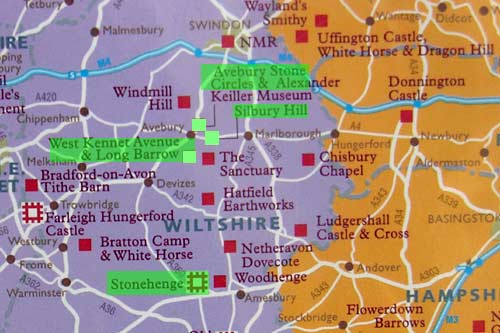
New Avebury to Stonehenge walk could rival Hadrian’s Wall

23 09 2010

The Great Stones Walk
A new long-distance footpath from Avebury Stone Circle to Stonehenge could topple Hadrian’s Wall as the UK’s most popular walking attraction.

The pathway is being planned by the Friends of the Ridgeway, who want to widen their focus beyond the National Trail.

Ian Ritchie, chairman of the Friends, told members of the Marlborough Area Board last week that the walk could pump an estimated £6 million into the local economy.

Mr Ritchie, who lives at Ramsbury, explained that the 29 mile Great Stones Walk connecting the two World Heritage Sites would pass through some of the best archaeological and historic sites in Britain.

He said: “This route has real historical integrity and goes by and through a wealth of archaeological and historic sites.

“It could become the première historical walking route in England held by Hadrian’s Wall at the moment.”

As well as being an international attraction for walkers, it would bring a welcome boost to the ailing rural economy.

Mr Ritchie said: “It will bring something like £6 million into the local economy, supported by the experience of the Hadrian’s Wall path, and create about 100 full-time or part-time jobs.”

The Friends estimate the walk would attract between 200,000 to 400,000 extra visitors a year and say consultations are taking place with landowners and parish councils along the route.

Later Mr Ritchie told the Gazette that the new path would link existing footpaths, bridleways and rights of way.

The cost of improving the route to National Trail standards has been estimated at about £105,000 and Mr Ritchie said it was hoped that much of the funding would come from the Salisbury Plain and North Wessex Downs AONB groups.

The area board meeting gave the new walk proposal its unanimous backing.

Merlin @ Stonehenge
The Stonehenge Stone Circle Website


Stonehenge Winter Solstice – 22nd December 2010

22 09 2010

Last year saw a large number of people (including Druids) turn up at Stonehenge on the wrong day in 2009?  I thought I would clarify the correct ‘Winter Solstice’ day for 2010 to save any embaresment.  The summer solstice is always on the 21st, however the winter solstice can fall on the 21st or the 22nd.  The celebration does not always fall on the same date as the solstice because the modern year does not correspond precisely to the solar one.

The exact time for the Winter Solstice is December 21st, 11.39pm (UK time). The sunset on the 21st is at 3.53pm and the sunrise on the 22nd of December at 8.04am. Exceptionally, you can also expect a full moon on December 21th.

English Heritage did not confirm the date for Open Access for Stonehenge for the Winter Solstice yet, but most likely this will be dawn on the 22nd of December. (The sunrise on the 22nd is closer to the actual solstice than that on the 21th of December.) Expect a short period of access, from approximately 7.30 to 9.00am

Stonehenge is carefully aligned on a sight-line that points to the winter solstice sunset (opposed to New Grange, which points to the winter solstice sunrise, and the Goseck circle, which is aligned to both the sunset and sunrise). It is thought that the Winter Solstice was actually more important to the people who constructed Stonehenge than the Summer Solstice. The Winter Solstice was a time when most cattle were slaughtered (so they would not have to be fed during the winter) and the majority of wine and beer was finally fermented.

Gerald Hawkins’ work

Gerald Hawkins’ work on Stonehenge was first published in Nature in 1963 following analyses he had carried out using the Harvard-Smithsonian IBM computer. Hawkins found not one or two alignments but dozens. He had studied 165 significant features at the monument and used the computer to check every alignment between them against every rising and setting point for the sun, moon, planets, and bright stars in the positions they would have been in 1500 BC. Thirteen solar and eleven lunar correlations were very precise against the early features at the site with precision falling during the megalithic stages. Hawkins also proposed a method for using the Aubrey holes to predict lunar eclipses by moving markers from hole to hole. In 1965 Hawkins wrote (with J. B. White) Stonehenge Decoded, which detailed his findings and proposed that the monument was a ‘Neolithic computer’.

Stonehenge – An Asronimical Calandar

Stonehenge features an opening in the henge earthwork facing northeast, and suggestions that particular significance was placed by its builders on the solstice and equinox points have followed. For example, the summer solstice sun rose close to the Heel Stone, and the sun’s first rays shone into the centre of the monument between the horseshoe arrangement. While it is possible that such an alignment can be coincidental, this astronomical orientation had been acknowledged since William Stukeley drew the site and first identified its axis along the midsummer sunrise in 1720.

Stukeley noticed that the Heel Stone was not precisely aligned on the sunrise. Year to year, the movement of the sun across the sky appears regular. However, due to temporal changes in obliquity of the ecliptic, illumination declinations change with time. The purported Heel Stone alignment with summer solstice sunrise would have been less accurate four to five thousand years ago. The Heel Stone, in fact, is located at 1/7th of circumference from due North, as noted by archaeologist James Q. Jacobs.[3] Stukeley and the renowned astronomer Edmund Halley were to attempt what amounted to the first scientific attempt to date a prehistoric monument. Stukeley concluded the Stonehenge had been set up “by the use of a magnetic compass to lay out the works, the needle varying so much, at that time, from true north.” He attempted to calculate the change in magnetic variation between the observed and theoretical (ideal) Stonehenge sunrise, which he imagined would relate to the date of construction. Their calculations returned three dates, the earliest of which, 460 BC, was accepted by Stukeley. That was incorrect, but this early exercise in dating is a landmark in field archaeology [4]. .

Early efforts to date Stonehenge exploited tiny changes in astronomical alignments and led to efforts such as H Broome’s 1864 theory that the monument was built in 977 BC, when the star Sirius would have risen over Stonehenge’s Avenue. Sir Norman Lockyer proposed a date of 1680 BC based entirely on an incorrect sunrise azimuth for the Avenue, aligning it on a nearby Ordnance Survey trig point, a modern feature. Petrie preferred a later date of AD 730. The necessary stones were leaning considerably during his survey, and it was not considered accurate.

Neolithic Computer

An archaeoastronomy debate was triggered by the 1963 publication of Stonehenge Decoded, by British-born astronomer Gerald Hawkins. Hawkins claimed to observe numerous alignments, both lunar and solar. He argued that Stonehenge could have been used to predict eclipses. Hawkins’ book received wide publicity, in part because he used a computer in his calculations, then a rarity. Archaeologists were suspicious in the face of further contributions to the debate coming from British astronomer C. A. ‘Peter’ Newham and Sir Fred Hoyle, the famous Cambridge cosmologist, as well as by Alexander Thom, a retired professor of engineering, who had been studying stone circles for more than 20 years. Their theories have faced criticism in recent decades from Richard J. C. Atkinson and others who have suggested impracticalities in the ‘Stone Age calculator’ interpretive approach.

There are a few tour companies offering Stonehenge Tours during the Solstice period.  Try the Stonehenge Tour Company, Best Value Tours, Salisbury Guided Tours and Premium Tours 

See you all at the Winter Sostice

Merlin @ Stonehenge
The Stonehenge Stone Circle Web site


Megalithic Poems – The stones are great

22 09 2010

The stones are great
And magic power they have
Men that are sick
Fare to that stone
And they wash that stone
And with that water bathe away their sickness


Indeed the stones are great, and certainly have had the power to capture the imagination of poets and artists through the centuries.

On the 21 September 2005, the heritage journal  started the anthology of Megalithic Poems, a colleague warned that we’d be hard pressed to find even half a dozen on the theme of the megalithic structures and prehistoric sites of Britain, Ireland and the European continent. Five years on and there are now some 300 poems on the blog, and an equal number of drawings, paintings, prints or photographs to accompany them.

The poems stretch over a period of some eight hundred years; from Laymon’s poem, Brut (above), of 1215 describing Stonehenge, to poems written only a few months ago. What does this tell us? Well, perhaps that not only have these structures inspired poets like Blake and Wordsworth (as well as artists such as Constable and Turner) down through the ages but also that this marvellous, mysterious megalithic heritage of ours continues to inspire us even today.

At a time when so much of our heritage is at risk through development and mismanagement (Tara in Ireland for example, even Stonehenge and Avebury) perhaps these poems, and the images that accompany them, will continue to inspire those who would take time out from busy lives to visit and ponder upon this often overlooked aspect of our heritage. Not only that, hopefully this anthology will also act as a warning that these places, built by our forefathers millennia ago, are in constant need of our care and attention lest, after thousands of years having, “…brav’d the continual assaults of weather…” (William Stukeley) they are finally lost for all time through the greed, ignorance and insensitivity of the 21st century.

Since September 2005 we’ve added many more poems and images on the megalithic theme in the hope that they’ll become a useful resource for those interested in the poetry, art and the history of our megalithic past – none of which would appear on the blog without the remarkable efforts and creativity of those who have written about megaliths or portrayed them in their work – not forgetting of course those who originally conceived and built these amazing structures!  To everyone, a very big thank you. We hope you will find as much pleasure browsing through the anthology as we have taken in compiling it.

Merlin @ Stonehenge
The Stonehenge Stone Circle Website


Stonehenge Ale – A Taste for Crop Circles

16 09 2010

A subject very close to my heart, Beer!

THE Stonehenge Ales brewery at Netheravon has come up with a new beer in honour of the many crop patterns that appear in Wiltshire fields each summer.

Stig and Anna Marie Andersen, who took over the independent brewery from its founder Tony Bunce in 1993, are fascinated by the weird and wonderful shapes that show up each year.

Mrs Andersen is studying fine art at Winchester College and said that, regardless of whether the crop patterns were man-made or not, they had become an art form in their own right, attracting tourists from all over the world.

The new beer reaches local pubs this week and is called Glyph, a name chosen by Mrs Andersen as it represents the hieroglyphs the crop patterns might or might not be although their messages so far remain undeciphered.

The logo on the Glyph beermats shows the pictogram dubbed Led Zeppelin that appeared in fields at Alton Barnes 20 years ago.

“Now, 20 years on, the new beer Glyph, manifests itself at Stonehenge Ales in celebration of that formation,” said Mrs Andersen.

The new light amber beer, which has an ABV of 4.5 per cent, also has one mystical ingredient – aromatic Chinook hops grown on the tribal lands in America of the Chinook tribe.

From each batch of Glyph produced the brewery will be making a donation to the Crop Circle Connector web site, which Mrs Andersen said was an independent site respected worldwide.

You guessed it, not alot of Stonehenge news this month,  Watch this space………………

There are still a number of crop circles in maize in the vicinty of Stonehenge and Avebury.  I met up with a local guide working for HisTOURies  UK yesterday who showed me some incredible images.  Yes we did have a pint of ‘Croppies’ together in the Alton Barnes Barge Inn.  (Crop Circle central)

Merlin @ Stonehenge
The Stonehenge Stone Circle Website