Stonehenge twin – ‘Timberhenge’ – discovered with radar imaging

27 07 2010

Stonehenge wasn’t the only mammoth circle in southern England 5,000 years ago. Using new radar imaging equipment, scientists have identified what was once a nearby circle of huge timbers.

Stonehenge, the mysterious circle of mammoth stone pillars in the middle of the English countryside, now has a slightly smaller twin.

//

Chart: Wooden ‘sister’ of Stonehenge discovered

Graphic News


//

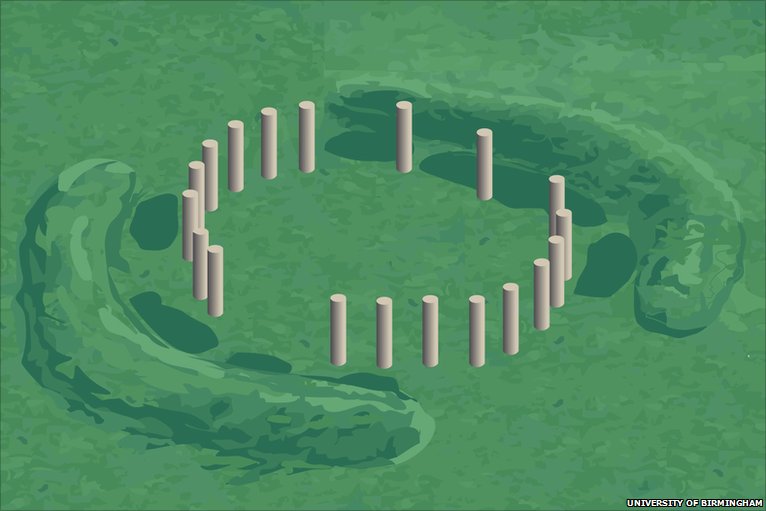
Scientist have discovered a second henge formation that once existed nearby made from huge timbers.

And there could be many more henge-type circles yet to be found in the vicinity, says archeologist Vince Gaffney of the University of Birmingham, which is leading an expedition of the site along with the Ludwig Boltzmann Institute of Austria.

“We didn’t expect to find another henge. There’s always been some presumption that the stones existed in splendid isolation,” Professor Gaffney says.

On July 16, just two weeks into their four-year project, Gaffney’s team discovered ‘Timberhenge,’ a 25-meter (82-foot) diameter, circular series of holes that were once filled with 24 huge wooden poles. It sits about 900 meters away from Stonehenge in southern England.

“Stonehenge isn’t the only henge monument in the area. There are several in the immediate vicinity,” says Dr. Gaffney, reached by phone today from Stonehenge.

‘Henge’ refers to a circular ditch with an external bank from the Neolithic period.

Archaeology without a shovel

Notably, not a bit of earth was dug up to make the discovery.

Gaffney’s ground-mapping project uses radar-imaging equipment, which is placed a wheels and pulled over the fields surrounding Stonehenge. His team plans to scan a 14-square-kilometer (nearly 9 mile) area at a cost of $500,000 to $1 million.

“We will not dig anything. The technologies we use will allow us to look at volumes of soil,” he says.

The new Timberhenge appears built on the same orientation as Stonehenge, with entrances to the northeast and southwest. Archaeologists say it was a worshipping site and burial ground, but Gaffney says the precise role of the structures remains unclear: Was it for commoners or tribal leaders, worshippers or religious leaders?

The radar-imaging project will provide a map of the area’s structures and a clearer idea of its size and functions.

Scientists have repeatedly unearthed new finds at Stonehenge.

In October 2009, the Stonehenge Riverside Project uncovered a 10-meter (33-foot) diameter stone circle of bluestones, brought from the Preseli mountains of Wales, 150 miles away, and dubbed ‘Bluestonehenge.’ The stones, now missing, once marked the end of an avenue that leads from the River Avon to Stonehenge, a nearly 2-mile-long processional route constructed at the end of the Stone Age.

Another Woodhenge

Nor is this the first wooden henge found in the area. Two miles northeast of Stonehenge sits the so-called ‘Woodhenge,’ a six-ringed circle of 168 timber holes identified in 1925. Another timber circle nearby was identified in 1966.

But Mike Parker Pearson of the University of Sheffield, director of The Stonehenge Riverside Project, says it’s premature to describe this latest find as another “Woodhenge.”

“No one has any idea if these were circles of posts, stones or just pits. Nor do we know what date they are other than broadly 3000-1500 BC. They are both great finds but we know too little about them as yet (without excavation) to say how they will change our understanding,” he says via email. “As we found last year with Bluestonehenge, there is still much to be found around Stonehenge.”

Gaffney agrees that much remains unknown.

“Despite the fact that this is probably the most studied landscapes in the world…we know nothing about it,” says Gaffney. “Having said that, we felt we needed to know much more about what was happening between the monuments to know how it’s organized.”

On Thursday, however, southern England’s summer rains had delayed further scans of the area, and sent Gaffney running for shelter in a car.

“It’s raining heavily, so we’re not doing anything at the moment,” he told the Monitor. “It’s a British summer: what do you expect?”

Merlin @ Stonehenge
The Stonehenge Stone Circle Website


How significant is the ‘new henge’?

27 07 2010

Stonehenge (Image: AFP) What does the new finding reveal about the famous world heritage site?

A major survey of the Stonehenge landscape started last week, and today we learn that archaeologists have found another henge.

This is a three-year project, so by 2013 there could be quite a list of new discoveries.

 Mike Pitts, editor of British Archaeology magazine

I am quite sure something else of at least equal interest will emerge before the three years are up”

Is this real? Do we know as little about the famous world heritage site as this seems to imply? Or is it another hyped science story that will vanish with the dawn?

 Let’s start with the new henge. Yes, it is a significant find, and my archaeological colleagues are already e-mailing each other with tempered excitement.

 The first thing to ask is, is it a henge? It might well be, but without excavation we cannot know – and it all depends what you mean by “henge”.

 Technically, a henge is a roughly circular space enclosed by an earthwork, distinguished by a ditch lying within a bank (rather than the other way around, which would make it a fort).

 However, that definition actually excludes Stonehenge from the class, and the word has come to be used loosely to describe any circular ritual site in Britain dating from the late Neolithic or copper age (3,000-2,000BC).

 A few of these had standing stones, but more common were rings of oak posts, sometimes several inside each other on a very large scale. It is this type of site that Vince Gaffney is claiming to have found.

 He might well be right. The geophysics plot seems to show a circle of some 24 postholes within two arcs of 10 or so large pits.

 These pits might have themselves held large posts. They might indeed have held megaliths (nearby “Bluehenge”, a 10m-diameter circle of 25 stone pits, was unexpectedly discovered by excavation only last year).

 But they might just be very big pits: there is a henge in Dorchester, Dorset, known as Maumbury Rings, that fits that description.

Artist's impression of a structure discovered by archaeologists studying the land surrounding Stonehenge (Image: University of Birmingham) Only detailed excavation will reveal the true importance of the discovery

On the other hand, the site could be something quite different. It was previously known as a ploughed-out burial mound or barrow of probable bronze age date (2,000-1,200BC).

 It may still be that, but with an unusual ditch or pit arrangement around it (in which case, the large pits would be quarries for a mound in the centre rather than a bank on the outside).

 This is after all close to Stonehenge, and the landscape is famous for the large number and unusual qualities of these barrows.

 So perhaps a henge, perhaps not, but an important discovery whose significance will be fully realised only with excavation.

 As to why archaeologists did not know about such a monument so close to Stonehenge, there are two main reasons.

 The landscape is extensive and fieldwork is slow and expensive. Most archaeologists are working with very small budgets – in the past, many were not paid at all.

 So archaeologists focused their attention where they knew there was something to be found. Until recently, there was endless excavation at Stonehenge itself, and almost none beyond. Inevitably, this had the effect of convincing some people that there was nothing else to find elsewhere.

 On the other hand, the science of archaeological fieldwork is advancing fast. Professor Gaffney and his colleagues from the University of Birmingham, and the Ludwig Boltzmann Institute for Archaeological Prospection and Virtual Archaeology in Vienna, are pioneering highly sophisticated survey equipment and software.

It is the extremely high resolution of the survey data that has allowed this “henge” to have been found.

So it is an important discovery that comes about because archaeology is learning new tricks. I am quite sure something else of at least equal interest will emerge before the three years are up. Who knows? As I am typing these words, the team is out there.

Merlin @ Stonehenge
The Stonehenge Stone Circle Website


Discovery adds to the mystery of Stonehenge

26 07 2010

Scientists scouring the area around Stonehenge said last week that they had uncovered a circular structure only a few hundred yards from the world-famous monument.

There’s some debate about what exactly has been found. The survey team that uncovered the structure said it could be the foundation for a circle of freestanding pieces of timber, a wooden version of Stonehenge.

But Tim Darvill, a professor of archaeology at Bournemouth University in southern England, expressed skepticism, saying he believed it was more likely a barrow, or prehistoric tomb.

Darvill also said the circle was one of an expanding number of discoveries being made around Stonehenge, which “really shows how much there is still to learn and how extensive the site really was.”

“In its day, Stonehenge was at the center of the largest ceremonial center in Europe,” he said.

Deep pits and a ring of holes

Although antiquarians have been poking around the area since the 18th Century, excavations are now tightly restricted. So archeologists have been scanning surrounding fields and pastures with magnetic and radar sensors that tractors or quad bikes pull across the grass.

The new structure was found when scans identified a cluster of deep pits surrounded by a ring of smaller holes about 900 yards from Stonehenge and within sight of its famous standing stones.

University of Birmingham archaeologist Henry Chapman said he was convinced the small holes were used to secure a circle of wooden poles that stood possibly 10 or more feet high.

The timber henge — a name given to prehistoric monuments surrounded by a circular ditch — would have been constructed and modified at the same time as its more famous relative and probably had some allied ceremonial or religious function, Chapman said.

Exactly what kind of ceremonies those were is unclear. The new henge joins a growing complex of tombs and mysterious Neolithic structures found across the area.

Still more to explore

Last year, researchers said they had found a small circle of stones on the banks of the nearby River Avon. Experts speculated the stone circle — dubbed Bluehenge because it was built with bluestones — may have served as the starting point of a processional walk that began at the river and ended at Stonehenge.

Chapman’s team is still in the early stages of its work, having surveyed only about 1 1/2 square miles of the 6 square miles it eventually plans to map.

The University of Birmingham and the Austria-based Ludwig Boltzmann Institute for Archaeological Prospection and Virtual Archaeology are leading the survey, with support from other institutions and researchers from Germany, Norway and Sweden.

Henges of various descriptions exist throughout Britain — from the Standing Stones o’ Stenness on the northern island of Orkney to the Maumbury Rings in the southern English county of Dorset.

Stonehenge, a World Heritage Site, remains the best-known.

Exciting times at Stonehenge
Merlin @ Stonehenge
The Stonehenge Stone Circle Website


Archaeologists unearth Neolithic henge at Stonehenge

22 07 2010

Archaeologists unearth Neolithic henge at Stonehenge

An image detailing the new 'henge'
Archaeologists say the find is “exceptional”

Archaeologists have discovered a second henge at Stonehenge, described as the most exciting find there in 50 years.

 The circular ditch surrounding a smaller circle of deep pits about a metre (3ft) wide has been unearthed at the world-famous site in Wiltshire.

 Archaeologists conducting a multi-million pound study believe timber posts were in the pits.

 Project leader Professor Vince Gaffney, from the University of Birmingham, said the discovery was “exceptional”.

 The new “henge” – which means a circular monument dating to Neolithic and Bronze Ages – is situated about 900m (2,950ft) from the giant stones on Salisbury Plain.

It’s a timber equivalent to Stonehenge”

 End Quote Professor Vince Gaffney University of Birmingham

Images show it has two entrances on the north-east and south-west sides and inside the circle is a burial mound on top which appeared much later, Professor Gaffney said.

 ”You seem to have a large-ditched feature, but it seems to be made of individual scoops rather than just a straight trench,” he said.

 ”When we looked a bit more closely, we then realised there was a ring of pits about a metre wide going all the way around the edge.

 ”When you see that as an archaeologist, you just looked at it and thought, ‘that’s a henge monument’ – it’s a timber equivalent to Stonehenge.

 ”From the general shape, we would guess it dates backs to about the time when Stonehenge was emerging at its most complex.

 ”This is probably the first major ceremonial monument that has been found in the past 50 years or so.

 ’Terra incognita’

“This is really quite interesting and exceptional, it starts to give us a different perspective of the landscape.”

 Data from the site is being collected as part of a virtual excavation to see what the area looked like when Stonehenge was built.

 Speculation as to why the 4,500-year-old landmark was built will continue for years to come, but various experts believe it was a cemetery for 500 years, from the point of its inception.

 In 2008, the first excavation in nearly half a century was carried out at the iconic site on Salisbury Plain.

 This latest project is being funded by the Ludwig Boltzmann Institute for Archaeological Prospection and Virtual Archaeology, in Vienna, and the University of Birmingham, and is assisted by the National Trust and English Heritage.

 Professor Gaffney said he was “certain” they would make further discoveries as 90% of the landscape around the giant stones was “terra incognita” – an unexplored region.

 ”The presumption was this was just an empty field – now you’ve got a major ceremonial monument looking at Stonehenge,” he said.

Merlin at Stonehenge
The Stonehenge Stone Circle Website


Astro-Archaeology at Stonehenge

15 07 2010

Its more than a pile of old stones…………….
The Revd. Edward Duke was the first person to associate astronomy with Stonehenge, describing it as a planetarium full of significant astronomical alignments – although he named none. Unfortunately most of his ideas on the subject were rather fanciful and over-imaginative, and not very scientific.

Sir Norman Lockyer (1836 – 1920) was the first person to identify the reason for the orientation of Stonehenge. He realised that on the summer solstice the sun rose at the end of the main axis (as it would have done in the second and third millenniums BC). He published these findings in a book in 1906. However, Lockyer made many errors and incorrect assumptions, which made archaeologists suspicious of the possibility of astronomical alignments.

Stonehenge, looking West (7 KB) - links to a larger 38 KB version

Therefore, it was not until the second half of the 20th Century that astro-archaeology became a major science in its own right. Gerald Hawkins, an American astronomer, published the results of an intense study of Stonehenge’s astronomical alignments in Nature in 1963. In the article he described how he had used a computer to prove that alignments between Stonehenge and 12 major solar and lunar events was extremely unlikely to have been a coincidence (Castleden, 1993). His book, Stonehenge Decoded, containing the fully developed theory, appeared in Britain in 1966. He described how he had found astronomical alignments among 165 points of Stonehenge associated purely with the Sun and the Moon, and not with any stars or the five naked-eye planets (Mercury, Venus, Mars, Jupiter and Saturn). He discovered that lunar eclipses could be predicted through a system of moving stones around the circle of Aubrey Holes.

Controversially, he went on to suggest that Stonehenge was an ancient computer. The 1960’s were still early in the computer revolution, and the Harvard-Smithsonian IBM had produced some fantastic results for him. This was merely Hawkins’ way of paying a high compliment to the architects and builders of Stonehenge (Castleden, 1993).

There are indeed a large number of astronomical alignments, prediction and measuring devices, and representative features to be found among the megalithic stones and holes of Stonehenge. Gerald Hawkins discovered many of them, and most of his discoveries are commonly accepted.

Stonehenge III

M. W. Postins wrote a booklet entitled Stonehenge: Sun, Moon, Wandering Stars in 1982. Postins built two scale models, which he called the ‘Temple model’ (Stonehenge III) and the ‘Enclosure model’ (which shows outlying features such as the Aubrey Holes and Station Stones of Stonehenge I and II). ‘Table 1’ below outlines the astronomical alignments from Stonehenge III. (Also see Figure 1.)

TABLE 1: Stonehenge III (Temple) Astronomical Alignments

Astronomical Event Alignment Stones From… …to between sarsens Summer solstice sunrise Altar Stone 30 + 1 Summer solstice sunset Northern Low Trilithon gap 23 + 24 Winter solstice sunrise Eastern Low Trilithon gap 6 + 7 Winter solstice sunset Great Trilithon gap 15 + 16 Summer solstice moonrise, major standstill Southern Intermediate Trilithon gap 9 + 10 Summer solstice moonrise, minor standstill Southern Intermediate Trilithon gap 8 + 9 Winter solstice moonrise, major standstill Altar Stone 29 + 30 Winter solstice moonrise, minor standstill Altar Stone 1 + 2 Winter solstice moonset, major standstill Western Intermediate Trilithon gap 21 + 22 Winter solstice moonset, minor standstill Western Intermediate Trilithon gap 20 + 21

Trilithons

In his booklet, Postins states that the five trilithons represented the planets visible with the naked eye.

Mercury and Venus are the two planets in the sky that keep in closest association with the Sun. The eastern and northern lowest trilithons have alignments through the sarsen circle relating directly to the Sun (see Figure 1). Therefore, Postins suggested that these two lowest trilithons represented Mercury and Venus.

The two intermediate trilithons represented Mars and Jupiter because they are associated with lunar alignments. Mars and Jupiter are associated with the Moon due to their paths through the Zodiac. Because of this they are not linked to sunrise and sunset events like Mercury and Venus, but may be observed close to the Moon as they all follow similar paths along the ecliptic. The two intermediate trilithons align with major and minor positions of the Moon, which the Altar Stone (stone 80) also does through gaps in the sarsen circle (see Figure 1).

The Great trilithon represented Saturn because Saturn moves very slowly across the sky compared to the other four planets. This stately pace may have indicated to the people who built Stonehenge that Saturn held some sort of ‘senior’ position in the heavens.

FIGURE 1: Stonehenge III (Temple) Astronomical Alignments

Stonehenge III alignments (30 KB) - links to a larger 50 KB version

The Sun-aligned low trilithons cannot be differentiated in order to determine which planet (Mercury or Venus) each represents. The same problem exists with the Moon-aligned intermediate trilithons representing Mars and Jupiter. Postins speculates that there could have been carvings on the trilithons, now long eroded from existence, which indicated which trilithon represented which planet.

All of the astronomical alignments within the sarsen circle are present in older parts of the monument, including the Station Stones, Heel Stone and the numerous holes and posts. See Figure 2, which illustrates all of the astronomical alignments among the features of Stonehenge.

The alignments are extremely precise, which illustrates the high level of knowledge possessed by the builders of Stonehenge. Such knowledge must have been gathered over decades or centuries of observations of the sky (during which the behaviour and interaction of the heavenly bodies was noted), before the idea of Stonehenge was even conceived.

Station Stones

The four Station Stones (SS), 91, 92, 93 and 94 formed a perfect rectangle, which is remarkable considering that the long axis of the rectangle is around 300 ft in length. The sarsen ring formed a circle 97 ½ ft across in which every upright was, on average, less than 3 inches out of position!

This geometric precision was investigated in around three hundred megalithic monuments all over Britain by Alexander Thom. He deliberately investigated large numbers of megalithic monuments prior to visiting Stonehenge (in 1973) in order to prevent obtaining a biased view. It would have been easy to see Stonehenge as the perfect example of a Megalithic monument and then proceed to examine other monuments with this assumption in mind.

During his study of these monuments he came across two standard units of measurement, which he called the ‘Megalithic Fathom’ (equivalent to 1.6 m or 5.44 ft) and the ‘Megalithic Yard’ (equivalent to 0.83 m or 2.72 ft – 8 ½ inches short of a standard English yard). Thom found that the Megalithic Yard had been used at Stonehenge, in the spacing and positioning on the sarsen circle uprights. With these commonly recognised units, it is understandable how the Neolithic peoples that built Stonehenge achieved such a level of precision – and hence produce a very accurate astronomical observatory. Figure 2, below, illustrates the many alignments among the stones of Stonehenge I and Stonehenge III.

FIGURE 2: Stonehenge I and III Astronomical Alignments

Stonehenge I and III alignments (40 KB) - links to a larger 64 KB version

Figure 2 shows that an observer looking from SS92 (Station Stone 92) over SS91 would see the summer solstice sunrise, as he would if standing behind the Altar Stone (stone 80) and looking over stones C and B in the Avenue, just to the left of the remaining Heel Stone. Many of the alignments are at exact right angles. This is due to latitude at which Stonehenge was built. The exact rectangle of alignments through the Station Stones can only be achieved on (or very close to) 51° North. Once again, this demonstrates the astronomical knowledge the Neolithic populations possessed.

TABLE 2: Stonehenge I Astronomical Alignments

Astronomical Event Alignment Stones From… …to… Summer solstice sunrise SS 93 SS 94 SS 92 SS 91 Summer solstice sunset Stone G SS 94 Winter solstice sunrise SS 94 Stone G Winter solstice sunset SS 91 SS 92 SS 94 SS 93 Summer solstice moonrise, major standstill SS 93 SS 92 Summer solstice moonrise, minor standstill SS 93 SS 91 Winter solstice moonset, major standstill SS 91 SS 94 Winter solstice moonset, minor standstill SS 91 SS 93 Most southerly moonrise SS 94 SS 91 Most northerly moonset SS 92 SS 93 Equinox sunrise SS 94 Stone C Equinox moonrise SS 94 Stone B [ SS = Station Stone ]

Bluestone Horseshoe

Consisting of 19 stones, the bluestone horseshoe (just inside the 5 sarsen trilithons) had a couple of possible uses.

They could be used for counting the period from a full moon on a particular day of the year to the next full moon that falls on that day of the year, which would be 19 years later. Known as the Metonic cycle (after Meton, a 5th Century BC Greek astronomer), this is correct to around 2 hours. (Postins, 1982)

It could also be used to follow the nodal cycle of the Moon, which has a period of 18.61 years. The extremes of the Moon’s position on the horizon are marked on Figure 1, with the two intermediate trilithons and stones 8, 9, 10, and 20, 21, 22 of the sarsen circle.

The Bluestone Horseshoe (inside the five trilithons) can also be used to predict eclipses. There are 19 of these stones, which again relate to the 18.61-year cycle of the Moon’s wandering rising and setting points on the horizon, and therefore also eclipses. “Due to the way in which the lunar nodes move around the Zodiac, it takes somewhat less than a year for the Sun to return to the same position in relation to the nodes. This period is 346.62 days, and is connected with the repetition of eclipses. It is known as an ‘eclipse year’. 19 eclipse years and 223 lunar months [each of 29.53 days] have the following relationship: –

19 x 346.62 = 6585.78 days,
and
223 x 29.53 = 6585.32 days.”

(Postins, 1982)

This means that to predict an eclipse, 223 full Moons must be counted before the Earth, Moon and Sun are again in the same positions as at the beginning of that time. This period of time is called the Saros, and it is possible that Stonehenge III people discovered it. However, not all eclipses would be predicted by this method of counting the bluestones in the horseshoe because eclipses occur quite frequently, except with slightly different positions of the Earth, Moon and Sun.

Aubrey Holes

Gerald Hawkins’ theory on the use of the 56 Aubrey Holes to predict lunar events was workable but imprecise. At intervals of 9, 9, 10, 9, 9, 10, you could place 6 alternately black and white marker stones around the Aubrey Hole (AH) circle, and move them clockwise or anti-clockwise around the ring one hole per year. (Castleden, 1993.) Aubrey Holes 51, 56 and 5 were fixed markers. See Figure 3 below, which illustrates the concept.

If a white marker arrived at AH56 the full Moon would rise over the Heel Stone that year. The next astronomical event would occur when a white marker arrived at AH51. At its extreme declination, in that year the winter solstice Moon rose over the alignment to hole D from the centre of the monument, along the alignment from SS94 to SS91, and was framed in the southern intermediate trilithon. The summer solstice Moon rose along the alignment from SS93 to SS92, and was framed in the western intermediate trilithon. (Castelden, 1993)

Hawkins successfully demonstrated that several important lunar alignments occurred in 1549 BC. He suggested that the astronomers at Stonehenge knew these alignments would take place when a white marker arrived at AH51 that year.

FIGURE 3: Gerald Hawkins’ Eclipse Predictor

Hawkins' Eclipse Predictor using the 56 Aubrey Holes (13 KB)

Eclipses of the Moon occur every 18.61 years. The reason why there are 56 Aubrey Holes is because 18.61 x 3 = 55.83 (or 56 to the nearest integer). Eclipses of the Moon in summer or winter took place when any marker stone arrived at AH56 or AH28, the two holes that lie on the main axis of Stonehenge. When a white marker reached AH5 or AH51, equinox eclipses would occur.

There are 30 uprights in the sarsen circle. A full Moon occurs every 29.53 days. A seventh marker stone (a Moon marker, shown in Figure 3) would be moved once a day around the sarsen circle to keep track of the phases of the Moon.

In the 1960’s many British Stonehenge archaeologists were frustrated that an American astronomer had determined the reasoning behind the monument’s structure, having barely laid a foot in Stonehenge! As Hawkins’ highly plausible ideas went down badly in the British archaeological circles, Glyn Daniel (the editor of Antiquity) sought assistance from Fred Hoyle, the current Professor of Astronomy at Cambridge University. Hoyle studied Hawkins’ work, and produced his own theories on lunar predictions using Stonehenge. In his scenario, Stonehenge became a Solar System model with Earth at the centre. Rather than seven stones, Hoyle chose 3 stones representing the Sun, Moon, and one node of the Moon’s orbit. The 3 stones were moved around the Aubrey Hole ring at their real rates relative to each other. When the 3 markers lay close together or almost opposite each other, eclipse seasons took place. Actual eclipses occurred in these seasons only when the Moon stone moved close to the Sun stone, or was diametrically opposed to it (i.e. precisely on the opposite side of the Aubrey Hole ring).

Stonehenge, looking East (7 KB) - links to a larger 36 KB version

Hoyle’s method is much more accurate than Hawkins’ because the actual day of the eclipse was predicted, as well as the eclipse season. It is also much simpler to operate on the ground.

Hoyle also studied other astronomical alignments, and came to the conclusion that, surprisingly, Stonehenge I was much more sophisticated than Stonehenge III, although the later monument was undoubtedly more architecturally impressive. (Castleden, 1993)

Even after Hoyle’s more rational efforts, many archaeologists remained unconvinced. Today it is regarded as remarkable that Hawkins’ eclipse prediction method was seen as such an impressive step towards understanding parts of Stonehenge. It is believed that his use of the Harvard-Smithsonian IBM computer made his theory ‘infallible’ at the time. After all, it is highly unlikely that even the people of Stonehenge I would have been satisfied knowing only the year in which an eclipse would occur!

Merlin @ Stonehenge
The Stonehenge Stone Circle Website

Tours of Stonehenge
The Stonehenge Tour Company
HisTOURies UK
Salisbury Guided Tours


Stonehenge Visitor Centre – the debate continues….

9 07 2010

Let’s build the visitor centre in Amesbury

It was with great delight that the news came through that the new government has pulled the plug on the £10million gift to an already wealthy organisation to build a pointless visitor centre so far away from Stonehenge.

Can you imagine all the American visitors’ remarks at having to travel another 1.5 miles on a freezing cold winter’s day? Or even a boiling hot one like we are now enjoying? English Heritage really has no claim to these stones, originally they belonged to Amesbury (which incidentally gets very little income from them but all the hassle). How it managed to take control is a mystery – it makes a lot of money from them and unlike the castles and country mansions it owns, Stonehenge has a very low maintenance budget.

A centre in Amesbury would have been better but not in Countess Road (more money wasted on land there, I remember) but nearer the west Amesbury area close to plenty of ground and nearer the shops and hotels etc. Alongside the river near the cemetery is a huge piece of open land, so whatever the planned transport system to the stones is, it could run from here. From west Amesbury to the dual carriageway west of Winterbourne Stoke runs a natural gully some 40ft lower than the A303 for a distance of 6.3 miles. This disturbs no one, unlike the huge bridge on stilts proposed for north of Winterbourne Stoke. If this route were taken then all the other roads around the stones could remain open for local traffic.

Or of course things could be just left as they are, after all we have lived with it for the 60-plus years I’ve lived here.

Tony Bull, Amesbury

Only the best for Stonehenge

The awful state of the present Stonehenge Visitor Centre is universally recognised and does not need repeating.

The remedy has generated wide debate but the views that really count are those from people who have long studied the problem and those who would be affected by a solution. Ignore the “we must not lose the lovely view of the Stones as we pass (at 70 mph)” brigade.

The demise of the cancelled “temporary” centre should be welcomed for saving precious funds from waste on a third-class idea linked to Olympic strays. Anyone sufficiently versed in the pros and cons of the subject, the Stonehenge Alliance for example, will rejoice at the decision because the chosen site has too many faults and the cost has already risen from £20million to £27.5million. The problem is unavoidably coupled with a roads problem and that could be eased at modest cost by closing or making the link with the A303 one way to or from the car park entrance.

No other plans should be contemplated until the country can afford the best solution for Stonehenge, which must include the removal of the A303 from the site. That proposal would satisfy the objections of the World Heritage Committee, ignored hitherto, and avoid the site the disgrace of losing World Heritage status.

John Ellis, Farley

This decision is so short-sighted

I still cannot believe that the new government has withdrawn the £10million that was to be invested in the Stonehenge Visitor Centre.

This is surely a very short-sighted decision. With the Olympics coming in 2012 Stonehenge will attract thousands of new visitors and the new centre would have made a lot of money. I believe the Government would have got their money back in very quick time as well as providing many short-term jobs in the construction process and a significant number of long-term jobs.

I hope English Heritage manages to raise the money elsewhere. Maybe it could launch a bond scheme so ordinary investors could have a stake.

Jan Belza, Durrington

Any more comments ?  I welcome your feedback ?

Merlin @ Stonehenge
The Stonehenge web site


Bryan builds his own henge

25 06 2010

IT’S Hampshire’s own answer to Stonehenge.

Bryan builds his own henge

Alone in a rural setting stands an eerie circle of stones, each painstakingly positioned in such a way as to celebrate the earth’s natural calendar.

But, unlike the world-famous monument on Salisbury Plain, it took just one person to build this modern version.

The 24 stone towers are made out of fly-tipped waste and they have been erected over a decade by a man fascinated with Britain’s ancient history.

Bryan Raines started his Millennium Circle in 2000, each year arranging the monuments in line with specific times in the year such as summer and winter solstice and the spring equinox.

The circle, in Bryan’s field near Awbridge Village Hall, surrounds a barrow constructed of soil.

The 55-year-old conservationist believes the site lies on an ancient ley line running from the Isle of Man to the Isle of Wight.

Bryan, who lives in Michelmersh, said: “I was in the process of collecting builder’s rubbish that I had accumulated and I thought I would use it for a stone circle.

“Some of the stones are between five and six feet high but, unfortunately, cows keep knocking them over.

“I’ve ended up with a sort of 24-hour sundial. It’s a good 50 metres across.

“I’m quite proud of it, actually. I have had quite a few people who were surprised about it.”

The lowdown on ley lines

Some people believe sites of geographical interest and ancient monuments and megaliths are connected by straight lines, known as ley lines.

Their existence was suggested in 1921 by the amateur archaeologist, Alfred Watkins, in his book, The Old Straight Track.

Those who believe in them think that the lines and their intersection points resonate a special psychic or mystical energy.

Watkins believed that, in ancient times, when Britain was far more densely forested, the country was crisscrossed by a network of straight-line travel routes on which prominent landmarks were used as navigation points.

Since then, ley lines have become the subject of magical and mystical theories.

Two British dowsers, Captain Robert Boothby and Reginald A. Smith, of the British Museum, linked the appearance of ley lines with underground streams and magnetic currents. HisTOUries UK offer guided tours of Stonehenge and Avebury abd demonstrate the ancien art of dowsing.

Merlin @ Stonehenge
The Stonehenge Stone Circle Website


Celebrations at Stonehenge Summer Solstice 2010

22 06 2010


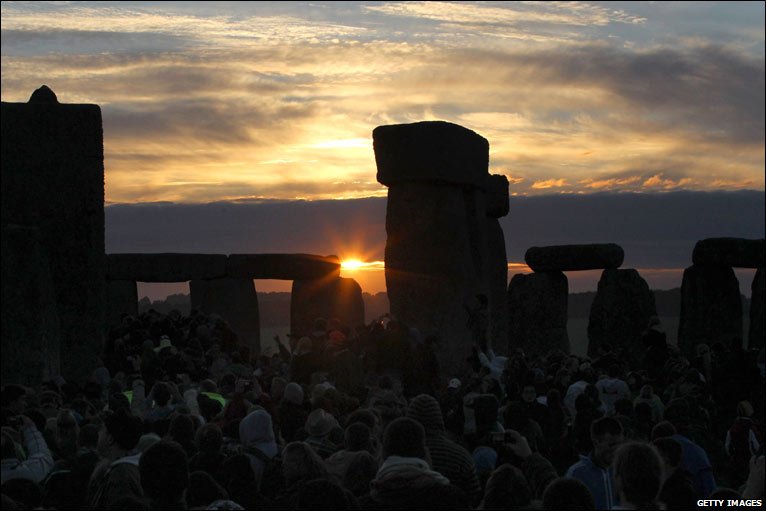
About 20,000 revellers were at Stonehenge to mark the Summer Solstice, each hoping to see the sun as it rose above the ancient stone circle at dawn.

Police described the event on Salisbury Plain in Wiltshire as one of the safest in years, although 34 people were arrested for minor drug offences.

Sunrise, marking the longest day of the year north of the equator, occurred over the circle at 0452 BST.

The Heel Stone, just outside the main circle, aligns with the rising sun.

Peter Carson from English Heritage said: “It has been quieter this year but it’s been a great solstice.

‘Monday morning’

“It’s an improvement on the last few years – the last time I remember seeing the sun rise was in 2003 – so it’s great to see the sun has put in an appearance.

“This year there are about 20,000 people and last year it was about 35,000 – so that is quite a bit down which has meant the operation is a lot easier. ”

He said two years ago the solstice happened early on a Saturday and about 30,000 people attended.

He added: “I think the days of the week do make a considerable difference to the number of people who come along – this year it’s a Monday morning.

Pagan roots

“The people who are streaming out now – a lot of them are going to work.”

Victoria Campbell, 29, was among those marking the solstice.

She said: “It means a lot to us…being British and following our pagan roots.”

The Londoner, who works in the finance industry, added “getting away from the city” was a major draw.

On Sunday police chiefs said they had planned for “all eventualities” ahead of the event.

Last year a record 36,500 revellers attended, causing traffic chaos and road closures.

Merlin @ Stonehenge

The Stonehenge Stone Circle Website


Building a 20ft man for summer solstice at Stonehenge

22 06 2010


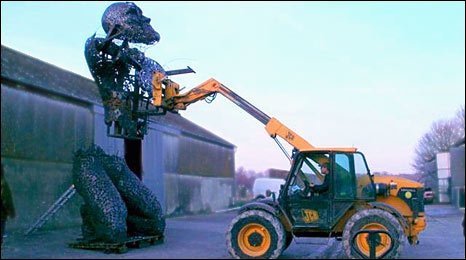
The massive steel Ancestor is over 20 feet tall and weighs in at an impressive six tonnes

For the last six months, like Dr Frankenstein, a married couple have been building a man – a 20-feet man in a barn a stone’s throw from Stonehenge. In Pictures: Solstice Giant at Stonehenge Reaching to the rafters, of a massive hangar, and weighing in just shy of an African bull elephant – he’s a monument in the making and the creation of Andy and Michelle Rawlings. “He’s very big,” admits Andy. “He’s as big as a double-decker bus and at least 20 feet on his knees. Shaped by eye the giant not only has a four-pack but a pot belly as well “And he’s going to weigh about six tonnes, when he’s finished. So, yeah he’s quite a chunk of metal.” ‘Quite a chunk of metal’, needless to say, is a bit of an understatement. Not only will this giant steel man dwarf a double-decker bus, by at least six feet, but his glittering mosaic of steel plates is a far cry from a hunk of a metal. Wielding plasma cutters and welders – Andy and Michelle, who found herself metal working after a ‘spectacular mid-life crises’, have not only cut their way through miles of steel plate. More miles then either say they’d liked to have actually walked. But painstakingly welded thousands of randomly cut steel pieces on to a super-sized steel frame in a colossus of a jigsaw. ‘Thierry Henry goal celebration’ “I’ve had to remove his crotch to give me access through there,” admits Andy, “it will be a removable panel. “It’s not the best entry point in the world but it’s got to be done.” Working with their heads, where even the solstice sun doesn’t shine, both Michelle and Andy have spent nine months creating their giant. An ancient-looking man who, both hope, will represent everyone’s ancestor on his knees in praise of the sun. “What we tried to do with his position,” says Michelle, “is to actually capture the very moment the sun comes up and he’s dropped to his knees in thanks. Andy is hoping that they’ll be able to fly him in by helicopter “One lad saw him and immediately said: ‘Thierry Henri goal celebration’ – it’s that moment that we’ve tried to create with him and hopefully we’ve pulled it off.” Created and shaped by eye, ‘in the old fashioned way’, without a computer or a CAD programme in sight – the Ancestor has, according to Michelle, had to evolve. And he’s evolved with slightly less then a six-pack. “Well he’s got a four pack and a little bit of a pot belly,” laughs Michelle, “in honour of the Great British pot belly. “We think the way he’s been built and where he’s been built really is a salute to the Great British shed heads – that do these mad projects in their sheds and pull it of. We salute them.” For Sale And like the Great British shed heads, Michelle and Andy have had to dig deep into their own pockets to create him. But with just weeks to go, before sun-up on the longest day, and just two gargantuan arms and hands to finish, the couple are hoping that they’ve found a buyer in Amesbury. “Hopefully the owner of the Holiday Inn will like him,” says Andy. “He’s been good enough to allow us to put him in front of his hotel for sale – with an option for him to buy. For Sale: the Ancestor is up for sale for an undisclosed amount “And he’s going to be in a very prominent position so that most people will be able to view him down the A303. So hopefully he’ll become our Angel of the South.” But with transportation arrangements having to include chopping him in half, a giant crane and a gang – Andy is hoping his ‘Angel of the South’ might actually take to the wing. “I would like to think we could fly him in by helicopter” says Andy. “but we’ve got to speak nicely to the Army for that. “But it would be nice and I would be very happy for him to be 100 foot up in the air.” But before the giant ancestor heads to Solstice park, or is spotted in the skies over Amesbury, he’s making a stop-off at Stonehenge just in time for sun-up on the longest day. But how will Stonehenge’s largest sarsen stone measure up to the 20ft steel man? And, despite the traditional lack of actual sun at solstice, will the massive sculpture overshadow the ancient monument? “No,” says Michelle. “We’re hoping to enhance. We’re not trying to compete. “We want to enhance the Stonehenge experience and just give people the opportunity to think about where we’ve actually come from and what a proud race we are.”

Merlin & Stonehenge
The Stonehenge Stone Circle Website


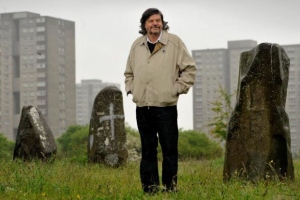
Glasgow Megalith – astronomer bids to rejuvenate stone circle

7 06 2010

It was created in the late 1970s to mirror the rise and fall of the moon and sun across Glasgow on a site of ancient astronomical interest.

Now efforts are being made to rejuvenate the Sighthill Stone Circle, created by amateur astronomer and science writer Duncan Lunan, who brought Britain’s first authentically alligned stone circle in more than 3000 years to Glasgow’s inner city.

More than 30 years later, Lunan hopes to revive interest in the stone circle, which was built by the Glasgow Parks Astronomy Department using funds from the former Jobs Creation Scheme.

When money for the project was abruptly scrapped by the then prime minister Margaret Thatcher, four pieces of stone never made it to the circle and are now stashed under a nearby bush in Sighthill Park. It is hoped the circle can now be completed as Lunan intended.

At the stones yesterday, Lunan said: “There is still nothing up here to say who built the circle, who it was built for or how it works. I have been told that nowadays children are afraid of it, that they think it is linked to black magic, that sort of thing. That is something I want to change.”

The site of the stones may not at first seem a likely spot of spiritual significance given that they are surrounded by 1960s tower blocks, acres of plain parkland and a belching incinerator.

Built on a hilltop with dramatic views across the city, they incorporate the line of the midsummer sunset across the city, which is historically mapped by Dobie’s Loan from the neolithic site, where Glasgow Cathedral now sits, to Summerhill.

It was here where midsummer parties were held to celebrate the sun at its highest and most powerful, where bonfires were lit to hail the light and ward off evil spirits believed to roam freely as the sun turned southwards again. The Pagan-style parties continued until the 17th century, when they were halted by the church.

Lunan would like to revive the celebrations of the midsummer sunset at Sighthill, with a gathering planned for the night of June 21.

Whereas in Neolithic times stone circle creators would take 100 years to observe the movement of the moon, the earth and the light of the sun, Lunan had a matter of months to work out the necessary co-ordinates on his New Stone Age calendar.

“Getting the precision right was the really hard part. And the winters of 1978 and 1979 were really terrible too, you could hardly see a thing,” he said.

Photographs and astronomical graphs gave Lunan and his colleagues the necessary guide with the last of the 17 stones lowered into place by an RAF helicopter from HMS Gannet.

“The moon stones were too big to be brought by helicopter so it was the sun stones and the star stones that came by air. That was a hell of a day,” he said.

At first the project was to build a replica Stonehenge and Callanish Stones using modern materials, but given the significant astronomical setting it became a true stone circle of which Lunan remains proud.

He built it in tribute to four academics at Glasgow University who are responsible for the promotion and understanding of ancient astronomy; Professor Archie Roy, Dr Ewan McKay, Professor Alexander Thom and his son, Dr Archie Thom. “It started with Alexander Thom who, between the two world wars, was inspired by the falling moon over the Callanish Stones,” Lunan said.

“He became convinced that they used astronomy and mathematics on an advanced scale.”

The work was continued by his son and explored further by McKay and Roy.

“This was at a time when most archaeologists wouldn’t go near this stuff, claiming that primitive society was not capable of such understanding. It is very fitting that this stone circle is in Glasgow, as a tribute to them.”

Lunan would ultimately like the stone circle to be a key feature of a city-wide astronomy map, with the entire solar system represented on the correct scale within the city limits. If the stone circle represented the sun, Pluto would be at Cathkin Braes, Lunan said.

An illustrated talk on the Sighthill Stone Circle will be held at the Ogilve Centre, St Aloysius Church, Rose Street, Glasgow, on Monday June 21, followed by a visit to the circle for midsummer sunset from 9.30pm to 10pm.

The stone festivals

Stonehenge: The axis of Stonehenge in Wiltshire is aligned with sunrise at the summer solstice. Druids and other Pagans have gathered here at different points in history to celebrate the longest day of the year. Because of clashes with police in the 1980s, ceremonies were banned until 2001.

Callanish: The prehistoric site on Lewis has become a focus of summer solstice celebrations. According to local legend, the “shining one” walks up to the stone on the midsummer dawn. A path has been laid around the perimeter by Historic Scotland to lessen the damage caused by visitors.

Cornwall: The Golowan Festival is held on June 23, the eve of St John’s Day. Bonfires, feasting and merrymaking define the celebration. The streets of Penzance were traditionally lined with burning tar barrels and fires blazed on nearby hills but these were scaled back for safety reasons.

Merlin @ Stonehenge
The Stonehenge Stone Circle Website