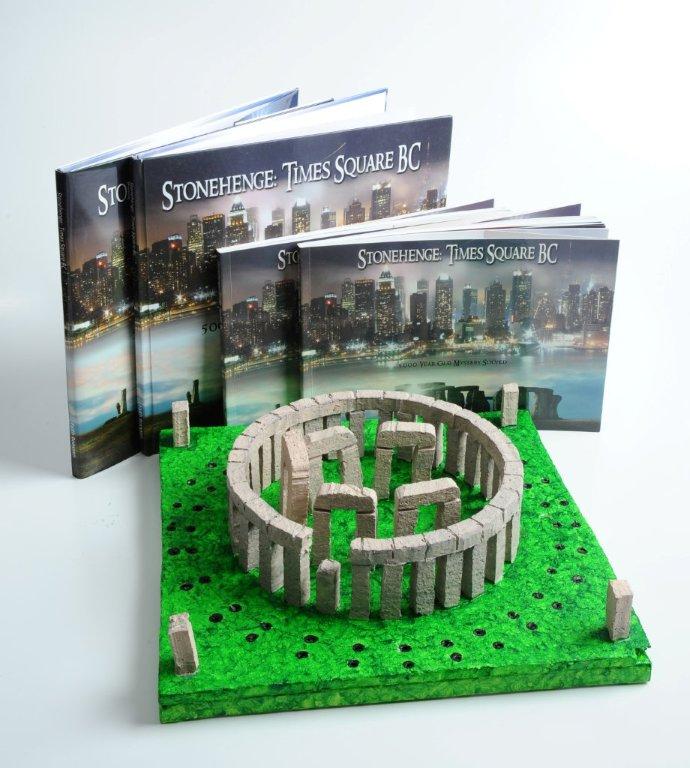
New Stonehenge book launched – Stonehenge Times Square BC

26 11 2010

New Stonehenge book

New Stonehenge book

Discover the Ultimate Function and Purpose of Stonehenge
Where would you be without your diary to check your appointments for the week, or your calendar to work out dates?

We are all ruled by hours, days, weeks and months – from getting up in the morning, to working out schedules, to planning holidays and important functions. In addition to this, most of us have heard of the mysterious, starkly beautiful monument, Stonehenge, and have wondered as to its construction. Be this as it may, how often have we given any thought as to how (and why) this Heritage Site was originated? Are we at all aware of the key role it has played in the concept of ‘time’ and in our New Year celebrations?

Once you have an understanding of the four ancient calendars, revealed and explained in this fascinating window to the past, you will realise that Stonehenge was a site of enormous importance and significance to the ancients. The monument was in fact a device or tool, for revealing the exact date of the year.

More importantly, we are given a glimpse of how the ancients discovered and designed their calendars with little more than sticks and stones to work with. Discover too, the accuracy of their calendars, which were accurate to within a day. Their solar calendar consisted of 365 days had 52 weeks, with 3 seasons of 91 days and 1 season of 92 days. Discover how 12, 30 day months were introduced around 3600 years ago with 5 tagged on days at the end of the year. This last calendar is known to have been used by both the Babylonians and Egyptians.

About the BookThe key points in any solar calendar are alignments with both midsummer and midwinter. Very early on, an important discovery made at Stonehenge was that certain of the megaliths would have aligned perfectly with the midsummer and midwinter solstices approximately 5000 years ago, when the monument was built.

Stonehenge, as it is seen today, is impressive and has fostered many theories as to its original function and purpose. However, this megalithic monument, impressive as it is, is not the full story. Archaeologists have discovered that before the Megaliths (Sarsen stones) were erected, there were earlier structures dating back to as far as 5000 years ago. The area at Stonehenge was in use long before the Sarsen megaliths were erected.

The author of Stonehenge: Times Square BC, Faith Booysen, realized that although some theories held for certain of the structures, taken as a whole, most theories did not explain the older structures.

Working on the assumption that these structures were calendars, her calculations proved that this was, indeed, so.

Her book, Stonehenge: Times Square BC sets out in detail the remarkable calculations and details of four calendars at Stonehenge. The brilliance of the ancient designers and builders are reflected in these calendars. With little more than primitive tools, they designed and built calendars that lasted for hundreds, if not thousands of years. The calendars formed the basis of the calendar we use to this day. Discover how the calendars evolved over a period of 1650 years from a circle of 56 wooden posts to the massive monument we see today.

Extract from the BookWe might never truly know whether the designers were local or foreign to Britain. What we do know is that designing and building calendars with primitive tools, required genius. Civilisation, it can be said, is built upon such genius, dedication and persistence.

These stone structures were built to last and because of this, crucial knowledge was passed down to future generations. Everything from a simple coffee in the morning to space exploration, testifies to this. Sadly, with the advent of written language, these structures fell into disuse and disrepair. Even so, after 5000 years and with little more than holes in the ground, scattered stones and a few remaining megaliths, we are able to reconstruct and understand their calendars.” Extract from Stonehenge: Times Square BC

About the AuthorThe author, Faith Booysen, has always had an overwhelming interest in the stone structures of the ancient world. Stonehenge in particular, held a strong fascination and in 2006, while watching a TV program on “Foamhenge” (a precise model of Stonehenge in polystyrene), she realized that the monument was only part of an equation and that the ancients would have used either loose stones or logs to mark their calendars daily.

It soon became obvious that the ruin of the Stonehenge monument seen today was preceded by other calendars. Stonehenge: Times Square BC is the result. Once the author had resolved the oldest calendar (the Aubrey Posts), she studied the remaining structures at Stonehenge and Woodhenge and these were revealed to be precise solar calendars. Mount Pleasant, a Neolithic henge in Dorset that supported wooden posts, proved to be a precise solar calendar as well.

Merlins CommentIt is obvious that the author knows and loves her subject and she has done some meticulous research to compile this fascinating account of the origins of our modern-day calendars and traditions behind our New Year celebrations.

Even those who are not ruled by the clock, or who are science buffs, will find that this absorbing account of the early designers who built one of the most fascinating monuments known to man and who made time and motion as we know it today all possible, makes you forget all about the time.

Link to TimeHenge book – http://www.timehenge.com/Link to Stonehenge Book Shop

Merlin @ Stonehenge
The Stonehenge Stone Circle Website


Stonehenge was ‘part of crazy golf course for race of giant humans’ claims archaeologist

26 11 2010

The ancient mystery of the Bronze Age monument known as Stonehenge was finally unlocked this week, after Britain’s most eminent archaeologist announced that his exhaustive twelve-year study conclusively proved that the monument was part of an ancient crazy-golf course that covered much of Wiltshire and was used by holidaying giant humans ‘who were taller than a really big tree’.

Professor Arnold Cockburn of Cambridge University, has devoted much of his life to this study of Europe’s greatest Bronze Age monument, and several colleagues looked a little uneasy as he made the announcement at a press conference for the science journal Nature.

‘Look at the shaft of this massive nine-iron golf club, that at the time was dismissed as section of old gas pipe.’ He said. ‘It proves that our ancestors were about a hundred feet high and built Stonehenge as the final hole in a novelty mini-golf range that stretched from Salisbury Plain to Maiden Castle’ he declared.

At this point his former colleague Sir Bryan Peterson interjected to say ‘Arnold has worked very hard on this research project, and I think the strain of it all may have clouded his usually razor-sharp mind. Especially with Deirdre leaving him like that. Arnold, why don’t we go and have a drink, I could help you redraft the research project?’

But Professor Cockburn was undaunted by the discomfort of the attendant journalists, adding that the hundred foot hunter-gatherers were also into Swingball, ping-pong and bike polo. ‘Although they were very tall, they had really small heads, and spoke with a marked Scandinavian accent, like that chef on the Muppets’ continued Britain’s leading academic on ancient European anthropology.

Chalk hill figureProfessor Arnold was recently arrested for trying to run over his wife’s lesbian lover while under the influence of alcohol and was offered paid leave by Cambridge University on condition that he sought medical help. But he claimed that his studies were the only thing that were keeping him sane, and resolved to see the project through to the end.

‘Arnold has had a pretty rough time of recently’ said another Cambridge don ‘and has clearly gone off his mind with this ‘crazy golf for giants’ theory. You only have to look at Stonehenge to realize that the giants obviously built it for croquet.’

History can’t always be serious, hope you liked this Stoonehenge spoof…….

Merlin @ Stonehenge
The Stonehenge Stone Circle Website


Did Stonehenge’s Builders Use Ball Bearings?

24 11 2010

When it comes to mystical places on Earth, few can rival Stonehenge — the enigmatic stone monument sitting on the Salisbury Plain of southern England. And now comes a new theory that suggests the Neolithic builders who erected Stonehenge may have used ball bearings to move the giant stones into place.

Aligned in a circle and made up of 30 vertical standing stones — called megaliths — over 10 feet tall and weighing many tons, Stonehenge is believed to be somewhere between 3,000 and 5,000 years old.

An archaeological study, the Stonehenge Riverside Project, suggested in 2008 that the original purpose of Stonehenge was as a burial ground.

Stonehenge

 
Researchers say the massive stones of Stonehenge could have been moved 10 miles a day using ball bearings.

But other questions raised about the structure have led scientists to wonder whether there wasn’t a more mystical or scientific reason for its existence, including the speculation that Stonehenge was built as a sophisticated astronomical observatory. Researchers have thought that the Stonehenge stones were aligned in such a way to accurately observe the heavens.

One of the lingering questions about Stonehenge is how the ancient builders were able to transport the huge stone slabs a distance of 150 miles from their quarry to the Salisbury Plain.

Now, scientists believe they’ve solved that mystery, the Daily Mail reports. In ongoing experiments, researchers from the University of Exeter have used wooden ball bearings placed in long grooves dug from wood planks.

When they put heavy concrete slabs onto a platform — resting above the balls — they found it was easier to move them.

Archaeologist Andrew Young added his own weight to the experiment by sitting on top of the slabs.

“The true test was when a colleague used his index finger to move me forward. A mere push and the slabs and I shot forward,” Young said. “This proved the balls could move large heavy objects and could be a viable explanation of how giant stones were moved.”

The researchers believe that, using this ball bearing technique along with several oxen, Stonehenge’s builders could have transported the massive stones 10 miles a day, or approximately two weeks from the quarry to their final destination.

All that’s known for certain is that the builders of Stonehenge left no explanation of how they did it or why.

An upcoming National Geographic special, “Stonehenge Decoded,” will consider the various theories to explain the purpose of Stonehenge: prehistoric computer, celestial observatory, place of worship, burial ground and, even, extraterrestrial origin.

Read more at the Daily Mail and National Geographic.

Merlin @ Stonehenge
The Stonehenge Stone Circle Website


English Heritage Gift of Membership makes the ideal Christmas present

24 11 2010

Gift of Membership
For the person who has everything.  Why not buy them an English Heritage membership
English Heritage Membership
English Heritage Gift of Membership makes the ideal Christmas present – free entry to over 400 English Heritage properties for a whole year! The gift of membership comes as a beautifully branded card, plus we offer felixible delivery options. 

Your Gift of Membership also includes:

  • exclusive members’ magazine Heritage Today
  • free English Heritage Handbook worth £8.95
  • free entry for up to six accompanying children (under 19 – within the family group)
  • free or reduced price entry to 100s of special events
  • free or reduced price entry to over 100 associated attractions

Please bear in mind that the last order dates for Christmas delivery are: delivery to UK: Friday 17th December, delivery to Western Europe: Thursday 9th December, delivery to Rest of World: Thursday 2nd December.

External Link: http://www.stonehenge-stone-circle.co.uk/overseas-visitor-pass.htm

Thats my Mum and Dad sorted!

Merlin @ Stonehenge
The Stonehenge Stone Circle Website


£10m investment from the Heritage Lottery Fund for Stonehenge

19 11 2010

Today, the Heritage Lottery Fund (HLF) has announced confirmed funding¹ of £10m for Stonehenge in Wiltshire. 

Heritage Lottery Fund (HLF)

Heritage Lottery Fund (HLF)


Dame Jenny Abramsky, Chair of the Heritage Lottery Fund, said:

“Stonehenge is one of the archaeological wonders of the world. It demonstrates the vital role heritage plays within the UK’s tourism industry as well as being a great example of our fascinating history. This Heritage Lottery Fund investment will help transform this site and give people a much greater understanding of why it is so significant.”

Stonehenge, described as ‘the most architecturally sophisticated pre-historic stone circle in the world’², was constructed and in use between 3,000BC to 1,600BC. It is thought to have been used for a variety of religious ceremonies and the surrounding landscape – a World Heritage Site -contains over 700 known archaeological features. Stonehenge attracts 900,000 visitors every year from across the globe.

Stonehenge visitor centre

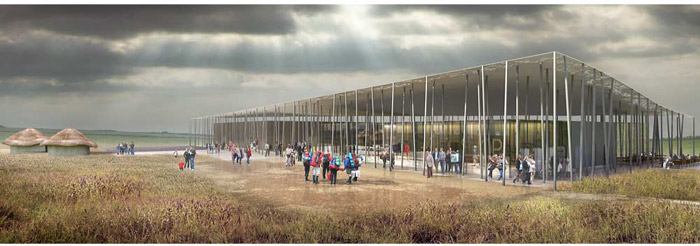
New Stonehenge visitor centre design

Neil Oliver, archaeologist, historian and broadcaster, said:

“Stonehenge is one of the most famous and important archaeological sites in the world – right up there with the Pyramids of Egypt and the Colosseum in Rome.  Just the sound of the word makes us wonder about our ancient past and our ancestors.” 

“It’s therefore fantastic news that thanks to this grant from the Heritage Lottery Fund, visitors will have an even better experience than before.  Perhaps more importantly, the money will help ensure the magic of that special place will be retained, and looked after into the future.  Stonehenge has always been a mind- blowing experience.  With this kind of support, it hopefully always will be.”

Dr Simon Thurley, Chief Executive of English Heritage, said,

”We are tremendously grateful for this generous grant. Not only does it help to narrow the funding gap for the project considerably, it also sends out a message of confidence about the transformational benefits that the project will bring – to tourism,  local economy, and the conservation and public enjoyment of Stonehenge and its landscape. “

HLF’s grant will support work to remove the existing visitor facilities allowing the experience of the stones to be more naturally integrated with its ancient processional approach and the surrounding landscape. These much-needed wider improvements will give people the chance to explore what the site would have been like thousands of years ago. The project aims to improve the visitor experience, including the creation of a new carefully designed visitor centre which will include education and exhibition spaces to help people learn more about Stonehenge’s history. The project will also support training opportunities and a new volunteering programme.

-Ends-

Notes to Editors

  • ¹ A confirmed award means that money had already been earmarked by HLF for the project in question and that the full amount has now been secured. 
  • ²The World Heritage Committee described Stonehenge as ‘the most architecturally sophisticated pre-historic stone circle in the world.’
  • Using money raised through the National Lottery, the Heritage Lottery Fund (HLF) sustains and transforms a wide range of heritage for present and future generations to take part in, learn from and enjoy. From museums, parks and historic places to archaeology, natural environment and cultural traditions, we invest in every part of our diverse heritage.  HLF has supported 33,900 projects, allocating £4.4billion across the UK. 

    Website:
    www.hlf.org.uk 
    www.English-Heritage.org.uk

    Progress, at last……………………… £10 million should do the job nicely!

    Merlin @ Stonehenge
    The Stonehenge Stone Circle Website


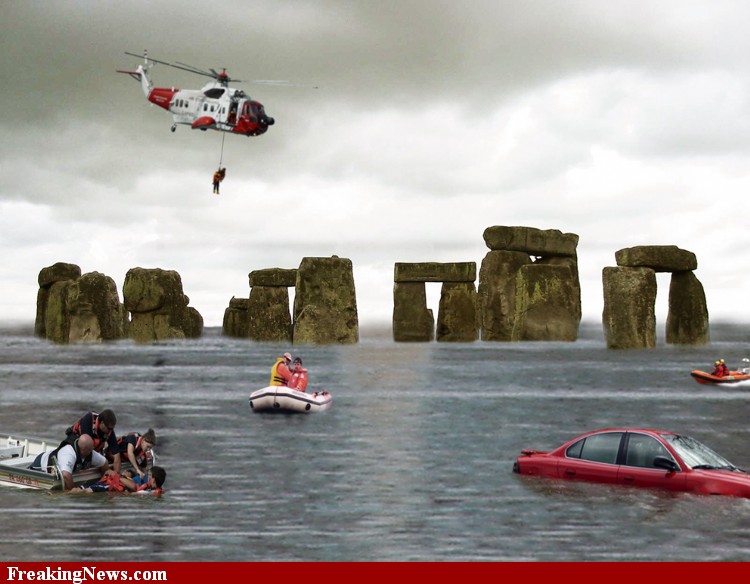
Heavy rain has caused severe flooding at Stonehenge

18 11 2010

• Heavy rain has caused severe flooding on Salisbury Plain
• Scores of residents have been rescued in nearby Amesbury
• Landslides have blocked train routes and the A303
• English Heritage cant open the shop

Stonehenge underwater

Stonehenge underwater

Stonehenge rescue efforts hampered by more rain…………………..

It cant all be serious……… and I did promise a few laughs.

Merlin @ Stonehenge


Proposals for the new Stonehenge Visitor Centre

16 11 2010

English Heritage’s plans are the culmination of months of working closely with a range of stakeholders and engaging with local residents.

Well worth a look!
Click here for the new English Heritage Stonehenge Proposal Video

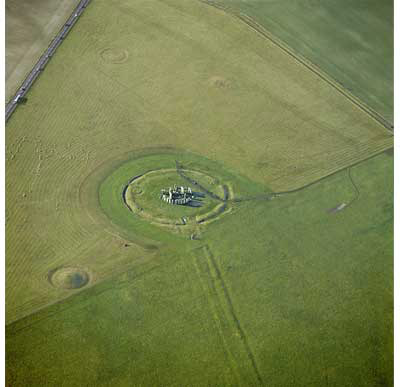
future-aerial-view_new

Wot no roads ? Future aerial view of Stonehenge

The scheme fulfils a long standing ambition to improve the facilities on offer to the many hundreds of thousands who visit each year and to restore a sense of dignity to the setting of one of the world’s most loved ancient monuments. It includes:

  • a new environmentally sensitive visitor centre 1.5miles away at Airman’s Corner with high quality exhibition and education facilities;
  • a low-key visitor transit system that will transport visitors from the visitor centre to a drop-off point close to the Stones;
  • removal of the current car park and facilities at the Stones. The area will be returned to grass, leaving only a minimal operations/security base and emergency toilets;
  • closure of the A344. Wiltshire Council will apply to restrict motorised vehicles on the A344 from the Stones to Airman’s Corner (with exemptions) and also on byways within the World Heritage Site; and
  • an upgrade of the Airman’s Corner road junction to a roundabout. The Highways Agency will also make improvements at Longbarrow Crossroads to mitigate the effects of the A344 closure.

Comments and links from the Heritage Journal

Forget the new Visitor Centre (who knows if it will be like that or built there or built at all this side of the Olympics in Rio de Janeiro) but look at the rest! It certainly looks excellent. 

We do have a few concerns – the land train for one. It looks a lot better and less intrusive than we feared it might – or still could but it would be nice to know it will look like that and there’s no question of it doing other than going from A to B and back and that having it buzzing all over the WHS won’t be considered.

We also wonder if this seductive vision of no fences, no ropes and apparently full access to the stones, that we’d all like, can actually prove viable? What about erosion? And security? How are they going to be dealt with?

But most of all we wonder about the fact the government has said all the good stuff like closing part of the road can’t happen unless the new Visitor Centre gets built! The latter doesn’t seem exactly a definite which means the good stuff might not happen either.

We’re certainly not alone in seeing the road closure as terribly important in it’s own right. Rescue and the Stonehenge Alliance for two! Surely, after all these years, a way can be found to treat the closure and grassing over of the road adjacent to the stones as THE UK heritage priority?

And just DOING it?

(And if money’s a problem, just run a public appeal. It would probably be one of the best supported ones in history!)

Progress at last…………..

Merlin @ Stonehenge
The Stonehenge Stone Circle Website


Canadian Archeologists given access to Bluehenge

12 11 2010

 Eerie, foreboding, mysterious and yet utterly familiar, the stone monuments at Stonehenge are part of the popular consciousness, and yet not much is known about them except that they predate recorded history.

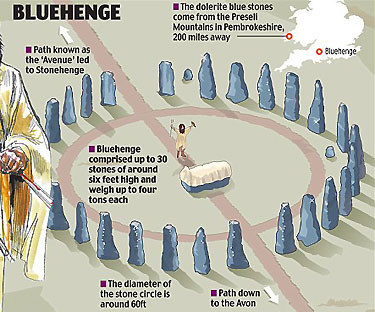
Bluehenge

Bluehenge

Until now, that is.

An archeological research team from PBS’s science program Nova was recently granted unique access to a stone-circle monument little more than a mile from the famous site in Wiltshire, England.

This new site, discovered just over two years ago and dubbed Bluestonehenge – or just plain Bluehenge – has prompted a renewed wave of speculation and investigation, using the latest in high-tech gadgetry and breakthroughs in carbon-dating techniques.

Armchair archeologists will get a kick out of Nova’s findings, which are even more compelling, because they’re presented as dry, scientific history, with none of the hype, loud music or tacky dramatized recreations of most docureality TV shows.

The big questions – who built Stonehenge, why, and how on earth did they manage without engineering blueprints, heavy machinery and construction unions – remain elusive, but it’s hard not to share the researchers’ excitement and enthusiasm as they seem to draw ever closer to the answers. The discovery of traces of charcoal, for example, suggests that some kind of ritual fire or ceremonial burnings happened there – shades of The Wicker Man – and it’s fun to let one’s imagination wander, in the best tradition of folk tales.

Archeologists have since hypothesized that stones may have been removed from Bluehenge around 2500 BC and used to shore up Stonehenge itself, which is known to have undergone major restoration around that time. One theory holds that Bluehenge was a place of life, where the living gathered, and Stonehenge was the “domain of the dead,” and ancient Britain’s first known cemetery.

Whether Stonehenge was created by the ancient Celts or by the magician Merlin, or by space aliens of the Erich von Daniken variety, the ruins’ origin and purpose remain one of the most enduring mysteries facing humankind today.

More than a million people make a pilgrimage to Salisbury Plain every year, and hardly any of them know why. Perhaps it was the site of the original Burning Man.  (what ?)

External links:
http://www.megalithic.co.uk/article.php?sid=23928
http://news.bbc.co.uk/1/hi/england/wiltshire/8288567.stm
http://blog.histouries.co.uk/2010/02/28/bluehenge-unearthed-prehistoric-site-that-could-be-famous-stone-circles-little-sister/
blog: http://www.canada.com/tv guy

Merlin @ Stonehenge
The Stonehenge Stone Circle Website


New Stone Circle Discovered ? 1000’s years older than Stonehenge.

10 11 2010

A stone circle located high in the highlands of Southern Armenia may in fact be the oldest stone observatory in the world, predating England’s Stonehenge. According to newly started excavations, the Armenian Stonehenge (Karahunj) has a history of 7500 years. It’s discovery has sparked a scientific debate in astronomical and astrological circles. Yerkir Media’s Gayane Avetisyan reports on the story for CNN World View.

7,500-YEAR-OLD STONE CIRCLE IN ARMENIA ALIGNED TO CYGNUS’S BRIGHTEST STAR
A Report by Andrew Collins

A new study into Armenia’s Carahunge stone circle complex, has shown that it is arguably one of the oldest known megalithic sites outside of Turkey, dating to around 5500 BC. Moreover, investigations by Russian prehistorian Professor Paris Herouni indicate that Carahunge (car means “stone” in Armenian, and hunge means “voice” or “sound”), located some 200km from the Armenian capital Yerevan, not far from the town of Sisian, was created as an astronomical observatory marking the movement not only of the sun and moon, but also the stars.

Indeed, Herouni’s work at Carahunge was impressive enough to draw in the expertise of the late Professor Gerald Hawkins, who was impressed by the thoroughness of the survey undertaken by his Russian colleague.

Key hole to Cygnus
More significant is that Carahunge’s principal stellar alignment is towards Deneb, the bright star in the constellation of Cygnus the swan.

One of the holed stones at Carahunge aligned to celestial events and key starsA number of the standing stones bear smooth angled spy holes that are 4 to 5cm in diameter, each one being angled towards different points on the horizon or ancient targets in the heavens.
A key stone had a hole that was focused due north towards the meridian. This suggested that it targeted a bright star at its culmination – i.e. the highest or lowest point it reaches as it revolves around the north celestial pole.

One of the holed stones at Carahunge aligned to celestial events and key stars.
Herouni ran the angle of the stone through various astronomical programmes and found that it was aligned to Deneb at a date of around 5,500 BC, suggesting that this was the time frame in which Carahunge was in use by an advanced society of astronomer priests. It was this alignment that provided the key to finally dating the site, which was expected to have been constructed during this distant epoch.

It is even now being claimed by Professor Herouni that Carahunge is the oldest stone obervatory in the world, although surely the stone setting at Nabta Playa in Egypt’s Libyan desert is at least as old as Carahunge, and arguably older. Plus there are my own findings with respect to the orientations of various Pre-Pottery Neolithic (PPN) sites in southeast Turkey, including the 12,000 year old Gobekli Tepe. In The Cygnus Mystery (2006) I demonstrated that, like Carahunge, they seemed to be orientated towards Cygnus’s brightest star, Deneb.

The importance of Professor Herouni’s findings regarding Carahunge is that in a time frame little different to the Neolithic city of Catal Huyuk in neighbouring Turkey, there was an astronomical observatory in Armenia not just aligned to the sun and moon, but also to the stars, and Cygnus in particular. I suspect that the interest in this star group goes back beyond the PPN sites of southeast Turkey to the Palaeolithic age, and the peoples who created the amazing cave art in Western Europe. Representations of Cygnus certainly exist in the Lascaux cave in the Dordogne region of southern France, and I suspect it is present in various other painted caves as well.

So why was Cygnus important?
Primarily it is because of its use as a time marker, its stars being so close to the north celestial pole they move very little across hundreds of years. Then there is its position on the Milky Way, exactly where this starry stream bifurcates to form what is known as the Cygnus Rift or Dark Rift. Universally, this area of the sky has been seen as the point of access into the sky-world, as well as a place of cosmic birth and death. It was also the place where the souls of the dead travelled in the afterlife, very often accompanied by, or in the form of, a bird, seen as a psychopomp, a soul carrier. Very often the identity of these birds corresponded with how the stars of Cygnus were represented in regional mythologies – a falcon in Egypt, a vulture on the Euphrates and a swan in Hellenic Greece and Turkey.

I am not surprised that Carahunge is aligned to Cygnus, although it is always pleasing when one’s theories are shown to be real. I think that in years to come we shall find a lot more about the cult of the swan, and its relationship to the earliest sky-religions of the ancient world. I also think there is much more to learn about the prehistoric beliefs of the proto Armenians, and how they held true age old beliefs that went back all the way to Palaeolithic times.

Professor Herouni has published a book of his findings with respect to Carahunge. Entitled ARMENIANS AND OLD ARMENIA “, it provides compelling evidence that this impressive megalithic site of over 200 standing stones spread out across 7 hectacres, was constructed and used by an advanced civilization. The book provides a detailed explanation of how the stone monument works as an astronomical observatory, and explains its context as the foundation point of Armenia and Armenian history.

Merlin @ Stonehenge
The Stonehenge Stone Circle Website


‘The Computer at Stonehenge’ Poem of the week

9 11 2010

THE COMPUTER AT STONEHENGE

Strange things are done to be number one
In selling the computer
IBM has their stratagem
Which steadily grows acuter,
And Honeywell competes like Hell,
But the story’s missing link
Is the system old at Stonehenge sold
By the firm of Druids, Inc.

The Druids were entrepreneurs,
And they built a granite box
It tracked the moon, warned of monsoons,
And forecast the equinox
Their price was right, their future bright,
The prototype was sold;
From Stonehenge site their bits and byte
Would ship for Celtic gold.

The movers came to crate the frame;
It weighed a million ton!
The traffic folk thought it a joke
(the wagon wheels just spun);
“They’ll nay sell that,” the foreman spat,
“Just leave the wild weeds grow;
It’s Druid-kind, over-designed,
And belly up they’ll go.”

The man spoke true, and thus to you
A warning from the ages;
Your stock will slip if you can’t ship
What’s in your brochure’s pages.
See if it sells without the bells
And strings that ring and quiver;
Druid repute went down the chute
Because they couldn’t deliver.

On a more serious note. Stonehenge: Eclipse Computer?
Every year on the first day of summer, the Sun rises at a point that is farther north than on any other day of the year. At the ruins of Stonehenge in England, this solstice sunrise appears on the horizon in direct alignment with the massive heel stone. This is the most outstanding feature of this ancient monument, built during the same era as the Great Pyramid of Egypt. There is little doubt that the builders of Stonehenge used it to mark this special day as the beginning of each year. By counting the number of days between these annual alignments, they could determine the length of the year. This could serve as a practical calendar to mark holidays and seasonal festivals and to ensure the timely planting and harvesting of crops.

But to predict eclipses, knowledge of two other cycles is required. One of these — the length of the lunar month — is easily determined. It is simply the number of days between one full Moon and the next. This cycle of 29-1/2 days is marked at Stonehenge by two rings of 29 and 30 holes, which together average 29-1/2. The other cycle, however, is of an altogether different character: it is a cycle of rotation of two invisible points in space. The evidence shows that the builders of Stonehenge probably discovered this cycle and could have used it to predict eclipses.

These two invisible points in space are called the lunar nodes (from the Latin for “knot”). They are the points where the Moon’s orbit, which is tilted at a slight angle, intersects the plane of the Earth’s orbit. It would have taken many decades of watching countless risings and settings of the Moon to figure out the cycle of the lunar nodes. This information — which must have been passed on from generation to generation — is preserved at Stonehenge. All the Moon alignments necessary for determining this cycle are marked by massive stones.

Who were these people who observed this subtle cycle even before the first metal tools were used by humankind? Some have suggested that Stonehenge was built by Druids, but we don’t really know much about the builders. We do know that the actual motions of the Sun and the Moon are reflected in the structure of Stonehenge, and we can reason how it may have been used to keep track of these cycles. The number of stones or holes in the ground in the various rings around Stonehenge each represents a certain number of days or years in the cycles. By moving markers (such as stones) around a ring in time with the cycles, the positions of the Sun and Moon — and the two invisible points — can be tracked. (The details of this method are explained in Chapter 2 of the book ECLIPSE, by Bryan Brewer.)

An eclipse can occur only when the Sun is close to being aligned with a node. By using Stonehenge to keep track of the position of the Sun and the nodes, these “danger periods” for eclipses can be predicted. A new (or full) Moon appearing during one of these periods would call for a special vigil to see if the solar (or lunar) eclipse would be visible from Stonehenge. A total solar eclipse would be a rarity. But the law of averages confirms that either a partial solar eclipse or a lunar eclipse can be seen (weather permitting) from the same point on the Earth about once every year.

Why would eclipses have been so important to the ancient people of Stonehenge? Perhaps they considered the darkening of the Sun or the Moon a fearsome event — a celestial omen of doom or disaster. Many cultures have interpreted eclipses this way. But the sophistication of the astronomy of Stonehenge suggests that the builders had something different in mind. Their understanding of the solar and lunar cycles must have led to a high regard for the cosmic order. Eclipses may have been seen as affirmations of the regularity of these cycles. Or perhaps the unseen lunar nodes formed an element of their religion as invisible gods capable of eclipsing the brightest objects in the heavens.

The idea that Stonehenge may have been a center for some kind of worship has occurred to many. It is not hard to imagine Stone Age people gathering at a “sacred place” at “sacred times” (such as solstices, equinoxes, and eclipses) to reaffirm their religious beliefs through ritual practices. British antiquarian Dr. William Stukeley, who in 1740 was the first to note the summer solstice alignment at Stonehenge, advanced the notion that the monument was built by Druids to worship the serpent. He claimed that Stonehenge and similar stone circles had been serpent temples, which he called “Dracontia.” Could this serpent symbolism be related to eclipses? Recall that the key to eclipses is the position of the lunar nodes. The length of time for the Moon to return to a node (about 27.2 days) astronomers call the draconic month. (Draco is the Latin word for “serpent” or “dragon.) Perhaps the mythical serpents of Stonehenge and the legendary dragon that eats the Sun are symbols of the same thing: the invisible presence in time and space that eclipses the Sun and the Moon.

Merlin @ Stonehenge
The Stonehenge Stone Circle Website