Stonehenge Built With Balls?

12 12 2010

New experiment suggests monumental stones could have rolled on rails.

It’s one of Stonehenge‘s greatest mysteries: How did Stone Age Britons move 45-ton slabs across dozens of miles to create the 4,500-year-old stone circle?
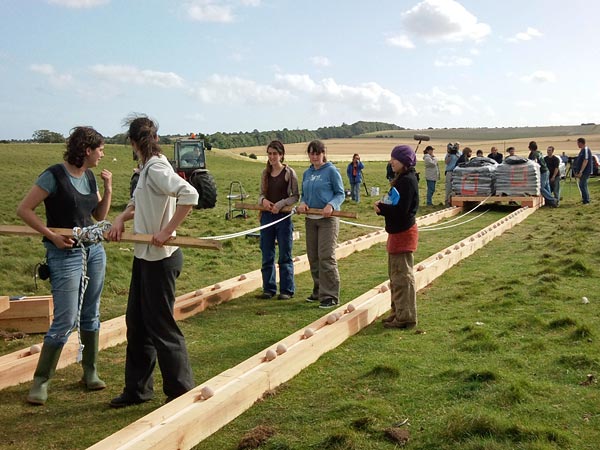
U.K. archaeology students attempt to prove a rail-and-ball system could have moved Stonehenge stones

U.K. archaeology students attempt to prove a rail-and-ball system could have moved Stonehenge stones

Now a new theory says that, while the ancient builders didn’t have wheels, they may well have had balls. (See Stonehenge pictures.)

A previous theory suggested that the builders used wooden rollers—carved tree trunks laid side by side on a constructed hard surface. Another imagined huge wooden sleds atop greased wooden rails.

But critics say the rollers’ hard pathway would have left telltale gouges in the landscape, which have never been found. And the sled system, while plausible, would have required huge amounts of manpower—hundreds of men at a time to move one of the largest Stonehenge stones, according to a 1997 study.

Andrew Young, though, says Stonehenge’s slabs, may have been rolled over a series of balls lined up in grooved rails, according to a November 30 statement from Exeter University in the U.K., where Young is a doctoral student in biosciences.

Young first came up with the ball bearings idea when he noticed that carved stone balls were often found near Neolithic stone circles in Aberdeenshire, Scotland (map).

“I measured and weighed a number of these stone balls and realized that they are all precisely the same size—around 70 millimeters [3 inches] in diameter—which made me think they must have been made to be used in unison, rather than alone,” he told National Geographic News.

The balls, Young admitted, have been found near stone circles only in Aberdeenshire and the Orkney Islands (map)—not on Stonehenge’s Salisbury Plain.

But, he speculated, at southern sites, including Stonehenge (map), builders may have preferred wooden balls, which would have rotted away long ago. For one thing, wooden balls are much faster to carve. For another, they’re much lighter to transport.

Proof of Concept

To test his theory, Young first made a small-scale model of the ball-and-rail setup.

“I discovered I could push over a hundred kilograms [220 pounds] of concrete using just one finger,” he said.

With the help of his supervisor, Bruce Bradley, and partial funding from the PBS series Nova, Young recently scaled up his experiment to see if the ball-and-track system could be used to move a Stonehenge-weight stone.

Sure enough, they found that, with just seven people pushing, they could easily move a four-ton load—about as heavy as Stonehenge’s smaller stones.

Using the ball system, Young said, “I estimate it would be possible to cover 20 miles [32 kilometers] in a day” by leapfrogging track segments.

But the inner circle’s “sarsen” stones weigh not 4 tons but up to about 45 tons. Young suspects a Stone Age system could have handled much heavier loads than his experimental one.

For one thing, he thinks oxen, not people, provided the pulling power—an idea supported by the remains of burned ox bones found in ditches around many stone circles.

For another, Britain’s old-growth forests hadn’t yet been razed 4,500 years ago, so the builders would have had easy access to cured oak. This tough wood—which was beyond the modern project’s budget—would have resulted in a stronger, more resilient system than the soft, “greenwood” system the researchers built.
Stonehenge Experiment Needs Scaling Up

Civil engineer Mark Whitby, who’s been involved with other Stonehenge-construction experiments, thinks the ball method could work for smaller stones but isn’t convinced it could shift a sarsen.

“The problem will be when the tip of the ball bears on the timber trough, it will bite” into the trough, possibly splitting the rail, said Whitby, who runs London-based +Whitby Structural Engineers. “When transporting lighter stones, this won’t be a problem. But when they get to 30 and 40 tons, it will be.”

Instead, Whitby prefers the sled theory—and even helped prove a sled could move a 40-ton replica sarsen for a 1997 BBC documentary.

Archaeologist David Batchelor, meanwhile, thinks the ball idea is plausible but isn’t completely convinced.

The ball technique “seems to be a development of the sledge method,” said Batchelor, of the government agency English Heritage. “But the added complexity needed to channel the track runners and then make the ball bearings all of one size seems to me a lot of work, which is probably unnecessary when animal-fat grease does the job.”

Research leader Young counters that the sled system, even with its animal-fat lubrication, still results in a lot of friction.

“Using wooden balls almost removes friction from the system and makes for a really efficient method of moving heavy weights around,” he said.

Even so, Young realizes he needs to prove the new system can be scaled up to handle heavier loads. To that end, Young’s team is seeking funding to repeat the experiment—this time with harder wood, stone balls, and oxen

What a load of old balls……………………………..
Merlin @ Stonehenge
The Stonehenge Stone Circle Website


Yule – Winter Solstice

9 12 2010
21st/22nd December
Yule or the Midwinter Solstice is the time of year when we experience our shortest day and longest night – the sun is at its lowest point in the sky at noon. Yule meaning ‘wheel’ is one of the oldest winter celebrations in the world.

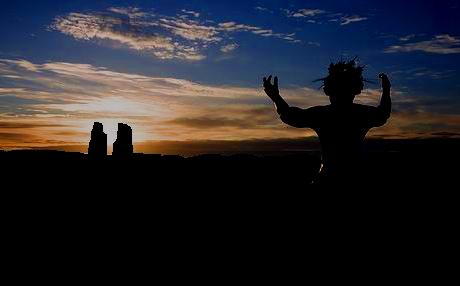
Stonehenge Winter Solstice celebrations

Stonehenge Winter Solstice celebrations

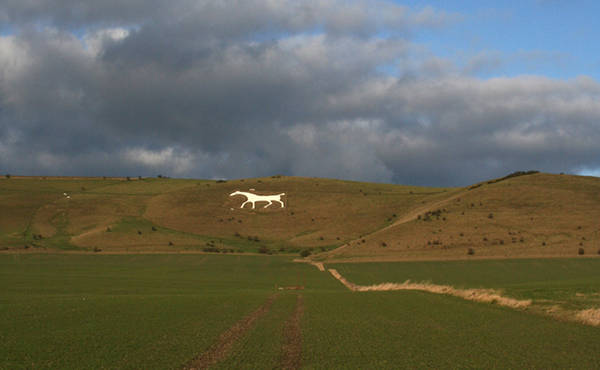
In Wiltshire the winter solstice is still celebrated by the lighting up of the white horse at Alton Barnes. Tea lights in jars are placed on the chalk, so that the horse glows with candlelight.

Wassailing
New Year’s Eve was the traditional time that this ceremony took place, and was originally held around the oldest tree in the apple orchard. The first cider crop was poured on the roots of the apple tree to thank the tree spirits for the crop of apples, and to ensure a good harvest next year.

Drumming and bamging sticks would beat away any bad spirits, and the wassail cup would be passed around. Toast dipped in cider would then be hung on the oldest tree, as an offering to the tree dryads.
‘Wassail’ was Saxon for ‘good health’.

In the eleventh-century, the Danish rule over England brought the Scandinavian term for Christmas – Yule. Christmastide was the time to bring out the wassail bowl or cup. The leader of the celebrations would call ‘Wassail’, which was Old English for ‘your health’, and the answer was ‘Drinkhail’, at which the bowl was passed round so everyone took took a drink and handed it on with a kiss

Symbolism of Yule:

Rebirth of the Sun, The longest night of the year, The Winter Solstice, Introspect, Planning for the Future.

Symbols of Yule:
Yule log, or small Yule log with 3 candles, evergreen boughs or wreaths, holly, mistletoe hung in doorways, gold pillar candles, baskets of clove studded fruit, a simmering pot of wassail, poinsettias, christmas cactus.

Herbs of Yule:
Bayberry, blessed thistle, evergreen, frankincense holly, laurel, mistletoe, oak, pine, sage, yellow cedar.

Foods of Yule:
Cookies and caraway cakes soaked in cider, fruits, nuts, pork dishes, turkey, eggnog, ginger tea, spiced cider, wassail, or lamb’s wool (ale, sugar, nutmeg, roasted apples).

Incense of Yule:
Pine, cedar, bayberry, cinnamon.

Colors of Yule:
Red, green, gold, white, silver, yellow, orange.

Stones of Yule:
Rubies, bloodstones, garnets, emeralds, diamonds.

Activities of Yule:
Caroling, wassailing the trees, burning the Yule log, decorating the Yule tree, exchanging of presents, kissing under the mistletoe, honoring Kriss Kringle the Germanic Pagan God of Yule

Spellworkings of Yule:
Peace, harmony, love, and increased happiness.

Deities of Yule:
Goddesses-Brighid, Isis, Demeter, Gaea, Diana, The Great Mother. Gods-Apollo, Ra, Odin, Lugh, The Oak King, The Horned One, The Green Man, The Divine Child, Mabon.

Symbolism of Yule:

Rebirth of the Sun, The longest night of the year, The Winter Solstice, Introspect, Planning for the Future.

Symbols of Yule:
Yule log, or small Yule log with 3 candles, evergreen boughs or wreaths, holly, mistletoe hung in doorways, gold pillar candles, baskets of clove studded fruit, a simmering pot of wassail, poinsettias, christmas cactus.

Herbs of Yule:
Bayberry, blessed thistle, evergreen, frankincense holly, laurel, mistletoe, oak, pine, sage, yellow cedar.

Foods of Yule:
Cookies and caraway cakes soaked in cider, fruits, nuts, pork dishes, turkey, eggnog, ginger tea, spiced cider, wassail, or lamb’s wool (ale, sugar, nutmeg, roasted apples).

Incense of Yule:
Pine, cedar, bayberry, cinnamon.

Colors of Yule:
Red, green, gold, white, silver, yellow, orange.

Stones of Yule:
Rubies, bloodstones, garnets, emeralds, diamonds.

Activities of Yule:
Caroling, wassailing the trees, burning the Yule log, decorating the Yule tree, exchanging of presents, kissing under the mistletoe, honoring Kriss Kringle the Germanic Pagan God of Yule

Spellworkings of Yule:
Peace, harmony, love, and increased happiness.

Deities of Yule:
Goddesses-Brighid, Isis, Demeter, Gaea, Diana, The Great Mother. Gods-Apollo, Ra, Odin, Lugh, The Oak King, The Horned One, The Green Man, The Divine Child, Mabon.

Merlin @ Stonehenge
The Stonehenge Stone Circle Website
Our ancestors celebrated the rebirth of the Sun god at Yule, and the expulsion of the evil winter spirits. The winter solstice was considered a mysterious and powerful time, for it is at this point the sun begins to make the return journey across our skies. After the longest night of the year the sun is seen as growing stronger and the return of the warmer season is welcomed – the concept of rebirth became strongly associated with the Winter Solstice.

Three days after Yule many people exchange gifts and celebrate Christmas – the birth of Jesus, as our ancestors celebrated the return of light and the sun growing in strength. The well-known figure of Father Christmas may have derived from the Pagan god, Herne the Hunter.
Yule was celebrated with bonfires to stimulate the ascent of the sun, and lamps illuminated houses decorated with evergreens to simulate summer.

It is a time to look on the past year’s achievements. The days will now grow longer up to the mid summer solstice.

Yule Traditions

The Yule Log – during medieval times, the decorated log was ceremoniously carried into the home on Christmas Eve, and placed in the fireplace. Traditionally the Yule log was lit with the saved stump of last year’s log, and then it was burnt over the twelve days of the winter celebration, and its ashes and stump were kept until the following year to sprinkle on the new log, so that the fortune would be passed on from year to year.
In France and Germany ashes from the Yule log were mixed with the cattle feed to ensure their health and in other regions the ash was sprinkled around fruit trees to increase their yield of fruit.

Yule wreaths
were traditionally made of evergreens and holly and ivy. Holly represents the female and ivy the male and the wreath’s circle symbolizes the wheel of the year. Both holly and ivy were used as protection in the home against bad spirits making a Yuletide wreath
solstice wreath making


The Great Stones Way – Britain’s newest long-distance walking trail opens in March 2011

8 12 2010

The Great Stones Way, a superb new 30 mile walking trail between the World Heritage Sites at Avebury and Stonehenge, will become one of Britain’s best loved and most used walking routes. 

Passing through the landscapes of the Wiltshire Downs, the Vale of Pewsey, Salisbury Plain and the Avon Valley, The Great Stones Way will be a great walk in itself. The combination of immense vistas and magnificent archaeology along the route will be irresistible – no other walking route has so much ancient heritage packed into such an attractive 30 miles.

Alton Barnes Chalk Hill Figure

The Great Stones Way is being developed by The Friends of The Ridgeway using existing footpaths and rights of way. Ian Ritchie, Chairman of The Friends of The Ridgeway says: “The Great Stones Way is a vital part of our ambition to open up the whole 360 miles of the Great Ridgeway from the south coast to East Anglia.  The section between Avebury and Stonehenge is currently a big gap in that route, and The Great Stones Way will fill it brilliantly.”

The Great Stones Way will be launched on Saturday 26 March 2011 with a series of walks along the trail.  Ian Ritchie explains: “Ambitious and experienced walkers will want to do the whole 30 miles in one day, and there will be an alternative 13 mile route from Casterley Camp on Salisbury Plain to Stonehenge.  A gentle four miles from Durrington to Stonehenge will suit people who want to walk a shorter distance.”

In addition to the two great stone circles at the World Heritage Sites of Avebury and Stonehenge, The Great Stones Way passes Silbury Hill, West Kennet Long Barrow, The Sanctuary, the Wansdyke, Adam’s Grave, Marden Henge, Broadbury Banks, Durrington Walls and Woodhenge. 

“Because The Great Stones Way could take some people up to three days to walk its entire length, we are creating a series of shorter circular trails of varying lengths and challenges to suit walkers of all abilities,” says Ian Ritchie. The whole experience will be enhanced by a dedicated local bus service, the Henge Hopper, which will enable walkers to minimise the use of their cars and to plan their own walks along The Great Stones Way

The Friends of The Ridgeway commissioned a professional feasibility study which estimated that opening up The Great Stones Way will bring more than 250,000 visitors to the area and over £6million into the local rural economy each year.  This will benefit accommodation providers in nearby towns and villages as well as several pubs and village shops along the trail.

Claire Perry, Devizes MP supports the new walking trail: “I believe that The Great Stones Way will be a vital link at the heart of the Ridgeway.  It will take walkers over some of the most ancient and important paths in our great country and link two extraordinary World Heritage Sites.  To be able to walk along a well signposted and well surfaced path will be a pleasure for both British and overseas walkers and will bring important benefits to our local economy.”

The Friends of The Ridgeway group has already held several public meetings with parish councils and communities along the route, and more are planned.  The group is fund-raising to improve signage, install disability access gates, repair the path surface in places, and to produce The Great Stones Way guidebook. 

Details of the inaugural walk will be published on The Great Stones Way website www.greatstonesway.org.uk (currently under construction). Anyone who would like to take part or contribute to fund-raising can visit the website for more information or contact The Friends of the Ridgeway via www.ridgewayfriends.org.uk

If you have not got the tme or the energy there are a few tour companies offering guided tours using cars or mini coaches.  You could try the Stonehenge Tour Company based in London, the excellent Histouries UK private guided tours from Bath or London or Salisbury Guided Tours.  We also have several discounted tours available on our website – click here

Merlin @ Stonehenge
The Stonehenge Stone Circle Website


Full Moon this Winter Solstice 2010

7 12 2010

The exact time for the Winter Solstice is December 21st, 11.39pm (UK time). The sunset on the 21st is at 3.53pm and the sunrise on the 22nd of December at 8.04am. Exceptionally, we can also expect a full moon on December 21st

Since 1793, when The Old Farmer’s Almanac began tracking heavenly events and seasonal changes, the Moon has been full on the first day of winter just nine times. The next occurrence will be in this coming Winter Solstice


Full moon at Stonehenge this Winter Solstice

Full moon at Stonehenge this Winter Solstice


The rarity of a solstitial full Moon—the average interval is about 19 years—reinforces the Moon’s role as a beacon playing on human history. Although our research could not find a correlation between these lunar events and significant historical happenings on similar dates in the past*, the combination of astronomical forces certainly affect the tides.

As astronomer Bob Berman explains, during this time of proxigean tides [unusually high tides due to the Moon’s phase and proximity to Earth], coastal flooding could occur if there is one more little extra effect, such as a storm at sea, on-shore winds, or low barometric pressure.

If the solstice night is calm and cloudless, with the full Moon beaming down on a blanket of snow, it will be irresistibly attractive, and electrical illumination—even your car’s headlights—may seem superfluous.

Full moon - Winter Solstice

Full moon - Winter Solstice

2010
Spring equinox – Mar 20 at 5.35pm
Summer solstice – Jun 21
at 11.30am
Autumn equinox – Sep 23
at 3.10am
Winter solstice – Dec 21

Merlin @ Stonehenge
The Stonehenge Stone Circle Website


All aboard the ‘Stonehenge Express’

7 12 2010

Two crucial aspects of the Stonehenge proposals have yet to be clarified…

 1. The transit system.

Will it be like one of the two examples shown here ? Not one like the Eden Project, please! That one is called “Percy”. Very tasteful! So more like the Dover Castle one? It may be, if this video is a true representation. But the video one pulls four carriages, not two. Is the vehicle up to it? And what about the livery? Can we be solemnly promised it will never ever carry advertising? And what’s wrong with buses? And what about talk in The Times letters column of Lord Lansdowne saying Stonehenge would be turned into a toytown with visitors approaching in dinky electric vehicles? Isn’t anything that prompts thoughts of Noddyland (which it’s hard not to think of when watching the video) to be absolutely avoided at our national icon? 

http://www.english-heritage.org.uk/daysout/properties/stonehenge/our-plans/our-proposals/

 2. The fences 

Will the fences be removed? Surely it has been decided upon? After all, if the detailed design of the new Visitor Centre and the colour of the transit system coaches have been decided then surely it is inconceivable that the matter of access to the stones (in other words the fences) hasn’t been been decided as well? English Heritage as good as says it has : “The need to care for Stonehenge properly has been recognised for many years. Improvement to its landscape setting and presentation to visitors are identified as priorities in the WHS Management Plan ……… The proposals to address this need have been agreed by a group of key stakeholders led by English Heritage

So what HAS been decided about the fences? The reason the question needs to be asked is because the video appears to show that there will be no fences – and although that would be very nice we have concerns that behind the scenes a different view might have been taken. The practicalities suggest that having no fences at all would prove impossible. Security is one problem. And erosion is another. But the video seems to suggests that nearly a million people a year will be free to walk amongst the stones, not held back by fences, ropes or rules. It seems unlikely.

A lot of people hold the “no fences and free access to the stones” concept very dear. If it is not going to happen then it would be better if people were told, not given a contrary impression by a video. Indeed, the public has the right to know does it not? Open access to the stones may or may not be impractical but open access to information about this matter certainly isn’t!

Exteran Links: http://heritageaction.wordpress.com/

Merlin @ Stonehenge
The Stonehenge Stone Circle Website


Solstice and “The Ancestor”

7 12 2010

A Winter Solstice celebration is to be held at which  The Ancestor will be receiving his new winter crown and decorations for the festive period….  Could it be the start of something significant?

Few would disagree that when he was set up at Stonehenge for the summer solstice The Ancestor was a marvelously apt symbol, a powerful expression of everyone’s feelings towards sunrise, particularly at the solstices. But clearly he can’t be shipped to Stonehenge twice a year so is there not an opportunity here? 

Everyone knows that vast gatherings at Stonehenge, particularly at summer solstices, pose major logistical, conservation and financial problems for English Heritage, ones that they will be finding increasingly difficult to cope with in the face of the cuts. The pagan community are acutely aware of this and also that the difficulties aren’t caused by them but by others attracted to the event without adequate appreciation of the need to respect the monument.

 So here’s a possible solution:

Suppose the main summer solstice celebration centred not on Stonehenge but elsewhere, around The Ancestor? Could this not take much of the pressure off Stonehenge and perhaps allow a smaller-scale, more seemly gathering at the stones, to the advantage of both pagans and the authorities?

Not that the alternative celebration need be any less valid. As well as The Ancestor there might be the opportunity to erect heel stones at the venue so more people could see the symbolism of the sunrise more accurately – after all, modern pagans are Neo Pagans are they not? Why shouldn’t they (and all of us) have a way to celebrate modern sunrises properly, not long-gone ones inaccurately? 

Who would pay? Well, presumably no-one would mind paying a pound or two at the gate since it wouldn’t be at Stonehenge and would be easily approached without a long cold hike. And the start-up costs? How about asking English Heritage if they’d mind paying that out of the savings they’d make out of not having to run the event at Stonehenge!? Seems like it would be a very good deal for them, the taxpayer, Stonehenge and all pagans.

So there’s the suggestion. Discuss! Could the Solstice be better celebrated by everyone? And could The Ancestor be made into the permanent and universally admired face of modern paganism?

External link: http://heritageaction.wordpress.com/2010/12/03/solstice-and-the-ancestor/

Merlin @ Stonehenge
The Stonehenge Stone Circle Website


Pagan Mistletoe Symbolism and Legend

4 12 2010

Mistletoe and Christmas After Celtic Pagans were converted to

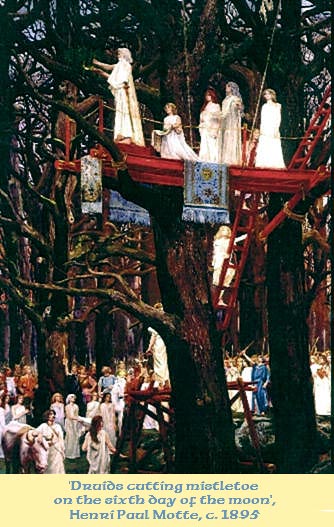
Druids cutting Mistletoe

Druids cutting Mistletoe

Christianity, Catholic bishops, with one exception, didn’t allow the mistletoe to be used in churches because it was one of the major symbols of Paganism. Before the Reformation, a priest at the Cathedral of York brought a bundle of mistletoe into the sanctuary each year during Christmastide and put it on the altar as symbolic of Jesus being the Divine Healer of nations.

‘Mistletoe, one of the most magickal and sacred plants of Paganism, symbolizes life and fertility and protects against poison. It was considered an aphrodisiac. ‘

The English used mistletoe as a Christmas decoration for their homes. In Medieval times, branches of mistletoe were hung from ceilings and put over houses and barn doors to repel evil spirits. People believed the plant could extinguish flames. Although much of the Pagan symbolism was forgotten, the plant represented good will, happiness, good fortune and friendship.

‘The sacred mistletoe is a hemiparasite, partial parasite that grows on branches or trunks of trees and has roots that penetrate into the tree for food. The American plant grows on trees while the European mistletoe can also be a green shrub with small yellow flowers and white berries. The plant contains toxins that can cause physical reactions including gastrointestinal disturbances and a slowed heartbeat.’

Mistletoe Sacred to Celtic Druids

The plant has qualities including the power of healing, rendering poisons harmless, good luck, great blessings, bestowing fertility on humans and animals, protection from witchcraft and banishing evil spirits. Enemies who met Druids under the forest mistletoe laid down their weapons, exchanged friendly greetings and kept a truce until the next day. The Celts suspended mistletoe over doorways or in rooms as a symbol of good will and peace to all who visited.

‘Mistletoe was revered by the ancient Druids both magically and medicinally. It’s possible that modern mistletoe traditions have their roots in ancient beliefs.’

Druid Mistletoe Ceremony

The plant is a fertility symbol and the soul of the oak tree. Belief was that the mistletoe could come to the oak tree during a lightning flash. Mistletoe was gathered at mid-summer and winter solstices. The plant, when it grew on the venerated oak tree, was especially sacred to the Celts. On the sixth night of the full moon after Yule, white-robed Druid priests gathered oak mistletoe by cutting the plant with golden sickles. Two white bulls were sacrificed with prayers that the recipients of mistletoe would prosper.

Mistletoe and the Ancient Druids

Pliny the Elder, a Roman historian interested primarily in natural history, recorded valuable information about the Druids and their religious and healing practices. These ancient priests of Celtic lands revered mistletoe as sacred. Pliny stated in Natural History, XVI, 95 that, “The Druids — that is what they call their magicians — hold nothing more sacred than mistletoe and a tree on which it is growing…Mistletoe is rare, and when found, it is gathered with great ceremony, and particularly on the sixth day of the moon.”

In the scene quoted above, the Druids are preparing for a ritual sacrifice which involves a white-robed priest carrying a golden scythe while climbing an oak tree to ritually cut the mistletoe. According to Pliny, it was the Valonia oak the Druid’s believed was the most sacred tree to gather mistletoe from and that it would heal poison and encourage fertility.

Mistletoe in Celtic Art

Celtic art is resplendent with what are believed to be mistletoe motifs. Some artifacts have been found that resemble human male heads adorned with a crown of comma-shaped leaves that resemble mistletoe. Historians believe these finds may be representations of crowned Druid priests.

External links:
http://www.mistletoe.org.uk/ A survey of Mistletoe use in Britain
http://www.mistletoes-r-us.co.uk/  Mistletoe matters
http://www.archaeology.co.uk/books/blood-and-mistletoe-the-history-of-the-druids-in-britain.htm The History of Druids – Blood and Mistletoe

 Next blog will be about -‘Yule’

Merlin @ Stonehenge
The Stonehenge Stone Circle Website


Could This Be How Stonehenge Was Actually Built? New theory

2 12 2010

One of the most puzzling mysteries is how Stonehenge, the prehistoric circle of stones in England, came to be. We know it was built around 4500 years ago, and the stones came from Wales, some 250km away… but how?

Of course, back then, it wasn’t so easy to transport stuff around the country – especially not 60 bluestones which are said to weigh between two and four tons each. Several theories have been bandied about over the years of how the stones were transported, including sledges; rafts along the rivers; and that Merlin himself used his magic to gather the stones there.

This week, an engineer and former BBC TV presenter, Garry Lavin, tested his theory that wicker baskets made from willows were used to roll the stones all 250kms from the quarry in Preseli Hills, Wales, to Salisbury, in Wiltshire, England. He built one himself, using willow and alder saplings, and enlisted several friends to help roll a one-ton boulder along the ground.

He thinks oxen might’ve helped roll the baskets in some parts, and that rivers could have floated them downstream. But it’s the baskets which Lavin is sure had a huge part in the formation of Stonehenge – and as he’s currently building a maxi-basket to move a five ton stone, we may soon find out the answer. Unless aliens decide to show up and show us otherwise, of course.

Well, your comments ?

Merlin @ Stonehenge
The Stonehenge Stone Circle Website


Ancient UK standing stone guided people through sacred landscape

29 11 2010

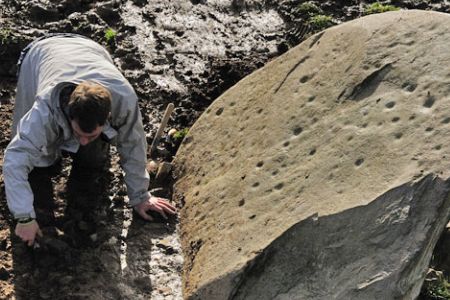
Archeologists say Trefael, a standing stone near Newport south-west Wales, was used as a ritual marker to guide communities through a scared landscape.

Studies showed that the cupmarks gouged onto the solitary stone represent a section of the night sky that includes the star constellations of Cassiopeia, Orion, Sirius and the North Star.

There are more than 75 cupmarks on the stone, which were revealed through complete exposure of the stone during recent excavations, Archeo News reported.

Until 40 years ago archaeologists assumed that the stone was part of a capstone covering a small burial chamber.

Later geophysical surveys unveiled the remains of a kidney-shaped anomaly, looking like remnants of the cairn that once surrounded the chamber, with an entrance to the east.

Excavations confirmed the site to be a portal dolmen, also exposing a cairn deposit within the eastern and northern sections of the trench.

A clear vertical cut was also found in section, which was parallel with the dip of the former capstone. This showed that the cairn had been excavated into and the capstone set and packed within the existing cairn, probably used as a standing stone during the Early Bronze Age when new burial-ritual monuments were introduced in Western Britain.

Archeologists found medieval and post-medieval pottery shards and two Mesolithic shale beads. They are planning to conduct further excavations in the area to assess the later prehistoric landscape setting and a contour survey of the monument.

Merlin @ Stonehenge
The Stonehenge Stone Circle Website


University student sparks new Stonehenge theory

29 11 2010

Stonehenge

A REVOLUTIONARY new idea on the movement of big monument stones like those at Stonehenge has been put forward by an archaeology student at the University of Exeter.

While an undergraduate, Andrew Young saw a correlation between standing stone circles in Aberdeenshire, Scotland and a concentration of carved stone balls, which may have been used to help transport the big stones by functioning like ball bearings.

Young discovered that many of the late Neolithic stone balls had a diameter within a millimetre of each other, which he felt indicated they would have been used together in some way rather than individually.

By plotting on a map where the carved balls were found, he realised they were all within the vicinity of Neolithic monuments known as recumbent stone circles.

These stone circle monuments in Aberdeenshire share an equivalent form to Stonehenge, yet with some much larger stones.

To test his theory Young built a model using small wooden balls which were placed in a grooved pieces of wood moulding, similar to a railway track but with a groove rather than a rail.

The balls were spread apart and a mirror image of the track was placed on top supporting a wood platform.

He then placed concrete slabs on the tracks, to replicate a heavy weight.

Young said: “I then sat on top of the slabs to add extra weight. The true test was when a colleague used his index finger to move me forward, a mere push and the slabs and I shot forward with great ease.

“This proved the balls could move large heavy objects and could be a viable explanation of how giant stones were moved, especially in relation to where the stone balls were originally found.”

A further experiment on a much larger scale was arranged with the financial assistance of Gemini Productions and WGBH, Boston for NOVA, an American documentary TV programme.

They were focusing on Stonehenge and wanted to see if a team of archaeology students directed by Professor Bruce Bradley, a lead archaeologist at the University of Exeter could build and test a life size model using wood that might reflect how massive stones could have been moved across the landscape.

Previous experiments, which others have carried out to move large stones had not been particularly effective.

The building of a hardened surface to roll logs on and the trench experiments only moved the stone with great effort and if they had been moved in this way the hardened surface or trench would show up in the archaeological record, however these have not been found.

In the large scale experiment, green wood was used for cost purposes. Neolithic people would have had access to much better materials, such as cured oak, which is extremely tough and was in abundance due to the great forests at the time.

They also had the technical ability to cut long timber planks, known through archaeological evidence of planks used as a way of creating tracks for people to walk on through bogs.

The experiment used hand shaped granite spheres as well as wooden spheres.

Professor Bradley said: “Our experiment had to go for the much cheaper option of green wood, which is relatively soft, however, we successfully moved extremely heavy weights at a pace.

“The demonstration indicated that big stones could have been moved using this ball bearing system with roughly ten oxen and may have been able to transport stones up to ten miles per day.

“This method also has no lasting impact on the landscape, as the tracks with the ball bearings are moved along leap-frogging each other as the tracks get moved up the line.”

He added: “It demonstrates that the concept works. It does not prove that Neolithic people used this method, but it was and is possible.

“This is a radical new departure, because previous ideas were not particularly effective in transporting large stones and left unanswered questions about the archaeological record they would have left behind.”

The next stage in the project is to collaborate with the engineering experts at the University who can calculate the loads which could be transported using various combinations of variables such as hard wood and U-shaped grooves.

This will provide the mathematical evidence to see how much force would be needed to get the stone moving and to keep it moving.

This will enable the project team to gain an even greater understanding of how stones may have been transported across huge distances and even up hills.

The ultimate goal is for a full-scale experiment in Aberdeenshire using more authentic materials, stone balls and a team of oxen.

Merlin @ Stonehenge
The Stonehenge Stone Circle Website