Book Extract: Stonehenge by Rosemary Hill

8 01 2011

Hill’s Stonehenge surveys the endless speculations around this mysterious monument

Antiquaries were a relatively new intellectual species, largely a
Rosemary Hill - Stonehenge

Rosemary Hill - Stonehenge

product of the Reformation, and they were interested in what could be discovered of the past by looking beyond the written records. They studied anything that was old – stones, metal, pottery, coins – attracting in the process much derision from contemporaries who thought it an “unnaturall disease” to be so “enamour’d of old age and wrinkles”. Yet the antiquaries were the first archaeologists. They were also the first oral historians, costume historians, art historians and folklorists. They opened up vast intellectual horizons and if, as later archaeologists have sometimes been quick to point out, they made mistakes, they were not alone in that and, working in an age before academic specialisation, before science and the arts had parted company, they were also able to make daring and useful connections.

It was James I, who prided himself on being up to date with intellectual fashion, who initiated the archaeological investigation of Stonehenge, although as befits the man known as “the wisest fool in Christendom” his efforts had mixed results. Staying nearby at Wilton House in 1620, he expressed an interest in the stones. Since the Reformation the land on which Stonehenge stood had passed into private hands and it was to remain private property until the 20th century. James’s intimate friend the Duke of Buckingham, eager to please, immediately tried to buy it for the King. The owner, however, refused to sell, so Buckingham had to be content with digging an enormous hole in the middle of it, from which he removed various objects now lost and, as John Aubrey later thought, caused one of the stones (stone 56) to tilt over “by being underdigged”. After this unpromising start the King approached the Royal Surveyor, Inigo Jones, and asked him to produce a report. Jones’s Stone-Heng Restored appeared posthumously in 1655. It was the first book entirely devoted to the subject and it argued that Stonehenge was Roman. The reaction that this theory provoked kick-started the antiquarian investigation of Stonehenge. If there was anything the typical antiquary liked more than proving himself right, it was proving somebody else wrong, and Jones’s book prompted two people, Walter Charleton and his friend John Aubrey, to throw their energies into discrediting it.

The archaeologist Jacquetta Hawkes famously remarked that every age “has the Stonehenge it deserves – or desires” and the Stonehenge of the Stuart antiquaries was born of the age that saw the foundation of the Royal Society, the wider exploration of the Americas and a new Baconian spirit of critical enquiry, in which nature and mathematics were the ultimate authorities. This critical, analytical cast of mind brought about a change in attitudes to the past and to the study of it. Until then history had been narrated, chiefly, as the story of a Golden Age, with everything since a long-protracted fall. “Till about the yeare 1649,” as Aubrey noted, “’twas held a strange presumption for a man to attempt an innovation in learning; and not to be good manners to be more knowing than his neighbours and forefathers.” Enquiry now was all the rage, but it was tinged also with melancholy and foreboding. The generation of antiquaries that had lived through the Civil Wars had seen towns and families divided. They had watched Puritans smash stained glass and knock the heads off the statues in churches; they feared for the past and for the future. Charleton, who was the first to respond to Inigo Jones, had been particularly close to these events as physician to Charles I and later to his son in exile. His book, Chorea Gigantum Or, The Most Famous Antiquity of Great Britain, Vulgarly called Stone-heng, was published in 1663. When Charleton looked at the monument he saw the stones “sleeping in deep forgetfulness, and well-nigh disanimated by the Lethargy of Time”. But he also saw the spot where Charles II, now restored as king, had paused on his flight after the Battle of Worcester at one of the most desperate moments of his life. Both images haunt Charleton’s treatise and inform its surprising conclusion that the circle was the work of the Danes.

The argument was based on some, admittedly rather loose, comparisons with the stone circles of Denmark documented by his Danish friend and fellow antiquary Ole Worm, but the method was new and not naïve. In trying to understand Stonehenge in its own terms, without magic and in relation to the other similar monuments, Charleton was a pioneer. The dedicatory poem that prefaces Chorea Gigantum was written by John Dryden and it associates Charleton firmly with the new spirit of “free-born Reason”. From now on the attempt to “make Stones to live” was to be on a par with medicine and exploration as a proper study for the best minds. In the end Charleton’s thesis found by analogy with Denmark that Stonehenge was not a temple, or the tomb of Boadicea as Edmund Bolton had suggested in 1624, but a meeting place for the election and coronation of kings. This was an especially happy conclusion given that Charleton’s book was dedicated to his employer, Charles II. As Dryden put it:

These Ruins sheltred once His Sacred Head,
Then when from Wor’ster’s fatal Field He fled…
His Refuge then was for a Temple shown:
But, He Restor’d, ’tis now become a Throne.

Charleton is usually written off as a sycophant as well as a poor scholar. Yet in so far as his book is a political statement, and there are few antiquarian texts of the 17th century which are not, he is no simple-minded royalist. Chorea Gigantum is not an endorsement of the Divine Right of Kings but of popular leaders, governing “by the general suffrage of the assembly”. It dwells, to the point of tactlessness in the circumstances, on the fact that the Danes were republicans. Charleton’s Stonehenge is an emblematic reminder to the restored monarch that he reigns only with the people’s consent.

The treatise concludes somewhat smugly that “this Opinion of mine, if it be erroneous, is yet highly plausible; having this advantage over the others… that it is not so easily to be refuted”. Charleton was wrong about that as well and he was not to rest on his laurels for long.

© Rosemary Hill 2008
Stonehenge’ by Rosemary Hill is published by Profile, £15.99
Buy the book here: Stonehenge (Wonders of the World)

About the author Rosemary Hill is a Fellow of the Society of Antiquaries, a trustee of the Victorian Society and a Brother of the Artworkers’ Guild. Her biography of AWN Pugin, ‘God’s Architect’, was published in 2007. She was born in London, where she lives with her husband, the poet Christopher Logue.

Well worth a read………………….
Merlin @ Stonehenege
The Stonehenge Stone Circle website


Stonehenge Spring Equinox 2011

5 01 2011

The exact time for the Spring (or Vernal) equinox at Stonehenge 2011 is;The sunset on the 20th is at 6.13pm and the sunrise on the 21th of March at 6.02am.

Druids - Stonehenge spring equinix

Druids - Stonehenge spring equinix

March 20th, 23.21 UCT.

 English Heritage did not confirm the date for Open Access for Stonehenge for the Spring Equinox 2011 yet, but most likely this will be dawn on the 21st of March.

Expect a short period of access, from approximately 5.45am to 8.00am.

This is the second of the four ‘sky points’ in our Wheel of the Year and it is when the sun does a perfect balancing act in the heavens.

At the Spring (or Vernal) Equinox the sun rises exactly in the east, travels through the sky for 12 hours and then sets exactly in the west. So all over the world, at this special moment, day and night are of equal length hence the word equinox which means ‘equal night’.

Of course, for those of us here in the northern hemisphere it is this equinox that brings us out of our winter.

For those in the southern hemisphere, this time is the autumnal equinox that is taking you in to your winter. And this is very much how I think of the equinoxes – as the ‘edges’ of winter. This is why they can be quite hard on our bodies as it is a major climatic shift, so it is a good time to give a boost to your immune system with natural remedies and cleansing foods.

Here in Wiltshire (as with the rest of rural Britain), it was traditional to drink dandelion and burdock cordials at this time as these herbs help to cleanse the blood and are a good tonic for the body after its winter hardships.

As the Vernal Equinox heralds the arrival of spring, it is a time of renewal in both nature and the home, so time for some spring-cleaning!

This is more than just a physical activity, it also helps to remove any old or negative energies accumulated over the dark, heavy winter months preparing the way for the positive growing energy of spring and summer.

As with all the other key festivals of the year, there are both Pagan and Christian associations with the Spring Equinox.To Pagans, this is the time of the ancient Saxon goddess, Eostre, who stands for new beginnings and fertility.

This is why she is symbolized by eggs (new life) and rabbits/hares (fertility).

Her name is also the root of the term we give to the female hormone, oestrogen.By now, you may be beginning to see the Christian celebration derived from this festival – Easter.

And this is the reason why the ‘Easter Bunny’ brings us coloured eggs (and if you’re lucky chocolate ones!) at this time of year.

So, as nature starts to sprout the seeds that have been gestating in her belly throughout the winter, maybe you can start to think about what you want to ‘sprout’ in your life now and start to take action.

Our sponsors ‘The Stonehenge Tour Company’ are offering transport from London. They have been offering ‘non obtrusive’ small group guided tours of the solstice and equinox events for many years and we welcome their approach and ‘thought provoking’ trips.  It works out much cheaper and possible at that time of the morning.  See you there…….

Merlin @ Stonehenge
The Stonehenge Stone Circle website


Stonehenge Art – The Prehistory collection

3 01 2011
Art of Stonehenge
As well as collecting objects from Stonehenge, Salisbury Museum has an extensive range of paintings, prints and drawings of the monument. These include some of the earliest known depictions of the stone circle, as well as works by contemporary artists.Stonehenge
By John Britton and W. Lowry
1816
Stonehenge, Wiltshire, England (Plans)Britton believed that the romanised Britons constructed Stonehenge at the end of the fifth century AD, about 1500 years ago. Nowadays archaeologists believe that Stonehenge is a lot older. The first phase probably dates from about 5000 years ago and the final phase around 4000 years ago.

Stonehenge: Plan of Avenue
By George Maunoir Heywood Sumner
Stonehenge: Plan of Avenue1916
This image was used in a guidebook to Stonehenge, called Stonehenge Today and Yesterday, by Frank Stevens, O.B.E. Stevens succeeded his father, Edward, as curator of the Salisbury and South Wiltshire Museum. Under his management it became one of the best provincial museums in the country. He was also passionate about education. He taught local school children about the history, archaeology and natural history of the area. Frank Stevens died in 1945.

Stonehenge: The Wheel of Time or The Perpetual Calendar of the Druids
By Martin and Hood
Stonehenge: The Wheel of Time or The Perpetual Calendar of the Druids1851 – 1875
This picture was used in a book written by the Rev. Edward Duke to illustrate his own theories about Stonehenge. Duke (1779-?1849) was born in Hungerford, Berkshire, but moved to Wiltshire in 1805 when he inherited the Elizabethan manor house in Lake. He was a learned man and very interested in archaeology. Sir Richard Colt Hoare helped him to excavate a barrow on his estate. Duke made frequent contributions to the Gentleman’s Magazine, mainly regarding the antiquities of Wiltshire. He published a book, called The Druidical Temples of Wiltshire, which is the culmination of his opinions. As well as being a clergyman, Duke, was a magistrate and helped the poor of the county.

The Borgia Ring
By Unknown
The Borgia Ring1826 – 1875
This image is from the Illustrated London News and it depicts a scene from a drama called The Borgia Ring that appeared at the Adelphi Theatre. The theatre was renamed the Adelphi in 1819. Distinguished actors and actresses appeared in its plays, including Madame Celeste who was the first heroine of what became known as Adelphi drama. It was pulled down in 1858 and then under new management from 1879 it was famous for melodramas, by writers such as Wilkie Collins, for the next twenty years.

The Druid’s Sacrifice
By William Overend Geller
The Druid’s Sacrifice1832
There is no historical or archaeological evidence that the druids constructed or worshipped at Stonehenge. The idea was popularised in the 18th century by Dr William Stukeley. The druids were part of Celtic society. One of their main functions was probably to supervise sacrifices and religious ceremonies. It is likely that they also recounted orally in verse the traditional stories about the tribe as well as upheld the law and acted as judges. Until the 20th century images of druids were heavily influenced by the writings of Roman authors.

The first spring clean
By William Heath Robinson
The first spring clean1921
This cartoon was first published in the magazine ‘Let’s Laugh’. Heath Robinson dated it 1921 BC. The joke in this date is actually quite accurate for dating the monument!


The Front View of Stonehenge
By William Stukeley
1740
The Front View of StonehengeThis image combines two prints that were in a book about Stonehenge by Dr William Stukeley. Stukeley drew them and then Harris engraved the plan and Gerard Van der Gucht engraved the main picture.


The North East Side of Stonehenge

By Edward Rooker
1751 – 1800
The North East Side of StonehengeA copy of this engraving appeared in Hervey’s New System of Geography written by Frederic Hervey in 1785. D.Fenning originally wrote this book and then Hervey edited a revised version. The landscape behind the monument is reminiscent of the bleak downland of Salisbury Plain but errors in the scale of the stones suggest that the artist did not draw this picture from life.

The Stupendous Stones called Stonehenge on Salisbury Plain
By Alexander Hogg
The Stupendous Stones called Stonehenge on Salisbury Plain1794
This simple and clear image shows a very accurate view of Stonehenge. However the scale of the figures in the foreground is completely wrong. They are far too small and serve only to make the stones look bigger than they really are. Wonderful Magazine, from which this picture is taken, specialised in articles on strange sights, creatures and phenomena. It was not beyond exaggeration as is demonstrated here.

Three prehistoric monuments
By W. Hamper
Three prehistoric monuments1806
This image appeared in an issue of the Gentleman’s Magazine in July 1806 (plate I page 600). The three images show Avebury and Stonehenge in Wiltshire and the Rollright Stones in Oxfordshire. All three stone circles attracted the attention of the early antiquarians.


Unknown
By Conrad Martin Metz and James Heath
Unknown1776 – 1825
This image has been clearly influenced by Italian Renaissance art. The stones have been portrayed quite accurately but the setting, particularly the shepherd in the lower left corner, is classical in style. This is typical of the fashion for artworks during this period. It also reinforces the emerging idea that Great Britain was becoming the most important empire in the world and therefore, the new Rome.

Large Stonehenge
By David Charles Read
Large Stonehenge1830
This is a beautifully atmospheric picture that shows off the skills of the artist very well. The sketchy effects of etching have been cleverly used to control the light in the image. The darkness increases the impressive size and presence of the stones, whilst enough moonlight is allowed through the clouds to reveal the people. Perhaps they are lovers, perhaps they are travellers. Either way, the picture has the feeling of an episode from a romantic novel.

Grand Conventional Festival of the Britons
By Samuel Rush Meyrick and Charles Hamilton Smith
Grand Conventional Festival of the Britons1801 – 1850
This picture is a low quality reproduction of Meyrick and Smith’s Grand Conventional Festival of the Britons. Until the 19th century all images of druids were heavily influenced by the illustrations in Britannia Antiqua Illustrata, written by Aylett Sammes (published 1676). Then in 1815 Meyrick and Smith issued a book, called The Costume of the Original Inhabitants of the British Isles. Their drawings were influential as they introduced British prehistoric ornaments as costume accessories. However, the authenticity of their images is questionable as they combined elements of dress from different periods of history, such as Early Bronze Age, Late Bronze Age, Celtic and Medieval.

External links:
logo

The Stonehenge Stone Circle Website


Neolithic New Year walk – Stonehenge Landscape

30 12 2010

Welcome in 2011 by discovering the astonishing Stone Age on a walk around the ancient monuments of the Stonehenge landscape. Why did people start to build massive monuments 6,000 years ago? Discover the astonishing Stone Age on a relaxed ramble around Stonehenge Down. Our six mile route will take us to Neolithic enigmas including Durrington Walls and the Stonehenge Cursus.

  • Wrap up warm against the January weather – we recommend plenty of layers and stout footwear. Bring a packed lunch and a hot drink.
  • Meet at the Stonehenge car park (not NT) by the bright green National Trust information panel on the grassy area of the main car park.
  • Dogs on leads welcome
  • Accompanied children welcome, free.
  • Light refreshments provided.
  • Access is by pedestrian and farm gates; the terrain is grassland and trackways, often uneven underfoot. Cattle and sheep graze the gently sloping downs.
  • More Information: Lucy Evershed, 01980 664780, stonehenge@nationaltrust.org.uk

    Walk in the steps of our ancestors at one of the world’s best-preserved prehistoric sites
     
    Don’t miss
    • Great views of the famous Stonehenge circle
    • Mysterious ceremonial landscape of ancient burial mounds, processional walkways and enclosures
    • Haven for wildlife, from brown hare and butterflies, to birds such as the skylark
    • Colourful displays of downland wildflowers in June and July
    Or do it yourself any day of the year……………
    Stonehenge Down
    The long grassland shrouded in mist at Stonehenge Down. © NT / Margriet van Vianen
    Home to skylark and brown hare, Stonehenge Down is a wide open landscape with fine views of the famous stone circle. From here you can also explore Bronze Age barrow cemeteries and prehistoric monuments, such as the Stonehenge Avenue and the mysterious Cursus. SU125425
     
    King Barrow Ridge
    Here Bronze Age burial mounds stand among impressive beech trees, with views of Stonehenge and the downs. The hazel coppice provides shelter for wildlife along the ridge, while in summer, chalk downland flora attracts butterflies such as the marbled white. SU134423
    King Barrow Ridge on a beautiful summer's day. © NT / Lucy Evershed
     
    Normanton Down
    Normanton Down on a bright summer's day, showing a field of daisies in the foreground. © NT / Margriet van Vianen
    Normanton Down offers one of the best approaches to the stone circle. The round barrow cemetery dates from around 2600 to 1600BC and is one of the most remarkable groups of burial mounds in the Stonehenge landscape. The downland and arable fields here are home to a variety of farmland birds such as corn bunting and stonechat. SU117415
     
    Durrington Walls
    In 2005 Durrington Walls was revealed to be the site of a rare Neolithic village, with evidence of shrines and feasting. You can still see some of the banks of this circular earthwork, the largest complete ‘henge’ in Europe. Post holes show that there were large timber structures here, like those at nearby Woodhenge. SU150437
    The red and gold hues of autumn at Durrington Walls. © NT / Stephen Fisher
     
    Winterbourne Stoke Barrows
    The Chalkhill Blue, common to chalk grassland, can be seen in the summer months. © NT / Margriet van Vianen
    Another fascinating example of a prehistoric cemetery. The wide range of barrow shapes found here show that this site was used over a long period of time for burials of people of high status. Newly sown chalk downland flora covers the landscape – look out for brown hares too. SU101417

    External link: http://www.nationaltrust.org.uk/event-search/events/show?id=2108044944

    Happy New Year!
    Merlin @ Stonehenge
    The Stonehenge Stone Circle Website


    Stonehenge Winter Solstice 2010

    23 12 2010

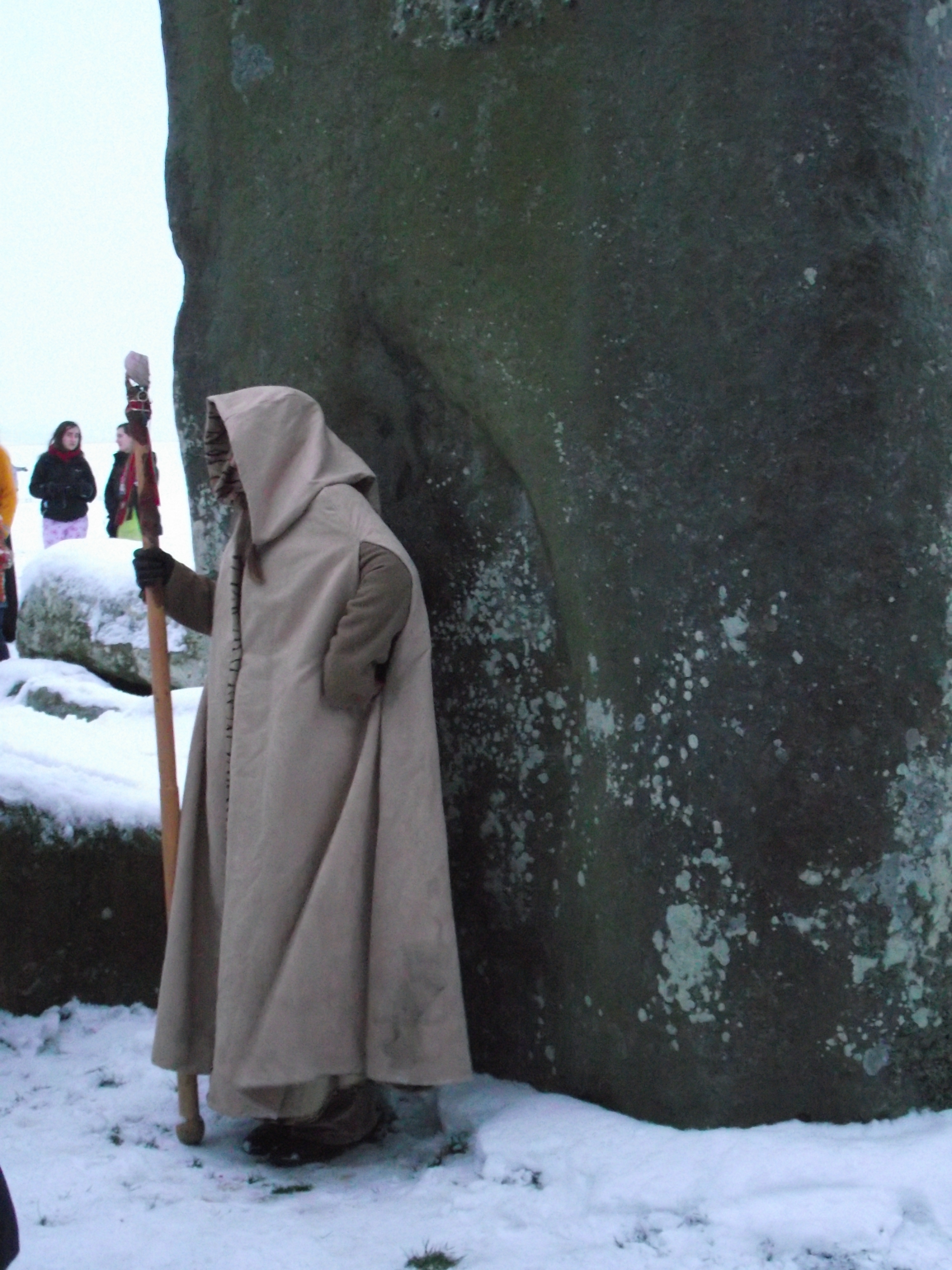
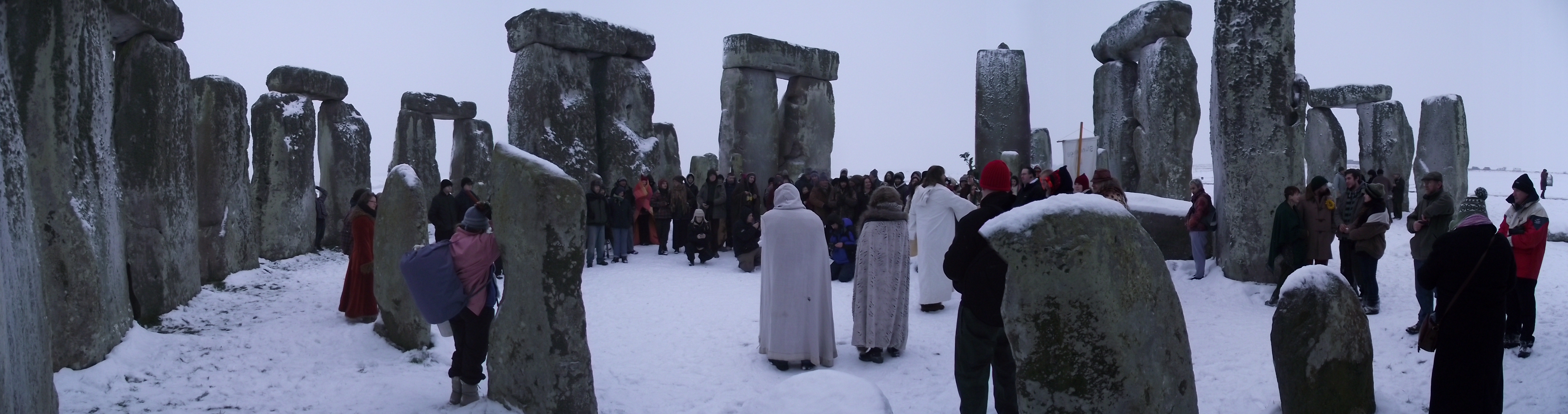
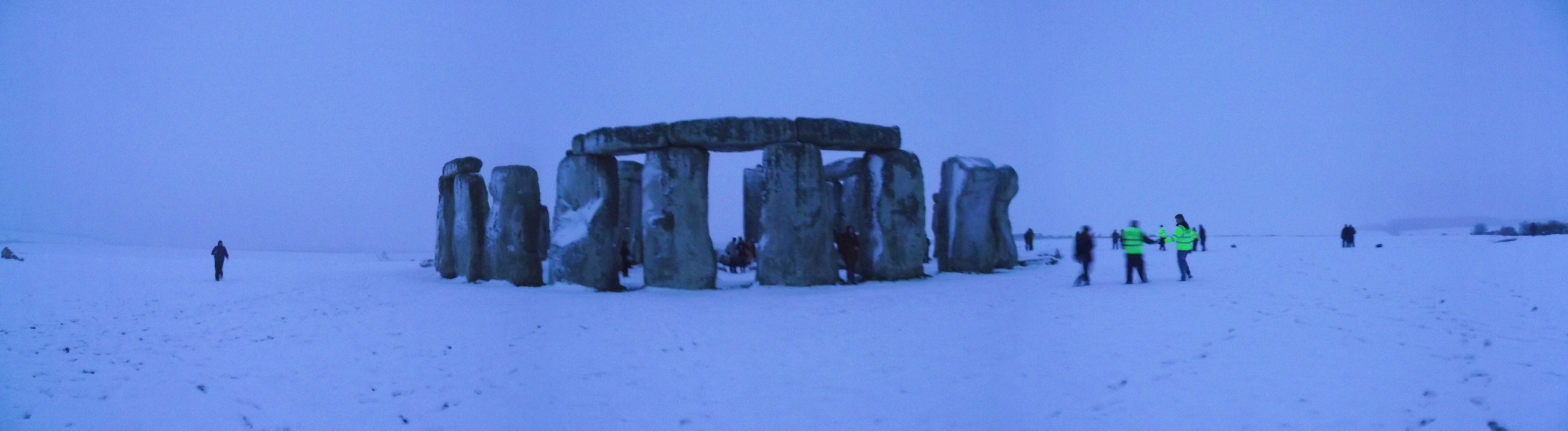
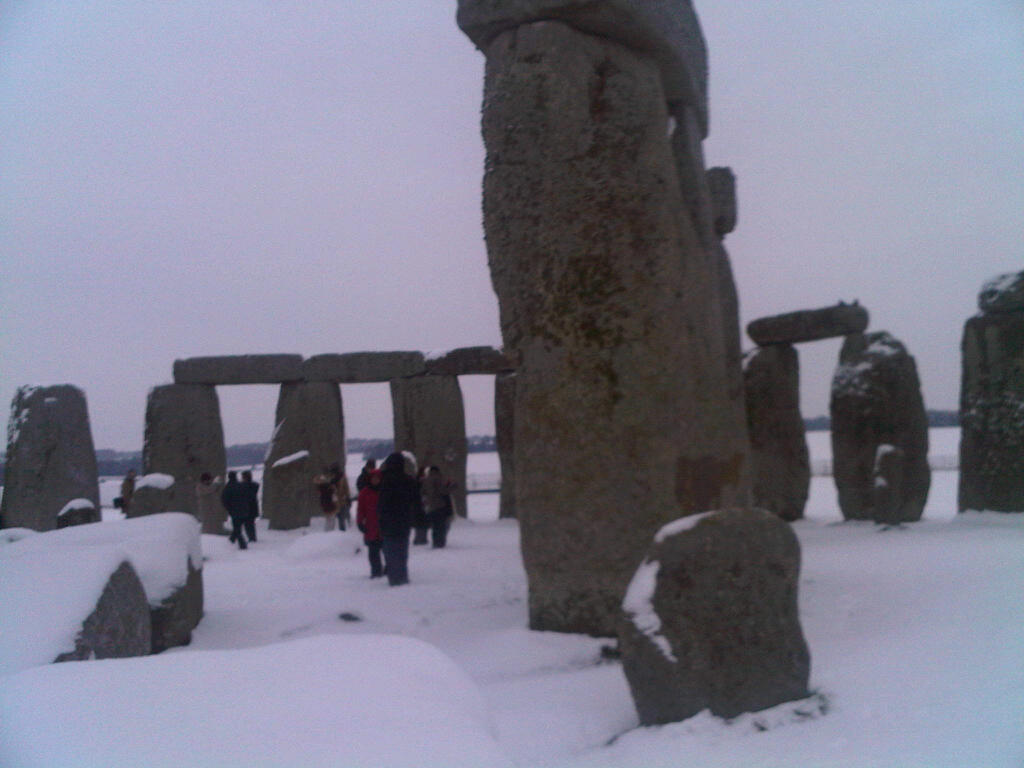
    Snow and ice failed to stop people visiting Stonehenge to watch the

    Stonehenge Solstice

    Stonehenge Solstice

    sunrise on the winter solstice, 22nd December 2010

    Almost 2,000 people gathered at the stones which were surrounded by a thick blanket of snow.

    As well as the traditional druid and pagan ceremonies, a spontaneous snowball fight erupted as people enjoyed the cold weather.  A good time was had by all.

    I will be uploading photos and videos later today – can you see yourself? 

    Many thanks for all the helpful tweets over the solstice – http://twitter.com/ST0NEHENGE

    Merlin @ Stonehenge
    The Stonehenge Stone Circle Website

    http://www.bbc.co.uk/news/uk-england-wiltshire-12061134
    http://www.stonehengetours.com (sponsor)
    http://www.HisTOURies.co.uk (sponsor)


    Stonehenge Winter Solstice Panoramic pictures

    21 12 2010

    Stonehenge Winter Solstice 2010 Panoramic

    Stonehenge Winter Solstice Panoramic

    Stonehenge Winter Solstice Panoramic (Copyright)

    Stonehenge Winter Solstice Panoramic

    Stonehenge Winter Solstice Panoramic

    Stonehenge Winter Solstice Panoramic (Copyright)

    Images are subject to Copyright.  Full Terms and Conditions of Submission and Use of Pictures can be requested.

    All rights reserved. All images included herein this  Internet Web Site publication are the copyright and property of the photographer and the text/design/html files are the property of The Stonehenge News Blog. All images and text are copyright in accordance  with the terms of the United Kingdom’s Copyright, Designs and Patent Act 1988, and  are protected under the United Kingdom and international copyright laws and  treaties which provide substantial penalties for infringement.
    The use of any images or other materials included herein, in whole or in part,  for any purpose other than for the private purpose of the user, including,  but not limited to, copying, reproduction, publication (including on Internet Web  Site), storage in a retrieval system (other than internet browser), manipulation (digital or otherwise),  or transmitted in any form or by any means, electronic, mechanical, photocopying,  recording or otherwise, is expressly prohibited without the written permission of  The Stonehenge News blog or and the photographer 

    What is © Copyright?

    The images on this website are known as “intellectual property”.  In law, they are hardly different from other forms of property (such as  your computer), as the creation of images also requires personal skill,  equipment, time and money. To take and distribute images without consent  is a form of theft and is therefore illegal. The images on this  Internet web site publication are not royalty free and a fee is required  for each specific usage. All of the images have been visibly and invisibly watermarked so that  they can be identified if used without permission, whether whole or in part. International  law now permits substantial penalty charges for infringement of copyright.

    Other Web Pages

    Unfortunately you may not use any of the images in your web pages without express written  permission as this constitutes publishing  the images and could conflict with the interests of our many clients. If, for instance, a  corporation buys a picture for a specific purpose which conflicts with  your website, then the corporation could take legal action against you.  We have to say “no” in order to protect you and our clients.

    More Stonehenge Winter Solstice 2010 images – click here
    Merlin @ Stonehenge


    Stonehenge Winter Solstice 21stDecember 2010

    21 12 2010

    I went to Stonehenge this morning hoping to witness the Lunar eclipse between 7.30am and 8am.  Sadly there was freezing fog and a snowy sky?  It was a pleasant surprise to find that English Heritage decided to grant access into Stonehenge today as well as tomorrow (22nd)  There were a few hundred ‘happy’ people, a pagan wedding and a small Druid ceremony.  It was extremely cold but well worth it. 
    I have uploaded these photos for your perusal – hot off the press!  They anticipate 2-3000 people for tomorrows Solstice celebrations – See you there!

    This slideshow requires JavaScript.


    Happy Solstice
    Merlin @ Stonehenge
    The Stonehenge Stone Circle Website


    Winter Solstice Celebrations at Stonehenge

    20 12 2010

    THE winter solstice will be celebrated at Stonehenge on Wednesday. Sunrise is at 8.09am on December 22 and visitors will be able to access the monument as soon as it is light enough to do so safely.

    Entrance is free and will be available from roughly 7.30am until 9am, when the site will close to visitors before re-opening as per usual at 9.30am.

    This photo was emailed to me yesterday ?

    Peter Carson from English Heritage said: “We are delighted to offer people a warm welcome to Stonehenge this Winter Solstice. Over the years, the event has grown from a handful of people to a celebration enjoyed by a couple of thousand of people. We work very closely with the Druid and Pagan community to ensure that the event is a success.”

    A date for the diary, that is if you are prepared to face the winter snow, but perhaps in the circumstances it would be wiser to stay at home and celebrate the Winter Solstice safely there!

    THE winter solstice will be celebrated at Stonehenge on Wednesday.

    Sunrise is at 8.09am on December 22 and visitors will be able to access the monument as soon as it is light enough to do so safely.

    Entrance is free and will be available from roughly 7.30am until 9am, when the site will close to visitors before re-opening as per usual at 9.30am…….

    There is no public transport to Stonehenge at that time of the morning and parking is limited – you have been warned!  Avebury Stone Circle could be a safer alternative ?

    Happy Solstice!
    Merlin @ Stonehenge
    I will upload images to this blog on the 22nd


    Geminid meteor shower set for clear skies

    13 12 2010

    With cloudless skies possible over Stonehenge and many parts of Britain, this year’s shooting stars could be particularly memorable

    Lovers of the night sky could be in for a treat tonight as clear conditions are predicted for one of the best astronomical shows of the year.

    Some experts believe the annual Geminid meteor shower is becoming more spectacular – though if it is, nobody is sure why – and with cloudless skies possible in many parts of the country, this year’s event could be a particularly memorable one.

    At its peak and in a clear, dark sky, up to 100 meteors – or shooting stars – may be seen every hour. The best time to see it is expected to be late on Monday night and in the early hours of Tuesday after the moon has set.

    In comparison with other showers, Geminid meteors travel fairly slowly, at about 22 miles per second. They are bright and have a yellowish hue, making them distinct and easy to spot.

    Meteors are the result of small particles entering Earth’s atmosphere at high speed, burning up and super-heating the air around them, which shines as a characteristic short-lived streak of light. In the case of the Geminids, the debris is associated with the asteroidal object 3200 Phaethon, which many astronomers believe to be an extinct comet.

    National Trust list of the best places to watch the shower

    • Stonehenge area in Wiltshire – chalk downland and crystal clear skies.

     Teign Valley in Devon, within Dartmoor national park.

    • Penbryn Beach, on the Ceredigion coast in west Wales.

    • Wicken Fen nature reserve in Cambridgeshire – dark skies and nocturnal wildlife.

    • Mam Tor in Derbyshire, an escape from the bright lights of cities such as Sheffield.

    • Friar’s Crag in Cumbria, jutting out into Derwentwater.

    See you at Stonehenge tonight

    Merlin @ Stonehenge
    The Stonehenge Stone Circle website


    Woodhenge: Is this one of the greatest discoveries of archaeology…or a simple farmer’s fence?

    12 12 2010

    The discovery of a wooden version of Stonehenge – a few hundred yards from the famous monument – was hailed as one of the most important archaeological finds for decades.

    But now experts are at loggerheads after claims that what was thought to be a Neolithic temple was a rather more humble affair – in fact the remains of a wooden fence.

    One leading expert on Stonehenge criticised the announcement of the ‘remarkable’ find in July as ‘hasty’ and warned it could become a ‘PR embarrassment’.

    The site, ringed, in a Seventies chart, which experts say shows a fenceMapped: The site, ringed, in a Seventies chart, which experts say shows a fence


    The radar image said to reveal the post holes of a Neolithic temple‘Evidence’: The radar image said to reveal the post holes of a Neolithic temple

    The discovery of what appeared to be a previously unknown ‘henge’, or earthwork, by a team of archaeologists conducting a multi-million-pound study of Salisbury Plain was widely reported amid great excitement.

    The team said they had found evidence of a ring of 24 3ft-wide pits that could have supported timber posts up to 12ft tall, surrounded by an 80ft-wide ditch and bank.

    They explained that, just like Stonehenge, the entrances to the site were aligned so that on the summer solstice the sun’s rays would enter the centre of the ring. Holes where the wooden posts once stood were identified below the ground using the latest high-resolution geophysical radar-imaging equipment.

    An artist's impression of how Woodhenge may have been 5,000 years agoCircle of confusion: An artist’s impression of how Woodhenge may have been 5,000 years ago
    Team leader Professor Vince Gaffney of Birmingham University said the ritual monument had been built about 5,000 years ago, making it roughly the same age as its stone counterpart 980 yards away, and it could have been used for Stone Age feasts or elaborate funerals.

    He said the find showed Stonehenge had not existed in ‘splendid isolation’ and he predicted further discoveries during the three-year survey of five square miles of countryside around Stonehenge.

    But sceptics have now suggested that the evidence is far from conclusive, especially as it appears from images of the plot produced by the Birmingham team that the ring of post holes was not arranged in a circle but was angular and more like a hexagon.

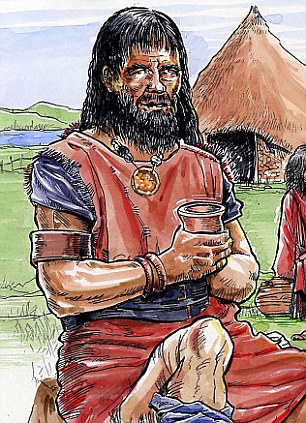
    How a Neolithic visitor may have lookedHow a Neolithic visitor may have looked

    Mike Pitts, editor of the magazine British Archaeology and an acknowledged expert on Stonehenge, said he had been prompted to study maps of the area after receiving a letter from an American reader.

    In the spot where Prof Gaffney had claimed to have uncovered his post holes, Mr Pitts said he and
    colleagues examined a Seventies Ordnance Survey map – and saw a fence marked out.

    He thought it probably was an early 20th Century construction, erected by the then Government’s Office of Works or a local farmer to protect what was thought to have been the most important site in a cluster of burial mounds that were ancient but later than Stonehenge.

    Mr Pitts said: ‘Vince Gaffney says his discovery encircles a burial mound within its circumference, but unless he has some unpublished material to substantiate his discovery, I am in no doubt that this was a modern fence line.

    ‘If I’m right then the post holes contained modern fencing stakes and they are actually in a hexagonal shape, not a circle.’

    He added: ‘I think that perhaps what has happened is that the professor’s field workers have presented him with the wrong picture and he’s shot from the hip and made an over-hasty announcement. He’s generally known for the high quality of his work and his enthusiasm which, on this occasion, may have let him down.

    ‘The full publication of his results and small-scale excavations of the site would clinch the matter.’

    But Prof Gaffney said: ‘We have mapped numerous fences and we know what they look like. The features appear to be 3ft across and as deep as 3ft. I have never seen a fence line that required holes that are 3ft across and 3ft deep.’

    He said that in the fuzzy, black-and-white radar image the post holes appeared angular but that was partly due to the poor resolution of the picture and because such monuments were not perfect circles.

    He went on: ‘The poles that would have stood in them would have been more like telegraph poles. You would not use them to build a fence.’

    Prof Gaffney added that no metal such as old nails had been found in the holes, which would have
    been expected.

    ‘On balance, we would still suggest this is a ritual monument of the late Neolithic period.’

     I love it when the ‘experts’ use the term ‘ritual‘ – in other words they do not know!
    Related artile: New Woodhenge found

    Read more: http://www.dailymail.co.uk/sciencetech/article-1337890/Woodhenge-Is-greatest-discoveries-archaeology–simple-farmers-fence.html#ixzz1Dj4rwwBM

    Merlin @ Stonehenge
    The Stonehenge Stone Circle Website