The man who bought Stonehenge

22 10 2010

It was 95 years ago, this week, that a man walked into a property auction in Salisbury and came out £6,600 poorer and the owner of Stonehenge.
Stonehenge had never been put up for auction before and never would again.
Sir Cecil Chubb, a wealthy Shrewton resident, was the new owner of Stonehenge.  He was also the last man to own it.

Bought ‘on a whim’

Stonehenge had been in private hands since the middle ages and been in the Antrobus family since the early 1800s.

But when the heir to the Antrobus baronetcy was killed in the Great War the estate was put up for sale.

Restoration of Stonehenge in 1950

Stonehenge undergoes restoration work in 1950

In the hands of Messrs Knight, Franck and Rutley, on the 21st September 1915, the historic site went under the hammer.

And Lot 15: Stonehenge with 30 acres of adjoining down land was sold at the Palace Theatre in Salisbury to the highest bidder.

Sir Cecil Chubb, who’d had no intention of bidding at the sale, bought it ‘on a whim’ as a gift for his wife who, it’s claimed, was none too pleased.

For the price of £6,600, the equivalent of £392,00 in today’s money, Sir Cecil Chubb’s intention that a “Salisbury man ought to buy it” was realised.

Stonehenge worth £51m

Just 95 years on and, according to a survey of 500 estate agents invited to put a price on national monuments across the UK, Stonehenge is now worth a monumental £51m.

Whilst the recommended estate agent’s blurb, suggested in the same survey carried out by findaproperty.com, could read:

Stonehenge “Airy property with bags of potential. Comes with land but needs serious renovation, including new roof and double-glazing.”

We would still advise our client to sell it at auction
Andrew Rome, Knight and Franck

But how would Messrs Knight, Franck and Rutley, the estate agents who originally handled the sale, sell Stonehenge today?

“We would still advise our client to sell it at auction,” says Andrew Rome from Knight and Franck.

“And to sell it as a going concern as a business based on the income it generates.”

With Stonehenge attracting around 900,000 visitors a year, paying an average of £5 per head, a £51m valuation starts to sound like a good investment.

Free admission

For Sir Cecil, however, Stonehenge belonged to the nation, and in 1918 after owning it for just three years he formerly handed it over to the country with a number of conditions.

His conditions were that the entrance fee should never be more then a shilling (5p) and that local residents should have free access.

“The 1918 deed of gift didn’t actually specify free access for local residents,” says Joy Kaarnijoki at English Heritage, “it was an agreement with the Parish Council.

“The road passed very close to the stones. The Council agreed that the rights of way could be diverted further from the stone circle on condition that local residents would be granted free access.”

Whether it was stipulated by Sir Cecil Chubb himself, or not, it’s an agreement that has continued to the present day.

According to English Heritage, the 30,000 local residents living in and around Stonehenge can still take up the offer of free access to one of England’s most famous monuments

Merlin @ Stonehenge
The Stonehenge Stone Circle Website

In 1915 Stonehenge was bought for just £6,600, its current valuation is estimated at £51m

In 1915 Stonehenge was bought for just £6,600, its current valuation is estimated at £51m


Delight for Druids says Avebury priest

18 10 2010

It has taken more than 11,000 years but finally the Druids, who lead the seasonal celebrations at Avebury and Stonehenge, can say they belong to an officially recognised religion.

No one is more delighted at this recognition than Druid priest Terry Dobney, who lives at West Kennett, and styles himself as the Archdruid of Avebury and Keeper of the Stones.

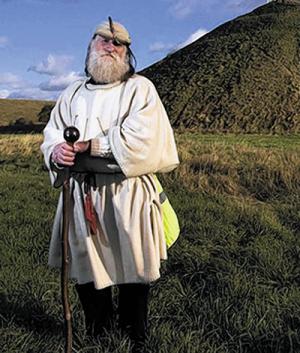
Every Midsummer’s Day Mr Dobney, 62, can be seen wearing his ceremonial robe, carrying his staff and with a pheasant feather in his flat cap leading the Summer Solstice celebrations in the stone circle at Avebury.

This week the Charity Commissioners revealed they were granting the Druid Network, the umbrella organisation for Druid groups across the UK, charitable status for the first time.

That decision establishes Druidry as a recognised religion under UK charity law for the first time giving it the same status as Christianity, Islam and Hinduism.

The ruling recognised that the Druid Network served “to advance religion for the public benefit” although in practice, said Phil Ryder, chairman of the Druid Network trustees, it means very little financial benefit for the Druids but established an important principle giving them official recognition.

Mr Ryder said: “It has been a long and frustrating process, exacerbated by the fact that the Charity Commissioners had no understanding of our beliefs and practices and examined us on every aspect of them.”

As well as regulating secular charities the Charity Commissioners decide what qualifies as a legitimate and genuine faith.

Mr Dobney, a practising Druid for more than 40 years, said: “It is high time that the Druids were recognised not only as a religion but as being one of the oldest religions in the world.

“Druidism dates back to more than 11,500 years ago and pre-dates Judaism.

“The early Druids were the priestly cast who ran societies and provided the leaders.”

To become a recognised Druid, he said, entrants had to serve an apprenticeship for seven years under a senior Druid and could not call themselves a Druid until completing 21 years of training.

As well as leading the summer solstice and other seasonal celebrations at Avebury, Mr Dobney also conducts Druid handfastings (marriages) and other religious ceremonies throughout the year.

Merlin @ Stonehenge
The Stonehenge Stone Circle Website


Stonehenge Tour. Excavation at Durrington, Wiltshire open day – October 13th

8 10 2010

The village of Durrington is well known for its early archaeological heritage, including the largest Neolithic henge in Britain at Durrington Walls and nearby Woodhenge, both over 4500 years old. However, excavations by Wessex Archaeology in advance of the construction of new housing by Persimmon Homes South Coast on the former Ministry of Defence estate offices have started to uncover the remains of a late Iron Age/ Romano-British settlement.

Aerial view of the late Iron Age/ Romano-British settlement at Durrington, WiltshireAerial view of the late Iron Age/ Romano-British settlement at Durrington, Wiltshire

This settlement lies within the north-west corner of the modern village of Durrington and at one time appears to have been surrounded by an enormous ditch over 6m in width and up to 4m in depth. The full extent of the enclosed settlement has yet to been determined, although it is possible- and further work will confirm this- that the enclosed settlement may be of a very substantial size.

The 6m wide enclosure ditch at DurringtonThe 6m wide enclosure ditch at Durrington

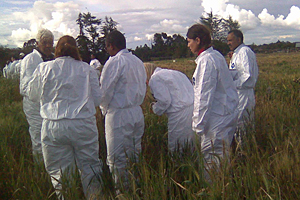
The excavations appear to be located at the southern edge of the settlement. Although the excavations are at an early stage, a wealth of archaeological features have been found including part of the enclosure ditch, possible granaries, large storage and quarry pits, cremation burials and a corn-drying kiln, as well as traces of earlier prehistoric activity within the site. The excavation is due to continue over the next year and will investigate the nature of this previously unknown settlement, which continued in the later Romano-British period and into the fifth century AD and may have been the first steps in the formation of the medieval estates at Durrington and the origin of the present village.

Come and see what they have found and find out more about the heritage of Avon Fields

Visit the Big Dig!
Wednesday October 13th 2010
Where: Avon Fields: Former MoD Headquarters  
Netheravon Road
Durrington
Free site tours Wednesday October 13th 2010 at 3.00pm and 5.00pm.
No booking required.

Please wear boots or sturdy shoes.

For more information please contact Andrew Manning or Margaret Bunyard 01722 326867 begin_of_the_skype_highlighting              01722 326867      end_of_the_skype_highlighting a.manning@wessexarch.co.uk

Histouries UK Tours and Salisbury Guided Tours in Salisbury offer independent tours of Stonehenge and the Durrington Walls.
Search this blog for more information on Durrington

Merlin @ Stonehenge
The Stonehenge Stone Circle Website


Stonehenge archaeologists reveal global warming theory behind crashed UFO remains

8 10 2010

Stonehenge, Wiltshire – (TinFoilHat Mess): Archaeologists excavating Stonehenge have found the remains of a pre-Atlanis era UFO which may have crashed during a flight from the Lunar base discovered by the moon-walking astronuts of the Apollo mission.

Stonehenge Quarantined

Stonehenge Quarantined

Much of the craft is believed to be intact with little corrosion to the mystery amalgam which makes up 90% of its structure.

Professor Tim Darvill of the Search for Extraterrestrial Intelligence (SETI) team that made the discovery said today that the next stage of the tricky operation would be entering the ancient craft and locating its cryogenic freezer units. ”

At this stage we don’t know if anything actually works inside,” Darvill commented, “but fingers crossed – we might be able to do a bit of thawing. “Without this intervention we’d have to wait for the natural phenomenon known as Global Warming to dictate the delicate process of unfreezing these alien remains.

 “Unfortunately we can’t wait that long. So our plan is to gently resurrect some of this advanced species – no blowtorches, microwaves or thermic lances, please chaps! – as well as any embryos and/or frozen infant offspring who clearly came here to seed our planet.” If the operation is successful the next stage will involve specialist scientists who are familiar with alien parenting techniques.

Professor Geoff Wainwright of the Yearling Extraterrestrial Intelligence (YETI) team in London’s Royal Freak Hospital will then take over while the Stonehenge site is quarantined.
Operation Homo erectus is being hailed as a triumph.

Now thats a story……………
Merlin @ Stonehenge Stone Circle


Stonehenge was not made from Preseli bluestones

6 10 2010

In the third of a series of Western Mail articles by speakers at this year’s Do Lectures, geologist and author Brian John debunks the ‘bluestone myth’ – the idea that prehistoric people travelled hundreds of miles in order to drag gigantic stones toSalisbury Plain 

THIS story is about the heroic neolithic tribesmen carrying scores of giant stones from the Preseli Hills to Stonehenge has now entered into British mythology. It has become gradually clearer, over the last decade or two, that there is no evidence to support this story. I want to inspire people to think very carefully about some of the myths that we as a community sign up for. 

A whole story has been developed over the years about this heroic human venture of tribesmen coming all the way to the Preselis to pick up the bluestones from a quarry – and then to carry those 80 stones all the way back to Stonehenge where they were going to be used as part of this amazing new monument. That has become a part of British mythology but is widely accepted as fact. It has become an immensely valuable story commercially for British tourism – a million people visit Stonehenge each year and nearly all of them are familiar with this heroic tale. That tale is used quite cynically, quite deliberately, by English Heritage and almost every other organisation that has anything to do with tourism in the promotion of Stonehenge, as a means of attracting even more visitors there 

The Questions? 

What I am trying to do is stand back from all that and question: what exactly is the evidence in support of this wonderful story?  When you start to dig a little bit you find that actually there is no evidence at all.  It is entirely a myth which was invented in 1922, immediately after the First World War. The myth received instant acceptance on the part of the British public because there was a desperate need for a feel-good factor after the war – national pride had been dented, the economy was in tatters and everybody needed a good news story. 

The story was invented by a Welsh geologist, Herbert Thomas. He gave a lecture which had purported to demonstrate that a lot of the bluestones had come from the Preselis. His geology was reasonably accurate. He was intent on telling this story of human transport.
His theory, once he had propounded it, was instantly grabbed hold of by everybody. It was a wonderful tale that showed us just how clever our neolithic ancestors were and they were a damn’ sight more clever than those ancestors on the Continent – especially in Germany. There was almost a strong, almost xenophobic element about this propaganda. 

No-one questioned this theory or seriously investigated it. 

It was just blown up from that point on. It has become one of the key beliefs of Britain, in the same way we believe about King Arthur and Glastonbury and Robin Hood in Sherwood Forest. It is now a part of British mythology. 

There is no evidence that the stones were taken from this so-called neolithic quarry at Carn Meini. In fact, there is no evidence of the quarry at all.  The stones which are supposed to have come from that one source actually came from many other places.  As the geology has advanced, with a lot of work from the Open University and many other geologists, we now know that the stones came from at least 20 other places. They haven’t come from the eastern end of the Preselis at all.  We know that at least two of the stones have come from the Newport area, quite possibly on the North Pembrokeshire coast. Another stone has come from the Brecon Beacons and some stones seem to have come from the Fishguard area. 

What the geologists say 

It was already known by some geologists in 1922 that during the Ice Age there had been an enormous glacier which had flowed across Pembrokeshire and had actually flowed up the Bristol Channel and into the coastlands of Somerset, Devon and Cornwall – we still don’t know how far east that glacier went, but it certainly did cross the Bristol Channel pressed up across the English coasts. A number of these old geologists had demonstrated this pretty clearly, but for reasons that I still don’t fully understand, Thomas in 1922 totally dismissed this theory in favour of his human transport theory. And still nobody has ever found any evidence as to how exactly the stones were moved, although of course there is endless speculation about it. There are literally thousands and thousands of pages on the internet devoted to precisely this question.  We should give more credence to scientific evidence and keep myths in the places they belong, namely mythology, and don’t let’s pretend that myths are telling us anything concrete about what happened in the past. 

The problem for archaeolo- gy is it has become involved in pedalling myths and seems to have lost its respect for evidence on the ground. People are so obsessed with making blockbuster TV programmes, for example, with support from National Geographic magazine and the Smithsonian Institute, that actually the archaeologists seem to be trying to out do each other on how spectacular their stories are. It has all become a little bit absurd. 

When we look at the hard science behind the bluestones story, there is quite a lot of evidence to support the idea that the bluestones at Stonehenge are no more than glacial erratics that were transported by the ice, maybe 450,000 years ago and then picked up somewhere in the Salisbury Plain in the East Somerset area – probably within easy striking distance of Stonehenge and that is where they were picked up from. 

The whole of the Stone- henge story is a complete fabrication. 

I have just put up a YouTube video called StoneHenge Unhinged in which I show that Stonehenge was probably never even finished. We have these wonderful reconstructions of Stonehenge, showing this incredible geometric arrangement of stones, and all the archaeologists and astronomers say this was a highly sophisticated astronomical observatory etc, but actually there is no evidence that it was ever finished. 

I think it was just an experiment. They tried to build something that was really rather ambitious but they really didn’t have enough stones to finish it. On the ground about half of the monument has never been excavated and 67 of the stones are totally missing, but people have just imagined that they were there without having any evidence to support that idea. 

Stonehenge has become a national icon and a key part of mythology with immense commercial value attached to it. Over and over again, people talk about the magical serenity of Stonehenge and the great feeling of power it gives you – which is wonderful, but I think people have been brought up to have this reverence for Stonehenge because it is such an iconic structure and that in itself creates a feeling of religious esteem or spirituality. 

I’m not saying Stonehenge is not wonderful. It is quite inspirational in the sense that it was a brave enterprise. The stones that are there are not very accurately placed and a lot of them are pretty rough and I think were just placed there as part of an ambitious building project

If you want to here all the theories why not organise a ‘Stonehenge special access’ tour with the English Heritage.  This enables you to go beyiond the fences before or after its open to the public.  The Stonehenge Tour Company and Histouries UK, based in Salisbury and Bath offer a ‘Rent a guide’ service. Salisbury guided Tours also offer specail access tours from Salisbury

Merlin @ Stonehenge
The Stonehenge Stone Circle Website 


Archaeologists debate Stonehenge future

5 10 2010

LEADING archaeologists got together at Salisbury & South Wiltshire Museum on Saturday for a Solve Stonehenge debate.

Professor Tim Darvill, Professor Mike Parker Pearson, Mike Pitts and Julian Richards, who have all directed work within the Stonehenge landscape over the last 30 years, were kept in order by Andrew Lawson as they shared their expertise, discussing such questions as Did Stonehenge have a roof?, Which is more important, Durrington Walls or Stonehenge? and Who built Stonehenge?.

The debate was part of a weekend conference to celebrate the museum’s 150th anniversary.

Merlin @ Stonehenge
The Stonehenge Stone Circle Website


Virtual Stonehenge with Google Streetmap

5 10 2010

Ancient Streetview: Now Google can take you to the historic pavements of Pompeii and Stonehenge

They are some of the most spectacular and unique places on the planet.

Now Google has taken tourism to the next level by allowing people from around the world to see monuments like Stonehenge, the streets of Pompeii and the remote landscapes of Antarctica from the comfort of their own living room.

But instead of the usual Google Streetview cars which have become a familiar sight on British streets, the new snaps were taken using a special Google tricycle.

The Street View trike, as it is known, was sent around the world to photograph some of the hardest to reach places on the planet.

The trike carries a mounted Street View camera, and a specially decorated unit with imaging & GPS technology.

Google’s Brian McClendon, head of Engineering, Google Earth and Maps, introduced the new feature by saying how thrilled he was that all seven continents could now be accessed using the technology.

He said: ‘We introduced Street View back in May 2007, enabling people to explore street-level imagery in five U.S. cities. We were excited to share a virtual reflection of the real world to enable armchair exploration.

‘Since then, we’ve expanded our 360-degree panoramic views to many more places, allowing you to check out a restaurant before dining there, to explore a neighbourhood before moving there and to find landmarks along the route of your driving directions.’

Many of the image have not yet been added to the Google Streetview program – but will appear in the near future.

Mr McClendon said: ‘Three years later, we’re happy to announce that you can now explore Street View imagery on all seven continents, with the addition today of Brazil, Ireland and Antarctica.

‘You can now see images from around the world spanning from the beaches of Brazil, to the moors of Ireland, to the icy terrain in Antarctica.

Some of the images show a group of penguins grouped together on an island in Antarctica and the remote dusty roads of the Australian Outback.

He said: ‘We often consider Street View to be the last zoom layer on the map, and a way to show you what a place looks like as if you were there in person—whether you’re checking out a coffee shop across town or planning a vacation across the globe.

Merlin @ Stonehenge
The Stonehenge Stone Circle Website


Druids as an official religion? Stones of Praise here we come

4 10 2010

This article written by Malanie Philips (Daily Mail) is sure to anger Pagans and the Druid Order

Will someone please tell me this is all a joke. Until now, Druids have been regarded indulgently as a curious remnant of Britain’s ancient past, a bunch of eccentrics who annually dress up in strange robes at Stonehenge to celebrate the summer solstice.

However, according to the Charity Commission, they are to be recognised as a religion and, as a result, afforded charitable status, with the tax exemptions and other advantages that follow.

After a four-year campaign, the Commission says it accepts that the Druids worship nature and that they also believe in the spirits of places such as mountains and rivers, as well as in ‘divine guides’.
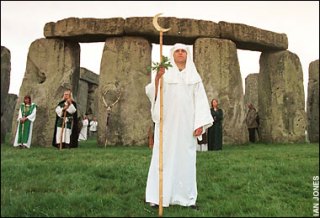
 This, apparently, makes them qualify as a religion.

Can it be long before the BBC transmits Stones Of Praise, or solemnly invites listeners to Radio 4’s Thought For The Day to genuflect to a tree?

Some might shrug this off. After all, the Druids don’t do any harm to anyone. What skin is it off anyone else’s nose how they are categorised?

CULT ?

Well, it actually matters rather a lot. Elevating them to the same status as Christianity is but the latest example of how the bedrock creed of this country is being undermined. More than that, it is an attack upon the very concept of religion itself.

This is because Druidry is simply not a religion. Now, it’s true that religion is notoriously difficult to define. But true religions surely rest on an established structure of traditions, beliefs, literature and laws.

Above all, they share a belief in a supernatural deity (or more than one) that governs the universe

By these standards, Druidry is surely not a religion but a cult — a group defined merely by ritual practices but which stands outside mainstream religion.

Nor does it seem to conform to the definition of a religion according to charity law.

When Radio 4’s Sunday Programme suggested yesterday morning to Phil Ryder, chairman of the Druid Network, that the legal definition of religion included a ‘significant belief in a supreme being or entity’, he saw no contradiction. Druids, he said cheerfully, might venerate many gods, inanimate objects or nature.

How very inclusive of them! But the key point is surely that none of these beliefs involves a ‘supreme’ being that exists beyond the Earth and the universe. On the contrary, Druids worship what is in or on the earth itself.

When asked further how Druidry benefited the public interest — the key test for charitable status — Mr Ryder burbled that its ethical framework consisted of forming ‘honourable and sustainable relationships’ with everything in the world, including animals, people and nature.

But there are many who subscribe to no belief system at all and who would say they, too, want to live in harmony with the earth and everything in it. Are they, therefore, also to be regarded as religious folk and given charitable status?

Maybe Prince Charles, who famously talks to his plants, could register himself on that basis as the founder of a new religion? Duchy Devotions, anyone?

If the Druids qualify as a religion, can other cults such as the Scientologists be far behind?

Can it be long, indeed, before the wise and learned theologians of the Charity Commission similarly grant charitable status to sorcery, witchcraft or even the Jedi — the fictional Star Wars ‘religion’ which the 2001 census recorded as having no fewer than 390,127 adherents in England and Wales.

The whole thing is beyond absurd. But it is also malevolent. For it is all of a piece with the agenda by the oh-so politically correct Charity Commission to promote the fanatical religious creed of the Left — the worship of equality.

The Commission was primed by Labour for this attempt to restructure society back in 2006, when charity law was redrawn to redefine ‘public benefit’ as helping the poor.

This put the independent schools in the front line of attack, since education was no longer itself considered a benefit — as it had been since time immemorial — but only insofar as it furthered the ideology of ‘equality’.

Extraordinary

Thus, we have arrived at the extraordinary situation where some of these schools, which have delivered such inestimable benefit to the nation, face the loss of their charitable status, which is to be given instead to people who dance naked around stones and worship the sun.

But the new respectability of paganism cannot be laid entirely at the Charity Commission’s door. For in recent years, pagan practices have been rapidly multiplying, with an explosion of the occult: witchcraft, parapsychology, séances, telepathy and mind-bending cults.

Astonishingly, around 100 members of the Armed Forces now classify themselves as pagans, and a further 30 as witches.

There are thought to be about 500 pagan police officers. A Pagan Police Association has even been set up to represent officers who ‘worship nature and believe in many gods’.

They have been given the right to take days off to perform rituals, such as leaving food out for the dead, dressing up as ghosts and casting spells, or celebrating the sun god with ‘unabashed sexuality and promiscuity’.

Britain’s prison authorities are equally hospitable to the occult: under instructions issued to every prison governor, pagan ‘priests’ are allowed to use wine and wands during ceremonies in jails. Inmates practising paganism are allowed a hoodless robe, incense and a piece of religious jewellery among their personal possessions.

Political correctness gone mad or what? As one disgusted police officer exploded: ‘What has it come to when a cop gets time off so he can sit about making spells or dance around the place drinking honey beer with a wand in his hand?’

Barking

How on earth has our supposedly rational society come to subscribe to so much totally barking mumbo-jumbo?

In part, it developed from the New Age embrace of Eastern beliefs in the inter-connectedness of everything in the universe. The defining characteristic of such faiths is a spirituality which is concerned with the self rather than the world beyond the individual.

These beliefs were, therefore, tailor-made for the ‘me society’ which turned against Biblical constraints on behaviour in the interests of others. They were subsequently given rocket fuel by environmentalism, at the core of which lies the pagan worship of ‘Mother Earth’.

And they were then legitimised by the doctrines of equality of outcomes and human rights — which, far from protecting the rights of truly religious people, aim to force Biblical morality and belief out of British and European public life altogether.

This is because human rights and equality of outcomes are held to be universal values. That means they invariably trump specific religious beliefs to impose instead equal status for all creeds.

But if all creeds, however absurd, have equal meaning then every belief is equally meaningless. And without the Judeo-Christian heritage there would be no morality and no true human rights.

There is nothing remotely enlightened about paganism. It was historically tied up with both communism and fascism, precisely because it is a negation of reason and the bedrock values behind Western progress.

The result is that, under the secular onslaught of human rights, our society is reverting to a pre-modern era of anti-human superstition and irrationality. From human rights, you might say, to pagan rites in one seamless progression.

Anyone who thinks radical egalitarianism is progressive has got this very wrong. We are hurtling backwards in time to a more primitive age**

 **Is that such a bad thing ?  Food for though!

Merlin @ Stonehenge
The Stonehenge Stone Circle Website


Druids Recognized As Religion For First Time In UK

3 10 2010
 

 Druids have been worshipping the sun and earth for thousands of years in Europe, but now they can say they’re practicing an officially recognized religion.

The ancient pagan tradition best known for gatherings at Stonehenge every summer solstice has been formally classed as a religion under charity law for the first time in Britain, the national charity regulator said Saturday. That means Druids can receive exemptions from taxes on donations — and now have the same status as such mainstream religions as the Church of England.

The move gives an old practice new validity, said Phil Ryder, the chairman of the 350-member Druid Network.

“It will go a long way to make Druidry a lot more accessible,” he said.

Druids have practiced for thousands of years in Britain and in Celtic societies elsewhere in Europe. They worship natural forces such as thunder and the sun, and spirits they believe arise from places such as mountains and rivers. They do not worship a single god or creator, but seek to cultivate a sacred relationship with the natural world.

Although many see them as robed, mysterious people who gather every summer solstice at Stonehenge — which predates the Druids — believers say modern Druidry is chiefly concerned with helping practitioners connect with nature and themselves through rituals, dancing and singing at stone circles and other sites throughout the country believed to be “sacred.”

Ancient Druids were known to be religious leaders, judges and sages among the Celts during pre-Christian times, although little evidence about their lives survived. There are now various Druid orders and about 10,000 practitioners in Britain — and believers said the numbers are growing because more people are becoming aware of the importance to preserve the environment.

The Druid Network fought for nearly five years to be recognized under the semi-governmental Charity Commission, which requires proof of cohesive and serious belief in a supreme entity and a moral framework.

After initially rejecting the Druid Network’s application, the Charity Commission decided this week that Druidry fit the bill.

“There is sufficient belief in a supreme being or entity to constitute a religion for the purposes of charity law,” the commission said.

Adrian Rooke, a Druid who works as a counselor, said Druidry appeals to people who are turning away from monotheistic religions but still long for an aspect of spirituality in their lives.

“It uplifts the spirit,” he said. “The world is running out of resources, and in that context it’s more important to people now to formulate a relationship with nature.”

2_Britain_Druids_Recognized.sff.jpg

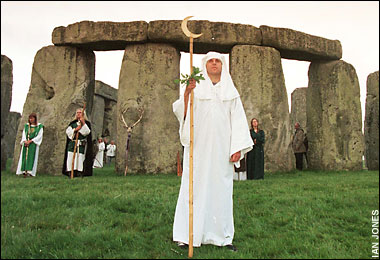
Associated Press Druids performing pagan rituals as part of the Summer Solstice ceremonies at Stonehenge, Wiltshire, England, before dawn, Monday June 21, 2004. The stone circle at Stonehenge is believed to be at least 4,500 years old. Druidry has been officially recognized as a religion in Britain under charity law. The Charity Commission has granted the Druid Network charitable status, giving it tax breaks and equal status to mainstream religions like Christianity. The commission said Saturday Oct. 2, 2010, that druidry has a coherent and serious set of beliefs and that it offers a beneficial ethical framework.

1_Britain_Druids_Recognized.sff.jpg

 Associated Press This Tuesday Aug. 10, 1999 photo from files shows Arch Druid Ed Prynn as he calls down the sun during his sun dance around a ring of stones, in St. Merryn, England. The druid dance is to celebrate the total eclipse of the sun, which is due in this part of southwest England on August 11. Druidry has been officially recognized as a religion in Britain under charity law. The Charity Commission has granted the Druid Network charitable status, giving it tax breaks and equal status to mainstream religions like Christianity. The commission said Saturday that druidry has a coherent and serious set of beliefs and that it offers a beneficial ethical framework.

More information try these links:

British Druid Order

The British Druid Order (BDO) teaches and practices a shamanic, mystical, celebratory form of Druidry, inspired by the past but deeply relevant to the
www.druidry.co.uk/

The Official Website Of The Council Of British Druid Orders – (CoBDO)™

The Council of British Druid Orders, CoBDO, would like to recommend one of our initial co-founders, who at present is not a member, the Order of Bards,
http://www.cobdo.org.uk/

Merlin @ Stonehenge
The Stonehenge Stone Circle Website


Historic sites consultation – Stonehenge, Avebury and Associated Sites World Heritage Property

1 10 2010

A consultation has been launched to find out what people think about a document which will help manage and protect the Stonehenge and Avebury World Heritage Site.

Stonehenge, Avebury and Associated Sites World Heritage Property Consultation Draft

Stonehenge, Avebury and Associated Sites World Heritage Property Statement of Outstanding Universal Value

This consultation is being hosted on behalf of the Stonehenge and Avebury Steering Committees of which Wiltshire Council is a member.

The Stonehenge, Avebury and Associated Sites World Heritage Property is one of Wiltshire’s greatest assets.  This consultation provides an opportunity for local people, community groups and other organisations to comment on its Statement of Outstanding Universal Value.  This Statement sets out formally why Stonehenge and Avebury are internationally important and what qualifies them to appear on the World Heritage List.  It also sets out how requirements for management and protection of these qualities are being met. 

This document is important for the protection of what makes Stonehenge and Avebury internationally significant.  It defines the World Heritage Site’s Outstanding Universal Value (OUV).  The United Kingdom signed up to protect the OUV of its World Heritage Sites when it ratified the United Nations Educational, Scientific and Cultural Organisation (UNESCO) Convention Concerning the Protection of the World Cultural and Natural Heritage (1972). 

The planning system has a very important role in this protection.  Planning Circular 07/2009 states clearly the need to protect the Outstanding Universal Value of World Heritage Sites, while the guidance accompanying the new Planning Policy 5 on the Protection of the Historic Environment (2010) identifies the Statement of OUV as a critical resource for local planning authorities in plan-making and reaching decisions relating to the significance of World Heritage Sites.  The document will also inform all management decisions which should prioritise the protection OUV as defined in the Statement.  Your comments on the Statement of OUV could therefore contribute to protecting the very special qualities of Stonehenge and Avebury for this and future generations. 

Since 2007 UNESCO has required a Statement OUV for all new World Heritage Properties.  Stonehenge and Avebury were inscribed in 1986.  All sites inscribed prior to 2007 are now required to submit retrospectively a Statement of OUV. This must be based on the original reasons for inscription set out in evaluation and decision documents from 1986.  The process of producing the Statement of OUV is not an opportunity to change or add to the reasons for inscription but a chance to distil them into a single document which will be key the World Heritage Property’s protection. It is however possible to reflect challenges which have emerged over the last 25 years as well as changes in the management and protection context. 

The original documents submitted to UNESCO during the nomination of the Stonehenge, Avebury and Associated Sites World Heritage Property in 1986 can be accessed via this link to the UNESCO website: http://whc.unesco.org/en/list/373/documents/ 

The Statement of OUV consists of four sections:The first section, the Statement of Significance, was agreed by UNESCO’s World Heritage Committee in 2008 after a period of consultation and sign off by the Stonehenge and Avebury Steering Groups representing key local and national stakeholders. 

We are now due to submit the final three sections:

2. Statement of Integrity

3. Statement of Authenticity

4. Requirements for  Management and Protection

We would appreciate your comments to assist us in shaping a robust and comprehensive document.  

Please note comments are sought only on the last three sections: integrity, authenticity and management and protection.  The first section, the Statement of Significance, has already been agreed by UNESCO’s World Heritage Committee.

Guidance on the UNESCO definitions of authenticity and integrity can be found the World Heritage Operational Guidelines (paras 79 – 89 and Annex 4) which can be found at http://whc.unesco.org/en/guidelines/ Further background information can be found in the management plans for the two halves of the World Heritage Site.  They include sections summarising integrity and authenticity as well as the provisions for management and protection

You can access the Stonehenge Management Plan on the English Heritage website via this link http://www.english-heritage.org.uk/daysout/properties/stonehenge/world-heritage-sites/stonehenge-management-plan/

You can access the Avebury Management Plan on the Wiltshire Council website via this link http://www.wiltshire.gov.uk/leisureandculture/museumhistoryheritage/worldheritagesite/aveburyworldheritagesitemanagementplan.htm

Merlin @ Stonehenge
The Stonehenge Stone Circle Website