Stonehenge most visited tourist spot in South West

17 08 2011

Stonehenge has become the most visited paid-for tourist attraction in the South West.
Stonehenge

Figures from tourist board Visit England show that last year the iconic Wiltshire attraction had more visitors than the Eden Project in Cornwall.

Over 1m people visited the stone circle in 2010, up 1.9% on the previous year.

It is the first time it has surpassed the Eden Project for visitor numbers since the Cornwall tourist attraction opened in 2001.

David Andrews, chief executive for Visit Wiltshire, said: “Stonehenge is a fabulous site and we’re extremely lucky to have it in the county.”
Links: http://www.bbc.co.uk/news/uk-england-wiltshire-14554689

Sponsored by ‘The Stonehenge Tour Company’ – www.StonehengeTours.com

Merlin @ Stonehenge
The Stonehenge Stone Circle Website


Perseid Meteor Shower at Stonehenge

12 08 2011

Star gazers prepare for Perseid meteor shower

Stonehenge in Wiltshire is one of the best places in Britain to witness this spectacular event.  As always I will be up all night overlooking Stonehenge as our ancestors have for 1000’s of years.
 

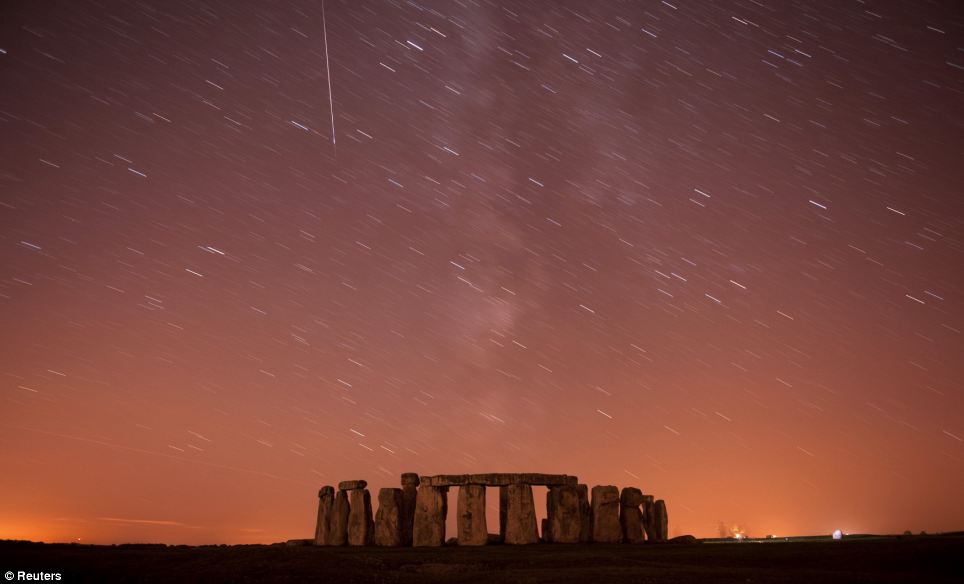
Perseid Meteor shower over Stonehenge.  Streaking down towards Stonehenge across the path of all the other stars in the sky, this shooting star is hurtling to Earth at 135,000 miles per hour – 100 times the speed of Concorde.

Perseid Meteor shower over Stonehenge. Streaking down towards Stonehenge across the path of all the other stars in the sky, this shooting star is hurtling to Earth at 135,000 miles per hour – 100 times the speed of Concorde.

Skywatchers were today given advice on how to enjoy this year’s display of Perseid meteors despite a full moon.

 The Perseids, which come every August, are normally one of the highlights of the celestial year for amateur astronomers.

Under ideal conditions up to 100 of the shooting stars an hour should be visible when the shower peaks tomorrow.
But the glare of the full moon will make it difficult to see the fainter meteors.

The moon generates natural light pollution that can be equal to that from an illuminated city centre.To help anyone hoping to spot the Perseids the National Trust has produced an online stargazing guide and listed some of its best “dark skies” locations.

Dr Marek Kukula, public astronomer at the Greenwich Royal Observatory in London, said: “The Perseids are always an exciting meteor shower to watch out for. Even in large cities it’s often possible to catch site of some of the brighter Perseid meteors streaking across the sky, but from a really dark site you can sometimes see dozens per hour.

 “Despite this year’s Perseid shower coinciding with the full moon it’s still well worth going out for a look. The meteors can appear anywhere in the sky so try looking away from the bright moon to maximise your chances of seeing one.”

 The Perseids are grains of dust shed from the tail of Comet Swift-Tuttle burning up in the atmosphere.

Every year in August the Earth ploughs through a cloud of the dust as it orbits the sun.

Among the locations highlighted by the National Trust are the area around Stonehenge in Wiltshire and Mam Tor in the Peak District, high above Sheffield.

Philip Broadbent, National Trust outdoors programme manager, said: “It’s worth spending the time to find the perfect spot to gaze up at the stars as once you’re there looking into the night sky it will take your breath away. And the best thing is that it won’t cost you a penny and this star time will always stay with you as one of those experiences that money can’t buy.”

 Alastair McBeath, director of the Society for Popular Astronomy’s meteor section, said: “As Perseid meteors near the peak are usually bright to occasionally very bright, this should mean observing will be quite rewarding despite the loss of fainter meteors to the moonlight.”

Sponsored by the ‘Stonehenge Tour Company’ www.StonehengeTours.com

Merlin at Stonehenge
The Stonehenge Stone Circle Wbsite


Visit Stonehenge on a Razorcat trike

29 07 2011

Visit Britain’s most iconic site on a Razorcat trike… 

Leave your daily routine behind and take a thrilling ride on board an exciting three-wheeler. Feel the exhilaration of the wind in your face and enjoy the freedom that only a Razorcat trike ride can give you.

 
Not only will you have a fantastic ride on our Razorcat trike but you will also experience the famous World Heritage site that has just got to be seen, Stonehenge.   On a spiritual level, it attracts people from all over the world. From an engineering point of view, it will astound you when you realise it was built over 3500 years ago and some of the stones weigh more than 40 tons – and came from Wales.

Time: 3½ hours
Distance: 75 miles
Cost: £260 – 2 people, including entrance fee

In brief:
Bath – Box – Melksham – Seend – Worton – Salisbury Plain – Stonehenge – Wyley Valley – Limpley Stoke – Bath

In detail:
From Bath we make our way over the toll bridge and on to Box. We pass Melksham and travel along the beautiful roads to Seend and Worton. We then hook up with the A360 that takes us over the Salisbury Plain. This is a fabulous road with fantastic views, taking us through some pretty little villages on the way.

As we top a rise in the road, Stonehenge is revealed in the distance for the first time – an awe-inspiring sight. We stop here for you to look around and take the tour and some photos.
Heading back, we ride a short distance on the Exeter road before cutting away to Warminster along the lovely Wyley Valley. By-passing Warminster, we make our way to Limpley Stoke and then back to Bath.

A fantastic ride to an iconic location – perfect.

When you take a ride on a Razorcat trike, YOU become the centre of attention.

Link: http://www.razorcattours.com/en/pages/tours-stonehenge.aspx

Sponsored by ‘The Stonehenge Tour Company’ www.StonehengeTours.com

Merlin @ Stonehenge
The Stonehenge Stone Circle Website


Chichen Itza points to Stonehenge – GPS research proves

26 07 2011

Jarome Vahai’s research on early GPS devices fascinated a group of students and scholars at this year’s Stanford Honors Research Symposium

Pyramids and monoliths around the world perform four functions that modern GPS devices perform, according to a newly released study by Jarome Vahai. The ancient navigational device researcher recently told a captivated audience at the 2011 Stanford Honors Research Symposium that ancient structures helped societies tell time, measure the circumference of the earth, pinpoint their location on the earth and identify their location during travel—just like modern GPS devices.

GPS systems are used for many things, including exploration, expanding territories, and conducting import/export trade and commerce over great distances.

“Early civilizations thought the same way we think now,” said Jarome Vahai. “We use GPS devices to locate where we are and how to get to other places—and so did they.” Vahai notes that as tools have improved, building structures like the pyramids has become unnecessary.

Many of the ancient landmarks that are still in existence are positioned in ways that mark the longest and shortest days of the year by the patterns of shadows they cast at equinox. In addition to showing calendar position, shadows could also be used to tell time during the day.

The Giza pyramids and shadows were also used by Eratosthenes to calculate the circumference of the earth. Ancient civilizations understood they were on a round, turning planet because their stone markers line up with one another around the globe. Some even line up with other planets and constellations, says Vahai.

Vahai’s research shows that markings identified at the pyramid at Chichen Itza point to the pyramids at Giza; others point to Stonehenge, the pyramids in China, and the great Cambodian temple Angkor Wat. He has also found that the stone markers of Ha’amonga, known as Tonga’s Stonehenge, line up with Fiji, Hawaii, Samoa, New Zealand and the Cook Islands.

“These ancient structures were lasting landmarks that told people where they are located in relation to other parts of the world,” said Vahai.

The usefulness of landmarks in the ancient world cannot be understated. Rulers had expansive empires that covered huge amounts of land, and protecting those lands could be challenging. Babylon and Giza are located in places that are difficult to find and get to, probably for security reasons. The large structures were helpful landmarks.

“I am very proud that Stanford selected my research; they only accept about 20% of submissions,” said Vahai. “The audience was extremely engaged—the moderator was so wrapped up in the topic, we ended up going over the time limit.”

Sponsored by ‘The Stonehenge Tour Company’ www.StonehengeTours.com

Merlin at Stonehenge
The Stonehenge Stone Circle Website


Taking a Guided Tour of Stonehenge Aotearoa – Hire a Henge!

14 07 2011

Taking a Guided Tour of Stonehenge (New Zealand?)

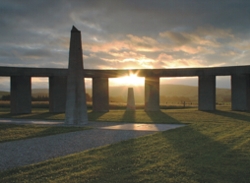
Stonehenge Aotearoa, a full-size model based on the ancient English stone circle, shows how the Sun, Moon and stars can be used “for life and survival”.
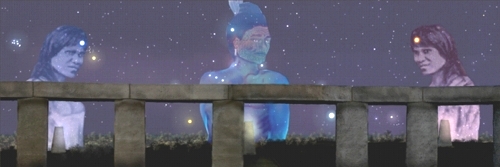
stonehenge-audio-visual

Apart from its majestic and mysterious appearance a stone circle has little meaning unless one knows how it works and why people built them eons ago.  The people who built Stonehenge Aotearoa have put together a special presentation that unravels ancient mysteries and takes the visitor on a journey of discovery.  Our tours include tales from antiquity of the solstices and equinoxes and signs of the Zodiac.  You will discover how stones, posts and shadows were used to unlock mysteries of the earth and sky which formed a cornerstone to the rise of civilization.

Allow enough time
A guided tour runs for just over an hour.  Do allow yourself time to check in before the presentation begins. We suggest that you arrive not less than 10 minutes before your tour is scheduled to start.   In addition, it is advisable to allow some free time following your tour.  Visitors often wish to ask questions, take a second look at some of the stone structures, or visit our Stonehenge shop.

When ?
Stonehenge Guided Tours are available to the public at 11am on Saturdays, Sundays and public holidays. At other times you may book a private tour – see below.  From December 27 through to January 15 there will be a tour every day at 11am.   The number of participants on any one tour are limited so bookings are recommended. 

What does it cost?
Adults $15, Senior Citizens (65+) $12, Students (13-17yrs) $10, Children (pre-teens) $6. Bookings recommended: Phone (06) 377 1600 or book online here.

PRIVATE & GROUP TOURS

may be held on any day at a time by arrangement. The fees per person are the same as those for a public tour:- $15 for adults, $12 for senior citizens (65+), $10 for students (13-17yrs), $6 for children (pre-teens), except that there is a minimum charge of $90. Thus, if you have 6 adults in your party this will cover the $90 minimum charge. Phone (06) 377 1600 or book online here.

Each tour is tailored to the weather conditions. It usually begins in our lecture theatre with an introductory talk on the historical significance of stone circles and the reasons why star-lore formed a cornerstone to the rise of civilization.  This part of the presentation may include an audio-visual about the Stonehenge on Salisbury Plain and Stonehenge Aotearoa.  We then explore the stone circle, listen to tales from antiquity, and discover how stones and shadows can be used to unlock mysteries of the universe.

 SUNRISE & SUNSET TOURS
Stonehenge Aotearoa can be magnificent at the time of sunrise or sunset.  These tours include (weather permiting) viewing the sun rise or set over the Henge. Of special interest is the times of the equinoxes and solstices when the sun can be observed to rise or set over one of the heel stones.  At these times we often have a special presentation about the equinox or solstice.  See “Special Events”.

Unless otherwise advertised Sunrise and Sunset Tours are only  available by arrangement as private or group bookings. 

 Maybe we should build one of these in Wilsthire?
Visit our sponsors for tours of the real Stonehenge – www.StonehengeTours.com

Merlin @ Stonehenge
The Stonehenge Stone Circle Website


Bulldozed Stonehenge would incur monolithic backlash

3 07 2011

So why has the eradication of the 4,000-year-old prehistoric Priddy Circles site not caused more national interest?
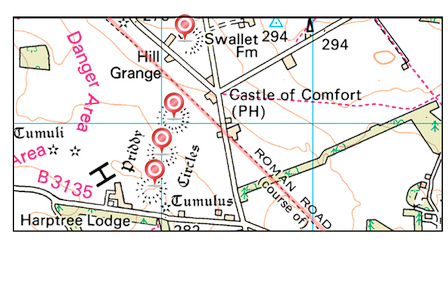
Priddy Circle Map

Hands-up folks, which of you had even heard of the Priddy Circles before last week? I would not anticipate there to be a large number of people, even locals, who had and I’m afraid to admit that I would not be among them.

It’s not surprising that they’re so little known as any reference to them makes only vague speculation as to their former purpose. The same could also be said to be true of Stonehenge, but, as any users of the A303 will attest, the mysterious splendour Stonehenge has captured the imagination of many, whereas Priddy Circles have remained unacknowledged by most.

I align them with Stonehenge because academic research on the phenomenon has claimed that ‘although no dating evidence has been found, they appear to be contemporary with Stonehenge’.

They are also said to probably be ‘Neolithic ritual or ceremonial monuments similar to a henge, they are external rather than internal ditches makes them unique in Britain and all this makes the circles the most important surviving Neolithic sites in Somerset’.

The recent rise in interest of the site is as a result of discoveries that English Heritage experts have been investigating claims that one of the four Priddy Circles has been obliterated.

Land near the circles appears to have been recently re-seeded and tree saplings have been planted close by.

The Ancient Monuments and Archaeological Areas Act 1979 makes it a criminal offence to destroy or damage a scheduled monument including agriculture, forestry, flooding and tipping.

If you want to view the site for yourself, they can be located using the map above – you are looking for an arrangement of four circular earthwork enclosures. The circles, each nearly 200m across, are best seen from the air. The damaged circle was the most clearly defined of the four. The total arrangement covers roughly 1.2km.

Other eyewitness accounts can be found at the Modern Antiquarian website. English Heritage has refused to be drawn on the extent of the alleged damage at this stage. 

To see the full extent of the damage from an aerial perspective, check-out these astounding photos by Pete Glastonbury.

Sponsored by the Stonehenge Tour Company – www.StonehengeTours.com

Merlin @ Stonehenge
The Stonehenge Stone Circle Website


Inquiry into Stonehenge A344 closure plans

26 06 2011

Plans to close the main road east of Stonehenge and return it to grass are being scrutinised at a public inquiry.

English Heritage wants to stop traffic from travelling close to the stones and

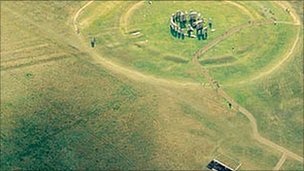
An aerial view of Stonehenge without the A344 road

An aerial view of Stonehenge without the A344 road

“restore the dignity” of the World Heritage Site by closing the A344.

Those opposed include chief druid Arthur Pendragon who has argued that it would give English Heritage a monopoly on access to the site.

The inquiry in Salisbury, Wiltshire, begins on Wednesday.

In June 2010 Wiltshire Council granted planning permission for a new visitors centre at Airman’s Corner, 1.5 miles (2km) west of Stonehenge.

Grassed over

Under the current scheme, the existing car park and visitor facilities at the stones will be removed and the area “returned to grass”.

English Heritage has said it will be necessary to close the A344 between Stonehenge Bottom and Byway 12 and close part of the B3086.

A new roundabout will replace the current Airman’s Corner junction to cope with the increased traffic caused by the road closures.

The Longbarow Roundabout on the A303 will also be improved.

English Heritage said it believed “everyone agrees that Stonehenge’s landscape setting is severely compromised by the intrusion of roads and traffic”.

Mr Pendragon said he was strongly opposed to the proposed traffic regulation order to restrict motorised vehicles on the remaining A344 west of Stonehenge and on two nearby byways.

He said: “We will not shrink from our responsibilities to ensure that future generations can enjoy the environs of Stonehenge and the World Heritage site without being excluded for fiscal reasons.”

Sponsored by ‘The Stonehenge Tour Company’ – www.StonehengeTours.com

Merlin @ Stonehenge
The Stonehenge Stone Circle Website


18,000 gather at a cloudy Stonehenge for all-night summer solstice party

22 06 2011

Tens of thousands of revellers gathered at Stonehenge for an all-night party to celebrate the longest day of the year this morning – despite grey clouds that obscured the sunrise.
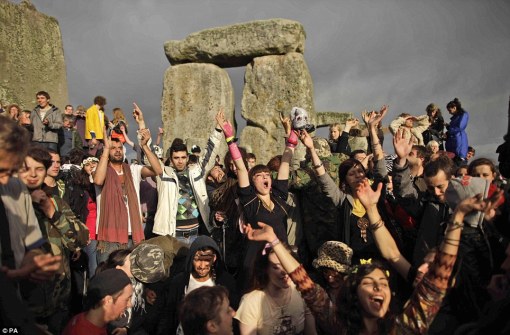
Here comes the sun: Revellers cheer as the sun finally breaks through the clouds, more than a couple of hours after daybreak

Here comes the sun: Revellers cheer as the sun finally breaks through the clouds, more than a couple of hours after daybreak

English Heritage say 18,000 revellers descended on the site that is usually roped off to the public to witness dawn at exactly 4.43am. The event is significant for druids, who were joined by hippies, pagans and tourists as well as hordes of younger visitors in search of a good party.

However the number of people who camped out overnight or arrived early to witness the dawn was down on previous years because of the poor weather and the solstice falling on a weekday.

There was no beautiful sunrise into clear blue skies – heavy overnight rain gave way to overcast but dry skies as the sun rose, greeted by cheering and applause.

The self-styled King Arthur Pendragon, the veteran druid who led the event, said it had passed off smoothly.

‘We didn’t get a great sunrise but it was dry,’ he said. ‘Everyone seems happy with the result.

‘It is great to see the stones being used in this way, as opposed to the usual manner with tourists being herded around.’

Stonehenge, which is between 4,000 and 5,000 years old, has in past years been the site of confrontations between revellers and police.

But Superintendent Gavin Williams, of Wiltshire Police, said the majority of the crowd this year were well-behaved and ‘came to see the sunrise in the spirit of the event’, which was policed in the same way as night spots in the county. However, two men were photographed fighting at the event.

Of the 20 arrests, 11 were for drugs offences and five for public

Mr Williams said: ‘Although it was disappointing that some individuals chose to bring drugs with them, they were dealt with robustly.’

English Heritage, which manages the Stonehenge site on Salisbury Plain in Wiltshire, said the atmosphere had been ‘peaceful and good natured’.

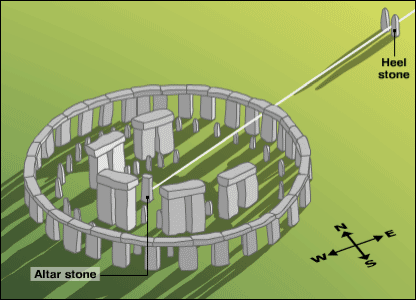
The annual event is a modern take on solstice celebrations which were once a highlight of the pre-Christian calendar. Celebrations focus on the Heelstone, which sits just outside the main circle, and is aligned with the midsummer sunrise.

The solstice is one of the few times access is granted inside the stone circle, which has been roped off since 1978 following years of erosion and vandalism.

Stonehenge’s origins remain a mystery, but one theory is that it is a huge astronomical calendar. Others say an ancient sun-worshipping culture aligned the structure with the midsummer sunrise and the midwinter sunset.

The World Heritage site was used as a cremation cemetery since its inception, archaeologists say, but it is unclear if that was its principal function.

It was build in three phases, with stones brought from up to 150 miles away, between 3000 BC and 1600 BC

http://www.dailymail.co.uk/news/article-2006112/Summer-solstice-18-000-gather-cloudy-Stonehenge-night-party.html

Sponsored by the Stonehenge Tour Company – www.StonehengeTours.com

Merlin @ Stonehenge
The Stonehenge Stone Circle website


Total Lunar Eclipse visible at Stonehenge tonight

15 06 2011

Todays’s total eclipse of the Moon may be the most striking for years but observers at Stonehenge must be content with a view of only the closing act of the drama.
Lunar Eclipse Stonehenge
The Moon stands over the southern Indian Ocean as it passes through the central dark umbra of the Earth’s shadow, plunging deeper into the shadow than during any eclipse since 2000. This may well result in an unusually dark eclipse, with the Moon’s disc turning a deep reddish-brown as all direct sunlight is blocked.

In fact, the umbra is never black. A little light must reach the Moon from the parts of the Sun’s outer atmosphere, the corona, that are not hidden by the Earth. But more sunlight is refracted and scattered around the edge of the Earth by our planet’s atmosphere. Just as sunsets and sunrises appear orange or red, so this light is predominantly red.

The umbra is not illuminated evenly, though, since less of this indirect light penetrates to its core and the amount reaching different zones of the umbra is affected by varying atmospheric conditions. In particular, dust thrown up by major volcanic eruptions can render the atmosphere less transparent and the eclipsed Moon so dark that it practically disappears.

Our image shows the previous total lunar eclipse as viewed from Florida last December. On that occasion, the Moon traversed the northern part of the umbra and its southern regions, which just missed the shadow’s core, are relatively dark. This week, the Moon passes about a half Moon’s-breadth farther southwards with respect to the shadow, so it will be interesting to discover just how dark and colourful it appears.

Wednesday’s eclipse begins when the Moon’s eastern limb begins to enter the penumbra of the Earth’s shadow at 18:25 BST. While within the penumbra, some direct sunlight falls on the Moon but little darkening of the disc will be noticed until a few minutes before the Moon begins to enter the umbra at 19:23. Totality, with the Moon entirely within the umbra, lasts from 20:22 until 22:03 with mid eclipse at 21:13. The Moon’s W limb has withdrawn from the umbra by 23:02 and finally exits the penumbra at 00:01.

For Britain, other than the far NW, the Moon rises in the SE during the latter half of totality. Observers in SE England may just glimpse the end of totality, but most of us may see nothing until it begins to emerge from the umbra. From London and Manchester, for example, the Moon stands less than 5° and 3° high respectively at 22:03 BST, with the Sun only a little way below the NW horizon and the sky brightly twilit. The Moon should be more obvious another 5° higher in a darker sky by 23:02.

Sponsored by ‘The Stonehenge Tour Company’ www.StonehengeTours.com

Merlin @ Stonehenge
The Stonehenge Stone Circle Website


World Heritage Site Landscape Project: Stonehenge, Amesbury, Wiltshire

10 06 2011

Summary of an English Heritage Report on Stonehenge by David Field and Trevor Pearson:

Analytical survey of the ground surface at Stonehenge revealed the presence of a number of interesting earthworks that have a bearing on interpretation and the development of the monument. Chief among these is a low mound that was revealed within the stone settings. Its location focuses attention on that part of the arrangement which is ruinous and supplements former reservations as to whether the monument was ever complete. Survey also revealed that the Y and Z holes are visible asStonehenge plan earthworks and that each circuit has a shallow bank within it. The feature known as the North ‘Barrow’ may have preceded the enclosure and therefore be one of the earliest elements at the site. The South ‘Barrow’ by contrast is, at least in one of its phases, a later feature. These are clearly not barrows and the more neutral term ‘circles’ is therefore preferred. An outer bank to the enclosure has been largely truncated by cultivation, while a mis-match of the Avenue at the enclosure entrance indicates that the two may have been mutually exclusive entities. The eastern ditch and bank of the Avenue is revealed to have changed course, perhaps in an attempt to avoid the pre-existing ditch around the Heel Stone.

http://services.english-heritage.org.uk/ResearchReportsPdfs/109_2010WEB.pdf
http://heritageaction.wordpress.com

Sponsored by ‘The Stonehenge Tour Company’ www.StonehengeTours.com

Merlin @ Stonehenge
The Stonehenge Stone Circle Website