18,000 gather at a cloudy Stonehenge for all-night summer solstice party

22 06 2011

Tens of thousands of revellers gathered at Stonehenge for an all-night party to celebrate the longest day of the year this morning – despite grey clouds that obscured the sunrise.

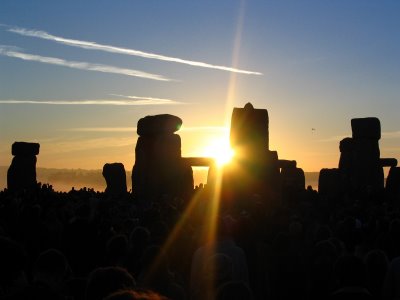
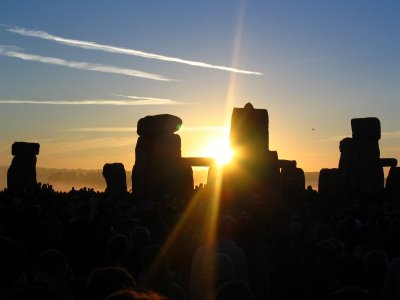
Here comes the sun: Revellers cheer as the sun finally breaks through the clouds, more than a couple of hours after daybreak

Here comes the sun: Revellers cheer as the sun finally breaks through the clouds, more than a couple of hours after daybreak

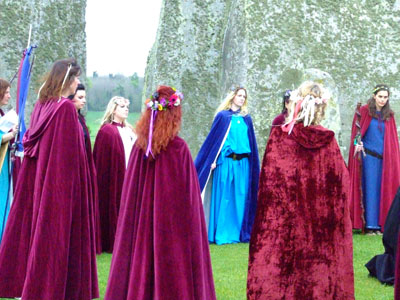
English Heritage say 18,000 revellers descended on the site that is usually roped off to the public to witness dawn at exactly 4.43am. The event is significant for druids, who were joined by hippies, pagans and tourists as well as hordes of younger visitors in search of a good party.

However the number of people who camped out overnight or arrived early to witness the dawn was down on previous years because of the poor weather and the solstice falling on a weekday.

There was no beautiful sunrise into clear blue skies – heavy overnight rain gave way to overcast but dry skies as the sun rose, greeted by cheering and applause.

The self-styled King Arthur Pendragon, the veteran druid who led the event, said it had passed off smoothly.

‘We didn’t get a great sunrise but it was dry,’ he said. ‘Everyone seems happy with the result.

‘It is great to see the stones being used in this way, as opposed to the usual manner with tourists being herded around.’

Stonehenge, which is between 4,000 and 5,000 years old, has in past years been the site of confrontations between revellers and police.

But Superintendent Gavin Williams, of Wiltshire Police, said the majority of the crowd this year were well-behaved and ‘came to see the sunrise in the spirit of the event’, which was policed in the same way as night spots in the county. However, two men were photographed fighting at the event.

Of the 20 arrests, 11 were for drugs offences and five for public

Mr Williams said: ‘Although it was disappointing that some individuals chose to bring drugs with them, they were dealt with robustly.’

English Heritage, which manages the Stonehenge site on Salisbury Plain in Wiltshire, said the atmosphere had been ‘peaceful and good natured’.

The annual event is a modern take on solstice celebrations which were once a highlight of the pre-Christian calendar. Celebrations focus on the Heelstone, which sits just outside the main circle, and is aligned with the midsummer sunrise.

The solstice is one of the few times access is granted inside the stone circle, which has been roped off since 1978 following years of erosion and vandalism.

Stonehenge’s origins remain a mystery, but one theory is that it is a huge astronomical calendar. Others say an ancient sun-worshipping culture aligned the structure with the midsummer sunrise and the midwinter sunset.

The World Heritage site was used as a cremation cemetery since its inception, archaeologists say, but it is unclear if that was its principal function.

It was build in three phases, with stones brought from up to 150 miles away, between 3000 BC and 1600 BC

http://www.dailymail.co.uk/news/article-2006112/Summer-solstice-18-000-gather-cloudy-Stonehenge-night-party.html

Sponsored by the Stonehenge Tour Company – www.StonehengeTours.com

Merlin @ Stonehenge
The Stonehenge Stone Circle website


Druids celebrate summer solstice at Stonehenge for first time as mainstream faith

17 06 2011

When robed Druids gather at Stonehenge for the summer solstice in next week, they will be worshipping at the prehistoric stone-circle monument for the first time as members of an established religion under British charity law. The classification means members of the ancient pagan tradition, which some see as a curiosity of Britain’s ancient past, have mainstream status equal to the Church of England. The change of status, which is controversial, gives them tax advantages.
Stonehenge Druid

Opponents of the change of status regard it as a mistake made for the sake of political correctness by a government agency, the Charity Commission. The see it as the first step to recognition of Scientology, sorcery, witchcraft or even the Jedi as religions eligible for tax-exempt status. The 2001 census recorded the country as having some 390,127 Jedi, the fictional Star Wars religion, in England and Wales.

After a four-year campaign by the Druids, the Charity Commission says it accepts that they worship nature and believe in the spirits of places such as mountains and rivers, as well as in divine guides.

Druids are best known for the gathering at Stonehenge each year on Jun 21 to greet the dawn, but they hold festivals eight times a year to mark stages in the solar and lunar cycles. Encyclopedia Britannica describes the ancient Druids as members of the learned class among the Celts. They do not worship a single god or creator, but seek to cultivate a sacred relationship with the natural world. The earliest known records of the Druids come from the 3rd Century BC. 

RELATED READING:

Druids: Worshippers of nature who were said to sacrifice humans (Telegraph 2 Oct 2010)
http://www.telegraph.co.uk/news/newstopics/religion/8037258/Druids-Worshippers-of-nature-who-were-said-to-sacrifice-humans.html

MELANIE PHILIPS: Druids as an official religion? Stones of Praise here we come (Daily Mail 4 Oct 2010)
http://www.dailymail.co.uk/debate/article-1317490/Druids-official-religion-Stones-Praise-come.html?ito=feeds-newsxml

Stonehenge preperations
THOUSANDS of revellers are expected to descend upon Stonehenge for this year’s Summer Solstice.
Sunrise will occur at about 4.45am on June 21, which is the longest day of the year.
English Heritage is opening Stonehenge to the public from 7pm on Monday, June 20, to 8am the following day.
The Solstice car park, just off the A303, will open from 7pm on Monday, June 20, with last admission at 6am on Tuesday, June 21. Access to the stones and car park will be free of charge but organisers have advised people to use public transport where possible.
Wilts and Dorset bus company will be running a regular service from Salisbury railway station, via the bus station, from 6.30pm on the Monday evening through to 1.15am on Tuesday. A return service will operate frequently from 4am to 9.45am on Tuesday – with buses stopping at any recognised bus stop along the Amesbury route

Sponsored by ‘The Stonehenge Tour Company’  www.StonehengeTours.com

Merlin at Stonehenge
The Stonehenge Stone Circle website
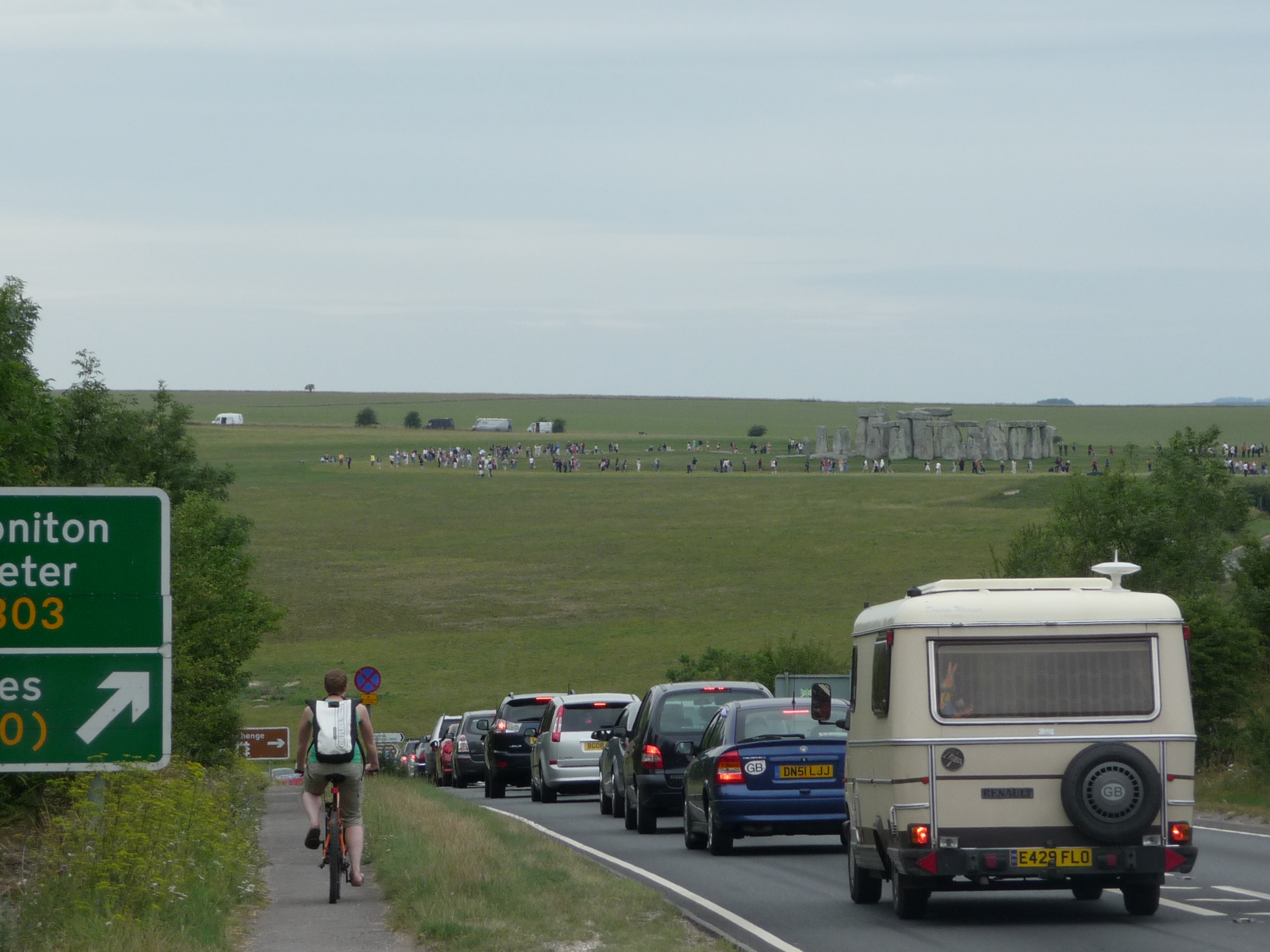


Stonehenge Summer Solstice advice for drivers – 2011

15 06 2011

Traffic on the A303 at Stonehenge is expected to be very busy on Monday 20th and Tuesday 21st June during the summer solstice celebrations.
A303 Stonehenge trafficPeople travelling to Stonehenge are advised to use public transport where possible. People arriving by car and through traffic on the A303 are advised to allow longer for their journeys.

Motorists can get up-to-the-minute advice about roadworks and travelling conditions by visiting the Highways Agency website www.highways.gov.uk, or telephone the Highways Agency Information Line on 0300 123 5000 at any time. Calls from landlines to 0300 and 08700 numbers can cost up to 8p per minute but are free from some landline providers: calls from mobiles usually cost more.

Before using any mobile, find a safe place to park. Never stop on the hard shoulder of a motorway except in an emergency. Make sure it’s safe and legal before you call.

http://www.hgvuk.com/06/15/stonehenge-summer-solstice-advice-for-drivers/

Follow Stonehenge on twitter for all the latest news and updates during the solstice celebrations:  http:www.TWITTER.COM/ST0NEHENGE.COM

Merlin @ Stonehenge
The Stonehenge Stone Circle Website


Druids celebrate summer solstice for first time as mainstream faith

8 06 2011

When robed Druids gather at Stonehenge for the summer solstice in 2011, they will be worshipping at the prehistoric stone-circle monument for the first time as members of an established religion under British charity law. The classification means members of the ancient pagan tradition, which some see as a curiosity of Britain’s ancient past, have mainstream status equal to the Church of England. The change of status, which is controversial, gives them tax advantages.
Stonehenge solstice druids

Opponents of the change of status regard it as a mistake made for the sake of political correctness by a government agency, the Charity Commission. The see it as the first step to recognition of Scientology, sorcery, witchcraft or even the Jedi as religions eligible for tax-exempt status. The 2001 census recorded the country as having some 390,127 Jedi, the fictional Star Wars religion, in England and Wales.

After a four-year campaign by the Druids, the Charity Commission says it accepts that they worship nature and believe in the spirits of places such as mountains and rivers, as well as in divine guides.

Druids are best known for the gathering at Stonehenge each year on Jun 21 to greet the dawn, but they hold festivals eight times a year to mark stages in the solar and lunar cycles. Encyclopedia Britannica describes the ancient Druids as members of the learned class among the Celts. They do not worship a single god or creator, but seek to cultivate a sacred relationship with the natural world. The earliest known records of the Druids come from the 3rd Century BC. 

RELATED READING:
Druids: Worshippers of nature who were said to sacrifice humans (Telegraph 2 Oct 2010)
http://www.telegraph.co.uk/news/newstopics/religion/8037258/Druids-Worshippers-of-nature-who-were-said-to-sacrifice-humans.html

MELANIE PHILIPS: Druids as an official religion? Stones of Praise here we come (Daily Mail 4 Oct 2010)
http://www.dailymail.co.uk/debate/article-1317490/Druids-official-religion-Stones-Praise-come.html?ito=feeds-newsxml

Sponsored by ‘The Stonehenge Tour Company’ www.StonehengeTours.com

Merlin @ Stonehenge
The Stonehenge Stone Circle Website
Follow me on twitter for all the Solsice news: http:/www.TWITTER.COM/ST0NEHENGE


Secrets of the Stones

30 05 2011

As the summer solstice will soon see thousands gather at Stonehenge, an archaeologist discusses his belief that the Wiltshire monument is evidence of a great civilisation which once thrived there

Sunrise at Stonehenge - June 21st

Sunrise at Stonehenge - June 21st

IN three weeks’ time, thousands of devotees will gather in the dark in a field in Wiltshire. They do this every year and each time their number grows.

They are there to celebrate the midsummer Solstice, the longest day of the year, and will wait until daybreak when the sun sends a piercing ray of light through Stonehenge, the ancient ruin they have come to venerate.

This primordial circle of stones, eight miles north of Salisbury in Wiltshire, exerts an extraordinary power over the people of Britain.

Some, like the Druids, claim it is the source of a mystical power while others, curious but sceptical, believe it to be the site of an ancient monument that has no relevance to the way we live today.

Whatever their conviction they are all missing the point according to one man who has studied the location for 30 years and believes he knows the real reason why Stonehenge is so special.

“Stonehenge is unique; it is already recognised as a World Heritage Site but it’s more than just an ancient curiosity, it is the place where civilisation began,” says writer and archaeologist Robert John Langdon.

“It’s simply the most amazing place in the world and we should all be celebrating the meaning of this incredible place.”

Robert fell under the spell of Stonehenge as a boy. He explored the massive stone monoliths and was intrigued by the official explanation of their origin. As the years passed and he learned more he was puzzled by contradictions in official explanation of its origins.

“The carbon dating of the stones is not consistent. I have discovered that stone post holes in what is now the car park for the site predate the accepted date for Stonehenge by 5,000 years. If this evidence is accepted, and it has been denied for years, it turns the conventional history of Stonehenge, and the rest of the world for that matter, on its head.”

If Robert is right, and he says he has the scientific evidence to prove he is, Stonehenge is the most important archaeological site in the world. It would mean Salisbury Plain is home to the first and most significant civilisation on earth. So how could this have happened?

“The geography and landscape of the site would have been very different. Britain would have been emerging from the last Ice Age, so much of the country we now recognise would have been under water. Stonehenge would have been on an estuary that led to the open sea. Too many important facts have been ignored,” says Robert.

“There is evidence that water was close, but that has been classified as a moat which I believe is wrong. It is also believed the stones were dragged over land from Wales which is misleading.

“The large sarsen stones came from an area close to Avebury which is not far from Stonehenge.  To have brought them overland all the way from Wales takes no account of the fact that according to the official time scale Salisbury Plain at that time would have been heavily forested which would have made that access all but impossible. The bluestones, which are the key to the secret of Stonehenge, were smaller and did come from Wales but they were brought there by boat.”

Robert’s hypothesis is based on his conviction that the men who built Stonehenge were much more skilled and sophisticated than is currently believed. In 10,000 BC, the Mesolithic period, he believes that men in ancient Britain developed the first recognisable civilisation and that Stonehenge was their greatest achievement.

“These were extremely capable people who found a way of drilling into stone and used sophisticated mortice and tenon joints to erect Stonehenge but most importantly they mastered the seas. These boat people, as we can call them, travelled widely and traded and these are the people I believe that Plato referred to in his writings on the origins of civilisation.”

So why did these people make such an effort to build Stonehenge? what was it intended to do?

“Stonehenge was accessible to boat people from  all over Europe and Mesolithic men and women came there to be cured of their ailments and to depart from this world. The alignment of the site to the sun and the moon is immensely significant but so is the presence of the bluestones in the circle.

“Bluestone turns blue in water, and was believed to have incredible powers of healing. Evidence from bones found close to Stonehenge suggests that the original inhabitants practised sophisticated medical procedures which included dentistry, limb removal and even brain surgery.

“These were not the fur-clad hunter gatherers living in mud huts that many mistakenly believe were the builders of Stonehenge. They were instead members of a great civilisation that moved out, leaving Stonehenge as the only surviving physical evidence of their genius.”

If Robert Langdon is right Stonehenge is much older than the Pyramids and there is a surprising connection between the two ancient stone monuments.

“Over the centuries the climate and landscape in Britain changed. Mesolithic men used their seafaring skills to move to a more sympathetic environment. They traded widely and sailed south to what is now the Mediterranean and moved in along the coast from Egypt to Greece and Italy. The ancient Egyptians’ skill at engineering and building with stone had its roots in the lessons learnt by the men who built Stonehenge.”

It is not only archaeologists with a theory about the significance of Stonehenge. The Druids regard it as a sacred place where they perform spiritual rituals.

Robert says: “I don’t have any disputes with the Druids and they don’t seem to mind me. I’ll be rubbing shoulders with lots of them at the midsummer solstice. The Druids may well have their beliefs but they came on the Stonehenge scene very late in the day.

“They would have discovered the site as an ancient and abandoned temple and taken it over but that’s all right. I get on pretty well with other archaeologists too although they do tend to dismiss my work, but that’s their loss. Stonehenge has a special hold on me and the more I learn about it the more fascinated I become. I’m already working on a new book which I think will ruffle quite a lot of feathers.

“In a sense what we know as Stonehenge is almost the foundations of a much bigger edifice. Stonehenge is, despite all the myths that have been fostered, a very special place. It is, I believe, the birthplace of civilisation and we all ought to give it the respect that it really deserves.”

Article from The Express Newspaper
Sponosred by ‘The Stonehenge Tour Compant’ www.StonehengeTours.com

Merlin @ Stonehenge
The Stonehenge Stone Circle Website


Stonehenge Winter Solstice 2012 – The end of the world is nigh, or is it ?

18 05 2011

 Stonehenge Stone Circle and 2012

I am surprised at the number of people asking questions and talking about the Stonehenge winter solstice next year.  Many connections are being made to the Mayan calander and ‘the end of the world’   Will we see a record number of people turning up for ‘open access’  from around the world on the December 21st 2012 ?

Stonehenge dates back to being built around 3100 BC. This is in collaboration with creation of the Mayan calendar and the invention of the Sumerian language. On analyzing the Stonehenge several historians have suggested the possibility of the Stonehenge giving clues to the end of time in the same way the Mayan calendar does; thus showing a link between the two.
Stonehenge 2012

It was believed that the Stonehenge was used to tell time using the Sun’s solstice. With the rising and setting of the sun, one can observe time. During one day of summer the sun is set as far in the sky as possible. At this time the sun rises in direct alignment to a section of the Stonehenge known as the “heal stone”. This stone serves the same purpose as the hands of a clock as it casts a shadow over the Stonehenge sector. Coincidentally, this clock goes backward and acts as a countdown to the end of time – on December 21st 2012! On this day due to the wobble of the Earth on its axis and several other alignments, the heal stone will cease to cast a shadow indicating that time has run out.

Moreover, archaeologists have found various carvings in the stone. Using carbon dating archaeologists some of these carvings include Sumerian numbers and writings. The numbers “33” and “32” is significantly engraved on the stones. Interestingly enough, with the Sumerian sexagesimal system, the number 33 is multiplied by 60 and then added to 32 giving 2012 ironically.

End of the world 2012Stonehenge and the Mayan Calendar

The writings of the Mayans and the Sumerians have suggested the world might come to end on December 21st 2012. Furthermore, the Mayan Long Count calendar ends on this particular date. These ancient civilizations lived in close proximity to each other; thus, had a lot of influence from each other to similarly predict the future. Yet, there are other objects that have marked the same date – Stonehenge! Could one of the “Seven Wonders of the World” really foretell the fate of our future?

It was believed that the Stonehenge was used to tell time using the Sun’s solstice. With the rising and setting of the sun, one can observe time. During one day of summer the sun is set as far in the sky as possible. At this time the sun rises in direct alignment to a section of the Stonehenge known as the “heal stone”. This stone serves the same purpose as the hands of a clock as it casts a shadow over the Stonehenge sector. Coincidentally, this clock goes backward and acts as a countdown to the end of time – on December 21st 2012! On this day due to the wobble of the Earth on its axis and several other alignments, the heal stone will cease to cast a shadow indicating that time has run out.

Moreover, archaeologists have found various carvings in the stone. Using carbon dating archaeologists some of these carvings include Sumerian numbers and writings. The numbers “33” and “32” is significantly engraved on the stones. Interestingly enough, with the Sumerian sexagesimal system, the number 33 is multiplied by 60 and then added to 32 giving 2012 ironically.

Stonehenge holds many secrets that mankind has yet to discover. It is possible that something will happen on December 21st 2012, as it is not only limited to one side of the world since the Mayans and Sumerians lived in Meso-America; 2012 is also a big part of history in other countries. As time passes, we might be able to discover more. Hopefully all this information should give us a better insight of what is to come.

What will happen after December 21st 2012 ?  hopefully December 22nd 2012 because I will be there trying to enjoy the sunrise and celebrations.

Links:
http://www.the2012discovery.com/2012-videos/2012-mayan-calendar-doomsday-stonehenge-link-video/
http://www.2012hoax.org/stonehenge
http://www.stonehengetours.com/html/stonehenge-winter-solstice-tour.htm

Sponsored by ‘The Stonehenge Tour Company’

Merlin @ Stonehenge
The Stonehenge Stone Circle Website
P.S My opinion – Stonehenge isn’t a doomsday clock!


Stonehenge: Could 2011’s solstice mass event be the last?

8 05 2011
 

As we recently observed people are fully entitled to see Stonehenge as their temple. However, while such claims are harmless in themselves they have also been responsible for some unwelcome effects. For isn’t it clear that a wish to avoid offending people of a spiritual nature has led to a reluctance to say that no, access by tens of thousands of revellers at Summer Solstice is unseemly and damaging and really must end?
1995 Stonehenge Summer Solstice

Get off those Stones! 1995 Stonehenge Summer Solstice

It seems to us there’s an easy and equitable solution that balances tourism, spirituality and conservation in a proper manner:

1. No more thousands of tipsy revellers standing on the stones. (It’s recent, not traditional, it carries a risk of damage to both the monument and the revellers and brings shame on our country – and it simply shouldn’t happen as English Heritage knows full well.)
2. Spiritual people yes. Of course. But in limited numbers, selected by ballot from the membership of well established pagan organisations.
3. Other people (whether non-spiritual or spiritual but without demonstrable group affiliations), yes of course and also in limited numbers, selected by ballot from those who apply.

So how many in total? That’s entirely EH’s affair, depending purely on how many they think can be safely and sensibly admitted without imposing a risk of damage or broadcasting an image to the world that we don’t treat Stonehenge as it should be treated.  It’s certainly time they decided what they could cope with rather than unsuccessfully trying to cope with many times more than they can!

So let’s SHARE Stonehenge, it’s the obvious thing to do. But not abuse it, which is also obvious.

If spiritual people agree to that and people in general agree to that (following a consultation) then English Heritage could surely have a mandate to make radical changes to what happens at Stonehenge as soon as next year? 

How about it?

Article extracted rom the excellent Heritage Journal – http://heritageaction.wordpress.com/
Sponsored by the Stonehenge Tour Company

Follow us on twitter for all the Stonehenge Summer Solstice News: http://www/twitter.com/ST0NEHENGE

Merlin @ Stonehenge
The Stonehenge Stone Circle Website


Beltane Facts (May Day)

1 05 2011

May Day is Beltane, which means ‘day of fire’. It is an ancient Pagan festival. Bel was the Celtic God of the sun. May Day marks the seasonal transition from Winter to Summer and celebrated the first spring planting.

Beltane Celebrations at Stonehenge

Beltane Celebrations at Stonehenge

Beltane kicks off the merry month of May, and has a long history. This fire festival is celebrated on May 1 with bonfires, Maypoles, dancing, and lots of good old fashioned sexual energy. The Celts honored the fertility of the gods with gifts and offerings, sometimes including animal or human sacrifice. Cattle were driven through the smoke of the balefires, and blessed with health and fertility for the coming year. In Ireland, the fires of Tara were the first ones lit every year at Beltane, and all other fires were lit with a flame from Tara.

  • May Day is Beltane, which means ‘day of fire’. It is an ancient Pagan festival. Bel was the Celtic God of the sun.
     
  • May Day marks the seasonal transition from Winter to Summer and celebrated the first spring planting.
  • Putting a Maypole up involved taking a growing tree from the wood and bringing it to the village to mark the coming of Summer. Single men and women would dance around the Maypole holding on to ribbons until they became entwined with their (hoped for) new loves.
  • Social hierarchy was set aside on May Day to involve everyone from the highest to the lowest.
  • May Day is a celebration of fertility. In the old days whole villages would go to the woods and all sorts of temporary sexual liaisons would take place.
  • Robin Goodfellow, also known as the Green Man was the Lord of Misrule on May Day. He and his supporters would make jokes and poke fun at the local authorities.
     
  • Parliament banned May Day festivities in 1644.
  • Unlike Easter, Whitsun, or Christmas, May Day is the one festival of the year with no significant church service.
     
  • In previous centuries working people would take the day off to celebrate, often without the support of their employer.
     
  • William Davidson, a black trade unionist and a revolutionary, was executed on May Day 1820. Davidson was born in the then pirate capital, Kingston, Jamaica and put a skull and crossbones on a black flag to say:“Let us die like men and not be sold like slaves.” He was executed for being part of a conspiracy to kill the entire cabinet, which was hoped to give the spark to a revolution in Britain.
  • May Day is recognized throughout the world as International Workers’ Day, or Labour Day. In 1884 US and Canadian trade unions declared that after May 1st 1886, 8 hours would constitute a legal days work.
  • May 1st was declared a holiday by the International Working Men’s Association (First International) in Paris in 1889. This was to commemorate the Haymarket Martyrs of 1886: 8 anarchists were wrongly accused of throwing a bomb at police and 4 were executed.
  • The USA and Canada do not recognize May Day. The US government attempted to erase the its history by declaring that May 1st was ‘Law Day’ instead. They pronounced that Labour Day was to be on the first Monday of September, a date of no significance.

    Links: http://www.new-age.co.uk/celtic-festivals-beltane.htm
    Sponsors: The Stonehenge Tour Company – www.StonehengeTours.com

    Happy Beltane everybody!
    Merlin @ Stonehenge Stone Circle


Stonehenge Summer Solstice Celebrations 2011 – June 20th / June 21st

27 04 2011

English Heritage are again expected to provide “Managed Open Access” to Stonehenge for the Summer Solstice. Please help to create a peaceful occasion by taking personal responsibility and following the conditions (see below).

Please note that a high volume of traffic is anticipated in the Stonehenge area on the evening of Sunday 20th June. The car park (enter off the A303 from the roundabout – it’s signposted) will open at around 7pm on Monday 20th June, and close at around noon on Tuesday 21st June.
Note that last admission to the car park for vehicles is at around 6am. Access Access to the stones themselves is expected to be from around 8.30pm on Monday 20th June until 8am on Tuesday 21st June.

Stonehenge Summer Solstice

 There’s likely to be casual entertainment from samba bands & drummers but no amplified music is allowed. When you visit Stonehenge for the Solstice, please remember it is a Sacred Place to many and should be respected. Van loads of police have been present in the area in case of any trouble, but generally a jovial mood prevails. Few arrests have been made in previous years, mostly in relation to minor drug offences.

Facilities Toilets and drinking water are available and welfare is provided by festival welfare services. There are normally one or two food and drink vans with reasonable prices but huge queues, all well away from the stones themselves.

Sunrise is at around 4:45am.

Conditions Rules include no camping, no dogs, no fires or fireworks, no glass bottles, no large bags or rucksacks, and no climbing onto the stones. Please use the bags given free on arrival and take them out, filled with your litter, to the skips provided.

Please respect the rules so that we’re all able to enjoy the solstice morning at Stonehenge for years to come.

Getting there: Where possible, please travel to Stonehenge using public transport. The local bus company, Wilts & Dorset, will be running a service from Salisbury railway and bus stations to Stonehenge over the Solstice period. This bus service will commence at 1830 hours (6.30pm) on Monday 20th June and run regularly until 0115 hours (1.15am) on Tuesday 21st June. A service taking people back to Salisbury will start again at 0400 hours (4am) and run frequently until 0945 hours (9.45am). Access to Stonehenge from the bus drop off point is through the National Trust farmland. More information will be here when available.  Needless to say this service is extremly busy, please allow plenty of time.

From London: Our friends at the ‘Stonehenge Tour Company’ will be offering their usual small group unobtrusive tours to the solstice from London.  There are two services departing London at 4pm and 1am – Click here: ‘Stonehenge Summer Solstice Tour 2011’
Stonehenge summer solstice tours

LINKS: http://www.efestivals.co.uk/festivals/stonehenge/2011/
http://www.english-heritage.org.uk/daysout/properties/stonehenge/explore/summer-solstice-2011/:
http://www.thestonehengetour.info/

TWITTER: Follow Stonehenge on twitter.  Get all the latest news and Solstice uddates – http://twitter.com/ST0NEHENGE

FACEBOOK: Join Stonehenge on facebook: http://www.facebook.com/stonehenge.tours

See you all at the Summer Solstice, yipee……………..

Merlin @ Stonehenge
The Stonehenge Stone Circle Website