Stonehenge Visitor Centre – the debate continues….

9 07 2010

Let’s build the visitor centre in Amesbury

It was with great delight that the news came through that the new government has pulled the plug on the £10million gift to an already wealthy organisation to build a pointless visitor centre so far away from Stonehenge.

Can you imagine all the American visitors’ remarks at having to travel another 1.5 miles on a freezing cold winter’s day? Or even a boiling hot one like we are now enjoying? English Heritage really has no claim to these stones, originally they belonged to Amesbury (which incidentally gets very little income from them but all the hassle). How it managed to take control is a mystery – it makes a lot of money from them and unlike the castles and country mansions it owns, Stonehenge has a very low maintenance budget.

A centre in Amesbury would have been better but not in Countess Road (more money wasted on land there, I remember) but nearer the west Amesbury area close to plenty of ground and nearer the shops and hotels etc. Alongside the river near the cemetery is a huge piece of open land, so whatever the planned transport system to the stones is, it could run from here. From west Amesbury to the dual carriageway west of Winterbourne Stoke runs a natural gully some 40ft lower than the A303 for a distance of 6.3 miles. This disturbs no one, unlike the huge bridge on stilts proposed for north of Winterbourne Stoke. If this route were taken then all the other roads around the stones could remain open for local traffic.

Or of course things could be just left as they are, after all we have lived with it for the 60-plus years I’ve lived here.

Tony Bull, Amesbury

Only the best for Stonehenge

The awful state of the present Stonehenge Visitor Centre is universally recognised and does not need repeating.

The remedy has generated wide debate but the views that really count are those from people who have long studied the problem and those who would be affected by a solution. Ignore the “we must not lose the lovely view of the Stones as we pass (at 70 mph)” brigade.

The demise of the cancelled “temporary” centre should be welcomed for saving precious funds from waste on a third-class idea linked to Olympic strays. Anyone sufficiently versed in the pros and cons of the subject, the Stonehenge Alliance for example, will rejoice at the decision because the chosen site has too many faults and the cost has already risen from £20million to £27.5million. The problem is unavoidably coupled with a roads problem and that could be eased at modest cost by closing or making the link with the A303 one way to or from the car park entrance.

No other plans should be contemplated until the country can afford the best solution for Stonehenge, which must include the removal of the A303 from the site. That proposal would satisfy the objections of the World Heritage Committee, ignored hitherto, and avoid the site the disgrace of losing World Heritage status.

John Ellis, Farley

This decision is so short-sighted

I still cannot believe that the new government has withdrawn the £10million that was to be invested in the Stonehenge Visitor Centre.

This is surely a very short-sighted decision. With the Olympics coming in 2012 Stonehenge will attract thousands of new visitors and the new centre would have made a lot of money. I believe the Government would have got their money back in very quick time as well as providing many short-term jobs in the construction process and a significant number of long-term jobs.

I hope English Heritage manages to raise the money elsewhere. Maybe it could launch a bond scheme so ordinary investors could have a stake.

Jan Belza, Durrington

Any more comments ?  I welcome your feedback ?

Merlin @ Stonehenge
The Stonehenge web site


Bryan builds his own henge

25 06 2010

IT’S Hampshire’s own answer to Stonehenge.

Bryan builds his own henge

Alone in a rural setting stands an eerie circle of stones, each painstakingly positioned in such a way as to celebrate the earth’s natural calendar.

But, unlike the world-famous monument on Salisbury Plain, it took just one person to build this modern version.

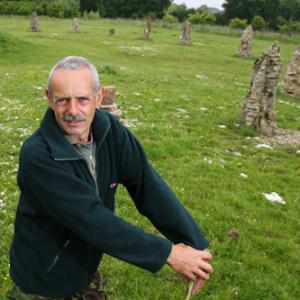
The 24 stone towers are made out of fly-tipped waste and they have been erected over a decade by a man fascinated with Britain’s ancient history.

Bryan Raines started his Millennium Circle in 2000, each year arranging the monuments in line with specific times in the year such as summer and winter solstice and the spring equinox.

The circle, in Bryan’s field near Awbridge Village Hall, surrounds a barrow constructed of soil.

The 55-year-old conservationist believes the site lies on an ancient ley line running from the Isle of Man to the Isle of Wight.

Bryan, who lives in Michelmersh, said: “I was in the process of collecting builder’s rubbish that I had accumulated and I thought I would use it for a stone circle.

“Some of the stones are between five and six feet high but, unfortunately, cows keep knocking them over.

“I’ve ended up with a sort of 24-hour sundial. It’s a good 50 metres across.

“I’m quite proud of it, actually. I have had quite a few people who were surprised about it.”

The lowdown on ley lines

Some people believe sites of geographical interest and ancient monuments and megaliths are connected by straight lines, known as ley lines.

Their existence was suggested in 1921 by the amateur archaeologist, Alfred Watkins, in his book, The Old Straight Track.

Those who believe in them think that the lines and their intersection points resonate a special psychic or mystical energy.

Watkins believed that, in ancient times, when Britain was far more densely forested, the country was crisscrossed by a network of straight-line travel routes on which prominent landmarks were used as navigation points.

Since then, ley lines have become the subject of magical and mystical theories.

Two British dowsers, Captain Robert Boothby and Reginald A. Smith, of the British Museum, linked the appearance of ley lines with underground streams and magnetic currents. HisTOUries UK offer guided tours of Stonehenge and Avebury abd demonstrate the ancien art of dowsing.

Merlin @ Stonehenge
The Stonehenge Stone Circle Website


Celebrations at Stonehenge Summer Solstice 2010

22 06 2010


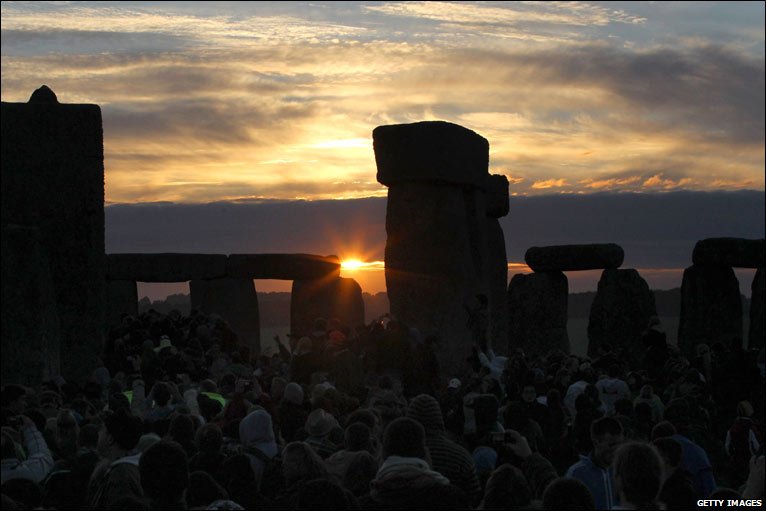
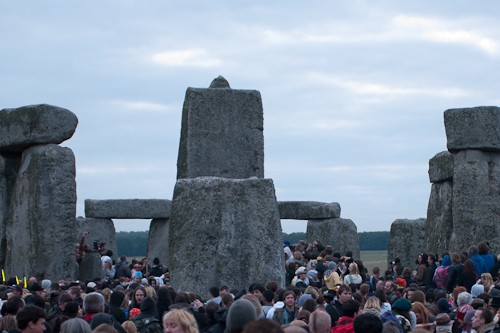
About 20,000 revellers were at Stonehenge to mark the Summer Solstice, each hoping to see the sun as it rose above the ancient stone circle at dawn.

Police described the event on Salisbury Plain in Wiltshire as one of the safest in years, although 34 people were arrested for minor drug offences.

Sunrise, marking the longest day of the year north of the equator, occurred over the circle at 0452 BST.

The Heel Stone, just outside the main circle, aligns with the rising sun.

Peter Carson from English Heritage said: “It has been quieter this year but it’s been a great solstice.

‘Monday morning’

“It’s an improvement on the last few years – the last time I remember seeing the sun rise was in 2003 – so it’s great to see the sun has put in an appearance.

“This year there are about 20,000 people and last year it was about 35,000 – so that is quite a bit down which has meant the operation is a lot easier. ”

He said two years ago the solstice happened early on a Saturday and about 30,000 people attended.

He added: “I think the days of the week do make a considerable difference to the number of people who come along – this year it’s a Monday morning.

Pagan roots

“The people who are streaming out now – a lot of them are going to work.”

Victoria Campbell, 29, was among those marking the solstice.

She said: “It means a lot to us…being British and following our pagan roots.”

The Londoner, who works in the finance industry, added “getting away from the city” was a major draw.

On Sunday police chiefs said they had planned for “all eventualities” ahead of the event.

Last year a record 36,500 revellers attended, causing traffic chaos and road closures.

Merlin @ Stonehenge

The Stonehenge Stone Circle Website


Building a 20ft man for summer solstice at Stonehenge

22 06 2010


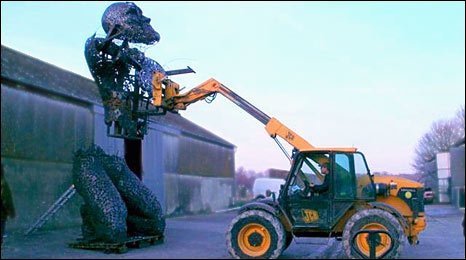
The massive steel Ancestor is over 20 feet tall and weighs in at an impressive six tonnes

For the last six months, like Dr Frankenstein, a married couple have been building a man – a 20-feet man in a barn a stone’s throw from Stonehenge. In Pictures: Solstice Giant at Stonehenge Reaching to the rafters, of a massive hangar, and weighing in just shy of an African bull elephant – he’s a monument in the making and the creation of Andy and Michelle Rawlings. “He’s very big,” admits Andy. “He’s as big as a double-decker bus and at least 20 feet on his knees. Shaped by eye the giant not only has a four-pack but a pot belly as well “And he’s going to weigh about six tonnes, when he’s finished. So, yeah he’s quite a chunk of metal.” ‘Quite a chunk of metal’, needless to say, is a bit of an understatement. Not only will this giant steel man dwarf a double-decker bus, by at least six feet, but his glittering mosaic of steel plates is a far cry from a hunk of a metal. Wielding plasma cutters and welders – Andy and Michelle, who found herself metal working after a ‘spectacular mid-life crises’, have not only cut their way through miles of steel plate. More miles then either say they’d liked to have actually walked. But painstakingly welded thousands of randomly cut steel pieces on to a super-sized steel frame in a colossus of a jigsaw. ‘Thierry Henry goal celebration’ “I’ve had to remove his crotch to give me access through there,” admits Andy, “it will be a removable panel. “It’s not the best entry point in the world but it’s got to be done.” Working with their heads, where even the solstice sun doesn’t shine, both Michelle and Andy have spent nine months creating their giant. An ancient-looking man who, both hope, will represent everyone’s ancestor on his knees in praise of the sun. “What we tried to do with his position,” says Michelle, “is to actually capture the very moment the sun comes up and he’s dropped to his knees in thanks. Andy is hoping that they’ll be able to fly him in by helicopter “One lad saw him and immediately said: ‘Thierry Henri goal celebration’ – it’s that moment that we’ve tried to create with him and hopefully we’ve pulled it off.” Created and shaped by eye, ‘in the old fashioned way’, without a computer or a CAD programme in sight – the Ancestor has, according to Michelle, had to evolve. And he’s evolved with slightly less then a six-pack. “Well he’s got a four pack and a little bit of a pot belly,” laughs Michelle, “in honour of the Great British pot belly. “We think the way he’s been built and where he’s been built really is a salute to the Great British shed heads – that do these mad projects in their sheds and pull it of. We salute them.” For Sale And like the Great British shed heads, Michelle and Andy have had to dig deep into their own pockets to create him. But with just weeks to go, before sun-up on the longest day, and just two gargantuan arms and hands to finish, the couple are hoping that they’ve found a buyer in Amesbury. “Hopefully the owner of the Holiday Inn will like him,” says Andy. “He’s been good enough to allow us to put him in front of his hotel for sale – with an option for him to buy. For Sale: the Ancestor is up for sale for an undisclosed amount “And he’s going to be in a very prominent position so that most people will be able to view him down the A303. So hopefully he’ll become our Angel of the South.” But with transportation arrangements having to include chopping him in half, a giant crane and a gang – Andy is hoping his ‘Angel of the South’ might actually take to the wing. “I would like to think we could fly him in by helicopter” says Andy. “but we’ve got to speak nicely to the Army for that. “But it would be nice and I would be very happy for him to be 100 foot up in the air.” But before the giant ancestor heads to Solstice park, or is spotted in the skies over Amesbury, he’s making a stop-off at Stonehenge just in time for sun-up on the longest day. But how will Stonehenge’s largest sarsen stone measure up to the 20ft steel man? And, despite the traditional lack of actual sun at solstice, will the massive sculpture overshadow the ancient monument? “No,” says Michelle. “We’re hoping to enhance. We’re not trying to compete. “We want to enhance the Stonehenge experience and just give people the opportunity to think about where we’ve actually come from and what a proud race we are.”

Merlin & Stonehenge
The Stonehenge Stone Circle Website


Glasgow Megalith – astronomer bids to rejuvenate stone circle

7 06 2010

It was created in the late 1970s to mirror the rise and fall of the moon and sun across Glasgow on a site of ancient astronomical interest.

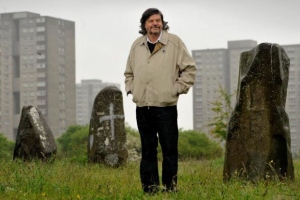
Now efforts are being made to rejuvenate the Sighthill Stone Circle, created by amateur astronomer and science writer Duncan Lunan, who brought Britain’s first authentically alligned stone circle in more than 3000 years to Glasgow’s inner city.

More than 30 years later, Lunan hopes to revive interest in the stone circle, which was built by the Glasgow Parks Astronomy Department using funds from the former Jobs Creation Scheme.

When money for the project was abruptly scrapped by the then prime minister Margaret Thatcher, four pieces of stone never made it to the circle and are now stashed under a nearby bush in Sighthill Park. It is hoped the circle can now be completed as Lunan intended.

At the stones yesterday, Lunan said: “There is still nothing up here to say who built the circle, who it was built for or how it works. I have been told that nowadays children are afraid of it, that they think it is linked to black magic, that sort of thing. That is something I want to change.”

The site of the stones may not at first seem a likely spot of spiritual significance given that they are surrounded by 1960s tower blocks, acres of plain parkland and a belching incinerator.

Built on a hilltop with dramatic views across the city, they incorporate the line of the midsummer sunset across the city, which is historically mapped by Dobie’s Loan from the neolithic site, where Glasgow Cathedral now sits, to Summerhill.

It was here where midsummer parties were held to celebrate the sun at its highest and most powerful, where bonfires were lit to hail the light and ward off evil spirits believed to roam freely as the sun turned southwards again. The Pagan-style parties continued until the 17th century, when they were halted by the church.

Lunan would like to revive the celebrations of the midsummer sunset at Sighthill, with a gathering planned for the night of June 21.

Whereas in Neolithic times stone circle creators would take 100 years to observe the movement of the moon, the earth and the light of the sun, Lunan had a matter of months to work out the necessary co-ordinates on his New Stone Age calendar.

“Getting the precision right was the really hard part. And the winters of 1978 and 1979 were really terrible too, you could hardly see a thing,” he said.

Photographs and astronomical graphs gave Lunan and his colleagues the necessary guide with the last of the 17 stones lowered into place by an RAF helicopter from HMS Gannet.

“The moon stones were too big to be brought by helicopter so it was the sun stones and the star stones that came by air. That was a hell of a day,” he said.

At first the project was to build a replica Stonehenge and Callanish Stones using modern materials, but given the significant astronomical setting it became a true stone circle of which Lunan remains proud.

He built it in tribute to four academics at Glasgow University who are responsible for the promotion and understanding of ancient astronomy; Professor Archie Roy, Dr Ewan McKay, Professor Alexander Thom and his son, Dr Archie Thom. “It started with Alexander Thom who, between the two world wars, was inspired by the falling moon over the Callanish Stones,” Lunan said.

“He became convinced that they used astronomy and mathematics on an advanced scale.”

The work was continued by his son and explored further by McKay and Roy.

“This was at a time when most archaeologists wouldn’t go near this stuff, claiming that primitive society was not capable of such understanding. It is very fitting that this stone circle is in Glasgow, as a tribute to them.”

Lunan would ultimately like the stone circle to be a key feature of a city-wide astronomy map, with the entire solar system represented on the correct scale within the city limits. If the stone circle represented the sun, Pluto would be at Cathkin Braes, Lunan said.

An illustrated talk on the Sighthill Stone Circle will be held at the Ogilve Centre, St Aloysius Church, Rose Street, Glasgow, on Monday June 21, followed by a visit to the circle for midsummer sunset from 9.30pm to 10pm.

The stone festivals

Stonehenge: The axis of Stonehenge in Wiltshire is aligned with sunrise at the summer solstice. Druids and other Pagans have gathered here at different points in history to celebrate the longest day of the year. Because of clashes with police in the 1980s, ceremonies were banned until 2001.

Callanish: The prehistoric site on Lewis has become a focus of summer solstice celebrations. According to local legend, the “shining one” walks up to the stone on the midsummer dawn. A path has been laid around the perimeter by Historic Scotland to lessen the damage caused by visitors.

Cornwall: The Golowan Festival is held on June 23, the eve of St John’s Day. Bonfires, feasting and merrymaking define the celebration. The streets of Penzance were traditionally lined with burning tar barrels and fires blazed on nearby hills but these were scaled back for safety reasons.

Merlin @ Stonehenge
The Stonehenge Stone Circle Website


Stonehenge Summer Solstice 2010

28 05 2010

Open Access at Stonehenge

 
Date:  Monday 21st June 10
Location:  Stonehenge, Wiltshire – MAP
Cost:  FREE (including FREE car park)
| |

There are 3 weeks and 3 days until Stonehenge 2010

English Heritage are again expected to provide “Managed Open Access” to Stonehenge for the Summer Solstice. Please help to create a peaceful occasion by taking personal responsibility and following the conditions (see below).

The car park (enter off the A303 from the roundabout – it’s signposted) will open at around 7pm on Sunday 20th June, and close at around noon on Monday 21st June. Note that last admission to the car park for vehicles is at around 6am.

Access to the stones themselves is expected to be from around 8.30pm on Sunday 20th June until 8am on Monday 21st June.

There’s likely to be casual entertainment from samba bands & drummers but no amplified music is allowed.

Van loads of police have been present in the area in case of any trouble, but generally a jovial mood prevails. Few arrests have been made in previous years, mostly in relation to minor drug offences.

Toilets and drinking water are available and welfare is provided by festival welfare services. There are normally one or two food and drink vans with reasonable prices but huge queues, all well away from the stones themselves.

Sunrise is at around 4:45am.

Rules include no camping, no dogs, no fires or fireworks, no glass bottles, no large bags or rucksacks, and no climbing onto the stones. Please respect the rules so that we’re all able to enjoy the solstice morning at Stonehenge for years to come.

More information will be here when available.

English Heritage Message

English Heritage is pleased to be providing Managed Open Access to Stonehenge for the Summer Solstice.  Please help us to create a peaceful occasion by taking personal responsibility and following the Conditions of Entry.

Please note that a high volume of traffic is anticipated in the Stonehenge area on the evening of Sunday 20th June.

Getting To Stonehenge

Where possible, please travel to Stonehenge using public transport.  The local bus company, Wilts & Dorset, will be running a service from Salisbury railway and bus stations to Stonehenge over the Solstice period.  This bus service will commence at 1830 hours (6.30pm) on Sunday 20th June and run regularly until 0115 hours (1.15am) on Monday 21st June. A service taking people back to Salisbury will start again at 0400 hours (4am) and run frequently until 0945 hours (9.45am). Access to Stonehenge from the bus drop off point is through the National Trust farmland.

The buses will stop at any recognised bus stop along the line of the route, which is via Amesbury.

Bus Service Information

Wilts and Dorset Bus Company
www.wdbus.co.uk
Tel: 01983 827005 begin_of_the_skype_highlighting              01983 827005      end_of_the_skype_highlighting

Train Information

South West Trains
www.southwesttrains.co.uk
Tel: 0845 6000 650 begin_of_the_skype_highlighting              0845 6000 650      end_of_the_skype_highlighting

Merlin @ Stonehenge
The Stonehenge Web Site


Stonehenge: How Did The Stones Get There?

14 05 2010
We  explain how the myth of the stones transported from south Wales to Salisbury Plain arose and why it is wrong.

History is full of enjoyable myths but Stonehenge has too many. They mutate. Hardly had modern scholars got rid of the pre-Roman druids than those soothsayers reappeared in the guise of 3rd-millennium BCE astronomer-priests who are said to have designed the great circle as a celestial computer for the prediction of eclipses.

There are other common fallacies. The Greek explorer, Pytheas of Marseilles, who provided the first written account of Britain when he visited the islands c.300 BCE, is sometimes said to have visited Stonehenge. In fact, he landed near the splendid circle of Callanish in the Outer Hebrides 500 miles to the north. Just as mistakenly, Stonehenge is  described as a British stone circle though it is not this at all, but rather an imitation in stone of a lintelled timber ring, with architectural influences from Brittany.

Perhaps the most persistent of these myths is that men ferried scores of enchanted Welsh stones hundreds of miles. Returning across the Irish Sea from the Wicklow mountains to their home in southern Britain some time after 3000 BCE, a group of gold- and copper-prospectors are said to have steered towards the landmark of the Preseli mountain range in south-west Wales. Regarding the Preselis as magical and their bluestones life-enhancing, the crews felt compelled to plunder them one by one for an intended megalithic sanctuary on Salisbury Plain. The romance has been repeated ….
Hear all the latest theories, myths and legends from a Stonehenge tour guide – try the excellent  local based ‘HisTOURies UK’ private tour company or Premium Tours based in London

Merlin @ Stonehenge
The Stonehenge Stone Circle Website


Crop circle found next to Stonehenge

13 05 2010

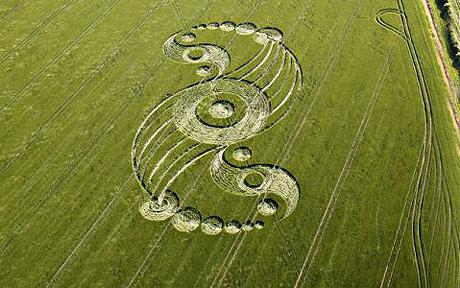
A huge intricate crop circle sculpted in a sea of barley has appeared near an ancient British burial mound in Wiltshire

As many other crop circles previously spotted in the area, it seems to follow the Yin and Yang theme Photo: APEX

The formation, measuring approximately 350ft (100 metres), seems to depict a Yin Yang pattern and appeared on May 25 beneath Windmill Hill, near Devizes.

It was captured on camera at an area close to the great man-made mound of Silbury Hill, Wiltshire.

 Related Articles
  • Crop circle picture gallery shows more complex forms

  • Mayan ‘apocalypse’ crop circle appears at Silbury Hill

  • Phoenix crop circle may predict end of the world

  • Dragonfly crop circle appears in Wiltshire

  • Man arrested for shooting over heads of crop circle fans

  • Ten great sightseeing campsites

  • As many other crop circles previously spotted in the area, it seems to follow the Yin and Yang theme.

    The green and then golden fields of the world’s crop circle capital of Wiltshire have spawned an array of patterns in the past that have fascinated those who seek them out.

    Enthusiasts and experienced crop pattern hunters have often spotted formations appearing close to these sacred sites.

    The crop circle season extends from April to harvesting in September, and is believed to be worth millions of pounds to the local economy.

    Windmill Hill is thought to date to the Early Neolithic period some 5000 years ago, 3700 BC and was constructed as a causeway enclosure. It is the largest known of its kind measuring 21 acres (8.5ha).

    It consists of three rings of concentric ditches, which were probably dug out in the same manner as the deep Avebury ditch, using antlers and oxen shoulder blades.

    It was a major task taking many man-hours over many years.

    It is thought that the camp was at its most important as a farming community during a relatively peaceful and prosperous time of approximately 3000- 3500 years until the advent of the Romans when their presence is evidenced by traces of a villa found on the western slopes of the mound.

    Merlin @ Stonehenge
    The Stonehenge Stone Circle Website


    Stonehenge Crop Circle – May 10th 2010

    11 05 2010

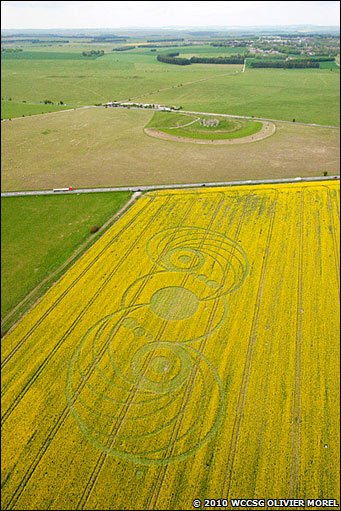
    Wow – look at this!  A guide for Histouries UK, a tour company based in Salisbury has sent reports of this amazing crop sircle directly opposite Stonehenge Stone Circle.  There are further
    reports of more in the area – watch this space……….

    Merlin @ Stonehenge
    The Stonehenge Stone Circle Website


    Two great hoaxes: Piltdown Skull and Bluestone Quarry?

    10 05 2010

    Some see a bluestone quarry — others don’t.
    Some see a Missing Link — others see a hoax.


    There was a piece on the telly the other day about the Piltdown Man hoax of 1912. One thing struck me in the commentary — namely the “fertile ground” which existed in Britain at the time, providing perfect conditions for the hoax to take root, to flourish and eventually (in spite of the reservations of some experts) to become part of mainstream thinking. This is what one web site says about the hoax:

    “Perhaps the most famous hoax was Piltdown man. In 1912, at a time when Darwin’s evolutionary theory was new, and people were looking for missing links between humans and apes, someone planted two fake skulls which came to be known as Piltdown Man.
    The part medieval man, part Orang-utang fossil was found, in the very English village of Piltdown in Sussex. Piltdown man’s scientific name, Eoanthropus dawsoni, reflected its finder’s name Dawson. To get a flavour of those times, the British Empire was still riding high, and Germany had their Heidelberg man fossil, Britain was desperate for a more important ‘ missing link’ between man and monkey.”

    The key to this is national pride, and a desire in Britain to demonstrate that whatever important discoveries there were in Germany, Britain had even better ones, showing the world what wonderful ancient civilizations we had here, and what brilliant archaeologists we had to uncover them and to expound new theories of evolution to the world…… OK, petty, nationalistic, xenophobic and even absurd, but that was the world around the time of the First World War. Germany had Neanderthal Man, and now Britain had the “Missing Link” — even more important.

    So what about HH Thomas and the bluestones? Well, I have suspected for some time that Thomas might have been guilty of simplification and selective citation of his samples and his rock identifications, in order to flag up the Carn Meini area as the source of the bluestones. I have also expressed my amazement in earlier posts that he “got away with murder” in that NOBODY seems to have seriously examined his evidence or questioned his wacky idea that the stones had been hauled by tribesmen all the way from Presely to Stonehenge in a totally unique feat of Stone Age long-distance transport. And why did people not scrutinize his theory more closely? Why, because there had been great discoveries about megalithic structures in Germany, and because British archaeologists were desperate to show that in these islands we had even more advanced prehistoric civilisations and even cleverer engineers and technicians.

    Sounds absurd? I don’t think so — and a number of other authors have suggested that Thomas’s idea was carefully put together around the time of the First World War as part of a national “feel good” strategy, and that the whole nation (and not just the archaeologists) just loved the idea when he announced it, and were disinclined to examine it carefully.

    So Thomas became famous, then the bluestones became famous, and the “bluestone transport story” entered the mythology of Britain. It is still trotted out ad infinitum, even though there is even less evidence for it now than there was in 1920. And anybody who dares to question it, or to undermine our cosy assumptions about the extraordinary skills of our Neolithic ancestors, is likely to get short shrift from the archaeology establishment. Look at what happened to poor Geoffrey Kellaway…….

    So was the Carn Meini / bluestone quarry / human transport story all a hoax? I think it’s a distinct possibility. How much longer will it be before the whole mad idea about human transport is finally consigned to the scrapheap? Not long, I suspect, since the new geology being done by Rob Ixer and colleagues in the Stonehenge area is revealing so many new sources for the stones and fragments at Stonehenge that we are going to have to talk about 20 quarries all over western Britain, rather than one. And that would be to stretch things to a rather extraordinary degree……

    All hoaxes have their day, and eventually bite the dust, leaving senior academics looking very foolish.

    Merlin @ Stonehenge
    The Stonehenge Stone Circle Website