Neolithic New Year walk – Stonehenge Landscape

30 12 2010

Welcome in 2011 by discovering the astonishing Stone Age on a walk around the ancient monuments of the Stonehenge landscape. Why did people start to build massive monuments 6,000 years ago? Discover the astonishing Stone Age on a relaxed ramble around Stonehenge Down. Our six mile route will take us to Neolithic enigmas including Durrington Walls and the Stonehenge Cursus.

  • Wrap up warm against the January weather – we recommend plenty of layers and stout footwear. Bring a packed lunch and a hot drink.
  • Meet at the Stonehenge car park (not NT) by the bright green National Trust information panel on the grassy area of the main car park.
  • Dogs on leads welcome
  • Accompanied children welcome, free.
  • Light refreshments provided.
  • Access is by pedestrian and farm gates; the terrain is grassland and trackways, often uneven underfoot. Cattle and sheep graze the gently sloping downs.
  • More Information: Lucy Evershed, 01980 664780, stonehenge@nationaltrust.org.uk

    Walk in the steps of our ancestors at one of the world’s best-preserved prehistoric sites
     
    Don’t miss
    • Great views of the famous Stonehenge circle
    • Mysterious ceremonial landscape of ancient burial mounds, processional walkways and enclosures
    • Haven for wildlife, from brown hare and butterflies, to birds such as the skylark
    • Colourful displays of downland wildflowers in June and July
    Or do it yourself any day of the year……………
    Stonehenge Down
    The long grassland shrouded in mist at Stonehenge Down. © NT / Margriet van Vianen
    Home to skylark and brown hare, Stonehenge Down is a wide open landscape with fine views of the famous stone circle. From here you can also explore Bronze Age barrow cemeteries and prehistoric monuments, such as the Stonehenge Avenue and the mysterious Cursus. SU125425
     
    King Barrow Ridge
    Here Bronze Age burial mounds stand among impressive beech trees, with views of Stonehenge and the downs. The hazel coppice provides shelter for wildlife along the ridge, while in summer, chalk downland flora attracts butterflies such as the marbled white. SU134423
    King Barrow Ridge on a beautiful summer's day. © NT / Lucy Evershed
     
    Normanton Down
    Normanton Down on a bright summer's day, showing a field of daisies in the foreground. © NT / Margriet van Vianen
    Normanton Down offers one of the best approaches to the stone circle. The round barrow cemetery dates from around 2600 to 1600BC and is one of the most remarkable groups of burial mounds in the Stonehenge landscape. The downland and arable fields here are home to a variety of farmland birds such as corn bunting and stonechat. SU117415
     
    Durrington Walls
    In 2005 Durrington Walls was revealed to be the site of a rare Neolithic village, with evidence of shrines and feasting. You can still see some of the banks of this circular earthwork, the largest complete ‘henge’ in Europe. Post holes show that there were large timber structures here, like those at nearby Woodhenge. SU150437
    The red and gold hues of autumn at Durrington Walls. © NT / Stephen Fisher
     
    Winterbourne Stoke Barrows
    The Chalkhill Blue, common to chalk grassland, can be seen in the summer months. © NT / Margriet van Vianen
    Another fascinating example of a prehistoric cemetery. The wide range of barrow shapes found here show that this site was used over a long period of time for burials of people of high status. Newly sown chalk downland flora covers the landscape – look out for brown hares too. SU101417

    External link: http://www.nationaltrust.org.uk/event-search/events/show?id=2108044944

    Happy New Year!
    Merlin @ Stonehenge
    The Stonehenge Stone Circle Website


    Stonehenge Winter Solstice 2010

    23 12 2010

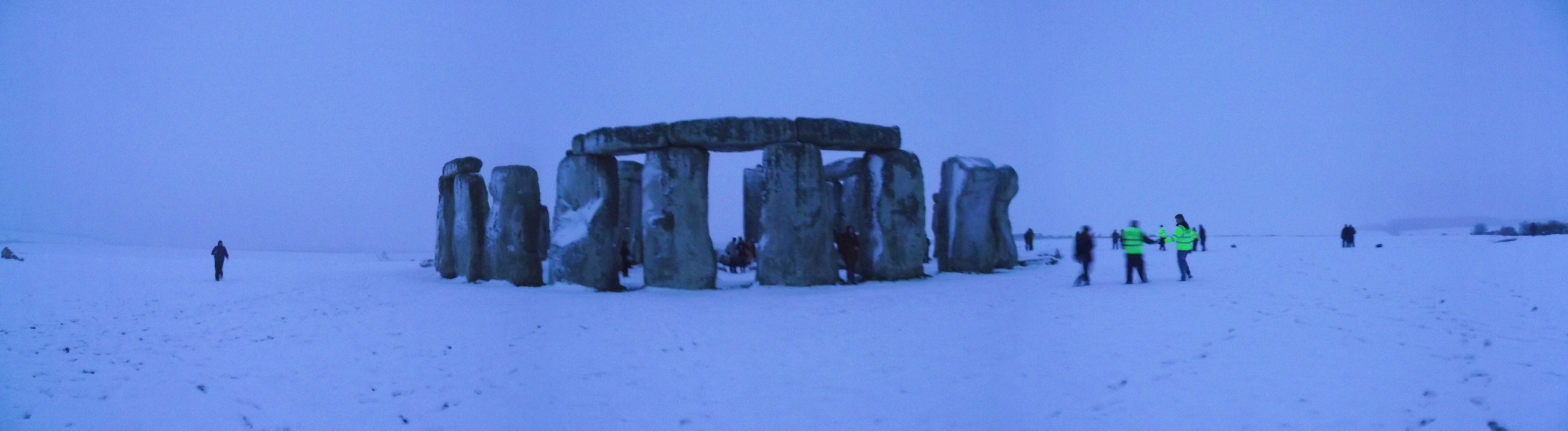
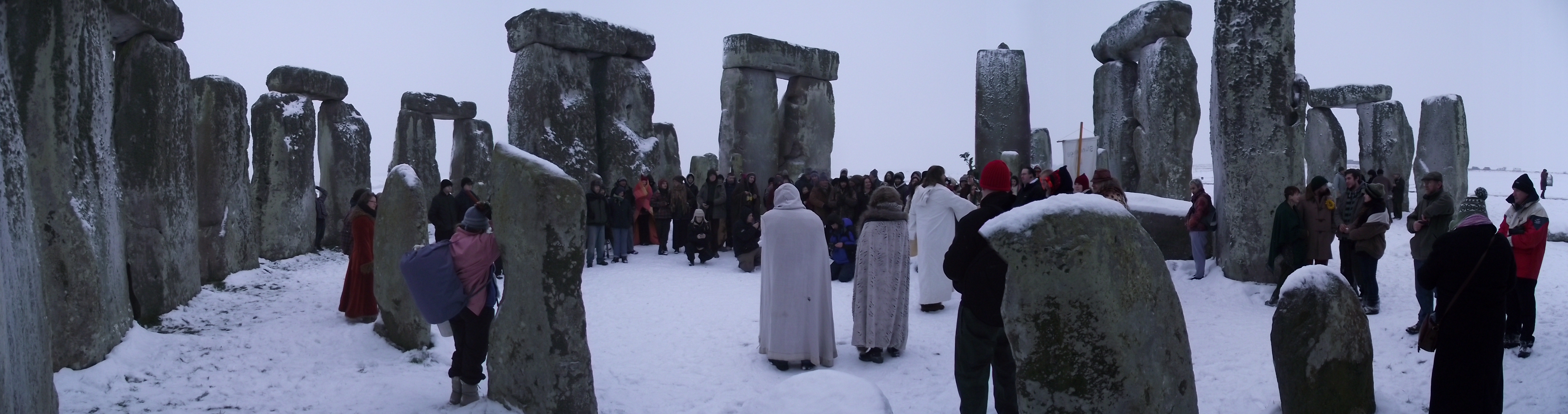
    Snow and ice failed to stop people visiting Stonehenge to watch the

    Stonehenge Solstice

    Stonehenge Solstice

    sunrise on the winter solstice, 22nd December 2010

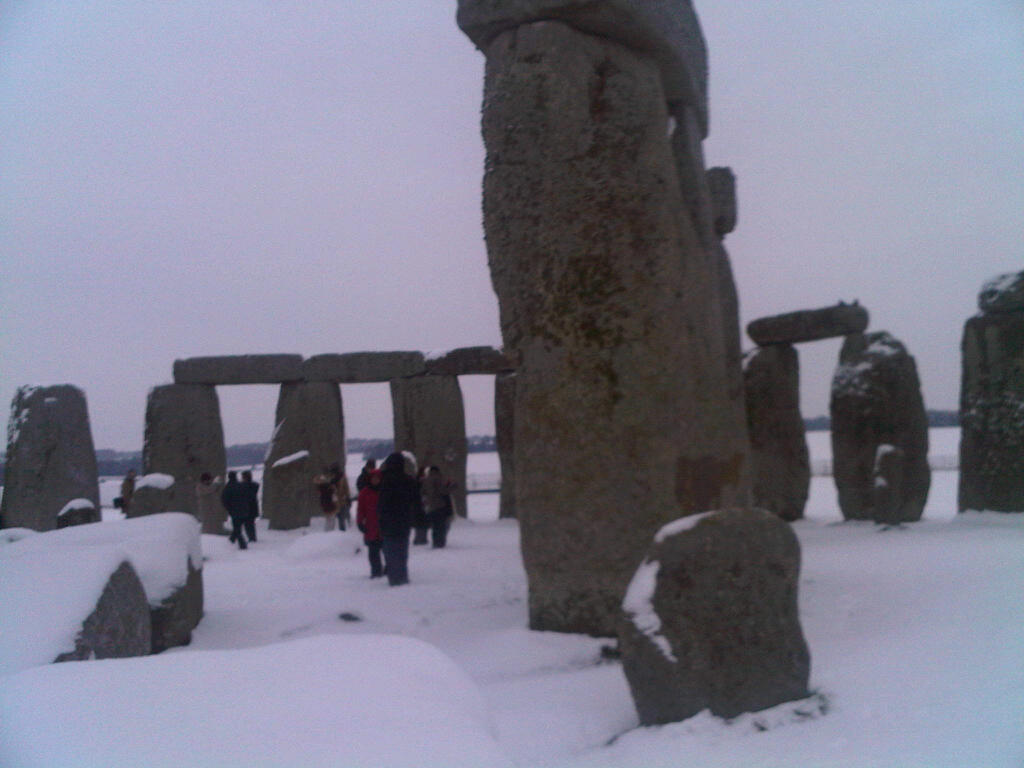
    Almost 2,000 people gathered at the stones which were surrounded by a thick blanket of snow.

    As well as the traditional druid and pagan ceremonies, a spontaneous snowball fight erupted as people enjoyed the cold weather.  A good time was had by all.

    I will be uploading photos and videos later today – can you see yourself? 

    Many thanks for all the helpful tweets over the solstice – http://twitter.com/ST0NEHENGE

    Merlin @ Stonehenge
    The Stonehenge Stone Circle Website

    http://www.bbc.co.uk/news/uk-england-wiltshire-12061134
    http://www.stonehengetours.com (sponsor)
    http://www.HisTOURies.co.uk (sponsor)


    Stonehenge Winter Solstice Panoramic pictures

    21 12 2010

    Stonehenge Winter Solstice 2010 Panoramic

    Stonehenge Winter Solstice Panoramic

    Stonehenge Winter Solstice Panoramic (Copyright)

    Stonehenge Winter Solstice Panoramic

    Stonehenge Winter Solstice Panoramic

    Stonehenge Winter Solstice Panoramic (Copyright)

    Images are subject to Copyright.  Full Terms and Conditions of Submission and Use of Pictures can be requested.

    All rights reserved. All images included herein this  Internet Web Site publication are the copyright and property of the photographer and the text/design/html files are the property of The Stonehenge News Blog. All images and text are copyright in accordance  with the terms of the United Kingdom’s Copyright, Designs and Patent Act 1988, and  are protected under the United Kingdom and international copyright laws and  treaties which provide substantial penalties for infringement.
    The use of any images or other materials included herein, in whole or in part,  for any purpose other than for the private purpose of the user, including,  but not limited to, copying, reproduction, publication (including on Internet Web  Site), storage in a retrieval system (other than internet browser), manipulation (digital or otherwise),  or transmitted in any form or by any means, electronic, mechanical, photocopying,  recording or otherwise, is expressly prohibited without the written permission of  The Stonehenge News blog or and the photographer 

    What is © Copyright?

    The images on this website are known as “intellectual property”.  In law, they are hardly different from other forms of property (such as  your computer), as the creation of images also requires personal skill,  equipment, time and money. To take and distribute images without consent  is a form of theft and is therefore illegal. The images on this  Internet web site publication are not royalty free and a fee is required  for each specific usage. All of the images have been visibly and invisibly watermarked so that  they can be identified if used without permission, whether whole or in part. International  law now permits substantial penalty charges for infringement of copyright.

    Other Web Pages

    Unfortunately you may not use any of the images in your web pages without express written  permission as this constitutes publishing  the images and could conflict with the interests of our many clients. If, for instance, a  corporation buys a picture for a specific purpose which conflicts with  your website, then the corporation could take legal action against you.  We have to say “no” in order to protect you and our clients.

    More Stonehenge Winter Solstice 2010 images – click here
    Merlin @ Stonehenge


    Stonehenge Winter Solstice 21stDecember 2010

    21 12 2010

    I went to Stonehenge this morning hoping to witness the Lunar eclipse between 7.30am and 8am.  Sadly there was freezing fog and a snowy sky?  It was a pleasant surprise to find that English Heritage decided to grant access into Stonehenge today as well as tomorrow (22nd)  There were a few hundred ‘happy’ people, a pagan wedding and a small Druid ceremony.  It was extremely cold but well worth it. 
    I have uploaded these photos for your perusal – hot off the press!  They anticipate 2-3000 people for tomorrows Solstice celebrations – See you there!

    This slideshow requires JavaScript.


    Happy Solstice
    Merlin @ Stonehenge
    The Stonehenge Stone Circle Website


    Winter Solstice Celebrations at Stonehenge

    20 12 2010

    THE winter solstice will be celebrated at Stonehenge on Wednesday. Sunrise is at 8.09am on December 22 and visitors will be able to access the monument as soon as it is light enough to do so safely.

    Entrance is free and will be available from roughly 7.30am until 9am, when the site will close to visitors before re-opening as per usual at 9.30am.

    This photo was emailed to me yesterday ?

    Peter Carson from English Heritage said: “We are delighted to offer people a warm welcome to Stonehenge this Winter Solstice. Over the years, the event has grown from a handful of people to a celebration enjoyed by a couple of thousand of people. We work very closely with the Druid and Pagan community to ensure that the event is a success.”

    A date for the diary, that is if you are prepared to face the winter snow, but perhaps in the circumstances it would be wiser to stay at home and celebrate the Winter Solstice safely there!

    THE winter solstice will be celebrated at Stonehenge on Wednesday.

    Sunrise is at 8.09am on December 22 and visitors will be able to access the monument as soon as it is light enough to do so safely.

    Entrance is free and will be available from roughly 7.30am until 9am, when the site will close to visitors before re-opening as per usual at 9.30am…….

    There is no public transport to Stonehenge at that time of the morning and parking is limited – you have been warned!  Avebury Stone Circle could be a safer alternative ?

    Happy Solstice!
    Merlin @ Stonehenge
    I will upload images to this blog on the 22nd


    Geminid meteor shower set for clear skies

    13 12 2010

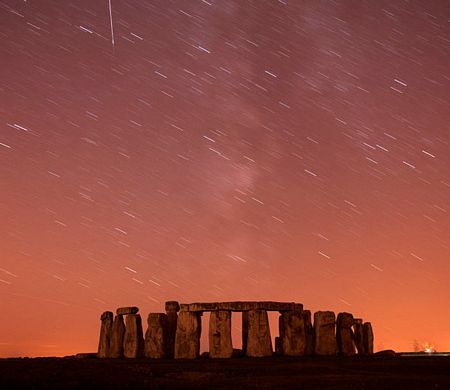
    With cloudless skies possible over Stonehenge and many parts of Britain, this year’s shooting stars could be particularly memorable

    Lovers of the night sky could be in for a treat tonight as clear conditions are predicted for one of the best astronomical shows of the year.

    Some experts believe the annual Geminid meteor shower is becoming more spectacular – though if it is, nobody is sure why – and with cloudless skies possible in many parts of the country, this year’s event could be a particularly memorable one.

    At its peak and in a clear, dark sky, up to 100 meteors – or shooting stars – may be seen every hour. The best time to see it is expected to be late on Monday night and in the early hours of Tuesday after the moon has set.

    In comparison with other showers, Geminid meteors travel fairly slowly, at about 22 miles per second. They are bright and have a yellowish hue, making them distinct and easy to spot.

    Meteors are the result of small particles entering Earth’s atmosphere at high speed, burning up and super-heating the air around them, which shines as a characteristic short-lived streak of light. In the case of the Geminids, the debris is associated with the asteroidal object 3200 Phaethon, which many astronomers believe to be an extinct comet.

    National Trust list of the best places to watch the shower

    • Stonehenge area in Wiltshire – chalk downland and crystal clear skies.

     Teign Valley in Devon, within Dartmoor national park.

    • Penbryn Beach, on the Ceredigion coast in west Wales.

    • Wicken Fen nature reserve in Cambridgeshire – dark skies and nocturnal wildlife.

    • Mam Tor in Derbyshire, an escape from the bright lights of cities such as Sheffield.

    • Friar’s Crag in Cumbria, jutting out into Derwentwater.

    See you at Stonehenge tonight

    Merlin @ Stonehenge
    The Stonehenge Stone Circle website


    Woodhenge: Is this one of the greatest discoveries of archaeology…or a simple farmer’s fence?

    12 12 2010

    The discovery of a wooden version of Stonehenge – a few hundred yards from the famous monument – was hailed as one of the most important archaeological finds for decades.

    But now experts are at loggerheads after claims that what was thought to be a Neolithic temple was a rather more humble affair – in fact the remains of a wooden fence.

    One leading expert on Stonehenge criticised the announcement of the ‘remarkable’ find in July as ‘hasty’ and warned it could become a ‘PR embarrassment’.

    The site, ringed, in a Seventies chart, which experts say shows a fenceMapped: The site, ringed, in a Seventies chart, which experts say shows a fence


    The radar image said to reveal the post holes of a Neolithic temple‘Evidence’: The radar image said to reveal the post holes of a Neolithic temple

    The discovery of what appeared to be a previously unknown ‘henge’, or earthwork, by a team of archaeologists conducting a multi-million-pound study of Salisbury Plain was widely reported amid great excitement.

    The team said they had found evidence of a ring of 24 3ft-wide pits that could have supported timber posts up to 12ft tall, surrounded by an 80ft-wide ditch and bank.

    They explained that, just like Stonehenge, the entrances to the site were aligned so that on the summer solstice the sun’s rays would enter the centre of the ring. Holes where the wooden posts once stood were identified below the ground using the latest high-resolution geophysical radar-imaging equipment.

    An artist's impression of how Woodhenge may have been 5,000 years agoCircle of confusion: An artist’s impression of how Woodhenge may have been 5,000 years ago

    Team leader Professor Vince Gaffney of Birmingham University said the ritual monument had been built about 5,000 years ago, making it roughly the same age as its stone counterpart 980 yards away, and it could have been used for Stone Age feasts or elaborate funerals.

    He said the find showed Stonehenge had not existed in ‘splendid isolation’ and he predicted further discoveries during the three-year survey of five square miles of countryside around Stonehenge.

    But sceptics have now suggested that the evidence is far from conclusive, especially as it appears from images of the plot produced by the Birmingham team that the ring of post holes was not arranged in a circle but was angular and more like a hexagon.

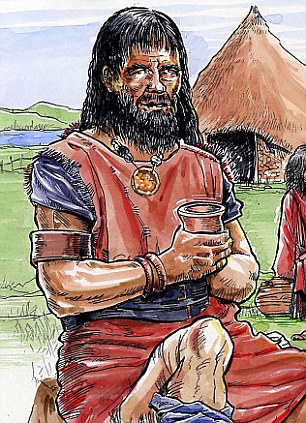
    How a Neolithic visitor may have lookedHow a Neolithic visitor may have looked

    Mike Pitts, editor of the magazine British Archaeology and an acknowledged expert on Stonehenge, said he had been prompted to study maps of the area after receiving a letter from an American reader.

    In the spot where Prof Gaffney had claimed to have uncovered his post holes, Mr Pitts said he and
    colleagues examined a Seventies Ordnance Survey map – and saw a fence marked out.

    He thought it probably was an early 20th Century construction, erected by the then Government’s Office of Works or a local farmer to protect what was thought to have been the most important site in a cluster of burial mounds that were ancient but later than Stonehenge.

    Mr Pitts said: ‘Vince Gaffney says his discovery encircles a burial mound within its circumference, but unless he has some unpublished material to substantiate his discovery, I am in no doubt that this was a modern fence line.

    ‘If I’m right then the post holes contained modern fencing stakes and they are actually in a hexagonal shape, not a circle.’

    He added: ‘I think that perhaps what has happened is that the professor’s field workers have presented him with the wrong picture and he’s shot from the hip and made an over-hasty announcement. He’s generally known for the high quality of his work and his enthusiasm which, on this occasion, may have let him down.

    ‘The full publication of his results and small-scale excavations of the site would clinch the matter.’

    But Prof Gaffney said: ‘We have mapped numerous fences and we know what they look like. The features appear to be 3ft across and as deep as 3ft. I have never seen a fence line that required holes that are 3ft across and 3ft deep.’

    He said that in the fuzzy, black-and-white radar image the post holes appeared angular but that was partly due to the poor resolution of the picture and because such monuments were not perfect circles.

    He went on: ‘The poles that would have stood in them would have been more like telegraph poles. You would not use them to build a fence.’

    Prof Gaffney added that no metal such as old nails had been found in the holes, which would have
    been expected.

    ‘On balance, we would still suggest this is a ritual monument of the late Neolithic period.’

     I love it when the ‘experts’ use the term ‘ritual‘ – in other words they do not know!
    Related artile: New Woodhenge found

    Read more: http://www.dailymail.co.uk/sciencetech/article-1337890/Woodhenge-Is-greatest-discoveries-archaeology–simple-farmers-fence.html#ixzz1Dj4rwwBM

    Merlin @ Stonehenge
    The Stonehenge Stone Circle Website


    Stonehenge Built With Balls?

    12 12 2010

    New experiment suggests monumental stones could have rolled on rails.

    It’s one of Stonehenge‘s greatest mysteries: How did Stone Age Britons move 45-ton slabs across dozens of miles to create the 4,500-year-old stone circle?
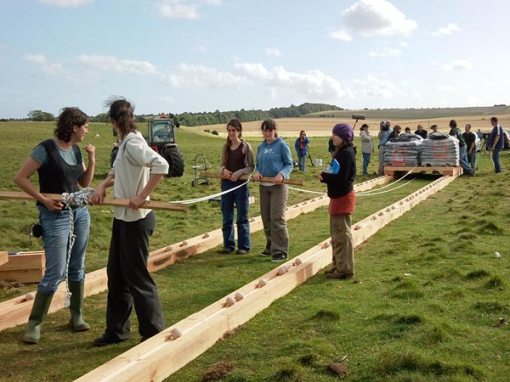
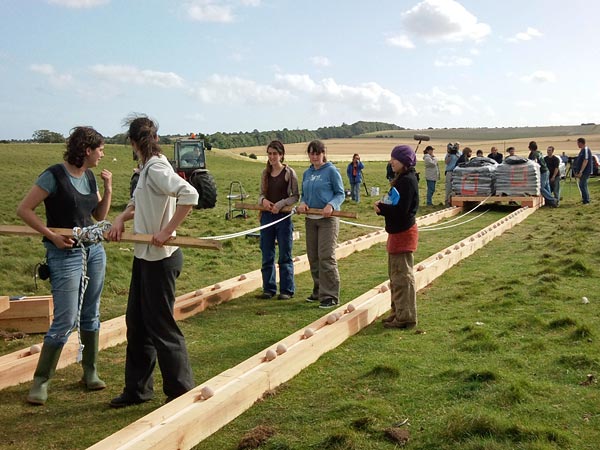
    U.K. archaeology students attempt to prove a rail-and-ball system could have moved Stonehenge stones

    U.K. archaeology students attempt to prove a rail-and-ball system could have moved Stonehenge stones

    Now a new theory says that, while the ancient builders didn’t have wheels, they may well have had balls. (See Stonehenge pictures.)

    A previous theory suggested that the builders used wooden rollers—carved tree trunks laid side by side on a constructed hard surface. Another imagined huge wooden sleds atop greased wooden rails.

    But critics say the rollers’ hard pathway would have left telltale gouges in the landscape, which have never been found. And the sled system, while plausible, would have required huge amounts of manpower—hundreds of men at a time to move one of the largest Stonehenge stones, according to a 1997 study.

    Andrew Young, though, says Stonehenge’s slabs, may have been rolled over a series of balls lined up in grooved rails, according to a November 30 statement from Exeter University in the U.K., where Young is a doctoral student in biosciences.

    Young first came up with the ball bearings idea when he noticed that carved stone balls were often found near Neolithic stone circles in Aberdeenshire, Scotland (map).

    “I measured and weighed a number of these stone balls and realized that they are all precisely the same size—around 70 millimeters [3 inches] in diameter—which made me think they must have been made to be used in unison, rather than alone,” he told National Geographic News.

    The balls, Young admitted, have been found near stone circles only in Aberdeenshire and the Orkney Islands (map)—not on Stonehenge’s Salisbury Plain.

    But, he speculated, at southern sites, including Stonehenge (map), builders may have preferred wooden balls, which would have rotted away long ago. For one thing, wooden balls are much faster to carve. For another, they’re much lighter to transport.

    Proof of Concept

    To test his theory, Young first made a small-scale model of the ball-and-rail setup.

    “I discovered I could push over a hundred kilograms [220 pounds] of concrete using just one finger,” he said.

    With the help of his supervisor, Bruce Bradley, and partial funding from the PBS series Nova, Young recently scaled up his experiment to see if the ball-and-track system could be used to move a Stonehenge-weight stone.

    Sure enough, they found that, with just seven people pushing, they could easily move a four-ton load—about as heavy as Stonehenge’s smaller stones.

    Using the ball system, Young said, “I estimate it would be possible to cover 20 miles [32 kilometers] in a day” by leapfrogging track segments.

    But the inner circle’s “sarsen” stones weigh not 4 tons but up to about 45 tons. Young suspects a Stone Age system could have handled much heavier loads than his experimental one.

    For one thing, he thinks oxen, not people, provided the pulling power—an idea supported by the remains of burned ox bones found in ditches around many stone circles.

    For another, Britain’s old-growth forests hadn’t yet been razed 4,500 years ago, so the builders would have had easy access to cured oak. This tough wood—which was beyond the modern project’s budget—would have resulted in a stronger, more resilient system than the soft, “greenwood” system the researchers built.
    Stonehenge Experiment Needs Scaling Up

    Civil engineer Mark Whitby, who’s been involved with other Stonehenge-construction experiments, thinks the ball method could work for smaller stones but isn’t convinced it could shift a sarsen.

    “The problem will be when the tip of the ball bears on the timber trough, it will bite” into the trough, possibly splitting the rail, said Whitby, who runs London-based +Whitby Structural Engineers. “When transporting lighter stones, this won’t be a problem. But when they get to 30 and 40 tons, it will be.”

    Instead, Whitby prefers the sled theory—and even helped prove a sled could move a 40-ton replica sarsen for a 1997 BBC documentary.

    Archaeologist David Batchelor, meanwhile, thinks the ball idea is plausible but isn’t completely convinced.

    The ball technique “seems to be a development of the sledge method,” said Batchelor, of the government agency English Heritage. “But the added complexity needed to channel the track runners and then make the ball bearings all of one size seems to me a lot of work, which is probably unnecessary when animal-fat grease does the job.”

    Research leader Young counters that the sled system, even with its animal-fat lubrication, still results in a lot of friction.

    “Using wooden balls almost removes friction from the system and makes for a really efficient method of moving heavy weights around,” he said.

    Even so, Young realizes he needs to prove the new system can be scaled up to handle heavier loads. To that end, Young’s team is seeking funding to repeat the experiment—this time with harder wood, stone balls, and oxen

    What a load of old balls……………………………..
    Merlin @ Stonehenge
    The Stonehenge Stone Circle Website


    Full Moon this Winter Solstice 2010

    7 12 2010

    The exact time for the Winter Solstice is December 21st, 11.39pm (UK time). The sunset on the 21st is at 3.53pm and the sunrise on the 22nd of December at 8.04am. Exceptionally, we can also expect a full moon on December 21st

    Since 1793, when The Old Farmer’s Almanac began tracking heavenly events and seasonal changes, the Moon has been full on the first day of winter just nine times. The next occurrence will be in this coming Winter Solstice


    Full moon at Stonehenge this Winter Solstice

    Full moon at Stonehenge this Winter Solstice


    The rarity of a solstitial full Moon—the average interval is about 19 years—reinforces the Moon’s role as a beacon playing on human history. Although our research could not find a correlation between these lunar events and significant historical happenings on similar dates in the past*, the combination of astronomical forces certainly affect the tides.

    As astronomer Bob Berman explains, during this time of proxigean tides [unusually high tides due to the Moon’s phase and proximity to Earth], coastal flooding could occur if there is one more little extra effect, such as a storm at sea, on-shore winds, or low barometric pressure.

    If the solstice night is calm and cloudless, with the full Moon beaming down on a blanket of snow, it will be irresistibly attractive, and electrical illumination—even your car’s headlights—may seem superfluous.

    Full moon - Winter Solstice

    Full moon - Winter Solstice

    2010
    Spring equinox – Mar 20 at 5.35pm
    Summer solstice – Jun 21
    at 11.30am
    Autumn equinox – Sep 23
    at 3.10am
    Winter solstice – Dec 21

    Merlin @ Stonehenge
    The Stonehenge Stone Circle Website


    All aboard the ‘Stonehenge Express’

    7 12 2010

    Two crucial aspects of the Stonehenge proposals have yet to be clarified…

     1. The transit system.

    Will it be like one of the two examples shown here ? Not one like the Eden Project, please! That one is called “Percy”. Very tasteful! So more like the Dover Castle one? It may be, if this video is a true representation. But the video one pulls four carriages, not two. Is the vehicle up to it? And what about the livery? Can we be solemnly promised it will never ever carry advertising? And what’s wrong with buses? And what about talk in The Times letters column of Lord Lansdowne saying Stonehenge would be turned into a toytown with visitors approaching in dinky electric vehicles? Isn’t anything that prompts thoughts of Noddyland (which it’s hard not to think of when watching the video) to be absolutely avoided at our national icon? 

    http://www.english-heritage.org.uk/daysout/properties/stonehenge/our-plans/our-proposals/

     2. The fences 

    Will the fences be removed? Surely it has been decided upon? After all, if the detailed design of the new Visitor Centre and the colour of the transit system coaches have been decided then surely it is inconceivable that the matter of access to the stones (in other words the fences) hasn’t been been decided as well? English Heritage as good as says it has : “The need to care for Stonehenge properly has been recognised for many years. Improvement to its landscape setting and presentation to visitors are identified as priorities in the WHS Management Plan ……… The proposals to address this need have been agreed by a group of key stakeholders led by English Heritage

    So what HAS been decided about the fences? The reason the question needs to be asked is because the video appears to show that there will be no fences – and although that would be very nice we have concerns that behind the scenes a different view might have been taken. The practicalities suggest that having no fences at all would prove impossible. Security is one problem. And erosion is another. But the video seems to suggests that nearly a million people a year will be free to walk amongst the stones, not held back by fences, ropes or rules. It seems unlikely.

    A lot of people hold the “no fences and free access to the stones” concept very dear. If it is not going to happen then it would be better if people were told, not given a contrary impression by a video. Indeed, the public has the right to know does it not? Open access to the stones may or may not be impractical but open access to information about this matter certainly isn’t!

    Exteran Links: http://heritageaction.wordpress.com/

    Merlin @ Stonehenge
    The Stonehenge Stone Circle Website