A new henge discovered at Stonehenge

5 02 2011

An archaeology team led by the University of Birmingham and the Ludwig Boltzmann Institute for Archaeological Prospection and Virtual Archaeology in Austria discovered a major ceremonial monument less than one kilometre away from the iconic Stonehenge.

History is set to be rewritten after an archaeology team led by the University of Birmingham and the Ludwig Boltzmann Institute for Archaeological Prospection and Virtual Archaeology in Austria discovered a major ceremonial monument less than one kilometer away from the iconic .

The incredible find has been hailed by Professor Vince Gaffney, from the University’s IBM Visual and Spatial Technology Centre, as one of the most significant yet for those researching the UK’s most important prehistoric structure.

Professor Gaffney says: “This finding is remarkable. It will completely change the way we think about the landscape around Stonehenge. “People have tended to think that as Stonehenge reached its peak it was the paramount monument, existing in splendid isolation. This discovery is completely new and extremely important in how we understand Stonehenge and its landscape.”

The new “henge-like” Late Neolithic monument is believed to be contemporaneous to Stonehenge and appears to be on the same orientation as the World Heritage Site monument. It comprises a segmented ditch with opposed north-east/south-west entrances that are associated with internal pits that are up to one metre in diameter and could have held a free-standing, timber structure.

The project, which is supported by the landowner, the National Trust, and facilitated by English Heritage, has brought together the most sophisticated geophysics team ever to be engaged in a single archaeological project in Britain.

Provided by University of Birmingham.  Find out more about the latest discoveries, join a guided tour of Stonehenge – book through ”The Stonehenge Tour Company

Merlin @ Stonehenge
THe Stonehenge Stone Circle Website


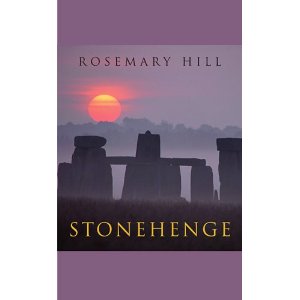
Book Extract: Stonehenge by Rosemary Hill

8 01 2011

Hill’s Stonehenge surveys the endless speculations around this mysterious monument

Antiquaries were a relatively new intellectual species, largely a

Rosemary Hill - Stonehenge

Rosemary Hill - Stonehenge

product of the Reformation, and they were interested in what could be discovered of the past by looking beyond the written records. They studied anything that was old – stones, metal, pottery, coins – attracting in the process much derision from contemporaries who thought it an “unnaturall disease” to be so “enamour’d of old age and wrinkles”. Yet the antiquaries were the first archaeologists. They were also the first oral historians, costume historians, art historians and folklorists. They opened up vast intellectual horizons and if, as later archaeologists have sometimes been quick to point out, they made mistakes, they were not alone in that and, working in an age before academic specialisation, before science and the arts had parted company, they were also able to make daring and useful connections.

It was James I, who prided himself on being up to date with intellectual fashion, who initiated the archaeological investigation of Stonehenge, although as befits the man known as “the wisest fool in Christendom” his efforts had mixed results. Staying nearby at Wilton House in 1620, he expressed an interest in the stones. Since the Reformation the land on which Stonehenge stood had passed into private hands and it was to remain private property until the 20th century. James’s intimate friend the Duke of Buckingham, eager to please, immediately tried to buy it for the King. The owner, however, refused to sell, so Buckingham had to be content with digging an enormous hole in the middle of it, from which he removed various objects now lost and, as John Aubrey later thought, caused one of the stones (stone 56) to tilt over “by being underdigged”. After this unpromising start the King approached the Royal Surveyor, Inigo Jones, and asked him to produce a report. Jones’s Stone-Heng Restored appeared posthumously in 1655. It was the first book entirely devoted to the subject and it argued that Stonehenge was Roman. The reaction that this theory provoked kick-started the antiquarian investigation of Stonehenge. If there was anything the typical antiquary liked more than proving himself right, it was proving somebody else wrong, and Jones’s book prompted two people, Walter Charleton and his friend John Aubrey, to throw their energies into discrediting it.

The archaeologist Jacquetta Hawkes famously remarked that every age “has the Stonehenge it deserves – or desires” and the Stonehenge of the Stuart antiquaries was born of the age that saw the foundation of the Royal Society, the wider exploration of the Americas and a new Baconian spirit of critical enquiry, in which nature and mathematics were the ultimate authorities. This critical, analytical cast of mind brought about a change in attitudes to the past and to the study of it. Until then history had been narrated, chiefly, as the story of a Golden Age, with everything since a long-protracted fall. “Till about the yeare 1649,” as Aubrey noted, “’twas held a strange presumption for a man to attempt an innovation in learning; and not to be good manners to be more knowing than his neighbours and forefathers.” Enquiry now was all the rage, but it was tinged also with melancholy and foreboding. The generation of antiquaries that had lived through the Civil Wars had seen towns and families divided. They had watched Puritans smash stained glass and knock the heads off the statues in churches; they feared for the past and for the future. Charleton, who was the first to respond to Inigo Jones, had been particularly close to these events as physician to Charles I and later to his son in exile. His book, Chorea Gigantum Or, The Most Famous Antiquity of Great Britain, Vulgarly called Stone-heng, was published in 1663. When Charleton looked at the monument he saw the stones “sleeping in deep forgetfulness, and well-nigh disanimated by the Lethargy of Time”. But he also saw the spot where Charles II, now restored as king, had paused on his flight after the Battle of Worcester at one of the most desperate moments of his life. Both images haunt Charleton’s treatise and inform its surprising conclusion that the circle was the work of the Danes.

The argument was based on some, admittedly rather loose, comparisons with the stone circles of Denmark documented by his Danish friend and fellow antiquary Ole Worm, but the method was new and not naïve. In trying to understand Stonehenge in its own terms, without magic and in relation to the other similar monuments, Charleton was a pioneer. The dedicatory poem that prefaces Chorea Gigantum was written by John Dryden and it associates Charleton firmly with the new spirit of “free-born Reason”. From now on the attempt to “make Stones to live” was to be on a par with medicine and exploration as a proper study for the best minds. In the end Charleton’s thesis found by analogy with Denmark that Stonehenge was not a temple, or the tomb of Boadicea as Edmund Bolton had suggested in 1624, but a meeting place for the election and coronation of kings. This was an especially happy conclusion given that Charleton’s book was dedicated to his employer, Charles II. As Dryden put it:

These Ruins sheltred once His Sacred Head,
Then when from Wor’ster’s fatal Field He fled…
His Refuge then was for a Temple shown:
But, He Restor’d, ’tis now become a Throne.

Charleton is usually written off as a sycophant as well as a poor scholar. Yet in so far as his book is a political statement, and there are few antiquarian texts of the 17th century which are not, he is no simple-minded royalist. Chorea Gigantum is not an endorsement of the Divine Right of Kings but of popular leaders, governing “by the general suffrage of the assembly”. It dwells, to the point of tactlessness in the circumstances, on the fact that the Danes were republicans. Charleton’s Stonehenge is an emblematic reminder to the restored monarch that he reigns only with the people’s consent.

The treatise concludes somewhat smugly that “this Opinion of mine, if it be erroneous, is yet highly plausible; having this advantage over the others… that it is not so easily to be refuted”. Charleton was wrong about that as well and he was not to rest on his laurels for long.

© Rosemary Hill 2008
Stonehenge’ by Rosemary Hill is published by Profile, £15.99
Buy the book here: Stonehenge (Wonders of the World)

About the author Rosemary Hill is a Fellow of the Society of Antiquaries, a trustee of the Victorian Society and a Brother of the Artworkers’ Guild. Her biography of AWN Pugin, ‘God’s Architect’, was published in 2007. She was born in London, where she lives with her husband, the poet Christopher Logue.

Well worth a read………………….
Merlin @ Stonehenege
The Stonehenge Stone Circle website


Woodhenge: Is this one of the greatest discoveries of archaeology…or a simple farmer’s fence?

12 12 2010

The discovery of a wooden version of Stonehenge – a few hundred yards from the famous monument – was hailed as one of the most important archaeological finds for decades.

But now experts are at loggerheads after claims that what was thought to be a Neolithic temple was a rather more humble affair – in fact the remains of a wooden fence.

One leading expert on Stonehenge criticised the announcement of the ‘remarkable’ find in July as ‘hasty’ and warned it could become a ‘PR embarrassment’.

The site, ringed, in a Seventies chart, which experts say shows a fenceMapped: The site, ringed, in a Seventies chart, which experts say shows a fence


The radar image said to reveal the post holes of a Neolithic temple‘Evidence’: The radar image said to reveal the post holes of a Neolithic temple

The discovery of what appeared to be a previously unknown ‘henge’, or earthwork, by a team of archaeologists conducting a multi-million-pound study of Salisbury Plain was widely reported amid great excitement.

The team said they had found evidence of a ring of 24 3ft-wide pits that could have supported timber posts up to 12ft tall, surrounded by an 80ft-wide ditch and bank.

They explained that, just like Stonehenge, the entrances to the site were aligned so that on the summer solstice the sun’s rays would enter the centre of the ring. Holes where the wooden posts once stood were identified below the ground using the latest high-resolution geophysical radar-imaging equipment.

An artist's impression of how Woodhenge may have been 5,000 years agoCircle of confusion: An artist’s impression of how Woodhenge may have been 5,000 years ago

Team leader Professor Vince Gaffney of Birmingham University said the ritual monument had been built about 5,000 years ago, making it roughly the same age as its stone counterpart 980 yards away, and it could have been used for Stone Age feasts or elaborate funerals.

He said the find showed Stonehenge had not existed in ‘splendid isolation’ and he predicted further discoveries during the three-year survey of five square miles of countryside around Stonehenge.

But sceptics have now suggested that the evidence is far from conclusive, especially as it appears from images of the plot produced by the Birmingham team that the ring of post holes was not arranged in a circle but was angular and more like a hexagon.

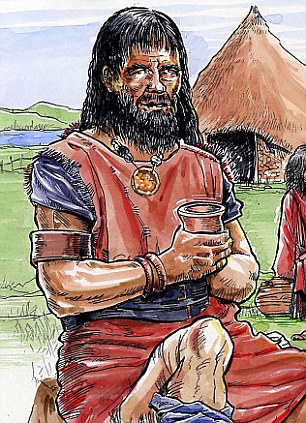
How a Neolithic visitor may have lookedHow a Neolithic visitor may have looked

Mike Pitts, editor of the magazine British Archaeology and an acknowledged expert on Stonehenge, said he had been prompted to study maps of the area after receiving a letter from an American reader.

In the spot where Prof Gaffney had claimed to have uncovered his post holes, Mr Pitts said he and
colleagues examined a Seventies Ordnance Survey map – and saw a fence marked out.

He thought it probably was an early 20th Century construction, erected by the then Government’s Office of Works or a local farmer to protect what was thought to have been the most important site in a cluster of burial mounds that were ancient but later than Stonehenge.

Mr Pitts said: ‘Vince Gaffney says his discovery encircles a burial mound within its circumference, but unless he has some unpublished material to substantiate his discovery, I am in no doubt that this was a modern fence line.

‘If I’m right then the post holes contained modern fencing stakes and they are actually in a hexagonal shape, not a circle.’

He added: ‘I think that perhaps what has happened is that the professor’s field workers have presented him with the wrong picture and he’s shot from the hip and made an over-hasty announcement. He’s generally known for the high quality of his work and his enthusiasm which, on this occasion, may have let him down.

‘The full publication of his results and small-scale excavations of the site would clinch the matter.’

But Prof Gaffney said: ‘We have mapped numerous fences and we know what they look like. The features appear to be 3ft across and as deep as 3ft. I have never seen a fence line that required holes that are 3ft across and 3ft deep.’

He said that in the fuzzy, black-and-white radar image the post holes appeared angular but that was partly due to the poor resolution of the picture and because such monuments were not perfect circles.

He went on: ‘The poles that would have stood in them would have been more like telegraph poles. You would not use them to build a fence.’

Prof Gaffney added that no metal such as old nails had been found in the holes, which would have
been expected.

‘On balance, we would still suggest this is a ritual monument of the late Neolithic period.’

 I love it when the ‘experts’ use the term ‘ritual‘ – in other words they do not know!
Related artile: New Woodhenge found

Read more: http://www.dailymail.co.uk/sciencetech/article-1337890/Woodhenge-Is-greatest-discoveries-archaeology–simple-farmers-fence.html#ixzz1Dj4rwwBM

Merlin @ Stonehenge
The Stonehenge Stone Circle Website


Stonehenge Built With Balls?

12 12 2010

New experiment suggests monumental stones could have rolled on rails.

It’s one of Stonehenge‘s greatest mysteries: How did Stone Age Britons move 45-ton slabs across dozens of miles to create the 4,500-year-old stone circle?
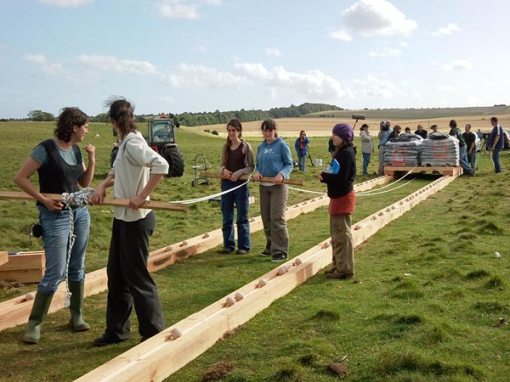
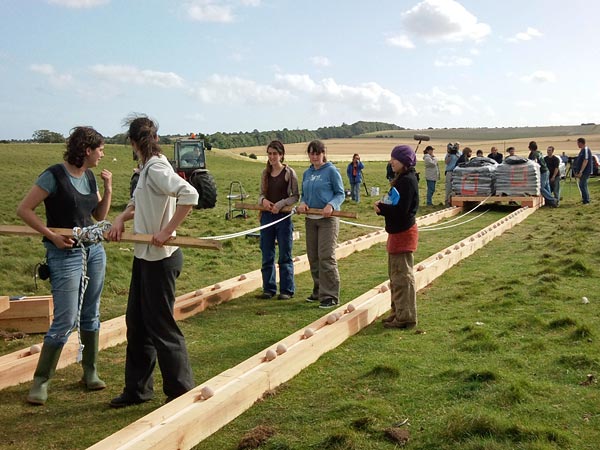
U.K. archaeology students attempt to prove a rail-and-ball system could have moved Stonehenge stones

U.K. archaeology students attempt to prove a rail-and-ball system could have moved Stonehenge stones

Now a new theory says that, while the ancient builders didn’t have wheels, they may well have had balls. (See Stonehenge pictures.)

A previous theory suggested that the builders used wooden rollers—carved tree trunks laid side by side on a constructed hard surface. Another imagined huge wooden sleds atop greased wooden rails.

But critics say the rollers’ hard pathway would have left telltale gouges in the landscape, which have never been found. And the sled system, while plausible, would have required huge amounts of manpower—hundreds of men at a time to move one of the largest Stonehenge stones, according to a 1997 study.

Andrew Young, though, says Stonehenge’s slabs, may have been rolled over a series of balls lined up in grooved rails, according to a November 30 statement from Exeter University in the U.K., where Young is a doctoral student in biosciences.

Young first came up with the ball bearings idea when he noticed that carved stone balls were often found near Neolithic stone circles in Aberdeenshire, Scotland (map).

“I measured and weighed a number of these stone balls and realized that they are all precisely the same size—around 70 millimeters [3 inches] in diameter—which made me think they must have been made to be used in unison, rather than alone,” he told National Geographic News.

The balls, Young admitted, have been found near stone circles only in Aberdeenshire and the Orkney Islands (map)—not on Stonehenge’s Salisbury Plain.

But, he speculated, at southern sites, including Stonehenge (map), builders may have preferred wooden balls, which would have rotted away long ago. For one thing, wooden balls are much faster to carve. For another, they’re much lighter to transport.

Proof of Concept

To test his theory, Young first made a small-scale model of the ball-and-rail setup.

“I discovered I could push over a hundred kilograms [220 pounds] of concrete using just one finger,” he said.

With the help of his supervisor, Bruce Bradley, and partial funding from the PBS series Nova, Young recently scaled up his experiment to see if the ball-and-track system could be used to move a Stonehenge-weight stone.

Sure enough, they found that, with just seven people pushing, they could easily move a four-ton load—about as heavy as Stonehenge’s smaller stones.

Using the ball system, Young said, “I estimate it would be possible to cover 20 miles [32 kilometers] in a day” by leapfrogging track segments.

But the inner circle’s “sarsen” stones weigh not 4 tons but up to about 45 tons. Young suspects a Stone Age system could have handled much heavier loads than his experimental one.

For one thing, he thinks oxen, not people, provided the pulling power—an idea supported by the remains of burned ox bones found in ditches around many stone circles.

For another, Britain’s old-growth forests hadn’t yet been razed 4,500 years ago, so the builders would have had easy access to cured oak. This tough wood—which was beyond the modern project’s budget—would have resulted in a stronger, more resilient system than the soft, “greenwood” system the researchers built.
Stonehenge Experiment Needs Scaling Up

Civil engineer Mark Whitby, who’s been involved with other Stonehenge-construction experiments, thinks the ball method could work for smaller stones but isn’t convinced it could shift a sarsen.

“The problem will be when the tip of the ball bears on the timber trough, it will bite” into the trough, possibly splitting the rail, said Whitby, who runs London-based +Whitby Structural Engineers. “When transporting lighter stones, this won’t be a problem. But when they get to 30 and 40 tons, it will be.”

Instead, Whitby prefers the sled theory—and even helped prove a sled could move a 40-ton replica sarsen for a 1997 BBC documentary.

Archaeologist David Batchelor, meanwhile, thinks the ball idea is plausible but isn’t completely convinced.

The ball technique “seems to be a development of the sledge method,” said Batchelor, of the government agency English Heritage. “But the added complexity needed to channel the track runners and then make the ball bearings all of one size seems to me a lot of work, which is probably unnecessary when animal-fat grease does the job.”

Research leader Young counters that the sled system, even with its animal-fat lubrication, still results in a lot of friction.

“Using wooden balls almost removes friction from the system and makes for a really efficient method of moving heavy weights around,” he said.

Even so, Young realizes he needs to prove the new system can be scaled up to handle heavier loads. To that end, Young’s team is seeking funding to repeat the experiment—this time with harder wood, stone balls, and oxen

What a load of old balls……………………………..
Merlin @ Stonehenge
The Stonehenge Stone Circle Website


Could This Be How Stonehenge Was Actually Built? New theory

2 12 2010

One of the most puzzling mysteries is how Stonehenge, the prehistoric circle of stones in England, came to be. We know it was built around 4500 years ago, and the stones came from Wales, some 250km away… but how?

Of course, back then, it wasn’t so easy to transport stuff around the country – especially not 60 bluestones which are said to weigh between two and four tons each. Several theories have been bandied about over the years of how the stones were transported, including sledges; rafts along the rivers; and that Merlin himself used his magic to gather the stones there.

This week, an engineer and former BBC TV presenter, Garry Lavin, tested his theory that wicker baskets made from willows were used to roll the stones all 250kms from the quarry in Preseli Hills, Wales, to Salisbury, in Wiltshire, England. He built one himself, using willow and alder saplings, and enlisted several friends to help roll a one-ton boulder along the ground.

He thinks oxen might’ve helped roll the baskets in some parts, and that rivers could have floated them downstream. But it’s the baskets which Lavin is sure had a huge part in the formation of Stonehenge – and as he’s currently building a maxi-basket to move a five ton stone, we may soon find out the answer. Unless aliens decide to show up and show us otherwise, of course.

Well, your comments ?

Merlin @ Stonehenge
The Stonehenge Stone Circle Website